Thursday, November 12, 2026
Home Blog Page 40

Trump ad campaign spends millions to encourage self-deportation : NPR

0

A woman who asked that we use only her first initial, S., says her family already got their U.S.-born children their American passports so that if they go back to El Salvador, the kids can eventually return to the U.S.

Jasmine Garsd/NPR


hide caption

toggle caption

Jasmine Garsd/NPR

Sitting at her kitchen table in Durham, N.C., a woman who goes by S lets out a deep sigh recalling the first few days of the second Trump administration. Her husband holds her hand; in the background the kids’ cartoons are blasting.

Both S and her husband are immigrants without legal status in the U.S., which is why she’s asked NPR to withhold her full name. Their two children are U.S. citizens.

“I felt so anguished,” S said. “I didn’t want to do anything in the house, I just wanted to sleep and sleep and wake up to find it was all over, it had all been a dream.”

She and her husband started staying up all night discussing whether to go back to their native El Salvador, and take the kids with them.

They haven’t reached a decision yet. But they said they started hearing about other Latino parents in their community getting children their U.S. passports — so in case they leave, the kids can later return. S and her husband decided to do the same.

Meanwhile, they continue debating the question many immigrants in the country without legal status are now asking themselves: has the time come to leave the U.S.? To self-deport?

Self-deportation is one of the centerpieces of the second Trump administration’s immigration policy. President Trump has launched a multimillion-dollar advertising campaign encouraging immigrants to self-deport. His policies, experts say, have aimed to make life difficult through highly publicized immigration arrests, sending migrants to El Salvador for detention, and stripping protections from once-safe spaces like schools, churches and hospitals.

To those seeing quality of life crumble, an administration message offers a directive: leave the country now and keep the chance of coming back some day. Or risk deportation and a permanent closed door. The Department of Homeland Security on social media has threatened to leverage fines of $998 per day against anyone who might have stayed in the U.S. despite receiving a final order of removal, and a fine of up to $5,000 if someone claims they will self deport and don’t.

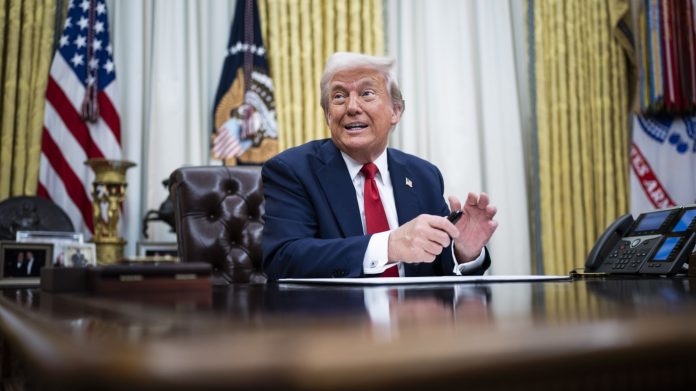
“People in our country illegally can self-deport the easy way or they can get deported the hard way and that’s not pleasant,” Trump said speaking from the Oval Office in one of the administration’s new ads.

An idea Mitt Romney floated

It’s not a new idea: self-deportation was a notable part of GOP candidate Mitt Romney‘s presidential campaign back in 2012. 

“The answer is self-deportation, which is people decide that they can do better by going home because they can’t find work here because they don’t have legal documentation to work here,” Romney said on the debate stage in Tampa, Fla. “We’re not going to round people up.”

Back then Donald Trump, several years before he launched his own political campaign, called it a “crazy policy” and “maniacal.” Speaking to conservative news outlet NewsMax after that election, he said it was part of the reason Romney lost: by promoting a policy that was deemed unkind to Hispanic-Americans.

“The Democrats didn’t have a policy for dealing with illegal immigrants, but what they did have going for them is they weren’t mean-spirited about it,” Trump told NewsMax. “He lost all of the Latino vote. He lost the Asian vote. He lost everybody who is inspired to come into this country.”

The idea was seen as ludicrous, even becoming the butt of a popular comedy skit. Why would anyone in their right mind just pick up and self-deport?

Most immigration experts argue that if the quality of life in countries that people leave is more dangerous, desperate or deadly than what people might find in the U.S., then no immigration deterrence would fully work.

As Adam Isacson, from the Washington Office on Latin America, a research and advocacy group, puts it: “There’s not that much you can do to make the experience more miserable for people than the conditions that they’re fleeing to begin with.”

But more than 10 years after Romney’s idea, the politics, and the country, have changed. More Latinos turned out for Republicans last year than in prior elections — at 43% in one exit poll, and Trump campaigned heavily on border security.

Mari hugs her children, all of whom are U.S. citizens. Mari has been adamant about staying in the U.S., while her husband says it’s time for them to go back to Guatemala.

Jasmine Garsd/NPR


hide caption

toggle caption

Jasmine Garsd/NPR

Illegal immigration, once seen as a product of a broken system that candidates promised to fix, is now discussed as a threat to be rid of, one of “human traffickers, drug smugglers, and gang members.”

For the last few months, for many immigrant families across the U.S., the basic quality of life has plummeted — in some cases becoming nothing short of nightmarish.

“We’re scared. We stay indoors all day,” Rosa, a heavily pregnant Honduran woman in Waukegan, Ill., told NPR back in January.

She was in line at a food bank run by the United Giving Hope Church, and asked that her last name be withheld due to fear of apprehension (she is in the U.S. without legal status). She said she’d been missing appointments with her OB-GYN for fear of being arrested by immigration officials at the hospital.

As she spoke, a woman named Melina walked by: a Mexican woman, also without legal status in the U.S. — she asked that her last name be withheld. She mentioned she’d gotten her children their passports, and is hoping to leave soon.

Pastor Julie Contreras, who created the food bank in Waukegan, said she’s been hearing from so many parishioners considering self-deportation, she’s planning on holding information sessions about how to get your U.S.-born children their passports.

Trump officials craft the message 

Less than a month after inauguration, Trump’s Homeland Security Department issued what it calls a domestic and international $200 million ad campaign. In a video, Homeland Security Secretary Kristi Noem stands in front of American flags and offers a warning.

“If you are here illegally, we will find you and deport you. You will never return,” Noem says in the ad, which features cinematic music over visuals of Trump in the White House contrasted with footage of the border and individual mugshots.

“But if you leave now, you may have an opportunity to return and enjoy our freedom and live the American Dream,” Noem says.

The government in March spent about $2.8 million on TV and radio ads in English across 43 stations in several major markets, with another $373,000 for TV and radio ads in Spanish, according to AdImpact data. The administration is also promoting ads on social media — with Spanish subtitles.

Vice President JD Vance last month traveled to Eagle Pass, Texas, along the U.S.-Mexico border, with the same message.

“One of the ways we want to make sure we are enforcing our border is that we make it easier for people who are here illegally to go back home on their own accord,” Vance told reporters.

A few days after Vance’s visit, Customs and Border Protection updated the CBP One App, now rebranded as CBP Home. During the Biden administration, the app facilitated quick asylum claims. Now, the app allows people to notify the government of their “intent to voluntarily depart” from the U.S.

DHS did not respond to questions about how the app was being used to reach people who are already in the U.S., but they said there is incentive to use it.

“Those who self-deport may have the opportunity to return legally in the future and live the American dream,” DHS spokesperson Tricia McLaughlin said in an email. “If they don’t, we will find them, we will deport them, and they will never return.”

McLaughlin told NPR that 5,000 people have used the app to self-deport as of the start of April. Immigration researchers estimate some 11 million people in the U.S. lack legal status.

Advocates say life becoming more difficult

But Adriana Cadena, director of the Protecting Immigrant Families Coalition, doesn’t think the administration is offering enough of an incentive. Right now those without legal status may have to wait up to 10 years before attempting to return.

“I would think that immigrants are smart enough to know the rhetoric is coming from the administration and not buy into this perception that if you leave you’ll be able to come back. There is no proof,” Cadena said, adding that the administration hasn’t built trust with communities, nor offered clarity on what the policy means.

Regardless of who believes the policy, the goal of making life difficult for immigrants is succeeding, experts and families said in interviews.

The administration’s policies that affect immigrants’ access to medical care, food access and education also affect U.S.-born children in mixed families.

In February, Trump signed an order “ending taxpayer-funded benefits for illegal aliens.” Immigrants without legal status already generally do not qualify for federal benefits. But immigration law experts say such policies do have an impact on U.S. citizen children, as well as other family members with legal status.

Several family’s NPR spoke to say their children’s mental health has been severely affected. A woman named Mari, in Maryland, who asked that NPR withhold the family’s last name because she and her husband are without legal status and fear deportation, says their youngest daughter, age 6, has been having panic attacks. “She’s been crying at school,” Mari says. “Having very bad stomach aches. A social worker had to step in.”

“I was just feeling sad,” her daughter told us. “Mom told me it would be ok. I worry something will happen to her, like something will get her. Immigration is taking persons to their state where they grew up. My mom is from Guatemala. We are from here.”

Mari’s husband, a roofer, wants to go back to Guatemala now. He wants the kids to get their U.S. passports if the situation in the U.S. devolves, Mari said. They recently went to the Guatemalan embassy to make sure that if they need to go, their kids have all the appropriate paperwork.

But Mari doesn’t want to leave. She said she wants her daughters to have access to an education, and is worried they’ll be targeted by gangs back in Guatemala. The debate is causing a rift in the marriage: she and her husband argue about this often, she said.

“He says we can’t live like this anymore,” Mari said. “And I say, ‘No. My children were born here. My daughters are going to school. We are staying.'”

The arguing has exacerbated her daughter’s anxiety. So for now, they’ve been telling her a different story: “Baby, if things keep getting worse, we’re going to go on a vacation.”
How cutting Medicaid would affect long-term care and family caregivers : NPR

0

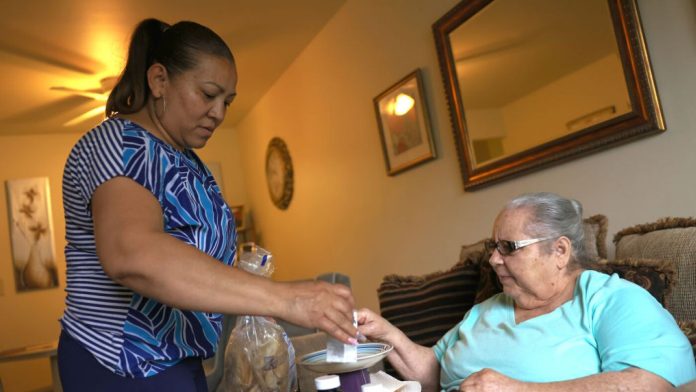
Medicaid pays for nursing home care and for some in-home and community based care, such as aides like Lidia Vilorio, who gives her patient Martina Negron her medicine and a snack in her home on May 5, 2021, in Haverstraw, N.Y. Proposed cuts to Medicaid could hit such home-based services first, making life harder for family caregivers.

Michael M. Santiago/Getty Images


hide caption

toggle caption

Michael M. Santiago/Getty Images

As Congress looks for ways to reduce the federal deficit, Medicaid is in the spotlight. Last week, the GOP-led House passed a budget framework that allows both chambers of Congress to work on a major budget plan they expect to pass without any Democratic votes. Some House Republicans have called for it to include reductions in Medicaid spending.

Family caregivers and people needing long-term care could be hard-hit by cuts to the program.

Medicaid, jointly funded by the federal and state governments, is the nation’s health insurance program for low-income people. But it is also the single biggest source of money for long-term care for disabled and elderly people, paying more than half the $415 billion spent on these services every year.

Medicare, the program for people over 65, does not pay for long nursing-home stays or for ongoing in-home help.

For people with low incomes and few assets beyond a home, Medicaid will pick up the tab for long-term or permanent nursing-home care. It pays for 60% of the nation’s extended nursing-home stays, including nearly 1 million people.

About half of Medicaid spending on elders is for “home and community based” services, which help about 4.5 million chronically ill or elderly people in the United States get care at home.

Medicaid pays wages to caregivers — friends, family members, or professional caregivers — who help with essential needs.

Reducing Medicaid services “would have profound effects on their health,” says David Grabowski, health economist at Harvard Medical School. “These are services they need every day to bathe themselves, dress themselves, get themselves to the kitchen.” Cuts could lead to hospitalizations, emergency room visits, and in some cases early death, he adds.

Medicaid also funds adult day programs, social work help, caregiver training, respite programs, and other services that help people stay well at home.

The services and funds help family caregivers stretched thin by their responsibilities. The average American caregiver spends more than $7,000 a year out of pocket, according to a study from AARP.

Sacramento resident Sharon Duchessi cares for her partner, who has diabetes and a bad back. She says there’s no way the two could manage without Medicaid support. The program pays her to help him. Both of them also rely on it for their health care. Even so, they’re stretched.

Sharon Duchessi and her partner Michael Kowalczyk

Sharon Duchessi and her partner

Sharon Duchessi


hide caption

toggle caption

Sharon Duchessi

As a loan processor, Duchessi made a good salary. Now she earns $18.65 an hour, capped at 189 hours a month. She estimates her partner’s care requires at least 250 hours each month. The program compensates her for only 30 minutes spent on laundry each week, for instance. But because he is prone to dangerous skin infections, she must scrub the washing machine and dryer every time she does his laundry.

If she didn’t care for him, she expects he’d be in and out of the hospital, which would be far more expensive and bad for his health.

Medicaid home caregivers in California and some other states are unionized, and Duchessi is currently regional vice president in her district of SEIU 2015.

Families bear the cost

Earlier this year, the House of Representatives introduced a budget resolution that would effectively require trimming Medicaid spending by as much as $880 billion over the next 10 years. The blueprint passed last week still includes this directive, though the Senate and House will have to negotiate about what ultimately gets included in the budget.

President Trump and House Speaker Mike Johnson promise to target fraud and abuse. But the federal government’s own investigations find that only about 5% of Medicaid payments are “improper,” a term including both fraud and paperwork errors, and estimate that outright fraud adds up to only about $6.5 billion a year. The remaining cutbacks would need to come from reducing enrollment, curbing services, or paying providers less.

States could potentially raise taxes to cover the difference. But most observers think it’s more likely that states will reduce payments, change eligibility requirements or cut back on services, which means unpaid family caregivers will likely pick up the slack, says Grabowski.

“It’ll put a huge burden on the family,” he says. “Even though there might be savings from a budgetary perspective, families bear this cost.”

Technically, the proposed budget wouldn’t be a cut to Medicaid’s budget, points out Michael F. Cannon, director of health policy studies at the Cato Institute, a libertarian think tank. It would just mean slower growth.

The Congressional Budget Office projects that to maintain current services, Medicaid’s budget would need to grow from between 4% and 6% each year, in line with the annual increase in spending by private insurance. In order to reduce the federal outlay by $880 billion over a decade, the program’s budget could only grow by an average of 3% a year.

Limiting Medicaid spending could have other consequences. For many years, the federal government has promoted policies to stabilize elders and disabled people like Duchessi’s partner at home, rather than put them into a nursing home. That’s usually what people prefer, and it’s cheaper. Medicaid spends about $47,000 a year for a long-term care home stay on average — about $11,000 more than it spends to provide community-based and in-home care, according to research and polling group KFF.

Medicaid rules require nursing home stays to be covered for those eligible. But they don’t require coverage of in-home personal care. If money is tight, nursing homes will still get paid, but home caregivers and other support services might not, says Nicole Jorwic, chief program officer at Caring Across Generations, an advocacy organization supporting care work.

“There’s a real likelihood of unnecessary institutionalization, because of what states would have to do,” says Jorwic. Disabled and elderly people who could have stayed home with some assistance might need to enter a nursing home, simply because that’s the only way they can get care.

Financial burden of long-term care

States could also change eligibility rules to make it more difficult for people with middle incomes to qualify for Medicaid. Eligibility varies by state and by program, but in many states, you must make less than $34,812 a year and have less than $2,000 in assets. In order to qualify, some families will spend down their savings. Currently, there are also legal ways to shield some of your assets if you prepare in advance.

If those loopholes were eliminated, some middle-income people might pay for services themselves.

“If you change eligibility rules so that fewer well-to-do people are eligible, you’d have more resources for people who are more needy,” says Cannon. For this reason, he predicts that Medicaid cuts would not have a dramatic impact on long-term care: “Some people would be able to tap their home equity, or rely on savings.”

However, some elders who are now eligible for Medicaid didn’t start out poor. Paying for long-term care can bankrupt even middle-class people. Assisted living runs an average of $70,800 a year, according to a major survey of providers in 2024. A private room in a nursing home averages $127,750.

More than half of all people over 65 are expected to need long-term care at some point. Only 4% have long-term care insurance to defray that cost.

Many states already have long waiting lists of people requesting Medicaid funds for in-home care, points out Jorwic. “Cuts would mean the list would grow; some people would get cut from services. It’d be a major impact on the unpaid caregiving that is already filling in the gaps.”

Trimming Medicaid’s payments could encourage more people to buy long-term care insurance for themselves, argues Cannon. Currently, the fact that Medicaid will pick up the cost for people who run out of money means there’s little incentive to buy insurance.

But that change wouldn’t address the needs of the families who currently rely on Medicaid to help with long-term care.

In Duchessi’s case, she’d have to go back to work and hope to find someone who could help her partner while she’s on the job. That might not be easy. “Caregivers — we’re a different breed,” says Duchessi. “It’s not something I’d encourage anyone to do unless they’re willing to do the work. It’s hard work.”

The Senate budget resolution that passed on April 5 does not include the same cuts as the House version, and some Republican senators say they oppose any Medicaid trims. The details, and the ultimate size of the Medicaid budget for the next 10 years, will be hashed out between the two chambers later this year.

Kat McGowan is a caregiving reporter based in Berkeley, Calif.

Trump’s tariffs on electronics; Meta antitrust case : NPR

0

Good morning. You’re reading the Up First newsletter. Subscribe here to get it delivered to your inbox, and listen to the Up First podcast for all the news you need to start your day.

Today’s top stories

The Trump administration on Friday outlined a substantial carve-out for mobile phones, computers and other electronics from the sweeping global tariffs. The updated guidance for President Trump’s tariffs will apply across dozens of countries, including China, which currently has 145% levies.

A man chats on his phone at the booth for Huawei at the 21st China International Semiconductor Expo in Beijing, in November 2024.

Ng Han Guan/AP


hide caption

toggle caption

Ng Han Guan/AP

  • 🎧 Electronics account for roughly a quarter of Chinese exports to the U.S., NPR’s John Ruwitch tells Up First. China’s commerce ministry said the decision to remove tariffs on these products was a small step toward correcting the error of imposing “reciprocal tariffs.” However, Trump plans to lump electronics in with semiconductors in a separate tariff he says he will announce in the next month or two. The idea is to force supply chains to return to the U.S. Trump seems to be waiting for Chinese leader Xi Jinping to pick up the phone and call, but that’s not how China operates, Ruwitch says.

El Salvador’s President Nayib Bukele is expected to meet with Trump at the White House today. Bukele has called himself the “world’s coolest dictator” and dismissed criticisms from human rights groups for putting thousands of people in prison without due process. Bukele received about $6 million in a deal with the Trump administration to imprison hundreds of people who were accused of being gang members and deported from the U.S. The deportations are facing legal challenges.

  • 🎧 During the visit, both sides might discuss how to expand their partnership, including the possibility of incarcerating some U.S. prisoners in El Salvador, freelance reporter Manuel Rueda says. El Salvador used to be one the most violent countries in the world. In 2022, Bukele declared a state of emergency that’s still ongoing, which gave police the power to arrest anyone suspected of being a gang member and lock them up without due process. Now, the concern is that people who are sent from the U.S. to El Salvador will get the same treatment as local prisoners and disappear into the system.

The Federal Trade Commission’s antitrust case against Meta starts today. It’s considered the most significant legal challenge that the social media giant faces. The case, which is expected to last two months, centers around whether Meta broke competition laws when it acquired Instagram and WhatsApp. Executives, including CEO Mark Zuckerburg, are set to take the witness stand.

  • 🎧 The FTC says when Meta acquired Instagram in 2012 and WhatsApp in 2014, it was part of a strategy to eliminate competition and maintain monopoly over the social media market, NPR’s Joel Rose explains. The FTC is pushing for Instagram and WhatsApp to be broken up into separate companies, allowing smaller social media companies to compete for consumers and ad dollars. Meta says it is being punished for being an innovative and aggressive tech company and that it competed fairly. Lawyers for Meta said in a court filing that regulators approved the Instagram and WhatsApp acquisitions at the time, and it’s unreasonable to try to unwind the deals years later.

Living better

padula_npr_doomscrolling_finalv3.jpg

Living Better is a special series about what it takes to stay healthy in America.

It can be easy to get lost in your phone, especially when you are tired and stressed and need an escape. But scanning through news headlines or arguments on social media may stress you out. Using social media can feel good in the short term because it activates the brain’s reward pathways and releases dopamine. However, once that spike subsides, you could be left feeling bad again, prompting you to go back for more. Instead of using cellphones as a mood booster, there are ways to retrain your brain to crave physical activity.

  • 🏃‍♀️Take a pause when you notice the urge to grab your phone to scroll. Observe what happens to that sensation if you don’t act on it.
  • 🏃‍♀️ Try adding in some movement when you want to use your phone. You could pick a song and have a dance session or do some squats and feel your muscles activate.
  • 🏃‍♀️ Practice savoring the things you love about movement. This could be the peaceful feeling a stretch provides you or how relaxed your breathing is.
  • 🏃‍♀️ Get flexible with your behavior and change up your routine. If you take the same walk every day, build in a surprise, like a new coffee shop or a sunset.

Picture show

U.S. Naval Academy croquet team Imperial Wicket Liam Wert holds the trophy above his head as he celebrates his team’s win over St. John’s College in the 2025 Annapolis Cup. At left is Annapolis mayor, Gavin Buckley, and Superintendent of the U.S. Naval Academy, Vice Adm. Yvette M. Davids. The 41st annual Annapolis Cup croquet tournament was held on April 5, 2025 at St. John’s College between the Johnnies and the neighboring U.S. Naval Academy team. Thousands of people donned fancy dress to attend the iconic event, which included not only croquet, but swing dancing, a New Orleans- style brass band, and choral singing. The Naval Academy midshipmen won the tournament 3 games to 2.

U.S. Naval Academy croquet team Imperial Wicket Liam Wert holds the trophy above his head as he celebrates his team’s win over St. John’s College in the 2025 Annapolis Cup. At left is Annapolis mayor, Gavin Buckley, and Superintendent of the U.S. Naval Academy, Vice Adm. Yvette M. Davids.

The 41st annual Annapolis Cup croquet tournament was held on April 5, 2025 at St. John’s College between the Johnnies and the neighboring U.S. Naval Academy team. Thousands of people donned fancy dress to attend the iconic event, which included not only croquet, but swing dancing, a New Orleans- style brass band, and choral singing. The Naval Academy midshipmen won the tournament 3 games to 2.

Tyrone Turner/WAMU/NPR


hide caption

toggle caption

Tyrone Turner/WAMU/NPR

Croquet teams from St. John’s College and the neighboring U.S. Naval Academy went head to head in their annual Annapolis Cup on April 5. The midshipmen dressed in pristine white uniforms. The Johnnies, who are notoriously secretive about their uniforms, arrived costumed as the tournament’s grass croquet courts, complete with mini wickets, mallets, balls and clips. The yearly competition began in the early 1980s. Legend says that a discussion between a St. John’s College student and the commandant of the Naval Academy led to the latter’s challenge that his midshipmen could beat Johnnies at any sport. Thousands attended the event, many in fancy dress and bowler hats.

3 things to know before you go

Rory McIlroy of Northern Ireland (R) celebrates winning with caddie Harry Diamond (L) after the playoff hole during the final round of the 2025 Masters Tournament at Augusta National Golf Club on April 13 in Augusta, Ga.

Rory McIlroy of Northern Ireland (R) celebrates winning with caddie Harry Diamond (L) after the playoff hole during the final round of the 2025 Masters Tournament at Augusta National Golf Club on April 13 in Augusta, Ga.

Andrew Redington/Getty Images


hide caption

toggle caption

Andrew Redington/Getty Images

  1. Rory McIlroy of Northern Ireland won the 2025 Masters tournament yesterday. He’s the sixth golfer in history to achieve a career Grand Slam.
  2. An art installation in Australia is using biological matter to rebuild some of the late composer Alvin Lucier’s brain, with his permission, to create and release new music.
  3. Nobel Prize-winning Peruvian writer Mario Vargas Llosa died yesterday at the age of 89. His career spanned decades. He published his first book, The Time of the Hero, in 1962.

This newsletter was edited by Suzanne Nuyen.

Students with disabilities lost a helpful program to DOGE cuts : NPR

0

Logan, 17 and a junior at Newton South High School, stands in his room in Newton, Mass. Logan was part of a program called Charting My Path, which helps students with disabilities prepare for life after high school. The Trump administration cancelled the program in February.

Cassandra Klos for NPR


hide caption

toggle caption

Cassandra Klos for NPR

If you visit the website for Elon Musk’s Department of Government Efficiency (DOGE), you’ll find a “Wall of Receipts” listing more than 7,000 federal contracts it has terminated.

Little detail is provided, besides the “savings” from each cancellation, and it’s hard to determine the cost or collateral damage of all these cuts. But for some families, there has been a cost.

One of these programs, cancelled on Feb. 10, was called Charting My Path for Future Success. It was a research-based effort to help students with disabilities make the sometimes difficult transition from high school into college or the world of work and self-sufficiency.

For just three weeks, beginning in January, some 1,600 high school juniors were enrolled in the program in 13 school districts across the country, including in Virginia, Arizona and Georgia.

A U.S. Education Department spokesperson, Madi Biedermann, told NPR in a statement that Charting My Path was a research project “with questionable implementation” and that too much of the program’s $43 million cost, by DOGE’s accounting, was going to contractors, not kids.

But some of the people closest to the program – families, educators and researchers – say Charting My Path could have helped millions of vulnerable teens.

Jessie Damroth was grateful her 17-year-old son’s school district, in Newton, Mass., was helping to pilot the program, until she learned it had been abruptly stopped.

“I cried all day,” she says.

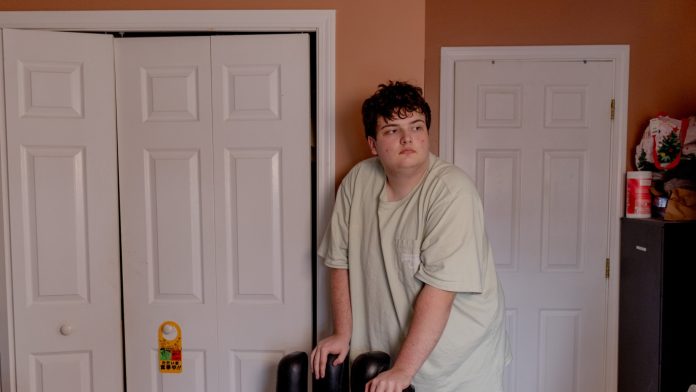
Logan sits with his mother, Jessie Damroth, during a telehealth appointment with one of his many medical specialists. Logan suffers from a cluster of conditions, including autism, anxiety, ADHD and hypersomnia, which can leave him feeling exhausted even after a long night’s sleep.

Logan sits with his mother, Jessie Damroth, during a telehealth appointment with one of his many medical specialists. Logan suffers from a cluster of conditions, including autism, anxiety, ADHD and hypersomnia, which can leave him feeling exhausted even after a long night’s sleep.

Cassandra Klos for NPR


hide caption

toggle caption

Cassandra Klos for NPR

With the right supports, “the sky’s the limit”

Damroth’s son, Logan, is a junior at Newton South High School. He’s tall, broad-shouldered and drinks his morning coffee from a hefty, powder blue mug emblazoned with the word “Imagination” and a favorite face from his childhood: SpongeBob SquarePants.

Logan asked that we only use his first name, so that he could speak freely about his experience and his disabilities.

In school, Logan says he loves physics, a course he took as a freshman.

“It just felt fun. I liked the problems. They always interested me,” he says. “I just like the idea of physics and quantum physics.”

Outside of school, he likes to shoot hoops or play games on a PC he built. The computer’s black metal case sits open on his desk, revealing a nest of wires and whirring fans lit an eerie green.

Logan says he wants to go to college and study physics or genetics. Genetics, because Logan, his younger sister and mother all suffer from a host of disorders caused by a rare variation in their TANC2 gene. Those disorders include autism, anxiety, ADHD, debilitating headaches and hypersomnia, which causes Logan to feel sleepy during the day even after a full night’s rest.

A framed photograph of Logan and his sister, Ayden, sits on a table in the entry of the family’s home in Newton, Mass.

A framed photograph of Logan and his sister, Ayden, sits on a table in the entry of the family’s home in Newton, Mass.

Cassandra Klos for NPR


hide caption

toggle caption

Cassandra Klos for NPR

“I want to help myself and people like me,” Logan says.

But preparing for that future, without extra help, was going to be a challenge. Logan sometimes misses school to attend hard-to-schedule appointments with medical specialists. And when he is in class, he can get so exhausted that he sometimes falls asleep.

“[Logan] is fully capable of having a wonderful career, a family if he wants. The sky’s the limit,” says Damroth, adding, “if he has the right supports.“

So when Damroth heard about a new research study, called Charting My Path, that offered a host of intensive supports, she quickly enrolled her son. Not long into the program, something began to change in Logan, she says.

He got more excited about school – and the future.

Students led, teachers followed

For students with disabilities, leaving high school can feel like stepping off a cliff, says John Curley, a special educator at Logan’s high school who worked on Charting My Path.

“We try so hard, as best we can, to build a parachute for individuals and families so that it’s a little bit of a more graceful fall,” Curley says. “That’s what I loved about [Charting My Path].“

America’s high schools are required by federal law to provide transition planning to students with disabilities who are preparing to graduate. This includes working with school staff to help a student explore and plan for college, career and independence.

Logan sits in his room in his family’s home in Newton, Mass. Logan enjoys physics and computers. An avid gamer, he built the PC on the desk behind him.

Logan sits in his room in his family’s home in Newton, Mass. An avid gamer, he built the PC on the desk behind him. Logan asked that we only use his first name, so that he could speak freely about his experience and his disabilities.

Cassandra Klos for NPR


hide caption

toggle caption

Cassandra Klos for NPR

Karrie Shogren, a researcher behind Charting My Path and a professor of special education at the University of Kansas, says schools are still hungry to know, when it comes to transition planning, “what works best” and gives students, schools and taxpayers the biggest return on investment.

That was the goal of Charting My Path. As part of the study, 1,600 high school juniors with disabilities were divided into three groups.

A control group simply received the districts’ pre-existing transition supports – the basic help required by federal law.

The second group received those basic supports plus they attended a Charting My Path class with its own research-based curriculum a few times a week.

There, they talked about their interests and ambitions and worked in small groups on goal-setting with a specially-trained instructor who would also check in occasionally with students’ families. The federal contract paid for these extra staff.

John Curley, the special educator in Newton, says the message of Charting My Path really appealed to students. Usually, in school, it’s teachers telling teens what to do, he says; in Charting My Path, students led, the adults followed.

The third group received the most support: All of the services of the first and second groups as well as one-on-one mentoring for the remainder of their junior and senior years, plus even more frequent family check-ins. Logan was in this group.

What’s more, while the services would last until graduation, the Charting My Path study would have collected data until at least 2028, to see if the interventions had a lasting impact.

Stepping stones to post-school independence

Charting My Path was built on research that shows students with disabilities who get quality transition services “are more likely to be employed after high school. They’re more likely to be enrolled in post-secondary education, and they’re more likely to identify that they have a higher quality of life,” says Catherine Fowler, a special education researcher at the University of North Carolina at Charlotte who has been involved with Charting My Path since 2019, when the contract began.

At the heart of Charting My Path was one of the most promising, research-based services: building students’ self-determination skills by working with them to set goals, then helping create concrete plans to achieve them.

A scheduling card for medical appointments appears among vacation magnets on Logan's family fridge.

A scheduling card for medical appointments appears among vacation magnets on Logan’s family fridge.

Cassandra Klos for NPR


hide caption

toggle caption

Cassandra Klos for NPR

A PowerPoint presentation created by one of the Charting My Path districts after the program’s termination (and shared with NPR) shows the striking range of student goals.

“I will get my application and documents submitted for welding school,” one student pledged.

Another: “To become a chef and work on a food truck with Dad.”

For students with more severe disabilities, some goals may seem less ambitious – like learning to “wash, dry and fold my laundry” or use “the microwave with help from my teacher to make frozen chicken nuggets” – but are still stepping stones on the path to post-school independence.

“I had never seen my high schooler so interested in her future”

Though the federal contract of Charting My Path began back in 2019, its rollout to students was delayed by the COVID-19 pandemic and didn’t happen until mid-January of this year. That’s when Logan began meeting multiple times a week with his Charting My Path teacher/mentor. “A kind dude,” Logan says.

During those first few classes, Logan says, Charting My Path was “helping me with what I wanted to do later in my life. They were helping me find what degree I personally wanted. And we were going to tour some colleges eventually.”

Logan told his teacher about his interest in physics and genetics, and they talked about eventually exploring which colleges might allow him to pursue those interests while also accommodating his disabilities.

John Curley, the transition specialist at Logan’s high school, says the years of work and research that went into Charting My Path led to “some of the best materials I’ve seen in my years of doing this work, and I thought it was a no-brainer for our school and our students and families.”

It’s impossible to assess the program’s effectiveness based on those early weeks. But, after just a few sessions, Logan’s mom, Jessie Damroth, was impressed enough by what she saw that she wrote Logan’s instructor/mentor a quick email, thanking him.

“Logan was just so excited,” Damroth remembers. “I picked him up [from school], and he was talking about maybe he’d be a professor. Maybe he could teach… And that is a light in this kid’s eyes that I hadn’t seen.”

Jessie Damroth poses for a family photo with her daughter Ayden, her son Logan and Logan's dog, Miller. The family adopted Miller to help Logan, and Damroth often calls the cocker spaniel her "chubby cherub."

Jessie Damroth poses for a family photo with her daughter Ayden, her son Logan and Logan’s dog, Miller. The family adopted Miller to help Logan, and Damroth often calls the cocker spaniel her “chubby cherub.”

Cassandra Klos for NPR


hide caption

toggle caption

Cassandra Klos for NPR

Another Newton parent, Janelle Phillips, says her daughter, Emily, “was so very excited and motivated about [Charting My Path].”

Phillips says Emily, like Logan, had only been getting services for a few weeks when the program was stopped but “it was amazing, and I had never seen my high schooler so interested in her future.”

Curley saw the same.

“I was really overwhelmed with how quickly students responded to these interventions and how devastated they were when it was abruptly taken away.”

Logan used the same word, “devastated,” to describe how he felt. “It hurt a lot because that was the support I needed and now it’s just gone.”

After years of researchers and educators developing Charting My Path – and just three weeks after students like Logan began the process – DOGE terminated the study on Feb. 10.

Damroth shared an email with NPR that Logan’s teacher sent his students soon after the program was shut down:

“I was inspired by your goals and dreams. I want you to know that I believe in you and hope that even if we are not meeting as a class, that you continue to work on achieving your dreams.”

Logan’s district, Newton Public Schools, declined to participate in this story.

Damroth has been public about her grief and anger, posting on social media and giving interviews. She tells NPR, “To have that door opened, it’s really hard to all of a sudden slam it and that’s it. There is no transition time. There’s no closure for those kids.”

Logan works on his geometry homework before a home-based tutoring session.

Logan works on his geometry homework before a home-based tutoring session.

Cassandra Klos for NPR


hide caption

toggle caption

Cassandra Klos for NPR

Calculating the loss

From the start, DOGE’s mandate has been to root out waste, fraud and abuse in government spending. In a March interview, Musk said “the sheer amount of waste and fraud in the government, it is astonishing — it’s mind blowing.”

In a statement to NPR, Education Department spokesperson Madi Biedermann said Charting My Path was cancelled after a review found that “over 50% of the contract was going to vendor overhead” and revealed “a questionable $600,000 payment for the main contractor to provide consulting services to a low performing subcontractor.”

The primary vendor on the Charting My Path contract – the American Institutes for Research (AIR), a nonpartisan, nonprofit research group – said in a statement to NPR that, prior to the Feb. 10 termination, “the Department of Education repeatedly affirmed to the AIR team that we were doing an excellent job implementing the study under this contract.”

As for the department’s contention that federal dollars were being wasted, AIR added: “The rates that AIR charged in this contract—including overhead costs—were negotiated in advance with the Department of Education and AIR fully adhered to those rates.”

While the department insists the program was cancelled after a review, it did not respond to a request to share that review with NPR.

The official termination record posted on the DOGE site is dated just three weeks after Donald Trump’s inauguration. And on that same day, Feb. 10, DOGE cancelled not just Charting My Path but 88 other Education Department contracts, gutting the department’s research division.

There’s also disagreement about just how much money was saved by cancelling the program.

According to DOGE’s “Wall of Receipts,” the Charting My Path contract was worth about $43 million and only about $5 million had been spent, creating a “savings” of roughly $38 million.

But those closest to Charting My Path, who would not speak publicly for fear of retribution, say the total contract value was over $45 million and that nearly $20 million – not $5 million – had been spent on research, instructor salaries and more before the contract was terminated.

The Trump administration did not respond to a request to explain its accounting.

Researchers and educators will never know how effective Charting My Path might have been.

Based on the early results he saw in Newton, John Curley says he was hopeful and calls the decision to cut Charting My Path “a huge mistake. I think investing in students with disabilities is investing in all of us because they’re part of our community, right? They’re our brothers and sisters, our kids, our neighbors, our coworkers.“

Logan heads to school, sometimes by bus and sometimes driven by his mother.

Logan heads to school, sometimes by bus and sometimes driven by his mother.

Cassandra Klos for NPR


hide caption

toggle caption

Cassandra Klos for NPR

Logan doesn’t like to talk about the program’s sudden end, because he still doesn’t understand why it was cut. Since the program closed, he hasn’t seen his instructor/mentor, who was moved to a different school so the district could take on his salary and continue his employment in a different role.

“I feel angry,” Logan says. “But I’ve also seen people who need this more than me be affected worse, and it’s just heartbreaking to see.”

The PowerPoint shared with NPR highlights one such story.

In it, a Charting My Path teacher wrote, “A student with autism found it very difficult to express his opinions and personal thoughts. Often he said, ‘I just don’t want [to] tell you personal things’ and would show frustration.”
But when the program was cancelled and the teacher asked the student if he was glad he wouldn’t have to participate anymore, the student said, “No, I was learning things.”
It’s Been a Minute : NPR

0

Are “healthy” choices hurting our kids?

Canva


hide caption

toggle caption

Canva


Are “healthy” choices hurting our kids?

Canva

Have you or someone you love been confused by the push to ‘Make America Healthy Again’?

Then you, my friend, are in dire need of our new series: The Road to Make America Healthy Again (MAHA). For the next few weeks, we’re delving into some of the origins, conspiracy theories, and power grabs that have led us to this moment, and what it could mean for our health.

After visiting the families of measles victims in Texas, Secretary of Health and Human Services Robert F. Kennedy Jr. stated on X, “The most effective way to prevent the spread of measles is the MMR vaccine.” But his history promoting the anti-vaccination cause alongside questionable alternative medicines has public health officials, parents, and even the MAHA constituency on edge.

For the second episode in our Road to MAHA series, NPR’s senior science and health editor Maria Godoy and NBC News senior reporter, Brandy Zadrozny, walk us through how anti-vaccine rhetoric has led to this moment in public health.

This episode was produced by Alexis Williams. It was edited by Neena Pathak. Our Supervising Producer is Barton Girdwood. Our Executive Producer is Veralyn Williams. Our VP of Programming is Yolanda Sangweni.

U.S. to launch investigation that could prompt semiconductor tariffs : NPR

0

A man chats on his phone at the booth for Huawei at the 21st China International Semiconductor Expo in Beijing, in November 2024.

Ng Han Guan/AP


hide caption

toggle caption

Ng Han Guan/AP

The Trump administration is considering new semiconductor tariffs, after the White House exempted certain electronics from reciprocal tariffs.

“We are taking a look at Semiconductors and the WHOLE ELECTRONICS SUPPLY CHAIN in the upcoming National Security Tariff Investigation,” Trump posted on social media.

Kevin Hassett, director of the National Economic Council, echoed Trump and told CNN that the administration is launching an investigation into semiconductors under Section 232 of the Trade Expansion Act of 1962. That section of trade law allows the president, after an investigation, to restrict imports of products that are seen as critical to U.S. national security.

“Semiconductors are the key, important part of a lot of defense equipment,” Hassett told CNN’s Jake Tapper on Sunday. “And there’s going to be a semiconductor 232 that studies those things carefully and decides what has to be on-shored in order to protect America.”

Hassett compared these possible semiconductor tariffs to the current 25% tariffs on steel and aluminum — which Trump also issued under Section 232. To Hassett, the fact that semiconductors aren’t manufactured in the U.S. is a national security issue.

“It actually is the case that it’s a very uncomfortable amount of Chinese input in our actual weapons systems,” Hassett said on CNN.

The prospect of additional tariffs on semiconductors, an essential part of many products from cars to cell phones, comes only days after U.S. Customs and Border Protection lifted what the administration calls “reciprocal” tariffs on certain electronics, including smartphones and computers. Friday’s action lifted steep tariffs on most technology imports, though Chinese technology continues to face a 20% “fentanyl” tariff — what the administration describes as a punitive measure over the nation’s role in the international drug trade.

Commerce Secretary Howard Lutnick told ABC News that these electronic tariff exemptions are only temporary — because they will soon be replaced by the yet-to-be-announced semiconductor tariff.

“What [Trump] is doing is he’s saying they’re exempt from the reciprocal tariffs, but they’re included in the semiconductor tariffs, which are coming in probably a month or two,” Lutnick told ABC News’ Jonathan Karl. “All those products are going to come under semiconductors, and they’re going to have a special-focus type of tariff to make sure that those products get re-shored.”

China is America’s top source of electronic products, according to the U.S. International Trade Commission, followed by Mexico, Taiwan, Vietnam and Malaysia.

Sanders holds LA rally with 36K supporters, his team says : NPR

0

Sen. Bernie Sanders speaks at a rally in Los Angeles on Saturday. There were 36,000 supporters in attendance, according to his team.

Mario Tama/Getty Images North America


hide caption

toggle caption

Mario Tama/Getty Images North America

Sen. Bernie Sanders, I-Vt., told a crowd of thousands at a rally in Los Angeles on Saturday that the U.S. was facing a moment of “extraordinary danger” as he criticized the political, economic and social policies of President Donald Trump.

Sanders, who also dropped by the music festival Coachella over the weekend, has been criss-crossing the U.S. to speak out against the new Republican administration.

“We are living in a moment of extraordinary danger,” he said, “and how we respond to this moment will not only impact our lives but will impact the lives of our kids and future generations.”

On the latest stop of his national “Fight Oligarchy” tour, the lawmaker criticized what he sees as Trump’s efforts to advance the interests of billionaire businesspeople over those of the working class.

“I’m no longer talking about how we’re moving to oligarchy,” Sanders told the crowd. “I’m talking about how we are living today in an oligarchic form of society.”

The same night but on the opposite coast, Trump attended the Ultimate Fighting Championship (UFC) event at the Kaseya Center in Miami, where the crowd erupted in applause as he entered and shouted chants of “U.S.A.”

He told reporters on his way back to the White House that he felt validated by the reception.

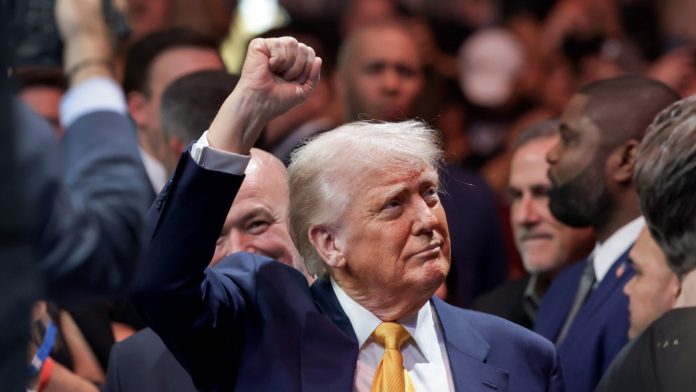
President Donald Trump attends an Ultimate Fighting Championship (UFC) event in Miami on Saturday.

President Donald Trump attends an Ultimate Fighting Championship (UFC) event in Miami on Saturday.

Lynne Sladky/AP


hide caption

toggle caption

Lynne Sladky/AP

“It says we’re doing a good job,” Trump said on Air Force One early Sunday morning. “If we weren’t doing a good job, we’d get the opposite.”

The tone was starkly different at Sanders’ rally earlier Saturday, which his team said was his largest yet with some 36,000 supporters in attendance. Musical icons Joan Baez and Neil Young were among the performers, in an event that lasted for over five hours.

Rep. Alexandria Ocasio-Cortez, D-N.Y., another leading Trump critic who has been joining Sanders on the tour, said at the rally that corporate interests and lobbyists have an outsize influence on modern American life, driving wealth inequality and making it increasingly challenging for workers to get by.

“The feeling of the water rising up to our throats, the impossibility to afford anything easily, the fear of speaking up, the deeply bitter and toxic division driven more by algorithms on social media than individual thought, the crumbling of our rights and protections,” Ocasio-Cortez said, “understand that all of this is what it means and what it feels like to be governed by billionaires.”

Sanders and Ocasio-Cortez will make additional stops on the tour this week in Idaho, California and Montana.

Fire at Pennsylvania Gov. Josh Shapiro’s residence was ‘an act of arson,’ police say : NPR

0

Investigators are on the scene after an overnight fire at the governor’s official residence on Sunday, April 13, 2025 in Harrisburg, Pa.

Marc Levy/AP


hide caption

toggle caption

Marc Levy/AP

An investigation is currently underway following a fire at the home of Pennsylvania’s governor, Democrat Josh Shapiro, early Sunday morning, according to state police.

The fire, which is being investigated as “an act of arson,” took place around 2:00 a.m. ET at the Governor’s Residence in Harrisburg, the commonwealth’s capital, Pennsylvania State Police said in a statement Sunday morning.

“While the fire was successfully extinguished, it caused a significant amount of damage to a portion of the residence,” state police also said. “The Governor and his family were present in a different part of the residence. They were evacuated safely and were not injured.” Authorities did not offer details about possible suspects or motivations.

Photos taken by the Associated Press on Sunday show broken windows and a damaged door at the front of the residence.

On Saturday evening, Shapiro, who is Jewish, posted a photo of his family’s Seder table on social media wishing his followers, “happy Passover and Chag Pesach Sameach!.” He later posted on Sunday morning, that he and his family were awakened by bangs on the door by state police.

“Thank God no one was injured and the fire was extinguished. Every day, we stand with the law enforcement and first responders who run towards danger to protect our communities,” Shapiro, a Democrat who was elected as governor in 2022 wrote. “Last night, they did so for our family — and Lori and I are eternally grateful to them for keeping us safe.”

Shapiro, 51, and his wife, Lori Shapiro have four children: Sophia, Jonah, Max, and Reuben who range in age from their teens to early 20s.

The governor’s residence, located by the Susquehanna River and completed in 1968, is described as a 29,000 square foot Georgian-style home designed by architect George Ewing.

In response to the incident, Pennsylvania State Police are offering a $10,000 reward for tips for “the arrest and conviction” of the person or persons responsible for the fire.

White House doctor : NPR

0

President Trump prepares to watch the Ultimate Fighting Championship at the Kaseya Center on Saturday in Miami, Fla.

Joe Raedle/Getty Images


hide caption

toggle caption

Joe Raedle/Getty Images

President Trump “exhibits excellent cognitive and physical health and is fully fit,” according to White House physician Capt. Sean Barbabella.

The White House released Trump’s three-page medical report Sunday morning following the president’s annual physical examination at Walter Reed National Military Medical Center on Friday.

“President Trump remains in excellent health, exhibiting robust cardiac, pulmonary, neurological and general physical function,” Barbabella said.

Trump, 78, is the oldest president to take the oath of office in the White House. Former President Joe Biden was a few months younger when he started his term and visibly slowed down while in office — sparking political turmoil and concerns about his cognitive ability.

These medical records mark the first detailed information on Trump’s health since the assassination attempt against him in Butler, Pa., in July.

The physical examination revealed a few “abnormalities,” according to Barbabella. The first was “scarring on the right ear” from the gunshot wound sustained during the assassination attempt.

Barbabella said Trump’s “hearing was normal.” The second was a “diverticulosis and a benign polyp” revealed during a colonoscopy in July. Diverticulosis is inflammation or infection in the digestive tract.

The White House physician recommended a “follow-up colonoscopy in three years.”

The medical report also showed that Trump weighs 224 pounds, 20 pounds lighter than he weighed in 2020. And his LDL — “bad” cholesterol levels — are now within an “optimal” range and lower than last reported in 2020. He is currently taking two cholesterol-control medications: rosuvastatin and ezetimibe. The latter medication was not noted in Trump’s 2020 medical report.

Trump’s vaccines are all “current,” but Barbabella did not list specific immunizations.

The president’s neurological exam “revealed no abnormalities in his mental status,” according to Barbabella. Trump was assessed for cognitive function, depression and anxiety. He scored within the normal range in all categories.

“I took a cognitive test. And I don’t know what to tell you, other than I got every answer right,” Trump told reporters on Friday following his exams. “I took just a lot of different tests, having to do with the heart, having to do with other things.”

At the end of Trump’s medical report, the White House physician said Trump’s days are full of meetings, public appearances, press conferences — and “frequent victories in golf events.”

Presidents are not obligated to share medical data, and many have shrouded their medical records.

Trump’s medical records over the years

One week after the Butler assassination attempt, Dr. Ronny Jackson — the president’s former doctor and a congressman from Texas — released a memo on Trump’s health.

Jackson said Trump was shot in the ear and “is doing well, and he is recovering as expected.” Jackson also reported that Trump received a “CT of his head” and that a hearing exam would be scheduled. Medical data from those exams were not shared publicly at the time, but Sunday’s release includes information from these exams.

In 2023, Trump released a brief doctor’s letter that lacked detailed medical data. But it did say Trump had lost weight and that “his cognitive exams were exceptional.” The Trump campaigned highlighted cognitive testing in the lead-up to the election.

In his final year as president, Biden’s doctors chose not to give him a cognitive exam.

During his first term, Trump took a number of physical exam and released his medical data.

In 2018, Dr. Jackson gave Trump a glowing report. He said Trump had “great genes” and that if he had a healthier diet “he might live to be 200 years old.” Jackson recommended the president lose some weight and cut back on fat and carbs.

Trump attacks on law firms begin to chill pro bono work on unfavorable causes : NPR

0

President Trump speaks to reporters and signs an executive order in the Oval Office on March 31.

Jabin Botsford/The Washington Post via Getty Images


hide caption

toggle caption

Jabin Botsford/The Washington Post via Getty Images

Since late February, President Trump has used the power of the presidency to punish law firms that he accuses of weaponizing the justice system and undermining the national interest, part of his promised campaign of vengeance against his perceived political enemies.

Trump’s use of executive orders against specific law firms is widely seen as an effort to intimidate and punish them for representing people or causes at odds with his administration. Many of the firms also were once home to lawyers who were involved in investigations of Trump himself, such as former special counsel Robert Mueller, who led the probe into Russian interference in the 2016 election.

Some law firms targeted by Trump have fought back. Others have cut a deal with him.

While the legal battle over this controversial use of presidential power is still playing out in the courts, ripple effects already are being felt beyond the boardrooms of the country’s most powerful law firms.

“I’ve never seen an administration target firms for their case selection, the clients they select. It really does set a very dangerous precedent of political interference in the legal profession,” said Lourdes Rosado, the president and general counsel of LatinoJustice PRLDEF, a New York-based civil rights nonprofit.

“The administration’s attacks on big law firms really create a climate of fear that could deter firms from taking on these very politically sensitive, yes, pro bono cases that are challenging unconstitutional actions right now.”

There’s concern over law firms curtailing pro bono work for causes that are unpopular with Trump

More than 180 lawsuits have been filed in federal court so far challenging Trump administration policies, according to a count kept by Just Security based at the New York University School of Law. Those cases have frustrated the president and slowed his agenda.

In many of those lawsuits, major law firms are working alongside advocacy groups like Rosado’s, adding resources and legal firepower. That pro bono assistance varies from case to case, but it can includes things like providing attorneys to conduct legal research or help build a case theory, or financial support to help pay for travel, experts and court costs.

NPR spoke with attorneys at a half-dozen organizations that regularly team up with big law firms that provide pro bono assistance to challenge government actions or policies. All of them say they have deep concerns that Trump’s campaign against law firms will cause firms to pull back from pro bono work that is at odds with Trump’s own views.

Some of them say it’s already happening.

“Increasingly, I’m hearing about political considerations being an issue in firms deciding whether they’re going to be able to assist,” said Dustin Rynders, the legal director of the Texas Civil Rights Project.

“I have been turned down on some recent requests where people have expressed concern about political ramifications, about being involved in immigrant rights work in this time, about being involved in civil rights, voting rights cases, in challenges against the administration,” he said.

For organizations like his, Rynders says, that pro bono work is vital.

“Without the assistance of those extra attorneys, those extra minds, those extra resources, we’re able to bring fewer cases, and we’re able to put less resources in the cases we bring, which can also impact your ultimate likelihood of success,” he said.

An attorney at another organization said that law firms they have teamed up with on a pro bono basis in the past have recently declined to work with them. The attorney, who spoke on condition of anonymity because of the sensitivity of the matter, said the firms provided no reason for their decision.

If law firms pull back on pro bono work, there likely will be fewer challenges to potentially unconstitutional actions by the government down the road. And if that happens, it’s not one case or one cause that suffers, said Jennifer Levi, the senior director of transgender and queer rights at GLAD Law.

“This isn’t just about progressive causes or any particular political stance,” Levi said. “This is ultimately about whether the legal system can function he way that it’s supposed to.”

Levi takes heart from that fact that some law firms are fighting back. Four firms targeted by Trump have sued in federal court. Judges who have reviewed the cases have already temporarily blocked enforcement of the executive orders’ punitive measures.

If the legal profession doesn’t push back now, Levi said, the whole idea of equal justice and the justice system is vulnerable.

“I don’t think that’s ultimately something that the legal profession can compromise on,” Levi said.