Thursday, November 12, 2026
Home Blog Page 41

Will the SAVE Act make it harder for married women to vote? We ask legal experts : NPR

0

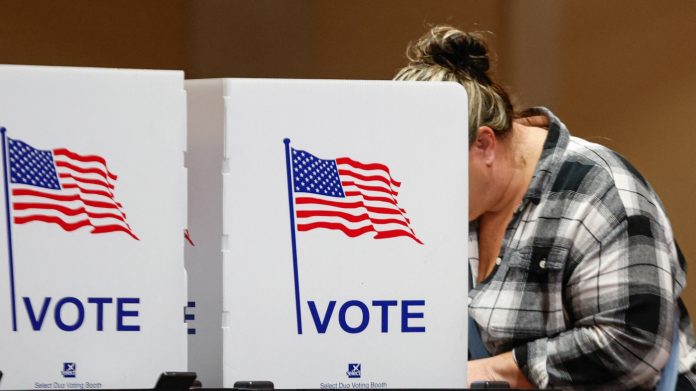
A woman votes at a polling location at The Chapel, an Evangelical church in St. Joseph, Mich., on Election Day, Nov. 5, 2024.

Kamil Krzaczynski/AFP via Getty Images


hide caption

toggle caption

Kamil Krzaczynski/AFP via Getty Images

As the Safeguard American Voter Eligibility Act heads to the Senate, there has been growing debate on how the bill may affect voting for millions of married women, particularly those who have changed their last names, if it becomes law.

The legislation, known as the SAVE Act, looks to make sweeping reforms on voter registration. It was introduced in response to fears about voter fraud, though research has consistently showed that such incidents are exceedingly rare and not a significant factor in American elections.

Among the most notable changes outlined in the bill is the requirement to prove U.S. citizenship before registering to vote. Acceptable documents will include a birth certificate, U.S. passport, naturalization paperwork and certain versions of the Real ID that indicate citizenship.

But for as many as 69 million American women who have taken on their spouse’s name, their birth certificates no longer match the names they use today, according to an analysis by the progressive Center for American Progress. Meanwhile, more than half of all Americans do not have a passport, according to a 2023 YouGov survey.

Some lawmakers who oppose the SAVE Act argue that the bill could make it harder for married women to vote. “This voter suppression bill will disenfranchise millions of voters, especially married women,” Democratic Rep. Ilhan Omar of Minnesota said on social media.

Meanwhile, supporters of the SAVE Act assert that the legislation orders states to determine what additional documents should be required when local voters have a discrepancy on their proof of citizenship document.

“The Democrats have been fearmongering about this bill, have been saying if married women change their name, they would not be able to vote. That is complete fallacy,” White House press secretary Karoline Leavitt said at a press conference on Friday.

Getting legal documents could be a challenge for some women

Legal experts told NPR that states can ease this potential hurdle by accepting secondary documents like a legal decree of a name change or a marriage certificate, but it might not fix the issue for all married people.

Tracy Thomas, a professor of constitutional law at the University of Akron, said the issue is that court decrees are uncommon since they are generally not required for married individuals who want to change their name.

While marriage certificates are more commonly issued, Thomas said obtaining one may be especially challenging for women who have been married for a long time and may no longer have their marriage certificate readily available.

“Obtaining that marriage certificate is an additional cost, administrative burden, and extra penalty that other voters do not have to do,” said Thomas, who teaches voting rights and general equality.

She added, “These might all seem like trivial costs, but they all add up. There is also time delays and administrative inconvenience and burden at each step that creates more obstacles and discouragement to voting.”

Experts say the bill could lead to varying policies across states

Legal experts also worry that the ambiguity in the bill will lead to uneven policies across the country, meaning some states and municipalities will enforce stricter document requirements than others.

“ Will marriage certificates be accepted equally across all jurisdictions? We don’t know because some marriage certificates have different types of information on them, depending on the jurisdiction,” said Keesha Middlemass, a professor in the department of political science at Howard University.

Middlemass, who is also a fellow in governance studies at the Brookings Institution, added that if the bill passes, it will take some time to identify where and how married women are being affected.

“ The disenfranchisement — we won’t know about it until after the fact,” she said.

It’s not unusual for voting laws to take time to iron out issues and identify those affected. But the prospect of sweeping changes to voter registration also comes at a time when elections have been competitive, Middlemass notes.

“That happens with every policy, there’s always hiccups,” she said. “ The challenge with … changing voting laws is we’ve had very close elections in the last three cycles, and so if you reduce the potential voters by 1 or 2% that could change the outcome of the election.”
Retrial of Sarah Palin’s defamation case against NY Times begins Monday : NPR

0

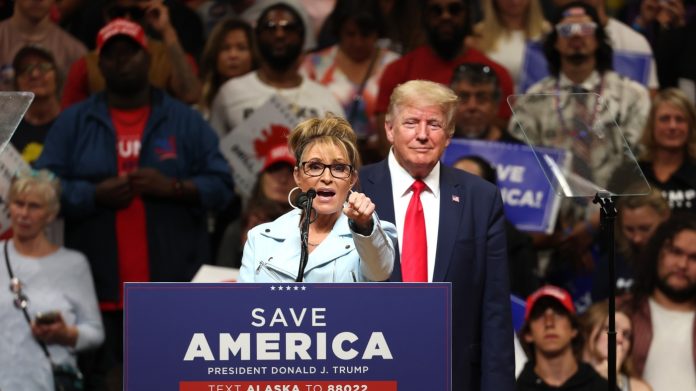
Former Alaska Gov. Sarah Palin campaigned for the state’s U.S. House seat in 2022 with the support of President Trump. She did not win. A retrial of her defamation case against The New York Times is slated to begin Monday.

Justin Sullivan/Getty Images/Getty Images North America


hide caption

toggle caption

Justin Sullivan/Getty Images/Getty Images North America

As another New York City institution once said, it’s deja vu all over again for The New York Times and former Alaska Republican Gov. Sarah Palin.

Palin has the rare opportunity to retry her defamation case against the Times even though she lost it twice in a 24-hour period in early 2022. Jury selection is slated to begin Monday in federal court in Manhattan, after a judge’s misstep in the initial suit opened the door to a retrial.

The case was sparked by a 2017 Times editorial that, Palin’s attorneys argued, had accused her of inciting murder six years earlier in the shooting in Tucson, Ariz. that killed six people and gravely wounded then-Rep. Gabby Giffords. No proof was ever found suggesting the shooter was motivated by, or even knew about, the Palin ad cited by the editorial.

Conservative allies had hoped to use the case to upend protections for the press stemming from a six-decades-old U.S. Supreme Court ruling in a defamation case that also involved the Times. 

Thanks to that ruling, Palin had an uphill battle: the bar to prove defamation is high for public figures such as Palin — a former governor, vice presidential candidate and vocal supporter of President Trump. She has not been able to make a credible case that she suffered tangible damages as a result of the Times’ editorial, and the newspaper moved relatively quickly to remedy its errors.

But the media landscape has shifted since that first trial. CNN recently settled a case filed by a former security contractor whom it had accused of “black market” rescue operations after the fall of Kabul to the Taliban. A Florida jury had awarded the man $5 million in pain and suffering; CNN agreed to pay him more to stave off the jury’s decision on how much to award him in punitive damages. MSNBC settled a defamation claim brought by a physician falsely accused in 2020 of performing mass hysterectomies on female detainees at an Immigration and Customs Enforcement facility.

And Trump has sued several media and social media companies, including X (formerly Twitter) and Meta, ABC, CBS and the Des Moines Register. ABC, X and Meta settled. CBS is litigating vigorously against Trump although parent company Paramount is also exploring a settlement. (Paramount is in the midst of selling itself to the son of Trump’s billionaire ally Larry Ellison.)

The judge’s misstep

The editorial in question in the Palin case was posted late in the evening of June 14, 2017. The Times published a correction the next morning, acknowledging the lack of any link between Palin’s ad and Gifford’s shooting. The day after, it corrected a related element. The Times’ then-editorial page editor, James Bennet, who had inserted the incorrect claims into the passage, wrote an apology that was posted to the opinion section’s social media account. It was then reposted by the Times.

Palin’s odds at trial in 2022 looked long. And yet a reprieve unexpectedly arose at that trial’s close, thanks to the judge. Even as jurors deliberated, U.S. District Judge Jed S. Rakoff ruled that Palin had failed to make a credible case and announced he would find the Times not liable for defamation.

Rakoff said each item put forward by Palin’s lawyers as proof of the Times‘ ill will “consists either of gross supposition or of evidence so weak that, even together, these items cannot support the high degree of particularized proof” needed to move forward.

Rakoff announced his decision in court, out of hearing of the jury. He said he would not issue it formally until the jury’s verdict, which he said he would set aside.

The next day, the jury unanimously found against Palin.

Upon being questioned by the judge’s law clerk, however, several jurors conceded that they had learned of Rakoff’s ruling dismissing the case through push alerts on their smartphones before they had finished deliberating

Palin’s legal team appealed; a three-judge panel of the 2nd U.S. Circuit Court of Appeals sent the case back. The appellate judges found that Rakoff, a senior judge, had not followed proper procedures in evaluating her legal claims and that she had, indeed, made a case that “states a plausible claim for relief.”

While acknowledging the case is ultimately about the bounds of the First Amendment, the appellate court also cited the notifications jurors received on their phones.

The panel wrote they had “no difficulty concluding that an average jury’s verdict would be affected if several jurors knew that the judge had already ruled for one of the parties on the very claims the jurors were charged with deciding.”

Palin failed to convince the appeals court, however, to disqualify Rakoff from hearing the case. So, he will preside over the trial of her legal claim once more in a trial expected to last at least a full week.

The New York Times declined to comment ahead of the case. Palin’s lead trial attorney did not respond to NPR’s query for this story.

Unclear what Palin may gain from a victory

Beyond the opportunity to unravel some of the protections for the press in the 1964 U.S. Supreme Court ruling, it is not entirely clear what Palin is hoping to gain. Federal courts apply state law to defamation cases. A New York state law — passed after her suit was first filed — strengthens press freedoms.

As conceded in court papers Palin and the Times jointly presented to the judge on how the retrial will be handled, “Governor Palin is not seeking to recover and will not claim or assert loss of income, jobs, or other paid opportunities,” including in book sales or ad revenues from her website.

Among the questions proposed by Palin’s legal team for prospective jurors this time around: “Do you receive push notifications from any news websites or apps?”

Up First from NPR : NPR

0
Jackie Lay/NPR

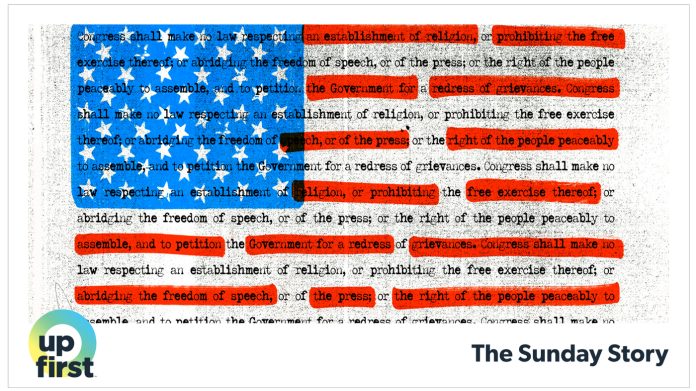
The first amendment is a cornerstone of American democracy. This week on The Sunday Story, we hear from people who feel their right to free speech might be changing under the Trump Administration. NPR’s Morning Edition co-host Leila Fadel joins Ayesha Rascoe to share what she learned when she talked to teachers and students, pastors and scientists, and others about whether they feel emboldened or silenced in America today.

This episode of The Sunday Story was produced by Justine Yan with help from Taylor Haney and Kyle Gallego-Mackie. It was edited by Liana Simstrom and Arezou Rezvani. Audio engineering by James Willets.

We’d love to hear from you. Send us an email at [email protected].

Trump administration gives judge update on Kilmar Armando Abrego Garcia : NPR

0

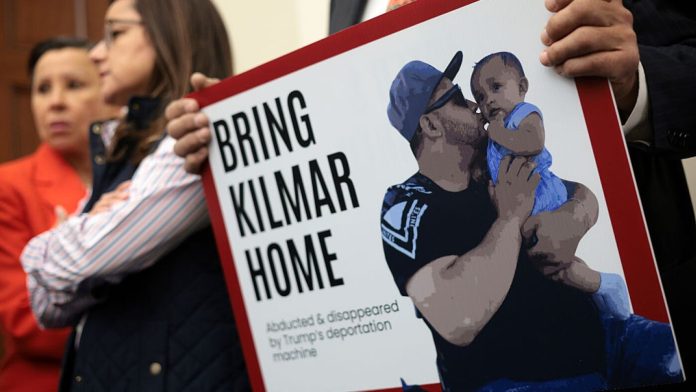
A member of the Congressional Hispanic Caucus holds a picture of Kilmar Abrego Garcia during a news conference to discuss his arrest and deportation on Apr. 9, 2025 in Washington, DC.

Alex Wong/Getty Images


hide caption

toggle caption

Alex Wong/Getty Images

A Maryland man who was wrongly deported to El Salvador is alive and still detained in the country, the Trump administration said in a filing to a federal judge on Saturday.

Kilmar Armando Abrego Garcia is being held at El Salvador’s Terrorism Confinement Center, according to Michael G. Kozak, a senior official in State Department’s Bureau of Western Hemisphere Affairs, citing the United States’ embassy in San Salvador in the filing.

“He is alive and secure in that facility. He is detained pursuant to the sovereign, domestic authority of El Salvador,” Kolzak also wrote.

The filing follows federal judge Paula Xinis’ order on Friday that the Trump administration provide daily updates on their efforts to return Abrego Garcia to the U.S.

In her new order, which was issued after the Supreme Court upheld her original order to bring Abrego Garcia back, Xinis directed the federal government to “take all available steps to facilitate the return” of Abrego Garcia to the U.S.as soon as possible. She also ordered the Justice Department to provide an immediate update on his location and status, the steps the government has taken so far to bring Abrego Garcia back and what additional actions it is considering.

The Trump administration on Friday asked for more time to answer Xinis’ questions, arguing that the government needs “a meaningful opportunity to review the Supreme Court’s decision before it is ordered to report what steps it will take in response to that decision.”

Abrego Garcia is a Salvadoran citizen who has lived in Maryland for almost 15 years. While he initially entered the U.S. without being granted legal status, a federal judge in 2019 granted him protection from being deported, due concerns for his safety if he were to return to El Salvador. He also has had no criminal record.

Abrego Garcia was arrested in March and, a few days later, placed on a flight with other men the Trump administration alleged were members of the Venezuelan gang Tren de Aragua. A Justice Department lawyer conceded in court that Abrego Garcia’s deportation was a mistake, or as he put it, an “administrative error.”

Abrego Garcia’s attorney, Simon Sandoval-Moshenberg, said in a statement to NPR, “We are incredulous. Twenty-four more hours and still no answers as to what they’ve done so far, and what they’re planning to do going forward, to carry out the Supreme Court’s ruling.”

NPR’s Joel Rose, Nina Totenberg and Christina Gatti sontributed to this report.

Trump urges Congress to make daylight saving time permanent : NPR

0

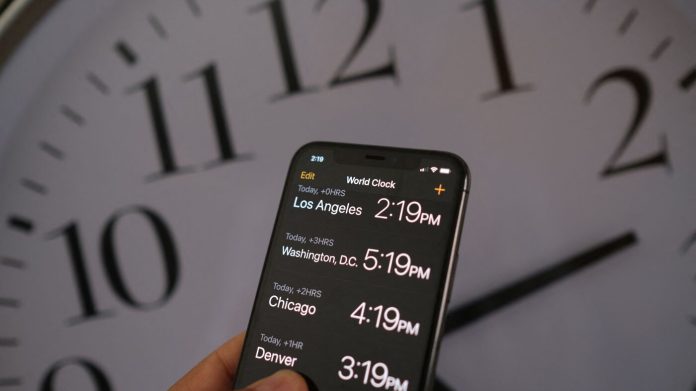
This illustration photo shows a clock in the background of a smartphone showing the time after daylight saving time was implemented in Los Angeles, Calif., on March 15, 2022.

Chris Delmas/AFP/Getty Images


hide caption

toggle caption

Chris Delmas/AFP/Getty Images

President Trump is urging Congress to pass legislation that would make daylight saving time permanent — which, if enacted, would put an end to a longstanding debate over whether to change the time in the U.S. twice a year.

Both the House and Senate should “push hard for more Daylight at the end of a day,” the president wrote Friday morning on Truth Social.

“Very popular and, most importantly, no more changing of the clocks, a big inconvenience and, for our government, A VERY COSTLY EVENT!!!,” Trump also wrote.

The latest directive from Trump follows ongoing efforts in Congress to adopt daylight saving time — including the Sunshine Protection Act, which was reintroduced in the House and Senate by Florida Republicans Rep. Vern Buchanan and Sen. Rick Scott in January. Another Florida Republican, then-Sen. Marco Rubio, had previously championed the bill, first introducing it in 2018 and reintroducing it in 2021. The Senate passed the bill in 2022, but it never came to a vote in the House.

Every state observes daylight saving time except for two — Hawaii and Arizona, with the exception of the portion of Navajo Nation that’s in the state. U.S. territories American Samoa, Guam, Puerto Rico, the Virgin Islands and the Northern Mariana Islands also don’t change their clocks.

Trump, who has long been supportive of the change and tweeted in 2019 that making it permanent was “O.K. with me!,” appeared to soften his stance when he called it a “50/50 issue” in early March, three days before clocks moved an hour forward in most parts of the country.

“I assume people would like to have more light later, but some people want to have more light earlier because they don’t want to take their kids to school in the dark … A lot of people like it one way. A lot of people like it the other way,” he told reporters then in the Oval Office.

The issue was debated during a Senate hearing on Thursday, where Republican Sen. Ted Cruz from Texas called changing the clocks twice a year an “outdated and harmful practice.” Cruz also said while changing the clocks made sense in the early 20th century, advancement in technology has “drastically reduced the relative price of energy compared to the past.”

“When we take a closer look at the implications of changing the clocks, its impact on our economy, our health and our everyday lives, we can see that this practice is more than an annoyance,” Cruz, who is chairman of the U.S. Senate Committee on Commerce, Science, and Transportation. “The disruption to sleep patterns and the result in fatigue can have consequences on our productivity, mental health and well-being.”

Democratic Sen. Lisa Blunt Rochester from Delaware also said changing clocks twice has a negative impact on Americans and that “it’s time to figure this out.”

“The back and forth between daylight savings time and standard time needs to change and needs to stop,” she said. “We need to stop the clock. We need to find a solution and stick with it.”

While there is concern among sleep experts that switching the time biannually is not good for one’s health, some in the medical community also say a permanent daylight saving time might not be a good solution, either.

Dr. Karin Johnson, medical director of the Baystate Regional Sleep Medicine Program, previously told NPR a permanent standard of time is more beneficial.

“The scientific and medical community really feel it’s very important for us to go to permanent standard time, which is much more aligned with the sun in the sky and so better for our overall health and well-being,” Johnson said.

Reporter's Notebook: on federal judges and the Trump administration

0

NPR’s Ryan Lucas speaks about his beat covering the federal judiciary during the tumult of the second Trump administration.

Smartphones and computers are exempt from Trump’s reciprocal tariffs : NPR

0

Versions of the new Apple iPhone 16 are displayed at an Apple store in in Manhattan Beach, Calif., on April 8.

Jay L Clendenin/Getty Images


hide caption

toggle caption

Jay L Clendenin/Getty Images

The Trump administration has amended its list of imports that will be affected by sweeping global tariffs in order to exempt certain electronics, including smartphones and computers.

The updated guidance was published Friday night by U.S. Customs and Border Protection. The exemption will apply to President Trump’s steep “reciprocal tariffs” imposed across dozens of countries, which have since been paused until early July as well as the 145% levies currently in place on China. That was the only country excluded from the reciprocal tariff pause.

The exemption is effective for products that entered the U.S. or left warehouses starting on April 5. The White House issued a presidential memo about the exemption on Saturday.

When asked about the reasoning behind the exemption, White House press secretary Karoline Leavitt said in a statement: “President Trump has made it clear America cannot rely on China to manufacture critical technologies such as semiconductors, chips, smartphones, and laptops.”

Leavitt added, “At the direction of the President,” companies including Apple, TSMC and Nvidia “are hustling to onshore their manufacturing in the United States as soon as possible.”

The electronics exemption is a major development in the tariff war with China, which has imposed a 125% tariff on U.S. goods. Prices for electronics from China, a key sector, had been expected to spike.

Among the items that will now be spared from Trump’s steep tariffs include smartphones, computers, semiconductors, and flat panel display modules. But the updated guidance did not address any changes to the existing 20% tariff on Chinese goods in response to China’s involvement in the fentanyl trade.

According to the U.S. International Trade Commission, China has long been America’s chief source for electronic products, with Mexico, Taiwan, Vietnam, and Malaysia rounding out the top five.

There was also concern for American tech giants that rely on supply chains in China, like Apple. Before the updated guidance, Apple was expected to experience major setbacks as a result of the tariffs, Dan Ives, global head of technology research at Wedbush Securities, told CNBC earlier this week.

Consider This from NPR : NPR

0

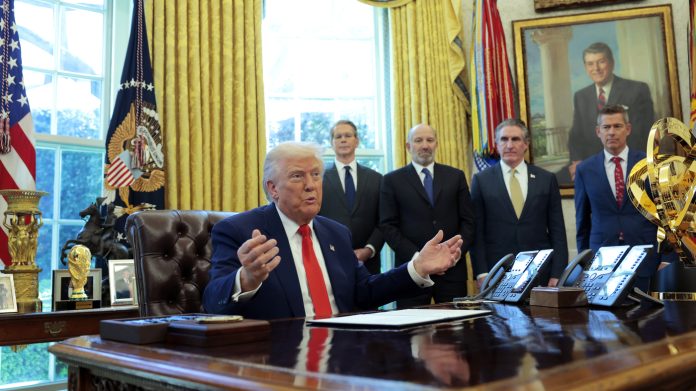
WASHINGTON, DC – APRIL 09: U.S. President Donald Trump speaks to reporters as he signs executive orders in the Oval Office. (Photo by Anna Moneymaker/Getty Images)

Anna Moneymaker/Getty Images


hide caption

toggle caption

Anna Moneymaker/Getty Images


WASHINGTON, DC – APRIL 09: U.S. President Donald Trump speaks to reporters as he signs executive orders in the Oval Office. (Photo by Anna Moneymaker/Getty Images)

Anna Moneymaker/Getty Images

For weeks, President Trump has been targeting certain law firms with executive orders. Some have fought back, but others have cut deals to avoid the damage.

For our weekly Reporter’s Notebook series, we dive into this legal drama with NPR’s Justice Correspondent Ryan Lucas, to see how this use of executive power is changing the landscape of the American legal system.

For sponsor-free episodes of Consider This, sign up for Consider This+ via Apple Podcasts or at plus.npr.org.

Email us at [email protected].

This episode was produced by Noah Caldwell. It was edited by Adam Raney and Courtney Dorning. Our executive producer is Sami Yenigun.

Federal judge orders USDA to unfreeze funds to Maine : NPR

0

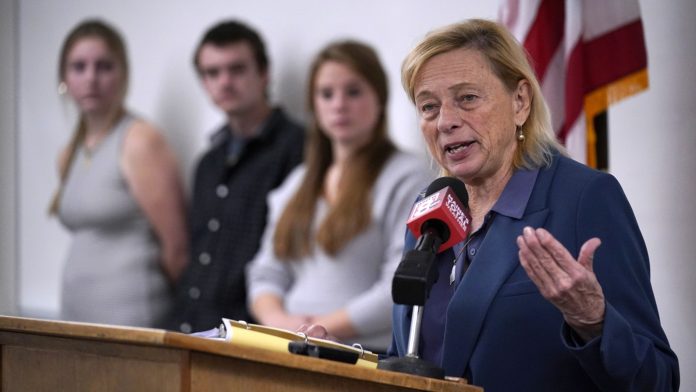
Maine’s Democratic Gov. Janet Mills speaks at a news conference at Morse High School on Oct. 20, 2022, in Bath, Maine.

Robert F. Bukaty/AP


hide caption

toggle caption

Robert F. Bukaty/AP

A federal judge ordered the Trump administration to unfreeze federal funding that was allocated to Maine from the U.S. Department of Agriculture — funds that had been withheld following President Trump’s clash with Maine Gov. Janet Mills over the issue of transgender athletes.

U.S. District Court Judge John Woodcock granted Maine’s request for a temporary restraining order on Friday. The USDA is just one of the agencies where federal funding for Maine has been threatened. The agency did not immediately respond to request for a comment.

The feud between Trump and the state of Maine began after the president issued an executive order in early February barring transgender student athletes from playing on girls’ sports teams. The order also calls for the federal government “to rescind all funds from educational programs that deprive women and girls of fair athletic opportunities.”

In response, the Maine Principals’ Association, which governs school sports in the state, said it will continue to allow trans girls to compete, asserting that federal action is at odds with state law. Then, on Feb. 21, during a governors’ event at the White House, Trump called out Mills for resisting his executive order.

“You better do it, because you’re not going to get any federal funding at all if you don’t,” Trump told Mills.

To which Mills replied, “See you in court.”

Since the confrontation, Trump has demanded an apology from the Maine governor. “We need a full throated apology from the Governor herself, and a statement that she will never make such an unlawful challenge to the Federal Government again, before this case can be settled,” he wrote on social media.

Following the fallout, the Trump administration has also initiated multiple investigations into Maine, citing concerns over Title IX, which prohibits discrimination in education based on sex, Maine Public Radio reported. That includes the Education Department and the Department of Health and Human Services.

The USDA got involved earlier this month. In a letter on April 2, Agriculture Secretary Brooke Rollins told Mills that USDA funding for certain administrative and technological functions in schools will be paused in response to the governor’s “defiance of federal law.”

It was unclear how much aid would be affected but Rollins threatened that other areas of research and education-related funding will be reviewed. In response, the state of Maine filed a complaint on Monday, arguing that the USDA did not follow the mandatory statutory and regulatory steps before it can terminate federal funds.

In the suit, Maine Attorney General Aaron Frey urged the court to reinstate federal funds, arguing that it was aid used to feed schoolchildren in Maine.

U.S.-Iran nuclear talks start in Oman over Iran’s nuclear program : NPR

0

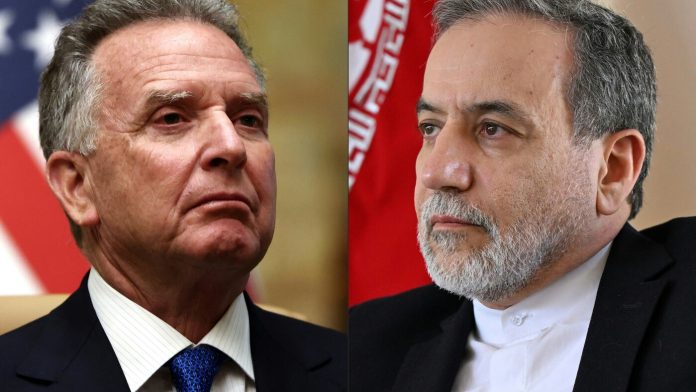
U.S. Middle East envoy Steve Witkoff (left) is expected to lead the U.S. delegation in nuclear talks with Iran’s Foreign Minister Abbas Araghchi on Saturday in Oman. The U.S. and Iran reached a nuclear accord in 2015, but President Trump withdrew from the deal during his first term in 2018.

Evelyn Hocksteinamer Hilabi/AFP via Getty Images


hide caption

toggle caption

Evelyn Hocksteinamer Hilabi/AFP via Getty Images

President Trump pulled out of a nuclear deal with Iran during his first term. On Saturday, his administration launched negotiations in search of a new agreement that would prevent Iran from acquiring a nuclear weapon.

The talks in Oman are between two countries divided by decades of hostility and deep skepticism about the motives of the other side.

“We face a significant wall of mistrust and harbor serious doubts about the sincerity of intentions,” Iran’s Foreign Minister Abbas Araghchi wrote in an op-ed in The Washington Post this week.

Araghchi is in Oman, according to photos released by Iran’s foreign ministry, showing him meeting with his Omani counterpart. Steve Witkoff, Trump’s special envoy to the Middle East, is thought to be heading the U.S. team, one day after meeting with Russian President Vladimir Putin in St. Petersburg. The high-level representation suggests both sides are serious, yet there’s already a disagreement on the nature of the talks.

The Trump administration is calling them direct negotiations, while the Iranians reiterated Saturday they are indirect talks that will be carried out through a mediator. However they interact, the differences run deep.

From the U.S. perspective, Iran’s nuclear program has been advancing and the country is believed to be capable of developing a nuclear weapon on short notice if it so chooses. In Iran’s view, Trump abandoned the previous nuclear accord in 2018, raising concerns about his willingness to agree to a deal and stick to it.

Still, both sides also have motivations to reach an agreement.

Trump says he wants to avoid endless conflict in the Middle East, and a deal with Iran would ease tensions.

Iran is looking for relief at a moment when it appears increasingly vulnerable. The economy has been crippled by decades of sanctions. Iran’s air defenses were substantially weakened in missile exchanges last year with Israel. And Iran’s regional proxies suffered major setbacks in wars with Israel, including Hamas in Gaza and Hezbollah in Lebanon.

“I think there is an opportunity as long as you can get the optics of this right,” said Alex Vatanka, an Iran expert at the Middle East Institute in Washington. “President Trump can declare victory and Iran can get serious sanctions relief.”

Regional tensions abound

The talks come as the Middle East is roiling with several conflicts. They include a U.S. bombing campaign against the Houthis in Yemen, a group backed by Iran. The U.S. has been striking Yemen daily for the past month, and has moved considerable firepower into the region.

The presence of an American aircraft carrier and powerful B-2 bombers is also seen as a warning to nearby Iran. Most analysts believe Trump is unlikely to resort to force against Iran at this juncture, pointing to his decision to launch negotiations. But he seems to be leaving that option open.

“I think everybody agrees that doing a deal would be preferable to doing the obvious. And the obvious is not something that I want to be involved with,” Trump said this week. He added: “Iran cannot have a nuclear weapon, and if the talks aren’t successful, I actually think it’ll be a very bad day for Iran.”

Araghchi, Iran’s foreign minister, warned against any attack. “To move forward today, we first need to agree that there can be no ‘military option,’ let alone a ‘military solution,'” he wrote.

Trump’s withdrawal from the 2015 deal

The U.S. and Iran, along with several European nations, reached a nuclear deal in 2015, known as the Joint Comprehensive Plan of Action (JCPOA). Iran was allowed to enrich uranium to low levels that could be used for civilian nuclear power, but not to high levels that could be used to make a nuclear bomb.

Iran also agreed to international inspections and pledged never to build a weapon. In return, Iran received limited sanctions relief.

But Trump argued that then-President Barack Obama negotiated a bad deal for the U.S. Trump unilaterally pulled the U.S. out of the agreement in 2018 despite a broad international consensus that Iran was abiding by the terms.

Iran has since enriched uranium to a much higher level — 60 percent purity — which it could ramp up to weapons grade — 90 percent purity — likely in a matter of weeks, according to nuclear experts.

Trump’s “maximum pressure” campaign during his first term hobbled Iran’s economy and further isolated it internationally. Yet Iran’s Islamic leaders remained in power and steadily moved ahead with the nuclear program.

Scope of the deal

One key question is how narrow or broad a proposed deal would be.

Iran is looking to keep the talks limited to nuclear issues. However, Trump aides have talked about a much wider arrangement that would include completely dismantling Iran’s nuclear program, addressing Iran’s arsenal of missiles and ending Iran’s support of proxy forces in the region.

The wider the scope, the harder it will be to reach an agreement, said Vatanka.

“There is a fear in the mind of [Iranian leader Ayatollah] Ali Khamenei that when the Americans start negotiating, they’ll start with one issue, but then they will introduce a lot of other issues,” he said. “So by the time you’re done, you’ve actually given the whole store away, as opposed to just putting some brakes on your nuclear program.”