

President Trump may have reduced some of his tariffs for now, but his faith in them remains consistent. Also, how the Supreme Court has weighed in on Trump administration actions.
White House looks at how to help farmers hurt by China tariffs : NPR
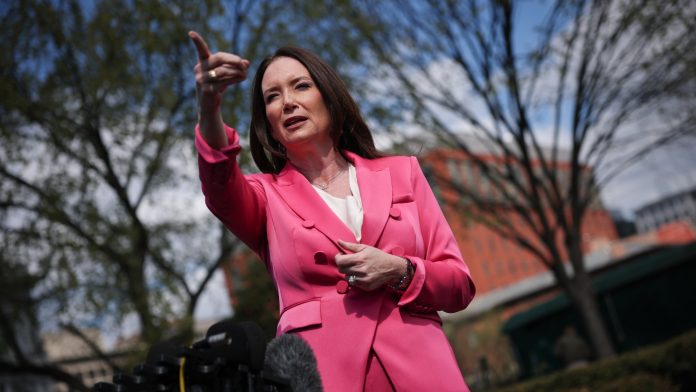
Secretary of Agriculture Brooke Rollins speaks with reporters outside the White House on March 26, 2025.
Win McNamee/Getty Image
hide caption
toggle caption
Win McNamee/Getty Image
Tariffs are making life more expensive for John Pihl. He’s been farming in Northern Illinois for more than 50 years.
“These tariffs are going to affect everything. It’ll affect our parts — it’s just across the board. Which is going to hurt everything,” he said.

Not only do tariffs affect the cost of farm supplies, but they also raise the risk of retaliation against exports of U.S. crops: a double-whammy for farmers like Pihl.
“It’s a good way to lose your customers,” he said. “And I think we’ll probably lose more on this round too, because I know that Mexico is our biggest importer of corn. But this time, they may figure out that they can get corn from South America just as easily as from the U.S.”
President Trump has imposed tariffs on countries from the world over, including 25% on steel and aluminum, 25% on some Canadian and Mexican goods, and a staggering 145% on Chinese goods. So far, the most notable retaliation has come from China, which has now imposed a 125% tariff on U.S. goods.

The White House is considering ways to help farmers. “We’re already starting to think about what a mitigation effort might look like,” Secretary Brooke Rollins said on Fox News this week.
She nodded to aid that Trump’s administration gave farmers during his first-term trade dispute with China, money that came from a fund called the Commodity Credit Corporation (CCC).
It’s a fund that had been around since the Great Depression, explained Joseph Glauber, a former USDA chief economist. “This was really a new thing that the Trump administration did, is that they tapped the CCC certainly at a level that had not been seen before for extraordinary payments,” Glauber said.

Soybean planting near Dwight, Ill., in a file photo from April 23, 2020.
Scott Olson/Getty Images
hide caption
toggle caption
Scott Olson/Getty Images
Trump spent $28 billion in his first term helping farmers hurt by tariffs
All told, the first Trump administration spent $28 billion bailing out farmers. This time around, the tariffs are much higher than they were six years ago, and it’s unclear how long they will persist.
NPR asked the White House for details on what relief is under consideration this time, but received no response.
The payments were helpful, Pihl said. But they weren’t a fix for the longer-term damage done by Trump’s first-term tariffs.
“That was just for the one year. What about the market loss that continued through his term and into Biden’s term? I think the amount is incredible,” he said.
China went elsewhere for soybeans
Soybeans are where that damage is most visible. China has long been the largest market for U.S. soybean exports. But during the trade dispute in Trump’s first term, China ramped up its purchases of Brazilian soybeans, replacing U.S. soybeans. The U.S. market share has never recovered.

Corn grows on a farm on August 11, 2024, near Elizabeth, Ill.
Scott Olson/Getty Images
hide caption
toggle caption
Scott Olson/Getty Images
Trump expressed confidence this week that he will be able to reach a deal with China to end the escalating trade fight. For now, some in the farm sector are hopeful about Trump making deals to help farmers.
“You know, he’s a negotiator,” said Kenneth Hartman, Jr., president of the corn board at the National Corn Growers Association. “He did a good job negotiating the [U.S-Mexico-Canada Agreement] USMCA when he negotiated that his first term. So we’re hoping that he can do something like that,” Hartman said.
Tariffs — and aid — can distort market signals
There’s another wrinkle to this all, which is timing. All of this tariff drama is unfolding in the spring, when farmers are making decisions about planting big export crops, like corn and soybeans.
American soybean farmers might decide to grow other crops, like corn, to avoid market risks in China. That could weigh on corn markets.
But also, an aid package announced too soon has the potential to distort markets, said Glauber, the former USDA economist.
“If you’re too generous with one crop vis-à-vis another, you could have farmers making planting decisions based on what they think those compensation payments might be,” Glauber said.
Farmers also say government aid is helpful, but it’s not their first choice.
“Farmers want markets. We need markets. We want to sell our grain at a profit,” said Hartman, adding that CCC payments are only a short-term fix.
“It’s supplemental, it’s needed because it keeps farmers from getting in worse financial situation, but payments are not the answer to a future successful agriculture operation in the United States,” Hartman said.
John Pihl feels similarly about the subsidies. “I don’t want it, but I’ll take it. I’d be an idiot not to take it. That’s about all I can say.”
Trump says he took a cognitive test during his physical : NPR
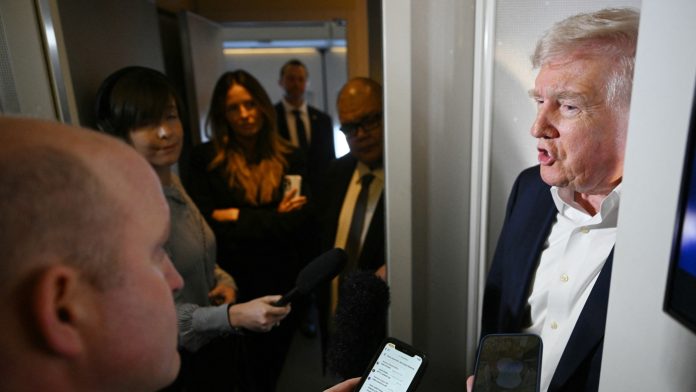
President Trump takes questions from reporters on Air Force One on April 11, 2025.
Mandel Ngan/AFP
hide caption
toggle caption
Mandel Ngan/AFP
President Trump told reporters that a cognitive exam was among the tests he had on Friday during his first physical of his second term at Walter Reed National Military Medical Center, and said his doctors would deliver a report about his results in coming days.

“I took a cognitive test. And I don’t know what to tell you, other than I got every answer right,” Trump said. “I took just a lot of different tests, having to do with the heart, having to do with other things.”
Presidents are not obligated to reveal their medical records, and there is a long history of presidents concealing their medical issues.
Trump — who has been less than forthcoming about his health information in recent years — is 78, the oldest president to start a second term in office. His predecessor former President Joe Biden started his first term at the same age, and visibly slowed down while he was in office.
A cognitive test was part of Trump’s first White House physical back in 2018. Trump later recounted how he “aced” the test.
The test was not part of Biden’s 2024 physical, a decision the White House had to defend after Biden struggled during his debate with Trump last summer before ultimately dropping out of the presidential race.
College students say Trump administration's crackdown on activism incites fear

On campuses nationwide, students are saying that the Trump administration’s efforts to crack down on antisemitism have caused a chilling effect on speech and political activity.
VA mental health therapists’ script: ‘I cannot guarantee complete confidentiality’ : Shots
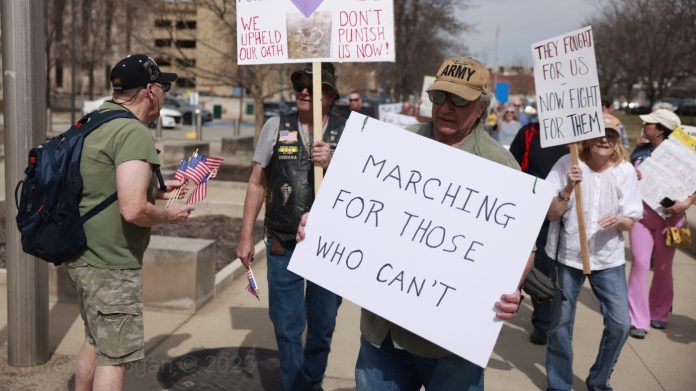
Veterans gathered in Indianapolis and in places across the country on March 14 to protest the Trump administration’s staff and budget cuts to the Department of Veterans Affairs.
Jeremy Hogan/SOPA Images/LightRocket via Getty Images
hide caption
toggle caption
Jeremy Hogan/SOPA Images/LightRocket via Getty Images
Panic, fear, uncertainty, and anger.
Those are the emotions mental health clinicians who work for the US Department of Veterans Affairs describe as they prepare for the VA’s mandatory return-to-office directive. Some are being summoned to offices as soon as Monday, April 14. Representatives from the VA say they are planning to have the back-to-office effort completed by May 5.

For this story, NPR interviewed ten clinicians in VA locations around the country, the majority of whom spoke on condition of anonymity because they were afraid of losing their jobs. Days before the April 14 return-to-office deadline, many were still unclear about the expectations for return dates. Some had received last minute changes or delays for reporting to an office.
In a memo obtained by NPR, regional leadership at one VA facility offered a script for its therapists to read to patients. “Before we begin our session, I want to inform you that I am currently in a shared office space,” reads the script. “While I will do my utmost to maintain your privacy, I cannot guarantee complete confidentiality.”
These directives come after the VA indicated it would cut about 80,000 staff in a massive restructuring effort. A widely circulated leaked memo, first obtained by the Associated Press, outlines the effort. In a video addressing the cuts, VA Secretary Doug Collins suggested the agency would eliminate waste and that the “the days of kicking the can down the road are over.” He offered reassurance that VA benefits would not be impacted and that the VA “regrets anyone who loses their job.”

Telehealth hires
Many VA therapists were hired on a telehealth basis and point out that there simply is not space for them to work at VA facilities. They are anticipating confusion and congestion around issues such as parking, bathroom use and adequate kitchen facilities to reheat their lunches.
But the primary concern for therapists is whether they will be able to deliver quality care to their patients in an environment without confidentiality.
In emails and meetings, VA managers described to VA mental health staff “pod” working environments, where clinicians work with headphones in a call-center like configuration to provide telehealth. In one recording obtained by NPR, a manager in a teleconference meeting acknowledged that it was inevitable therapy sessions would be overheard and exhorted people not to share any confidential information.
Supervisors working from “a shower”
“We won’t be able to provide private sessions,” says one licensed clinical social worker, who asked to be identified by a middle initial, L., for fear of retaliation. Guaranteed privacy between patient and doctor is a fundamental tenet of quality mental health care, protected by federal law.
A group of 20 House Democrats signed a letter to VA Secretary Doug Collins vocalizing their outrage on this issue. They describe one scenario in which a social worker supervisor has been ordered to return to work “sharing a 100-foot shower with another supervisor,” to provide case management and clinical supervision. “We’re sure you can agree,” they write, “this sort of arrangement is hardly conducive to delivering the quality of care veterans deserve.”
VA response
VA representatives have repeatedly insisted that federal privacy laws will be upheld. In an email response to questions about these issues, VA spokesperson Peter Kasperowicz reiterated an accusation that employees who are sounding alarms are motivated by a desire to “phone it in.”

A person walks into the Department of Veterans Affairs’ headquarters a block from the White House on March 6. President Trump and Elon Musk’s DOGE effort targets about 80,000 jobs to be cut from the VA.
Chip Somodevilla/Getty Images
hide caption
toggle caption
Chip Somodevilla/Getty Images
Kasperowicz wrote that these continuing concerns are “fear mongering from the media,” and wrote that “the small number of employees who are desperate to avoid returning to the office will do more to drive away staff and patients than VA’s commonsense return-to-office policy ever will.”
VA care, he said, would continue uninterrupted and the “VA will ensure that employees have a workspace that is appropriate for the work they do.”
But therapists say they do not see logistically how this is possible.
L. worried the disclaimers therapists are being encouraged to use at the start of sessions would not withstand legal scrutiny, as consent for information sharing needs to be granted in writing.
“Therapists will either cancel the session themselves,” L. says, “and risk being reprimanded, or their patients will cancel.”
L. forsees longer waiting times for veterans seeking care as a result and points out that veterans are at disproportionate risk for suicide than those who have not served. Wait times are already bad. Often, he says, his clients “have been waiting months and months – many of them with severe mental health issues, including suicidal thoughts.”
Dates changing at the last minute
The VA is one of the biggest providers of mental health care across the US.
In emails shared with NPR, some clinicians were told they would be returning to the office May 5, some were granted exemptions, and some were told to report to work April 14 – though these dates were also subject to change. One document obtained by NPR outlines steps for managers.
“This memo provides a framework to inform a standardized approach to terminating remote and telehealth agreements,” it reads.
Many clinicians expressed bewilderment about why certain workers were on the list of mandatory returns and others are not. Others were evaluating the possibility of working from their cars or finding space in a bathroom stall to conduct therapy sessions.
Some workers were asked to participate in rearranging furniture in order to accommodate group seating arrangements. Tasks like “rolling tables to podded rooms as temporary desks,” or “rolling away excess furniture,” were on a to-do list, obtained by NPR.
“Distress across the board”
The American Psychological Association issued a statement criticizing the policy and raising concerns about compliance with federal privacy laws.
“Providers are facing difficult choices between violating ethical standards regarding patient confidentiality or facing disciplinary action for non-compliance with return-to-office mandates,” reads the statement. It goes on to warn that the policy “could compromise access to care and confidentiality standards that are key to effective mental health treatment.”


Under President Biden, the PACT act allocated nearly $800 billion to expand VA care and benefits for veterans exposed to toxins. The current efforts aim to reduce staffing numbers to the levels VA had before this legislation. It is not clear how VA would reduce staff to 2019 levels and still fulfill its legal requirements under the PACT act.
Many clinicians described their recent experience as a kind of emotional warfare, and noted the irony of compromising their own mental health while trying to provide mental health care for others.
“ I’m anticipating a good deal of distress across the board,” says L. “And that we will generally fail at our mission of treating veterans.”
If you or a loved one is in crisis, call, text or chat the 988 Suicide and Crisis Lifeline.
Republican Sen. Todd Young on Trump’s tariffs : NPR
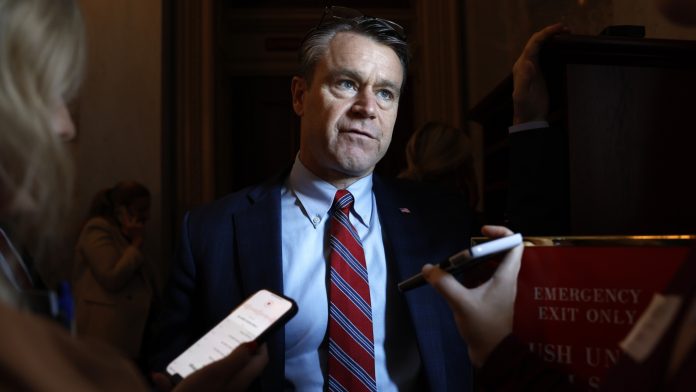
Sen. Todd Young speaks to reporters before a Republican Senate policy luncheon at the U.S. Capitol Building on September 19, 2023.
Anna Moneymaker/Getty Images/Getty Images North America
hide caption
toggle caption
Anna Moneymaker/Getty Images/Getty Images North America
Senator Todd Young says he’d like some clarity on an important point about the trade war: “How all this ends.”
Congress has largely left the trade war to the president, but Young is an exception. He’s one of seven Republican senators who joined many Democrats in supporting a bill that would reclaim some of the president’s tariff powers.
“I have a job to do,” Young told Morning Edition. “And that job is laid out both in precedent and also our Constitution … to have a say on behalf of my constituents when it comes to tax policy and tariff policy.”

Young is a low-key Indiana lawmaker with an enthusiasm for wonky, but important national security issues. He’s a protégé of the late Sen. Richard Lugar, a low-key Indiana lawmaker who had an enthusiasm for wonky but important national security issues.
Young is not harshly critical of President Trump, who carried Indiana by 19-points in last year’s election. But as a senator who won the same state by 21-points, he tries for a sophisticated approach to China, the country now facing the heaviest of the president’s tariffs.
Young spoke with NPR on Thursday, the same day the White House clarified that the tariff on Chinese goods has risen to 145%.
Here are some key insights from that conversation:
He wants Trump to articulate his goals
“No other leader, certainly in modern history, has decided to right the wrongs of some unfair trade relations. So many of my constituents want credit to be given where credit is due,” Young said. He added that his constituents also want “clarity” on what the plan is and “how all this ends.”
Young says his constituents also want consistency.
“What I’ve been pushing for is more clarity so that our investors and businesses know when they can deploy capital and what return on investments they can project and all the rest of it.”

He wants Congress to take a more active role.
He disapproves of laws passed by prior Congresses that gave the president considerable latitude to raise tariffs, even though the power to tax belongs to Congress. “What we have seen in modern history as members of Congress, candidly, it seems to me they didn’t want to make really hard decisions, so they delegated those hard decisions to successive presidents … I think my constituents … want Congress to right the balance … It’s time for all the branches of government to do work, not just to be social media influencers.
He’s a Marine who thinks a lot about national security.
“I perceive that most of the national security issues we’re facing today [are] coming down to issues of innovation and techno economic competition.” That explains why he supported the Chips and Science Act, a Biden-era law that is helping the U.S. to build up its computer chip-making capacity.
Young also leads a commission that just issued a warning about China’s growing power in biotechnology– advanced medical research, genetic research, new kinds of weapons, and more.

“This has been sobering,” he said. China “is leading in some key areas… They have outflanked the United States when it comes to bio-manufacturing in particular. We need to right the course.” China provides the active ingredients for many U.S. medicines, giving it potential leverage over the United States in a crisis.
Whatever his doubts about the trade war, Young is hoping the U.S. improves its position.
“There is certainly risk, but there’s also great risk to the United States of America if we’re so reliant on critical nodes in our supply chains and critical inputs that we might be starved of those inputs when we need them. That’s called economic coercion. And no one else has really tackled these things in the past.”
Are Trump’s tariffs a bargaining chip for a new global economic order? : Planet Money : NPR
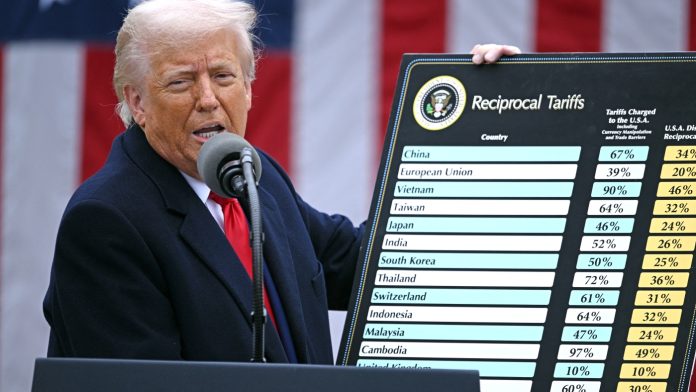
US President Donald Trump holds a chart as he delivers remarks on reciprocal tariffs during an event in the Rose Garden entitled “Make America Wealthy Again” at the White House in Washington, DC, on April 2, 2025.
BRENDAN SMIALOWSKI/AFP via Getty Images/AFP
hide caption
toggle caption
BRENDAN SMIALOWSKI/AFP via Getty Images/AFP
This is an excerpt of the Planet Money newsletter. You can sign up here.
Amid the dizzying trade actions President Trump has taken in recent days, it was easy to miss a remarkable speech the White House released by one of Trump’s top economic advisors, Stephen Miran. In that speech, Miran hinted that the White House might be working to establish a new kind of global economic order that goes beyond just higher tariffs.
As the White House has already made pretty clear, its economic goals include reducing or eliminating America’s trade deficits with foreign countries and boosting domestic manufacturing. Tariffs are one big tool for those goals. But the existing global economic system is built on more than just low tariffs and free trade. It’s built on a special role that the U.S. dollar plays in the global economy. The dollar is the “international reserve currency.” It’s the main currency the world uses to trade and save.
This special role for the dollar can be traced back to 1944. That’s when global financial leaders met at a fancy hotel in Bretton Woods, New Hampshire, and hammered out the details of a new global economic order that would take hold after World War II ended. (For more on the fascinating history of this, read this old Planet Money newsletter and listen to this Planet Money episode).
In this recent speech and previous writings, Miran has complained that — while this special status for the dollar gives benefits to the United States and the global economy — it also strengthens the dollar, making American exports more expensive and U.S. manufacturing less competitive. He has suggested that America basically needs another Bretton Woods-style meeting to reform the international economic system, which would include potentially helping the United States to devalue the dollar or getting the world to compensate the United States for the special role the dollar plays in it. He has dubbed this potential summit the “The Mar-A-Lago Accord.”
Some observers, including Stanford historian Jennifer Burns, believe this idea is actually a primary motivation for Trump’s aggressive tariff policy. That the White House wants to strengthen their hands in negotiations for a grand bargain that serves America’s economy.
Is the special global role for the dollar a privilege or burden?
The reserve currency status of the dollar offers many benefits to the United States. One big one is it gives the United States a financial weapon to sanction other countries, by, for example, cutting their banks off to the flow of dollars or seizing U.S. financial assets, like the U.S. did to Russia after it invaded Ukraine. Because the dollar is the international reserve currency, it’s the lifeblood of trade around the world — even trade that doesn’t involve the United States. Control over the dollar gives the U.S. government a superpower over the global economic system.
Another big benefit of this special role for the dollar is lower interest rates on U.S. debt. People around the world have really wanted dollars and dollar-backed assets like U.S. Treasury bonds, which is how the government issues debt. When we buy stuff from abroad, those countries get dollars, and they need to do something with them. A lot of the time they buy U.S. debt. This mighty global demand for U.S. debt lowers interest rates on it. It’s like the United States has a special, low-interest credit card and can spend like crazy and not face the same financial consequences as other nations. Economists have called this and other benefits the U.S. gets from this system “the exorbitant privilege.”
But in his speech this week, Miran painted the dollar’s reserve currency status as a kind of exorbitant burden. “While it is true that demand for dollars has kept our borrowing rates low, it has also kept currency markets distorted,” Miran said. In particular, with so much global demand for U.S. dollars, the value of the dollar is higher than it would otherwise be. That’s great if you’re an American consumer because foreign imports are relatively cheaper with a stronger dollar, but that’s less great if you’re an American exporter. A stronger dollar means that American exports are more expensive to foreigners.
There’s another sort of weird quirk about having the dollar as the global reserve currency. In what’s known as “the flight to safety,” during times of economic stress, there’s been a tendency for global investors to flee risky assets like stocks and buy “safer” U.S. Treasury bonds. Economists debate whether that’s a good or bad thing, but it means that the dollar tends to strengthen even more during recessions. That’s not great for American exporters, including manufacturers, during hard economic times. (Importantly — and this apparently really scared the White House — during this week’s economic turmoil there was no flight to safety. In fact, there was a flight away from U.S. financial assets. Interest rates on U.S. debt spiked — and people began worrying about a potential financial crisis).
Miran said in his recent speech, the “reserve function of the dollar has caused persistent currency distortions and contributed, along with other countries’ unfair barriers to trade, to unsustainable trade deficits. These trade deficits have decimated our manufacturing sector and many working-class families and their communities, to facilitate non-Americans trading with each other.”
As we’ve covered before in the Planet Money newsletter, Vice President JD Vance has also questioned whether the reserve currency status of the dollar is a privilege or a burden. Last year, when he was a Senator, JD Vance highlighted that the reserve currency status strengthens the value of the dollar. That may be nice for American consumers, who get benefits like cheaper foreign goods and international travel. “But it does come at a cost to American producers,” Vance said. “I think in some ways you can argue that the reserve currency status is a massive subsidy to American consumers but a massive tax on American producers.” This, he suggested, contributes to “our mass consumption of mostly useless imports, on the one hand, and our hollowed-out industrial base on the other hand.”
We spoke with UC Berkeley economist Barry Eichengreen, a leading scholar of international finance and the author of books like Exorbitant Privilege: The Rise and Fall of the Dollar and the Future of the International Monetary System. And we asked him for his perspective on Miran and Vance’s arguments about the costs of the dollar’s special role in the world.
“There is a technical economic term for those arguments: Nonsense,” Eichengreen says.
Yes, Eichengreen says, the dollar is slightly stronger because of its central role it plays in international commerce. “ But that’s like factor number 17 on the list of determinants of U.S. export competitiveness.” There are just so many more important factors determining whether American manufacturing is competitive, like the productivity and wages of U.S. workers, the innovativeness of businesses, the inflation rate, the quality of our machines and equipment, and on and on. The higher value of the dollar due to high international demand to hold it in the existing system “is just way down there in the factors hollowing out — or not hollowing out — our manufacturing sector.”
Eichengreen says that the special role for the dollar on the international stage is “a significant benefit for America.” Sure, he says, economists debate about the size of this benefit. “ But I think there is a broad-based consensus that America is better off having the dollar playing this exceptional role.”
To be clear, President Trump himself has said that the dollar’s reserve status is really important. A month before winning reelection, Trump said in an interview that if the dollar stopped being the reserve currency, America would go to “third-world status.” He continued, “We cannot lose it.” If any country tried to abandon it, he said he’d tell them, “You’re going to pay a 100% tariff on everything you sell into the United States” and force them to abandon those plans.
After taking office, Trump threatened a group of countries known as the “BRICS” group — including Brazil, Russia, India, Iran, China, and South Africa (hence, the acronym) — which has been working to develop an alternative reserve currency to the dollar.
“We are going to require a commitment from these seemingly hostile countries that they will neither create a new BRICS currency, nor back any other currency to replace the mighty U.S. dollar or, they will face 100% Tariffs,” President Trump said on Truth Social in late January. “There is no chance that BRICS will replace the U.S. dollar in international trade, or anywhere else, and any country that tries should say hello to tariffs, and goodbye to America!” he added.
But, as Miran and Vance have highlighted, having the dollar as an international reserve currency also comes with tradeoffs, including potentially a stronger dollar. And Miran and other Trump officials are making a big deal out of the downsides of that tradeoff. How can they have their cake and eat it too?
“The Mar-A-Lago Accord”
Miran has provided a potential roadmap to maintain the dollar as an international reserve currency while attempting to reduce the costs to America for it. And some observers, including Jennifer Burns, believe this plan might help explain why Trump has been so aggressive in raising tariffs on countries around the world.
About a month before President Trump selected Miran to lead his Council of Economic Advisors, Miran published a long essay outlining a series of potential reforms.
One of his big ideas was what he called a “Mar-A-Lago Accord.” The basic idea is to get a bunch of representatives together — like the United States did in Bretton Woods back in 1944 — and rewrite the terms of the global economic system. With this meeting, the United States could get concessions, like helping the United States to devalue the dollar to improve manufacturing competitiveness and reducing America’s debt burden.
In his speech this week, Miran argued that the United States is basically underwriting the global economy with their use of the dollar and also global security with protection from its military. He said it’s time for the world to share in paying for what he views as a large burden.
Miran offered various ideas for countries to pay the United States for these global “public goods” it provides. They can, for instance, “accept tariffs on their exports to the United States without retaliation.” They could buy more from America or invest in factories here. They could even “simply write checks to [the U.S.] Treasury that help us finance global public goods.”
It is unclear that this is all the actual strategy behind Trump’s sprawling tariffs. Some believe there’s no coherent strategy at all. The Trump administration has been throwing the kitchen sink in their arguments justifying their trade actions and different advisors have been saying different things. The rollout of the tariffs has been erratic. U.S. financial markets — including the market for U.S. government bonds — have been freaking out about all of this.
“ I hope that the events of the last few days have reminded everybody in the administration that financial markets have a low tolerance for these kind of ideas more broadly and for erratic changes in policy,” Eichengreen says.
Despite this turmoil and antagonistic global diplomacy, there’s a stickiness to the U.S. dollar as the international reserve currency. Scholars — including Eichengreen — have been warning that the dollar’s special status is in danger for decades. But the world keeps using it. There are tremendous benefits to using the dollar because everyone else is using dollars. And there’s not a ready-to-go alternative.
Plus, Eichengreen says, the U.S. has — until now — been “a good steward” of the dollar and the role it plays in the international economic system. The world has had faith in American institutions. It’s a big reason for the “flight to safety.” But that didn’t happen during this week’s self-imposed financial turmoil. There was an epic stock market downturn, and investors didn’t flock to Treasuries and other U.S. financial assets.
Eichengreen says that interest rates on the bond market have moved for all sorts of potential reasons, including the potential of higher inflation because of the tariffs. He’s wary about reading short-term price movements as telling us something big about the future of the dollar. But, he says, he is definitely more worried these days.
“I’m very much more concerned all of a sudden than I have been in the past,” Eichengreen says. “We have not seen in our lifetimes an effort to blow up the international economic order as we know it. So now we’re in a world where anything that we used to take for granted — and that certainly includes the international role of the dollar — is suddenly in doubt.”
Senator Todd Young on U.S.-China relations
Republican Sen. Todd Young of Indiana speaks with NPR’s Steve Inskeep about a range of China issues, from the administration’s trade war with Beijing to China’s growing advantage in biotechnology.
Beijing slaps 125% tariffs on U.S. goods in latest U.S.-China trade escalation : NPR

People stand outside a brokerage house, as an electronic board displays shares trading, in the Central Business District in Beijing on Thursday.
Andy Wong/AP
hide caption
toggle caption
Andy Wong/AP
BEIJING — China retaliated Friday to higher U.S. tariffs, slapping 125% levies on U.S. goods, but signaled it would apply no further measures in the future.

“If the U.S. continues to increase tariffs on Chinese exports, China will not respond,” China’s Ministry of Finance said in a statement announcing the new levies, in a sign that Chinese authorities see no real upside to any further tit-for-tat measures beyond these.
“Given the current level of tariffs, U.S. goods exported to China are no longer market-viable,” the statement added by way of explanation.
Asian markets closed with a mixed picture on Friday
Asian markets closed with a mixed picture just before the statement was released Friday, as investors struggled to interpret sometimes conflicting signals over the escalating trade war between the world’s two largest economies.
Japan’s Nikkei slumped nearly 3% on Friday, while South Korea’s Kospi fell by 0.5%.
But Taiwan’s composite index jumped nearly 3%, Hong Kong’s Hang Seng Index rose 1.3% and key indices in China also rose slightly.
Early trading on European markets opened largely higher on Friday, but within minutes of the latest announcement from Beijing the major indices in London, Frankfurt and Paris began to move lower, into negative territory.
U.S. futures, which indicate the likely movement of stocks on exchanges including the Nasdaq, S&P 500 and the Dow Jones Industrial Average, also started to fall in the hours ahead of U.S. trading.
The mixed trading day followed losses on Wall Street on Thursday, as the initial optimism surrounding President Trump’s 90-day suspension of higher global tariffs faded.
The “ongoing trade policy volatility” has shaken investors’ and policymakers’ confidence and “will put downward pressure on global activity and investment in the near term, regardless of the outcomes,” analysts at the Australian bank ANZ wrote in a note to clients.

The White House clarified on Thursday that China now faces a tariff rate of 145% on its exports to the United States. That figure includes a preexisting 20% tax on goods and has stoked significant fears — now realized — that the U.S.-China trade spat could further deteriorate.
But some economic and political analysts say the numbers themselves are becoming almost irrelevant at this point.
“Tariffs at 150%, or 45%, or 125% is already probably maxed out. You can increase that to 300%, 1,000% but it’s not really meaningful. The result of having such high tariffs between China and the United States means … China-U.S. trade will come to an abrupt halt in a matter of weeks,” said Victor Gao, with the Beijing-based think tank the Center for China and Globalization.
“I’m afraid at this particular moment, unless the United States demonstrates flexibility and promises to deal with China with decency and dignity, there is really no meaning for any dialogue or negotiation,” he said. “If the United States wants to turn China into an enemy, they will get an enemy.”
In the meantime, China has been seeking to shore up its ties with other regional economic players.
Finance and central bank officials from China, Japan and South Korea recently met to discuss the impact of U.S. tariffs, China’s central bank said in a statement on Friday.
Amid trade war with the U.S., Xi is to visit Southeast Asia
State media also reported that President Xi Jinping will visit Vietnam, Malaysia and Cambodia next week, a possible sign the Chinese leader wants to strengthen ties with Asian trading partners as its relationship with the U.S. fractures.
Several of those Asian nations now face a precarious balancing act though, as they look to maintain relations with Beijing — without incurring the wrath of Washington.
All three countries were slapped with very high U.S. tariffs this month, and all subsequently said they wish to negotiate with the Trump administration — Vietnam even offered to slash tariffs on U.S. imports to its country to zero almost immediately.
But that offer seems not to have satisfied U.S. officials, who have accused the country of allowing Chinese products bound for the U.S. to be routed through Vietnam, thereby helping Chinese manufacturers avoid the steeper levies that currently target Beijing.
Vietnam was facing American tariffs of 46% before Trump’s temporary suspension was announced, and the U.S. had been Vietnam’s biggest export market.

In an effort to see the steeper rates reduced when the suspension ends, Vietnam is now preparing to crack down on Chinese goods being shipped to the U.S. through the country, according to Reuters. It will also tighten controls on sensitive exports to China.
Willem Marx contributed to this report from London.
How DOGE used Social Security data to push dubious fraud claims : NPR
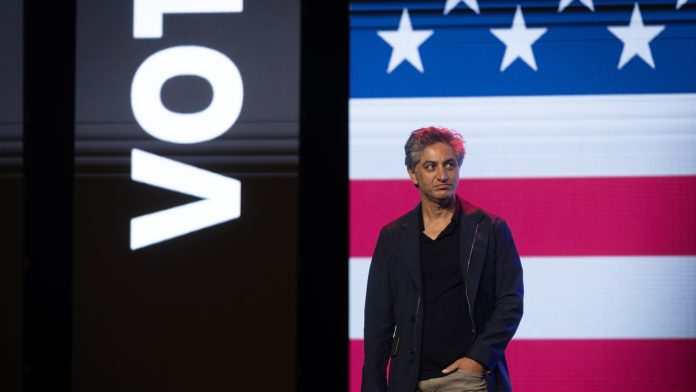
Investor Antonio Gracias at a town hall with Elon Musk in Green Bay, Wis., on March 30. Gracias, who is part of Musk’s Department of Government Efficiency team, has been working at the Social Security Administration.
Scott Olson/Getty Images
hide caption
toggle caption
Scott Olson/Getty Images
One of Elon Musk’s Department of Government Efficiency lieutenants working in the Social Security Administration has been pushing dubious claims about noncitizens voting, apparently using access to data that court records suggest DOGE isn’t supposed to have.
The staffer, Antonio Gracias, made the claims as part of larger misleading statements about the SSA’s enumeration-beyond-entry, or EBE program, which streamlines the process for granting Social Security cards to certain categories of eligible immigrants.
Gracias said in an April 2 appearance on Fox and Friends that “5-plus million” noncitizens who “came to the country as illegals” received Social Security numbers “through an automatic system” and proceeded to “get into our benefit systems.”
“And just because we were curious, we then looked to see if they were on the voter rolls. And we found in a handful of cooperative states that there were thousands of them on the voter rolls and that many of them had voted,” Gracias said.
State-level audits of voter data have found few examples of noncitizens voting, which is a federal crime punishable with prison and deportation.
Later that week, Gracias furthered his claims on a podcast. “I think this was a move to import voters,” he said, echoing a conspiracy theory that Donald Trump and Musk elevated during the 2024 campaign season and Republican lawmakers are invoking to push for stricter voting policies.

While Musk and some Republican lawmakers are now amplifying Gracias’ claims online, experts familiar with Social Security say Gracias is mischaracterizing the program, and voter registration experts say they doubt the accuracy of his claims about noncitizens voting.
From “no access granted” to data shared by Musk
Using Social Security data to imply that noncitizens are breaking the law also could have violated a court order that prevents DOGE staffers from handling sensitive SSA systems.
It’s the latest example of concerns among privacy activists that DOGE’s sweeping access to personal and financial information of millions of Americans may violate privacy laws and may be used for inappropriate purposes.

Gracias, the billionaire chief executive officer and chief investment officer of Valor Equity Partners, is one of 10 DOGE staffers embedded in the Social Security Administration. That description matches “Employee 4” in court records filed Wednesday in a case challenging DOGE access to sensitive SSA systems.
A description of Gracias’ scope of work in his role with DOGE notes that he is tasked with work on death data and reducing improper payments and that “security controls will be implemented to prevent detailee from accessing or viewing sensitive data” within the agency’s payment files and master Social Security databases.
It does not mention his analysis of how noncitizens are given Social Security numbers. Gracias is also not supposed to see or share personally identifiable information, or PII, within agency data, according to earlier court filings.
“Appointee shall not share any Personally Identifiable Information accessed or obtained through the use of SSA systems or work performed for SSA, with any external entity, organization, or agency federal or state,” an addendum to his appointment request reads.

A sign in front of the entrance of the Social Security Administration’s main campus in Woodlawn, Md.
Kayla Bartkowski/Getty Images
hide caption
toggle caption
Kayla Bartkowski/Getty Images
In a March 12 declaration from the SSA’s then-Chief Information Officer Michael Russo, Gracias is one of two SSA DOGE employees listed as not having access to sensitive databases or PII.
“No SSA data or personally identifiable information access, or access to systems containing such information, has been granted to Employee 6 and Employee 4,” the document reads. Employee 6, listed in the record as a “Growth Equity Vice President,” appears to be Jon Koval, an associate of Gracias at his venture capital firm, who is also detailed to DOGE.
A third Valor employee, Payton Rehling, appears to be the “Senior Associate, Data Engineer” listed as Employee 9 in court records who was given access to a production copy of PII from several SSA databases starting March 4.
On March 20, a federal judge in Maryland issued a temporary restraining order blocking DOGE employees from accessing SSA data. Gracias first publicized his claims alongside Musk at a rally in Wisconsin on March 30, ahead of the state’s special Supreme Court election.
A federal appeals court dismissed the Trump administration’s effort to lift that temporary restraining order April 1.
A few days after his Fox News interview on April 2, Gracias joined the All-In podcast on April 4 and offered more details on the data he says he used and the conclusions he drew, which has been subsequently shared by conservative media outlets and amplified by Musk on his social media site X for several days.
In court documents filed Monday, lawyers for the government reiterated the earlier claim that Gracias never had access to SSA data or personally identifiable information and did not list Gracias — or examination of the EBE program — in its explanation of which DOGE staffers it said needed access to sensitive data for proposed projects.
Neither Gracias nor a DOGE spokesperson responded to NPR’s questions about when and how any Social Security data was accessed and whether it complied with the court order.
NPR reached out to Social Security and initially spoke to acting press officer Nicole Tiggemann. In a subsequent email from a generic press account, the agency declined to answer detailed questions about DOGE’s data access. It did confirm that a chart Gracias publicized showing totals of noncitizens with Social Security numbers through EBE was taken from an SSA dashboard — but claimed that the restraining order prevented them from responding to NPR’s request for additional data from the program. The agency did not respond to inquiries asking to confirm who gave the emailed answer.
That leaves many questions still unanswered about the Social Security data behind DOGE’s claims. It’s possible the analysis was conducted before the March 20 TRO or that Gracias is not the DOGE employee who accessed any personal Social Security information. So far, there has been no evidence provided of any states sharing public or private voter data with the DOGE team at SSA either.
It’s also possible that the data about noncitizens comes from non-DOGE activities. The judge overseeing the case wrote on March 21 that the TRO only applies to “SSA employees working on the DOGE agenda. It has no bearing on ordinary operations at SSA.”
One clue about the data’s potential provenance comes from this week’s court filing: a March 17 email exchange from someone identified as Employee 7 who copied Gracias and Koval on a request for access to the U.S. Citizenship and Immigration Services’ Systematic Alien Verification for Entitlements program, which SSA uses to verify the immigration status of EBE applicants.
“This access is absolutely critical to get detailed immigration status for non-citizen SSNs to detect fraud and improper payments,” the email reads.

Employee 7 appears to be DOGE staffer Marko Elez, who resigned from his post at the Treasury Department over past racist tweets — and who shared a spreadsheet of personal information in violation of data-sharing policies, an audit found — before being rehired at multiple federal agencies.
That includes the Labor Department and Health and Human Services Department, where a different court case revealed Elez was granted access to new hire data through the Office of Child Support Services. The SSA lawsuit documents say Employee 7 is a Labor employee detailed to SSA who obtained access to new hire data through the Office of Child Support Services.

Questions about DOGE’s data on noncitizens
Gracias puts the EBE program at the center of his account about how his team decided to check voter rolls. The program started in 2017 during the first Trump administration but grew dramatically under the Biden administration, which allowed millions of asylum-seekers to enter the U.S. and expanded the categories of immigrants who could stay on a temporary basis.
Until recently, under the EBE program, noncitizens applying for work permits, green cards or naturalization with U.S. Citizenship and Immigration Services could apply for Social Security cards without visiting a field office. The Washington Post and other outlets reported that the EBE program was paused in mid-March, citing an internal email. NPR has not independently confirmed the reporting.

A sign directs voters to cast their ballots at a polling station set up at the Flagler County Public Library on April 1 in Palm Coast, Fla. People associated with DOGE are using Social Security data to advance debunked claims that large numbers of noncitizens are voting.
Joe Raedle/Getty Images
hide caption
toggle caption
Joe Raedle/Getty Images
Lawfully present immigrants who are authorized to work get Social Security numbers to ensure they are “paying their taxes into the Social Security trust funds as required by law,” said Kathleen Romig, director of Social Security and disability policy at the liberal-leaning Center on Budget and Policy Priorities.
Since immigrants in the process of naturalizing could use the EBE program, those individuals could be expected to appear on voter rolls once they became U.S. citizens.
It remains unclear which state records the DOGE team checked for noncitizens. On the All-In podcast, Gracias described checking the public voter rolls of four “friendly” states to find noncitizens on the rolls. He then said “we went even further with those friendly states and found that many of those people had actually voted.”
Later in the program, he said “well over a thousand voted” in one state. He has said his team has referred those cases for federal prosecution. In the same unsigned email, the unnamed SSA spokesperson declined to respond to NPR’s questions about the inquiry into individuals who allegedly were identified as illegal voters using Social Security data, citing “ongoing criminal investigations on this matter.”
But voting experts say the data cross-checking Gracias describes raises legal questions and can be prone to many kinds of errors.
“There are huge accuracy questions here,” said Charles Stewart, the director of MIT’s Election Data and Science Lab.
Typically, states’ public voter rolls would not include Social Security numbers, which would make data matching far less precise. There are known issues with false matches when just using names and birthdays.
Furthermore, it is common for states to find voters who have since naturalized and become citizens when cross-checking databases of noncitizens against their voter rolls.
“DOGE has repeatedly made massive data errors,” said David Bier, the director of immigration studies at the libertarian Cato Institute. “I have some doubts that they’ve discovered anything more than maybe just some poor government data quality tracking or they don’t understand the data they’re looking at.”
It’s also not clear if the DOGE effort to combine Social Security data with other sources inside and outside the federal government runs afoul of data sharing and privacy laws that are designed to limit access to sensitive information to those who have a need to use it.
“The use has to be consistent with the reason that you’re asking for the records in the first place, which has to be consistent with your own agency’s mission,” said Justin Levitt, a law professor at Loyola Law School and a voting policy adviser in the Biden administration. “‘Because I’m curious’ is not a thing when the federal government comes to data.”

President Trump signs an executive order in the Oval Office of the White House in Washington, D.C., on March 6.
Mandel Ngan/AFP via Getty Images
hide caption
toggle caption
Mandel Ngan/AFP via Getty Images
Gracias appeared to attribute some of his team’s access to an executive order signed by the president last month that directs agencies to facilitate “both the intra- and inter-agency sharing” of records.
“President Trump had the courage to allow us to go across databases, he signed an executive order,” he said on Fox News. “It’s never been done before where agencies could talk to each other and databases can talk to each other. That allowed us to connect all this data to find these people across the system, across the benefits system, all the way to the voting records.”
Another executive order, “Preserving and Protecting the Integrity of American Elections,” directs the Department of Homeland Security and DOGE to “review each State’s publicly available voter registration list” among other requests, similar to Gracias’ effort at SSA.
Both presidential actions include the caveat that any sharing must occur “consistent with law.”
The latest in DOGE data concerns
Multiple federal judges have found the DOGE effort has likely broken the law in its effort to comb through agencies to find “waste, fraud and abuse.” Court records have also shown the Trump administration is unable to account for the scope of DOGE’s data access, or the need for a small number of staffers to have virtually unfettered access to sensitive, compartmentalized data across the government.
The claims made by Gracias and Musk about Social Security data underscores growing questions around how DOGE is using the data it has gathered. In a ruling blocking DOGE access to Treasury systems, Judge Jeannette Vargas warned that “a real possibility exists that sensitive information has already been shared outside of the Treasury Department, in potential violation of federal law.”
Additionally, DOGE has at times overstated savings claims from canceling contracts, terminating federal office leases and the reshaping of the federal workforce and has not found evidence of fraud.

But Gracias’ latest claims about noncitizens voting continues to have an impact on policy in the Trump administration and with the Republican-controlled Congress. During Thursday’s House debate over the SAVE Act, Rep. Aaron Bean, R-Fla., mentioned DOGE’s allegations and the claim that the Biden administration had “imported” noncitizens as a reason to pass the bill.
“We have evidence that they’re participating in our elections,” Bean said. “The DOGE team just announced millions of illegals now have Social Security numbers. It’s happening and it ends today when we vote on this SAVE Act.”
Have information you want to share about DOGE access to government databases, Social Security, immigration and IT systems? Reach out to these authors through encrypted communication on Signal. Stephen Fowler is at stphnfwlr.25, and Jude Joffe-Block is at JudeJB.10.