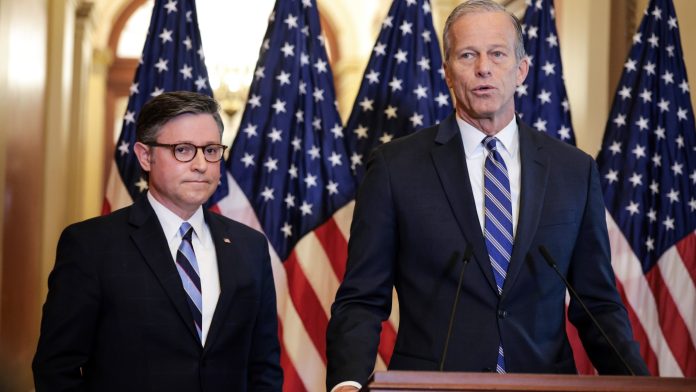
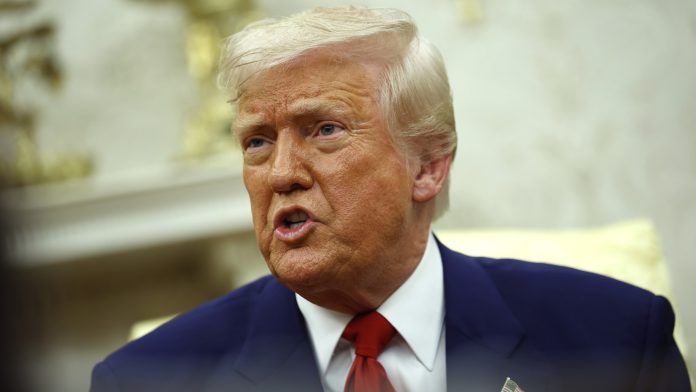
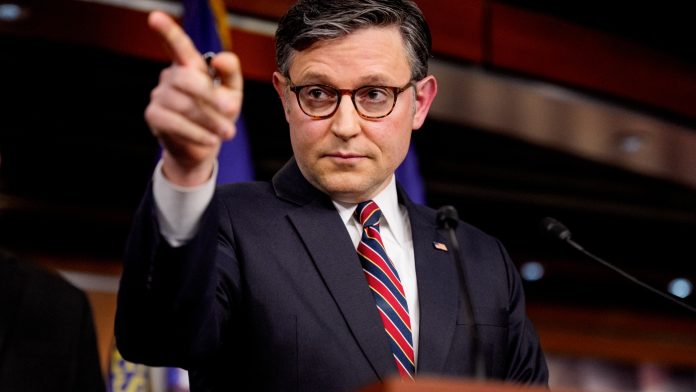
Senate Majority Leader John Thune (R-SD) (R) and Speaker of the House Mike Johnson (R-LA) held a press conference on the Republican budget bill on April 10. (Photo by Kayla Bartkowski/Getty Images)
Kayla Bartkowski/Getty Images/Getty Images North America
hide caption
toggle caption
Kayla Bartkowski/Getty Images/Getty Images North America
House Republicans have approved a multitrillion budget framework that allows the party to begin the process of drafting legislation to enact key elements of President Trump’s domestic policy agenda – including tax cuts and spending on defense, energy and immigration policy.
The budget blueprint was approved Thursday by a vote of 216 to 214. Ultimately, two Republicans voted no. The vote is a victory for Trump and other Republican leaders who spent days convincing fiscal hawks within the Republican party to vote for the bill despite their frustration over the level of spending cuts included in the Senate version of the plan that passed on Saturday. The Senate framework outlines only about $4 billion in spending cuts. The House version seeks at least $1.5 trillion.
Now that Republicans have passed identical versions of the framework in the House and Senate, they are able to unlock a special budget tool known as reconciliation – a complicated process that allows them to avoid a filibuster in Senate and pass a final version of the legislation with a 51-vote simple majority.
Budget framework passes after intraparty drama that is likely to persist
The final vote came after House GOP leaders delayed a scheduled vote Wednesday night because of dissent from conservative hardliners concerned that approving the Senate amendment would prevent them from achieving the level of spending cuts they want in the final bill.
The vote allows Congressional Republicans to unlock a budget tool called reconciliation, which enables the Senate to bypass a filibuster tied to Democratic opposition and instead pass the final bill with a simple majority. Both chambers passing the same budget resolution is just an early step in a lengthy process that will require intense negotiations from both chambers as they now get to work on the final legislative product.
Senate Majority Leader John Thune, R-S.D., and House Speaker Mike Johnson, R-La., gave a brief press conference ahead of the House vote, emphasizing unity despite months of daylight between the chambers over the scope of spending cuts.
“Our two chambers are directly aligned also on a very important principle, and that is the principle of fiscal responsibility,” Johnson said. “We are committed to finding at least $1.5 trillion in savings for the American people while also preserving our essential programs.”
He added: “I’m very happy to have our our partners in the Senate working so closely with us as one team, one unified team, which is very important for us to deliver on all these objectives.”
Thune said they are aligned on making the 2017 tax cuts permanent and to secure significant spending cuts.
“We have got to do something to get the country on a more sustainable fiscal path,” he said. “The speaker’s talked about one and a half trillion dollars. We have a lot of United States senators who believe that as a minimum. And we’re certainly will do everything we can to be as aggressive as possible to see that we are serious about the matter, not only of making our federal government more fiscally sustainable, but also deficit reduction.”
Lefty O’Doul shakes hands with Crown Prince Akihito (at that time future emperor, now abdicated emperor) during the 1949 SF Seals Goodwill Tour to Japan during the Allied occupation.
David M. Dempsey (owner of photo, Japanese photographer unknown)/Yuriko Gamo Romer, Diamond Diplomacy
hide caption
toggle caption
David M. Dempsey (owner of photo, Japanese photographer unknown)/Yuriko Gamo Romer, Diamond Diplomacy
At their core, the humanities are all about what makes us human — like language, religion, philosophy, history, art, community, and identity.
In practical terms, grants from the National Endowment for the Humanities (NEH) have funded historical preservation, museums, literary festivals, media projects and community-based research. Examples include Ken Burns’ film The Civil War and the Lower East Side Tenement Museum, as well as efforts to save the Tlingit language and to mark the Mississippi Blues Trail.
Funding the future, from AI to community colleges
“The humanities help us understand the human experience in the past and today in order to frame it and shape it for the future,” said Lauren Tilton, a professor of digital humanities at the University of Richmond.
Last year, a project she manages received a grant of $491,863 for the Center for Liberal Arts and AI (CLAAI) at the University of Richmond, as part of the NEH’s Humanities Perspectives on Artificial Intelligence initiative.
The center would be the nexus for 15 colleges across the southeast aiming to study “how we understand and develop AI because AI is affecting all parts of our lives. How do we want to design AI? What do we want it to do? What do we not want it to do and how does it impact people and communities?” Tilton said.
After working on the project for two years, her group expected to launch the Center for Liberal Arts and AI this fall. Then, last week, she got a letter stating that NEH funds for her project were terminated effective immediately. More than a thousand grants befell the same fate in rural and urban areas in all 50 states.
“It was incredibly painful to read,” said Tilton.
The letter stated, in part, that the agency was “repurposing its funding allocations in a new direction in furtherance of President Trump’s agenda.”
Tilton said she believes the AI center would further President Trump’s agenda, pointing to his executive orders related to AI. “So now we’re defunding the very area and research and teaching that is supposed to be central to the future of our nation,” she said.
As for what now, Tilton said the schools involved are looking to private philanthropy for funding. “We’re moving forward. But the shifts in funding really slows us down,” she said.
Making grants more accessible
Neither the White House nor the NEH responded to NPR’s requests for comment.
Critics of federal funding for arts and culture have argued that taxpayers shouldn’t pay for highbrow museums, theaters and other institutions that don’t serve everyday Americans.
“Since art museums, symphony orchestras, humanities scholarship, and public television and radio are enjoyed predominantly by people of greater-than-average income and education,” writes the libertarian think tank Cato Institute in its Handbook for Policy Makers, “the federal cultural agencies oversee a fundamentally unfair transfer of wealth from the lower classes up.”
Yet both the arts and humanities endowments have awarded millions of dollars in grants that prioritize underserved communities across the U.S. They include the NEH’s Cultural and Community Resilience grant program, which supported efforts to safeguard cultural resources from the effects of climate change and the NEA’s Challenge America, which primarily supported small arts organizations. The future of both of those initiatives is unclear. Challenge America has been “canceled for FY 2026” and Cultural and Community Resilience is “not being reoffered,” according to the agencies’ websites.
Making grants more accessible
R. Chris Davis is a history professor at Lone Star College which has campuses throughout the Houston area. He was thrilled to learn about the Humanities Initiatives at Community Colleges, a grant program the NEH launched in 2015.
“It’s an opportunity for faculty to explore ideas, initiatives, professional development, and create course content for students at these oftentimes underserved institutions,” he said.
Last spring, Lone Star College-Online received a $150,000 NEH grant for Davis to develop customized courses that would teach history through the lens of different “thematic tracks” such as technology, culture, sports or medicine. Davis said the idea came after surveying students about what would make them more engaged in history.
R. Chris Davis, a history professor at Lone Star College, a community college with campuses in Houston, on April 16, 2019.
Diana Sorensen/R. Chris Davis, Lone Star College
hide caption
toggle caption
Diana Sorensen/R. Chris Davis, Lone Star College
Davis said students could supplement their regular course content with topics “geared more toward their interests.”
Now, with the grant terminated, the project is “in limbo.” Davis said he’s mostly disappointed for his students.
“Many of our students are working full time. They’re caretakers of parents or their own kids,” he said. “So anything we can do to help them be more successful, make their college career more interesting, improve not just success rates, but retention rates. You know, this was an idea to help foster that.”
Getting an NEH grant is like scoring a home run
It is no small feat to receive a Humanities endowment grant. The competition is stiff. In most cases applicants must have a proven track record, describe their proposals and budgets in detail, enlist academic consultants and show how they will measure impact.
“It was a huge honor to be awarded a National Endowment for Humanities grant last year,” said filmmaker Yuriko Romer. “And now for this to happen is just heartbreaking.”
Yuriko Gamo Romer was awarded a grant from the NEH for her documentary Diamond Diplomacy.
YouTube
Last August, Romer was awarded a grant for Diamond Diplomacy, a documentary tracing the history of U.S.-Japan relations through the lens of baseball. “I was originally awarded $600,000 for my documentary and the remaining balance sits at $342,598,” she said.
Romer started working on Diamond Diplomacy about 10 years ago “because it’s taken me that long to raise the money to make this film.”
She said she’s employed about 14 people to help with production, research, accessing archival material and more. There are plans to screen the documentary at the National Baseball Hall of Fame in Cooperstown, New York, at the end of May.
Romer said she’s on the homestretch to finish the film but in order to pay for expenses and compensate her crew, she’s “going to have to cobble together some more funding at this point.”
Romer said losing the remainder of her NEH grant is discouraging — that making documentaries is a tough business. “None of us do this to make money,” she said. “We’re all passionate about the stories that we want to tell.”
Facing pressure from world markets, President Trump stepped back from his plans to slap steep tariffs on a broad range of countries — except for China.
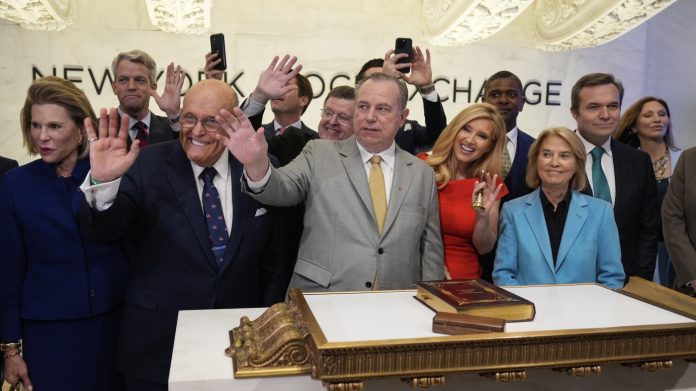
Newsmax CEO Christopher Ruddy, center, and former New York Mayor Rudy Giuliani, center left, celebrate the conservative network’s initial public offering on the floor of the New York Stock Exchange on April 3.
Seth Wenig/AP/AP
hide caption
toggle caption
Seth Wenig/AP/AP
A Delaware judge, once again, has found that a conservative news outlet broadcast false and defamatory claims about the role a voting technology company played in the 2020 presidential election. This time, that network is Newsmax, Fox News’ upstart rival, which is fresh off a successful initial public offering.
Following Joe Biden’s victory over Donald Trump that November, Trump’s allies and supporters took to right-wing media to accuse Dominion Voting Systems of rigging the vote to help Biden.
In his opinion, Judge Eric M. Davis says Dominion “presents clear and convincing evidence” that shows Newsmax broadcast segments with inaccurate information that “would likely cause reasonable viewers to think significantly less favorably about Dominion than if the viewers knew the truth.” He also noted that Newsmax’s “clarification” posted in mid-December 2020 about a lack of evidence of voter fraud showed that Newsmax “acknowledged the falsity” of several lies regarding Dominion and the election.
If the lawsuit heads to trial as scheduled later this month, the jury will be asked to decide whether to award damages and how much, and whether the broadcasts were aired with “actual malice,” which means knowledge of falsity or disregard for the truth.
Wednesday’s ruling was another win for Dominion from the same judge who presided over a similar defamation lawsuit the voting tech company brought against Fox News. That case, also linked to false claims of rigging the 2020 election, resulted in a $787.5 million settlement on the eve of trial.
In a statement, Newsmax said it covered the issue fairly and never defamed Dominion.
“This case represents a serious threat to free speech and a free press and Newsmax will defend itself vigorously at trial,” the statement read.
The ruling caps an extraordinary rollercoaster for Newsmax and its founder and CEO, Chris Ruddy. On March 21, Ruddy was sitting front row in the Delaware courtroom, listening intently as Dominion lawyers tried to personally hold him and other key executives liable in the case.
Just a few days later, Ruddy would be on the phone with President Trump, drumming up excitement for Newsmax’s impending public launch.
By the following week, Ruddy would reportedly become a billionaire, as Newsmax stocks soared over 1,000% in the hours after its initial public offering. Ruddy and his team, joined by other notable figures like Trump’s former lawyer Rudy Giuliani, even rang the opening bell at the New York Stock Exchange (albeit on the same day stocks plunged the farthest since the beginning of the Covid pandemic). Within a week of going public, Newsmax also announced a standby purchase agreement with Yorkville Advisors for up to $1.2 billion.
In Dominion’s case against Newsmax, which is set to go to trial on April 28, Davis has ruled that the at-issue broadcasts falsely accused Dominion of being affiliated with the late Venezuelan dictator Hugo Chavez and participating in crimes such as rigging elections in the U.S. and abroad. Dominion’s lawyers have argued in court that the company is facing a “slow death” as new customers dry up and contracts aren’t renewed.
The jury will be asked to decide what, if any, damages Dominion absorbed because of the Newsmax broadcasts and whether those segments were broadcast with “reckless disregard” for the truth.
Davis has also allowed Dominion to add Newsmax Broadcasting LLC, a subsidiary of Newsmax Media, Inc., to the lawsuit. In an “11th hour” legal strategy, the Newsmax legal team attempted to argue — supported by a late affidavit provided by Ruddy — that Dominion was suing the wrong company altogether.
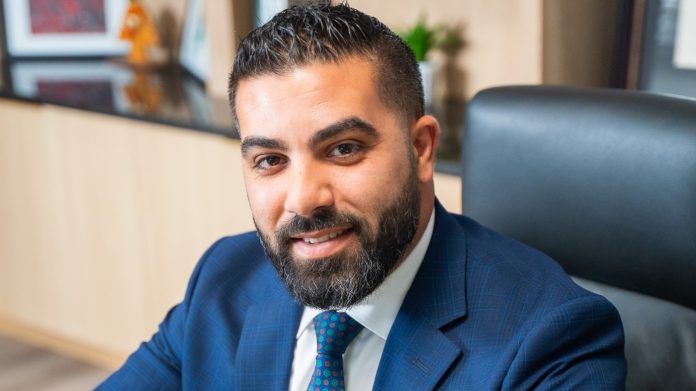
Amir Makled is a Michigan-based attorney who was detained by federal agents when returning to the U.S. from a family vacation.
Amir Makled/
hide caption
toggle caption
Amir Makled/
Earlier this week, Michigan-based attorney Amir Makled was detained by federal immigration agents while returning home from a family vacation to the Dominican Republic.
On Sunday at the Detroit Metro Airport, Makled — who is a U.S. citizen — attempted to pass through customs with his wife and children. The rest of his family was able to enter the country without issue. But when Makled’s turn came, he overheard one of the agents call for assistance from the “Tactical Terrorism Response Team.”
“My heart fell into my stomach at that point, I was so concerned and worried,” Makled told NPR.
Border agents pressured Makled to hand over his cell phone. He refused. After more than 90 minutes of back-and-forth, he eventually showed agents his contacts list. He was eventually released. Makled says he was never given a reason for his detainment.
However, one of his current clients is a student who has been charged in connection to a pro-Palestinian protest at the University of Michigan.
Makled does not think it’s a coincidence that he was targeted after deciding to represent this client following the Trump administration’s crackdown on visa holders who have expressed support for Palestine.
“The purpose of searching my phone doesn’t have anything to do with terrorism, there is only a chilling effect, and it’s done to be intimidating.”
NPR reached out to Customs and Border Protection, but has not yet received a response.
Makled sat down with All Things Considered host Juana Summers to describe his experience.
This interview has been lightly edited for length and clarity.
Interview Highlights
Juana Summers: Did you have any sense of why they wanted to see your phone? What did they tell you?
Amir Makled: Well, it was apparent to me at that point that they’d already done their homework about me before I arrived because they knew that I was taking on some some cases. [The agent] knew who I was and he knew where I was coming from. And he knew I was an attorney. So it wasn’t a random selection. They were prepared to talk to me and discuss things with me. And he was adamant that he wanted to see my phone.
Summers: What did you do then? Did you give him your phone?
Makled: No. At that point I said, ‘Listen, you know that I’m attorney. Everything in my phone could be privileged information. I have emails that go back over ten years. I have text messages with clients. I have all my court filings, and my office filings are in my cloud, which is available on my phone. You’re not getting full and unfettered access to my device. It’s not going to happen.’ And so that puzzled this agent and he had to go to a supervisor. Supervisor comes back and says, ‘Here’s a legal pad, here’s a pen. Write down everything that you believe is privileged. We won’t go through that.’ I looked at him with astonishment. How do you expect me to go through ten years or more of information that’s in my device and say, ‘This is privileged and this isn’t.’ It was a ridiculous conversation.
Summers: A CBP spokesman named Hilton Beckham told the Detroit Free Press, which you spoke to, that searches of electronic media have not gone up during the Trump administration. And “allegations that political beliefs trigger inspections or removals are baseless and irresponsible.” Your response?
Makled: I say to them, ‘What was the purpose of searching my device then?’ If you know that there’s there’s no probable cause, there’s no warrant, there’s no concern that I’m a threat to national security or anything of that nature? The purpose of searching my phone doesn’t have anything to do with terrorism, there’s only a chilling effect, and it’s done to be intimidating, in my opinion, for the causes that I was engaging in. I’m standing up for students. I’m standing up for immigrants and political dissenters. And I think this was a way to try to dissuade me from taking on these types of cases.
Summers: If this is part of a much broader effort to intimidate lawyers who work whose work runs counter to administration priorities. I want to ask you in the minute or so that we have left, is this working?
Makled: No, I think it’s doing the opposite effect. The outpouring of support that I have received from members of the Bar Association, not just in Michigan but nationally, and members of the community, is a showing that people are offended by this type of conduct. This is not what America is all about. We are a nation of laws. We have protections. We have amendments, the Fourth Amendment included, of your right to privacy, which includes not having your personal facts and papers searched. And it’s setting a terrifying precedent if government agents can target a lawyer at the border. What’s stopping them from doing it to anyone who dares to speak out?
Coffee is among the products that will be affected by President Trump’s tariffs.
Angela Weiss/AFP via Getty Images
hide caption
toggle caption
Angela Weiss/AFP via Getty Images
Coffee is among the products that will be affected by President Trump’s tariffs.
Angela Weiss/AFP via Getty Images
After a week of market turmoil, President Trump announced he would reset his most extreme tariffs to 10 percent across the board, with the exception of China — which he boosted to a 125% tariff rate. Even at the reduced level, the tariff rates are the highest the nation has seen in many decades.
And higher tariffs translate to higher prices for American consumers. Martha Gimbel of the Budget Lab at Yale takes an imaginary walk through a big box store to look at how much more people might pay for t-shirts, rice, medication and other staples.
For sponsor-free episodes of Consider This, sign up for Consider This+ via Apple Podcasts or at plus.npr.org.
This episode was produced by Erika Ryan and Connor Donevan, with audio engineering by Simon-Laslo Janssen. It was edited by Christopher Intagliata. Our executive producer is Sami Yenigun.
President Trump has promised to carry out the largest deportation program in U.S. history. Some Republicans worry about political backlash, especially in swing districts with immigrant populations.
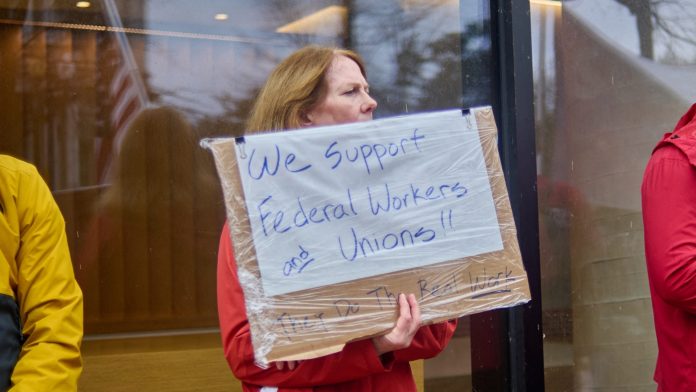
Public sectors unions are among the plaintiffs who have sued the Trump administration over the firings of probationary employees.
Dominic Gwinn/AFP via Getty
hide caption
toggle caption
Dominic Gwinn/AFP via Getty
In a win for President Trump, a panel of judges on the Fourth Circuit Court of Appeals has vacated a lower court ruling ordering 20 federal agencies to reinstate tens of thousands of employees they had fired.
The decision further clears the way for the Trump administration to re-fire, for now, probationary employees. Those are typically federal workers in their first or second year on the job, or who have been recently promoted into new roles.
In a 2-to-1 decision, the appeals court said the Trump administration was likely to succeed in showing that the lower court lacked jurisdiction in the case, which was brought by 19 states and the District of Columbia. The court did not rule on whether the probationary firings were lawful. It’s expected to consider the merits of the case in coming weeks.
The ruling comes a day after the Supreme Court vacated a different lower court ruling that ordered six federal agencies to bring fired employees back to work.
In an unsigned decision, the Supreme Court said the nonprofits that brought that case likewise lacked standing. The justices also did not rule on whether the firings were lawful. The Ninth Circuit Court of Appeals will consider the merits of that case in coming weeks.
The two decisions represent a significant setback for the states, the unions and the civic organizations that had sued the government in an effort to block the summary firings of more than 24,000 federal workers.
After initial wins in the lower courts, fired probationary employees are largely back where they started before the lawsuits were filed — save for thousands of Department of Agriculture employees who have been reinstated through April 18 by order of the Merit Systems Protect Board, a federal agency that considers employees’ workplace claims.
It’s unclear how quickly agencies might move to re-fire probationary employees. The vast majority have been reinstated at least to paid-leave status — and many to full duty status. The government has decried the process as costly and time-consuming.
The rulings come as the Trump administration has been pursuing other ways of downsizing the federal workforce.
A growing number of agencies have reopened their deferred resignation offers — allowing employees to resign now but keep their pay and benefits through September. Some recently reinstated probationary employees have accepted those offers, though others may have still been considering the option when these decisions came down.
Agencies have also begun rolling out their reorganization plans, outlining where they are planning mass layoffs, as directed by the Trump administration. The civil service rules governing reductions in force generally disadvantage employees with shorter tenure in the government. Probationary employees may be among the first to go, though they too must be given proper notice. At some agencies, that’s already happening.
The Department of Health and Human Services noted in a status report provided in the states’ case that more than 300 of the 2400 probationary workers it had reinstated had been issued termination notices under the agency’s pending reorganization.
President Trump answers a reporter’s question in the Oval Office on Monday. On Wednesday, the president said he was hiking reciprocal tariffs against China to 125%.
Kevin Dietsch/Getty Images
hide caption
toggle caption
Kevin Dietsch/Getty Images
President Trump on Wednesday said on social media that he would pause tariffs on most countries for 90 days but would immediately hike tariffs on China to 125%.
White House press secretary Karoline Leavitt told reporters at the White House that tariffs would be brought down to a “universal 10%” level during the 90-day pause, aside from China.
Treasury Secretary Scott Bessent told reporters, “It took great courage — great courage — for him [Trump] to stay the course until this moment.”
Bessent said China was the “biggest source” of trade issues for the United States and the rest of the world.
“I’m not calling it a trade war, but I’m saying that China has escalated, and President Trump responded very courageously to that, and we are going to work on a solution with the our trading partners,” he said.
Treasury Secretary Scott Bessent speaks to the press outside the West Wing of the White House on Wednesday about President Trump’s decision to pause tariffs on U.S. trading partners, but not for China.
Saul Loeb/AFP via Getty Images
hide caption
toggle caption
Saul Loeb/AFP via Getty Images
Bessent said the decision to pause tariffs was not made because of the sharp decline in the stock market, insisting the pause was needed to come to “bespoke” trade arrangements with other countries.
“It is going to take some time, and President Trump wants to be personally involved. So that’s why we’re getting the 90-day pause,” he said.
Bessent said that a range of issues would be on the table during talks with other countries, including liquefied natural gas (LNG) deals, non-tariff trade barriers, currency policies and subsidies. He said he has a meeting with Vietnamese officials today.
“These are complicated negotiations. These are imbalances that have taken decades to create,” he said.
Bessent told reporters that Trump had made his decision on Sunday. “This was driven by the president’s strategy. He and I had a long talk on Sunday, and this was his strategy all along.”
House Speaker Mike Johnson, R-La., is preparing to hold a vote on a budget resolution meant to advance many of President Trump’s policies, despite continued opposition from within his own party.
Andrew Harnik/Getty Images North America
hide caption
toggle caption
Andrew Harnik/Getty Images North America
House Republican leaders are pushing forward Wednesday with a vote on a budget framework meant to advance much of President Trump’s domestic agenda, despite opposition that threatens to derail the bill.
Fiscal hawks within the House GOP raised alarm over limited cuts to the federal deficit and other issues in the Senate-passed plan, which left the fate of the bill unclear. But Trump ramped up pressure to pass the bill on Tuesday, triggering House Republican leaders to roll the dice on a framework for the multi-trillion plan of new tax, immigration, defense and energy policy.
“Just in case there are a couple of Republicans [not] there: you just gotta get there, close your eyes and get there,” Trump urged at a National Republican Congressional Committee dinner on Tuesday night. “It’s a phenomenal bill. Stop grandstanding. Just stop grandstanding!”
Republicans are working toward a plan that they hope will become a hallmark of Trump’s second term, including a tax overhaul, a flurry of new policies revamping immigration and other top GOP priorities. First, House and Senate Republicans need to pass identical versions of a budget resolution to get access to reconciliation, a feature of the budget process that bypasses a Senate filibuster tied to Democratic opposition.
House Speaker Mike Johnson, R-La., can only afford to lose three votes for the bill to pass. So far, two hard-line conservatives— South Carolina Rep. Ralph Norman and Texas Rep. Chip Roy— already announced in the rules committee they would vote against the measure on the floor.
During a House Rules Committee meeting Wednesday morning, top panel Democratic Rep. Jim McGovern, D-Mass., quoted several House Republicans publicly trashing the Senate plan. He argued he’d add more orders to Trump’s demand to vote for the blueprint anyways.
“Close your ears, cover your ears and hide your calculators,” McGovern said. “He wants all of you guys to close your eyes and kiss his ass.”
House and Senate Republicans remain trillions of dollars apart in expectations of how much should be cut from the federal budget in this process, triggering an intense intraparty divide.
The Senate plan, which was passed early Saturday after a late night session, directs only about $4 billion in the federal deficit cuts. That falls dramatically short of minimum $1.5 trillion reductions in the House version.
The divide put House Budget Committee Chair Jodey Arrington, R-Texas, in an awkward position, seemingly testifying for and against the plan in a House Rules Committee hearing on the framework.
“It’s critical that the reconciliation bill be guided by the House’s resolution framework, otherwise we do risk adding trillions of dollars to the national debt,” he told the panel.
House Rules Committee Chair Virginia Foxx, R-N.C., called the naysaying “scare tactics.”
Tariff messaging also on the line
House Republicans also added a provision to a necessary procedural step that would essentially ban any vote to roll back Trump’s tariffs for the next six months. The language was included in the measure setting rules for debating the legislation. That measure must pass before the House can move ahead with the underlying budget bill.
Democrats attempted to remove the provision in committee but were voted down.
The decision to add the tariff language to the rule fueled Democrats’ attacks on GOP members backing the bill. Top Democrats vowed to hammer swing district Republicans in the midterms for going on the record backing Trump’s economic policies.
CJ Warnke, Communications Director of the House Democrats’ Super PAC, known as House Majority PAC or HMP, confirmed the plan in a written statement to NPR.
“House Republicans will today vote to tank the economy, destroy retirement savings, lay off workers, and raise prices,” Warnke wrote. “HMP thanks them for writing our ads for us.”
Republicans still hope to move ahead
Republicans are hoping to bridge the divide by highlighting the areas where they do agree. Both plans would raise the U.S. debt limit by $5 trillion, which would avert a potentially catastrophic default this summer.
Senate and House Republicans also direct similar levels of new funding to a range of GOP policy priorities, including U.S. border enforcement, immigration initiatives and defense spending.
Republicans also agree they’d like to extend the Tax Cuts and Jobs Act passed in 2017 under Trump’s first term. However, the cost of extending those cuts is closely tied to fiscal hawks’ concerns. The independent, non-partisan tax analysis arm of Congress, Joint Committee on Taxation, has estimated extending the cuts could cost more than $4 trillion. But there is a significant dispute among Republicans about that cost and how to account for it in the policy writing process.
The tax cuts are set to expire by year end, which Republicans argue would mean a tax hike for millions of Americans.
NPR Congressional Correspondent Deirdre Walsh contributed to this report.