Thursday, November 12, 2026
Home Blog Page 45

Trump administration backs off Nvidia’s ‘H20’ chip crackdown : NPR

0

Nvidia CEO Jensen Huang delivers the keynote address at the annual Nvidia GTC conference in San Jose, Calif. last month.

Justin Sullivan/Getty Images


hide caption

toggle caption

Justin Sullivan/Getty Images

When Nvidia CEO Jensen Huang attended a $1 million-a-head dinner at Mar-a-Lago last week, a chip known as the H20 may have been on his mind.

That’s because chip industry insiders widely expected the Trump administration to impose curbs on the H20, the most cutting-edge AI chip U.S. companies can legally sell to China, a crucial market to one of the world’s most valuable companies.

Following the Mar-a-Lago dinner, the White House reversed course on H20 chips, putting the plan for additional restrictions on hold, according to two sources with knowledge of the plan who were not authorized to speak publicly.

The planned American export controls on the H20 had been in the works for months, according to the two sources, and were ready to be implemented as soon as this week.

The change of course from the White House came after Nvidia promised the Trump administration new U.S. investments in AI data centers, according to one of the sources.

American lawmakers have been pressuring the Trump administration for weeks to place stricter curbs on cutting edge technology related to artificial intelligence. In February, Sens. Elizabeth Warren, D-Mass., and Josh Hawley, R-Mo., jointly called for export controls on the H20 chip after Chinese tech company DeepSeek unveiled a breakthrough AI chatbot that stunned the world in January.

The Trump administration’s decision to allow Chinese firms to continue to purchase H20 chips is a major victory for the country, said Chris Miller, a Tufts University history professor and semiconductor expert.

“Even though these chips are specifically modified to reduce their performance thus making them legal to sell to China — they are better than many, perhaps most, of China’s homegrown chips,” Miller said. “China still can’t produce the volume of chips it needs domestically, so it is critically reliant on imports of Nvidia chips.”

The White House and the Commerce Department did not return requests for comment. A spokesman for Nvidia declined to comment.

It is unclear if Huang spoke directly to Trump during the Friday event, but two sources say until then, the assumption had been that Washington’s trade war with China would soon include tight controls on the H20 chip — which were among the chips used by DeepSeek.

Since 2022, U.S. regulators have restricted what semiconductor chips Nvidia can sell to China out of fear that Beijing could harness American technology to bolster its AI and military capabilities. The H20 arose under these constraints, becoming the most powerful AI chip it could export to China under the law.

This year, the H20 chip has become increasingly coveted by artificial intelligence companies, because it is designed to support inference, a computational process used to support AI models like China’s DeepSeek and other AI agents being developed by Meta and OpenAI.

As a result, the H20 had appeared as if it, too, would be subject to a Trump administration crack down. And tech companies in China responded. In the first three months of the year, leading Chinese tech firms purchased $16 billion worth of H20 chips, The Information reported last week, stockpiling the components in anticipation there would soon be U.S. export controls on the chip.

Despite mounting political pressure to broaden American export controls to cover the H20 chip, the regulatory process has encountered delays, in part because of a lack of staff at the Bureau of Industry and Security (BIS), the Commerce Department office responsible for designing and enforcing such controls, according to a third person familiar with the agency’s operations who was also not authorized to speak publicly.

BIS has been hobbled by federal cuts and reshuffling under the Trump administration. The country’s most senior export control expert, Matthew Boreman, left BIS this year as part of an exodus in February of senior agency staff.

President Trump has also moved fast to dismantle and reorganize technology policies implemented by the Biden administration, particularly the CHIPS Act, which authorized $39 billion in subsidies for companies to invest in semiconductor supply chains in the U.S.

Last month, Trump ordered the establishment of a new investment “accelerator” office which will take over much of the portfolio of semiconductor investment work from CHIPS Act staff laid off from National Institute of Standards and Technology (NIST), a federal agency hit hard by ongoing federal restructuring efforts.
Shortage of immigration judges could slow down Trump deportation goals : NPR

0

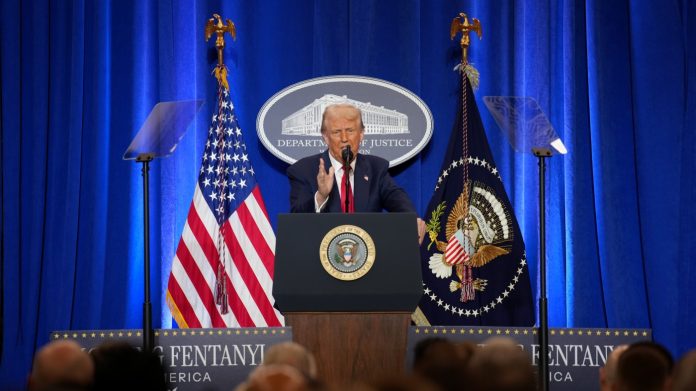
President Trump speaks at the Justice Department on March 14, 2025 in Washington, DC.

Andrew Harnik/Getty Images


hide caption

toggle caption

Andrew Harnik/Getty Images

Dozens of immigration courts around the country are facing vacancies, creating potential bottlenecks to proper due process for people President Trump wants to deport.

The Trump administration fired over two dozen immigration judges during the president’s first month in office.

Those firings come on top of the 100 people who were laid off, decided to retire early, or took advantage of offers to resign within immigration courts. The judicial vacancies exacerbate millions of backlogged cases already piled up in those immigration courts.

Labor and immigration advocates are raising questions over how an already over-subscribed court system is supposed to facilitate Trump’s mass deportation goals.

“It takes over a year for these immigration judges to actually get into the job, get hired, get trained,” said Matt Biggs, president of the International Federation of Professional and Technical Engineers, a union which represents immigration judges. “Most of these judges that were fired were ready to take the bench.”

The Trump administration has sought to reassign and fire officials at the Justice Department who investigated Trump himself or were seen as not being aligned with the administration’s goals. Some of the laid off immigration judges had been hired at the tail end of the Biden administration, though Biggs said the selection process is not political.

Immigration judges, which work out of the Justice Department, were also allowed to take the offer to resign — something that personnel across other parts of immigration law enforcement were not allowed to do.

“It begs the question of: does this administration believe that the immigrants deserve their due process?” Biggs asked. “It’s limited due process, albeit, but it’s due process.”

The Executive Office for Immigration Review, or EOIR, the immigration judge division at the Justice Department, declined to comment on personnel matters. It referred questions about the deferred resignation program to the Office of Personnel Management, which also declined to comment.

“EOIR is currently reviewing applications and interviewing candidates from the last vacancy announcement for Immigration Judges,” the Justice Department says on its website, which was last updated February 26. “While the agency does not currently have an open advertisement for Immigration Judge positions, it expects to announce additional vacancies in the next few months.”

There are about 700 immigration judges across the country’s 71 immigration courts and adjudication centers. These judges are the only ones who can revoke someone’s green card and issue a final order of removal for those who have been in the country for more than two years and are in the deportation process.

When someone is put in removal proceedings, they do not have the right to a lawyer, but they do have the right for someone to hear their case as to why they should not be removed. That can include asylum claims, or other measures to withhold or cancel deportation.

But immigration law experts warn that the system is already backed up. Judges review on average 500 to 600 cases a year. Still, there were 4 million pending cases in the last quarter of 2024, including nearly 1.5 million asylum cases. In fiscal year 2024, immigration courts issued only 666,177 initial case decisions.

Of the judges who were fired, five were in Texas — a state with one of the largest backlogs of cases.

Late last month, over two dozen Democratic senators and representatives wrote to Attorney General Pam Bondi raising concerns about the firings. They said that just the terminations of 40 assistant chief immigration judges, which oversee operations of immigration courts, left about a quarter of immigration courts “without appropriate or established leadership or additional judges to preside over immigration matters.”

Some argue the firings were politically motivated

Greg Chen, senior director of government relations for the American Immigration Lawyers Association trade group, said the immigration case backlog originates from both the former Obama and Trump administrations, when there was a focus on enforcement.

More investment from Congress into law enforcement agents outpaced the investment in the court system that processes the arrests, he said.

“Firing judges, getting rid of personnel and making ideologically-driven choices for the courts is not going to make the cases run more efficiently through the immigration courts. In fact, it will slow it down,” Chen said.

One judge who was fired was Kerry Doyle, who formerly served as the principal legal adviser for Immigration and Customs Enforcement, which prosecutes immigration cases. She was later at the DHS Office of General Counsel during the Biden administration.

Doyle was one of 13 judges who were fired right before they officially took the bench.

“I was excited to do the job,” Doyle told NPR, noting that it would have taken her back to her home state of Massachusetts. “I was hopeful that they would prioritize keeping immigration judges. And really the need is to hire more immigration judges and more immigration prosecutors to make the system work more efficiently.”

Doyle, who served as a political appointee at ICE under Biden, sees her firing as politically driven.

“I didn’t think it would just be two months,” she said.

Concerns about politics predate Trump

In addition to the exodus of immigration judges, over 100 staff members that included schedulers, lawyers and interpreters were also let go, according to the union.

The Department of Justice did not respond to a request for comment about whether politics played a role in any firings.

Concerns over the White House’s influence on immigration courts are not new.

During former President Joe Biden’s term, Republicans in Congress questioned when at least six judges were terminated.

At the time, the firings, which also included probationary employees, was seen as an unprecedented political “ouster.”

An inspector general memo investigating whether any firings or hirings during Biden’s tenure had been politically motivated concluded that there was not sufficient evidence that the Justice Department had engaged in systemic favoring or disfavoring of immigration judge candidates to warrant a full investigation.

The memo did take issue with parts of the hiring process dating back to the first Trump administration. It identified “decreased transparency” in how applicants are selected for interviews.

And in 2002, then-Attorney General John Ashcroft cut judges on the Board of Immigration Appeals — firings that advocates argued were done on the basis of the judges’ potential biases, an accusation officials denied at the time.

Trump is getting a physical. What will be included in the report? : NPR

0

President Trump meets with a group of his ambassadors in the Cabinet Room of the White House on March 25.

Win McNamee/Getty Images


hide caption

toggle caption

Win McNamee/Getty Images

President Trump is getting the first physical of his second term on Friday at Walter Reed National Military Medical Center.

“I have never felt better, but nevertheless, these things must be done!” Trump said on social media.

At 78, Trump is the oldest president to start a second term in office. He follows former President Joe Biden, who took office at the same age, and visibly slowed down during his term.

Trump has been less than forthcoming about his health information in recent years, even as the issues of health and age were in the spotlight during the 2024 presidential campaign.

Presidents have access to excellent preventive care and daily contact with White House physicians. It’s one of the factors that has led to presidents living longer than the general population, said S. Jay Olshansky, a professor in the School of Public Health at the University of Illinois Chicago, who has studied the health of presidents.

Olshansky said there are many armchair doctors, but a president’s own physician is the only one who truly has all the necessary context.

“Keep in mind, medical records are private,” Olshansky said. “Presidents do not have to reveal their medical records.”

White House physician Dr. Ronny Jackson briefs reporters at the White House on Jan. 16, 2018.

White House physician Dr. Ronny Jackson briefs reporters at the White House on Jan. 16, 2018.

Nicholas Kamm/AFP


hide caption

toggle caption

Nicholas Kamm/AFP

What Trump’s past disclosures showed

When Trump first ran for office in 2015, his then-doctor issued a statement describing his lab results as “astonishingly excellent” and concluding he would be the “healthiest individual ever elected to the presidency.” The doctor later said Trump had dictated it to him.

His first White House physical in 2018 yielded a glowing report from Dr. Ronny Jackson, who proclaimed to reporters that Trump’s good health came down to his “great genes.”

“I told the president that if he had a healthier diet over the last 20 years, he might live to be 200 years old,” Jackson said in a White House briefing.

The president is known for his love of McDonald’s and isn’t a fan of exercise. Jackson said Trump needed to lose some weight, exercise more consistently and reduce his intake of fat and carbs.

Jackson held court, taking questions from reporters about everything from Trump’s cardiac calcium score to his cognitive function.

“I was not going to do a cognitive exam, I had no intention of doing one,” Jackson said. “The reason that we did the cognitive assessment is, plain and simple, because the president asked me to do it.”

Jackson said Trump scored a 30 out of 30. Years later, in a Fox News interview, Trump described the test, known as the Montreal Cognitive Assessment.

“You’ll go ‘Person, woman, man, camera, TV,'” Trump said, describing how he easily recalled a short series of unrelated words during the exam.

“Because I have, like, a good memory,” Trump said. “Because I’m cognitively there.”

People at the Old Town Pour House watch the presidential debate on June 27, 2024 in Chicago. President Joe Biden's poor performance led to his decision to withdraw from the race.

People at the Old Town Pour House watch the presidential debate on June 27, 2024 in Chicago. President Joe Biden’s poor performance led to his decision to withdraw from the race.

Scott Olson/Getty Images


hide caption

toggle caption

Scott Olson/Getty Images

Trump’s most recent disclosure was brief

In 2023, as he ran for a second term, Trump released a brief doctor’s letter without any data, saying he had lost weight and “his cognitive exams were exceptional.”

He leaned in on cognitive testing as a campaign issue — both before and after Biden dropped out of the race following a disastrous debate performance.

“We should have cognitive tests for anybody that runs for president and vice president,” Trump said at a rally in October.

Last year, Biden’s doctors chose not to give him a cognitive exam. The White House defended that decision repeatedly.

“Everything that he does — day in and day out as it relates to delivering for the American people — is a cognitive test,” his press secretary, Karine Jean-Pierre, told reporters after he struggled during his debate against Trump.

Trump has been known to jumble words. During the campaign, he wobbled like he might fall when getting into a garbage truck. And he is acutely aware that some have raised questions about his fitness. At another rally in October, he talked about his critics pouncing when he mispronounces words.

“They’ll say ‘He’s cognitively impaired!'” Trump said mockingly. “I’ll let you know when I will be. I will be someday. We all will be someday. But I’ll be the first to let you know.”

The long history of selective medical disclosures from the White House

There is a long history of presidents concealing their health challenges. For example, John F. Kennedy denied he had Addison’s disease among other medical ailments.

When Woodrow Wilson had a stroke, his wife and doctor covered for him, noted Jeff Kuhlman, who was a physician in the Clinton, Bush and Obama White Houses.

“They covered up for him for several months and they were not truthful with the American people,” Kuhlman said.

While there is no law requiring presidents to get physicals, Kuhlman said it’s something that the public and media now expect.

Kuhlman wrote a book about transforming the way physicians serve the president. He recently argued in a New York Times opinion piece that presidents should have their critical decision-making capacity assessed through extensive cognitive testing — not just the short screening exams like the one Trump has taken in the past.

“To me, the purpose of the physical for the president is to give him honest feedback,” about physical and cognitive health, said Kuhlman.

Whether that honest feedback is also shared with the public is another question entirely.

How tariffs got their name : NPR

0

The word “tariff” made its way into English sometime in the 16th century.

Hulton Archive/Getty Images


hide caption

toggle caption

Hulton Archive/Getty Images

Tariffs are President Trump’s favorite word. That’s not an exaggeration.

“I always say ‘tariffs’ is the most beautiful word to me in the dictionary,” he said at a rally just hours after his inauguration in January. “Because tariffs are going to make us rich as hell. It’s going to bring our country’s businesses back that left us.”

His second administration hit the ground running with a series of threatened, imposed and delayed import duties, originally targeting Canada, Mexico, Colombia and China, as well as products including steel, cars and car parts.

Ever since, talk, threats and fears of tariffs have continued to dominate the discourse — in the U.S. and around the world — especially in the wake of Trump’s “Liberation Day” announcement.

Those tariffs — a baseline minimum of 10% on all imports, plus additional taxes on goods from dozens of countries — sent markets tumbling and recession fears soaring after they were unveiled last week. They prompted criticism from Wall Street and world leaders, and they brought multiple countries to the negotiating table, despite Trump’s insistence that they will not be paused.

Mainstream economists have long criticized tariffs as a barrier to free trade that disproportionately burdens low-income U.S. consumers. But Trump maintains that tariffs are key to protecting American jobs and products, raising revenue, rebalancing the global trading system and alternately punishing and extracting concessions from other countries.

“It’s my favorite word,” he said at an October 2024 event. “It needs a public relations firm to help it, but to me it’s the most beautiful word in the dictionary.”

This raises the question: How did “tariff” get its name? The word itself — like most in English — is actually an import.

Where did the word come from?

This photo shows a smartphone that is displaying a list of countries and the Liberation Day tariffs they are subject to. A pair of hands is holding the phone.

President Trump’s “Liberation Day” tariffs include taxes on imported goods from dozens of countries.

Nano Calvo/VW Pics/Universal Images Group via Getty Images


hide caption

toggle caption

Nano Calvo/VW Pics/Universal Images Group via Getty Images

“Tariff” literally means “a schedule of duties imposed by a government on imported or in some countries exported goods,” or the “duty or rate of duty imposed in such a schedule,” according to Merriam-Webster.

The word originally referred to a list of prices in the context of shipping, linguist and content creator Adam Aleksic told NPR.

“It had the implication of a guy at a dock with a table [of prices], and he would charge goods as they came in by the good, based on their value in the table,” he said.

The word can be traced back to Latin as well as the Arabic word “taʽrīf,” meaning “notification” or “inventory.”

Global trade disseminated variations of the word into other languages, including French, Italian and Persian, before it made its way to English in the 16th century. Merriam-Webster dates the first known use of “tariff” to 1592.

“There was a lot of trading with the Arabic world, which led to financial and mathematical terms being borrowed into Latin and then eventually into English,” Aleksic said.

Perhaps ironically, it’s quite a global journey for a word nowadays associated with isolationism. But Aleksic says the path it took is not actually that unusual.

“Even words that were traced back to Old English eventually come from Proto-Indo-European,” he explains. “So all language is imported, in that sense.”

How has the word been used over time?

In this black-and-white photo, members of the Senate Finance Committee meet around a long wooden table to formulate a tariff bill in 1929. Most of the men have books open in front of them on the table, and many onlookers stand around the table.

Members of the Senate Finance Committee meet to formulate a tariff bill in 1929.

Bettmann Archive/‎


hide caption

toggle caption

Bettmann Archive/‎

Tariffs have been central to U.S. trade policy since the country’s founding.

“The second act passed by Congress was a tariff act,” Douglas Irwin, an economics professor at Dartmouth College, told NPR’s Planet Money. “And that’s because the most important problem that was facing the country was the government had no money.”

The Tariff Act of 1789 — which President George Washington signed on July 4 — placed a 5% tax on all imports for the express purpose of protecting domestic manufacturing and raising revenue for the federal government.

By the mid-1800s, however, the goals of U.S. tariffs started to shift from revenue to restriction.

“U.S. industry had begun to grow up during this period,” Irwin explained. “Steel producers and others wanted to keep foreign steel and foreign textiles out of the U.S. market.”

The federal government passed the Tariff of 1828 — at a rate as high as 49% — in response to lobbying from Northern manufacturers who wanted to protect fledgling U.S. industries from British competition, according to the Bill of Rights Institute.

But it was incredibly unpopular among Southern planters, who relied on European trade and had little to do with domestic manufacturing. They gave it another name: the Tariff of Abominations.

“Basically, people were as upset about tariffs as some are today,” Aleksic said. “In the South particularly, people were having this protectionist attitude against tariffs that may honestly be still currently informing our discourse downstream.”

South Carolina declared in 1832 that it would nullify the tariff within its borders. That caused a conflict between the state and federal government known as the Nullification Crisis, which ended only with the passage of the Compromise Tariff of 1833 — and foreshadowed the Civil War.

Tariffs had made up some 90% of U.S. government revenue before the Civil War, but that figure decreased to around 50% with the advent of new taxes to fund the war effort, according to History.com. Tariffs became even less important revenue sources after the introduction of the income tax in 1913, but they were increasingly used to protect domestic industries from competition.

The controversial Smoot-Hawley Tariff Act in 1930 raised tariffs on a wide range of imports by an average of 20%, which prompted retaliatory tariffs from many other countries and significantly disrupted global trade. While the tariffs didn’t single-handedly cause the Great Depression, many economists believe they exacerbated the United States’ financial downturn — and many policymakers saw the tariffs as a mistake.

The Reciprocal Trade Agreements Act of 1934 is seen as ushering in a new era of trade policy focused on negotiating lower tariff rates to promote freer and fairer trade. It continued into the postwar period and beyond, leading to the creation of the World Trade Organization and the North American Free Trade Agreement in the 1990s.

All of this history matters today, Aleksic says, pointing to the political — and patriotic — connotations of the word.

“When Trump says the word ‘tariff,’ he’s not using the word in isolation — he’s using it in the context of all the tariffs that have happened in U.S. history,” he says. “All the cultural context of what it means to be American, in the context of tariffs, is something that people carry with them, regardless of whether they actually know that those tariffs were around.”

Why does the word matter today?

This photo shows a billboard ad in Mumbai, India, that has a cartoon-style drawing of President Trump holding up a list of tariff rates. The top of the ad says: "Tariffying Scenario!" In the foreground, people ride motorbikes and drive cars.

A billboard ad in Mumbai, India, provides commentary on President Trump’s tariffs.

Hindustan Times via Getty Images/‎


hide caption

toggle caption

Hindustan Times via Getty Images/‎

While the United States’ policies on tariffs have evolved over the centuries, the meaning of the word has effectively remained the same. But Aleksic says it may be starting to change.

He points to Trump’s use of the term “reciprocal tariffs” to describe the country-specific taxes he is levying against nations across Europe, Asia and the rest of the world.

“Reciprocal” implies that these tariffs match the tariffs imposed by those countries, but it’s a bit of a misnomer here: The White House’s math reveals they do not actually correspond to the exact tariff rates in other countries.

“[Trump is] not using ‘tariff’ in that historical sense of a set price going down in an arithmetic table,” Aleksic said. “He’s instead using it as general economic punishment or, I guess in the literal White House definition, trade deficit over total goods imported.”

In other words, the definition of “tariff” seems to be widening beyond simply a rate of tax. Aleksic calls this an example of “semantic broadening,” which happens all the time in language and isn’t inherently cause for concern from a linguistics point of view.

That doesn’t mean it’s not noteworthy.

“One should be aware when words change meaning in politics, because they’re often being used as loaded language or dog whistles or buzzwords,” he said. “And I think there’s part of ‘tariff’ right now that is a political buzzword for sure.”

Trump tariffs face bipartisan challenge, Sen. Maria Cantwell says : NPR

0

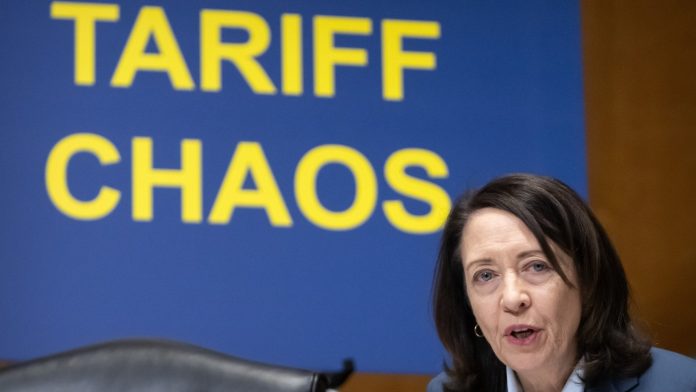
Sen. Maria Cantwell, D-Wash., speaks during a hearing of the Senate Committee on Finance on Capitol Hill, Thursday, March 6, in Washington.

Mark Schiefelbein/AP


hide caption

toggle caption

Mark Schiefelbein/AP

President Trump’s escalating tariffs on trading partners has not only rattled U.S. and international markets – it’s also set off alarm bells in Congress.

In response, a group of Senators have introduced bipartisan legislation to reign in presidential power on tariffs. Sens. Maria Cantwell, D-Wash. and Chuck Grassley, R-Iowa have introduced a bill requiring the president to notify Congress of impending tariffs within 48 hours. Congress would have to approve of the action within 60 days of notification.

President Trump has threatened to veto the bill that already had slim prospects of passing as it is unclear if it would even get a vote in the House.

In an interview with Morning Edition, Cantwell said “We are the conduit to those constituents. Those sectors of the economy, like agriculture or manufacturing or small business who are being hurt.”

NPR’s Leila Fadel spoke to Cantwell about the future of the bipartisan bill – and what she’s hearing from constituents affected by the tariffs.

This interview has been edited for length and clarity. 

Interview Highlights 

Leila Fadel: What would the bill you’ve drafted accomplish if it became law?

Sen. Maria Cantwell: Congress constitutionally has the right on trade, really, if you think about it, on interstate commerce and foreign commerce. But this president has misconstrued and we think actually misused this authority. So we’re saying we want Congress to reassert itself in this debate and get approval for these unbelievable tariffs that are costing consumers so much money and ruining people’s 401(k) savings.

Fadel: Now, this is described as a bipartisan bill. You co-authored it with Sen. Chuck Grassley, a Republican. But how much Republican support is there for this bill? I mean, can it pass?

Cantwell: We have seven Republicans on the bill so far, which was just introduced last week. The House representatives introduced a bill with two Democrats and two Republicans. So it is continuing to be bipartisan, bicameral. And, I think, it’s because people are hearing from their constituents who are saying, “Wait, why am I paying this extra tax on these consumer goods? I don’t want to do it.”

Fadel: Now, the president has threatened to veto your bill if it ever comes to his desk. What would you do in that case if you get this bill passed and Trump vetoes it?

Cantwell: I don’t think people thought the economy was going to drop $11 trillion in investment either. This is wreaking havoc on consumers. Basically GDP is about 70% consumer spending. So Congress has a right to say, “what is the plan here? Why aren’t you consulting with us as we have to consult with our constituents?”

And the thing that people don’t want is to have continued uncertainty. A lot of people who are looking at their 401(k), and were maybe going to retire this year, have great concerns about what that means for them personally.

Fadel: But what I’m asking is if there is a true path in both chambers to get this to become law?

Cantwell: Oh, for sure. This continues to be an economic nightmare for people. Yes, there will be a path.

Fadel: And if Trump vetoes the bill, you would need to get two-thirds in both chambers for it to pass. Are there other paths or are there other options?

Cantwell: Well, my colleague, Sen. Ron Wyden, D-Oregon, is introducing another resolution related to this. So the good news is that our colleagues are waking up to the fact that the president went too far and that we need to have a discussion. We need to listen to our constituents. We need to listen to the small businesses. We need to listen to the consumer who’s being hurt here and decide what it is that we can do to reassert ourselves in the debate.

Note: Wyden’s privileged resolution would force a vote on the emergency declaration under which President Trump instituted the global tariffs, according to a statement from Wyden and other senators who have signed on to it. 

Fadel: Now, Trump says the tariffs are necessary short term pain or medicine to deal with this long-term problem of the $1.2 trillion trade deficit. Do you agree with that?

Cantwell: I disagree. First of all, we need to continue to drive inflation down. A tariff is just like a tax that’s going to make everything more expensive at the grocery store, at the appliance store. If the president wanted to use power, he should unite people collectively, like the Europeans or other Asian countries and try to counter China that way through a coalition. And then they could force open markets or force more fair accommodations.

 Fadel: That would be the approach you would support to closing the trade gap?

Cantwell: Oh, for sure, yes. I represent one of the most trade-dependent states in the country. And so we’re very proud that we make airplanes, that we grow a lot of agricultural products. So we want the United States to be a leader in the economy of tomorrow and all the job creation that is going to come with that. And we think that the way you get there, just like these companies have become big juggernaut companies in the Northwest, is by innovating, having a great skilled workforce and by having open markets to sell your product to. There are strategies to take the next step that would help the United States in an information age win more market share. And we should be doing that versus kind of taking our best trade allies and making them mad at a time when we really need them to be on our side.

Sen. Maria Cantwell says there is bipartisan support to rein Trump’s tariffs : NPR

0

NPR’s Leila Fadel speaks with Democratic Senator Maria Cantwell of Washington about bipartisan legislation she is proposing to require the president to notify Congress of impending tariffs within 48 hours and to obtain congressional approval within 60 days.

Why Trump is sending Venezuelans to El Salvador : Code Switch : NPR

0

Juan plays a video of his son Carlos riding a bike, which Carlos purchased the day before being taken into custody, at his home in Cedar Park, Texas, on Jan. 29, 2025.

Tamir Kalifa


hide caption

toggle caption

Tamir Kalifa


Juan plays a video of his son Carlos riding a bike, which Carlos purchased the day before being taken into custody, at his home in Cedar Park, Texas, on Jan. 29, 2025.

Tamir Kalifa

One of President Trump’s main campaign promises was carrying out mass deportations. Now, the administration has removed legal protections for people from certain countries, like Venezuela, invoked a 18th century wartime law, and arrested immigrants regardless of their legal status or criminal record. We look at how the Trump administration is testing the U.S. legal system to make good on its promise, starting with the story of one family trying to find their 18-year-old son after immigration agents showed up at their doorstep.

This episode was produced by Christina Cala. It was edited by Courtney Stein and Dalia Mortada with help from Luis Trelles. Our engineer was Jimmy Keeley.

Trump trade official signals tariffs are negotiating tool amid GOP skepticism : NPR

0

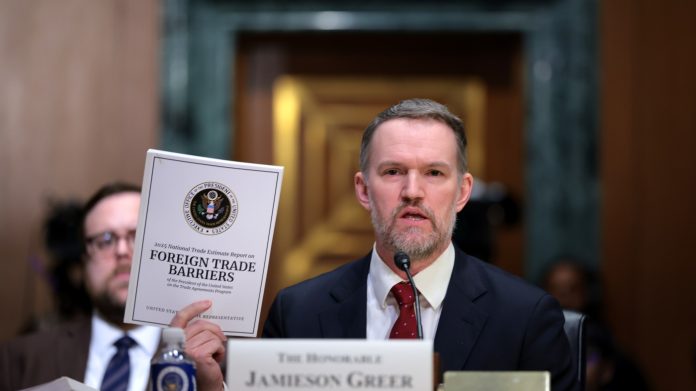
U.S. trade representative Jamieson Greer testifies before the Senate Finance Committee on April 8. Greer testified on President Trump’s 2025 trade policy agenda.

Kayla Bartkowski/Getty Images


hide caption

toggle caption

Kayla Bartkowski/Getty Images

As market turmoil over President Trump’s sweeping tariffs continued to churn, the U.S. trade representative told a Senate panel that the goal of the policy is to negotiate a new series of trade deals.

Jamieson Greer, the U.S. trade representative, said roughly 50 countries reached out to talk with the administration instead of retaliating. That, he suggested, is evidence that Trump’s approach is working. But he faced skepticism and questions from Republican lawmakers on the Senate Finance Committee who wanted answers on the broader strategy.

Even the president’s allies admitted the mixed messaging coming from the White House was confusing — with some saying Trump’s tariffs were a tactic to bring countries to the table to adjust trade imbalances and others saying the tariffs were a longer-term gambit to remake the global trade economy.

Tuesday’s hearing was the first opportunity for a top Trump official to explain the theory of the case before Congress. Greer assured lawmakers that the goal was to incentivize negotiations.

“As these countries approach us, the idea is that we’ve had years and years of nonreciprocal access and it’s contributed to these trade deficits,” Greer said, and outlined that if countries present solutions for shifting the dynamic, the message to them is “we want to negotiate with you.”

He repeatedly pointed to examples of countries like Vietnam and India reaching out.

Later, White House press secretary Karoline Leavitt told reporters that Trump directed his trade team to create “tailor-made trade deals” in negotiations with countries seeking tariff cuts.

Leavitt said almost 70 countries have reached out since Trump’s bombshell across-the-board tariff announcement last week.

“The president met with his trade team this morning, and he directed them to have tailor-made trade deals with each and every country that calls up this administration to strike a deal,” she said in a press briefing.

“Each and every one of these trade deals should be tailored and unique based on that country’s markets, based on that country’s exports, the imports here in the United States of America, what makes the most sense for the American worker and for our industry,” Leavitt said.

On Capitol Hill, Greer made clear that China was taking a much harder line and repeated that Trump’s plans to impose new tariffs would go forward as scheduled for midnight. He said China seems “to be choosing its own path on market access.”

The White House has said tariffs on China are set to rise to at least 104% on Wednesday.

The top Democrat on the committee, Sen. Ron Wyden of Oregon, pointed to retirement funds falling and markets being shut to U.S. goods, saying, “The U.S. economy has gone from the envy of the world to a laughingstock in less time than it took to finish March Madness.”

Wyden announced he was introducing a bipartisan privileged resolution that would terminate the national emergency Trump invoked to impose his tariffs. Several Democrats co-sponsored the measure, and Republican Sen. Rand Paul of Kentucky also joined the effort. Last week, the Senate approved a similar resolution to undo the tariffs on Canada, with four Republicans joining Democrats. But the House of Representatives has no plans to take up the measure.

Republican skepticism and questions

Top Republican leaders continue to say that the president deserves some time to assess the full impact of his policies. Sen. Chuck Grassley, R-Iowa, has introduced legislation to claw back congressional power over international trade and tariffs that the legislative branch ceded to the executive branch over decades. Grassley repeated his concerns about that dynamic to Greer. But he also said, “I support President Trump’s agenda to lower tariffs and nontariff barriers other countries impose on American goods.”

But several Republicans on the Senate Finance Committee made it clear they were hearing from worried constituents, including business owners unable to plan for supply chain issues.

Republican Sen. James Lankford of Oklahoma pressed Greer for a timeline for the tariffs, but the trade representative declined to specify any target date.

Instead, Greer cautioned that the trade deficit was “decades in the making, but it’s not going to be solved overnight.”

Republican Sen. Ron Johnson of Wisconsin, who noted his own experience in the manufacturing sector, told Greer he was disappointed that exclusions for some companies “are being ruled out right now.”

He said, “I hope you and the president are very sensitive about companies potentially going bankrupt by these actions.”

And Johnson added, “We want fair trade, but tariffs are a double-edged sword and, I would argue, a somewhat blunt instrument.”

Another Republican, Sen. Thom Tillis of North Carolina, admitted that he wasn’t an expert but that the Trump administration faced a tight window of roughly 14 months for these policies to demonstrate they were working. Tillis, who is running for reelection in 2026, noted that people who voted for the president and for him — mentioning he grew up in a trailer park — would face the possible negative impact, like job losses.

“I wish you well, but I am skeptical,” Tillis concluded.

Sen. Todd Young, R-Ind., asked Greer to factor in that trade retaliation doesn’t fall on everyone evenly, noting that tech companies in New York feel impacts differently from soybean farmers in his home state. “I hope that’s something that’s being factored into your analysis.”

Sen. Mark Warner, D-Va., pressed Greer to explain why the administration took the same approach to allies and partners like Canada and Mexico as with adversaries like China.

He reported that he spoke with senior Wall Street executives and that one remarked about the market’s gains on Tuesday as “a good day in hospice.”

As the markets brace for fallout from increased tariffs on China on Wednesday, Senate Majority Leader John Thune, R-S.D., who has cautioned against broad tariffs, noted on Tuesday that Trump ran on the issue in 2024.

“Seventy-seven million people voted for him and his agenda, and I think he deserves the opportunity to see what kind of deals he can get from some of our trading partners, and I think most of us are giving him space in which to do that and hope he’s successful, because it’s not only good for him and his administration but it’s good for the country.”

Mixed messages on tariffs raises scrutiny on Trump aides : NPR

0

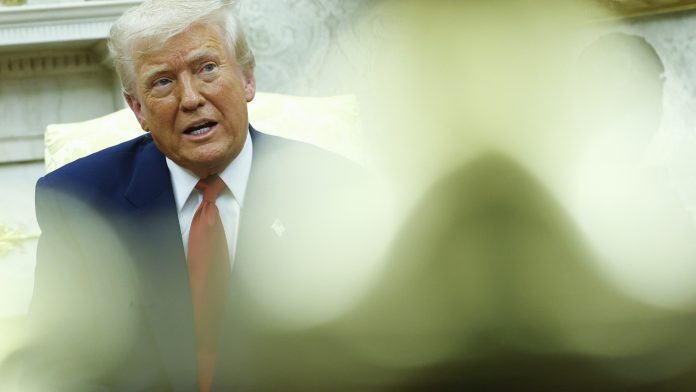
President Trump answers a reporters question during a meeting with Israeli Prime Minister Benjamin in the Oval Office of the White House on April 7.

Kevin Dietsch/Getty Images


hide caption

toggle caption

Kevin Dietsch/Getty Images

President Trump is boasting about the wheeling and dealing he’s doing to cut deals on steep new tariffs that take effect on Wednesday. But for weeks, his own aides have insisted that tariffs were not a bargaining chip.

Trump has said he wants to see manufacturing return to the United States — the kind of big-dollar investments that businesses are reluctant to make unless there is certainty that policies are not about to suddenly shift. But he has now opened the door to talks with a long list of countries trying to strike their own deals for tariff relief.

“There can be permanent tariffs — and there can also be negotiations because there are things that we need beyond tariffs,” Trump told reporters this week.

The conflicting message is just the latest example of how hard it can be for Trump’s aides to try and sell his ever-evolving trade agenda. It has increased scrutiny on Commerce Secretary Howard Lutnick and Treasury Secretary Scott Bessent who are tasked with explaining his plan to people on Wall Street and Main Street who have been spooked by the sharp downward market moves sparked by the tariff announcement.

Lutnick and Bessent brought Wall Street credentials to their jobs

Lutnick, the former CEO of financial services firm Cantor Fitzgerald, and Bessent, a former hedge fund investor, were picked for their cabinet jobs because their experience provided some assurance to Wall Street that there were steady stewards at the helm.

But they have both taken hits to their credibility over the rollout of potentially trillions of dollars in new tariffs that have rocked stock markets and spread uncertainty across the globe, said Daniel Drezner, a former international economist at Treasury and a former Republican.

“What you’ve seen for the last two months, two plus months, is evidence that, in fact, Bessent is not in charge of foreign economic policy. Neither is Lutnick. It’s Donald Trump,” said Drezner who now teaches international politics at the Fletcher School of Law and Diplomacy at Tufts University.

Last month, Bessent laid the ground for tariffs by warning Americans that long-term economic gain could not occur without some short-term pain.

“Access to cheap goods is not the essence of the American Dream,” he told members of the Economic Club of New York last month.

Lutnick has done dozens of interviews, often channeling Trump’s tough rhetoric.

On CNBC last week, he said the U.S. needs to “to stop supporting the rest of the world and start supporting American workers.”

Last week, he insisted it was too late for countries to try and negotiate.

“I don’t think there’s any chance that President Trump’s going to back off his tariffs. This is the reordering of global trade,” Lutnick said on CNN.

But within hours of that interview — with Lutnick standing right behind him — Trump told reporters on Air Force One that he would be open to negotiating. “Every country is calling us. That’s the beauty of what we do,” Trump said. “We put ourselves in the driver’s seat.”

The problem with mixed messages

Top aides have a fine line to walk when their boss changes the message, says Caitlin Legacki, who was a senior adviser in former President Joe Biden’s Commerce Department.

She said they have to be able to maintain their credibility while not angering their boss.

“Especially for people like [Bessent and Lutnick], there’s huge potential damage to their reputations outside of Washington, D.C.,” Legacki said.

She said they also risk being blamed by Trump if he doesn’t think their sales job was good enough.

On Sunday, Bessent and Lutnick tried to do some damage control.

Bessent was cautious when asked directly if the tariffs were permanent. “That’s going to be a decision for President Trump,” Bessent said on NBC’s Meet the Press. “But I can tell you that as only he can do at this moment, he’s created maximum leverage for himself.”

But over on CBS’ Face the Nation, Lutnick sought to hold the line.

“There is no postponing,” Lutnick said. “They are definitely going to stay in place for days and weeks. That is sort of obvious. The president needs to reset global trade.”

There are other trade voices in Trump’s orbit, too

Another factor is the number of people who speak for Trump on trade — experts who don’t necessarily share the same opinions. Trump’s adviser Peter Navarro, for example, has long taken hardline positions on trade. Navarro and Elon Musk, who advises Trump on government restructuring but doesn’t like the tariffs, openly fought in interviews and on social media this week.

The White House said it shows Trump is willing to listen to people with diverse views as he weighs his decisions. Spokesman Kush Desai said Trump has assembled the “best and brightest economic team in modern history.”

“President Trump has rightfully identified the trade deficits that our country has run for decades and that are responsible for decimating our industries and communities as a national emergency,” Desai said. “Instead of prioritizing special interests, President Trump once again acted in the best interest of our country and our citizens when he made his decision on reciprocal tariffs.”

But the market turmoil could have been avoided if the tariff roll-out had been clearer or more consistent, said Republican strategist Alex Conant, who represents some companies impacted by tariffs.

“The messaging is all over the place,” Conant said. “They talk about the need for tariffs to cut the deficit. They talk about the need for tariffs to bring manufacturing jobs home. But they also talk about the need for tariffs in order to make trade more fair. All three of those cannot be true at the same time – which makes it a tough sales job,” he said.

New Social Security rules will create hurdles for millions of seniors, report finds : NPR

0

A closed entrance to the Social Security Administration headquarters sits empty in Woodlawn, Md., on March 20.

Wesley Lapointe/The Washington Post via Getty Images


hide caption

toggle caption

Wesley Lapointe/The Washington Post via Getty Images

Americans seeking retirement or survivor benefits from the Social Security Administration will no longer be able to apply over the phone, starting on Monday.

Instead, they will have to seek services online or travel in-person to a local Social Security field office, which a new analysis from the left-leaning Center on Budget and Policy Priorities, or CBPP, found amounts to a “45-mile trip for some 6 million seniors.”

The group wrote this change “will close off an important mode of service for millions of people” who are eligible for services.

“More than 4 in 10 retirees apply for their Social Security benefits by phone, as do most spouses who are eligible for benefits,” researchers wrote. “So do the substantial majority of bereaved family members who are eligible for benefits following the death of a worker.”

This new policy, which also applies to anyone making changes to their direct deposit account, was first announced last month — and then partially walked-back a week later due to push back from disability groups and other stakeholders.

Agency officials have said these new measures “will further safeguard Social Security records and benefits against fraudulent activity” by creating “stronger identity verification procedures.”

In a statement to NPR, a spokesperson at the SSA said “telephone remains a viable option to the public” when these new policies go into effect. As of now, Medicare, disability, and supplemental income applications are exempted from the new changes.

“Beginning on April 14, Social Security will perform an anti-fraud check on all claims filed over the telephone and flag claims that have fraud risk indicators,” they wrote. “We will continue to conduct 100 percent ID proofing for all in-person claims. 4.5 million telephone claims a year and 70K may be flagged.”

Advocates for seniors and people with disabilities, however, have argued these changes amount to barriers to services for many of the people the agency is required to serve. This policy was also included in a legal challenge from disability rights groups against the agency that was filed last week.

The Social Security Administration runs a slew of programs for seniors and people with disabilities. Besides retirement services — which make up the largest share of services — the agency also runs programs that provide survivor benefits and disability benefits and supplemental income for the very poor. According to the latest monthly data, more than 50 million Americans received retirement benefits from the SSA in February and thousands of Americans newly qualify for benefits every day.

Kathleen Romig, the CBPP’s director of Social Security and disability policy, told NPR these new in-person verification requirements will be “really burdensome” for the many Americans who qualify for these benefits, particularly those who live in more rural parts of the country.

For one, she said, it’s already “a lengthy process” to get an appointment for in-person services.

“There’s no way to schedule an appointment online,” Romig said. “So you have to call the agency’s 800 number. Right now, the wait for a call back from Social Security is two and a half hours. And that’s if you get through to an agent at all. Most people don’t.”

She also said once someone does get through and makes an appointment, they usually wait “more than 28 days for the next appointment” that’s available.

And for many seniors and disabled Americans, Romig said, an in-person appointment is not physically doable.

“Not everyone drives, particularly seniors or people with disabilities,” she said. “And not everyone is able to leave the house. Think about people who are homebound or hospitalized. So, this is incredibly burdensome for the older and disabled people that the SSA serves.”

Romig said this new policy disproportionately affects every bereaved person who is applying for a Social Security survivor’s benefit, because they don’t have the option of applying online.

“That is Social Security’s version of life insurance, that a widow or widower or surviving child of a worker who has died,” she said. “Those are the monthly benefits that Social Security calls survivor’s insurance. So, all of those people need to go in person to apply for benefits because there is no online option for that.”

And even when beneficiaries are able to apply online, there are still hurdles, the CBPP report found.

“Many seniors and people with disabilities lack internet service, computers or smartphones, or the technological savvy to navigate a multi-step, multi-factor online verification process,” researchers wrote. “Even as SSA is encouraging people to do business online, the Department of Government Efficiency (DOGE) is making changes to online identity authentication that are triggering system outages and access problems.”

Romig said ongoing staff cuts at the agency also make it likely that wait times for in-person services will continue to grow.