Thursday, November 12, 2026
Home Blog Page 46

Judge orders White House to give AP access to Oval Office : NPR

0

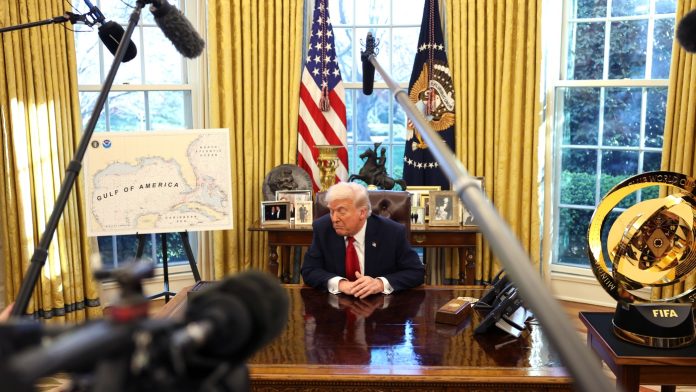
President Trump speaks to the press in the Oval Office next to a map of what he has renamed the “Gulf of America” on March 26. The administration has denied the Associated Press access to such events because it calls the body of water the “Gulf of Mexico,” even as it acknowledges his preferred designation.

Win McNamee/Getty Images/Getty Images North America


hide caption

toggle caption

Win McNamee/Getty Images/Getty Images North America

A federal judge on Tuesday ordered the Trump White House to let Associated Press journalists return to the Oval Office and other spaces to cover news events, ruling it was unlawful to block the news service in a dispute over its choice of words.

Even so, an AP reporter and photographer were turned back from joining a reporting pool on a presidential motorcade early Tuesday evening, almost two hours after the decision came down.

The AP had angered the White House because it refused to call the Gulf of Mexico by President Trump’s preferred name for it: the Gulf of America. The AP acknowledges in its coverage that the U.S. government now calls it the Gulf of America, but the news service still relies on the more familiar, traditional designation — especially as the AP serves clients internationally.

Trump and his aides have barred the news service’s White House reporters from dozens of events since February, including events limited to the reporting pool that shares details with other outlets. The AP has participated in such pool coverage for more than a century. The White House has argued it is a privilege to cover Trump up close — one that he controls.

U.S District Court Judge Trevor N. McFadden, a Trump appointee, ruled that the Trump administration’s reason for barring AP reporters mattered.

“[T]he Court simply holds that under the First Amendment, if the Government opens its doors to some journalists — be it to the Oval Office, the East Room, or elsewhere — it cannot then shut those doors to other journalists because of those viewpoints,” he wrote. “The Constitution requires no less.”

The judge wrote that he was not preventing the White House from choosing to whom the president grants interviews. McFadden added that he also was not requiring the administration to admit all eligible journalists, or even any journalists, to government spaces that are not open to the public, such the Oval Office.

“The Government repeatedly characterizes the AP’s request as a demand for ‘extra special access’,” McFadden wrote. “But that is not what the AP is asking for, and it is not what the Court orders. All the AP wants, and all it gets, is a level playing field.”

President Trump, White House Press Secretary Karoline Leavitt, White House Chief of Staff Susie Wiles and Deputy Chief of Staff Taylor Budowich have pointed publicly to the dispute over the Gulf’s name as the reason why AP’s White House reporters have not been allowed in the Oval Office or on Air Force One since the issue arose. In some instances, photographers and AP reporters based abroad have been allowed in.

After AP Executive Editor Julie Pace lodged a formal complaint in mid-February, Wiles wrote back to say the AP’s editorial choice “denies the appropriate authority of the duly elected President.”

Wiles said other choices reflected in the AP’s Stylebook, which inform those in other newsrooms around the world, reflected bias. “We believe strongly that the American public deserves neutrality from those privileged enough to enjoy close up access to some of the most important moments of history,” Wiles wrote.

The White House did not immediately offer a response to McFadden’s order, which found that the wire service would likely prevail in a full trial.

AP spokesperson Lauren Easton said the wire service was gratified by the court’s decision.

“Today’s ruling affirms the fundamental right of the press and public to speak freely without government retaliation,” Easton said in a statement. “This is a freedom guaranteed for all Americans in the U.S. Constitution. We look forward to continuing to provide factual, nonpartisan and independent coverage of the White House for billions of people around the world.”

After seeking to get the White House to drop its punishment in February, the Associated Press sued, noting that it had been part of the rotating pool of news outlets that cover the White House for more than a century. It argued that prior court rulings set precedents preventing the White House from punishing journalists for coverage it does not like.

Yet, as the AP’s lead trial attorney, Charles Tobin, argued, Trump officials have repeatedly done that. The administration has wrested control of who determines which journalists participate in that pool from the White House Correspondents Association, a group of media outlets whose reporters routinely cover the White House.

“The AP has now spent 44 days in the penalty box,” Tobin said in a court hearing on March 27. “They have created some sort of opaque system that has some rotation process to it that happens to exclude the AP every single time.”

McFadden’s ruling paid close attention to the evidence developed in that hearing, at which the government brought forward no witnesses. The AP had two of its most senior White House journalists testify in open court.

The wire service’s chief photographer in Washington, Evan Vucci, testified that the AP has relied on Reuters and the New York Times for images from smaller events in the Oval Office, Air Force One and Mar-a-Lago. He called his rivals “heroes” for sharing, but said they withheld their best photographs and often sent them 45 minutes after sharing with their own clients. That meant the AP lagged behind its competitors in serving clients hungry for material. Usually, Vucci told the court, he can transmit photos to his editors within 30 to 40 seconds.

He pointed to the coverage of Trump’s tense exchange with Ukrainian President Volodymyr Zelenskyy at the Oval Office: the primary photo the AP transmitted, taken by an AP videographer based in Ukraine, showed the two leaders appearing calm; their shouting match was anything but.

“We’re basically dead in the water on major news stories,” Vucci testified. “That’s what we’re all about — speed and quality.”

In an earlier session, Judge McFadden denied the AP’s request for a temporary restraining order. At the hearing in March, he appeared to struggle to see how the dispute had damaged the AP – one component required for the preliminary order that the AP had sought. In his ruling on Tuesday, however, the judge found the AP’s evidence and logic compelling, writing that it had “suffered significant, concrete harm.”

In ensuing days, the White House signaled it intends to take over assignments of who sits where in the briefing room from the correspondents’ association.

The Trump administration’s treatment of the AP is just part of a growing war against the U.S. news media. Trump earlier sued ABC and CBS. The former settled. His chief broadcasting regulator has launched investigations of ABC, CBS, NBC, NPR and PBS. Notably, the Fox broadcast network, owned by Trump ally Rupert Murdoch, is not among them.

“For anyone who thinks the Associated Press’s lawsuit against President Trump’s White House is about the name of a body of water, think bigger,” Pace wrote in the opinion pages of the Wall Street Journal (owned by Trump ally Rupert Murdoch) in late March. “It’s really about whether the government can control what you say.”

In her piece, Pace argued the spat involved significant stakes.

“The AP has no corporate owner and no shareholders,” Pace wrote. “If we don’t step up to defend Americans’ right to speak up freely, who will? Today the U.S. government wants to control the AP’s speech. Tomorrow it could be someone else’s.”

Judge McFadden affirmed the broad sweep of her news service’s argument.

“The Court merely declares that the AP’s exclusion has been contrary to the First Amendment, and it enjoins the Government from continuing down that unlawful path,” he concluded.


Republican congressman wants limits on presidential tariff authority

0

NPR’s Ailsa Chang speaks with GOP Rep. Jeff Hurd of Colorado about a bill he is co-sponsoring that would limit the president’s authority on tariffs and require congressional approval for the measures.

DHS tells migrants who used CBP One to leave ‘immediately’ : NPR

0

The CBP One app was a central part of the Biden administration’s strategy to relieve pressure at the U.S. border. It allowed migrants to schedule appointments at legal ports of entry instead of crossing into the U.S. illegally to seek asylum.

John Moore/Getty Images


hide caption

toggle caption

John Moore/Getty Images

Y. was working her regular shift at a California Walmart on Monday when she got a notification on her phone. It was an email from the U.S. Department of Homeland Security.

“It is time for you to leave the United States,” the email began. “DHS is now exercising its discretion to terminate your parole immediately.”

Y., a Venezuelan woman who asked NPR to use the initial of her first name because of her immigration status, panicked.

“I got nervous, desperate,” she told NPR in Spanish. “Even though I came in through a CBP One appointment, I don’t feel safe.”

The Trump administration is telling some migrants who entered the U.S. using the CBP One mobile app to leave immediately, as part of a broader push to revoke temporary legal status for migrants who entered during the Biden administration under a legal authority known as humanitarian parole.

Starting in January of 2023, the CBP One allowed migrants to schedule appointments at legal ports of entry instead of crossing the border illegally to seek asylum. It was a central part of the Biden administration’s strategy to relieve pressure at the border by creating temporary legal pathways under an authority known as humanitarian parole.

The Trump administration quickly dismantled that policy, and is now urging migrants who benefited from it to leave immediately.

“Canceling these paroles is a promise kept to the American people to secure our borders and protect national security,” according to an emailed statement from the DHS Press Team.

The Department of Homeland Security says it sent formal termination notices to some migrants who were allowed to enter the U.S. through the CBP One app — though DHS did not say how many migrants have received those notices.

Y. came to the U.S. with her two children in July of 2024 after waiting in Mexico for an appointment through the CBP One app for more than eight months, she said.

They are among the more than 936,000 migrants who used the app to schedule appointments at ports of entry.

DHS is now encouraging migrants to report their departure via the same mobile app, according to the termination notice seen by NPR, which the Trump administration has rebranded and relaunched under the name CBP Home.

“With the launching of the CBP Home app, we are restoring integrity to our immigration system,” Homeland Security Secretary Kristi Noem said in a statement last month.

The Trump administration has already moved to terminate parole for more than 500,000 people who entered the U.S. through another Biden-era program for Cubans, Haitians, Nicaraguans and Venezuelans. But it has not yet terminated protections for those who entered under Uniting For Ukraine or Operation Allies Welcome, two other programs that also rely on humanitarian parole.

The notice sent this week warns that migrants whose parole has been terminated will also lose their work authorization, and also could be subject to criminal prosecution, fines and removal from the U.S., although it does make an exception for those who have “otherwise obtained a lawful basis to remain here.”

DHS has not explained how the termination notices would affect migrants who are in the process of applying for asylum, Temporary Protected Status, or other protections.

“People are really confused, especially if they have pending applications or pending court proceedings,” said Erika Pinheiro, the executive director of Al Otro Lado, a nonprofit that has worked with hundreds of migrants who used the CBP One app.

Pinheiro says the vast majority should still be protected from deportation temporarily because they do not have final orders of removal, and are fighting deportation in immigration courts, where many are seeking asylum.

“They are protected from deportation,” Pinheiro said. “But the letter seems to indicate otherwise.”

For many of these migrants, Pinheiro said, the main practical effect of the termination may be losing the work authorization that came with parole. But she says these notices may have less tangible impacts as well.

“The fear that they’re putting into individuals receiving the letter is real. And so a lot of immigrants, whether or not they have protection from removal, are scared,” Pinheiro said.

That includes Y., the Venezuelan woman who received the email.

“These last two months I’ve felt a lot of anxiety because I feel in a limbo,” she said Tuesday.

Y. traveled by land from Venezuela through Mexico, where she says she was sexually assaulted by Mexican police on the way to her CBP One appointment. She found a home in California and is working legally at a Walmart.

Y. told NPR she has her first immigration court hearing on Thursday. She’s planning to attend with her two kids.

“I’m anxious, and scared, but I will go,” she said. “I’m going to continue to do things the right way.”

Sexual assault prevention division gutted amid HHS layoffs : NPR

0

In April, many communities hold events to raise awareness of sexual violence, such as this event in Reading, Pa., in 2021, put on by Safe Berks. Sexual violence prevention efforts often get funding and support from the federal government.

Ben Hasty/MediaNews Group/Reading Eagle/Getty Images


hide caption

toggle caption

Ben Hasty/MediaNews Group/Reading Eagle/Getty Images

April 1 was the first day of Sexual Assault Awareness Month. It’s also the day the Department of Health And Human Services fired the teams that work on sexual violence prevention.

The layoffs were part of a round of dramatic cuts to the federal health agencies, amid the Trump administration and Elon Musk’s efforts to shrink the federal workforce.

Most of the Division of Violence Prevention staff was fired, according to multiple sources, including current and former staffers. The division is part of the Injury Center at the Centers for Disease Control and Prevention. At the same time, the leader of another HHS agency that works on domestic violence, the Office of Family Violence Prevention and Services, was placed on administrative leave.

Congress mandated the work these agencies do, which includes supporting state and local programs on sexual assault around the country. Those laws, including the Violence Against Women Act, have had bipartisan support.

The timing of the layoffs was “a combination of heartbreaking and insulting,” says Matthew Huffman of the Missouri Coalition Against Domestic and Sexual Violence, a membership association of domestic violence shelters and rape crisis centers around the state.

He says that the current situation is confusing and stressful for local groups, who rely heavily on federal funds for their work. Without federal staff in place to administer the funds and support them, “it leaves a huge gap in our ability to really be effective.”

“Even in a red state, we’ve never had issues with getting our work through,” says a Midwest state health official who NPR agreed not to name because she fears retaliation for speaking with the media. “It’s not a super controversial thing — you don’t want your daughter to be raped in college, right?”

In response to NPR’s question about how sexual violence prevention funds will be distributed now that these teams have been cut, HHS spokesperson Emily Hilliard wrote: “All statutorily required positions and offices will remain intact, and as a result of the reorganization, will be better positioned to execute on Congress’s statutory intent.”

Decades of experience ‘wiped out’

One of the fired CDC employees estimates that two-thirds of division staff were fired last week, about 100 people, based on crowdsourced documents and her knowledge of the division’s staffing. NPR agreed not to name her because she fears retribution for speaking with the media.

The division works on prevention strategies for sexual assault, childhood abuse and gun violence among other forms of violence. Research and programming staff in all these areas got cut.

The CDC employee says that even though there has been bipartisan support for these efforts in the past, she was not surprised that the programs focused on sexual violence were cut.

“We had an inkling,” she says. “A lot of our work is looking at gender-based violence and gender disparities and health equity and all of that quote unquote ‘woke ideology,'” she says, which has been a major target in the second Trump administration.

As an example of its work, CDC has helped fund and evaluate the mapping of “hot spots” where students feel unsafe and vulnerable to sexual assault so schools can intervene. In Colorado, hot spot maps lead some schools to add lights and cameras in certain places and relocate locker rooms.

CDC can guide community partners in their programs and help them evaluate the impact. “We have the ability, we have the infrastructure, we have the expertise to figure out what works to prevent sexual violence,” the CDC employee says.

Another fired CDC staff member says she was surprised that some parts of the Division of Violence Prevention were preserved, including the surveillance branch. That made the cuts to her team feel more targeted.

“I think [it] tells a story about what was important in terms of what they think CDC should do,” she says. NPR agreed not to name her for fear of retribution. “The story it tells me is that violence prevention doesn’t matter, that women in abusive situations don’t matter, that women who have been sexually assaulted don’t matter.”

She says she and her colleagues feel “gutted” by the cuts. “All of us are just reeling, trying to figure out what we do next,” she says. “This wasn’t just a job for us, this was something that we were all passionate about.”

Without the federal government supporting these efforts across the country, state and local groups are on their own, says Lynn Rosenthal. She was HHS director of sexual and gender-based violence under the Biden Administration, and has also worked as an advocate with the National Network to End Domestic Violence and as the director of a local rape crisis center.

“Decades — literally — of work will be lost as a result of the Division of Violence Prevention being wiped out in this way,” Rosenthal says. She explains that the reason why there is a federal role in preventing and intervening in domestic violence and sexual assault is because states needed help with funding and program design and evaluation, and asked for federal action.

The CDC teams that were cut helped local groups “learn what’s working and what’s not working — what should we try?” she says. “They’re very generous with convening people around the country to try to learn from their experiences.” The fact that they’ve been fired, she adds, is “a great loss.”

Local groups nervous about federal funds

Congress recently appropriated $210 million for local grants over five years for the Rape Prevention and Education Program at CDC. However, since the staff that distributed the funds and advised on the projects have been fired, the money may be hard to access.

In state health departments, “we’re in a holding pattern because they didn’t end the money yet, but if there’s no one there to distribute the funds, then we’re not sure if we’ll have the money to actually pay for our staff [or] if we’ll be able to draw down our funds,” says the health official in the Midwest.

This funding was already interrupted in the first weeks of the Trump administration, when the White House paused all domestic spending, causing some Texas shelters to lay off staff.

Huffman at the Missouri Coalition Against Domestic and Sexual Violence says that the current situation is confusing and stressful for local groups. “Here in Missouri, many of our domestic violence agencies rely on that funding for anywhere from one half to one third of their overall operating budget,” he says.

A group of congressional Democrats sent a letter to Secretary of Health Robert F. Kennedy Jr. on Friday to express concern about these cuts. “We ask that you immediately rescind the reduction in force for these important initiatives, and explain how you will ensure that these programs continue to operate effectively,” they wrote.

Several Republican lawmakers who have sponsored related legislation in the past did not respond to NPR’s request for comment about the cuts.

One of the fired CDC employees worries that funding might not get out the door because of paperwork problems. “I don’t know what that’s going to look like,” she says. “What I do know, though, is that the field is very strong. We are made up of advocates — that is the heart of who we are — and so I expect that there will be some barnstorming.”

Have information you want to share about the layoffs and restructuring across federal health agencies? Reach out via encrypted communications: Selena Simmons-Duffin @selena.02

‘Uncharted’ details President Biden’s decline : NPR

0

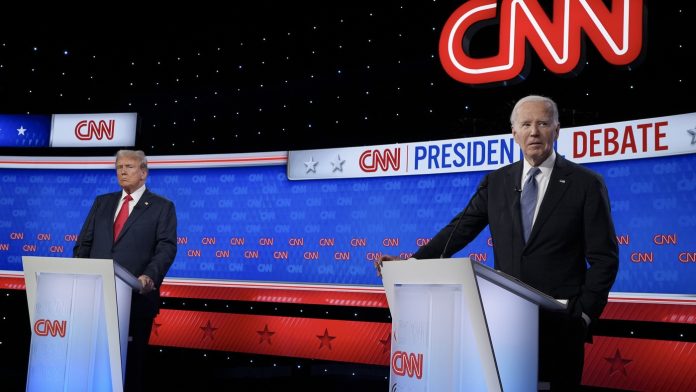
President Joe Biden debated former President Donald Trump on June 27, 2024. Biden’s lackluster performance led to increased calls for him to drop out of the election.

Andrew Harnik/Getty Images North America


hide caption

toggle caption

Andrew Harnik/Getty Images North America

Five months after the 2024 election, some Democrats are still wondering: Why didn’t President Biden end his reelection campaign sooner? Why did he run for reelection knowing that he would have been 82 when he started his second term, and 86 when it ended?

In his new book, Uncharted: How Trump Beat Biden, Harris, and the Odds in the Wildest Campaign in History, author Chris Whipple argues that Biden’s family and closest advisers operated in a “fog of delusion and denial” with regard to his ability to serve another term.

Whipple had his own reasons for wondering if the Biden staff was shielding the president from scrutiny. He notes that when he was working an earlier book, which detailed the first two years of the Biden administration, Whipple asked for an interview with the president and was told he could email questions and receive written answers in reply.

“Clearly, they were uncomfortable even then with the prospect of the president having an interview in real time with a reporter,” Whipple says. “So there’s no doubt that they were protecting the president, they were minimizing his contact with others.”

As the 2024 campaign kicked into gear, the president couldn’t hide from public scrutiny, Whipple says. He notes that in the days leading up to his disastrous debate with President Trump, Biden “was in a terrible state.”

“He was absolutely exhausted. He was unable really to follow what was happening in the campaign. He was tuned out,” Whipple says. “Early on, he walked out of a [debate preparation] session in the Aspen Lodge, the president’s cabin, went over to the pool, sank into a lounge chair, and just fell sound asleep.”

The debate marked a turning point in the Biden reelection campaign — less than a month later, Biden dropped out of the race and endorsed then-Vice President Kamala Harris. Harris would later lose the general election to President Trump.

Whipple sees parallels between the twists and turns of Biden’s reelection campaign and a Shakespearean tragedy.

“I think that it’s unquestionable that there was just an abdication of leadership starting within that inner circle,” he says. “The inability of any of those [staffers] to sit the president down and say, ‘Look, you need to look at this clear eyed and realize that you’re going to be 86 years old and you’re not up to this and everybody knows it.’ That never happened.”

Interview highlights

Uncharted: How Trump Beat Biden, Harris, and the Odds in the Wildest Campaign in History, by Chris Whipple

Uncharted: How Trump Beat Biden, Harris, and the Odds in the Wildest Campaign in History, by Chris Whipple

Harper Collins


hide caption

toggle caption

Harper Collins

On why Biden’s staffers believed he could still govern

I think that this is much more interesting and not nearly as simple as the notion of a cover-up. In other words, I am convinced that Joe Biden’s inner circle was convinced that Joe Biden was capable of governing, and they believed that he could do it for another four years. And we can’t dismiss the fact that Biden on the very last day, July 21st, that Sunday when his aides came to hammer out his abdication statement, Joe Biden was on the phone parsing the details of a complex multi-nation prisoner swap. He was on top of every detail.

People who visited Biden in the Oval Office to talk about the Middle East said he was on top of every nuance of Middle Eastern policy. … Joe Biden, behind closed doors, was governing, capably, whether you liked his policies or not. So there’s no question that he was a shadow of the campaigner that he once was, and that was true from 2020 all the way to the end. But, you can’t dismiss the fact — it’s an inconvenient fact for people who say it was a cover-up — that Biden was capable.

 On Biden and Obama’s relationship

The whole relationship between Joe Biden and Barack Obama is so complex and fascinating and with so many levels to it. I mean, on the one hand, there’s no question about the fact that they really bonded over Bo Biden’s tragic death. And Barack Obama took Joe Biden under his wing, and they developed a closeness there. But at the same time, there’s a real competitiveness between them. And the Obama camp, for example, was not amused when Biden’s staffers were going around early in his first term and talking about how the American Rescue Plan was so much bigger than Obama’s stimulus package back in 2009. They’re just competitive, these two camps. The other major factor here is that Joe Biden never forgave Barack Obama for putting his thumb on the scale for Hillary Clinton to become the nominee in 2016. That was a really deep wound for Joe Biden.

And in the end, it became clear that as during that fateful weekend of July 20-21, that Barack Obama wasn’t really there. He just wasn’t there for Joe Biden. One of Biden’s closest friends told me that the thing that really got him was that Obama never picked up the phone and called him and just said, “You know Joe, geez, are you sure you’re up to this?” That never happened. There was a phone call earlier after the debate saying, “Hey, it was just a bad night. Don’t worry about it.” But when things went south and Biden was on the ropes, Barack Obama never picked up the phone.

On Kamala Harris putting together a “stealth campaign” before Biden officially dropped out

Prior to that weekend when Biden made his decision, up to that point, Harris had had to be absolutely scrupulous. She was walking through a minefield. I mean, she had to be so careful not to give any hint that she was thinking about taking over the top spot on the ticket. But the truth was that she was quietly and secretly preparing. Her camp had reached out to Democratic political operatives who were looking at the rules and getting ready and making sure that if that day came, when that day came, I think they thought that she would be ready to go. And sure enough, she was. But not only were those operatives looking at the rules and figuring out how she could grasp the nomination, they were also putting out the word to some senators that they needed to come out in favor of Joe Biden stepping aside. And so there was a campaign, a stealth campaign going on prior to that Sunday.

On Harris’ inability to differentiate herself from Biden

She had to be prepared for the $64,000 question, which they knew was coming, and that was: What would you do differently from Joe Biden? And when that day came, when Kamala Harris was appearing on the ABC program, The View, it was a disaster. She fumbled the answer. … Inexplicably, she said, “Well, I can’t think of a single thing,” was how she began the answer. That was immediately turned into a campaign commercial by the Trump team, which was devastating. And that was a real turning point of the campaign. … She was prepared, but she couldn’t answer the question. and I think the reason is that fundamentally Kamala Harris was loyal to Joe Biden.

One of the ironies here is that her top campaign officials, Jen O’Malley-Dillon and Lorraine Voles, had gone to the White House and specifically sat down with Jeff Zients, Joe Biden’s chief of staff, and in effect asked for permission to separate themselves from Biden. And Zients told them, go for it. Do whatever you have to do. Not only that, Joe Biden personally called Kamala Harris and said, look, I get it. You need to win this campaign and don’t worry about hurting my feelings, in effect, not in those words. It’s fascinating to me that even then she was unable to make that break.

Sam Briger and Anna Bauman produced and edited this interview for broadcast. Bridget Bentz, Molly Seavy-Nesper and Dana Farrington adapted it for the web.

House GOP leaders prep vote on budget despite rift within the party : NPR

0

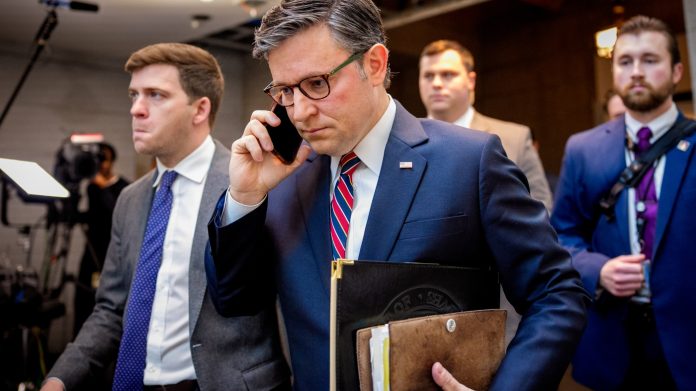
Speaker of the House Rep. Mike Johnson (R-LA) arrives for a House Republican Caucus meeting at the U.S. Capitol on April 8, 2025. (Photo by Andrew Harnik/Getty Images)

Andrew Harnik/Getty Images/Getty Images North America


hide caption

toggle caption

Andrew Harnik/Getty Images/Getty Images North America

House Speaker Mike Johnson, R-La., says he’s forging ahead with a plan to have the chamber vote on the Senate’s budget resolution on Wednesday, despite not yet having the votes to pass it. The intra-party dispute is a litmus test not only of the strength of Johnson’s speakership but also of the conference’s loyalty to President Trump.

The Senate passed a budget framework in the early hours on Saturday, a critical step in unlocking a legislative path forward for much of Trump’s agenda. In order to advance, both chambers have to get on board with the same resolution.

But GOP members left a weekly conference meeting Tuesday saying they don’t think they have the votes to pass the resolution, with deficit hawks and fiscal conservatives arguing the Senate version doesn’t include enough spending cuts alongside tax cuts.

“The Senate budget does not reduce deficits. The Senate budget would increase deficits,” Texas Rep. Chip Roy, a member of the House Freedom caucus, told reporters. “The Senate needs to produce a plan to us with seriousness and resolve to reduce deficits. I’m tired of the fake math in the swamp.”

Johnson can only afford to lose three lawmakers. Larger opposition threatens to undermine Republican plans to use a budget tool called reconciliation to pass items like increasing spending on border security and extending the tax cuts from the first Trump administration, which expire at the end of the year.

Lawmakers from across the party have opposed the Senate resolution, from Freedom Caucus members to Pennsylvania Rep. Lloyd Smucker to House Budget Committee Chairman Jodey Arrington, who called the resolution “unserious and disappointing.”

Their objections range from philosophical differences over how much to reduce the deficit by, to concerns about the programs that could be affected in the process. For example, the House-passed resolution from February directs the Energy and Commerce Committee to find $880 billion in savings. That committee has jurisdiction over spending for programs like Medicaid, and various GOP members and senators have already said they won’t support such steep cuts to a popular social safety net program.

Johnson tried to rally members on Tuesday, making the pitch that the House can still achieve historic spending reductions in the final bill.

“The budget resolution is not the law, okay? All this does is it allows us to continue the process, begin drafting the actual legislation that really counts,” he said at a press conference at the Capitol.

“The House is not going to participate in an us versus them charade,” he added. “To secure and accomplish our mission, we’ve got to be working together.”

Johnson’s goal is to get the final bill to President Trump’s desk by Memorial Day.

A group of House Republicans is scheduled to visit the White House Tuesday afternoon. But several of the most outspoken opponents of the Senate resolution said they either weren’t invited to the meeting or declined to attend.

Trump, who has previously helped whip support among GOP holdouts for his priorities, hasn’t minced words on what he wants the House to do.

“THE HOUSE MUST PASS THIS BUDGET RESOLUTION, AND QUICKLY,” he posted on social media Monday night.

It’s possible the proposed midweek vote could be shifted to later this week if GOP House leadership can’t get the votes in time for Wednesday.

Supreme Court lets Trump move forward with firing thousands of federal workers : NPR

0

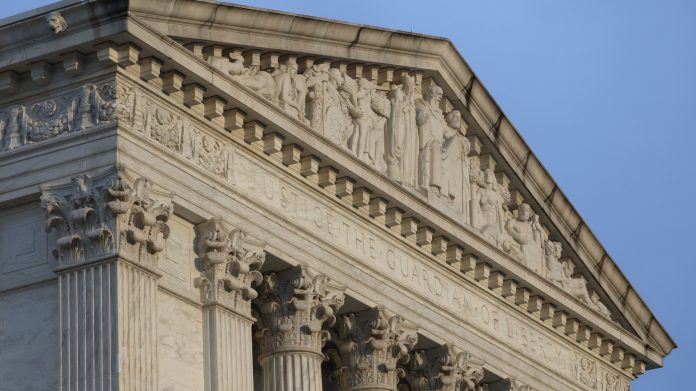
The U.S. Supreme Court is shown March 17, 2025 in Washington, DC.

Win McNamee/Getty Images North America


hide caption

toggle caption

Win McNamee/Getty Images North America

The U.S. Supreme Court on Tuesday allowed the Trump administration’s firing of 16,000 probationary federal employees go forward, at least for now.

In an unsigned opinion and without reaching the question of whether the terminations themselves were lawful, the court said that the nonprofits that brought the case did not have legal standing to sue over federal employees’ firings.

The vote was 7 to 2. Justices Sonia Sotomayor and Ketanji Brown Jackson would have kept the firings paused while the case plays out in the lower courts.

The court’s narrow ruling applies only to the nonprofits in Tuesday’s lawsuit, and it did not decide on the case as a whole. Nonetheless, the court’s decision makes it more difficult for groups affected by government layoffs to challenge mass firings systematically.

In that sense, the court’s action is a victory for the Trump administration and its effort to dramatically shrink federal agencies and programs, concentrating executive power in the White House.

Probationary employees dismissed

Following an executive order signed by President Trump on February 11, The Office of Personnel Management told agencies to terminate all but essential probationary employees. Probationary employees are typically recent agency hires or tenured employees serving in new roles.

Various agencies promptly began firing employees, ultimately totaling tens of thousands. Federal workers’ unions and a group of nonprofit organizations sued the Office of Personnel Management and several agencies, including the Departments of Veterans Affairs, Agriculture, Defense, Energy, Interior and Treasury, to halt the firings.

Those challenging the dismissals argued that OPM doesn’t have the authority to order firings. They also argued that the federal government did not follow the proper procedures for firing probationary federal workers, including adequate notice for the terminated employees as well as notice to affected state and local governments.

Judge William Haskell Alsup, a former President Bill Clinton-appointed district court judge in San Francisco, initially ruled that while the unions had no legal standing to bring the case, the nonprofits did have standing because they depend on government services and say they’re negatively affected by the government’s reduced capacity, he said.

After a brief hearing last month, Alsup reinstated federal employees at six departments — the Departments of Agriculture, Defense, Energy, Interior, Treasury and Veterans Affairs.

Alsup said that the Office of Personnel Management, which helps set the government’s human resources policies, could not direct agencies to conduct mass firings. Rather, only the departments themselves may make those decisions.

The government countered that OPM did not direct agencies to do anything, and that the terminations were otherwise lawful. It took that argument to the court of appeals, which refused to intervene immediately.

So the Trump administration kicked the case up to the Supreme Court, asking the justices to come to the rescue.

In its Supreme Court briefs, the government contended that the terminations, like all employment disputes, were exclusively between the federal government and its employees. The government insisted the nonprofits didn’t have standing to bring this case on behalf of the employees because the employees themselves needed go through the proper, yet limited, channels to challenge their firings, with each employee fighting his or her own battle.

Indeed, a majority of the court seemed to side with the Trump administration on that point, ruling that Judge Alsup’s decision allowing the nonprofits to continue bringing their case was a mistake.

That being said, the Supreme Court’s stay, which allows the administration to execute the firings for now while it litigates in federal court, does not mean the terminations were lawful. The High Court did not reach those questions Tuesday, and left the door open for other parties, with better standing arguments, to bring a case in the future.

Still playing out in the lower courts is a similar challenge in Maryland where 19 states and the District of Columbia sued to reinstate employees at more than 20 different agencies, and so far have partially prevailed. The Maryland case, as opposed to Tuesday’s case, may still prevail because it was brought by states, which have a better standing argument.

Trump says the U.S. will hold direct talks with Iran : NPR

0

A man writes a slogan on a portrait of the U.S. President Donald Trump during a rally commemorating anniversary of Iran’s 1979 Islamic Revolution that toppled the late pro-U.S. Shah Mohammad Reza Pahlavi and brought Islamic clerics to power, in Tehran, Iran, Monday, Feb. 10, 2025. Trump says the US and Iran will have direct nuclear talks soon.

Vahid Salemi/AP/AP


hide caption

toggle caption

Vahid Salemi/AP/AP

President Trump said that the United States will hold direct talks with Iran on its nuclear program, starting Saturday.
 
“We have a very big meeting, and we’ll see what can happen. And I think everybody agrees that doing a deal would be preferable to doing the obvious,” Trump said, as he met with Israeli Prime Minister Benjamin Netanyahu in the Oval Office.

During his first term, Trump withdrew from the 2015 landmark nuclear deal with Iran negotiated by then-President Barack Obama.

Trump offered few details about the upcoming talks, only saying the meeting will be at “almost the highest level.”

Netanyahu, who has frequently called the possibility of a nuclear-armed Iran an existential threat to Israel, said he and Trump are united in the goal that Tehran will never get nuclear weapons.

“If it can be done diplomatically in a full way, the way it was done in Libya, I think that would be a good thing, Netanyahu said. “But whatever happens, we have to make sure that Iran does not have nuclear weapons.”

Trump said it would be in Tehran’s best interests to make a deal with his administration.

“We are dealing with them directly and maybe a deal is going to be made. That would be great, it would be really great for Iran,” he said, warning that if the talks weren’t successful “it will be a very bad day for Iran.”

Gaza ‘freedom zone’

The meeting Monday was the second between the U.S. and Israeli leaders since Trump began his second term. During their first meeting, also at the White House, Trump announced a proposal to remove the Palestinian population of some 2 million people from the Gaza Strip, where Israel has been fighting Hamas since the militant group launched an assault on Israel in October 2023.

Netanyahu’s visit comes just weeks after the Israeli military resumed a major ground offensive in Gaza, shattering hopes that a ceasefire would be extended to get out more the remaining 58 Israeli hostages taken by Hamas 18 months ago. More than 30 are believed to be dead.

Trump said he hoped a new ceasefire could be worked out, and that remaining Israeli hostages would be released.

He also returned to his vision of the future of a post-war exodus of Palestinians from Gaza, which Arab nations have roundly rejected.

“I think it’s an incredible piece of important real estate, and I think it’s something that we would be involved in. But, you know, having a peace force like the United States, there controlling and owning the Gaza Strip, would be a good thing,” he said.

He said if the Palestinians were moved to other countries, the Gaza Strip could then become what he termed a “freedom zone.”


House and Senate members at odds over budget framework ahead of 2-week recess

0

Republicans hope to make progress this week on the president’s domestic agenda. But there are signs of trouble between members in the House and Senate — right before they leave for a two-week recess.

Trump’s election order could jeopardize last-minute mail ballots : NPR

0

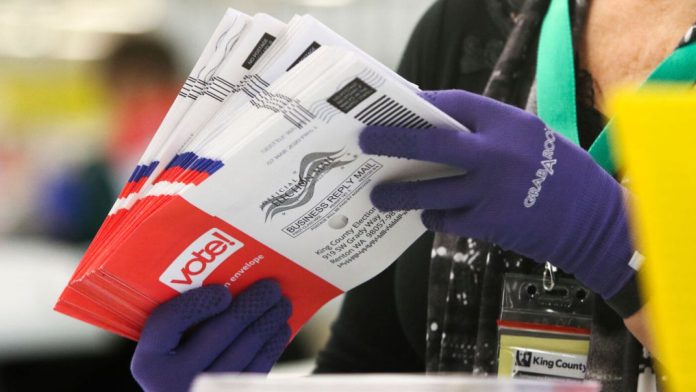
An election worker sorts vote-by-mail ballots for the presidential primary at King County Elections in Renton, Wash., in March 2020.

Jason Redmond/AFP via Getty Images


hide caption

toggle caption

Jason Redmond/AFP via Getty Images

The state of Washington has been allowing election officials to count mail ballots that don’t make it to their office until after Election Day for more than a hundred years now. It’s a practice that could be prohibited in upcoming elections, thanks to a sweeping executive order signed by President Trump last month.

“All the way back in 1917, we started this tradition and have since modified the language a little bit,” said Stuart Holmes, the director of elections for Washington’s Secretary of State’s Office.

Holmes said this grace period is something that many voters in Washington have come to rely on. In the last presidential election, state officials reported they counted more than 250,000 ballots that didn’t make it to their offices until after Election Day.

“At no fault of the voters, there could be some unforeseen delay in getting that to the county auditor’s office or otherwise prevented to be received on Election Day,” Holmes told NPR. “And so, Washington’s had this long-standing tradition as long as we’ve been absentee voting to allow ballots to be received after Election Day and counted and included in the election results.”

According to the National Conference of State Legislatures, 18 states — plus the Virgin Islands, Puerto Rico and Washington, D.C. — count mail-in ballots that are received by election officials after Election Day. Most states require the ballots be postmarked by or before Election Day.

States with a large share of mail ballots often take more time to count votes. Mail-in ballots take longer to process. Election officials are often counting ballots in the days after Election Day regardless of whether ballots make it back to them before or after in-person voting ends.

Republicans have argued, without evidence, that the longer a state takes to count ballots after Election Day, the less secure their elections are. Misinformation about this — which proliferated after the 2020 election — has led to calls for limits to the counting of mail ballots.

To that end, Republicans have sought to eliminate these grace periods in states across the country — both through legislation and legal challenges. The success of those efforts has been mixed.

This effort got a significant boost last month, however, when Trump signed an executive order that, among other things, specifically prohibits this practice. He cited voter fraud while signing the order.

“This will go a long way toward ending it,” Trump said. “There are other steps that we will be taking next in the coming weeks.”

Barbara Smith Warner with the National Vote at Home Institute — which advocates for wider access to mail-in voting — said there’s no proof that counting ballots after Election Day makes elections less secure. She said getting rid of these grace periods would mostly just trip up voters who are used to returning their ballots closer to Election Day.

“It’s going to lead to voter confusion,” Warner said, “and ultimately not only disenfranchisement of those folks, but the bigger term impact is going to be people being afraid to vote, or thinking, ‘OK, I’m afraid I’m going to do this wrong, and so I’m just not going to do it at all.’ It is going to keep people from voting.”

According to data provided to NPR, six states — Alaska, Illinois, Maryland, Nevada, Ohio and Oregon — plus Washington, D.C., counted more than 170,000 mail-in ballots in total during the last presidential election that were received after Election Day. In California — where more than 13 million mail-in ballots were cast last year — voters have a week-long grace period.

In Washington state, Holmes said he and other officials in the state do not want their voters to lose access to voting because of issues with the post office. He said he anticipates that if Trump’s order stands, it would disproportionately affect rural voters across the country, as well as busy people who remembered to put their ballots in the mail closer to Election Day.

“The impacts for the voters would be substantial and significant,” he said, “likely resulting in thousands, hundreds of thousands of ballots being rejected simply just based on timeliness alone.”

Whether Trump’s order stands, though, is an open question. So far, there’s been a slew of lawsuits filed against the Trump administration in response to this election order — including one recently filed by 19 states.

Ultimately, Warner said, she thinks Trump will not be allowed to tell states they can’t count mail ballots after Election Day.

“The president has no ability to tell the states how to run their elections,” she said. “That is actually in the Constitution, a right that is given to the states to determine how they run their elections.”