Thursday, November 12, 2026
Home Blog Page 47

Why did ICE ship at least 4 academics it wants deported to Louisiana and Texas? : NPR

0

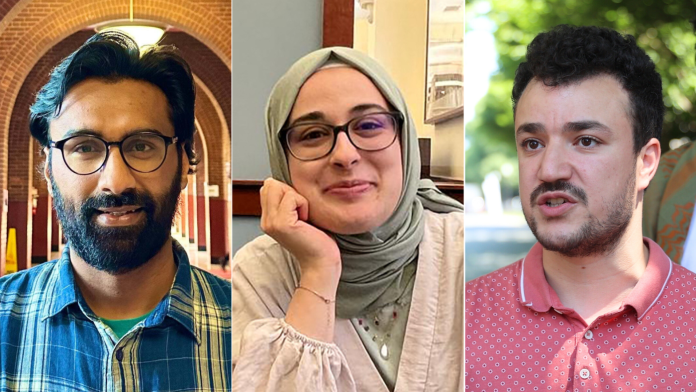
Badar Khan Suri, Rumeysa Ozturk and Mahmoud Khalil were arrested by immigration officials and, in a matter of hours, were sent to detention centers in Louisiana and Texas — more than a thousand miles from home.

Via Georgetown; via Ozturk family/Reuters; Selcuk Acar/Anadolu via Getty Images


hide caption

toggle caption

Via Georgetown; via Ozturk family/Reuters; Selcuk Acar/Anadolu via Getty Images

After a dinner with his wife and friends, Mahmoud Khalil was arrested by immigration agents at his New York apartment on March 8. The next night, the Columbia University graduate student went to bed in a remote Louisiana detention center almost three hours from the nearest city. Mask-wearing agents picked Tufts student Rumeysa Ozturk up off the street near Boston, and less than a day later checked her into a private prison in rural, southern Louisiana. Georgetown scholar Badar Khan Suri was arrested near Washington, DC, and shipped first to Louisiana before being sent to a detention center in Texas.

Students and scholars that the Trump administration has arrested as part of the president’s promise to deport pro-Palestinian activists have been whisked in some case more than a thousand miles away – despite their lawyers’ attempts to stop it – to detention centers in the remote South that advocates have described as “black holes” where people are kept in deplorable conditions.

Louisiana, Texas and Mississippi are home to 14 of the 20 largest immigration detention centers in the country. Democratic and Republican administrations have long used them as a hub for immigrant detention.

Immigration and Customs Enforcement’s decision to quickly ship several of the academics arrested in the last few weeks to Louisiana has brought heightened awareness to how crucial the state has become in the process since Donald Trump’s first term. And it has revived concern about a longstanding practice called “forum shopping,” a strategy lawyers for the detained say the government is using to have these deportation cases heard before more conservative courts.

A Customs and Border Patrol officer watches as Homeland Security Secretary Kristi Noem tours the San Ysidro Port of Entry, March 16, 2025, in San Diego.

A Customs and Border Patrol officer watches as Homeland Security Secretary Kristi Noem tours the San Ysidro Port of Entry, March 16, 2025, in San Diego.

Alex Brandon/AP/AP


hide caption

toggle caption

Alex Brandon/AP/AP

In court papers, government lawyers claim ICE sent Khalil, Khan Suri and Ozturk to Louisiana because there were no available beds or “detention space” in facilities closer to where they were arrested.

On Friday, the federal judge hearing a challenge to Ozturk’s arrest questioned the credibility of the government’s claim. In her ruling rejecting the government’s request to transfer the case to Louisiana, the judge noted that when the Turkish national was picked up outside Boston, there were available beds about a hundred miles away at an ICE facility in Maine.

And a lawyer for Khan Suri, a Georgetown University professor and Indian national, asked why – if the government was looking for bed space – her client is now sleeping on the floor.

In an interview with NPR, she said Khan Suri, who is now being held at the Prairieland Detention Center in Alvarado, Texas, is on a mattress in a common room because no beds are available.

“It’s pretty alarming,” said Edith Heilman, a legal director for the ACLU of Virginia, which has taken on Khan Suri’s case. “There appeared to be an effort to get him out of the state of Virginia.”

Brett Kaufman, an ACLU attorney, said sending detainees south is not about bedspace.

“It’s now a pattern, I think, that has become quite clear,” he said. “The government believes it has an advantage if it brings people down there.”

Lawyers for detained say the government is following a pattern

Today, Louisiana has the second highest number of detainees in the country after Texas. Of the roughly 47,000 people ICE was holding nationwide last month, more than 7,000 of them were in Louisiana, according to data from TRACreports, a nonpartisan firm that analyzes immigration data. ICE has nine detention jails in the state, most run by for-profit companies, and 23 in Texas.

Kaufman said shipping an immigrant far away for detention makes it harder to fight deportation.

“You take someone away from their community, from their family, from their lawyers,” he said. “It really is a huge, debilitating thing to not be able to walk into a facility and spend time with your client face to face.”

The Department of Homeland Security’s ICE detention facility is shown in Jena, La., on March 21. Mahmoud Khalil, a Columbia graduate student, and a recently detained doctoral student from the University of Alabama named Alireza Doroudi are both being held at this detention center.

The Department of Homeland Security’s ICE detention facility is shown in Jena, La., on March 21. Mahmoud Khalil, a Columbia graduate student, and a recently detained doctoral student from the University of Alabama named Alireza Doroudi are both being held at this detention center.

Stephen Smith/AP/AP


hide caption

toggle caption

Stephen Smith/AP/AP

But legal experts have also noted another possible advantage for the government of sending people south. Several of the arrested academics have filed federal challenges to their arrests. If those cases are heard by a federal court in Louisiana, any appeals would be heard by the Fifth Circuit court of appeals, widely considered the most conservative in the country.

“If the Fifth Circuit was known to be particularly liberal and friendly to immigrants, there’s no way, in my view, they would have moved them there,” said Amanda Frost, a law professor at the University of Virginia

The Justice Department declined NPR’s request that it respond to the claims that the government is seeking out more favorable jurisdictions. ICE did not respond to a request for comment for this story.

Protesters gather outside federal court during a hearing with lawyers for Rumeysa Ozturk, a Tufts University doctoral student from Turkey who was detained by immigration authorities on April 3 in Boston.

Protesters gather outside federal court during a hearing with lawyers for Rumeysa Ozturk, a Tufts University doctoral student from Turkey who was detained by immigration authorities on April 3 in Boston.

Rodrique Ngowi/AP/AP


hide caption

toggle caption

Rodrique Ngowi/AP/AP

Khalil, a lawful permanent resident who is Palestinian but was born in Syria, was arrested in New York and briefly held in New Jersey. But the government has since been arguing his lawsuit challenging his arrest should be heard in Louisiana because that’s where he’s now detained.

But last week, a federal judge ruled the case will be heard in New Jersey, where Khalil was when his lawyer filed her case. The government plans to appeal.

Lawyers for some of the other detained academics have been seeking similar rulings.

On Friday, a federal judge ruled that Ozturk will have her case heard in Vermont. Attorneys for Khan Suri have asked a federal judge to keep his case in Northern Virginia. In all of these federal cases, the academics are accusing the government of violating their constitutional rights.

Even as their suits against the Trump Administration move forward, the government is moving forward to try to deport them. Khalil is scheduled to appear before an immigration judge in Louisiana on Tuesday. The government is trying to strip his green card on charges his pro-Palestinian activism “aligned with Hamas terrorism.” His lawyers say the charges against him are baseless, and say officials have not provided any evidence to support them.

U.S. students face deportation after speaking out about Gaza : NPR

0

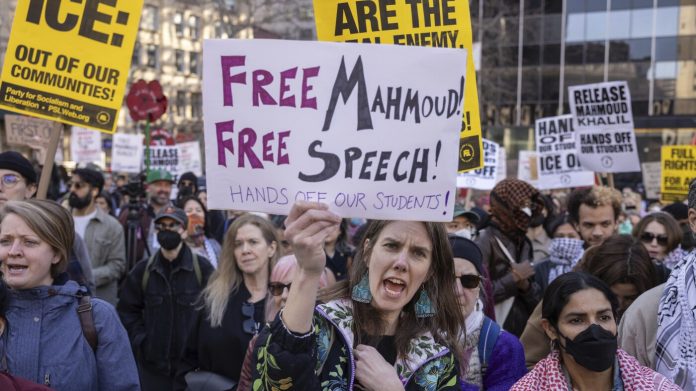
Protesters attend a demonstration in support of Palestinian activist Mahmoud Khalil in New York City on March 10.

Yuki Iwamura/AP


hide caption

toggle caption

Yuki Iwamura/AP

In recent weeks, several international university students have been taken by immigration agents or had their legal status questioned.

Turkish graduate student Rumeysa Öztürk was detained by masked agents in plainclothes as she walked to meet friends for dinner. She says she is being targeted over an op-ed about Gaza that she wrote in the Tufts University student newspaper.

Columbia University graduate student Mahmoud Khalil was arrested in his university housing despite being a legal permanent resident. He says he was taken over his peaceful protests against Israel’s war in Gaza.

YouTube

Columbia University Ph.D. student Ranjani Srinivasan was accused publicly by the Department of Homeland Security of being a terrorist sympathizer, with no evidence, when she got notice that her visa was revoked. She chose to leave.

Their cases raise concerns that more students could be targeted for their views. That alarm is found among free speech advocates across the political spectrum, including pro-Palestinian and pro-Israel groups that uphold the First Amendment for views they both agree and disagree with.

Tune in to NPR and visit NPR.org every day this week for in-depth stories on “The State of the First Amendment: The Right From Which All Other Rights Flow.” 

Secretary of State Marco Rubio said he has revoked more than 300 visas and has defended the decisions.

“We gave you a visa to come and study and get a degree, not to become a social activist that tears up our university campus. We’ve given you a visa and you decide to do that — we’re going to take it away,” Rubio said in a recent news conference.

None of these students has been charged with a crime. Instead, the government is using a rarely invoked immigration act that allows the secretary of state to revoke immigration status if the secretary deems their presence a threat to U.S. foreign policy.

The students, their families and their lawyers say these detentions and visa revocations should worry every American.

“This is what happens in a dictatorship, and these are test cases,” said Eric Lee, a lawyer who represents Momodou Taal, a Cornell University Ph.D. student and advocate for Palestinian rights whose visa was revoked. “If the government can get away with doing this to these students, it can do it to everybody in this country. Your citizenship won’t save you. … Your views will be next.”

Taal sued the government on the grounds of free speech this year. After the case was filed, Immigration and Customs Enforcement called on Taal to turn himself in for deportation. Taal didn’t turn himself in and continued the case until just over a week ago, when he issued a public statement on X sharing that he had left the country.

This photo shows Momodou Taal from about the shoulders up. He's wearing a black cap and a red and white keffiyeh that's draped around his shoulders.

Momodou Taal is a Cornell University Ph.D. student and advocate for Palestinian rights whose visa was revoked.

Via Eric Lee


hide caption

toggle caption

Via Eric Lee

“Given what we have seen across the United States,” he wrote, “I have lost faith that a favourable ruling from the courts would guarantee my personal safety and ability to express my beliefs. I have lost faith I could walk the streets without being abducted.”

The suit has now been withdrawn, but Taal’s lawyers say the implications of this case go well beyond their client.

“The First Amendment applies to people who are physically in the United States, regardless of their alienage, regardless of what country they were born in, regardless of the color of their skin, regardless of their immigration status,” Lee said. “By … saying that attending a protest makes one a threat to American foreign policy, the administration is admitting that the Constitution is getting in the way of the fight for democracy. Something is not right there.”

Defenders of the Trump administration’s policy say it’s about national security.

Critics of the detentions are using words like “abducted” and “disappearing” to describe them, calling them an affront to the Constitution, which protects free speech for immigrants and citizens alike.

The concern centers on a question: Is immigration being used to censor viewpoints?

That question goes beyond these students.

A Nobel Peace Prize laureate and two-time president of Costa Rica recently had his visa revoked. Óscar Arias Sánchez was told it was because of his close ties to China. He resumed relations with the country in his second term as president from 2006 to 2010.

Arias has been a vocal critic of President Trump online, comparing him to a “Roman emperor, telling the rest of the world what to do” in a social media post.

“I have to imagine that my criticism of President Trump might have played a role,” he said in a recent interview with NPR. “The president has a personality that is not open to criticism or disagreements.”

The detentions and visa revocations have some other green-card holders and visa holders, even those who are not students, watching and worrying.

Raymond, a lawful permanent resident from Hong Kong who asked us not to use his full name in case it impacts his immigration status, said he worries that political opinions he has shared online might be used against him when returning to the United States. He’s not a student, but he said he has started scrubbing his social media and he’s considering hiding his Instagram app before an upcoming trip abroad for a wedding.

For the first time since he has been in the United States, he also thinks about what he says and does publicly.

In this photo, protesters hold signs showing support for Palestinians during a demonstration. Some demonstrators are also holding Palestinian flags and wearing keffiyehs.

People hold signs showing support for Palestinians during a Fight for Our Rights demonstration by Shut It Down for Palestine and various local groups at the University of Washington campus in Seattle on March 15.

Jason Redmond/AFP via Getty Images


hide caption

toggle caption

Jason Redmond/AFP via Getty Images

“I don’t join protests now,” he said. “I feel like it’s a stupid thing because I feel like I’m now being compliant before the thing even hits me. But it also feels like the risk is higher … that there’s a higher chance that my legal status is going to be in jeopardy.”

Nothing has happened to Raymond. But because of what he’s seeing, he’s choosing to be silent in public spaces to protect himself.

“The lack of due process is what concerns me more when it comes to freedom of speech,” he said.

World markets regain some ground after Trump tariffs shock investors : NPR

0

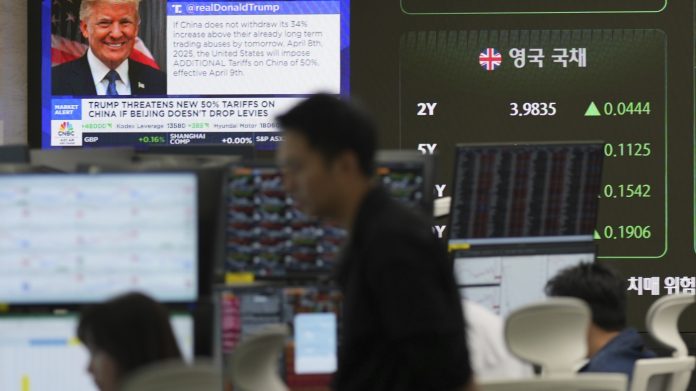
Currency traders watch computer monitors near the screen showing news reporting with a picture of President Trump at a foreign exchange dealing room in Seoul on Tuesday.

Lee Jin-man/AP


hide caption

toggle caption

Lee Jin-man/AP

Shares in Europe and Asia rebounded slightly on Tuesday after several days of sustained sell-offs that saw equity markets crater since President Trump’s announcement of global trading tariffs.

U.S. stock markets may now also be poised for a small jump at the start of the trading day, according to futures trading data that often predicts a market’s opening move. That followed a tumultuous day on Wall Street Monday, where stocks swung wildly for the third consecutive day of trading.

But after major slides and significant volatility in equity trading last week and into Monday — from Shanghai to New York, Frankfurt to Tokyo — any slight uptick in stock prices on Tuesday will only repair part of the value destruction that saw trillions of dollars in investor wealth wiped out over the past few days.

The major stock markets in Hong Kong and Shanghai — the Hang Seng Index and Shanghai Composite, respectively — closed slightly higher on Tuesday, while Tokyo’s Nikkei ended the day’s trading in Japan up more than 6%. It hit its lowest level in 18 months on Monday, with its listed stocks having lost almost a fifth of its value over the past two weeks.

European markets have begun Tuesday’s trading positively, but investors in the continent’s major stock markets have also suffered significant losses in the past week, and that’s even before exporters have really begun to feel the effects of significant tariffs on European products sold to the United States.

As investors seek out assets that can serve as a bulwark against uncertainty in other markets, the price of gold has continued to soar to above $3,000 an ounce, prompting financial analysts to liken the current geopolitical and economic uncertainty to that of the late 1970s and 1980s, when gold prices also spiked significantly.

And in light of the uncertainty over the United States’ future role on the world stage, analysts say another asset usually considered a safe haven for investors — the dollar — may also continue to weaken against other global currencies.

In China, a number of large, government-backed businesses and listed companies have announced they will buy back their own shares, as part of a wider effort to calm the local equity markets.

Officials in China said Tuesday that they wouldn’t back down in the face of Trump’s threats to impose a further 50% tariff on Chinese exports to the U.S., saying “China will fight till the end if the U.S. side is bent on going down the wrong path.”

Democrats hold 'shadow hearing' on what they call Trump's attacks on the rule of law

0

Democrats in Congress on Monday held a “shadow hearing” — without Republicans — to put a spotlight on what they say are President Trump’s attacks on the rule of law.

Iran says U.S. talks to be ‘indirect,’ refuting Trump : NPR

0

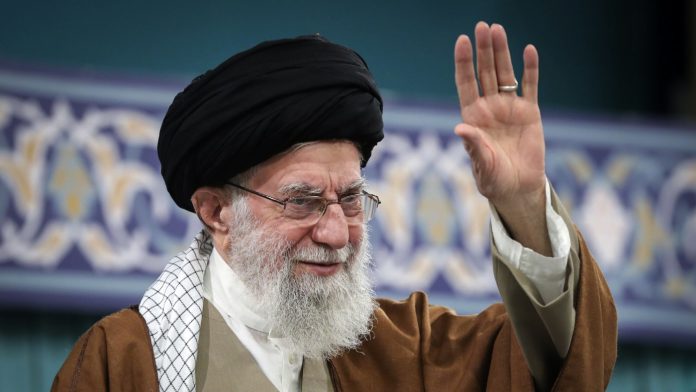
Iranian Supreme Leader Ayatollah Ali Khamenei waves to the crowd in Tehran, Iran, March 31.

Office of the Iranian Supreme Leader/AP


hide caption

toggle caption

Office of the Iranian Supreme Leader/AP

TEL AVIV, Israel — Iran says it will have indirect talks with the United States this weekend in Oman, opening a possible path to diplomacy over Iran’s nuclear program but revealing a potential sticking point about the format for negotiating.

President Trump said Monday, “We’re having direct talks with Iran.” Speaking in the Oval Office beside Israeli Prime Minister Benjamin Netanyahu, Trump said the U.S. and Iran would have “a very big meeting” on Saturday at “almost the highest level.” He did not say where, or who would take part.

Overnight, Iranian Foreign Minister Abbas Araghchi said on social media: “Iran and the United States will meet in Oman on Saturday for indirect high-level talks.”

During Trump’s first term, he withdrew from the 2015 nuclear deal with Iran negotiated by former President Barack Obama and signed by several world powers. As a part of that deal, Iran agreed to limits and inspections on its nuclear development in return for relief from economic sanctions. When Trump withdrew from the deal in 2018, the U.S. imposed tough sanctions and what Trump called “maximum pressure” on the country.

An annual U.S. intelligence report made public last month said “we continue to assess Iran is not building a nuclear weapon.”

This year Iran’s leaders have rejected Trump’s offers to engage in direct negotiations. Iranian President Masoud Pezeshkian cited America’s “breach of promises” and said “they must prove that they can build trust.” An aide to Supreme Leader Ayatollah Ali Khamenei said Iran was open to indirect talks.

Speaking Monday, Trump said, “We are dealing with them directly and maybe a deal is going to be made.” But he warned, “If the talks aren’t successful with Iran, I think Iran is going to be in great danger.”

Writing on X overnight, Iran’s foreign minister said Saturday’s indirect dialogue would be “as much an opportunity as it is a test. The ball is in America’s court.”

China vows retaliation after Trump’s latest tariff threat : NPR

0

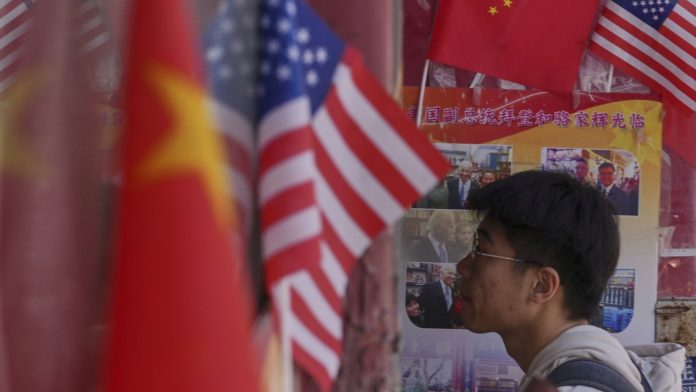
A man walks into a merchandise store displaying Chinese and United States’ national flags, in Beijing on April 3.

Andy Wong/AP


hide caption

toggle caption

Andy Wong/AP

BEIJING — China said on Tuesday it will not back down in the face of President Trump’s fresh threat to impose an additional 50% tariff on Chinese imports, as the trade war between the world’s top two economies looked set to worsen.

Trump said on Truth Social he would impose the new tariffs on China if Beijing did not retract a 34% retaliatory tariff on U.S. goods that it announced in response to Trump’s initial salvo last Wednesday.

In a strongly worded statement, China’s commerce ministry said the U.S. threat to impose additional tariffs “is adding a mistake on top of a mistake, once again exposing the extortionate nature of the United States, which China will never accept.”

“If the United States obstinately clings to this course, China will have no choice but to see it through to the end,” the statement said, adding that if the U.S. escalates its tariff measures, “China will resolutely take countermeasures to safeguard its rights and interests.”

Global equity markets have been pummelled as recession fears have grown following Trump’s “Liberation Day” announcement of tariffs that touch most countries and most U.S. imports.

On Tuesday, however, Asian stocks took a breather and gained ground in early trading, after heavy losses on Monday. Key indexes in China, Japan, Hong Kong and South Korea were up.

If Trump follows through, Chinese goods coming into the U.S. will be subject to a combined 104% tariff. Trump hit Beijing with 20% in tariffs in the first weeks of his presidency, and then an additional 34% tariff on Wednesday.

According to the office of the U.S. Trade Representative, the U.S. imported $438.9 billion in goods from China last year, up 2.8 percent from 2023.

Aowen Cao contributed to this report.

NIH leaders offered Indian Health Service jobs in Alaska, Montana, Dakotas : Shots

0

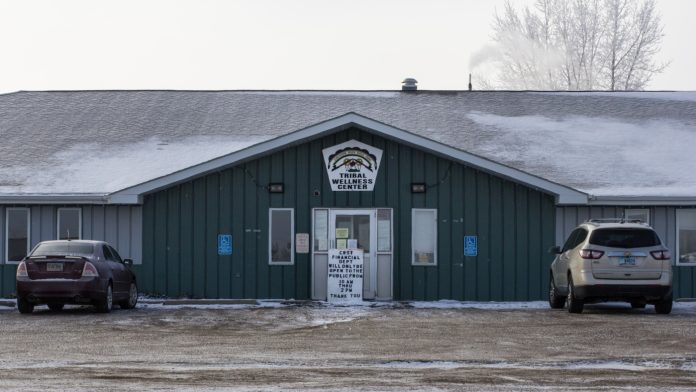
The Cheyenne River Sioux Tribal Wellness Center is an Indian Health Service facility in Eagle Butte, South Dakota. This picture was taken in 2021, when the area was hard hit by the COVID-19 pandemic.

Dawnee LeBeau/Bloomberg via Getty Images


hide caption

toggle caption

Dawnee LeBeau/Bloomberg via Getty Images

The emails started arriving late on a Monday night.

“The Department of Health and Human Services (HHS) proposes to reassign you as part of a broader effort to strengthen the department and more effectively promote the health of American people,” the email read. “One critical area of need is in the American Indian and Alaskan Native communities.”

Amid the Trump administration’s massive layoffs at HHS, these reassignment emails accelerated an apparent purge of leadership at federal health agencies. Top officials in different parts of HHS were put on administrative leave with the option of relocating to a new job in Alaska, Montana, New Mexico or other postings within the Indian Health Service (IHS).

“I did not see this coming at all,” a senior executive at the Department of Health and Human Services told NPR. The executive asked not to be identified for fear of retribution from the administration.

William “Chief Bill” Smith chairs an organization that advocates for the IHS on behalf of tribes, the National Indian Health Board. “Any major leadership changes within IHS should be made in full consultation with Tribal Nations, as required by law,” Smith wrote in a statement to NPR. “Tribal Consultation is not just a procedural step—it is a fundamental responsibility of the federal government.”

“Utmost disrespect”

The number of health leaders who got the emails and the reasons for who was picked remain unclear. The email doesn’t specify what will happen to those placed on administrative leave if they don’t accept the offer.

HHS did not respond to NPR’s questions about the scope of the reassignment offers. NPR has confirmed that nine leaders got the reassignment email; there may be more.

“The move displays the utmost disrespect for public service. It is clearly designed to force talented scientists and health experts to leave government,” says Richard Besser, CEO of the Robert Wood Johnson Foundation, a nonprofit philanthropy focused on health. “It is also an insult to those health care professionals in the Indian Health Service who dedicate their lives to providing health care services on tribal lands.”

It is unclear whether anyone took the offer or plans to take it.

“I’m a career public servant. I’ve worked for Republicans and Democrats,” the HHS executive told NPR. “Public service is noble work, and the ability to serve our country and impact entire populations just by coming to work is a gift. So there’s a sadness that comes with this.”

Connections to Fauci

At the National Institutes of Health (NIH), some sources who spoke to NPR suspect the targets were picked as retribution dating back to the COVID-19 pandemic.

Dr. Jeanne Marrazzo, who took over as the director of the National Institute of Allergy and Infectious Diseases after Dr. Anthony Fauci departed, got the offer, according to an email obtained by NPR.

So did Fauci’s wife, Christine Grady, the top bioethicist at the NIH, along with two others close to Fauci, according to a source who was not authorized to speak about the situation.

Fauci, who left the NIH in 2022, became a hero to many during the pandemic, but he has also been vilified by critics of the government’s response. Dr. Francis Collins, who also worked closely with Fauci as NIH director, was recently forced out of the agency.

The offer appears to be “an opportunity to try and say they’re not being let go — they’re being offered a new opportunity,” said Susan Polan, associate executive director of the American Public Health Association. But that “does not seem to be the ultimate goal. The goal really does seem to be to undermine the leadership in these agencies.”

IHS used as “a pawn”

Polan spoke during a briefing last week by public health advocates and officials decrying cuts of about 10,000 workers at the Centers for Disease Control and Prevention, the Food and Drug Administration, the NIH and other agencies.

“IHS needs are not being met and it is being used as a pawn in the game of forcing HHS staff to resign instead of being fired,” Polan added later in an email to NPR.

“It’s a way to try to get people to quit,” added Dr. Philip Huang, director of Dallas County Health and Human Services, at the briefing.

The Indian Health Service provides crucial services and deserves to be adequately staffed with the most qualified workers, Huang and others at the briefing said.

The officials, who got the offer on Monday, March 31, or Tuesday, April 1, had until 5 p.m. ET on Wednesday, April 2, to respond to the offer, according to the email obtained by NPR.

The email reads: “This underserved community deserves the highest quality of services, and HHS needs individuals like you to deliver that service.” It is from Thomas J. Nagy Jr., deputy assistant secretary for human resources at HHS.

Reassignment locations

Nagy’s email gives the officials the options of working in a variety of places that are a mix of states, cities and reservations. They appear to correspond to IHS areas, an official designation, with some exceptions. This is the list from the email:

  • Alaska
  • Albuquerque [New Mexico]
  • Bemidji [Minnesota]
  • Billings [Montana]
  • Great Plains [South Dakota, North Dakota, Nebraska, Iowa]
  • Navajo [Arizona, New Mexico, Utah]
  • Oklahoma

“We would like to understand your preference across these potential reassignment opportunities,” the email says.

“Specifically, we would like to know which regions you would accept a voluntary reassignment and the order of your preference, if any, across the regions,” it states.

Health leaders offered transfer

According to sources who shared information with NPR on the condition of anonymity because they are not authorized to speak to the press, officials in addition to Marrazzo and Grady who received the IHS reassignment offer include:

— Dr. H. Clifford Lane, deputy director for clinical research at the National Institute of Allergy and Infectious Diseases, who had long worked with Fauci

— Dr. Emily Erbelding, director of the Division of Microbiology and Infectious Diseases at the National Institute of Allergy and Infectious Diseases

— Renate Myles, director of communications for the NIH

— Dr. Eliseo J. Pérez-Stable, director of the National Institute on Minority Health and Health Disparities

— Shannon Zenk, director of the National Institute of Nursing Research

— Dr. Diana Bianchi, the director of the Eunice Kennedy Shriver National Institute of Child Health and Human Development

— Brian King, director of the Food and Drug Administration’s Center for Tobacco Products

IHS is a priority for RFK Jr.

The Indian Health Service was an early target of Elon Musk’s DOGE cuts, when 950 employees were fired in February. But HHS Secretary Robert F. Kennedy Jr. quickly intervened and said all of those staff members should be rehired. “The Indian Health Service has always been treated as the redheaded stepchild at HHS,” Kennedy said at the time in a written statement to ICT, a nonprofit news organization that covers Indigenous people.

This photo shows two SUVs lined up in a parking lot. A worker with a clipboard is standing next to the open driver's window of one vehicle. Other workers wearing medical-style masks and fluorescent safety vests stand in the parking lot.

A COVID-19 vaccination event organized by the Navajo area Indian Health Service in Gallup, New Mexico, in March 2021.

Cate Dingley/Bloomberg via Getty Images


hide caption

toggle caption

Cate Dingley/Bloomberg via Getty Images

Kennedy announced he would be visiting the Navajo Nation in a Western trip from Monday through Wednesday. Kennedy dubbed it a “MAHA tour” — referring to his Make America Healthy Again slogan. He will also go to Arizona and Utah and meet with tribal leaders, though HHS did not share a precise itinerary in a news release on the trip.

Indian Health Service and all HHS divisions have been ordered to cut contract spending by 35%, HHS spokesman Andrew Nixon confirmed to NPR.

Dr. Georges Benjamin, executive director of the American Public Health Association, says broader cuts to federal health programs affect tribal communities too. “When they cut grants or close down CDC programs, they also directly and indirectly cut IHS programs,” he says.

Benjamin says he doesn’t think the intent of the NIH reassignment offers was to “hurt or demean” IHS, but to “take a person trained in clinical skills that has not been practicing clinically is usually not helpful if the job is a clinical one or even a clinical manager job.” He added: “The most cynical view is this is a way to get senior people to quit.”

Smith, who is from Valdez village in Alaska and who chairs the National Indian Health Board, says tribal leaders need the chance to weigh in on any changes.

“We urge the Department of Health and Human Services (HHS) to uphold this obligation and engage in meaningful Tribal Consultation before moving forward with any reassignments,” Smith wrote in the statement.

Other top federal health officials who have been recently forced out include Dr. Peter Marks, who was the top vaccine regulator at the Food and Drug Administration.

Health secretary RFK Jr. endorses the MMR vaccine — stoking fury among his supporters : Shots

0

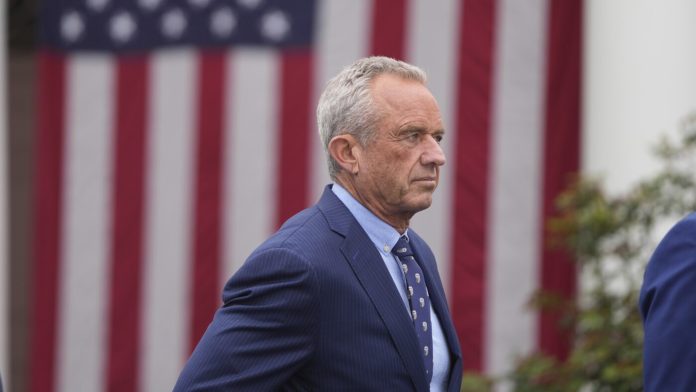
Health and Human Services Secretary Robert F. Kennedy Jr. arrives before President Trump speaks during an event to announce new tariffs Wednesday in the Rose Garden at the White House in Washington, D.C.

Mark Schiefelbein/AP


hide caption

toggle caption

Mark Schiefelbein/AP

An endorsement of the measles, mumps and rubella vaccine by Health and Human Services Secretary Robert F. Kennedy Jr. has provoked an angry outcry from anti-vaccine activists.

“The most effective way to prevent the spread of measles is the MMR vaccine,” Kennedy said in the third paragraph of a lengthy post on the social media platform X. Kennedy made the post following meetings on Sunday in Gaines County, Texas with the families of two children who have died of measles during a recent outbreak in the state. He also said he had instructed the Centers for Disease Control and Prevention to “supply pharmacies and Texas run clinics with needed MMR vaccines,” along with other medical supplies.

Kennedy’s endorsement is in line with all available scientific evidence on the MMR vaccine. “A single dose is roughly 93% effective at preventing illness, and the second dose gets that up to 97%,” says Dr. Paul Offit, director of the Vaccine Education Center at the Children’s Hospital in Philadelphia. According to the Texas Department of State Health Services, just 10 of the 481 measles cases recorded as of April 4 were in partially or fully vaccinated individuals — that’s around 2% of all overall cases. So far three unvaccinated people, the two children in Texas and an adult in New Mexico, have died from the disease.

“I’m delighted to hear what Secretary Kennedy has said about giving the vaccination,” says Dr. Kathryn Edwards, a retired professor of pediatric infectious disease. Edwards said she’d hoped for an explicit endorsement of the vaccine much earlier in January but that “it’s better late than never.”

But Kennedy’s suggestion that the vaccine was effective infuriated several members of the anti-vaccine community who responded on X to the statement.

Anti-vaccine anger

“I’m sorry, but there is no defense for this poorly worded statement,” wrote Dr. Sherri Tenpenny, a prominent anti-vaccine activist who once claimed during a legislative hearing in Ohio that the COVID vaccine could cause patients to become magnetized, allowing them to stick “spoons and forks” all over their bodies.

Del Bigtree, a prominent anti-vaccine activist who supported Kennedy’s presidential run and recently co-founded a non-profit with him called MAHA Action, also questioned the health secretary’s endorsement. Bigtree suggested that Kennedy’s post had “got cut off.” He then went on to make unproven claims about vaccines and autism, and linked to a documentary he had made on the topic.

“We voted for challenging the medical establishment, not endorsing it,” posted Dr. Mary Talley Bowden, a Texas-based physician who has opposed COVID vaccines and is currently fighting a complaint from Texas’s medical board over hospital admitting privileges. Bowden says the complaint is related to her prescribing patients ivermectin. Ivermectin is an unproven alternative therapy for COVID.

“Kennedy was one of those candidates that attracted people who might not vote for Trump,” Bowden told NPR in an interview. Much of the attraction was from people who were “very fed up with what happened during the pandemic,” she says. “Neither Biden or Trump were willing to even talk about the pandemic, and Kennedy was,” she says.

A funeral procession is seen after the second measles death in the state, Sunday, April 6, 2025, in Seminole, Texas. (AP Photo/Annie Rice)

A funeral procession is seen after the second measles death in the state, Sunday, April 6, 2025, in Seminole, Texas.

Annie Rice/AP


hide caption

toggle caption

Annie Rice/AP

She says that Kennedy’s decision to endorse the MMR vaccine to control the outbreak reminds her of the heavy-handed response to COVID.

“Do we need to make a proclamation, ‘Ok, this is what needs to be done’?” she says. “That’s what rubs me the wrong way.”

Kennedy’s statement also contradicts years of his own vaccine skepticism. The health secretary formerly chaired an anti-vaccine non-profit called Children’s Health Defense that, during a measles outbreak in 2019, tried to sue New York over the state’s school vaccine requirement. It ultimately lost the case.

In 2023, during an interview with the popular podcaster Joe Rogan, Kennedy denied that the measles vaccine had led to a drop in deaths. He claimed that malnutrition was the root cause of measles deaths, and that by the time the vaccine debuted in 1963, mortality was already low. The few deaths that did occur “were all kids in the Mississippi Delta, black kids, severely malnourished, and they were dying of measles,” he told Rogan. Kennedy did not cite any evidence for that claim.

In his new role, the health secretary has occasionally acknowledged the efficacy of the MMR shot. “Vaccines not only protect individual children from measles, but also contribute to community immunity, protecting those who are unable to be vaccinated due to medical reasons,” he wrote in an op-ed on Fox News on March 2. But in the same post, Kennedy claimed vitamin A can “dramatically reduce measles mortality.” Offit says vitamin A does not affect the disease course in developed nations like the United States, and that it can damage children’s livers in large doses. Texas Public Media reported that several children in West Texas were hospitalized with vitamin A toxicity following his Fox News statement.

Alternative Therapies

It was unclear why Kennedy chose this moment to explicitly endorse the MMR shot. The Department of Health and Human Services did not immediately respond to NPR’s request for a comment. In a second post later Sunday evening, Kennedy posted pictures posing with the families of those who had lost children, and promoted two therapies, “aerosolized budesonide and clarithromycin.”

Budesonide is an inhaled steroid used to treat asthma and has “no role in measles,” Offit says. Clarithromycin is an oral antibiotic, but Offit says it’s the wrong kind of antibiotic for treating secondary bacterial infections caused by measles. “Both of those things are valueless,” he says.

Offit says that, despite Kennedy’s online endorsement, he expects the measles outbreak to continue and possibly worsen. “This is a massive outbreak that is not being controlled,” Offit says. Measles was eliminated in the U.S. in 2000, but it is killing children again. “I have never been more upset; it’s just so hard to watch this.”

NPR’s Selena Simons-Duffin and Rob Stein contributed to this report.

Consider This from NPR : NPR

0

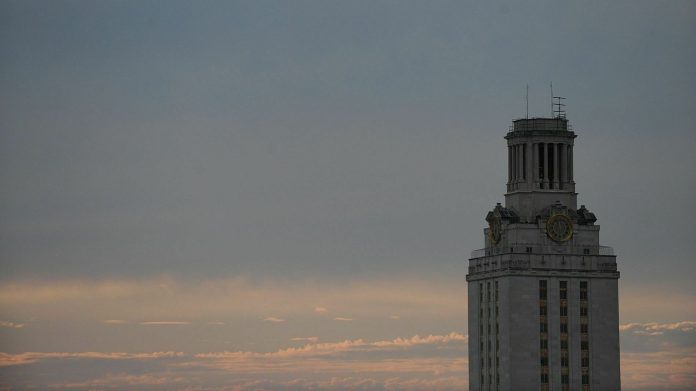
The University of Texas Tower on the University of Texas campus. The school was the site of the recent “Natal Con” gathering.

Ronald Martinez/Getty Images


hide caption

toggle caption

Ronald Martinez/Getty Images


The University of Texas Tower on the University of Texas campus. The school was the site of the recent “Natal Con” gathering.

Ronald Martinez/Getty Images

Billionaire Elon Musk told Fox News recently that falling birth rates keep him up at night. It’s a drum he’s been beating for years.

Musk is one of the world’s most visible individuals to elevate this point of view. Vice President JD Vance also talks about wanting to increase birthrates in the U.S.

But it’s not just them. There are discussions across the political spectrum about birth rate decline and what it means for the economy.

One response to this decline is a cause that’s been taken up by the right, and it has a name – Pronatalism. Many of its advocates met up recently in Austin, Texas, at “Natal Con.”

Pronatalists think they have a friendly audience in the White House. How do they want to use it?

For sponsor-free episodes of Consider This, sign up for Consider This+ via Apple Podcasts or at plus.npr.org.

Email us at [email protected].

This episode was produced by Audrey Ngyuen and Connor Donevan with audio engineering by Zo vanGinhoven. It was edited by Brett Neely and Courtney Dorning. Our executive producer is Sami Yenigun.

Trump administration cuts team in charge of researching IVF

0

President Trump has promised to expand access to IVF, but his administration has eliminated a team in charge of researching those treatments.