


In response to falling birth rates, influential figures on the right including Elon Musk and Vice President JD Vance want to encourage people to have more children.
They had left their DEI roles. Trump still fired them : NPR
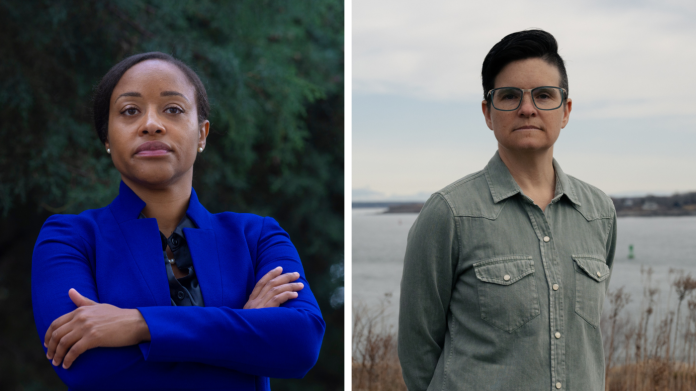
Sherrell Pyatt (left) and Mahri Stainnak were removed from their federal government positions soon after President Trump signed two executive orders ending diversity, equity, inclusion and accessibility (DEIA) efforts in the federal government. That’s despite the fact that they were not working in DEIA offices at the time of their dismissals.
Alyssa Pointer and Tristan Spinski for NPR
hide caption
toggle caption
Alyssa Pointer and Tristan Spinski for NPR
Mahri Stainnak had just started a job at the Office of Personnel Management focused on bringing more engineers, technologists and scientists into the government.
Sherrell Pyatt helped to resolve personnel disputes, including through mediation, at the Department of Homeland Security.
Jessica Swan’s position at the Department of Education was overseeing grants to help some 5 million children in the U.S. learn English.
Each brought years of experience to their roles. Each was removed from their position soon after President Trump signed two executive orders ending diversity, equity, inclusion and accessibility (DEIA) efforts in the federal government.
That’s despite the fact that they were not working in DEIA offices at the time of their dismissals. They contend their jobs don’t conflict with those executive orders.
Instead, they believe they are among hundreds and possibly thousands of federal employees targeted because of their past involvement with government DEIA programs and initiatives — or perhaps because the Trump administration merely associated them with the concepts of diversity, equity, inclusion and accessibility. Many of these workers say they’ve never received an explanation for why they’re being fired.
Now, Stainnak, who uses they/them pronouns, is asking for their job back. They are the named appellant in a complaint filed with the independent agency tasked with hearing personnel disputes within the federal government. The complaint alleges that Stainnak was among a pool of federal employees unlawfully fired by the Trump administration as a punishment for “their perceived political affiliations.”

Mahri Stainnak had just started a job at the Office of Personnel Management focused on bringing more engineers, technologists and scientists into the government when they were removed from their position following Trump’s executive orders to end DEIA efforts.
Tristan Spinski for NPR
hide caption
toggle caption
Tristan Spinski for NPR
“It’s not right that myself and others have been targeted and illegally fired based on who the Trump administration thinks we are or the assumptions they make about our values,” says Stainnak.
Swan and Pyatt have both been told they will be terminated in the coming months. They plan to join the complaint once they are separated from the government.
Summary firings lead to legal challenges
As Trump and his billionaire adviser Elon Musk have swiftly made good on their promises to dramatically slash the federal government, legal challenges have piled up. So have warnings that the government is losing talented, experienced civil servants who have faithfully served the American public through multiple administrations.
“It’s the opposite of trying to develop the meritocracy economy that we want to have,” says Kelly Dermody, a managing partner with Lieff, Cabraser, Heimann & Bernstein, one of the law firms that together with the American Civil Liberties Union of the District of Columbia brought the complaint on behalf of federal workers. “It’s a huge loss.”
Under federal law, government employees generally cannot take their personnel disputes directly to court. Instead, they must work through the Merit Systems Protection Board, an agency set up by Congress to hear such complaints.
But now, that board itself faces uncertainty. In February, Trump fired one of its members, Democrat Cathy Harris. Harris has sued to get her seat back, citing federal law that protects board members from removal for reasons other than cause. On Monday, the D.C. Circuit Court of Appeals reinstated her, though the Trump administration is expected to ask the Supreme Court to weigh in.
In response to NPR’s questions about the class complaint and the legal fight at the merit board, White House spokesperson Anna Kelly wrote: “President Trump has the authority to manage personnel within his Executive Branch, end unlawful DEI practices in government offices, and ensure hiring and firing decisions are based only on merit.”
In one of his executive orders, Trump says the federal government and many institutions outside government have adopted and are actively using “dangerous, demeaning, and immoral race- and sex-based preferences” masquerading as DEI.

The order says those policies “undermine the traditional American values of hard work, excellence, and individual achievement in favor of an unlawful, corrosive, and pernicious identity-based spoils system.”
A dinnertime call brings perplexing news
Stainnak first learned something was up on Jan. 21, the day after Trump returned to the White House to start his second term.
“I was having dinner with my family and my personal cell phone rang,” they recall. It was someone from human resources at the Office of Personnel Management. Stainnak began shaking.

Stainnak believes their firing had nothing to do with their new position — and everything to do with their work over the previous four years when they were in a DEIA role during the Biden administration.
Tristan Spinski for NPR
hide caption
toggle caption
Tristan Spinski for NPR
Hours earlier, the Trump administration had directed agencies to shut down their offices focused on diversity, equity, inclusion and accessibility, citing Trump’s executive orders.
Sure enough, Stainnak was told they were being put on administrative leave immediately. “I was incredibly shocked,” they recall. “The first thing I said was ‘I’m not in a diversity, equity and inclusion role.'”
At that time, Stainnak was in a brand-new job as the director of OPM’s Talent Innovation Group, focused on bringing more people with technical skills into the government. Stainnak had only been in that job for a week.
But the Trump administration had asked agencies to identify all employees who were working in DEIA roles as of Nov. 5, 2024, the day Trump was reelected — two and a half months before he’d signed the new executive orders.
Back in 2024, Stainnak was in a DEIA role. Under the Biden administration, Stainnak had worked at OPM’s Office of Diversity, Equity, Inclusion and Accessibility, including on LGBTQ issues and later as deputy director, supporting workers across the government.
“My team put together events that helped veterans and people with disabilities and recent graduates, including from minority serving institutions, be able to learn about federal jobs across agencies that might be of interest to them,” says Stainnak. “Having a government that represents all segments of society … absolutely makes us stronger.”
Stainnak was officially terminated from their new job on March 26, some 60 days after being given formal notice.
An illegal reduction in force
Stainnak believes their firing had nothing to do with their new position — and everything to do with their work over the previous four years.
Their complaint before the MSPB asserts that the Trump administration is not merely resetting priorities, as new administrations always do, but attempting to punish those it believes supported its political opponents.
“President Trump has explicitly associated DEIA programs with his Democratic predecessor, Joseph R. Biden, without regard to the worker’s skills or current job assignment,” the complaint alleges. “Most notably, President Trump repeatedly has called DEI work the function of a ‘leftist ideology’ and a ‘woke’ political agenda.”

The complaint also asks the merit board to examine whether Trump’s anti-DEIA executive orders discriminated against — or adversely affected — federal workers who are not white or male, which would be a violation of Title VII of the Civil Rights Act.
It’s not yet clear how many federal employees might join the class complaint. Attorneys involved with the case say they currently represent nearly a dozen employees at the Federal Aviation Administration, the Centers for Disease Control and Prevention, the National Institutes of Health, and the departments of Labor, Homeland Security and Labor.
Some, like Stainnak, worked in DEIA offices under Biden. For others, the only DEIA-related activity attorneys say they could find was involvement in a training or employee resource group.
A 4th generation civil servant ousted

Sherrell Pyatt was put on administrative leave after a decade working in the federal government at several agencies.
Alyssa Pointer for NPR
hide caption
toggle caption
Alyssa Pointer for NPR
Sherrell Pyatt began her federal career a decade ago with a job at the U.S. Postal Service, where four generations of her family have served. Her work there included research into how to stop illegal drugs from entering the country through the mail. It led to other roles in the government.
During the first Trump administration, she worked as a congressional liaison for Immigration and Customs Enforcement, helping members of Congress find legislative fixes to problems. As part of her job, Pyatt brought lawmakers to the border and into detention facilities to get an up-close view of conditions there.
“It was a way not only to support our agents and officers at the border so that they could get what they needed, but also so that the American public could see exactly what was going on and understand why we were saying there was a crisis at the border,” she says.
Later, Pyatt was part of a Customs and Border Protection team that examined what went wrong in the in-custody deaths of two people, work that was recognized with a commissioner’s award.
After Biden took office during the pandemic, Pyatt was detailed to FEMA, where she helped communities in the Southeast get information about COVID vaccines. As the sole Spanish speaker on her team, she also helped Latino communities understand how to get help after a hurricane.
“It was ensuring that the public could trust information that was coming out of the government and was also able to access the services that we provide,” says Pyatt.

In January 2024, she moved to the Department of Homeland Security’s Office for Civil Rights and Civil Liberties, and a month before Trump’s inauguration, she transitioned into an equal opportunity specialist role in that office.

Sherrell Pyatt holds pins she received while working for the Department of Homeland Security, the United States Postal Service and Immigration and Customs Enforcement.
Alyssa Pointer for NPR
hide caption
toggle caption
Alyssa Pointer for NPR
Title VII of the Civil Rights Act requires that federal agencies establish equal employment opportunity programs to ensure that personnel decisions involving workers and job applicants are free of discrimination.
“It’s not something that is ‘DEI.’ It is mandated by law,” Pyatt says.
Still, on Jan. 30, she was put on administrative leave and told it was because of Trump’s anti-DEI executive orders. Last month, the entire Office for Civil Rights and Civil Liberties received a termination notice, citing a different executive order focused on maximizing efficiency through a downsizing of the federal workforce.
“These offices have obstructed immigration enforcement by adding bureaucratic hurdles and undermining [the department’s] mission,” DHS spokesperson Tricia McLaughlin said in a statement, referring to Pyatt’s office and two others.

Pyatt’s official termination date is May 27, after which she says she will join Stainnak’s complaint before the merit board.
Most government jobs are nonpartisan
Pyatt points out that all the government jobs she’s held are nonpartisan. “We don’t pick a side. We don’t get to decide who our boss is,” she says.
Dermody says this is true for many of her clients — federal employees whose work crosses administrations.
“They don’t serve any particular person in the White House or the Congress,” she says.
Pyatt worries the loss of so many people who have stepped up to serve the country will cost the American public.

Sherrell Pyatt holds a commissioner’s award she received for work she did at Customs and Border Protection examining in-custody deaths.
Alyssa Pointer for NPR
hide caption
toggle caption
Alyssa Pointer for NPR
“The community at large suffers when you have these sort of rash actions that are not based in any kind of research or evidence,” she says.
The White House press office did not respond to NPR’s question about whether these mass layoffs are resulting in a brain drain in the federal workforce.
What now for English language learners
Jessica Swan worries about a particular community being affected by the cuts: the 5 million children in the U.S. who are English language learners.
Swan, who joined the Department of Education in 2020 after decades in the field, including as an educator, had a job administering grants to prepare teachers to meet these children’s needs.
“My role is not considered a DEI position,” says Swan. “In fact, if I had to sum up the importance of my role, it is in being a guardrail for federal funding … to prevent any fraud, waste or abuse.”
Yet she, too, received an email sent on Jan. 31, informing her that she was being put on leave because of Trump’s anti-DEIA executive orders.
“I was immediately in tears because I know I have spent the last three decades of my life working to support this particular population of kids — our English learners,” says Swan.
She spent the next 10 days calling people at the Education Department, trying to figure out why she and her colleagues in the Office of English Language Acquisition had been swept up in the DEIA purge.
“To date, I’ve been given no answer,” she says.
Swan conferred with others at the Education Department who’d similarly been put on leave.

“The only commonality that we could find was that we all had enrolled at some point in a diversity training that was recommended that we take by former Secretary Betsy DeVos under the first Trump administration,” she says.
Asked if this was the reason some Education Department staff were put on leave, Madi Biedermann, deputy assistant secretary for communications at the department, wrote: “At the Department of Education, we are evaluating staffing in line with the commitment to prioritizing meaningful learning ahead of divisive ideology in schools and putting student outcomes above special interests.”
Two months into her leave, Swan still hasn’t received her official termination notice but expects it is coming soon, as the Trump administration takes steps to dismantle the entire Education Department.
Closing down her office makes no sense, Swan says, especially in light of Trump’s executive order making English the official language of the U.S.
“We’ve got over 5 million kids who will need access to English, who will need the ability to learn and to grow in the language,” she says. “These are our kids. This is the present and the future of our country, of our democracy.”
Have information you want to share about ongoing changes across the federal government? NPR’s Andrea Hsu can be contacted through encrypted communications on Signal at andreahsu.08.
Supreme Court asked to enter case of deported Maryland man : NPR
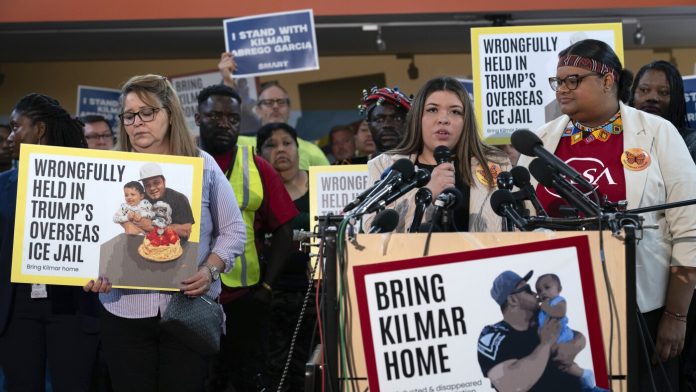
Jennifer Vasquez Sura, the wife of Kilmar Abrego Garcia of Maryland, who was mistakenly deported to El Salvador, speaks during a news conference Friday at CASA’s Multicultural Center in Hyattsville, Md.
Jose Luis Magana/AP
hide caption
toggle caption
Jose Luis Magana/AP
The U.S. Department of Justice has asked the Supreme Court to block a court order requiring the return of Kilmar Abrego Garcia, the Maryland man who was mistakenly deported to El Salvador last month.
U.S. District Judge Paula Xinis gave the Trump administration a deadline of 12:00 a.m. Tuesday to bring Abrego Garcia back from El Salvador. The Justice Department appealed that order, arguing that the court no longer has jurisdiction, in part because Abrego Garcia is now in El Salvador.
On Monday, a U.S. Court of Appeals for the 4th Circuit panel l voted unanimously to deny the Justice Department’s request for an emergency stay.
“The United States Government has no legal authority to snatch a person who is lawfully present in the United States off the street and remove him from the country without due process,” wrote Judge Stephanie Thacker. “The Government’s contention otherwise, and its argument that the federal courts are powerless to intervene, are unconscionable.”
The Trump administration then quickly asked the Supreme Court to block the lower court’s order, writing that it is “absurd” and “interferes with sensitive international negotiations.”
“A grievous error”
Abrego Garcia had been living in Maryland for over a decade, with a form of legal protection known as ‘withholding of removal.’ In spite of that, Immigration and Customs Enforcement (ICE) officers arrested Abrego Garcia last month, and deported him to El Salvador, alongside hundreds of other men accused of being gang members.
The White House argues that Abrego Garcia is a member of the Salvadoran gang known as MS-13.
“He should be behind bars, whether it be in El Salvador or in a U.S. detention facility. He should not be on the streets of America,” said Tricia McLaughlin, the Assistant Secretary for Public Affairs at the Department of Homeland Security, in an interview with NPR’s All Things Considered.
“An immigration judge reviewed evidence and determined he actually is a verified member of MS-13,” McLaughlin told NPR on Sunday. “There’s also intelligence reports that he’s involved in human trafficking.”
But Abrego Garcia’s lawyers vigorously dispute those allegations. And his lawyers note that he has no criminal record in the U.S., El Salvador, or any other country.
An immigration judge did order Abregio Garcia held without bond after reviewing the gang allegations against him in 2019. But after a full evidentiary hearing, Abrego Garcia was granted “withholding of removal” – a form of legal protection that should have prevented his deportation to El Salvador.
Abrego Garcia’s lawyers say the MS-13 allegations are based largely on an accusation from a confidential informant who accused him of being a member of the gang in New York, a state where Abrego Garcia has never lived.
Judge Xinis described the accusations as “vague” and “uncorroborated,” and noted that the Trump administration has introduced no evidence of a criminal indictment or complaint into the record.
Likewise, the Trump administration has not made public intelligence reports or other evidence to support the allegation that Abrego Garcia was involved in human trafficking.
The Trump administration admitted in court filings that Abrego Garcia was mistakenly deported due to what it calls an “administrative error.” He is now being held at CECOT, a notorious Salvadoran detention center.
“They had no legal authority to arrest him,” Judge Xinis wrote, “no justification to detain him, and no grounds to send him to El Salvador — let alone deliver him into one of the most dangerous prisons in the Western Hemisphere.” She described the erroneous deportation as “a grievous error.”
The White House doubled down — and put its attorney on administrative leave.
At a hearing last Friday, Judge Xinis asked Justice Department lawyer Erez Reuveni why Abrego Garcia was not returned as soon as it became clear he’d been sent by mistake, he responded that he’d asked his client, but “I have not received, to date, an answer that is satisfactory.”
Reuveni was placed on administrative leave the next day.
The Justice Department continues to argue that Abrego Garcia is out of its hands, and that the district court judge overstepped her authority.
“The United States does not control the sovereign nation of El Salvador, nor can it compel El Salvador to follow a federal judge’s bidding,” the Justice Department argued in its brief before the Supreme Court.
Judge Xinis rejected that argument, and pointed out that the Trump administration is paying El Salvador to hold these prisoners. The Fourth Circuit appeals court panel agreed with that reasoning.
“The facts of this case thus present the potential for a disturbing loophole: namely that the government could whisk individuals to foreign prisons in violation of court orders,” wrote Judge J. Harvie Wilkinson III, and then contend “that it is no longer their custodian, and there is nothing that can be done.”
“It takes no small amount of imagination to understand that this is a path of perfect lawlessness, one that courts cannot condone,” wrote Wilkinson, who was appointed to the bench by former President Ronald Reagan.
‘Due process does look different’ : NPR
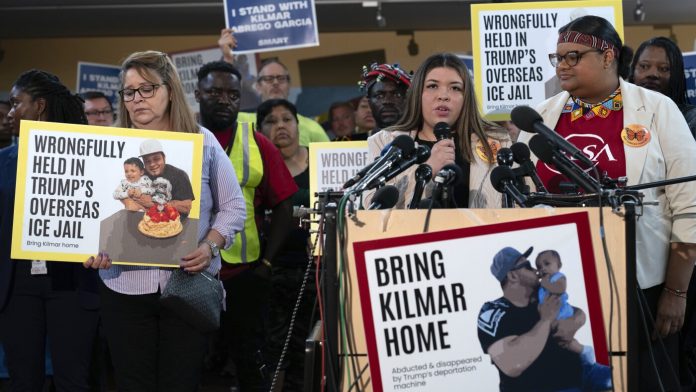
Jennifer Vasquez Sura, the wife of Kilmar Armando Abrego Garcia of Maryland, who was mistakenly deported to El Salvador, speaks during a news conference on April 4.
Jose Luis Magana/AP
hide caption
toggle caption
Jose Luis Magana/AP
The Trump administration has defended its deportation of Kilmar Armando Abrego Garcia — a Maryland man mistakenly sent to a prison in El Salvador — saying “due process does look different” for people they say are members of gangs the White House has designated as terrorist organizations.
Abrego Garcia was arrested and deported in March, despite having been granted protection by an immigration judge in 2019 that should have prevented him from being deported to El Salvador.

The Justice Department has admitted the deportation was an “administrative error,” but DOJ lawyers argued in court papers that he is a member of the criminal gang MS-13.
In an interview with All Things Considered guest host and NPR White House correspondent Asma Khalid on Sunday, Tricia McLaughlin — assistant secretary for public affairs at the Department of Homeland Security — said the Trump administration’s deportations are legal.

In this photo provided by El Salvador’s presidential press office, a prison guard transfers deportees from the U.S., alleged to be Venezuelan gang members, to the Terrorism Confinement Center in Tecoluca, El Salvador, Sunday, March 16.
El Salvador presidential press office/via AP
hide caption
toggle caption
El Salvador presidential press office/via AP
“In every single case, there is due process,” McLaughlin said. But, she added, there are different processes for people deemed members of terrorist groups.
This interview has been lightly edited for length and clarity.
Interview highlights
Asma Khalid: I want to begin by asking you why the administration asked for a stay to the order to return Abrego Garcia when he was deported in error. The judge said that the administration has not shown “any evidence of gang membership.”
Tricia McLaughlin: Well, that actually is just not true. An immigration judge reviewed evidence and determined he actually is a verified member of MS-13. There’s also intelligence reports that he’s involved in human trafficking. So I think the bottom line for the American people and for those who are listening today is that this individual in question, who’s an MS-13 gang member, he should be behind bars, whether it be in El Salvador or in a U.S. detention facility. He should not be on the streets of America. And to remind listeners, MS-13 is a gang that murders, rapes, traffics drugs. They maim for sport. These are individuals we do not want in our country, especially those who are here illegally.
Khalid: Tricia, I know you all are saying that he is a member of MS-13. To be clear, the judge has seen no evidence of that. His lawyers also deny this. Will you all be releasing any evidence to the public supporting this claim?
McLaughlin: Well, every time that a gang member denies being a gang member doesn’t mean we’re going to share intelligence reports that undermine our national security, but I do have to correct the record there because there’s been multiple immigration judges who have reviewed evidence that he’s an MS-13 member and confirmed doing so, including the DOJ’s immigration appeals. They affirmed his dangerousness and dismissed his appeal.
Khalid: You know, beyond the specifics of this one case, just given the sheer numbers of deportations that we are seeing without hearings, under this administration, do foreigners living in the United States have the right to due process, to a court process?
McLaughlin: Absolutely. In every single case, there is due process. When you’re looking at members of MS-13 and Tren de Aragua and other terrorist organizations that were designated as terrorist organizations under president Trump and the Trump administration, due process does look different because you’re under terrorist authority. So it’s going to be more law enforcement sensitive, but I can guarantee, and our DOJ guarantees, due process to these individuals.
Khalid: So Tricia, you’re saying that the cases that we have seen of people being put into detention facilities or, in some cases, flown to a foreign country without any hearing that there is due process? Because it doesn’t look to the public like we’ve seen any indication of due process or court process.
McLaughlin: There is due process. It’s more difficult to get into specifics when you’re looking at national security issues, especially with terrorist individuals.
Khalid: Can you give us any indication of what that due process looks like?
McLaughlin: Again, it’s law enforcement sensitive, and to give out intelligence reports just because these individuals are denying being members of these vicious gangs would undermine national security. If we did that every single time, that would simply be insane.
Khalid: So it sounds like in these cases, it’s the government’s word, though, against, say, a lawyer’s word or against an individual’s word. And there’s no ability for any sort of recourse?
McLaughlin: Oh, I completely disagree with that. I mean, we’ve had multiple instances, actually, with the individual in question that you were mentioning earlier, the Maryland MS-13 gang member, where multiple immigration judges reviewed evidence and determined that he is a verified member of MS-13. That wasn’t one judge. That wasn’t two judges. That was multiple judges and an appeals board. So I would actually just completely disagree with you. There’s been multiple reviews and process, not just by lawyers, not just by the government, but by these immigration judges themselves.
Khalid: I want to ask you about students we have seen detained, in some cases now facing deportation. The White House and DHS have asserted that these students were supporting terrorism. They say that they were exercising their free speech rights criticizing Israel’s war in Gaza. Can you articulate what sort of evidence you all have that support the claims of ties to terrorism?
McLaughlin: Absolutely. I mean, some of this looks like defacing property. Some of this is holding buildings hostage, making threats against other students, especially harassing Jewish students.
Khalid: But defacing property is not considered a terrorism charge, according to my understanding and broad…
McLaughlin: Of course not. But these individuals are here on visas, and visas are a privilege, not a rule.
Khalid: And so there’s a different set of rules – you’re saying – for foreigners living in the U.S.?
McLaughlin: If you are here on a visa, absolutely. There is a — that is a privilege, not a right. And the secretary of state maintains the authority to revoke that visa. And if that’s the case, then ICE and DHS will enforce it.
‘All Boys Aren’t Blue’ tops the ALA’s list of most challenged books in 2024 : NPR
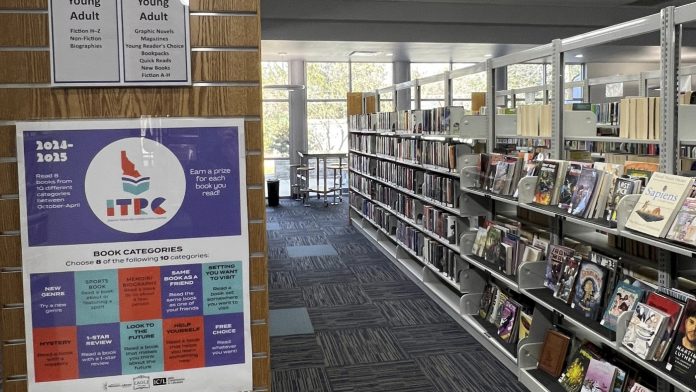
According to the American Library Association, organized groups are behind the push to censor books in libraries.
Rebecca Boone/AP
hide caption
toggle caption
Rebecca Boone/AP
George M. Johnson’s memoir All Boys Aren’t Blue has been a target of book challenges for years. According to a new report by the American Library Association (ALA), it was the most challenged book of 2024.
The ALA defines a challenge as “an attempt to remove or restrict materials, based upon the objections of a person or group.” Other frequently challenged books include Maia Kobabe’s Gender Queer, Toni Morrison’s The Bluest Eye and Stephen Chbosky’s The Perks of Being a Wallflower.

According to the report, there were 821 attempts to censor library books across all library types in 2024. This is down from the previous year, though still the third-highest number of book challenges recorded by the ALA. The report also noted that 72% of demands to censor books in school and public libraries came from “pressure groups, elected officials, board members and administrators” compared to the 16% that came from parents.
A majority of the titles challenged were either about queer people or people of color.
“We are witnessing an effort to eliminate entire genres and categories of books from library shelves in pursuit of a larger goal of placing politics and religion over the well-being and education of young people and everyone’s right to access and find information in our libraries,” wrote Deborah Caldwell-Stone, director of the ALA’s Office for Intellectual Freedom.

The report comes just a week after President Trump moved to dismantle the Institute of Museum and Library Services (IMLS), placing its entire staff on administrative leave. The IMLS is the federal agency that provides grant funding to libraries and museums across the country. On Friday, 21 attorneys general filed a lawsuit against President Trump to stop him from shutting down three federal agencies, including the IMLS.
Below is the list of the ALA’s top 10 most challenged books in 2024:
1. All Boys Aren’t Blue, by George M. Johnson
2. Gender Queer, by Maia Kobabe
3. (TIE) The Bluest Eye, by Toni Morrison
3. (TIE) The Perks of Being a Wallflower, by Stephen Chbosky
5. Tricks, by Ellen Hopkins
6. (TIE) Looking for Alaska, by John Green
6. (TIE) Me and Earl and the Dying Girl, by Jesse Andrews
8. (TIE) Crank, by Ellen Hopkins
8. (TIE) Sold, by Patricia McCormick
10. Flamer, by Mike Curato

Free speech is shifting under Trump. We’re exploring how : NPR
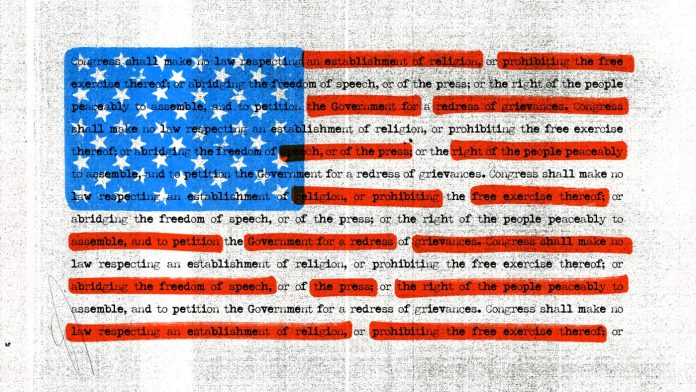
A series from NPR’s Morning Edition will explore who felt censored before President Trump returned to office and who feels stifled now.
Jackie Lay/NPR
hide caption
toggle caption
Jackie Lay/NPR
Many Americans are worried that their First Amendment right to free speech is fading.
NPR’s Morning Edition has talked to legal experts, activists, immigration lawyers, scientists, students, teachers and others over several weeks to understand why.
Our series “The State of the First Amendment: The Right From Which All Other Rights Flow” will explore who felt censored before President Trump returned to office and who feels stifled now.
Our reporting found that scientists are scrubbing reports and federal grant applications of words the Trump administration has banned. Some student activists are afraid that participating in protests could lead to deportation. Teachers are nervous about a new online portal where students or parents can file complaints about diversity, equity and inclusion lessons in class with the U.S. Department of Education.
“When students make connections to events in history that don’t frame the current administration in a positive light and then ask questions, it gives me pause,” says E., a high school history teacher, who asked NPR to use only her first initial for fear she could be reported for speaking out. “I’ve had to hold back, sometimes changing the subject abruptly, telling them that I can’t comment.”
Tune in to NPR and visit NPR.org every day this week for in-depth stories on “The State of the First Amendment: The Right From Which All Other Rights Flow.”
Yet plenty of others — including anti-abortion activists, the far-right activist group Moms for Liberty and members of university Republican clubs — say they feel more free today to express views without fear of a backlash now that President Trump is back in office.
“We now have more members who are willing to help us publicize the club, attach their faces to the club, and be outwardly and openly conservative than we did before the election,” says Miguel Muniz, president of the College Republicans at the University of California, Berkeley.
Free speech ranked as the second most important issue for voters heading into the 2024 presidential election, ahead of crime, immigration and health care, according to a poll by the Foundation for Individual Rights and Expression taken a month before the election. Republicans were more likely to rate it “very important” and nearly half of Republican respondents said they spoke less freely under President Joe Biden than they did under President Trump.
That may be why soon after President Trump was sworn back into office, one of the first actions he took was to sign an executive order aimed at “restoring freedom of speech and ending federal censorship.”
His critics say his concern for free speech is only for speech his administration finds acceptable.
You can find all the stories in this series here.
The artist behind ‘the worst’ Trump portrait defends her work : NPR
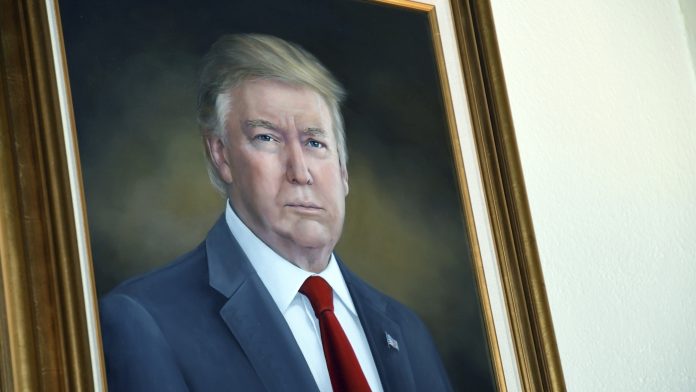
President Trump’s portrait in the Colorado Capitol in August 2019.
Thomas Peipert/AP
hide caption
toggle caption
Thomas Peipert/AP
After President Trump said how much he disliked a painted portrait of him hanging in the Colorado state Capitol, the artist now says that his knock to her abilities has threatened her livelihood of many decades.
Sarah Boardman painted the portrait for the Capitol building in Denver, where it hung starting in 2019, after being commissioned during Trump’s first term. Other presidential paintings line the building’s rotunda walls, including Boardman’s depiction of former President Barack Obama.

Last month, Trump said in a post on Truth Social that the portrait “was purposefully distorted.”
While he praised her portrait of President Obama, Trump said “the one on me is truly the worst.”
He went on to degrade Boardman’s talents, without naming her. “She must have lost her talent as she got older,” the president wrote. “I would much prefer not having a picture than having this one.”
Shortly after Trump’s insult, state Republicans had the portrait removed.
Boardman responded to Trump’s comments over the weekend in a statement on her website. The Colorado Springs-based painter said the president’s words called into question her “intentions, integrity, and abilities.”
She said she created the rendering without political bias or any intention to distort or caricature the president. Boardman said her portrait of Trump received overwhelmingly positive feedback during the six years that it hung in the Capitol building’s rotunda, but that Trump’s recent comments “are now directly and negatively impacting my business of over 41 years which now is in danger of not recovering.”

Portraits of President Donald Trump and former President Barack Obama, painted by artist Sarah Boardman, hang in the Capitol Rotunda in Denver last month. The Trump portrait has since been taken down.
Jesse Bedayn/AP
hide caption
toggle caption
Jesse Bedayn/AP
According her website’s biography, Boardman studied painting in Germany on an apprenticeship in which she practiced the techniques of the “Old Masters” — a group of famous European artists dating back to the Renaissance, such as Rembrandt. She’s also painted former President George W. Bush, a district court judge and members of the U.S. military. But, her bio says, some of her favorite subjects are “wonderfully ordinary people.”
The artist didn’t elaborate on the consequences to her business.
Republicans raised $11,000 in donations to commission the oil painting, Colorado Public Radio reported.
Colorado state Senate Minority Leader Paul Lundeen said he requested the portrait’s removal so that it could be replaced with a “contemporary likeness” of Trump. As CPR reported, “He said he was following a precedent set by the country’s only other president to serve nonconsecutive terms, Grover Cleveland, who is represented in the gallery by a single portrait from his second term.”

Trump follows other presidents who have disliked their portraits.
Theodore Roosevelt, for example, was disappointed in French artist Théobald Chartran’s depiction of him from 1902, WETA reported. The Roosevelt family felt the painting cast the proud, nature-loving leader as meek, and nicknamed the work the “mewing cat.”
And Lyndon B. Johnson called his portrait the “ugliest thing I ever saw.” Peter Hurd, a successful artist who painted the work, dismissed the president’s “very damn rude” behavior in his comments to the press, according to Smithsonian Magazine.
A portrait for Richard Nixon quietly went up in the White House in 1981, years after his resignation over the Watergate scandal. He wasn’t happy with the painting and in 1984, he instead donated one done by James Anthony Wills, who had painted President Dwight D. Eisenhower’s portrait. “He liked it better,” a federal official told The Washington Post.
Netanyahu to meet Trump to talk tariffs, Gaza war : NPR
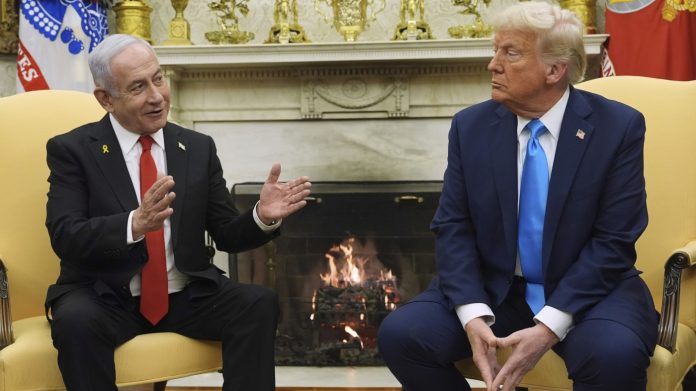
Israeli Prime Minister Benjamin Netanyahu meets with President Trump in the Oval Office of the White House, Feb. 4, in Washington, D.C.
Evan Vucci/AP
hide caption
toggle caption
Evan Vucci/AP
TEL AVIV, Israel — Israeli Prime Minister Benjamin Netanyahu is in Washington for a second meeting since President Trump took office and as Israel’s war in Gaza marks a year and a half. Netanyahu says he expects to discuss efforts to release Israeli hostages from Gaza, as well as new U.S. tariffs.

The Trump administration imposed 17% tariffs on Israel as part of new trade measures on goods from many countries.
Netanyahu is facing pressure at home from former Israeli security chiefs, protesters and the families of hostages still held in Gaza to return to ceasefire negotiations, which his far-right coalition has resisted.
The meeting with Trump comes on the 18-month mark since Israel’s war in Gaza began, following the deadly Oct. 7, 2023, Hamas-led attack on Israel. Israel has ramped up its military offensive since ending two months of ceasefire. It has also enforced five weeks of a blockade on aid and goods into the Gaza Strip.
Human rights groups and the United Nations have criticized the blockade saying it violates international law.
Israel’s government says it is seeking to increase pressure on Hamas to release all hostages and eventually eliminate the militant group.
Gaza’s Health Ministry says nearly 60 people were killed in Israeli strikes in the past 24 hours across the territory.
In one incident overnight, an Israeli airstrike hit a tent where journalists were sheltering in the southern Gaza city of Khan Younis, killing two people and injuring nine others, according to health officials in Gaza. The Israeli military has not commented on the attack.
Journalist Alem-Al Din al-Sadeq said a group had gathered to eat together before the strike hit.
“I saw my colleague sitting on a chair engulfed in flames,” he said. “We have no water to put out the flames.”
Other airstrikes hit central Gaza, trapping a family of 15 under the rubble. One attack killed four women and a child in a different area of central Gaza. The densely packed areas were targeted, Israel’s military says, because rockets were fired from there toward Israel on Sunday.
This is a developing story and will be updated.
Anas Baba contributed reporting from Gaza.
Small business owners are trying to survive Trump tariffs : NPR

Small business owners across the U.S. are crunching numbers how to cover new costs from tariffs on virtually all imports.
Alexander Spatari/Getty Images
hide caption
toggle caption
Alexander Spatari/Getty Images
Many American shop owners are feeling like collateral damage in the global trade war.
Sarah Wells ponders how her 13-year-old business, selling breast-pump backpacks and other items for new moms, will run under President Trump’s new tariffs on all imports.
Just this year alone, her company Sarah Wells Bags has shouldered the cost of two rounds of tariffs, which took effect right as Wells’ shipment from China was en route.
Her large order was loading at the port in February, when the White House raised tariffs on Chinese imports by 10%. By the time it docked stateside in March, tariffs had gone up again, by another 10%. Wells had to shell out an unexpected $15,000 to release her goods from customs.

Now, with the latest round sending total tariffs on Chinese imports to 54% — eating her profit margin — Wells is reeling. She may have to raise prices, but how much before shoppers rebel and stop buying? She plans to retrench: order less, pause hiring, stop developing new products.
“Even if we pass some (cost) to the consumer, we can’t pass it all,” says Wells, based in Virginia. “So I really think the honest answer is that businesses will close.”

Sarah Wells packs and prepares to ship some of her bags and accessories for new moms.
Courtesy of Sarah Wells
hide caption
toggle caption
Courtesy of Sarah Wells
For some, it’s survival mode, which means shrinking selections and freezing hiring
How much or how quickly shoppers might pull back is not clear. The National Retail Federation had forecast retail sales to grow this year — slower than in recent years, though more like they did before the pandemic: between 2.7% and 3.7%.
But the forecast was released before the magnitude of new tariffs became clear — spanning the globe, ranging from 10% to over 50% — and now the trade group says it’s “impossible to predict … the magnitude of change on prices and on consumer spending.”
Giants like Walmart, for example, are now pressuring their foreign suppliers for discounts to offset some of the tariffs. Smaller retailers don’t have that kind of muscle. In surveys, retailers across the board warn they’ll have to raise prices.

And then there’s the scale-back. Like Wells, many business owners are thinking of pulling back: perhaps shrink the store’s selection so there’s less to ship, freeze hiring, pause advertising or developing new products — stop growing and go into survival mode.
“What is the need-to-have versus the nice-to-have … I think right off the bat, that’s where it will start,” says Jessica Bettencourt, who runs Klem’s general store in Massachusetts. Founded by her grandfather 75 years ago, Klem’s sells a wide range of products including hardware, pet food and clothes.
U.S.-made can mean 3 to 4 times the cost
One key argument President Trump makes in favor of tariffs is that they would jump-start American manufacturing, forcing more companies to source their products domestically.
Wells, Bettencourt and many others will say: They’ve tried.
U.S. manufacturers couldn’t tackle the scale of Wells’ orders, she says, when she looked into making or at least assembling her backpacks and purses here. Plus, those manufacturers told her, the raw material would have to come from China anyway.
South Carolina business owner Rozalynn Goodwin ran into a similar challenge.
“We have, for the last eight years, been trying to manufacture in the United States,” says Goodwin. She and her daughter sell double-snap hair barrettes called GaBBY Bows.
“Every manufacturer in the United States we’ve spoken to has told us, ‘You need to continue making this in China. It’s going to cost you three to four times more to make it here,'” Goodwin says. “Our customers will not pay $8 or $10 more for this product.”
The case of $400 work boots
For many common items — clothes, shoes, toys, electronics — the U.S. has not manufactured them at scale in ages, if ever. Smaller-scale operations are much costlier, often double or triple the price of overseas options, and typically require imported supplies anyway, as Wells had discovered.

Bettencourt says, consider work boots. Her store does carry American-made boots, and they’re $400 a pair. Imported alternatives sell for half that amount.
“Not everyone can buy a $400 pair of work boots,” she says. “So I do want to always look at that U.S.-made product first, but I also have to offer my customers what they can afford.”
As another shopkeeper put it: Small-business owners like to make their own decisions and feel like they can live and die by them; the sweeping blanket tariffs are taking that ability out of their control.
It’s Been a Minute : NPR

Who are the crunchy conservatives?
Getty Images / pixabay
hide caption
toggle caption
Getty Images / pixabay

Who are the crunchy conservatives?
Getty Images / pixabay
Have you or someone you love been confused by the push to ‘Make America Healthy Again’?
Side effects may include:
– Being inundated by uncredentialed wellness influencers and crunchy mommy bloggers selling supplements
– Feeling perplexed by how RFK Jr. went from an ‘environmental champion’ to an anti-vax conspiracy theorist
– Or maybe seeing the names Dr. Phil and Dr. Oz more and more in your feeds?
Then you, my friend, are in dire need of our new series – The ROAD to Making America Healthy Again (MAHA). For the next few of weeks, we’re delving into some of the origins, conspiracy theories, and power grabs that have led us to this moment, and what it could mean for our health.
This week, we take on the crunchy conservative – but not without some help! Brittany sits down with co-host of the Conspirituality podcast, Derek Beres, and biomedical scientist, Dr. Andrea Love, to uncover how crunchy went from more liberal hippie tree huggers to more conservative conspiracy theorists.
This episode was produced by Alexis Williams. It was edited by Neena Pathak. Our Supervising Producer is Barton Girdwood. Our Executive Producer is Veralyn Williams. Our VP of Programming is Yolanda Sangweni.