

An investigation into the deportation supply chain and its hidden costs
Politics chat: 'Hands Off' protests in Washington, Trump's tariffs and Republicans

President Trump’s tariff regime puts him at odds with Congressional Republicans seeking to cut taxes.
Trump paused a program to upgrade aging affordable housing : NPR
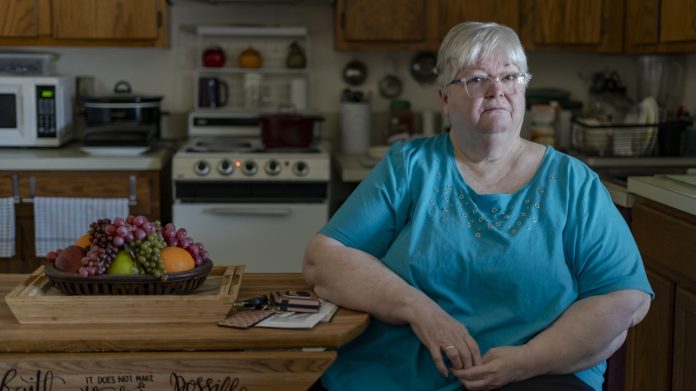
Linda Morgan on March 28 in her sister’s apartment at Trinity Woods senior living in Emporia, Va., where they both live. The building’s decades-old central air conditioning system died three years ago. “It’s terribly hot,” said Morgan, who uses six fans and portable coolers to stay comfortable during long summers.
Carlos Bernate/for NPR
hide caption
toggle caption
Carlos Bernate/for NPR
EMPORIA, Va. — Linda Morgan loves living at Trinity Woods, a subsidized senior residence in the tiny Virginia town where she grew up near the North Carolina border. But for three years, since the building’s decades-old air conditioning system sputtered and died, she’s had to set up an elaborate arrangement to stay cool during long, intense summers.
There’s a portable air conditioner by the living room window, a swamp cooler in the bedroom that she keeps filled with water, and a fan in the kitchen. In her closet — soon to be brought out as the weather warms — three more fans are stashed from the top shelf to the floor.
“That’s what I have to do to get any kind of coolness or comfort in here,” she said. In the afternoons, especially, when the sun hits her window, “it’s terribly hot.”

Deanna Moore in her Trinity Woods apartment March 28. The affordable senior living center gave residents window units after their central AC system died three years ago. But last summer, Moore says, the building’s community room was too hot to hold bingo nights.
Carlos Bernate/for NPR
hide caption
toggle caption
Carlos Bernate/for NPR
The building’s community room is even harder to cool. “Last year it was god-awful,” said resident Deanna Moore. “We had bingo on Tuesday and Friday nights, [but] we couldn’t even play.”
Residents say family and friends don’t visit because it’s too hot. And the lack of central AC is especially hard on the many people with asthma or other conditions that affect their breathing, said Morgan, who’s a retired nurse.
“We’ve sacrificed so much in our lives already,” she said, “and to think that we cannot live in a comfortable, safe environment as we’re older is just devastating to me.”
That’s why residents were thrilled when Trinity Woods was awarded $5.4 million a year ago for a new heating and cooling system, among other upgrades. It was part of a $1.4 billion Department of Housing and Urban Development program to make aging affordable housing across the country more energy efficient and climate resilient, including by installing solar panels on some buildings to bring down utility bills.

But the cost-cutting DOGE team overseen by billionaire Elon Musk “terminated” the program, according to an internal email seen by NPR. The move is part of a series of staffing cuts and funding freezes at the housing agency that critics said threatens to worsen the country’s severe shortage of affordable housing.
HUD said the program continues but is under review.
“HUD helps to ensure Americans have access to fair and affordable housing,” agency spokesperson Kasey Lovett said in a statement to NPR. “The previous administration’s energy efficiency crusade diverted valuable resources, including funding, from the department’s mission. The department is evaluating options to ensure rural, tribal and urban communities have the resources they need, which are not solar panels.”
Trinity Woods and other groups with projects across the country say they’ve received no explanation from HUD about the change, and in fact no communication at all. But they’re scrambling to both challenge the funding pause and find alternative financing to replace it.
“This is how government works at its best”

Rusty patches and cracked rubber insulation on the 1993 chiller at Trinity Woods, which died three years ago. The Inflation Reduction Act of 2022 included a program to help hundreds of affordable housing operators upgrade aging infrastructure, but the Trump administration has halted that funding.
Carlos Bernate/for NPR
hide caption
toggle caption
Carlos Bernate/for NPR
Just outside a back door at Trinity Woods is a large, pale green metal box, with rusty spots and cracked rubber insulation around one pipe. An engraving notes the year it was installed: 1993. It’s a chiller, the backbone of the building’s air conditioning system, and it sits silent and still.
“I have been pleading for at least three years to do something about this air conditioning,” said Rev. Richard Bridgford, head of Norfolk Urban Outreach Ministry and president of the board of Trinity Woods. His organization worked with HUD to develop this senior housing complex and two others, one of which was also slated to receive upgrade funding.
Affordable housing budgets are tight, and providers can’t just raise rents to cover a major overhaul. This type of subsidized housing also does not gain equity, which means it’s not allowed to take on debt. “So you can’t get any funds, any money to fix anything,” Bridgford said.

Trinity Woods planned to use a federal loan to replace its 32-year-old heating and cooling system with solar panels and heat pumps. But the Department of Housing and Urban Development now says the Biden administration’s “energy efficiency crusade” does not fit its mission.
Carlos Bernate/for NPR
hide caption
toggle caption
Carlos Bernate/for NPR
The Green and Resilient Retrofit Program, passed by Congress as part of the Inflation Reduction Act, provided a way to get that money.
“This is an extremely efficient and effective use of government funds,” said Julia Gordon, who served as assistant secretary for housing at HUD during the Biden administration.
Grants and loans were awarded across 42 states in every region of the country, she said, and would improve living conditions for more than 30,000 seniors, families and disabled residents.

Rev. Richard Bridgford of Norfolk Urban Outreach Ministry, in the community room at Trinity Woods. He struggled for years to find a way to finance an overhaul of the senior living center’s aging heating and cooling system.
Carlos Bernate/for NPR
hide caption
toggle caption
Carlos Bernate/for NPR
Trinity Woods hoped to use its loan to generate matching funds for a $10 million overhaul. The goal was to upgrade not only its cooling, but also heating, as one of two 1993 boilers is also irreparably broken. That would let residents individually control their own thermostats instead of switching the entire building to heat or AC twice a year. Installing new windows and siding was also on the wish list.
“This is how government works at its best,” Gordon said. “It uses government funds to help the parts of private industry that are trying to provide affordable housing in today’s housing market. It helps them save so much more money.”

Depending on the project, she said, these upgrades could save on the need to rebuild after a flood or hurricane, and could save on property insurance costs that have skyrocketed.
For Bridgford, who said he operates on a shoestring budget, savings would include moving away from propane fuel that is “just gobbling up our utilities.” And reduced operating costs would let him provide more benefits for residents, he said, like better maintenance.
Advocate say it’s crucial to preserve what affordable housing exists

Trinity Woods resident Sonya Urquhart says that before moving in, she was living in her car and with friends from the restaurant where she still works. She said the lack of central AC is horrible, but, “I love this building. I would not want to leave. I know a lot of us can’t leave.”
Carlos Bernate/for NPR
hide caption
toggle caption
Carlos Bernate/for NPR
In exchange for the retrofit funding, owners are required to keep their properties affordable for at least 20 more years. That can be crucial in a rural area like Emporia, where there are not many other options.
Before Sonya Urquhart moved into Trinity Woods two years ago, she said she “lived in my car for a minute” and stayed with friends at the restaurant where she still works. Despite the lack of AC, “I love this building. I would not want to leave,” she said. “A lot of us can’t leave.”
Resident Lynn Mason said he also had nowhere else to go. He’d been a lift operator then hurt his back. He lived with an aunt and uncle for 20 years and helped take care of their home, but when they died the house went to their child. A judge “gave me 60 days, I had to go,” Mason said. He was grateful to land here.

Lynn Mason said he had nowhere else to go when he moved into Trinity Woods nearly three years ago. The upgrade funding the Trump administration has halted was meant to preserve affordable housing and extend its life, especially in rural areas like Emporia, Va., where there are not many other options.
Carlos Bernate/for NPR
hide caption
toggle caption
Carlos Bernate/for NPR
“The first tenet of any housing advocate is to preserve what we have,” said Linda Crouch, a senior vice president at the aging services nonprofit LeadingAge.
The organization has more than 50 members around the country that are awaiting funding from the HUD retrofit program that’s been paused. The average household income of their residents is around $16,600 a year. “It is so financially irresponsible to let go of existing, deeply affordable units,” she said.

Nationally, only about 1 in 3 seniors who qualify for subsidized housing are able to get it. And as the U.S. ages rapidly, a record number of seniors are burdened by high housing costs. Millions of older homes are also deteriorating, making the shortage of affordable places worse. Older Americans are a growing share of the homeless population.

The chiller at Trinity Woods in Emporia, Va., was the backbone of the senior living center’s air conditioning system until it died. One of the building’s two 1993 boilers also stopped working, and the spark plug it needs is no longer made.
Carlos Bernate/for NPR
hide caption
toggle caption
Carlos Bernate/for NPR
The subsidized housing that is available often has years-long waiting lists. In 2023, when one Manhattan property opened up slots for a waitlist of 157, more than 10,000 people applied, Crouch said. For many seniors, “it’s no hope [of] getting in within their lifetime,” she said.
On top of all this, advocates also worry about the Trump administration’s plan to dramatically shrink HUD. In a recent letter to the agency, Crouch’s organization wrote, “Large, swift reductions in HUD staff will effectively make the administration of housing programs impossible.”
For now, contractors who’ve already done advance work for Trinity Woods are applying for reimbursement and expect to get paid, said Gates Kellett, an expert on affordable housing development who helped the property apply for the retrofit program.

But only 22 properties are likely to get full funding for their projects, most of them small, said a HUD staffer with knowledge of the program’s status. They asked NPR not to use their name because they’re not authorized to speak with the media. The staffer said only 22 properties out of 270 nationwide closed their financing deals before the funding freeze.
Kellett is helping Trinity Woods search for different funding from HUD and elsewhere, but says it’s highly competitive and may not provide nearly as much money.
Bridgford, the head of the Trinity Woods board, said that could mean simply “replacing what we have, which sounds so stupid” compared with the modern, efficient HVAC system they were planning. But he hopes something comes through, so residents can at least get relief from the heat and sleep better.
Vietnam Urges United States to Delay Imposing Tariffs On It

Vietnam’s top leader, To Lam, has asked President Trump to delay the imposition of tariffs for at least 45 days so the two sides can avert a move that would devastate the Vietnamese economy and raise prices for American consumers.
The 46 percent tariff rate the United States has said it will impose on Vietnam is among the highest any country faces. The prospect of such a steep tariff has left Vietnam with a sense of whiplash and deep apprehension. It also presents a sharp contrast to Washington’s recent embrace of Hanoi as an important bulwark against China and a manufacturing destination for many American apparel brands.
Mr. Lam’s proposal to President Trump was laid out in a letter dated Saturday, according to a copy obtained by The New York Times. In the letter, Mr. Lam called on Mr. Trump to appoint a U.S. representative to lead negotiations with Ho Duc Phoc, a Vietnamese deputy prime minister, “with the goal of reaching an agreement as soon as possible.”
Mr. Lam had been one of the first world leaders to reach out to Mr. Trump after the tariffs were announced. In a phone call, he offered to reduce tariffs on U.S. imports to zero, and urged Mr. Trump to do the same, according to the Vietnamese government. Vietnam has said its tariffs on U.S. goods is an average of 9.4 percent.
Mr. Trump later described the call as “very productive.”
In his letter, Mr. Lam asked Mr. Trump to meet him in person in Washington at the end of May “to jointly come to an agreement on this important matter, for the benefit of both our peoples and to contribute to peace, stability and development in the region and the world.”
Vietnam’s Foreign Ministry did not respond to a request for comment.
Vietnam, which faces punishingly high tariffs along with China, Cambodia and Laos, would be the hardest-hit economy in Asia if the tariffs are imposed as planned on Wednesday, according to economists. The United States is Vietnam’s largest export market, accounting for about 30 percent of the country’s total exports. A 46 percent tariff rate would put 5.5 percent of Vietnam’s gross domestic product at risk, according to ING, a Dutch financial services company.
It would also hurt American consumers, because Vietnam is crucial in the global manufacturing supply chain. For decades, the country has built its economy around attracting foreign investment with cheap labor and a young work force. It is now a top manufacturer of brands such as Adidas and Lululemon. Nike makes about 50 percent of its footwear in Vietnam.
After Mr. Trump imposed tariffs on China during his first term, Vietnam benefited from companies shifting their manufacturing there.
Within Hanoi, the recent moves by the Trump administration have cast doubts on the reliability of the United States, which in recent years has assiduously courted Vietnam. In 2023, the two former enemies cemented a new strategic relationship, a move seen as a milestone in U.S. foreign policy. Even though Vietnam fought a brutal, decades-long war against the United States, surveys had shown that many Vietnamese welcomed the political and strategic influence of the United States.
The Biden administration viewed Vietnam — one of the few Southeast Asian nations that has publicly pushed back against China’s assertiveness in the South China Sea — as critical to the U.S. effort to counter China’s mounting ambitions in the region.
“Vietnam’s position in the Pacific, its view on China, its willingness to work with America, was its strongest card,” said Huong Le Thu, the deputy program director for Asia for the International Crisis Group. “Trump doesn’t see it that way. He doesn’t see allies or strategic values. He just sees numbers and tariffs, so Vietnam needs to try harder.”
Analysts say Vietnam had a largely positive opinion of Mr. Trump during his first administration, seeing him as a pragmatic businessman who would not moralize with them over human rights.
While explaining the tariffs, Mr. Trump said: “Vietnam: great negotiators, great people, they like me. I like them.” He said “the problem” was that the country charges the United States “90 percent,” a figure apparently reached by basing it on Vietnam’s current trade surplus with the U.S., worth $123.5 billion. (Vietnam disputed that calculation.)
The tariffs come at a precarious time for Mr. Lam, who was named as general secretary of Vietnam’s ruling Communist Party last year after the death of the previous party chief, Nguyen Phu Trong. Mr. Lam needs to secure a strong economic performance as he heads into next year’s party congress, where the country’s top leaders will be selected.
Even before Mr. Trump’s tariff announcement, Vietnam was working to win favor with the new administration. It signed provisional deals to import U.S. liquefied natural gas, cut some tariffs on American imports, and allowed SpaceX to open a company to launch its Starlink satellite internet service in Vietnam. The Trump organization is developing a $1.5 billion golf course and hotel project in Vietnam’s northern Hung Yen province, Mr. Lam’s home province.
Alexandra Stevenson contributed reporting.
Trump’s Tariffs Will Wound Free Trade, but the Blow May Not Be Fatal

President Trump’s self-proclaimed “liberation day,” in which he announced across-the-board tariffs on the United States’ trading partners, carries an echo of another moment when an advanced Western economy threw up walls around itself.
Like Brexit, Britain’s fateful vote nearly nine years ago to leave the European Union, Mr. Trump’s tariffs struck a hammer blow at the established order. He is pulling the United States out of the global economy much as Britain withdrew from a continentwide trading bloc, in what its backers viewed as a comparable act of liberation.
The shock of Mr. Trump’s move is reverberating even more widely, given the larger size of the American economy and its place at the fulcrum of global commerce. Yet as with Brexit, its ultimate impact is unsettled: Mr. Trump could yet reverse himself, chastened by plummeting markets or mollified by one-off deals.
More important, economists say, the rise of free trade may be irreversible, its benefits so powerful that the rest of the world finds a way to keep the system going, even without its central player. For all of the setbacks to trade liberalization, and the grievances expressed in Mr. Trump’s actions, the barriers have kept falling.
The European Union, optimists point out, did not unravel after Britain’s departure. These days, the political talk in London is about ways in which Britain can draw closer to its European neighbors. Still, that sense of possibility has come only after years of turbulence. Economists expect similar chaos to buffet the global trading system as a result of Mr. Trump’s theatrical exit.
“It will not be the end of free trade, but it is certainly a retreat from unfettered free trade, which is the way the world seemed to be going,” said Eswar S. Prasad, a professor of trade policy at Cornell University. “Logically, this would be a time when the rest of the world bands together to promote free trade among themselves,” he said. “The reality is, it’s going to be every country for itself.”
Such a world will be not only unruly, but also potentially more dangerous. While trade wars do not necessarily spiral into shooting wars, historians note that some conflicts, like the War of 1812 and the Opium Wars of the mid-19th century, were rooted in trade disputes. An all-out trade war between the United States and China would inject sparks into an already combustible relationship.
“If you think about the broader conflict between the U.S. and China,” Professor Prasad said, “the economic and financial relationship provided a degree of balance. That balance is now eroding.”
Mr. Trump has stopped short of the kind of gunboat diplomacy used by Britain against China in the Opium Wars. But his pugilistic posture toward some of America’s closest trading partners, like Canada and Mexico, has deepened the sense of dislocation and could divide the response of countries.
Economists said the United States’ singular position as the biggest engine of global growth, because of its unquenchable appetite for cars manufactured in Germany and iPhones assembled in China, would make it hard for countries to reorient their trading relationships around a less welcoming American market.
That suggests many countries will end up trying to cut deals with Mr. Trump, as Prime Minister Keir Starmer said he would do last week, after the United States hit Britain with a 10 percent tariff. Others will impose retaliatory tariffs to try to better their bargaining position with the United States.
China struck swiftly on Friday, with tit-for-tat tariffs of 34 percent, after speculation that it might coordinate its response with its neighbors Japan and South Korea. Already, the European Union is warning countries that find themselves priced out of the American market not to dump cheap exports in its market.
“A lot will depend on how Europe decides to play this,” said Simon Johnson, a professor at the Sloan School of Management at M.I.T. and former chief economist at the International Monetary Fund. “The Europeans could get closer to China and pick up a lot of the slack from Vietnam.”
“That would create a big non-U.S. trading bloc,” he continued. “But I don’t think the Europeans are going to be comfortable with all those Chinese exports pouring into Europe. Where do these excess exports go?”
Europe’s likely resistance to absorbing more Chinese imports will confront China’s leaders with a thorny challenge. They can either adopt measures to make China less reliant on exports by stoking demand among their own population, something they tried to do in the past with mixed results. Or they can seek a deal with Mr. Trump, something they failed to do during his first term, despite signing a preliminary agreement.
For all of the criticism of Mr. Trump’s blunt-force methods, economists say he is responding to a genuine problem: the rise of China as a hypercompetitive trading power, one that heavily subsidizes its own companies. That has hollowed out American manufacturing, in Mr. Trump’s view; the tariffs, he claims, will bring it back.
When he came into office, President Barack Obama asked whether one of his Democratic predecessors, Bill Clinton, had given away too much in allowing China to join the World Trade Organization. Mr. Obama imposed a 35 percent tariff on China from 2009 to 2012, for dumping tires into the American market. After Mr. Trump left office in 2021, President Joseph R. Biden Jr. left his China tariffs in place.
“The global trading system has been under pressure for a while, and that pressure has really been symbolized by the rise of China,” Professor Johnson said. “It was more damaging and disruptive than Japan.”
In 2024, Professor Johnson, along with Daron Acemoglu of M.I.T. and James A. Robinson of the University of Chicago, received the Nobel Memorial Prize in Economics for research into the colonial-era institutions that made some countries wealthier than others as they developed. One common factor, whether in Asia or Africa: “Almost all countries that escaped poverty did it through trade,” he said.
For that reason, it is unlikely that the world will drift into a state of autarky, where countries try to produce all they need within their own borders. The nature of global supply chains — from semiconductor factories in Taiwan to auto-parts suppliers in Canada — makes such economic isolation all but impossible, in any event.
The countries that will face the most pain from a trade war, economists said, are low-income exporters of commodity goods, which have little leverage to respond to Mr. Trump. Several are in Africa, among them Nigeria, which was hit with a 14 percent tariff, and Kenya and Ghana, both hit with 10 percent.
The World Trade Organization estimated that Mr. Trump’s measures, on top of his previously announced tariffs, will reduce global merchandise trade volume 1 percent in 2025, a downward revision of nearly four percentage points from its earlier forecast. A full-scale trade war would do further damage.
Still, some optimists predicted that Mr. Trump’s tariffs would accelerate the integration of other countries, either through bilateral trade deals or regional trade pacts. The United States, they note, is the only country that pulled out of the Trans-Pacific Partnership, which was later renegotiated without it, forging a trade pact among the other big economies that border the Pacific.
Even Brexit, though it drew on the same grievances about globalization as Mr. Trump’s MAGA movement, was not framed as a protectionist project. Brexiteers argued that, once freed from the shackles of the European Union, Britain could negotiate better trade deals on its own. Last week, they credited Brexit as the reason Britain’s 10 percent tariff was half that of the European Union.
“You’re going to see more countries around the world striking free trade deals, just around the U.S.,” said Jason Furman, a professor of economic policy at Harvard Kennedy School who was chairman of the Council of Economic Advisers during the Obama administration. “I see it as a turning point for the United States at the center of the global trading system,” he said, “but not for how the world thinks about free trade.”
Syria Likely Has Over 100 Chemical Weapons Sites, Inspectors Say

More than 100 chemical weapons sites are suspected to remain in Syria, left behind after the fall of the longtime president, Bashar al-Assad, according to the leading international organization that tracks these weapons.
That number is the first estimate of its kind as the group, the Organization for the Prohibition of Chemical Weapons, seeks to enter Syria to assess what remains of Mr. al-Assad’s notorious military program. The figure is far higher than any that Mr. al-Assad has ever acknowledged.
The sites are suspected to have been involved in the research, manufacturing and storage of chemical weapons. Mr. al-Assad used weapons like sarin and chlorine gas against rebel fighters and Syrian civilians during more than a decade of civil war.
The number of sites, and whether they are secured, has been a mystery since rebels toppled Mr. al-Assad last year. Now, the chemicals represent a major test for the caretaker government, which is led by the group Hayat Tahrir al-Sham. The group is designated as a terrorist organization by the United States, but it has renounced its links to Al Qaeda.
The stakes are high because of how deadly the weapons are, particularly when used in densely populated areas. Sarin, a nerve agent, can kill within minutes. Chlorine and mustard gas, weapons made infamous in World War I, burn the eyes and skin and fill the lungs with fluid, seemingly drowning people on land.
Experts are concerned about the potential for militant groups to gain access to poorly secured chemical weapons facilities.
In a surprise visit in March to the global chemical weapons watchdog headquarters at The Hague, Syria’s foreign minister said that the government would “destroy any remains of the chemical weapons program developed under the Assad regime” and comply with international law.
Experts are cautiously optimistic about the government’s sincerity. The current government allowed a team from the watchdog to enter the country this year to begin work documenting the sites, according to people with knowledge of the trip.
But Syria remains in a precarious spot, as violence erupted in the coastal region in recent weeks between government forces and groups aligned with Mr. al-Assad. And despite promises, the new government has not yet appointed an ambassador to the watchdog — a key first step that is seen as a sign of a country’s commitment. Syria’s defense ministry declined to answer written questions about the weapons, saying without elaboration that the questions were not under its purview.
In the early years of the civil war, Mr. al-Assad’s government declared the locations of 27 sites to the Organization for the Prohibition of Chemical Weapons, or O.P.C.W., which sent inspectors to visit and shut them down. But Mr. al-Assad continued to use chemical weapons until at least 2018, and research showed that his government kept importing essential precursor chemicals.
The current estimate of more than 100 sites comes from the watchdog and has been circulated recently among experts and international nonproliferation analysts. The organization said it had arrived at the number based on outside researchers, nonprofit groups and intelligence shared by its member countries.
Some sites are probably hidden in caves or other places that are tough to find using satellite images, according to researchers, former organization staff members and other experts. That increases the likelihood that some weapons are not secured.
“There are many locations that we don’t know about because the old regime was lying to the O.P.C.W.,” said Raed al-Saleh, the leader of the Syria Civil Defense, also known as the White Helmets, a volunteer group that says it is working with the government to try to dismantle chemical weapons sites.
Nidal Shikhani, who leads the Chemical Violations Documentation Center of Syria and has worked with the Organization for the Prohibition of Chemical Weapons for years, said his group had identified dozens of new locations that could be chemical weapons stockpiles or former research sites based on interviews with Syrian government scientists living in Europe.
Finding and taking control of these sites is important for reasons beyond security. Inspectors also want to collect evidence for their investigations into Mr. al-Assad’s repeated use of chemical weapons. International observers, independent researchers and Syrian humanitarian groups have documented dozens of attacks, with thousands of people, including children among the victims. The most notorious was a 2013 sarin gas assault on the area of Ghouta, a suburb of Damascus, the capital.
Last year, Israel launched airstrikes on several Syrian regime facilities where chemical weapons were known to have been held. But it is unclear whether those strikes destroyed chemical weapons.
Mr. Shikhani and others said they worried that the strikes merely created environmental contamination and destroyed evidence. International groups hope that chemical evidence will answer key questions about the Assad government’s research and help with international prosecutions.
“The Israeli attacks that happened right after the fall of Assad are probably likely to not have put a dent in some of this, and potentially also obscured efforts toward accountability,” said Natasha Hall, a senior fellow with the Center for Strategic and International Studies in Washington.
Sarin gas is prohibited under international law. The rules are murkier for other chemicals. Chlorine gas, for instance, can be created using common household cleaning products. That makes it nearly impossible to regulate the sale of precursors.
Syria’s chemical weapons program began in the 1970s with the help of hundreds of government scientists, many of whom were trained in Germany and other parts of Europe, according to a Syrian former senior government chemist who spoke on the condition of anonymity out of fear of retribution.
The scientist worked in the chemical weapons division of the military’s Scientific Studies and Research Center. That center, which is under international sanctions, worked on conventional, chemical and nuclear arms.
Many scientists, he and others said, fled the country during the war, but others remain in Syria. The United States has imposed sanctions on more than 300 people and entities in connection with Syria’s chemical weapons program.
Despite the assurances of the new government, weapons inspectors are tempering their optimism. They have heard such assurances in Syria before.
Syria first agreed to get rid of chemical weapons more than a decade ago. But as inspectors conducted their work, they became convinced that Mr. al-Assad had no intention of revealing complete information about his stockpiles. Former staff members say they were perpetually hamstrung by the government.
In one episode in 2014, inspectors and Syrian staff members were investigating a potential site when a car in their convoy struck a roadside bomb. Two Syrians who were in the convoy blamed the government for misleading them and assuring them the route was safe. Other staff members recalled being constantly afraid that the government was eavesdropping on their conversations or spying them.
Mr. al-Assad’s government also covered up attacks in which it used sarin and chlorine gas on its own people.
In the town of Zamalka, near Damascus, headstones mark the names of many residents killed during the war, and the dates of their death. On the other side of the cemetery sits a mound of dirt, piled high to the ground, its significance unmarked.
It was there, a local official said, that the town had buried the local men, women and children who were killed in a 2013 suspected chemical weapons attack. When Mr. al-Assad’s government recaptured the town in 2017, the official said, the government removed the headstones and covered up the gravesites.
Peace in Ukraine Will Not Mean a Return Home, Russian Émigrés Say

President Trump has said he trusts President Vladimir V. Putin of Russia to abide by any peace deal on Ukraine they negotiate. Many Russians who fled the country in the early months of the war are not so sure.
Nor do they have much faith that the conditions that drove them abroad — including a crackdown on any political dissent — will change anytime soon, whether Mr. Trump manages to broker a cease-fire or not. For the moment, those talks appear to have stalled since Mr. Putin rebuffed a proposal by Mr. Trump and Ukraine for a 30-day truce.
“The war will be over when Putin is over,” said Pavel Snop, a real-estate agent from St. Petersburg who fled to Turkey three years ago. He added, “Putin is going to keep bargaining: But he’s bargaining not for his country and its citizens, but for sanctions relief for himself and his friends.”
For the Kremlin, the future of some 800,000 Russians who fled their country after the invasion is a sensitive political and economic subject. Their existence is a stark reminder that many Russians opposed the war, or at least did not want to fight in it.
The exodus of so many people, who tend to be highly educated and work in professional fields that are in high demand, has also been damaging for the economy, experts say.
But even if they are homesick and struggling to put down roots elsewhere, many Russians abroad do not believe that the Kremlin will stop persecuting people for their anti-government stance no matter what happens on the battlefield in Ukraine.
A survey conducted by the research project OutRush that surveyed some 8,500 Russian émigrés in more than 100 countries from July to November, before cease-fire talks began, showed that only a small share planned to move back to Russia if the war ended.
While the survey is not representative of all Russian émigrés, it showed that about 40 percent of poll respondents said they would consider returning if they saw democratic changes in Russia.
“Right now, trust in the Russian government is extremely low,” said Emil Kamalov, who is part of the OutRush team, based in Italy and in the United States, that has studied the Russian exodus.
On a recent Friday in Istanbul, émigrés from Russia, predominantly in their 30s and 40s, mingled with glasses of sparkling wine and kombucha at the opening of an exhibition at Black Mustache, a bookstore opened by a Russian exile in 2022. They shared stories of the bureaucratic complications of getting a residence permit in Turkey, of the difficulty of finding an apartment in Berlin and of hunts for work in their new countries.
But many have friends or family still in Ukraine, and say their own ordeals pale in comparison to what they have gone through: loss of life, large-scale destruction and Russian occupation.
Mikhail, 37, who said he works in entertainment, described the wrenching experience of uprooting his wife and young daughter from Moscow in March 2022, soon after the full-scale Russian invasion started. He asked that his surname not be used, fearing retribution against his wife who, unlike him, occasionally visits Russia.
Now settled in Istanbul, Mikhail says he would like to at least visit Moscow without fear of being grabbed off the street and drafted to fight in Ukraine.
After a first wave right after the invasion of Ukraine, the exodus of Russians, particularly of young men of fighting age, intensified in the fall of 2022 when Mr. Putin announced a partial mobilization.
Some went back after the Kremlin stopped issuing call-up orders for civilians, but the mobilization decree is still technically in place. That means the government can force any Russian civilians of military age into service.
“Moving back is not even on the agenda for us right now,” Mikhail said. “Russia would need to at least officially end the mobilization so that I and others feel we are no longer in danger.”
He said he saw “no concrete steps” by the Kremlin that would make him change his mind about the direction in which Mr. Putin was taking his country.
Russian officials have made no public indication that they plan to ease things on the home front.
Vyacheslav V. Volodin, speaker in the Russian Parliament, recently doubled down on threats against Russian émigrés, saying that those who left should “come and repent on Red Square.”
Other lawmakers have been drafting laws to go after Russians involved with “hostile” foreign organizations — or who have merely spoken out against the war.
Within two weeks of attending antiwar protests in St. Petersburg in 2022, and after being arrested and fined, Mr. Snop, the real-estate agent, booked a one-way ticket to Istanbul and said goodbye to his parents.
That decision proved to be prescient: Six months into the war, and after he had left, Mr. Snop was issued a summons by the military. When his father died in 2023, he could not go to the funeral, fearing arrest over the draft-dodging and his antiwar activism.
After three years of burning through his savings and grappling with the ups and downs of exile, Mr. Snop set up a business in Istanbul last summer with a local partner advising on real-estate deals for fellow Russians.
The idea of going back to his old job in his beloved city of St. Petersburg is tempting, he said, but he does not want to return to a country he sees as increasingly authoritarian.
He added that some Russians now take precautions when returning home, including purging their social media accounts, to avoid trouble with the authorities. His dream is “to be able to come to my favorite city freely, without deleting Telegram, speaking loudly and freely on the bus and at cafes.”
Konstantin Sonin, an economics professor at Chicago Harris School of Public Policy, said that the departure of so many younger people could cause profound damage to Russia’s long-term economic development.
“The brain drain is a major blow to the economy, and the young, most talented and promising ones were the first to get offers and leave,” he said.
The OutRush poll showed that 80 percent of Russian émigrés have a university degree, compared with the average in Russia of 54 percent.
Some sectors of the economy were hit particularly hard, like information technology and higher education, Professor Sonin said.
In some host countries, the influx of well-educated Russians with high purchasing power has helped spur an economic boom: In Armenia, the economy in 2022 grew by 14 percent, with economists partly crediting the Russian émigrés.
Clearly disturbed by the flight of thousands of young I.T. professionals, some Russian officials in the initial months of the full-scale invasion tried luring them back with preferential mortgage rates and deferrals from military service.
But the Kremlin has since largely given up such efforts.
Oleg Chernousov is among those who said he was unlikely to return anytime soon.
He arrived in Istanbul in March 2022 with no Turkish and few savings, before setting up the Black Mustache store, where he hosted the recent exhibition by an artist friend from St. Petersburg alongside a large selection of English-language books.
Mr. Chernousov said that, whatever the outcome of cease-fire talks, the main concern of the émigrés he knows was the erosion of freedoms in Russia. And he does not think closer relations between Washington and Moscow will reverse that.
“I don’t think Trump cares about what is happening inside Russia — democratic change in Russia definitely does not depend on that,” he said.
‘0 to 1939 in 3 seconds’: Why Anti-Elon Musk Satire Is Flourishing in Britain

The mischievous posters began appearing all over London in the past two months.
On the side of an East London bus stop, one of them shows Elon Musk, the world’s richest man, emerging from a Tesla’s roof with his hand pointing upward in a straight-armed salute. “Goes from 0 to 1939 in 3 seconds,” the ad reads. “Tesla. The Swasticar.”
Another mock ad shows Mr. Musk and President Trump in front of a red Tesla with the words: “Now With White Power Steering.” In North London, a fake movie billboard blares: “The Fast and the Führer,” with a picture of Mr. Musk saluting beside a Tesla with a DOGE license plate, a reference to the budget-slashing federal agency he currently leads on behalf of Mr. Trump.
“Parental Guidance,” warns the billboard, put up by a group calling themselves Everyone Hates Elon. “Tesla’s CEO is a far-right activist. Don’t give him your money.”
Across the British capital and in several European cities, Mr. Musk’s signature business has become the target of the same kind of political anger that has fueled vandalism of Tesla cars in the United States and sometimes violent protests at his dealerships.
There have been some instances of unruly protests and vandalism in Europe. But much of the anti-Musk sentiment has taken the form of political satire, of the kind that has flourished in Britain since at least the 18th century.
Just outside Berlin, a group called the Center for Political Beauty used high-power lights to project the word “Heil” onto the side of a Tesla factory so that it read “Heil Tesla,” along with a picture of Mr. Musk saluting during a speech in Washington. In Italy, street art depicts Elon Musk taking off a mask to show Adolf Hitler’s face underneath. The words “Elon Mask” appear above the picture.
“There’s never been a target exactly like this,” said John Gorenfeld, a software engineer who helped start a London-based group called “Takedown Tesla.” The group has organized protests of several dozen people for the past several weeks. They hold posters along freeways that say “Honk if you hate Elon.” And they have printed bumper stickers for Tesla owners with phrases like “Don’t make the same mistake” and “Pre-2020 Model.”
“Nobody who is that rich and powerful has behaved that outrageously,” Mr. Gorenfeld said. “There’s something campy and ridiculous about Musk’s brand of toxicity. And it opens up a real space to ridicule.”
In Europe, Mr. Musk is not just a faraway example of American wealth and power. Over the last year, he has become a frequent political meddler, often weighing in on behalf of far-right causes on X, his social media platform, where he has 218 million followers.
In Britain, Mr. Musk is known for sharing misinformation about a child rape scandal and calling for Prime Minister Keir Starmer to be jailed. He has called for the release of Tommy Robinson, a far-right, anti-immigrant agitator who is in prison for contempt of court. And he criticized the seven-year sentence of a neo-Nazi who incited and took part in anti-immigrant riots last summer.
The small anti-Musk groups that have popped up around Europe have the same basic goal: Tank Tesla’s stock price and sales as a way of sending a message to Mr. Musk and other super-wealthy people who are thinking of promoting far-right politics around the world. Some groups declined to be interviewed about their actions, citing concern about becoming a target of Mr. Musk’s ire on social media. But others were more open about their aims.
“The point of this is to show Musk and other billionaires that they are vulnerable and can’t act with impunity,” said Ben Stewart, a founder of a British satirical activist group called Led by Donkeys, which worked with the Center for Political Beauty to project Mr. Musk’s image on the Berlin factory. “We have to harness global public opinion to push back.”
Organizers think it’s working. Tesla’s stock price has almost halved since its high in December, around the same time that Mr. Musk began his high-profile role overseeing the firing of government workers and slashing federal agency budgets. This week, Tesla reported a 13 percent drop in sales compared with a year ago.
“What they’re trying to do is put massive pressure on me, and Tesla I guess, to you know, I don’t know, stop doing this,” Mr. Musk said last week in Wisconsin where he was campaigning for a state supreme court candidate.
And yet, he added with a shrug, “Long term, I think Tesla stock’s going to do fine, so maybe it’s a buying opportunity.”
The protesters who spoke about their aims said they wanted to challenge Mr. Musk’s influence without resorting to the vandalism that the billionaire has called out in the United States as “coordinated violence against a peaceful company.”
Theodora Sutcliffe, a London resident who helped organize Tesla Takedown, said none of the people she works with are participating in violence. Instead, they have sought to find other ways to capture public attention.
At one of their protests, a wavy, 20-foot balloon man who vaguely resembled Mr. Musk saluted into the air. At other times, Ms. Sutcliffe and her fellow protesters have left fliers on the windshields of Tesla cars.
“Once upon a time, Teslas were cool,” one flier says. “Now, sadly, that’s not the case. Driving a Tesla and using Tesla chargers means you’re propping up Elon Musk, a man who promotes climate deniers and fossil-fuel junkies.”
“If you want to go viral in the U.K., you have to be smart, I think,” Ms. Sutcliffe said. “That’s our sense of humor normally.”
The anti-Musk efforts in Berlin were led by Philipp Ruch, the artistic director for the Center for Political Beauty, a German activist group. In an interview, he said that much of the anger at Mr. Musk in Germany stems from the billionaire’s support for the country’s far-right party, the Alternative for Germany.
“The first day that the administration comes in, he does the Hitler salute,” Mr. Ruch said. “This is something we couldn’t tolerate, politically and artistically.”
Mr. Ruch performs many of his protests by “overwriting” one image with another. At the Tesla dealership, he used lights to superimpose his words and images of Mr. Musk to create a new artistic creation. (He said the police are now investigating his efforts, which were visible for about an hour.) Pictures of the building were spread widely on social media.
Other efforts have gone viral, too.
There are mock car air fresheners called “Musk-B-Gone” that promise to cover “the stench of fascism.” And cardboard cutouts of Mr. Musk and Mr. Trump, thanking Tesla owners for their support when they top up their cars at the company’s supercharger lots.
“There are some people who are coming at Musk as though he’s some sort of passive agent of Trump and that really, this is just another way of getting to Trump,” said Ms. Sutcliffe. “There’s other people who perceive Musk as somebody who’s a unique type of threat that we really haven’t seen before in terms of his economic control and control of the information space.”
Nationwide ‘Hands Off’ protests erupt against Trump and Musk : NPR
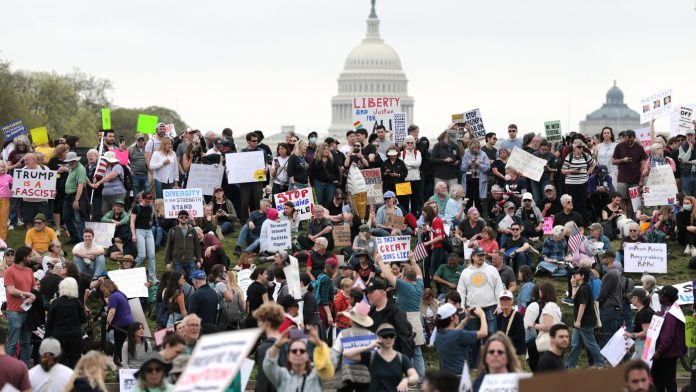
Protesters attend a “Hands Off” rally Saturday to demonstrate against President Trump on the National Mall in Washington, D.C.
Anna Moneymaker/Getty Images
hide caption
toggle caption
Anna Moneymaker/Getty Images
Demonstrators gathered across the country on Saturday, many animated by differing issues, but united in opposition to the Trump administration with the single message: “Hands off.”
Organizers said more than 1,300 “Hands Off” rallies of varying sizes took place on Saturday.
Since President Trump took office in January, various protests have taken place against his administration’s plans and policies — from the mass firing of federal workers to immigration raids to the involvement of billionaire Elon Musk in the federal government.
Saturday’s protests appeared to be the most widespread to date of Trump’s second term.
“There are so many issues,” said Kelley Laird from Rockville, Md., who attended a rally in Washington, D.C., on Saturday. “They’re coming after education, coming after health care, coming after the arts, coming after the press.”
In Boston, protesters gathered to push back against the federal cuts on research and against the arrest of Rümeysa Öztürk, a Tufts University doctoral student who was arrested by federal agents in plain clothes, as member station WBUR reported.
In Sylva, N.C., over 300 people came together to oppose cuts to national parks, education and veteran services, according to BPR News. And in Portland, Ore., several thousand people rallied against what they describe as an “illegal, billionaire power grab” by Trump and Musk, OPB reported.

Demonstrators gather Saturday on Boston Common during the nationwide “Hands Off” protests against President Trump and Elon Musk, in Boston.
Joseph Prezioso/AFP via Getty Images
hide caption
toggle caption
Joseph Prezioso/AFP via Getty Images
In D.C., thousands filled the grass near the Washington Monument, holding up signs supporting reproductive rights, LGBTQ rights, Social Security, veterans benefits, and opposing tariffs.
Laird and her neighbors said they formed a group chat after Trump took office this year. They use the group chat, named “Sisters of the resistance,” to coordinate attending protests together and offer support.
“We need to form community to bolster each other up because we have to be in this for the long run,” said Emily Peck, who started the group chat.

Protesters watch a series of speakers at a “Hands Off” rally to demonstrate against President Trump near the Washington Monument on the National Mall on Saturday in Washington, D.C.
Anna Moneymaker/Getty Images
hide caption
toggle caption
Anna Moneymaker/Getty Images
Many attendees who spoke to NPR said they felt compelled to show up, because new concerns keep emerging.
“This is first time that I am trying to regularly participate,” said Patty Kim, a retired federal worker, who attended the D.C. rally with her husband. “I felt so frustrated and paralyzed by the bunch of things that are going on that undermine human rights and humanity in this country that I love, that I had to do something.”

Protesters gather during a “Hands Off” protest against the policies of President Trump and Elon Musk on the National Mall in Washington, D.C., on Saturday.
Roberto Schmidt/AFP via Getty Images
hide caption
toggle caption
Roberto Schmidt/AFP via Getty Images
Veterans Colleen Boland and Sonia Lundy, who have been actively participating in protests, said they view it as a continuation of the military oath they took years ago to protect Americans.
“We took an oath long ago to protect against all enemies foreign and domestic, and I don’t think either Sonya or I ever imagined that we would have to kick in on the domestic piece of our oath, but we have, we are, and we will,” said Boland, who said she served in the Army and Air Force.
They are especially concerned with the future of Social Security and veterans’ benefits. While the White House has insisted that the Trump administration will not make cuts to Social Security benefits, there are plans for major changes, including the closure of dozens of Social Security offices; the elimination of thousands of jobs; and a new policy that will require more stringent identity checks.
“I was going to rely on this money. Is it going to be there?” said Lundy, who said she served in the Army.

A demonstrator is dressed as the fictional character Waldo during the “Hands Off” protest against the Trump administration on the National Mall in Washington, D.C., on Saturday.
Bryan Dozier/AFP via Getty Images
hide caption
toggle caption
Bryan Dozier/AFP via Getty Images
Al and Bev Mirmelstein were among the passengers in a three bus caravan that traveled to the D.C. rally from Charlottesville, Va., organized by the group Indivisible Charlottesville. At the protest, the Mirmelsteins held up signs that read: “Hands off our Constitution, rule of law, Social Security, free speech, health care,” and “Save our democracy.”
The couple said they joined multiple protests back home too, including one against the opening of a Tesla showroom. Both 77 years old now, they said they were too young to join demonstrations during the Vietnam War, but now they are committed to their activism.
“I didn’t participate in that, and I feel like I’m making up for it now,” Al said.
Israel Says Its Account of Rescue Workers Killed in Gaza Was Partly ‘Mistaken’

The Israeli military on Saturday acknowledged that the initial accounts from troops involved in the killing last month of 15 people in southern Gaza — who the United Nations said were paramedics and rescue workers — had been partially “mistaken.”
The assessment, which was shared in a briefing with reporters by an Israeli military official, came the day after a video obtained by The New York Times appeared to contradict the military’s earlier version of events. The official spoke on the condition of anonymity under army rules.
The Israeli military official said the internal investigation of the attack, which has drawn international scrutiny and condemnation, is ongoing.
Briefing reporters on Saturday night on the military’s initial findings, the official said forces from a reserve infantry brigade had been lying in ambush along a road to the north of the Gazan city of Rafah in the pre-dawn hours of March 23 and, at 4 a.m., had killed what he described as two Hamas security personnel and detained a third one.
Two hours later, as dawn was breaking, a convoy of ambulances and a fire truck approached the same spot. The Israeli forces were still on the ground and received a report from a surveillance aircraft that the convoy was moving toward them, the official said. When the rescue workers arrived and left their vehicles, he said, the forces believed that more Hamas operatives had arrived and opened fire on the occupants of the vehicles from afar.
The Israeli military had previously asserted, repeatedly and erroneously, that the vehicles were “advancing suspiciously” toward the troops “without headlights or emergency signals.”
The video obtained by The Times shows that the approaching ambulances and fire truck were clearly marked and had their emergency signal lights on when Israeli troops hit them with a barrage of gunfire.
The military official briefing reporters on Saturday did not offer an explanation for the contradiction, other than to say that the initial account from forces on the ground had been “mistaken.”
The military official said that Israel believes at least six of the 15 were Hamas operatives, but did not immediately provide any evidence, citing the classified nature of the intelligence work involved in the identification process. In recent days, the military had repeatedly asserted that nine of those killed had been militants belonging to Hamas and Islamic Jihad.
The Red Crescent, the International Committee of the Red Cross and the United Nations have previously said all of those killed were humanitarian workers who should never have come under attack.
On March 30, rescue teams found 15 bodies, most in a shallow mass grave along with their crushed ambulances and a vehicle marked with the U.N. logo. The video obtained by the Times was discovered on the cellphone of a paramedic who was found in that mass grave.
The Israeli official declined to comment on whether any of those killed had been armed. He said Hamas operatives in Gaza often did not wear military uniforms and that Israel had seen them posing as civilians, hiding in hospitals and school buildings.
The killings have drawn international scrutiny since the 15 people first went missing. The United Nations and the Palestine Red Crescent Society said the aid workers had not been carrying weapons and posed no threat. The president of the Palestine Red Crescent Society, Dr. Younis Al-Khatib, said that the bodies had been “targeted from a very close range.”
Palestine Red Crescent Society officials said last week that ambulances had set out around 3:30 a.m. on March 23 to evacuate Palestinian civilians wounded by Israeli shelling but that an ambulance and its crew had been hit on the way.
Several more ambulances and a fire truck headed to the scene over the next few hours to rescue them, according to the society, as did a U.N. vehicle, the United Nations said. Seventeen people were dispatched in total, of whom 10 were Red Crescent workers, six were emergency responders from Gaza’s civil defense and one was a U.N. worker.
The Red Crescent said one medic was still missing and that one had been detained by Israeli forces and then later released.