Thursday, November 12, 2026
Home Blog Page 51

Netanyahu Will Meet Trump in Washington

0

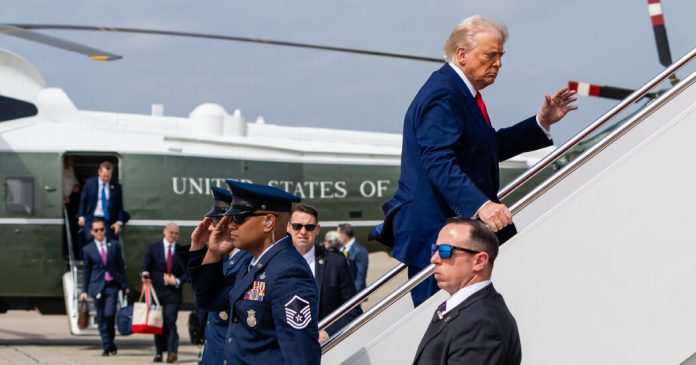
Prime Minister Benjamin Netanyahu of Israel is set to meet with President Trump at the White House on Monday, according to a White House official, in the second such visit by the Israeli leader since the new administration began in January.

Mr. Netanyahu will arrive in Washington after renewing Israel’s military campaign against Hamas in Gaza late last month, despite efforts by Mr. Trump’s aides to broker a new truce to stop the fighting there and free more hostages.

A spokesman for Mr. Netanyahu did not respond to a request for comment. The Israeli prime minister has been in Hungary on a state visit, where he met with the country’s leader, Viktor Orban.

During Mr. Netanyahu’s last visit, Mr. Trump described a vision for Gaza that involved a U.S. takeover and the mass exit of Palestinians from the enclave. Mr. Netanyahu has since issued a call for what he calls voluntary emigration by Gazans, which critics have denounced as effectively forced displacement.

Israeli forces have been steadily bombarding Gaza and advancing deeper into the enclave since the war resumed in late March. Israel has also barred aid from entering Gaza in an apparent attempt to pressure Hamas, leading to fears of a worsening humanitarian crisis for Gaza’s civilians.

The Trump administration has thrown its weight behind Israel, blaming Hamas for the return to fighting. Hamas has accused Israel of overturning the cease-fire that Mr. Trump’s aides had helped broker.

How ​South Korea’s Democracy Prevailed Over a Reckless Leader

0

When Yoon Suk Yeol was running for president, he had the word “king” written on his palm. South Koreans dismissed — and ridiculed — it as a shamanistic ritual that reflected his desire for top government office.

But ​after his inauguration in May 2022, it didn’t take long for ​them to see an authoritarian streak in Mr. Yoon.

On short notice, he ​moved the presidential office from the graceful Blue House to a drab military building. When he turned 63 in December 2023, his security team sang songs honoring him as “a president sent from Heaven” and describing his “845,280 minutes” in office so far as “a time blessed.” Two months later, a college student who protested Mr. Yoon’s decision to cut government budgets for scientific research was gagged and dragged out by the president’s bodyguards. When journalists published what he called “fake news,” prosecutors raided their homes and newsrooms to collect evidence.

Mr. Yoon kept pushing the envelope, until he made his fatal mistake: ​On Dec. 3, he declared martial law​, threatening a deeply cherished part of South Korean life: democracy.

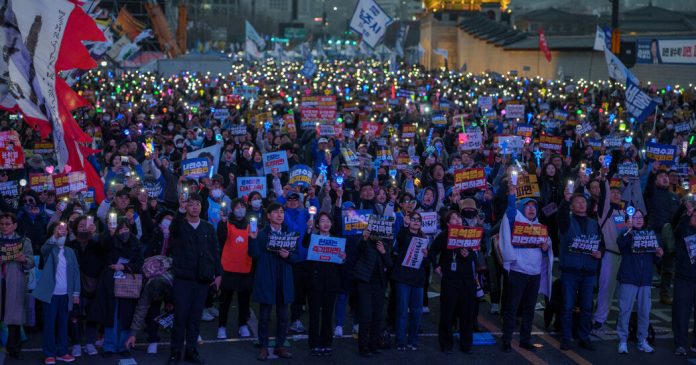
To​ South Koreans, democracy has never been something given​; it was fought for and won through decades of struggle against authoritarian leaders at the cost of torture, imprisonment and bloodshed​. All the major political milestones in South Korea — an end to dictatorship, the introduction of free elections, the ouster of abusive leaders — were achieved after citizens took to the streets.

So when people saw troops sent by Mr. Yoon storming the National Assembly to seize the legislature by force, their response was immediate. But unlike those who fought government repression in the ​1950s through the ​’80s, South Koreans protesting in recent months had ​democratic institutions on their side.

The current Constitution, written in 1987 after a huge pro-democracy uprising, gave the National Assembly the power to vote down martial law and ​impeach presidents. The Constitutional Court, created under ​that Constitution, got to decide whether to remove or reinstate an impeached president. And leaders democratically elected under that Constitution imprisoned those who had earlier taken power by military force​.

Younger generations, including the paratroopers Mr. Yoon sent to seize the Assembly ​in December, grew up learning of that history through box office-hit movies and novelists like the Nobel laureate Han Kang.

On Dec. 3, the troops hesitated before angry citizens blocking them with bare hands, allowing time for lawmakers, including some members of Mr. Yoon’s own party, to gather and vote to lift his martial law decree. The Assembly then impeached him, on Dec. 14.

And on Friday, the Constitutional Court’s eight justices, including those appointed by Mr. Yoon or his party, unanimously upheld that impeachment, putting an end to his military rebellion.

To one observer, these events were a victory for the democratic institutions created​ in the late 1980s. “The response to Yoon’s attempted coup d’état displayed the maturity of Korean democracy — first of all, the resilience of civil society, which reacted immediately and massively to oppose the coup, most notably with the passion of Korean youth who were not alive in the 1980s and experienced the dangers of a return to autocratic rule for the first time,” said Daniel Sneider, a former journalist who covered South Korea back then and is now a lecturer at Stanford University.

“The fact that it was a unanimous decision of the Constitutional Court, with conservative appointees joining the decision, was a very important expression of not only the clarity of the case, but also the ability to overcome ideological polarization,” Mr. Sneider said.

Mr. Yoon’s power grab also exposed the vulnerabilities of democracy in South Korea. If such a thing can happen in a nation long considered an exemplary case of democratization in Asia, scholars warned, it can happen elsewhere, too.​

Despite his removal, the deep polarization that led up to Mr. Yoon’s declaration of martial law persists. ​ ​The partisan struggle between the left and right is likely to intensify in the next two months as the country lurches toward a presidential election.

But the past four months have also shown the resilience of South Korean democracy.

​Until Mr. Yoon came along, few South Koreans thought that a return to military rule was possible in their country, a peaceful democracy known globally for its cars, smartphones and K-dramas. Many of those who joined protests calling for Mr. Yoon’s ouster in recent weeks said they had been more proud of their democracy than of their cultural exports like the boy band BTS or the Netflix hit “Squid Game.”

When Mr. Yoon hurt that pride, he picked a fight he couldn’t win. During rallies, people shared a video clip of former President Kim Dae-jung, an iconic figure in South Korea’s democratization struggle.

“Democracy is not free,” Mr. Kim said in the clip. “You must shed blood, sweat and tears for it.”

If the Constitutional Court had voted to reinstate Mr. Yoon, South Korea would have seen a “second wave of democratization movement” and “a second Gwangju,” said Cho Gab-je, a prominent South Korean journalist who has covered the nation’s political evolution since 1971, referring to the brutally suppressed uprising against martial law in the southern city of Gwangju in 1980.

“We had our share of martial law, but Yoon Suk Yeol was the first president to send armed troops into Parliament,” Mr. Cho said.

Mr. Yoon was once a hero among South Koreans. He built his national image as an uncompromising prosecutor when he helped imprison two former presidents for corruption. But he proved disastrous as a politician — unable to engage in the give and take of compromise with the opposition, which controlled the National Assembly.

He was accused of filling his presidential staff with officials too timid to speak up. He was nicknamed “Mr. 59 Minutes,” because that was how long he was said to speak during an hourlong meeting. He rarely apologized for his wife’s scandals or even for deadly disasters. He used his veto power to kill opposition bills. The opposition slashed his budgets and impeached an unprecedented number of political appointees in his government.

“A player busy playing on the field doesn’t look at the electronic scoreboard,” Mr. Yoon once said when asked about his dismal approval ratings.

Such an attitude allowed him to push unpopular efforts, such as improving ties with Japan and drastically increasing the number of doctors. But even many who sympathized with his struggle against the opposition didn’t see martial law coming.

“Koreans do not want the 1980s option, when martial law and tear gas made forcibly disappeared people painful to so many families,” said Alexis Dudden, a professor of history at the University of Connecticut. “Yoon and his advisers missed the mark of reading today’s South Korea in many obvious ways.”

Senate GOP passes budget plan, setting up a critical next phase for Trump agenda : NPR

0

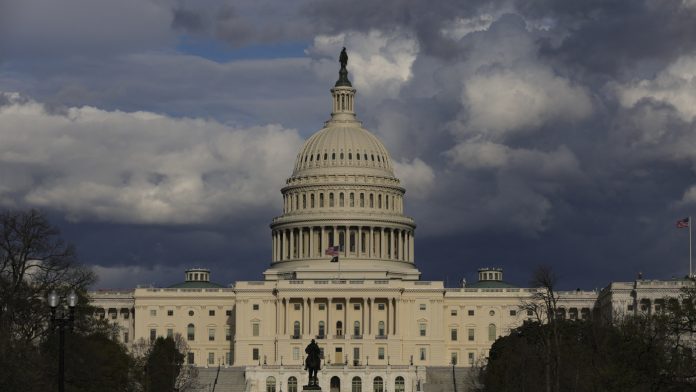
Senate Republicans have approved a new framework for a sweeping multi-trillion dollar plan to address defense, energy, immigration and tax policy. Above, the U.S. Capitol is seen on March 31.

Bryan Dozier/AFP via Getty Images


hide caption

toggle caption

Bryan Dozier/AFP via Getty Images

After a flurry of overnight votes, the Republican-led Senate has approved a revised framework for a sweeping budget plan that is critical to President Trump’s domestic agenda.

The 51-48 vote in the early morning hours on Saturday brings congressional Republicans one step closer to finalizing a sweeping multi-trillion dollar plan to address defense, energy, immigration and tax policy.

“This resolution is the first step toward a final bill to make permanent the tax relief we implemented in 2017 and deliver a transformational investment in our border, national, and energy security,” said Senate Majority Leader John Thune, R-S.D., ahead of the vote.

Republicans in the House and Senate need to pass identical versions of a budget resolution in order to get access to reconciliation, a feature of the budget process that allows them to pass other policies and avoid a filibuster by Senate Democrats.

But they still face an uphill battle, as there are already signs of trouble in the House over details of the Senate framework.

Here is a quick look at what the Senate plan would accomplish, and what to expect in the days ahead as lawmakers move to the next phase.

An extension for Trump’s 2017 tax cuts

All together the Senate plan would allow for more than $5 trillion in tax cuts. The blueprint would extend the Tax Cuts and Jobs Act passed in 2017 under Trump’s first term. The program is set to expire by year end, which would mean a tax hike for millions of Americans.

The bill also provides for an additional $1.5 trillion in new tax cuts.

Republicans are hoping the new cuts can make good on several of Trump’s promises from the campaign, like no taxes on tips.

The House, by comparison, has passed a budget framework that sets aside $4.5 trillion for tax cuts.

Paying for tax cuts

One of the biggest differences between the Senate plan and the House plan is how to pay for tax cuts. The bill directs both chambers to cut the deficit through spending cuts. While the Senate spending cuts are set at just around $4 billion, the House intends to cut at least $1.5 trillion. That includes a directive to the House Energy and Commerce Committee to cut $880 billion in spending, which has raised fear that those cuts can’t happen without a significant hit to Medicaid benefits.

Senate Republicans are also hoping to use a procedural gimmick that would effectively work to make the $3.8 trillion it would take to extend the Trump tax cuts appear to cost nothing. It’s a risky approach that is already causing tension between Republicans in the Senate and their House counterparts — and could prove one of the biggest obstacles to final passage.

The plan would lift the debt limit

To avoid a catastrophic financial default this summer, the Senate plan would raise the U.S. debt limit by $5 trillion. Without an increase, the government would be unable to issue new debt, which means it wouldn’t have money to pay its bills, including the interest it owes to bondholders.

Economists warn that if the U.S. were to ever default on its debt, it would be disastrous not just for the U.S., but for the global economy. The Congressional Budget Office, Congress’ nonpartisan scorekeeper, predicts that if lawmakers don’t act, the U.S. may breach the debt limit by August or September.

Money for the border and the Pentagon

The Senate plan also calls for an additional $521 billion in spending for a range of GOP policy priorities. There as much as $175 billion that’s expected to be used for border enforcement, plus $150 billion for defense spending.

Plenty of wildcards still to be sorted out

While Republicans in both chambers are largely in line on their hopes to get a plan to President Trump’s desk in the coming weeks, their razor thin margins threaten their ambitious agenda with lots of moving parts.

There are already some fiscal hawks in the House who still want to see bigger and more specific plans to cut spending. That’s handing House Speaker Mike Johnson, R-La., a tall order to win over these holdouts.

The two chambers are likely headed for a high-stakes clash over how deep to go on deficit reduction, versus the cost of extending the Trump tax cuts and whether they’ll have to cut into Medicaid to make it work. Ultimately, it will test congressional Republicans appetite to touch a political third rail in a pivotal moment for the party.

In Canada’s Auto City, Tariffs Have Already Caused a Shutdown

0

Outside City Hall in Windsor, Ontario, it was apparent on Friday morning that at least one American thing wasn’t being boycotted. Fans dressed in Detroit Tigers clothing were gathering at a bus stop to cross the river to take in the team’s home opener.

Beyond the opening day festivities, however, it was a week of particularly bad news for Windsor, my hometown.

President Trump finally announced a raft of global tariffs on Wednesday, including a new 25 percent tariff on cars assembled outside the United States. Its effect on Windsor was unexpectedly immediate. Hours before the tariff went into effect, Stellantis, the automaker that is the city’s largest employer, told Unifor, the union that represents its workers, that about 3,600 of the union’s members would be laid off for two weeks while the company sorts out its tariff strategy.

[Read: Auto Tariffs Take Effect, Putting Pressure on New Car Prices]

[Read: Canada’s Prime Minister Puts Tariffs on U.S.-Made Cars and Predicts Global Upheaval]

[Read: With Trump’s Tariffs, the Chasm Between Allies and the U.S. Widens]

While industry executives and auto analysts had warned for months that the tariffs Mr. Trump was threatening would lead to plant shutdowns, they also thought that wouldn’t happen for weeks.

The contract between Unifor and Stellantis will mitigate the immediate financial impact of the shutdown on union assembly workers. But most workers at auto parts plants in Canada and the United States, which will also probably close or lay off employees, don’t have the same income protection guarantees.

Stellantis and the other companies that make passenger vehicles in Canada — Toyota, Honda, General Motors and Ford — have much to consider. For Canada and Mexico, the United States’ partners in the free trade agreement Mr. Trump signed in his first term, the tariffs will be reduced by the amount of American content in each car, so automakers may be rethinking where they get some of their parts. Auto parts imported from Canada will face similarly reduced tariffs next month, once U.S. officials figure out a way to measure their American content; the task is much more complex for parts than for finished vehicles.

Windsor, the capital of Canada’s auto industry, could now be facing its greatest crisis since 2008, when Chrysler Canada, as Stellantis was then known, needed federal and provincial assistance to avoid financial collapse and a total shutdown.

To get a sense of the new challenges, I met Windsor’s mayor, Drew Dilkens, at City Hall for a follow-up interview. When we spoke two months ago, he said the biggest problem at the time was the uncertainty surrounding Mr. Trump’s trade intentions.

Our conversation has been condensed for space and edited for clarity.

What is happening at Stellantis?

Stellantis is saying, Let’s see what the inventory looks like and let it adjust for two weeks. Let us do the math and figure out what it is now going to cost us to make the vehicle. What do we have to sell it for, and will people buy it?

What do you expect the short-term consequences to be?

Demand for vehicles will fall because prices will go up. Which means you will need fewer people to build fewer vehicles. And you’re going to have this cascading of layoffs throughout the auto industry in the part sector that is not going to be a pleasant experience.

Will that mean the gradual end of assembly plants and parts-making in Canada?

I’m still optimistic that with the exchange rate difference between the U.S. and Canada — and given the number of parts companies that exist here — it’s not practical to think that the U.S. can repatriate all of that. I think the bigger risk is that getting parts from China will become more attractive, even with the tariff rate that is now in place.

Is there anything any politician in Canada can do to end the U.S. tariffs in the short term?

We’re in a tough place, there’s no doubt about it. And I don’t think we ever want to be in this place again.

This shows the risk for Canada from being so reliant on the United States as a trading partner. Still, I think the U.S. will always be our largest trading partner by virtue of proximity and its buying power.

But this decision by the president will have people looking at other markets and contemplating how they can better mitigate that risk.


The Trump tariffs again dominated the election campaign this week. While Mark Carney pledged to create a government-owned affordable housing development agency, Pierre Poilievre, the Conservative leader, offered a tax break for investors who put their gains back into Canadian investments, and Jagmeet Singh of the New Democrats proposed reviving “victory bonds” to bolster the economy during the trade battle in the United States.

  • Chris Donovan, a photographer from Saint John, New Brunswick, has created a compelling photo essay of his city and the overarching influence the Irving family holds over it.

  • Dr. Joanne Liu, a physician in Montreal and a professor at McGill, was supposed to give a long-planned speech in New York at NYU Langone Health, the hospital affiliated with her alma mater, New York University. But after she arrived in the United States, Dr. Liu, a former international president of Doctors Without Borders, was told that her presentation was canceled because it could be perceived as antisemitic and opposed to the U.S. government.

  • In Opinion, the author Stacy Schiff notes that Benjamin Franklin and George Washington, like Trump, tried to persuade Canadians to join the United States — and that those efforts throughout history have had “all the grace and romance of Pepé Le Pew on the trail of Penelope Pussycat.”

  • Also in Opinion, Jill Lepore, the Harvard historian, explores the ideas of Elon Musk’s grandfather, Joshua Haldeman, “a cowboy, chiropractor, conspiracy theorist and amateur aviator.” Before leaving Canada for South Africa, Mr. Haldeman was the leader in Canada of a political movement known as technocracy.

  • Tamara Lich and Chris Barber, two of the main organizers of the four-week blockade that paralyzed downtown Ottawa in 2022, were convicted on Thursday after an unusually long trial.

  • A fan wore a “Canada is not for sale” hat to a Toronto Blue Jays game and was thrown out for it. Vanessa Friedman, The Times’s chief fashion critic, writes that such caps are part of a worldwide phenomenon.

  • A tape that sat gathering dust in a Vancouver record shop for perhaps a decade turned out to be a recording of the Beatles’ 1962 audition for Decca Records, a session that notably ended with the band’s rejection.

  • Peter S. Goodman writes about a family-owned business in Ottawa that makes violin shoulder rests and how it’s been caught up in the trade war.


Ian Austen reports on Canada for The Times based in Ottawa. He covers politics, culture and the people of Canada and has reported on the country for two decades. He can be reached at [email protected]. More about Ian Austen


How are we doing?
We’re eager to have your thoughts about this newsletter and events in Canada in general. Please send them to [email protected].

Like this email?
Forward it to your friends, and let them know they can sign up here.

Week in politics: New tariffs tank stock market, Sen. Cory Booker breaks Senate record

0

President Trump’s announcement of sweeping tariffs on nearly every country sent the stock market plunging this week and ignited anxiety about the future of the economy.

Works of Art – The New York Times

0

If you sit close enough to the front of the theater for “A Streetcar Named Desire” at the Brooklyn Academy of Music, you can see Paul Mescal spit and sweat as he stalks the stage as Stanley Kowalski, an artist doing his work in real time and space. It had been a while since I’d seen live theater when I went to see “Streetcar” a few weeks ago, and I found myself in awe of the very liveness of it. I’ve grown so accustomed to experiencing culture through screens that I forgot how exciting it is to be in the room where the art is happening, to witness the effort and passion and bodily exertion that go into it.

It’s not just movies and TV, of course — we’re all aghast at how much time we spend on devices, consuming content, whatever that means. Reading and watching and posting and shopping, always shopping for things and ideas and comfort and distraction. Surely this endless marketplace will turn up something that satisfies us at some point! I complained to a friend that I had the blues recently and her advice surprised me in its specificity and simplicity: “Engage with things that someone put a lot of work into.”

This wisdom seemed to cut through a lot of the bargaining I do with myself about how I spend my time. “Well, it’s OK that I spent the last 45 minutes reading the NYCBike subreddit because I learned about how they’re ticketing cyclists who run red lights on Second Avenue, which is useful to me as someone who frequently cycles down Second Avenue,” I might rationalize. But if I am determined to engage only with things that someone put a lot of work into, idly reading Reddit is out. So is my habit of scrolling through Instagram Reels of senior dogs. No more using ChatGPT as a therapist — there isn’t even a “someone” in that equation.

I had thought my online hygiene was unimpeachable, that I’d skirted many of the mental-health hazards of social media by using it only as a source of impersonal pleasure (no looking at friends’ envy-inducing vacation photos, no posting, just the aforementioned old dogs, some fashion stuff, maybe some inspiring quotes from interviews with famous authors).

But once I started cutting stuff out and noticed my mood improving, I realized that it wasn’t the nature of the content that was making me sad, but the volume. If I sometimes feel like my hard drive is full, then it doesn’t matter if what I’m adding to the drive is, on its face, soothing. It’s just more stuff, more data, more things to process. By adopting my friend’s elevated standard for what’s allowed in, I decreased the number of inputs, the number of demands for thought and work and reaction I was requesting of my brain.

Of course, there are complications that arise with this rule. “A lot of work” is a subjective measurement, and often the things that entail a lot of work are expensive, only available to those who can afford them, which risks creating a pretty boring, exclusionary selection for cultural consumption.

I’m not interested in — nor is it a realistic proposition, given my means, tastes, profession — subsisting solely on great novels and live theater to the exclusion of all else. But any rubric that stems the tide of information we’re allowing into our brains and hearts, even temporarily, can be helpful. It helps to remember we have choices: You don’t have to check Facebook every day just because you always have. You don’t have to read that blog while you drink your coffee or watch TikToks on the toilet. If you’re experiencing a general sadness or ennui or overwhelmsion without obvious origin, why not try switching things up? It might not totally reverse your mood, but then again — who knows? — it might.

Tariffs

  • The singer and songwriter Tracy Chapman has avoided the spotlight for the past decade. In an interview with The Times, she breaks her silence and looks back on her powerful hit “Fast Car.”

  • The Irish actor Andrew Scott calls his solo performance in “Vanya,” an Off Broadway production of Chekhov’s melancholy comedy, an “endless experiment.”

  • Take five minutes out of your day to fall in love with the music of Billie Holiday. Listen here.

  • Mark Hoppus, the bassist and singer in Blink-182, recounts his personal struggles and his band’s history in a new memoir.

🎸 Bon Iver, “Sable, Fable” (Friday): For those who love “very talented and very sad person with a guitar” music, Bon Iver’s “For Emma, Forever Ago,” released almost 20 years ago, is almost certainly still in rotation. It is for me at least. After a five-year hiatus, Bon Iver is back with another studio album, “Sable, Fable,” and sounding a little different — healed, even. In the intervening years, the frontman, Justin Vernon, began courting joy instead of pain. The result of that personal work is an album that “captures hope, thrills and a kind of unselfconscious exultation,” the Times critics Jon Caramanica and Joe Coscarelli write. Watch Vernon’s interview with The Times.

Sarah DiGregorio’s shrimp in purgatory has the garlicky, chile-flake sauciness of the traditional Southern Italian egg dish, but instead of using those pricey orbs of chicken caviar, Sarah’s recipe stars succulent, sweet shrimp. Serve this one over polenta or couscous for maximum red sauce absorption, or chunks of a torn, crusty baguette for a contrasting crunch.

A dash of respect: Bartenders revere the daiquiri. Why, then, do they not sell more of them?

Getting creative: Easter eggs are so expensive that some Americans are dyeing potatoes.

Supermarket tourism: Visiting local grocery stores has become an essential stop on the vacation itinerary.

Fertility: Your weed habit may be messing with your sperm.

Well, The Times’s personal health section, is hosting its first festival on May 7. Times journalists will chat with Peter Attia, Padma Lakshmi, Robin Arzón, Sara Bareilles and others about the science and art of living well. Find out more here.

There are few things that tax the human heart more than seeing pets approach the end of their lives. And while you can’t stop time, there are things you can do to keep an aging pet comfortable, including investing in gear that may help them sleep better, eat more and generally feel at ease. Since hardwood and tile can be slippery, rugs, carpets and yoga mats can be helpful for traction. Elevating their food and water bowls can help reduce the strain of bending down. And a sharp pill cutter can make it easier to sneak smaller bits of their medicine into a treat. For more, Wirecutter’s experts have a list of considerations and helpful tools; consider it a starting point as you navigate this phase of your pet’s life. — Mel Plaut

Duke vs. Houston, men’s N.C.A.A. tournament: For a second straight year, Duke and Houston will face off in the tournament. And although all four No. 1 seeds are playing tonight for a spot in the national championship, it’s this later game that has the makings of a classic. An unstoppable force, Duke’s top-rated offense, is meeting an immovable object, Houston’s top-rated defense. If Duke has an edge, it’s the standout freshman Cooper Flagg, The A.P.’s player of the year and most likely the top pick in the next N.B.A. draft. Tonight at 8:49 p.m. Eastern on CBS

Trump Envoy Visits Lebanon Amid Fears Over a Shaky Cease-Fire

0

A top Trump administration envoy to the Middle East was in Lebanon on Saturday amid U.S. pressure on the country to crack down on Hezbollah and as tensions with Israel flare despite a U.S.-brokered cease-fire.

Morgan Ortagus, President Trump’s deputy Middle East envoy, met with senior officials after strikes over the past two weeks threatened the truce that went into effect in November.

The Lebanese government has been trying to rebuild the country in the wake of the devastating war between Israel and Hezbollah in which about 4,000 people in Lebanon were killed and roughly one million displaced. Hezbollah, the Iran-backed militant group that had long been a dominant force in Lebanon, was severely weakened in the war, but still has significant influence.

On Saturday morning, Ms. Ortagus met with Lebanon’s new president, Joseph Aoun, to discuss issues including the situation in southern Lebanon, according to a statement from Mr. Aoun’s office. Under the cease-fire, the Lebanese military is supposed to take charge in the country’s south, where Hezbollah had long been deeply entrenched.

Last week, militants fired rockets at Israel, prompting Israeli forces to bombard the outskirts of Beirut, the capital, and southern Lebanon. Israel later struck the area south of Beirut — known as the Dahiya — in what it said was targeting a Hezbollah official, raising further fears that the truce could fall apart.

Hezbollah denied any connection to the rocket fire. Neither Israel nor Hezbollah has shown appetite for a return to full-scale war. The cease-fire has continued to hold, at least for now, despite the tensions.

Ms. Ortagus and Mr. Aoun also discussed ongoing financial overhauls by the new Lebanese government, according to the Lebanese statement. Lebanese officials hope the effort will help bring in increased foreign assistance — including from the United States — to rebuild the country.

The total damage and economic loss from the war is estimated to be $14 billion, and Lebanon needs $11 billion to rebuild, the World Bank said last month, making the conflict the country’s most destructive since its long civil war ended in 1990.

Experts say the amount of international aid is likely to depend on whether the Lebanese government can assert its control over the country, including by disarming Hezbollah. Before the war, the armed group was so powerful that it was generally considered a state within a state.

Trump Treats European Allies as a Cash Cow

0

It was not long ago that President Joseph R. Biden Jr. was marshaling European allies to resist the Russian invasion of Ukraine. He illustrated the point that a top American diplomat, R. Nicholas Burns, recently summarized as the way the United States wins the global competition for power and prosperity: “Be nice to your allies.”

President Trump clearly has a different view. His antagonism toward Europe has been public for decades, seeing allies as economic competitors and geopolitical parasites. And his decision on Thursday to impose controversially calculated tariffs on America’s partners, including Ukraine — but not on Russia or North Korea — laid bare his willingness to fracture a trans-Atlantic alliance that has largely kept the peace in Europe for 80 years.

Combined with Mr. Trump’s demand that NATO allies spend up to 5 percent of their gross domestic product on the military and his expressed desires to seize territory from Denmark, a NATO ally, the tariffs highlight long-term damage to American relations with Europe that are unlikely to ever be fully repaired.

“The tariffs are another addition to the perception and assessment in Europe that the U.S. under Donald Trump is not only an unreliable partner, but a partner that cannot be trusted in any way,” said Guntram Wolff, an economist and a former director of the German Council on Foreign Relations. “That changes 80 years of postwar history, when the trans-Atlantic alliance was the core of the Western world and of the global multilateral system.”

As much as Brussels will try to preserve some of these key relationships, Mr. Wolff added, “It cannot on its own underpin the global system.”

Mr. Trump’s effort to transform the global order also seems to benefit Russia, NATO’s chief antagonist, by potentially weakening the Kremlin’s adversaries in the rest of Europe, though plummeting oil prices on Friday hit Russia as well.

“There seems to be no order in the disorder,” said Ursula von der Leyen, the president of the European Commission, on Thursday. “No clear path through the complexity and chaos that is being created as all U.S. trading partners are hit,” while “hurting the most vulnerable citizens.”

Europeans are increasingly aware that Mr. Trump, unmoderated and even encouraged by more ideologically compatible and loyal advisers in his second term, intends to follow through on his intentions to distance the United States from Europe. But “the intensity, speed, aggression and imperialism of this administration has been a surprise to some people,” said Mark Leonard, director of the European Council on Foreign Relations.

Many European governments thought they could navigate Mr. Trump’s demands through transactional methods, such as buying more weapons and liquefied natural gas — major American exports — and doing more burden-sharing. The developments of the past weeks show the limits of that approach, including the Trump administration’s uneven application of tariffs on Britain and the European Union and its demand for Ukrainian minerals in return for years of military aid.

“The challenge for Europe is how to deal with a predatory America willing to use the vulnerability of allies to extort them, whether it’s a mineral deal in Ukraine or attempts to annex Greenland or the open way Trump is trying to divide Britain from the E.U. with differential trade deals,” Mr. Leonard said.

For now, the European Union is holding together, in large part because Mr. Trump applied the same 20 percent tariffs to all its 27 member states, including more ideologically friendly countries like Hungary, Slovakia and Italy. But Washington may also choose to use differentiated tariffs on certain sectors to pressure individual countries, like Denmark, over issues like Greenland.

There is a general assumption that the tariffs are a prelude to a deal, as Mr. Trump’s son Eric urged in a message on X. “I wouldn’t want to be the last country that tries to negotiate a trade deal with @realDonaldTrump,” he wrote. “The first to negotiate will win — the last will absolutely lose.”

Sophia Besch, a German analyst at the Carnegie Endowment in Washington, sees two fundamentally different messages from the Trump administration. “It’s not clear whether this is an opening offer to negotiate, or whether they really are remaking the world, with no interest in repairing it,” she said. “Different people around Trump are pursuing different things.”

The issues of tariffs and security are distinct but hardly separate, Ms. Besch and others said, displaying Mr. Trump’s willingness to use American power crudely and even uncaringly against friends, their economies and the poor, who are most likely to suffer from inflation and higher consumer taxes.

Secretary of State Marco Rubio tried to be reassuring in Brussels this past week, at a meeting of NATO foreign ministers, as he mixed emollience with warning. He denounced “hysteria and hyperbole” in the media and insisted that Mr. Trump supports the alliance and its commitment to collective defense. “President Trump’s made clear he supports NATO,” Mr. Rubio said. “We’re going to remain in NATO.”

But not any NATO.

Mr. Trump expects European allies to take the main responsibility for their own security and for Ukraine’s as America turns toward Asia, Mr. Rubio warned. “He’s against a NATO that does not have the capabilities that it needs to fulfill the obligations that the treaty imposes upon each and every member state.”

Yet the economic impact of the tariffs, expected to cause inflation and lower economic growth, will make it only harder for European allies to increase military spending to the 3.5 percent of G.D.P. goal that NATO is considering for its summit in July, let alone the 5 percent that Mr. Trump has demanded.

For Germany alone, a rich country, the impact will be considerable, with Germany’s finance minister, Jörg Kukies, estimating a 15 percent reduction in German exports to the United States. He says Germany will continue to try to negotiate better terms with Washington, even as Brussels retaliates forcefully if carefully for the bloc. Still, the German Economic Institute estimates the possible costs of these tariffs to Germany alone at around 200 billion euros ($218 million) over the next four years.

Europeans will now search for other markets and more free-trade deals, like the ones it has with Canada and Mexico, said Maggie Switek, an economist and director of research at the Milken Institute. “There is still room for cooperation with the U.S. and U.S. companies as we think through how to navigate this new situation and new American theory,” she said.

But for Moscow, which does little unsanctioned trade with the United States, the tariff blow to American allies was another gift. The former president of Russia Dmitri Medvedev crowed happily on X about the damage done.

Invoking an old Chinese proverb, he said Russia would “sit by the river, waiting for the body of the enemy to float by. The decaying corpse of the EU economy.”

Chaotic HHS layoffs leave employees at CDC, FDA and NIH reeling : Shots

0

A worker wheels out the belongings of a fellow employee who was dismissed, outside of the Mary E. Switzer Federal Office Building, which houses HHS offices in Washington, D.C., on Tuesday.

Al Drago/Bloomberg/Getty Images


hide caption

toggle caption

Al Drago/Bloomberg/Getty Images

Chaos and confusion dominated the restructuring affecting thousands of workers at the U.S. Department of Health and Human Services this week.

Some people who were fired are being unfired, at least temporarily. Some managers don’t even know who still works for them. With human resources teams gutted, answers are extremely hard to come by. This is according to interviews with more than a dozen staff, many of whom did not share their names for fear of retaliation.

Firings began early this week. Many workers only found out they had been fired when they tried to enter the building and their security badges didn’t work.

The confusion escalated through the week. Health Secretary Robert F. Kennedy Jr. admitted about a fifth of the cuts were “mistakes,” telling reporters on Thursday: “We’re reinstating them. And that was always the plan,” he said. “We talked about this from the beginning, [which] is we’re going to do 80% cuts, but 20% of those are going to have to be reinstalled, because we’ll make mistakes.”

Among those “mistakes,” Kennedy said, was the elimination of a division of CDC that, among other things, helps public health departments around the country address lead contamination in water. A massive testing effort was about to begin in Milwaukee’s school system when CDC sent its notices.

By Friday afternoon, a day after Kennedy said the lead surveillance program was reinstated, officials in that division said they had heard nothing about resumption of the work, or plans to reinstate their jobs.

In a statement, HHS said the restructuring “is about realigning HHS with its core mission: to stop the chronic disease epidemic and Make America Healthy Again.” It said roughly 10,000 employees were cut this week and the cuts focused on “redundant or unnecessary administrative positions.”

RIF’ed and then unRIF’ed?

At the National Institutes of Health, six workers in the public records office who had been terminated with their jobs set to end in 60 days, were then ordered to return to work. NPR obtained the email they received, calling them back to work — though not restoring their jobs. It reads in part:

NIH leadership has directed that you return to work and that your logical and physical access be restored immediately, if it was terminated. Your RIF notice is not cancelled. NIH leadership is actively working on these issues. We do not have additional information and neither does [Office of Human Resources] at this time…

At the Food and Drug Administration, the travel coordination staff are in a similar situation. The team was laid off and then called back in, according to one staffer. But their jobs are still eliminated — they’ll be gone again in June.

Some staff have had their firings fully rescinded. For instance, 29 of 82 workers cut at the National Institute of Neurological Disorders and Stroke have been invited to return to work, including 11 senior scientists, according to an individual familiar with the situation who was not authorized to speak publicly.

HHS did not respond to a request for comment about the number of personnel whose firings had been reversed.

Fired or not? Hard to tell

An HHS worker at a regional office believed that she had avoided the layoffs and was able to use her badge and begin work in the office as normal on Tuesday.

After a few hours, she received an email, shared with NPR, saying that even though she hadn’t received a RIF email yet, “it is our understanding […] that you may be among the impacted employees.” She was told to take her laptop and personal items and “exit the building as soon as possible.”

Days later, her work email access stopped working, but she still hadn’t received any official notice that she was being fired.

A former head of a division at CDC, who believed all or nearly all his staff had also been placed on administrative leave pending termination, was confused about who among his colleagues remained at the agency, or what would become of the programs he and his staff ran.

Another manager and a staffer at one unit of the CDC’s National Institute of Occupational Safety and Health said a handful of staffers appeared to still have jobs. But with the vast majority of their colleagues missing, they can’t carry out their work anyway. They asked that their names be withheld for fear of retaliation.

Vanessa Michener, a health communication specialist at the CDC who worked on HIV outreach, was notified that her position was among those being cut on Tuesday. She said she’s stunned by the chaotic way the layoffs have unfolded.

“Haphazardly doesn’t even begin to describe it,” she said. “Instead of letting people be involved in the decision making, they just randomly wiped out entire programs.”

“I don’t understand how any average American that is seeing this unfold could see how this could possibly make sense,” she said. “It is an ungodly amount of additional waste for no reason.”

Crowdsourcing crucial information

The government is not providing precise details about the positions and functions that have been cut.

Instead, some workers have worked on crowdsourcing lists of those cut.

The picture they paint is stark. For instance, at the CDC, entire divisions were hit hard. Outside of the human resources and IT functions, some of the hardest hit appear to include the National Institute for Occupational Safety and Health, and divisions that monitor birth defects, zoologic and infectious disease, and chronic disease — one of the areas Kennedy said is a priority for the country.

With human resources teams out in many divisions, HHS staff are also crowdsourcing advice. One document obtained by NPR advises employees not to “preemptively resign.”

“If you are laid off in a RIF you have rights, possible severance pay, and the right to receive unemployment benefits from your state agency,” it says. The document also advises employees not to blame themselves — or to harm themselves — and it links to the 988 Suicide and Crisis Lifeline.

On Thursday, HHS announced all contract spending must be cut by 35%. This move adds to the confusion and difficulty of those staff who remain in place to do their jobs, one CDC staffer told NPR. “Folks at CDC who are our contracting officers have been destroyed,” which means even trying to cancel contracts will be “a tall order” for the remaining staff.

“We are already just picking up the pieces,” the worker said. “It will take weeks at a minimum but likely one to two months to get in a place where we are functioning somewhat OK again.”

Fears for the future

Chanapa Tantibanchachai was among 18 people on the FDA’s press team who were fired Tuesday. Communications staff at other health agencies within HHS were also cut.

“It does not fit into ‘radical transparency,'” Tantibanchachai told NPR, referring to Kennedy’s promise for how he would run the HHS. “How can there be radical transparency when there are no communicators to do the work of providing that transparency?”

Press officers at FDA worked on designated subject matters, like food safety, vaccines, and oncology drugs, setting up interviews with reporters and subject matter experts, and updating the public on their topics.

“None of that is going to exist now,” she said, adding she didn’t know what that would mean for the future. “It’s a bad day for journalists that relied on us. It’s a bad day for the public that relies on the news stories that you all are putting out based on the information you would get from us.”

At NIH where about 1,300 employees were laid off, there’s widespread anger and despair. Most of those cut appear to have been involved in support jobs, communications, IT, human resources, those who order supplies and specialists who handle contracts and grants. These jobs are crucial for enabling scientists to search for new cures for everything from asthma, allergies and Alzheimer’s to AIDS, cancer and heart disease.

“I don’t even know where to start with the devastation that is being wrought in infectious disease in particular,” said an NIH official who did not want to be identified because of fears of retribution.

“It is going to take us more than a generation to recover, not just with the science but with the cuts to training grants and supporting mentees. And all the while, China is continuing to pour investments into these very areas … and we will quickly be eclipsed,” the official said via email.


What Is Next for Yoon Suk Yeol, South Korea’s Ousted President?

0

Yoon Suk Yeol’s political career may be over, but his troubles are not.

Ex-President Yoon, a former prosecutor, was removed from office by the Constitutional Court on Friday. But he still faces criminal charges of leading an insurrection over his short-lived imposition of martial law on Dec. 3. A separate trial on those charges began in February and is ongoing.

Prosecutors say that Mr. Yoon committed insurrection when he banned all political activities and ordered military commanders to break the National Assembly’s doors down “with axes” or “by shooting, if necessary” and “drag out” lawmakers.

Mr. Yoon has repeatedly rejected the claims of orchestrating an insurrection. He said that he declared martial law to protect the nation from “anti-state forces” who infiltrated the government.

If the court finds Mr. Yoon guilty, he could face a long prison term. But many of South Korea’s former imprisoned presidents, including Park Geun-hye, who was convicted of bribery, have ended up being released early. Ms. Park was pardoned in 2021 by then-president Moon Jae-in, less than five years into her 20-year prison term.

The criminal case will not be directly affected by the Constitutional Court ruling that upheld his impeachment.

Mr. Yoon’s time in office was plagued with problems and scandals. After his narrow electoral win in 2022, he soon became a deeply unpopular and divisive leader.

As president Mr. Yoon used lawsuits, state regulators and criminal investigations to clamp down on speech that he called disinformation, efforts that were largely aimed at news organizations. The police and prosecutors repeatedly raided the homes and newsrooms of journalists whom his office accused of spreading “fake news.”

Mr. Yoon was also accused of using his power to advance his own interests. He was accused of pressuring the Defense Ministry to whitewash an investigation into the death of a South Korean marine in 2023, and vetoed a bill pushed through Parliament by the opposition calling for a special prosecutor to investigate the claim.

Mr. Yoon’s wife, Kim Keon Hee, was also at the center of some of his troubles. In late 2023, spy cam footage emerged showing Ms. Kim accepting a $2,200 Dior pouch as a gift. The episode roiled his political party and became a significant issue ahead of parliamentary elections.

Relations with North Korea sank to longtime lows after Mr. Yoon took office. For decades, the two Koreas — which never signed a peace treaty after the 1950-53 Korean War ended in a truce — have swung between conciliatory tones and saber rattling. North Korea’s leader, Kim Jong-un, has been unpredictable and bellicose, developing nuclear weapons and supplying Russia with munitions and troops for its war against Ukraine.

Mr. Yoon adopted a confrontational approach and called for spreading the idea of freedom to the North to penetrate the information blackout there. He also expanded joint military drills with the United States and Japan.

North Korea, under Mr. Kim, has veered toward a more hawkish stance, shutting off all dialogue with Seoul and Washington, doubling down on testing nuclear-capable missiles, and vowing to treat South Korea not as a partner for reunification but as an enemy that the North must annex should war break out.

Mr. Yoon leaves behind a government without an elected leader and facing a presidential poll within 60 days.

“It has been a great honor for me to work for the country,” Yoon Suk Yeol said in a statement released through his lawyers after he was removed from office. “I thank those who supported and cheered me despite my shortcomings. I am regretful and sorry that I could not live up to your expectations,” he said, without directly commenting on the Constitutional Court’s decision.

Mr. Yoon and his wife will need to vacate the official residence where he once holed up to resist arrest, protected by barricades and scores of security guards.

The couple is expected to move back into their private home in Seoul, where they had lived before Mr. Yoon’s election. But they will continue to have the protection of the presidential security services — one of the few benefits allowed for a former leader ousted through impeachment.