Thursday, November 12, 2026
Home Blog Page 52

What Will Trump’s Tariffs Do to EU-China Trade Relations?

0

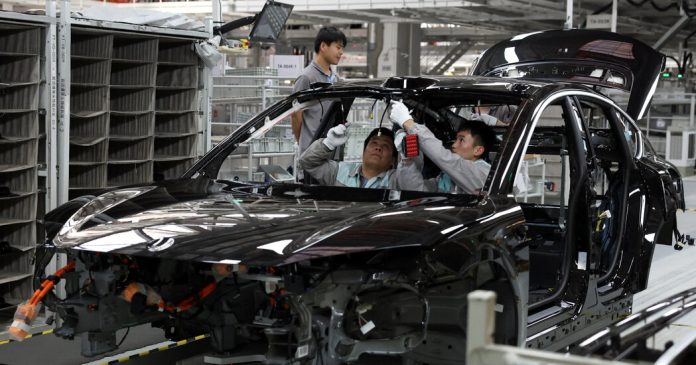
President Trump’s tariffs mean that companies across the European Union and around the world are at risk of losing access to the world’s largest consumer market.

Naturally, they are looking for the next big thing. Statistically speaking, that would mean China.

The E.U. has the second-largest consumer market in the world behind America; China is third. But China and the E.U. have not exactly been cozy in recent years. Europe has regularly blasted China for overproducing and dumping artificially cheap products on the global market, and European leaders have criticized China’s stance toward Russia’s war in Ukraine, among other political and social issues.

Still, the E.U. is staring down 20 percent across-the-board tariffs in the United States, and even higher levies on major products like cars and trucks. China is confronting rates in excess of 50 percent. There’s a small chance that those tariffs could drive the two large economies closer together, experts said — an unintended consequence at a time when Mr. Trump’s America has been trying to weaken China.

There have been early hints of a thaw. The E.U. imposed higher tariffs on Chinese-made electrical vehicles last year, but China’s commerce ministry said at a news conference on Thursday that the two sides had agreed to restart negotiations. Olof Gill, an E.U. spokesman for trade, said officials had agreed to “continue discussions” on electric vehicle supply chains and take a “fresh look” at pricing.

But there is an even greater possibility that this moment will tear the E.U. and China further apart. China’s reduced access to American consumers could prod its companies to send even more cheap metals, chemicals and other products in Europe’s direction, worsening concerns about dumping and heightening already-high tensions on other matters. Relations between the two nations could deteriorate, widening the damage as America blows up longstanding global trade patterns.

“There’s two ways that this could play,” said Theresa Fallon, an analyst at the Center for Russia, Europe, Asia Studies in Brussels. “Europe is in a really tough position.”

Europe is responding quickly to Mr. Trump’s trade war. It plans to finalize next week initial lists of goods destined for retaliatory tariffs, and officials have promised more will come. It is also trying to negotiate to get rid of the tariffs, with the E.U. trade commissioner set to meet his U.S. counterparts through teleconference on Friday.

If the U.S. tariffs are not quickly negotiated away, Europe — and China — could find themselves looking for new consumers.

Another big part of Europe’s strategy? Making new friends.

Since late last year, the bloc has worked to expand relations with India, South American countries, South Africa, South Korea and Mexico. It has also drawn nearer to Canada and the United Kingdom, especially on defense issues.

Yet the U.S. is difficult to replace with one-off trade deals elsewhere because of the sheer size of its consumer market: $18.8 trillion in 2024, according to World Bank data. The E.U. trails at about $10 trillion, China at about $7 trillion. America is the E.U.’s most important export market.

Filling a U.S.-shaped void with China, while mathematically obvious, would be tricky. China and the E.U. have been moving further apart in recent years, with declining trade flows, and regular accusations by the E.U. that China is using trade practices that distort the market.

Europe’s dilemma when it comes to China has been on full display in the way that European leaders have talked about the Asian nation in recent months.

“We must engage constructively with China,” Ursula von der Leyen, who heads the E.U.’s executive arm, said during a speech in Davos, Switzerland, in January. She talked about expanding trade and investment ties “where possible.”

But when Mr. Trump’s tariff announcements came out this week, a flood of cheap goods coming from Asia was an immediate concern.

“We will also be watching closely what indirect effects these tariffs could have, because we cannot absorb global overcapacity, nor will we accept dumping on our market,” Ms. von der Leyen warned in her televised response on Thursday to the Trump tariffs.

The E.U. and China are to have a summit this year, though details on timing and location have yet to be determined.

Noah Barkin, a Berlin-based visiting senior fellow at the German Marshall Fund and a specialist on China, said: “Trump’s tariffs are likely to divert a massive amount of Chinese exports into the E.U.”

“The bloc is likely to throw its entire trade policy toolbox at Beijing in response,” he added. “It is difficult to envision a scenario where this ends well for the E.U.-China relationship.”
Russia Executes P.O.W.s Without Caring Who Watches, Ukraine Says

0

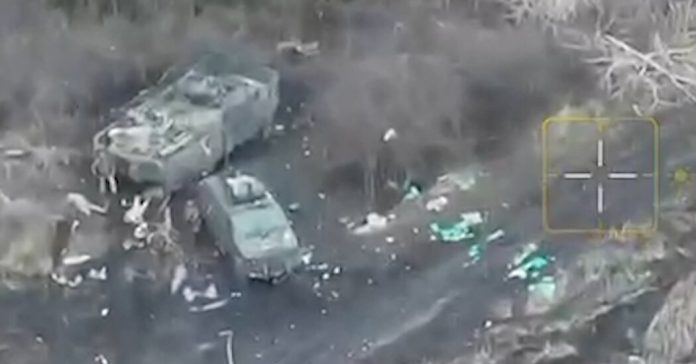
On a Monday morning last fall, Ukrainian drone pilots watched what had become a familiar scene unfold on a drone’s live feed: Russian soldiers pointed their guns at two Ukrainians, who seemingly surrendered. Then, the footage showed, the Russians shot them point blank.

The video, provided by a pilot who said he had witnessed the killing on the feed, was verified by The New York Times and the Centre for Information Resilience, a nonprofit organization. It appeared to show the Ukrainian prisoners executed near the village of Novoivanovka in the Kursk region of Russia.

“There were no polite words spoken among us — we were filled with rage and an intense desire for revenge,” said the pilot, 26, who served with the 15th Mobile Border Guard and asked to be identified by his call sign of “One Two” in accordance with military protocol.

As the United States embraces Russian talking points in its push for a cease-fire in Ukraine, many Ukrainians wonder whether allegations of Russian war crimes will simply be forgotten. President Trump has indicated that he would like to re-establish ties with Russia and end the war — or at least, wind down the U.S. commitment to Ukraine made under President Joseph R. Biden Jr.

The U.S. informed European officials recently that it is withdrawing from a multinational group created to investigate allegations of war crimes against senior Russian leaders and allies responsible for launching the full-scale invasion of Ukraine in 2022. The Biden administration joined the group in 2023. The U.S. State Department has also ended funding for the tracking of tens of thousands of Ukrainian children abducted by Russia.

While both sides have been accused of committing war crimes, Russia has faced far more allegations, not only from Ukraine but also human-rights groups and the United Nations. In recent months, Ukrainian and international human-rights officials have accused Russian troops of executing Ukrainian soldiers who have surrendered instead of taking them as prisoners of war, as required under the Geneva Conventions treaties that outline how nations should treat enemy forces and civilians during armed conflict.

A recent U.N. report decried an “alarming spike” in Russian executions of Ukrainian prisoners. In December, Ukraine’s human rights ombudsman office announced that 177 Ukrainian prisoners of war had been executed on the battlefield since the beginning of the war; of those, 109 were killed in 2024 alone. Russians have killed at least 25 additional Ukrainian soldiers since then, according to Artem Starosiek, who runs Molfar, a Ukrainian consultancy that supports the war effort and analyzed videos to come up with that tally. The Times could not independently verify that count.

“This could be one of the largest campaigns of intentional P.O.W. murder in modern history,” Ukraine’s foreign minister, Andrii Sybiha, said in February.

The Russian Defense Ministry did not reply to a request for comment on the Ukrainian allegations, although the Kremlin has repeatedly denied that Russia commits war crimes in Ukraine.

Five Ukrainian drone pilots said in interviews that they had watched as drone videos showed their fellow soldiers surrendering, only to be killed. On Telegram, such videos have become commonplace. Although Russian officials have denied committing war crimes in Ukraine, some Russian soldiers appear so unconcerned about potential repercussions that they have posted their own videos of killing unarmed Ukrainians.

In past conflicts, war crimes usually happened out of sight, only to be revealed later through investigations. But drones mean that these executions can be tracked in real time: Grainy footage showed as many as 16 men, lined up and shot dead Sept. 30, after surrendering near the eastern Ukrainian town of Pokrovsk, according to the Ukrainian prosecutor general’s office. Nine Ukrainian drone operators were forced to strip to their underwear and lie face down on the ground in Kursk before being shot Oct. 10 — the footage was so clear, a mother of one man later recognized him.

Some perpetrators film the videos themselves — like one posted in January that circulated widely on social media and appeared to show the executions of six Ukrainian soldiers near Donetsk, the Ukrainian prosecutor general’s office said.

“One’s mine,” one Russian said on the video.

“Film me on camera, damn it,” another added.

The video ended with a seventh Ukrainian on the ground, his fate unclear.

Although the video’s location couldn’t be independently verified, the men killed in the video wore yellow armbands, like Ukrainian forces are known to. One soldier involved was identified by open source researchers, and later The Financial Times, as a Russian named Oleg Yakovlev.

Since the end of August, the U.N. human-rights monitoring mission in Ukraine has documented 29 encounters in which Russian soldiers killed at least 91 incapacitated Ukrainian soldiers, including the episode witnessed by One Two. Human-rights monitors analyzed videos and photos published by Ukrainian and Russian sources showing executions and dead bodies, interviewed witnesses and verified that the reported executions took place near Russian offensives, said Danielle Bell, the head of the mission.

“It’s horrible,” Ms. Bell said in an interview. “And these are just the cases that we have assessed as being credible and reliable.”

During those same six months, the United Nations documented one execution of an incapacitated Russian soldier by Ukrainian troops, Ms. Bell said.

She would not speculate on why the number of killings has increased. But in August, Ukrainian soldiers invaded Kursk, potentially sparking retaliation. Some military analysts said the Russians could be trying to intimidate potential Ukrainian recruits from joining the army and make Russian soldiers think twice before surrendering — because the Ukrainians might want revenge.

Russian soldiers captured after executing Ukrainian troops said in interrogations that they were ordered to kill them — even after telling commanders that the Ukrainians had surrendered and tossed their weapons on the ground, according to an edited video of the interrogations released recently by the Ukrainian Special Forces.

The Ukrainians apparently began to run “after hearing the command over the radio to open fire,” one captured Russian said in the video. He added: “And fire was opened on them.”

In mid-March, as Russian forces sought to retake Kursk, a photo circulated of several Ukrainian prisoners of war with their hands behind their backs. Another video, which could not be independently verified, showed the same prisoners, now dead, with three of them bleeding from the backs of their heads. The person filming used slurs to refer to them as he counted the corpses for the camera.

The orders are likely to come from the top, analysts said. The deputy head of Russia’s Security Council — Dmitri Medvedev, the former president — said that Ukrainian soldiers had no right to life or mercy after Ukraine’s Azov Brigade posted a video of a soldier shooting what appeared to be an injured Russian soldier on social media in July. “Execute, execute and execute,” Mr. Medvedev wrote on Telegram.

In October, the Washington-based Institute for the Study of War said: “Russian commanders are likely writ large condoning, encouraging, or directly ordering the execution of Ukrainian P.O.W.s.”

When drone pilots have seen the Russians pointing their weapons at the Ukrainians on video, the pilots said, they often went quiet watching their comrades get shot. Then they swore.

One commander said one scene still haunted him: A Russian soldier shot four Ukrainian soldiers lying face down in a trench near Chasiv Yar, and he could do nothing to stop it. “Without hesitation, he executed them all,” said the commander, who uses the call sign “Madara,” for a Japanese manga hero.

In another video, Russians surrounded four injured Ukrainians, forced them out of their shelter into a yard and confiscated their weapons. The Russians then took three of the soldiers to the street and shot them, said one military intelligence officer from the 110th Brigade with the call sign of “Grandfather.” It was one of three executions of Ukrainian soldiers in the Donetsk region he had watched on video feeds from drones at a command post over the past year.

“The worst part was the helplessness — we couldn’t do anything to help our men,” Grandfather said.

After seeing the Ukrainian soldiers killed on the morning of Nov. 11, One Two said commanders wanted the drone pilots to retaliate. The pilots of three units met on a video call. One Ukrainian drone tracked five Russians — the two who shot the Ukrainians, and the three who stood by — and gave a live feed of their movements into the forest. Ten other drones followed, surrounding the five Russians. And then, One Two said, the drone pilots fired their weapons and killed them.

Marc Santora, Oleksandra Mykolyshyn and Liubov Sholudko contributed reporting from Kyiv, and Alina Lobzina from London.

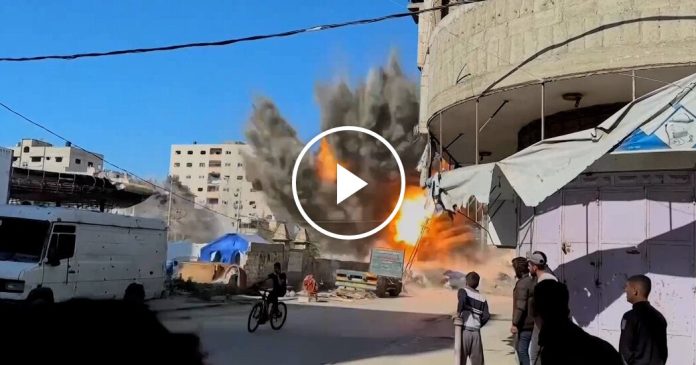
Renewed Israeli Strikes Deepen Gaza’s Displacement Crisis

0

The United Nations estimates that 280,000 Gazans have been displaced since the collapse of the temporary truce between Hamas and Israel on March 18. The New York Times examined one strike that destroyed an evacuated displacement camp, killing the 4-year-old Razan Hamdiye.

Detained in The Hague, Duterte Pursues a Political Comeback at Home

0

Rodrigo Duterte has been kept in a cell in The Hague for more than three weeks on charges of crimes against humanity for the deadly antidrug campaigns he oversaw in the Philippines.

But the former president is still on the ballot in elections for mayor in his home base next month, a race that political analysts say he stands a good chance of winning. A wave of sympathy for Mr. Duterte has also prompted candidates in other races to express support for him.

Even from a distance, he still draws crowds.

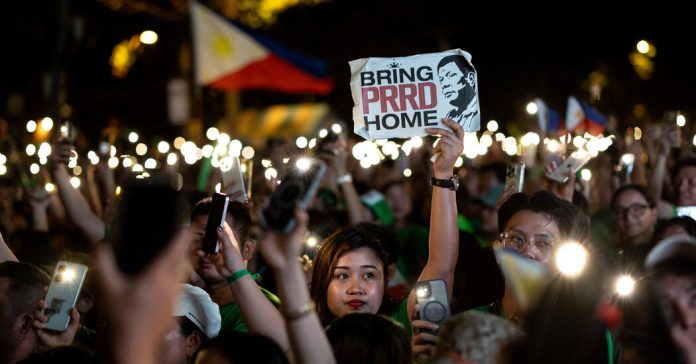
Thousands of people dressed in the green associated with his political party flooded the streets of Davao City, in the southern Philippines, on March 28, turning an 80th birthday celebration for Mr. Duterte into an enormous political rally.

Other rallies took place across the Philippines and abroad — including outside the detention center at the International Criminal Court in the Netherlands where Mr. Duterte is being held after having been arrested on March 11.

In Davao, Mr. Duterte remains widely popular, remembered for cracking down on problems like drugs, petty crime and violence.

“Why is the man who saved us the one in jail?” asked Joel Valles, 46, who joined the rally last month with his mother, Proferia Valles, 84.

The restaurant the Valleses run in Davao City, Sana’s Original Kabawan and Bulaloan, was a favorite hangout of Mr. Duterte’s and is adorned with photographs of the former president and his children.

Like many business owners in Davao, Mr. Valles said he had closed early so his employees could attend the gathering.

Many people brought cakes and large cardboard cutouts with pictures of Mr. Duterte to the rally. A concert followed, with singers and local politicians appearing onstage until midnight.

As mayor, Mr. Duterte was lionized in the Philippines. When he launched a bid for the presidency in 2016, Ferdinand Marcos Jr. — now the president — flew to Davao to ask if he could be his running mate. (He was turned down.)

To Mr. Duterte’s supporters, Davao became a model city under him: safe, orderly and disciplined. His critics said it was a place where extrajudicial killings of suspected criminals were normalized.

Mr. Duterte is accused by the I.C.C. of running a so-called death squad in Davao City, a vigilante group that acted as judge, jury and executioner. Its targets mainly were petty criminals and small-time drug dealers from poor neighborhoods, rights groups say.

From 1998 to 2015, the squad killed at least 1,424 people in Davao alone, according to a local coalition cited by Amnesty International. As president, Duterte’s drug war was even bloodier. Rights groups place the death toll between 12,000 and 30,000.

Now Mr. Duterte is trying a political comeback from his cell, running for mayor of the city he first governed in 1988 and ruled for over two decades.

His youngest son, Sebastian Duterte, holds the post but stepped aside to run for vice mayor. The campaign for the May 12 election began on March 28 — Mr. Duterte’s birthday.

Karlo Nograles, a former cabinet secretary for President Duterte, had been seen as leading the mayoral race against the unpopular incumbent. But political analysts said the elder Mr. Duterte’s candidacy had upended the race, and that he stood a good chance of winning.

Analysts see the candidacies of Mr. Duterte and his family members as an effort to defend and maintain his family’s crumbling dynasty in the south.

Another son of Mr. Duterte, Paolo, is also running for office as a district representative. Paolo’s son, Rodrigo II, is aiming to become a city councilor. If all four Dutertes win, and the former president resigns after the election, Sebastian would become mayor, and Rodrigo II could become vice mayor if he wins more votes than other elected councilors.

With elections for the Senate taking place the same day, Mr. Duterte’s campaign has also had ripple effects in national politics. That has further complicated a tangled web of allegiances and rivalries in which President Marcos has been at odds with his vice president, Sara Duterte, his predecessor’s daughter.

Mr. Marcos said early in his administration that he would not cooperate with the I.C.C. in its pursuit of Mr. Duterte, but later reversed course after Ms. Duterte threatened to have him and his family assassinated.

In Manila, some candidates for the Senate who are aligned with Mr. Duterte appeared to be getting a slight lift in the polls, political analysts say. Even some candidates backed by Mr. Marcos, including his sister Imee, have spoken out against Mr. Duterte’s arrest.

Still, questions linger about how long the Dutertes can sustain their momentum.

Ms. Duterte has said her father longed to come home and “serve Davao.” But in the same breath, she urged supporters to move on because he “may never return.”

Back in Davao, the crowd at the birthday rally seemed hopeful he would.

At one point, a drone show lit up the night sky, with the formations showing a series of images: Mr. Duterte’s face, his trademark clenched fist, and then his signature.

“Bring him home!” the crowd cried.

Renewed Israeli Strikes Deepen Gaza’s Displacement Crisis

0

The United Nations estimates that 280,000 Gazans have been displaced since the collapse of the temporary truce between Hamas and Israel on March 18. The New York Times examined one strike that destroyed an evacuated displacement camp, killing the 4-year-old Razan Hamdiye.

Celebrations as South Korean Court Removes Impeached President Yoon Suk Yeol

0

South Korea’s top court ended months of political turmoil when it unanimously decided to remove the impeached president Yoon Suk Yeol on Friday, clearing the way for the country to elect a new leader.

But the political crisis that Mr. Yoon triggered with his misjudged declaration of martial law in December — and his ensuing impeachment by the National Assembly — exposed a deep fissure in South Korea’s polarized politics that may prove harder to heal. For months, protesters for and against Mr. Yoon have taken over the streets in Seoul.

The country must continue without an elected leader before the elections take place, as it deals with external challenges that include the deepening military cooperation between North Korea and Russia and an upheaval in global trade ignited by President Donald J. Trump’s new tariffs.

But after months of political limbo, the ruling by the Constitutional Court on Friday finally gave South Korea a sense of direction that it has desperately needed.

Mr. Yoon, who had defiantly held onto his job despite his impeachment, is a former president now. In the coming days, he must vacate his hilltop presidential residence in central Seoul, and the government will schedule a national election because his successor must be chosen within 60 days. On Friday, officials lowered a presidential emblem in front of a building from where Mr. Yoon used to run the government. Military units began removing his portraits.

“This is a victory for South Korean democracy,” said Sung Deuk Hahm, dean of the Graduate School of Political Studies at Kyonggi University, remembering how South Koreans had sacrificed their lives to oppose military rule in the past. “It has taken time, but this time, the rule of law eventually prevailed without blood-shedding or serious violence.”

Mr. Yoon’s institution of martial law, which lasted six hours until the National Assembly voted to kill it, was the first attempt by a South Korean leader to use the military as a political tool since the country began democratizing in the 1980s.

In a ruling millions of South Koreans, including schoolchildren, watched on live television on Friday, the Constitutional Court found Mr. Yoon guilty of “violating the constitutional order” and “betraying the people’s trust” when he sent troops to seize the legislature during his short-lived martial law.

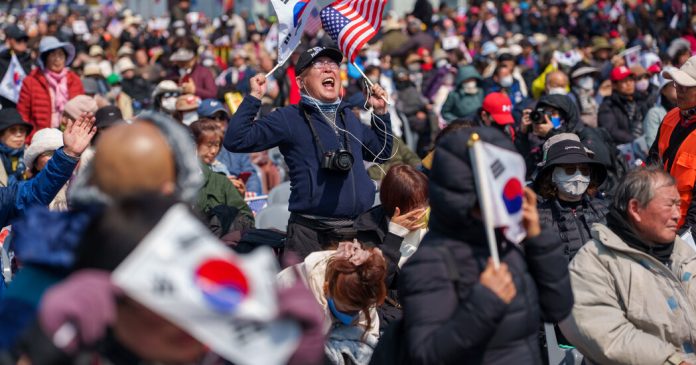
Hours before the ruling, supporters and opponents of Mr. Yoon gathered for rival rallies in Seoul, some camping out on the pavement overnight. As Acting Chief Justice Moon Hyungbae began reading out the 22-minute-long decision, silence fell as the crowds listened intently to every word of the ruling that would determine Mr. Yoon’s fate — and the future of South Korea’s democracy. Some clasped their hands together in prayer.

When the verdict came, a crowd gathered near the court erupted. Those supporting Mr. Yoon’s removal reacted with screams of delight, pumping their fists into the air and hugging each other.

“This is the day I’ve been waiting for over the past four months of protesting,” said Jang Jaeeuk, 21, who said he had stayed out on the street near the court overnight along with other students from his university, getting only three hours of sleep.

At a rally of supporters of Mr. Yoon, there was loud booing. Some people folded over in dismay, and others loudly cursed.

Ye Chung-ho, 65, had come to Seoul from Geoje Island, off the south coast of South Korea, spending two nights on the street to support Mr. Yoon.

“The constitution has collapsed,” he said after the ruling. “The decision is illegal.”

But the crowds dispersed quickly after the court’s announcement despite earlier fears of violent clashes. The police had been on their highest alert, erecting tall barricades around the courthouse. Schools in the neighborhood were closed. Businesses told employees to work from home.

“Today marks the beginning of a true South Korea,” said Lee Jae-myung, the main opposition leader, who campaigned for Mr. Yoon’s removal. Mr. Lee is expected to win the nomination of the Democratic Party, and polls have shown that he had the strongest chance to win if a presidential election were held now. No strong front-runner has emerged in Mr. Yoon’s party.

Mr. Yoon thanked his supporters and apologized to the people. But he did not comment directly on the court’s ruling, only saying: “I am regretful and sorry that I could not live up to your expectations.”

But his People Power Party said it “humbly” accepted the ruling.

Political turmoil could continue if Mr. Yoon’s hard-line supporters continue their protests. But “it won’t pose a big threat, as the People Power Party must shift its gears toward the new election,” said Ahn Byong-jin, a professor of political science at Kyung Hee University in Seoul.

Mr. Yoon plunged his country into its biggest political crisis in decades when he suddenly declared martial law on Dec. 3 at a time when many world leaders were busy preparing for Mr. Trump’s return to the White House. Instead of building bipartisan cooperation, he attempted to seize the National Assembly with troops, labeling the opposition “anti-state forces.” Citizens quickly mobilized to block the military takeover, giving lawmakers time to gather and vote down his martial law declaration. Mr. Yoon ended up getting impeached, leaving his country to face Mr. Trump — and North Korea’s leader Kim Jong-un — under an acting president with no popular mandate.

“South Korea has managed to avoid the worst outcomes and can see light at the end of a long political crisis,” Leif-Eric Easley, a professor of international studies at Ewha Womans University in Seoul, said about Friday’s ruling. “And not a moment too soon, given how the next administration in Seoul must navigate North Korea’s military threats, China’s diplomatic pressure and Trump’s trade tariffs.”

Mr. Yoon’s ouster was a crushing blow to the country’s conservative camp: He was the second conservative president in a row to be ousted by impeachment. (The first was President Park Geun-hye in 2017.) It increased the chances of his progressive foes in the current opposition to regain power and reshape South Korea’s foreign policy.

Mr. Yoon pleased conservatives by adopting tough stances toward North Korea and China and expanding joint military drills with the United States. He also won plaudits from Washington when he improved ties with Japan to lay the ground for trilateral cooperation to deter China. His progressive rivals favor dialogue with North Korea and seek to be on good terms with both the United States, South Korea’s main military ally, and China, its biggest trade partner.

“It will be an uphill battle for the conservative party to win a snap presidential election,” said Duyeon Kim, a Seoul-based fellow with the Center for a New American Security. “If Lee wins, South Korea’s foreign policy will likely look very different from what the U.S. and like-minded countries have enjoyed during Yoon’s presidency, because of the demands of the progressive base.”

Mr. Yoon’s martial law also exposed how dangerously close the country could come to a military takeover. South Korea is grappling with a deepening political polarization, online demagoguery and the mainstreaming of a radical right wing. Its legislature is gridlocked by partisan warfare.

“Whoever wins the next election will face the daunting challenges of bringing together a deeply fractured society, as well as dealing with Trump’s tariffs,” said Mr. Hahm.

Video Shows Aid Workers Killed in Gaza Under Gunfire Barrage, With Ambulance Lights On

0

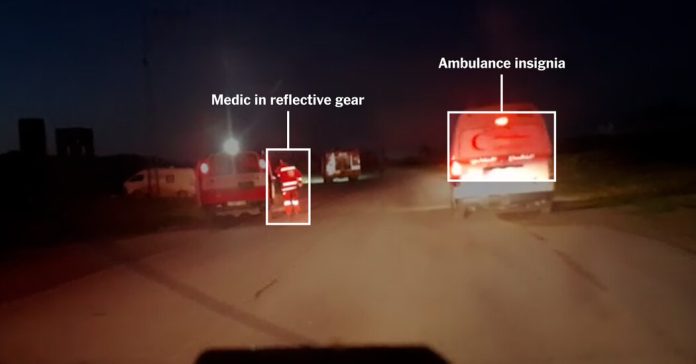
A video recording, discovered on the cellphone of one of the paramedics who was found along with 14 other aid workers in a mass grave in the Gazan city of Rafah in late March and obtained by The New York Times, shows that the ambulances and fire truck that they were traveling in were clearly marked and had their emergency signal lights on when Israeli troops hit them with a barrage of gunfire.

Officials from the Palestine Red Crescent Society said at a news conference on Friday at the United Nations moderated by the International Federation of Red Cross and Red Crescent Societies that they had presented the nearly seven-minute recording to the U.N. Security Council.

An Israeli military spokesman, Lt. Col. Nadav Shoshani, said earlier this week that Israeli forces did not “randomly attack” an ambulance, but that several vehicles “were identified advancing suspiciously” without headlights or emergency signals toward Israeli troops, prompting them to shoot. Colonel Shoshani said earlier in the week that nine of those killed were Palestinian militants. Israel did not immediately respond to a request for comment on the video.

The Times obtained the video from a senior diplomat at the United Nations who asked not to be identified to be able to share sensitive information.

The Times verified the location and timing of the video. Filmed from what appears to be the front interior of a moving vehicle, it shows a convoy of ambulances and a fire truck, clearly marked with headlights and flashing lights turned on, driving south on a road to the north of Rafah in the early morning. The first rays of sun can be seen, and birds are chirping.

The convoy stops when it encounters a vehicle that had veered onto the side of the road — one ambulance had been dispatched earlier to aid wounded civilians and had come under attack. The new rescue vehicles detoured to the side of the road.

Rescue workers, at least two of whom can be seen wearing uniforms, are seen exiting a fire truck and an ambulance marked with the emblem of the Red Crescent and approaching the ambulance derailed to the side.

Then, the sounds of intense gunfire break out.

A barrage of gunshots is seen and heard in the video hitting the convoy.

The camera shakes, the video goes dark. But the audio continues for five minutes, and the rat-a-tat sound of gunfire does not stop. A man says in Arabic that there are Israelis present on the scene.

The paramedic filming is heard on the video franticly reciting, over and over, the “shahada,” or a Muslim declaration of faith, which people recite when facing death. “There is no God but God, Muhammad is his messenger,” the paramedic is heard saying. He asks God for forgiveness and says he knows he is going to die.

“Forgive me, mother. This is the path I chose — to help people,” he said. “Allahu akbar,” God is great, he says.

In the backdrop, a commotion of voices from distraught aid workers and soldiers shouting commands in Hebrew at each other can be heard. It was not clear what they were exactly saying.

The Palestine Red Crescent Society spokeswoman, Nebal Farsakh, said in an interview from the West Bank city of Ramallah that the paramedic who filmed the video was later found with a bullet in his head in the mass grave. His name has not been disclosed yet because he has relatives living in Gaza who are concerned about Israeli retaliation, the U.N. diplomat said.

At the news conference, held at the U.N. headquarters, the president of the Palestine Red Crescent Society, Dr. Younis Al-Khatib, and his deputy, Marwan Jilani, told reporters that the evidence the society has collected — including the video and audio from the incident, and forensic examination of the bodies — contradicted Israel’s version of events

The deaths of the aid workers, who first went missing on March 23, has drawn international scrutiny and condemnation in recent days. The U.N. and the Palestine Red Crescent said the aid workers were not carrying weapons and posed not threat.

“Their bodies have been targeted from a very close range,” said Dr. Khatib, adding that Israel did not provide information on the missing medics’ whereabouts for days. “They knew exactly where they were because they killed them,” he said. “Their colleagues were in agony, their families were in agony. They kept us for eight days in the dark.”

It took five days after the rescue vehicles came under attack and fell silent, for the United Nations and Red Crescent to negotiate with the Israeli military for safe passage to search for the missing people. On Sunday, rescue teams found 15 bodies, most in a shallow mass grave along with their crushed ambulances and a vehicle marked with the U.N. logo.

The area where the convoy stops in the video was captured in a satellite image a few hours later and analyzed by The Times. At that point, the five ambulances and the fire truck had been moved off the road and clustered together.

Two days later, a new satellite image of the area showed the vehicles were apparently buried. Next to disturbed earth are three Israeli military bulldozers and an excavator. Additionally, bulldozers erected earthen barriers on the road in both directions from the mass grave.

One member of the Palestinian Red Crescent is still missing and Israel has not said whether he is detained or has been killed, Dr. Khatib said.

Dr. Ahmad Dhair, a forensic doctor who examined some of the bodies in Gaza’s Nasser hospital, said four out of the five aid workers he examined were killed by multiple gunshots, including wounds to the head, torso, chest and joints. One paramedic employee of the Red Crescent in the convoy was detained and then released by the Israeli military and provided witness account of Israeli military shooting at the ambulances, the U.N. and Red Crescent Society said.

Dylan Winder, the representative of the International Federation of Red Cross and Red Crescent Societies to the U.N., called the incident an outrage and said it represented the single deadliest attack on Red Cross and Red Crescent Society workers any where in the world since 2017.

Volker Türk, the U.N.’s High Commissioner for Human Rights, told the council that an independent investigation must be conducted into Israel’s killing of the aid workers and that the incident raises “further concerns over the commission of war crimes by the Israeli military.”

Neil Collier, Sanjana Varghese and Ephrat Livni contributed reporting. Natalie Reneau contributed video editing.

Russell Brand Is Charged With Rape and Sexual Assault in U.K.

0

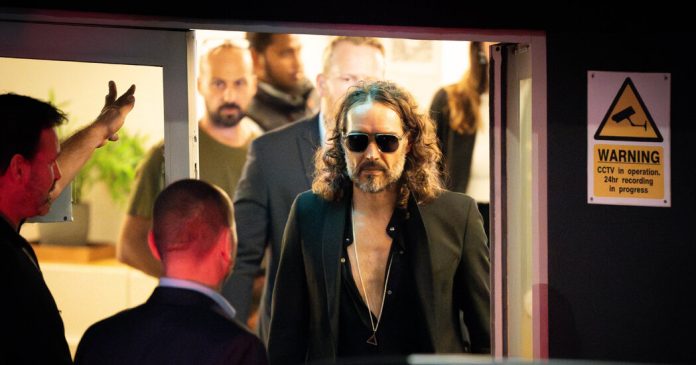
Prosecutors in Britain have charged Russell Brand, the comedian and actor, with multiple counts of sexual assault, including two counts of rape.

The country’s Crown Prosecution Service announced the charges on Friday.

Jaswant Narwal, a prosecutor, said in the statement that Mr. Brand, 50, would appear at Westminster Magistrates’ Court in London for a first hearing on May 2.

Ms. Narwal added that the charges “relate to reported non-recent offenses between 1999 and 2005, involving four women.”

The British police began investigating Mr. Brand’s past behavior in September 2023, after The Sunday Times, The Times of London and the TV network Channel 4 published a joint investigation into allegations against him.

On Friday, Mr. Brand posted a video on social media in which he denied ever having committed rape or sexual assault and said he had “never engaged in nonconsensual activity.”

Mr. Brand added that he was grateful that he would have a chance to defend himself in court.

The Metropolitan Police in London outlined further details of the charges in a news release on Friday. Mr. Brand is accused of raping a woman in the Bournemouth area, in southern England, in 1999; of indecently assaulting a woman in London in 2001; of orally raping and sexually assaulting a woman in London in 2004; and, between 2004 and 2005, of sexually assaulting a fourth woman in London.

The police statement added: “The Met’s investigation remains open and detectives ask anyone who has been affected by this case, or anyone who has any information, to come forward and speak with police.”

Under British law, it is an offense for news outlets to identify people who make sexual assault allegations unless they choose to waive their right to anonymity.

Mr. Brand became a star in Britain in the 2000s thanks to acclaimed stand-up shows that often focused on drugs and sex, and that saw him selling out arena dates. He also became known as a TV and radio host for broadcasters including MTV and the BBC. He achieved fame in the United States after starring in movies such as “Forgetting Sarah Marshall” and “Get Him to the Greek,” and through a brief marriage to the singer Katy Perry.

More recently, Mr. Brand has become well known as a politically charged YouTuber. Over six million users subscribe to his channel where he posts videos that regularly include discussion of conspiracy theories and feature conservative figures like Tucker Carlson.

In Britain, strict rules prevent the reporting of anything that could prejudice a jury at trial after charges have been filed.

Russian Strike Kills 16, including Six Children, Ukraine Says

0

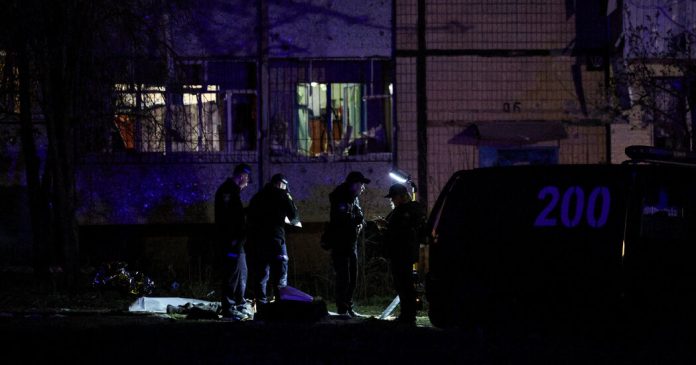
A Russian missile strike Friday on Kryvyi Rih, a city in central Ukraine, killed at least 16 people, including six children, and wounded more than 50, local officials said. It was the latest in a series of Russian attacks on urban centers in recent days, despite ongoing cease-fire talks, that have caused significant civilian casualties.

Serhii Lysak, the head of the Dnipropetrovsk region, which includes Kryvyi Rih, said on social media that the missile struck a residential neighborhood, with a playground nearby. Other officials warned the death toll could rise as rescuers continued to search the rubble for victims.

Russia’s defense ministry acknowledged the missile strike on Kryvyi Rih on Friday. It claimed that the missile had targeted a restaurant where Ukrainian commanders and Western military instructors were meeting, killing a total of 85 servicemen.

Moscow has long claimed that it only aims at military targets, although direct Russian strikes on civilian areas and facilities have often been documented by journalists and independent organizations.

Friday’s attack came as Russia appeared to have ramped up its attacks on civilian areas in recent weeks. Kryvyi Rih, the hometown of President Volodymyr Zelensky, was also struck on Wednesday in an attack that killed four people. On Thursday, a Russian drone attack on the eastern city of Kharkiv also killed four people, according to the city’s mayor.

The number of civilian casualties could not be independently verified.

The unusually high toll on Friday comes as both countries have engaged in cease-fire negotiations partly aimed at reducing the war’s impact on civilians. Ukraine and Russia have so far committed to halting attacks on energy infrastructure and in the Black Sea, but these truces have yet to be implemented, with both sides accusing each other of violations.

The start of cease-fire negotiations in mid-February raised hopes that the fighting would ease, as both sides aimed to demonstrate to the United States, the mediator, that they were willing to engage and reach an accord. But the war has raged on unabated.

A series of Ukrainian cities, many of them far from the front lines, have suffered deadly strikes. A large Russian drone attack on Kyiv, the capital, killed three civilians late last month, hours before U.S.-mediated talks to discuss a partial cease-fire began in Saudi Arabia.

Ukraine, meanwhile, has also continued its assaults, including by launching drones inside Russia.

In a post on social media, Mr. Zelensky said Friday’s attack was proof that “Russia does not want a cease-fire, and we see it.”

Mr. Zelensky echoed a widespread sentiment in Ukraine that the Kremlin has engaged in cease-fire negotiations as an empty show of good will to curry favor with the White House, but has no intention of halting the fighting.

Ukraine had initially agreed to a unconditional 30-day cease-fire to halt all fighting. But Russia rejected the proposal and instead suggested a more limited truce focused on the Black Sea and energy infrastructure, which Ukraine accepted last week.

Since then, both sides have accused each other of attacking their respective energy systems. Moscow has demanded the lifting of economic sanctions before a truce at sea takes effect, effectively freezing its implementation.

The Trump administration appears to have grown tired of the drawn-out cease-fire negotiations.

U.S. Secretary of State Marco Rubio told reporters in Brussels on Friday that Russia was running out of time to convince the Trump administration that it was serious about a peace deal with Ukraine.

“We’re testing to see if the Russians are interested in peace,” Mr. Rubio added. “Their actions — not their words, their actions — will determine whether they’re serious or not, and we intend to find that out sooner rather than later.”

Images of the aftermath of Friday’s attack, posted by Mr. Zelensky, showed bodies sprawled on the grass of what appeared to be a playground, some covered with rescue blankets. Around the playground, tree tops had been torn off and building windows shattered by the blast.

Olena Zelenska, Mr. Zelensky’s wife, posted a lengthy and emotional message on social media after the attack, pointing to the series of recent Russian strikes that killed civilians.

“‘What’s going on in Ukraine? Is it quieter now? We heard something about a cease-fire,’ foreigners ask, far away from the war,” she wrote.

“We heard ‘something’ too, of course,” she continued. “The sounds of alarm. The approach of missiles and drones. The screams and the crying. We hear them even now. They are with us forever.”

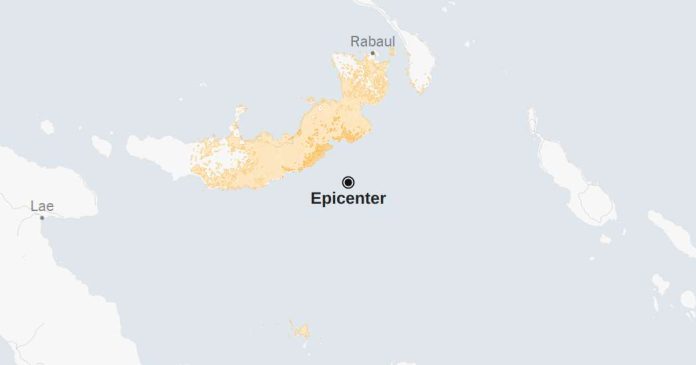
Map: Earthquake Near Papua New Guinea Prompts Tsunami Alert

0

Note: Map shows the area with a shake intensity of 4 or greater, which U.S.G.S. defines as “light,” though the earthquake may be felt outside the areas shown. The New York Times

A strong, 6.9-magnitude earthquake struck in the Solomon Sea on Saturday, according to the United States Geological Survey. A “tsunami threat” was issued for some parts of the coast of Papua New Guinea.

The U.S. Tsunami Warning System said waves of 3 to 10 feet above normal tidal levels were possible near the quake’s epicenter. The system did not issue alerts for places elsewhere in the Pacific Ocean.

The temblor happened at 6:04 a.m. Papua New Guinea time about 121 miles southeast of Kimbe, Papua New Guinea, data from the U.S.G.S. shows.

As seismologists review available data, they may revise the earthquake’s reported magnitude. Additional information collected about the earthquake may also prompt U.S.G.S. scientists to update the shake-severity map.

Aftershocks in the region

An aftershock is usually a smaller earthquake that follows a larger one in the same general area. Aftershocks are typically minor adjustments along the portion of a fault that slipped at the time of the initial earthquake.

Quakes and aftershocks within 100 miles

Aftershocks can occur days, weeks or even years after the first earthquake. These events can be of equal or larger magnitude to the initial earthquake, and they can continue to affect already damaged locations.

When quakes and aftershocks occurred

Source: United States Geological Survey | Notes: Shaking categories are based on the Modified Mercalli Intensity scale. When aftershock data is available, the corresponding maps and charts include earthquakes within 100 miles and seven days of the initial quake. All times above are Papua New Guinea time. Shake data is as of Saturday, April 5 at 6:20 a.m. Papua New Guinea time. Aftershocks data is as of Saturday, April 5 at 8:04 a.m. Papua New Guinea time.