Thursday, November 12, 2026
Home Blog Page 54

Trump Weighs In on Marine Le Pen Conviction

0

“FREE MARINE LE PEN!”

With this blunt call, a strange one in that the French far-right leader is walking the streets of Paris, President Trump has waded into the politics of an ally, condemning her conviction this week on embezzlement charges and her disqualification from running for public office.

The conviction was “another example of European Leftists using Lawfare to silence Free Speech,” Mr. Trump wrote on Truth Social. Elon Musk, his billionaire aide, drove home the point: “Free Le Pen!” Mr. Musk echoed on his social media platform X.

More than an extraordinary American intervention in French politics, the statements ignored the overwhelming evidence arrayed against Ms. Le Pen, who was convicted of helping orchestrate over many years a system to divert European taxpayers’ money illicitly to offset the acute financial difficulties of her National Rally party in France.

Instead, for the American president and his team, as well as an angry chorus of Le Pen supporters at home, her case has become part of a vigorous campaign to undermine the separation of powers and the rule of law, which have been portrayed by Vice President JD Vance as no more than a means to stifle the far right and to quash democracy in the name of saving it.

Ms. Le Pen will speak at a big National Rally demonstration Sunday in Paris under the banner “Let’s Save Democracy!” The National Rally was founded in 1972 as the National Front, an antisemitic party of fascist roots, by her father, Jean-Marie Le Pen. It was long seen as a direct threat to the democratic rule of the Fifth Republic, before Ms. Le Pen embarked on a makeover.

She is a front-runner in the 2027 French presidential election, but will not be able to run unless she secures a more lenient ruling on appeal. The Paris Court of Appeal, expediting the process, has said a decision is expected to be reached by summer 2026. It is far from clear, however, that this verdict would go her way.

The court sentenced Ms. Le Pen to four years in prison, with two of those suspended, and the other two to be served under a form of house arrest. Under this verdict, she would not be put behind bars. For now, Ms. Le Pen’s appeal puts her sentence on hold.

Mr. Trump, who said France had put Mr. Le Pen “in prison” and censored her, neither of which is true, compared her treatment to his own at the hands of a “group of Lunatics and Losers.” He faced indictments, convictions and criminal cases on his way to winning the presidency last year.

“They get her on a minor charge that she probably knew nothing about,” Mr. Trump said. “Sounds like a ‘bookkeeping error’ to me.”

In fact, the reams of evidence produced at trial and detailed in the more than 150-page verdict placed Ms. Le Pen at the heart of an elaborate system developed over three legislatures from 2004 to 2016 that used no-show “assistant” jobs at the European Parliament to finance her party. The people in these “jobs” worked for the party in roles like Ms. Le Pen’s security guard or personal assistant.

She has denied all charges, saying that the people involved were political aides, not European Parliament employees, even though they were paid with the assembly’s funds. Her sweeping dismissal of volumes of evidence was viewed as cavalier by the presiding judge, Bénédicte de Perthuis, one reason she considered her capable of similar acts if not barred from running for public office.

According to the court ruling, in June 22, 2014, Jean-Luc Schaffhauser, a former National Rally lawmaker at the European Parliament, wrote to Wallerand de Saint-Just, the party’s former treasurer. “What Marine is asking us to do is the equivalent of signing for fictitious jobs,” he said. “I understand Marine’s reasons, but we’re going to get burned because we’ll certainly be scrutinized as such a large group.”

That same month, Mr. Saint-Just wrote to Ms. Le Pen, portraying the party’s grave financial situation, the court said. “In 2013, monthly expenses were 100,000 euros more than expected,” as a result of missions, receptions, travel and conferences, he said. “We will only get by if we make significant savings thanks to the European Parliament.”

Those “savings” amounted to close to $4.8 million over the time the scheme ran its course. At the same time, in 2014, Ms. Le Pen, using her ties to President Vladimir V. Putin of Russia, had secured in extremis a loan from a Russian bank to bail out the party.

French courts, acting on laws passed and vigorously supported by Ms. Le Pen over the past 15 years in response to public outrage over political corruption, have hardened their positions on cases involving prominent politicians, including Nicolas Sarkozy, a former president.

The 2017 presidential bid of François Fillon, a former prime minister, was derailed by an investigation into no-show parliamentary jobs involving his wife and several children. He was convicted in 2020 but his case is still going through the appeals process.

While Ms. Le Pen’s conviction and disqualification conform with these developments, they are unique in barring a leading presidential candidate.

This has ignited political passions and led to an intense debate pitting “democracy” and the “people” against the law, even if a state stripped of the rule of law is almost certainly headed toward autocracy.

“The verdict is heavy, a severe decision given Ms. Le Pen’s long disqualification,” said Anne-Charlène Bezzina, a senior lecturer in public law at the University of Rouen. “There’s never been anything like it in the Fifth Republic. But is it anti-democratic? Evidently not. A functioning justice system independent of political power is the sign of a healthy democracy.”

An opinion poll by the Ouest-France newspaper and the Ifop polling institute this week found that 64 percent of French people supported a court’s ability to immediately bar convicted politicians from running for office. At the same time, a poll by Sud Radio and Ifop found that 49 percent of people believe Ms. Le Pen should be allowed to run for president.

Markets head for another brutal day over Trump tariffs shock : NPR

0

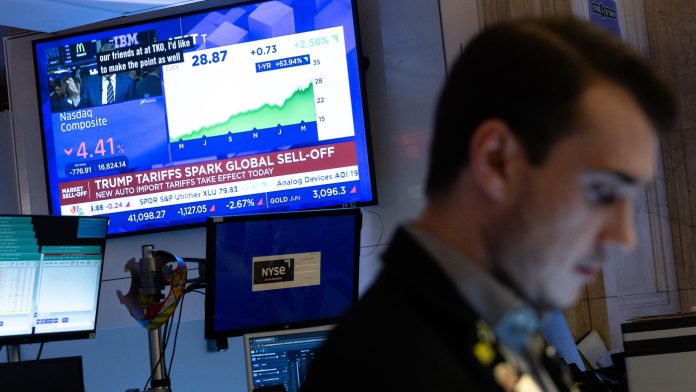
Traders work on the floor of the New York Stock Exchange on Thursday, which saw the worst markets selloff in five years.

Michael M. Santiago/Getty Images/Getty Images North America


hide caption

toggle caption

Michael M. Santiago/Getty Images/Getty Images North America

Wall Street is not Main Street — but this week, investors and consumers alike seem terrified of how President Trump’s tariffs could upend the global economy.

The pain continued for U.S. stocks on Friday, a day after the stock market suffered its worst day in five years.

On Friday morning, the Dow Jones Industrial Average fell a further 1,200 points — or 3% — shortly after the open. That deepened its Thursday selloff of nearly 1,700 points, or 4%.

The tech-heavy Nasdaq and the benchmark S&P 500, which tracks the largest U.S. companies, also continued to tumble: Both fell more than 3.5% on Friday morning.

Trump shocked businesses, investors, and global trading partners on Wednesday, when he announced that his long-promised tariffs would affect almost all U.S. imports. He has imposed the taxes on U.S. allies and foes alike: Most U.S. imports will now face tariffs of at least 10 percent, with higher taxes on goods from the European Union, Japan, China, and dozens of other countries.

The global trade war intensified on Friday. China responded to Trump’s taxes with a reciprocal 34% tariff on all U.S. imports; other countries are also likely to retaliate.

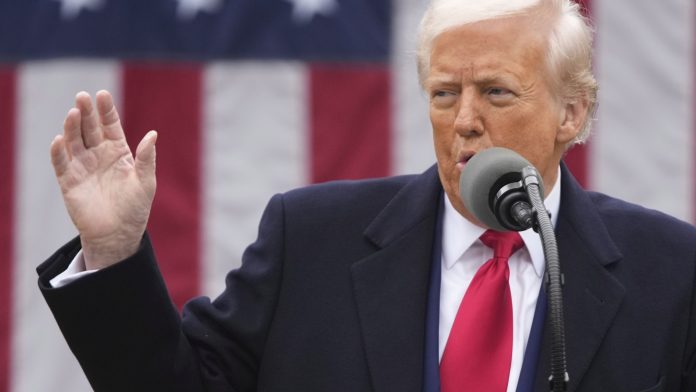
President Trump announcing his latest tariffs during an event in the Rose Garden at the White House in Washington, D.C., on Wednesday.

President Trump announcing his latest tariffs during an event in the Rose Garden at the White House in Washington, D.C., on Wednesday.

Chip Somodevilla/Getty Images/Getty Images North America


hide caption

toggle caption

Chip Somodevilla/Getty Images/Getty Images North America

Shock and anger

Economists warn the new taxes will result in higher prices and slower growth in the United States — while spilling over into other countries and hurting the global economy.

Investment bank JPMorgan on Thursday warned that the tariffs are likely to push the U.S. and the world into a recession.

Businesses of all sizes reacted with shock and anger as they processed the sweeping costs that they — and their customers — will now have to pay to continue doing business.

Consumer spending is already slowing down, while consumer confidence has plummeted. And even a reassuring jobs report on Friday morning — with employers adding more jobs than expected last month — couldn’t quiet widespread market fears about the outlook for the post-tariffs economy.

Mass Grave From Roman Empire Found Under Vienna Soccer Field

0

Under a soccer field in a Vienna neighborhood along the Danube, archaeologists have found a mass grave dating to the era when the Roman Empire was battling Germanic tribes almost 2,000 years ago, experts announced this week.

The grave was discovered in October by a construction company doing renovations for the field in Vienna’s Simmering district, a team of archaeologists and historians at the Vienna Museum said in announcing its findings. The extraordinary discovery was tied to what they called a “catastrophic” military event, possibly one where Roman troops were badly defeated and fled the site quickly.

Radiocarbon dating traced the bones to approximately A.D. 80 to 234 — a period in which more than a dozen Roman emperors ruled, including Domitian and Trajan, who clashed with ancient Germanic people in the region. An analysis of other items found in the grave, including an iron dagger, lance points, scale armor and a cheek piece of a helmet, helped confirm the time period.

Near the foot of one skeleton, the archaeologists also discovered shoe nails that came from distinctly Roman military shoes called caligae.

The discovery of such skeletal remains is exceedingly rare, experts said, in part because ancient Romans almost exclusively practiced cremation until the third century A.D.

“For all of middle Europe from the first century, we don’t have any unburned, uncremated human remains,” said Michaela Binder, the lead anthropologist on the project. “So aside from the military aspect, it is an absolute unique chance to study the life histories of people in the first century A.D.”

She added, “We have the unique opportunity to study the lives of normal Roman soldiers.”

Martin Mosser, an archaeologist for the Vienna Department of Urban Archaeology who worked on the project, said that because Romans took great care with ritualized burials and cremation of bodies, the remains began to tell a story of what happened to the men buried there.

“The undignified nature of the burial site along with the deadly wounds found on each individual suggests a catastrophic military confrontation, possibly followed by a hasty retreat,” he said.

There are historical accounts of battles between Germanic tribes and the Romans on the border of the Roman Empire at the end of the first century, and the team called the grave the first physical evidence of such fighting in the area of modern-day Vienna. The remains could represent the start of the metropolis’s history, the team said — theorizing that a Roman defeat could have led to the expansion of a small military base a few miles away.

“It suggests a concrete reason for the buildup of Vindobona into a full-scale legionary fortress, which would take us to the founding moment of Vienna,” Mr. Mosser said, referring to the military base.

The evidence astonished the team. Mr. Mosser said that before this evidence surfaced, no Roman evidence had been found in this area of the city. “Nor could we have expected a Roman battlefield to be located in the Vienna area,” he said.

The remains in the grave belonged to at least 129 people, the archaeologists found, but the total number might exceed 150 as some bones were found intermixed.

All of the dead examined so far were men, mostly between 20 and 30 years old, and many had suffered ghastly injuries, particularly to their skulls, torsos and pelvises.

Experts said the wounds seemed to be from weapons like spears, daggers, swords and iron bolts from ranged weapons, such as crossbows, which suggested the dead were not executed but had perished in battle.

The bodies appeared to have been buried hastily, with many found lying on their stomachs or sides with limbs intertwined.

They were most likely professional Roman soldiers, according to David Potter, a professor of Greek and Roman History at the University of Michigan who was not involved in the research.

“I think we’ve got another moment reflecting a Roman defeat and a burial of troops after the fact,” he said, drawing parallels to how the bodies of Roman soldiers were handled after their forces suffered a brutal defeat at the hands of Germanic warriors in the Battle of the Teutoburg Forest in A.D. 9.

“You get a sense for the nature of battle from the injuries that these poor people have sustained,” he said, adding, “the other side had a lot of big clubs.”

The team in Vienna said its experts were only beginning their research and that DNA analysis could provide more information about the origins and living conditions of the people buried in the grave. The museum’s report also laid out plans to look more into the objects found in the grave.

On a personal level, Mr. Mosser said the case struck a chord. “With so many young individuals buried so irreverently, one inevitably thinks about the horrific wars of the more recent past as well as the present,” he said, adding, “The unfortunate conclusion: Humans have not become any wiser.”

Jubilation in South Korea After President Who Declared Martial Law Is Ousted

0

For hours, the atmosphere in the streets surrounding South Korea’s Constitutional Court in downtown Seoul had been tense. Dozens had camped out overnight in the early spring chill in the lead-up to the court’s historical decision on Friday.

The crowds for and against the dismissal of the country’s impeached president, Yoon Suk Yeol, were separated by police buses and metal barriers up to 13 feet in height.

As the acting chief justice began reading out the decision, filled with technical legal jargon, the crowds grew quieter, straining to hear from outdoor loudspeakers the outcome that would determine Mr. Yoon’s fate — and that of the country. Some people opposed to Mr. Yoon cheered and applauded intermittently as the reading went on. Protesters on both sides clasped their hands together in prayer. Many held up their phones to record the moment.

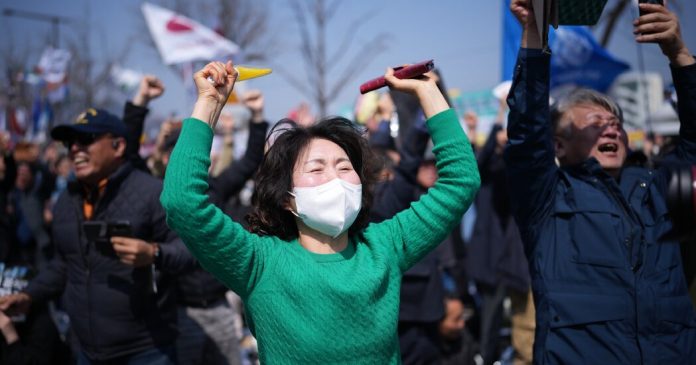
And then, the crowd erupted.

Those supporting Mr. Yoon’s impeachment reacted with hugs, screams and fists pumped in the air to the unanimous decision to remove him from office. At a rally of supporters of Mr. Yoon near his residence, there was loud booing. Some people folded over in dismay, and others loudly cursed.

Protesters celebrating in downtown Seoul.Credit…Jun Michael Park for The New York Times
Two women are overcome with emotion after the ruling.Credit…Jun Michael Park for The New York Times

“It’s been so hard, but now my heart is relieved,” said Kim Ji-seon, 55, who brought her daughter to witness the verdict in the hopes that Mr. Yoon’s impeachment would be upheld. “I hope they can create a country where people can be happy.”

Soon after the decision was announced, only a handful of people, some wearing “Make Korea great again” and “stop the steal” hats, were left at a pro-Yoon demonstration that was scheduled to last all day outside the presidential office. Construction workers were taking down scaffolding, and dozens of chairs had been stacked and pushed to the side.

Jang Jaeeuk, 21, said he had stayed out on the street near the court overnight along with other students from his university, getting only three hours of sleep, because it was such an important day for his country.

“I’m happy that the hardships of the past four months haven’t gone to waste,” he said after crying and hugging his fellow students upon hearing the verdict. “Now I feel that we can change the world and, in that sense, I’m hopeful for the future.”

Supporters of Mr. Yoon near the court, who were predominantly men, said that they were deeply disappointed that the president was removed and went home.

Supporters of Mr. Yoon near his residence.Credit…Chang W. Lee/The New York Times
People watching as the acting chief justice began reading out the decision.Credit…Chang W. Lee/The New York Times

Yoon Seo-jun, 18, sitting on the edge of a sidewalk, said he was distrustful of the system that led to the impeachment and dismayed about the future of the country.

“South Korea’s democracy is dead,” he said, adding that he hoped the National Assembly, which had impeached Mr. Yoon, would be dissolved.

After the decision, some South Koreans expressed apprehension about what might come next and the possibility of further political upheaval.

Lee Yongseok, 27, who watched the court’s televised decision at a screen at Seoul’s main railway station, said that although he supported the verdict, he knew that others would be skeptical of the ruling and of the judges who made it.

“I feel like something big is going to come to my country,” he said.

Even as supporters and opponents of Mr. Yoon tried to grasp what comes next for their country, government officials were taking steps to move on.

In a gesture that underlined the finality of the court’s ruling, the officials removed the presidential emblem in front of the building where Mr. Yoon used to work as president. The emblem bears the image of a mythical bird, the phoenix.

Choe Sang-Hun, Chang W. Lee, Jun Michael Park and Victoria Kim contributed reporting.

Trump downplays the role of far-right activist in firings of NSC staff : NPR

0

President Trump speaks during an event to announce new tariffs in the Rose Garden at the White House on April 2, 2025, in Washington.

Mark Schiefelbein/AP


hide caption

toggle caption

Mark Schiefelbein/AP

President Trump is downplaying reports that far-right activist Laura Loomer influenced National Security Council firings on Thursday.

Trump confirmed that some number of people were fired but would not specify how many or why. “Always we’ll let go (of) people — people that we don’t like or people that we don’t think can do the job or people that may have loyalties to somebody else,” he told reporters on Air Force One Thursday night.

Loomer addressed her role in the firings in a post on X Thursday night.

“You know how you know the NSC officials I reported to President Trump are disloyal people who have played a role in sabotaging Donald Trump?” adding that the fired officials were “being defended by” commentators on CNN and MSNBC.

National Security Council spokesperson Brian Hughes said the NSC would not comment on personnel matters.

Trump said he had spoken with Loomer on Wednesday and said she made some hiring recommendations, but denied she had anything to do with the NSC firings. Trump said he listened to her recommendations, “like I do with everybody. I listen to everybody and then I make a decision.”

Loomer, who has had two failed Republican bids for Congress, is known for promoting conspiracy theories as well as anti-immigrant and anti-Muslim views. She shared a video on X that claimed 9/11 was an “inside job” and mocked former Democratic presidential nominee Kamala Harris’ Indian heritage.

She has been banned by multiple social media platforms. She was reinstated on X, once it came under Elon Musk’s ownership. She has more than 1.5 million followers on the platform now.

Trump called Loomer a “patriot” and a “good person.”

The firings also follow scrutiny of the security practices of the administration. National Security Adviser Mike Waltz or a staffer inadvertently added Atlantic journalist Jeffrey Goldberg to a chat on the messaging app Signal. Defense Secretary Pete Hegseth shared information relating to airstrikes in Yemen in that chat.

The Pentagon acting inspector general is now investigating, at the direction of members of Congress.

President Trump has resisted calls to fire Waltz and Hegseth, and the White House says no classified information was shared.

Israeli Military Orders New Evacuation of Gaza City Neighborhoods

0

The Israeli military has called on residents to evacuate several neighborhoods in Gaza City, the latest in a series of orders that have forced Palestinians to flee as Israel again escalates its offensive against Hamas in the war-battered Gaza Strip.

The new evacuation order late Thursday came not long after the Palestinian health authorities said dozens of people, including children, were killed in Israeli strikes on a school turned shelter in Gaza City. Israel said it was looking into the episode.

The departure order has brought renewed hardship to Palestinians who had already endured displacement from their homes and miserable conditions during the first 15 months of the war. A shaky two-month-old cease-fire between Israel and Hamas collapsed in mid-March after they failed to reach an agreement to extend it, ending a brief respite for Palestinians in Gaza.

The Israeli military has since embarked on a major bombing campaign throughout Gaza that Israeli officials have said was intended to compel Hamas to release more hostages. Avichay Adraee, the military’s Arabic-language spokesman, said in a post late Thursday on social media that he was providing a “final” warning before a new attack, urging people to relocate southward. Mr. Adraee suggested that militant groups were operating among civilians in the area.

While many people have complied with such evacuation orders from the military during the most recent Israeli campaign, others have chosen to stay in their homes or shelters, saying they could not bear being displaced — many of them have already been uprooted several times during the war — or that they have nowhere else to go.

The Israeli military has said it was looking into reports about the Thursday incident in the Tuffah neighborhood of Gaza City. As of Friday morning, it said it still could not comment.

On Wednesday, Mr. Adraee had called for people to leave Tuffah. His order on Thursday was for other parts of the city.

Multiple videos verified by The New York Times on Thursday show an explosion and its chaotic aftermath at the Dar al-Arqam school, where civilians were sheltering. The strikes were followed by a chaotic scene at Al Ahli Arab Hospital in Gaza City, where dust-covered and bloodied children were rushed from vehicles.

The bodies of 27 people killed in the strike arrived at the hospital, the Gaza health ministry said. The ministry does not distinguish between civilians and combatants in its casualty counts.

One of those killed was the grandson of Khalil al-Hayya, Hamas’s top negotiator based in Qatar, the Hamas-run Al Aqsa TV channel reported.

Israel has previously targeted schools being used as shelters, contending that Hamas militants were operating command centers in them. Hamas has denied such claims in the past. The United Nations has said that Israeli strikes on schools probably violated the law by causing disproportionate harm to noncombatants.

More than 1,000 people in Gaza have been killed since the collapse of the cease-fire on Mar. 18 and more than 50,000 people have been killed since the start of the war, according to the Gaza health ministry. The war started after Hamas-led forces attacked Israel, killing roughly 1,200 people.

Nader Ibrahim contributed reporting.

Takeaways from the week : NPR

0

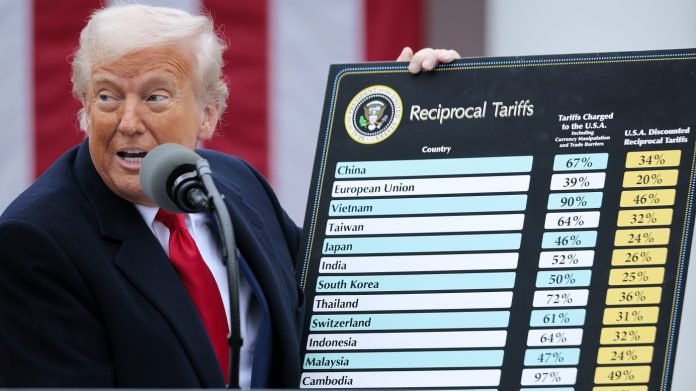
President Trump holds up a chart while speaking during a trade announcement event in the White House Rose Garden on April 2.

Chip Somodevilla/Getty Images


hide caption

toggle caption

Chip Somodevilla/Getty Images

A GOP electoral warning points to Elon Musk in the hot seat, and President Trump employs a third-term distraction. Also, the trade war rages, and there were mass firings at key scientific agencies.

It was another week of big headlines as President Trump, in his seventh week of his second term, continued to overhaul policy, both foreign and domestic.

Here are four takeaways from the week in our continued look at President Trump’s first 100 days in office:

1. Musk in the spotlight after Democrats win in Wisconsin.

Musk became the central figure in a judicial race in Wisconsin. He spent $20 million there and made an appearance in the state just ahead of the election, where he raised the stakes. But in a state that Trump won by a point in 2024, the Republican-endorsed judicial candidate lost on Tuesday by 10 points.

That’s a pretty big loss for the party, but especially for Musk. He put a lot on the line there, and given how controversial his team’s federal cuts have been, that was a big risk. Now, Democrats feel emboldened to run against Musk and make him the face of Trump’s agenda. Republicans, meanwhile, are questioning the world’s richest man’s political value.

“I’m honestly shocked,” Pam Van Handel, chair of the Republican Party of Outagamie County in Wisconsin, told Politico. “I thought we had it in the bag. I thought [Musk] was going to be an asset for this race. People love Trump, but maybe they don’t love everybody he supports. Maybe I have blinders on.”

Republicans on Capitol Hill, though, don’t want to show any break with Trump, and they’d still love Musk’s money, but they might not like what a wild card he can be. DOGE, his informal Department of Government Efficiency, has caused them headaches at town halls, and his comments about potentially cutting entitlements is like political kryptonite.

He’s more unpopular than Trump, and this loss in Wisconsin means the heat shield he may have been for Trump to be able to absorb negativity about federal government restructuring is melting. It appears political gravity is setting in for Musk, and don’t be surprised if he’s out after his 130-day special government employee status expires at the end of next month.

Businessman Elon Musk speaks during a town hall meeting at the KI Convention Center on March 30 in Green Bay, Wisc., ahead of the state’s high-profile Supreme Court election between Circuit Court Judge Brad Schimel, who has been financially backed by Musk and endorsed by President Donald Trump, and Dane County Circuit Court Judge Susan Crawford.

Businessman Elon Musk speaks during a town hall meeting at the KI Convention Center on March 30 in Green Bay, Wisc., ahead of the state’s high-profile Supreme Court election between Circuit Court Judge Brad Schimel, who has been financially backed by Musk and endorsed by President Donald Trump, and Dane County Circuit Court Judge Susan Crawford.

Scott Olson/Getty Images


hide caption

toggle caption

Scott Olson/Getty Images

Then Republicans will be hoping he stays quiet and just writes the checks.

2. Trump’s real goals in floating a third term: Distract from bad news and try not to be a lame duck.  

In politics, to stay relevant, you never want to completely wave people off from the notion that you’re at least thinking about running for president. But what do you do when you’re president and facing a constitutional amendment that bars you from running again?

Cryptically say you’re looking at ways to do it, and float at least one far-flung theory that’s remotely possible. That’s what Trump did this week when he told NBC’s Kristen Welker that his team is looking at it and that he’s “not joking.” He was more cagey the next day when NPR’s Tamara Keith pressed him on Air Force One about the comments. Trump repeatedly said he didn’t want to talk about it, that’s it’s far off and didn’t commit to leaving the White House on Jan. 20, 2029 when the next president should be sworn in.

Trump’s provocative comments serve a few of other political purposes: (1) set the stage to run for an unconstitutional third term by normalizing the idea of something abnormal that chips away at democratic norms; (2) help avoid being a lame duck — if people think it’s possible he runs again, then his agenda matters more in his last two years than a traditionally term-limited president would be; and (3) distract from bad news — like the Signal chat group controversy that was still getting attention when he made the comments and his trade war that is ringing market alarm bells around the world all while continuing to make drastic cuts at key federal agencies.

3. Trump tries to build the wall — of tariffs. Get ready for higher prices.

“A lot of people are tired of watching the other countries ripping off the United States,” Trump said, adding, “They laugh at us. Behind our backs, they laugh at us because of our own stupidity.”

Trump on Wednesday announcing his broad, sweeping tariffs on the U.S.’s top trading partners all over the world? No. It was him in 1987 talking about tariffs on Larry King Live. Trump has long loved the idea of tariffs — first on Japan, then when its economy went into recession, he shifted his gaze to China.

But it’s never great policy to be ideologically rigid and not adjust with the times. Trump’s trade war is now roiling markets, and experts are warning of higher prices and slower growth, as well as potential recessions in other countries.

What’s more, these tariffs are coming after an election when prices were the top concern for voters — and Trump made a pretty big promise.

“When I win, I will immediately bring prices down,” Trump said in August of last year.

Well, not immediately, clearly. After he was elected, he said bringing prices down would be “hard.” After being sworn in, he said, actually, he never thought inflation was really the top issue in the campaign, anyway — that it was immigration.

“[Y]ou can only talk about it so long,” Trump told House Republicans a week after he was inaugurated. “The price of apples doubled; the price of bacon has quadrupled; everything is a disaster. And you say it — and then what do you do?”

This lack of a focus on bringing down prices in the short term — and actively likely making them higher — is a serious political gamble Trump is taking for his party. He believes he can convince people to give him the space to set the country on a track to bring back more manufacturing by building a wall of tariffs.

But so far, they aren’t. In fact, his economic approval ratings have been trending downward and below his overall rating. Two polls this week, AP/NORC and Reuters/Ipsos, show Trump’s overall approval at his lowest point since being sworn in for his second term — 42% and 43%, respectively.

His economic approval in AP’s poll is 40%, while in Reuters’ it’s 37%, including just 30% for his efforts to lower the cost of living.

4. The federal cuts hit health agencies.

Speaking of other substantive things Trump may be trying to distract from, his administration began firing some 10,000 staffers at the Department of Health and Human Services this week.

The cuts included leaders and some of the country’s leading scientists and researchers, as well as the forcing out of the Food and Drug Administration’s top vaccine regulator, Dr. Peter Marks.

Despite that, HHS Secretary Robert F. Kennedy Jr. claimed in an interview last week on NewsNation, “We’re not cutting scientists. We’re not cutting frontline workers.”

He talked of trying to make the “sprawling” agencies, as he called them, more efficient when it comes to things like human resources and communications. It’s possible that there were mistakes made in who received reduction-in-force notices, as there have been with some of the other cuts made.

But many see dangers to the country in what’s already been done.

“It has become clear that truth and transparency are not desired by the secretary, but rather he wishes subservient confirmation of his misinformation and lies,” Marks wrote in his letter of resignation.

Dr. Ashish Jha, who was President Biden’s COVID-19 response coordinator and is currently dean of the Brown University School of Public Health, told NPR: “I’m worried that what we’re going to see is more people getting sick, more disease outbreaks and infrastructure that is going to be less and less capable of responding to those threats.”

Wendy Armstrong, director of infectious diseases at the University of Colorado and vice president of the Infectious Diseases Society of America, was even more blunt in an interview with The Bulwark: “It’s astounding. It will affect patients with all kinds of different kinds of infections, and Americans will suffer, and people will die, and that’s a horrible thing to see coming.”

Over several decades, the United States has become a leader in science research, relied upon not just domestically but internationally. That’s because agencies under HHS like the National Institutes of Health, Centers for Disease Control and Prevention and the Food and Drug Administration study and help fund and develop breakthroughs in everything from autism and cancer to neurological disease.

They’re gatekeepers for the medicines Americans take, and they’re on the front lines of helping to stop the spread of infectious diseases and help develop vaccines that help prevent the spread of pandemics.

These agencies had long had bipartisan support and were among the most trusted in the federal government. But COVID changed all that. Largely because of widespread online misinformation given credence by political leaders on the right, these agencies became lightning rods and officials were vilified by MAGA.

Sen. Bill Cassidy, the Louisiana Republican and chairman of the Senate Health committee, is calling on Kennedy to testify to explain the cuts.

Employees of the Department of Health and Human Services stand in line to enter the Mary E. Switzer Memorial Building on April 2. Layoffs began earlier this week at the agency after it was announced last week that the Trump administration plans to cut 10,000 HHS jobs.

Employees of the Department of Health and Human Services stand in line to enter the Mary E. Switzer Memorial Building on April 2. Layoffs began earlier this week at the agency after it was announced last week that the Trump administration plans to cut 10,000 HHS jobs

Anna Moneymaker/Getty Images


hide caption

toggle caption

Anna Moneymaker/Getty Images

“The news coverage on the HHS reorg is being set by anonymous sources and opponents are setting the perceptions,” Cassidy said in a statement. “In the confirmation process, RFK committed to coming before the committee on a quarterly basis. This will be a good opportunity for him to set the record straight and speak to the goals, structure and benefits of the proposed reorganization.”

Here’s a day-by-day look at what happened in the past week:

Friday, March 28:

  • In Greenland, Vice President Vance says the U.S. can’t ignore the encroachment of Russia and China there. On the Signal controversy, he says that it is in the U.S. interest to preserve navigation, but that it has to be done “right.” He adds that he “always supported” Trump striking the Houthis. “Our message to Denmark is very simple,” Vance says, “you have not done a good job by the people of Greenland. You have under-invested in the people of Greenland, and you have under-invested in the security architecture of this incredible, beautiful landmass filled with incredible people. That has to change, and because it hasn’t changed, this is why President Trump’s policy in Greenland is what it is.” He also says that using military force to obtain the island is not what the administration wants. Trump previously said that was not off the table.
  • Trump says on social media that he is nominating Sara Carter director of the Office of National Drug Control Policy. Carter, a Fox News contributor, has focused on stories involving drug trafficking, immigration and national security. The position requires Senate confirmation.
  • In a 2-1 ruling, an appeals court clears the way for Trump to fire officials in quasi-independent government agencies. 
  • Texas health officials have confirmed 400 reported measles cases since the outbreak began there in January. That’s a jump of 77 new cases since Tuesday. This year, the U.S. has reported more than 480 measles cases in 20 states. That’s more cases than in all of 2024.
  • The top vaccine official at the FDA is forced out, and he didn’t mince words in his resignation letter.
  • Trump commutes the sentence of Carlos Watson, Ozy co-founder, who was convicted in a financial conspiracy case. He was set to report just hours later for a 10-year prison sentence. (Watson served as a corporate director of NPR, but stepped down from his company in 2021 amid allegations of wrongdoing at his company.)
  • The FCC is investigating Disney and ABC over diversity policies. 

Saturday:

  • Rep. Victoria Spartz, R-Ind., has a contentious town hall. She says the Signal chat was “actually very bad.” 
  • The White House Correspondents Association cancels the comedian it had booked for its annual dinner later this month. The organization’s president said in a statement that “[at] this consequential moment for journalism, I want to ensure the focus is not on the politics of division, but entirely on awarding our colleagues for their outstanding work and providing scholarship and mentorship to the next generation of journalists.”

Sunday:

  • Trump tells NBC that he’s “not joking” that he’s thinking about running again and his team has looked into ways of doing it. 
  • He also tells NBC News he’s “angry” — even “pissed off” —  with Russian President Vladimir Putin over comments that Ukraine President Volodymyr Zelenskyy is an illegitimate leader. Trump threatens Russia with more sanctions on Russian oil if a peace deal isn’t struck. 
  • Of tariffs potentially raising car prices, Trump says: “I couldn’t care less if they raise prices, because people are going to start buying American-made cars. … I couldn’t care less. I hope they raise their prices, because if they do, people are gonna buy American-made cars. … [I]f the prices on foreign cars go up, they’re going to buy American cars.”
  • Iran rejects direct talks with the U.S. Iranian President Pezeshkian says: “We don’t avoid talks; it’s the breach of promises that has caused issues for us so far. They must prove that they can build trust.”
  • France balks at a letter sent from the State Department to French companies saying a presidential executive order on diversity, equity and inclusion also applies to French companies who do business in the U.S.
  • Greenland’s prime minister pushes back on Trump assertions that the U.S. will take the island: “President Trump says that the United States ‘will get Greenland.’ Let me be clear: The United States will not get it. We do not belong to anyone else. We decide our own future.”
  • A University of Minnesota graduate student is detained by ICE. 
  • Wisconsin’s attorney general asks a judge to stop Elon Musk’s $1 million payments to voters. 
  • The administration plans overseas firings of U.S. Institute of Peace employees. 
  • Musk holds a town hall in Wisconsin, where he wears a cheese hat and notes that depopulation is the greatest problem facing humanity.
  • The White House intends to take over the seating of correspondents in the briefing room.
  • The Wall Street Journal reports that National Security Adviser Mike Waltz has hosted other Signal chat rooms with sensitive material, including about Ukraine.
  • AP/NORC poll finds Trump’s approval rating dropping to 42% overall and 40% on the economy. He does best on immigration at 49%.

Monday:

  • Goldman Sachs raises the odds of a recession to 35%.
  • Trump commutes sentence of Jason Galanis, a former Hunter Biden associate who cooperated with the GOP House investigation.
  • Defense Secretary Pete Hegseth appoints his brother to the position of Department of Homeland Security liaison and senior adviser. The AP notes: “Based on Phil Hegseth’s publicly available resume, his past experience includes founding his own podcast production company, Embassy and Third, and working on social media and podcasts at The Hudson Institute.”
  • The White House says it has closed its investigation of the Signal chat group breach.
  • Trump says he hasn’t looked into running for a third term in his interview with Fox and hints that DOGE may come to an end at the 130-day mark. 
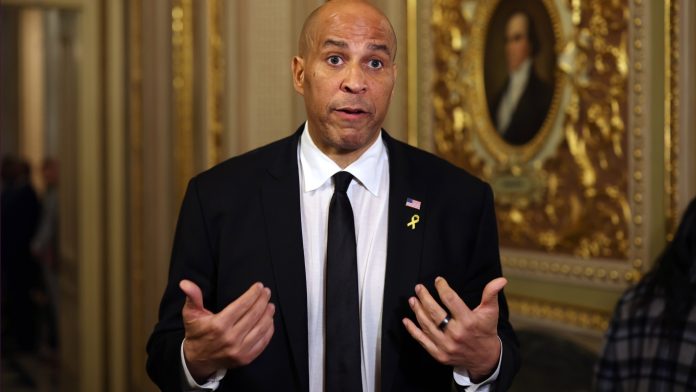
  • Sen. Cory Booker, D-N.J., begins a talk-a-thon in the Senate in protest of the Trump administration’s policies. 
  • Trump administration gets another loss in federal court. This time on temporary protected status for Venezuelans. 
  • Elon Musk visits the CIA to discuss DOGE efforts. 
  • Trump signs executive order to end collective bargaining at agencies that deal at all with national security. 
  • Judge rules that Alabama cannot prosecute groups that help women get abortions in other states.
  • Trump signs an executive order seeking to crack down on ticket scalping — with Kid Rock by his side in the Oval Office.
  • The administration deports 17 more people to El Salvador despite a court order blocking the flights. The administration is using a different justification calling them counterterrorism efforts. 

Tuesday:

Wednesday:

  • Trump imposes broad tariffs against trading partners. He’s calling it “Liberation Day.”  Here’s a tariff timeline. 
  • Politico reports that Waltz set up at least 20 Signal groups to discuss various international issues. 
  • Senate Republicans unveil their budget. They are looking at trying to get around the Senate parliamentarian, so Trump’s tax cuts appear to have no cost to the federal budget and to have more latitude on what can be included in a reconciliation bill, a procedural maneuver that would bypass a potential filibuster and only need 51 votes for passage. 
  • Another U.S. law firm strikes a deal with Trump: Milbank.
  • New York Mayor Adams — newly out from under federal corruption charges — says he won’t run in a Democratic primary for another term, but is planning to run instead as an independent.
  • Musk’s favorability rating in Wisconsin is recorded at 38% in a poll from Marquette Law School
  • The Wall Street Journal reports that Meta’s Mark Zuckerberg is lobbying President Trump to try and come up with a settlement to avoid an upcoming antitrust trial brought by the Federal Trade Commission that would force it to unwind WhatsApp and Instagram.
  • The New York Times reports that Amazon put in a last-minute bid to try and buy TikTok.
  • Trump is listed at No. 700 on the world’s list of billionaires. Musk is listed as No. 1.
  • Reuters reports that a former Costa Rican president and Nobel Peace Prize winner had his visa revoked because of comments critical of Trump.
  • Democratic California Sen. Adam Schiff has placed a permanent hold on Ed Martin’s nomination to be U.S. attorney in Washington, D.C.
  • Trump’s social media company files paperwork with the Securities and Exchange Commission that would pave the path for Trump’s trust to sell $2 billion worth of shares.

Thursday:

  • Global markets are down because of tariffs. There are questions about how they were calculated. Former Treasury Secretary Larry Summers says of the tariffs: “It’s now clear that the Trump administration computed reciprocal tariffs without using tariff data. This is to economics what creationism is to biology, astrology is to astronomy, or RFK thought is to vaccine science.”
  • Political leaders around the world are upset with the tariffs. French President Macron has asked European Union businesses to hold off on U.S. investments for now.
  • Trump’s Commerce Secretary Howard Lutnick says Trump “is not going to back off” these tariffs and that the U.S. is the economic “sumo wrestler” of the world.
  • Democratic Senate Leader Chuck Schumer points out that Russia was conspicuously left off Trump’s tariff list.
  • Former Vice President Mike Pence calls the tariffs the “largest peacetime tax hike in U.S. history.” The Tax Foundation estimates that average families will see an increase in cost of $2,100 over the year.
  • Sens. Chuck Grassley, R-Iowa, and Maria Cantwell, D-Wash., introduce legislation to limit the president’s tariff power.
  • American carmaker Stellantis announces it is laying off 900 autoworkers after Trump’s tariffs were announced. It has also paused production at plants in Mexico and Canada.
  • Trump is expected to make an appearance at the Saudi-backed LIV golf’s first domestic event in Florida.
  • Trump’s executive orders are making it difficult for Justice Department lawyers to defend them all in court. 
  • Secretary of State Rubio is in Europe visiting NATO. 
  • For the first time in many years, a senior Russian official is in Washington to meet with U.S. administration officials. 
  • Federal Judge James Boasberg, says there’s a “fair likelihood” the administration violated his order to turn flights around of deported Venezuelans and acted in “bad faith.” 
  • Trump approval drops to 43% in Reuters/Ipsos poll. Just 37% approve of his handling of the economy and 30% approve of his efforts to lower the cost of living. Majorities also think tariffs will do more harm than good and will hurt someone close to them.
  • Multiple news outlets report that Trump fired multiple National Security Council staffers after meeting with far-right conspiracy theorist and activist Laura Loomer, who questioned their loyalty. 
  • Senators voted, in a nonbinding resolution, to overturn Trump’s 25% tariffs on Canada. Four Republicans voted with Democrats — Sen. Susan Collins of Maine, Mitch McConnell of Kentucky, Lisa Murkowski of Alaska and Rand Paul of Kentucky. McConnell and Paul are concerned about the effect on exports of Kentucky bourbon. Collins cited her concerns over tourism, farming and lobster processing.
  • Defense Department acting inspector general launches investigation into Defense Secretary Hegseth’s use of the Signal app. (NPR CEO Katherine Maher is chair of the board of the foundation that oversees the Signal app.)
  • The Trump administration is warning states to end what it sees as DEI policies or not receive federal funding for schools. Title I funding is used to help low-income schools. A letter state that includes “the use of Diversity, Equity, & Inclusion (‘DEI’) programs to advantage one’s race over another — is impermissible.”
  • U.S. government bans U.S. employees in China from engaging in romantic relationships with Chinese citizens, the AP reports, noting that these kinds of “non-fraternization” policies have not been in place officially since the Cold War.


China Retaliates Against Trump With 34% Tariff on U.S. Goods

0

The Chinese government will match President Trump’s plan for 34 percent tariffs on goods from China with its own 34 percent tariff on imports from the United States, China’s Finance Ministry said on Friday.

Separately, China’s Ministry of Commerce said it was adding 11 American companies to its list of “unreliable entities,” essentially barring them from doing business in China or with Chinese companies. The ministry imposed stringent limits on exports of certain rare earth elements that are mined almost exclusively in China and are used in everything from electric cars to smart bombs.

The commerce ministry also announced it was beginning two trade investigations into American exports of medical imaging equipment — one of the few manufacturing categories in which the United States remains internationally competitive.

China’s General Administration of Customs said that it would halt chicken imports from some of America’s biggest exporters of agricultural commodities.

Taken together, the measures released by three different government agencies within minutes showed that China has no intention of backing down in the trade war that Mr. Trump began this week with his own steep tariffs on imports from around the world.

China’s new tariffs will hit fewer goods than President Trump’s tariffs only because China sells far more to the United States than it buys. China bought $147.8 billion worth of American semiconductors, fossil fuels, agricultural goods and other products last year. It sold $426.9 billion worth of smartphones, furniture, toys and many other products.

But while President Trump’s tariffs exempted some large categories of imports, like semiconductors and pharmaceuticals, the Chinese tariffs have no exemptions.

China’s Finance Ministry issued a statement strongly criticizing Mr. Trump’s tariffs, which will begin to take effect on Saturday and fully kick in next Wednesday. “This practice of the U.S. is not in line with international trade rules, seriously undermines China’s legitimate rights and interests, and is a typical unilateral bullying practice,” the ministry said.

The Chinese tariffs are scheduled to take effect next Thursday — 12 hours after the American tariffs take effect.

This is a developing story. Please check back for updates.

Claire Fu contributed reporting from Seoul.

The history of filibustering, before Cory Booker’s speech : NPR

0

Sen. Cory Booker speaks to reporters as he leaves the Senate chamber after delivering a record-setting floor speech on Tuesday. Contrary to popular belief, the speech was not technically a filibuster.

Tasos Katopodis/Getty Images


hide caption

toggle caption

Tasos Katopodis/Getty Images

Sen. Cory Booker’s impassioned oration against the policies of President Trump’s administration — with the help of multiple fellow Democrats — didn’t just break the record for the longest Senate floor speech in history. It also renewed a spotlight on a time-honored tradition.

The New Jersey Democrat spent a consecutive 25 hours and 5 minutes standing and speaking at the podium Monday night into Tuesday, captivating hundreds of thousands of viewers and sending Google searches skyrocketing for the word “filibuster.”

The catch? While no less impressive, Booker’s efforts didn’t technically constitute a filibuster, since he wasn’t seeking to block a specific bill or nomination.

The term refers to action “designed to prolong debate and delay or prevent a vote on a bill, resolution, amendment, or other debatable question,” according to the U.S. Senate.

“That can have an effect of just raising attention for the issue that the senator is talking about … or it can be a means to literally give more time for senators to have the backroom conversations to dilute the bill that is for some reason objectionable to the senator,” explains Casey Burgat, Legislative Affairs Program Director at George Washington University’s Graduate School of Political Management.

The delay tactic is as old as the Senate itself, where the rules permit unlimited debate. It has been used prolifically — and controversially — throughout the decades, including when then-Democrat Strom Thurmond filibustered the Civil Rights Act of 1957 for over 24 hours, setting the record that Booker broke this week.

Booker’s speech has, ironically, put the filibuster in focus. And while the act itself may be considered dull, the word’s history and use over time are anything but. NPR’s first installment of Word of the Week traces its evolution, from swashbuckling to stonewalling.

Where did the word come from? 

An 1857 engraving of William Walker at a table with other men.

An 1857 engraving of William Walker, an American who was elected president of Nicaragua and referred to at the time as a “filibuster.”

Bettmann/Bettmann Archive/Bettmann


hide caption

toggle caption

Bettmann/Bettmann Archive/Bettmann

“Filibuster” was originally used to describe an unauthorized military adventurer, specifically “an American engaged in fomenting insurrections in Latin America in the mid-19th century,” according to Merriam-Webster.

It comes directly from the Spanish word “filibustero,” which translates to freebooter or pirate.

When the word first arrived in English in the 1840s, it was used to describe Americans who went to foreign countries to fight in their wars without the U.S. government’s permission. But before long it moved to the political sphere, where it became shorthand for stalling senators.

The practice of delaying legislation by giving long speeches dates back to the very first session of the Senate in 1789, the chamber says, but it wasn’t until the 1850s that it became commonplace enough to earn its colorful name.

It first appeared in Congress as a metaphor, after one debate got so long it seemed to be disrupting government business. The implication was that filibustering lawmakers were pirates, raiding the institution for their own political gain.

The term caught on quickly in the debate-friendly Senate, as NPR has reported. In January 1853, for example, Mississippi Democrat Albert Brown commented, “I saw my friend standing on the other side of the House filibustering.”

“A month later, North Carolina senator George Badger complained of ‘filibustering speeches,’ and the term became a permanent part of our political lexicon,” reads the U.S. Senate website.

By the 1870s, the filibuster had become both a fixture of the political process and a noun — though it was initially applied to the person who gave the speeches, rather than the act of speaking itself, Merriam-Webster says.

How has the word been used over time? 

The filibuster — a marathon speech by a small group of senators or an enterprising individual — has been immortalized in popular culture, in large part thanks to Frank Capra’s 1939 film Mr. Smith Goes to Washington.

In the movie, idealist freshman Sen. Jefferson Smith (played by James Stewart) finds himself at odds with a corrupt political machine, whose leaders try to destroy his reputation when he attempts to expose them. In the climax of the film, he stages a one-man filibuster to proclaim his innocence, which ran over 23 hours and ended only after he collapsed in exhaustion on the Senate floor.

“We have this big conception in our head, at least the public does, of what a filibuster is, of the Mr. Smith Goes to Washington … standing on your principles-type of senatorial behavior,” Burgat told NPR. “But that’s increasingly rare in the Senate, where the filibuster is not used all that often.”

There have been some famous filibusters in the real-life Senate, like a 1917 speech in which Wisconsin Sen. Robert La Follette opposed U.S. entry into World War I and nearly hurled a spittoon at the presiding officer after losing his temper. In 1953, Sen. Wayne Morse of Oregon protested against the Submerged Lands Act for 22 hours and 26 minutes — now the third-longest such speech in history, according to the Senate Historical Office, thanks to Booker’s new record.

Sen. Strom Thurmond (D-S.C.) speaks to reporters as he leaves the Senate Chamber after ending his 24 hour and 18-minute speech against the Civil Rights Bill in August 1957.

Sen. Strom Thurmond (D-S.C.) speaks to reporters as he leaves the Senate Chamber after ending his 24 hour and 18-minute speech against the Civil Rights Bill in August 1957.

Bettmann/Bettmann Archive/Bettmann


hide caption

toggle caption

Bettmann/Bettmann Archive/Bettmann

Thurmond — who held the record for almost seven decades — was one of many southern Democrats who used the filibuster to successfully delay the passage of civil rights legislation by about a decade in the mid-20th century, says Burgat.

“[The Civil Rights Era] seems to be the historical peak,” he said. “And then we transitioned into an era of the silent or assumed filibusters, as these margins got closer and closer.”

In today’s era of partisanship and small majorities, he says, senators who are opposed to pieces of legislation don’t necessarily need to actually make a big speech on the floor.

Because 60 votes are required to cut off debate (known as cloture) — and effectively, pass a law — if a group of 41 or more senators simply threatens a filibuster, the Senate majority leader can just refuse to call a vote, the Brennan Center for Justice explains.

“And then that filibuster comes off the Senate floor and is actually silent in that they don’t have to hold the floor, stand up and recite Green Eggs and Ham,” Burgat explains, nodding to the fact that senators often read books or speeches aloud to pass the time while filibustering.

“It’s really just assumed, and the majority doesn’t even make them go through that process … because they would rather process other senatorial business.”

That’s not to say there haven’t been filibusters — or Booker-style long, public speeches — on the Senate in recent years. Some standouts include a nearly 15-hour filibuster by Sen. Chris Murphy, D-Conn., for gun control legislation in 2016, and a more than 21-hour effort by Sen. Ted Cruz, R-Texas, to defund the Affordable Care Act in 2013.

Why does the word matter today? 

Supporters of Sen. Cory Booker hold a sign and an American flag outside the Capitol.

Supporters of Sen. Cory Booker gather outside the Capitol as he speaks on the Senate floor on Tuesday.

Roberto Schmidt/AFP via Getty Images


hide caption

toggle caption

Roberto Schmidt/AFP via Getty Images

In recent years, talk of reforming the filibuster has been almost as widespread as the practice itself.

The Senate has changed the rules of filibustering several times over the decades, like reducing the number of votes required for cloture in 1975 and allowing a simple majority to end debate on nominations in the 2010s.

Critics of the filibuster point to its racist past — former President Barack Obama called it a “Jim Crow relic” — and impact on productivity. Some politicians have proposed further changes or eliminating it altogether.

“The critiques are often convenient politically, in that: I hate it when I’m in the majority and it’s stalling me, I love it when I’m in the minority and I need to do the stalling,” Burgat says, though he predicts the filibuster is likely to undergo changes eventually.

Former President Joe Biden said in 2022 that he supported scrapping the filibuster in order to codify abortion and voting rights, for example. While many Democrats were on board then, Burgat says they are likely grateful for the filibuster now, with a Republican-controlled Congress and White House.

Burgat considers Booker’s use of the right to unlimited debate, in full public view, as a boon for democracy at a time when trust in institutions is historically low.

“Though it didn’t stall any piece of legislation, he got the conversation he was after. And to me, that’s the senator’s job,” he said.

He says part of the reason that we don’t see such speeches very often these days is because of how physically taxing it is to stay upright and talking — without leaving for a bathroom break — for so long. A hoarse Booker, by the way, told reporters afterward that he had cut out food and water long before he took the podium.

Still, Burgat is surprised that more senators haven’t tried to take advantage of the opportunity to go viral — and says Booker’s speech could potentially inspire others to do the same.

“I want them talking to each other, even if they’re fundamentally disagreeing with each other. That’s how it’s supposed to work,” he says.

Strike in UK’s Second Largest City Leaves Trash Piled High

0

A pungent smell of rotting garbage fills the air. Bulging sacks of trash pile high, some spilling their festering contents. And, with vermin plaguing parts of the city, at least one resident has claimed to have been bitten by a rat.

With its heritage as a manufacturing powerhouse and its proud civic history, Birmingham likes to call itself Britain’s second city.

Right now, it’s the nation’s garbage capital.

A standoff between striking refuse workers and city officials has left an estimated 17,000 tons of trash piled on city streets that is attracting rats, foxes, cockroaches and maggots. On Monday, Birmingham’s municipality declared it a “major incident,” which allows it to access more resources from the government and other nearby regions.

Some garbage collections are still taking place and the city has managed to keep many areas, including the center, clear of trash. But in several residential districts and parks it was highly conspicuous on Wednesday.

In Small Heath, a neighborhood two miles from the city center, black plastic bags had piled up at the end of some streets, and people from other areas had added to the mess by dumping their uncollected garbage.

“I have lived in England for 36 years. I have never seen a situation like this before,” said Javad Javadi, 51, a delivery driver who is originally from Iran, as he walked past overflowing plastic trash bins that lined Malmesbury Road.

“Of course, at night time, if you come after 10 o’clock you see many rats,” he said. “So many that the cats don’t chase them.”

Birmingham’s garbage pileup has caused a political stink in Britain’s Parliament where Jim McMahon, a minister from the governing Labour Party, warned of public health risks, and one Birmingham lawmaker, Preet Kaur Gill, said a constituent had written to say “that they had been bitten by a rat.”

An opposition lawmaker, Julian Lewis, compared the situation to an infamous 1978 garbage collection strike during industrial unrest under the Labour government of James Callaghan. The period became known as the “winter of discontent,” and the following year Labour lost a general election, ushering Margaret Thatcher into power.

This dispute, however, is confined to Birmingham, where more than 350 workers began limited walkouts in January that last month escalated into an indefinite full-scale strike.

“We cannot tolerate a situation that is causing harm and distress to communities,” Birmingham City Council leader, John Cotton, said in a statement.

Trade union members claim that a restructuring plan pushed by the municipality would leave around 150 workers up to 8,000 pounds (about $10,400) a year poorer. The council disputes this, saying that “the number of staff that could lose the maximum amount (just over £6,000) is 17 people.”

While the two sides remain deadlocked, the results were evident in Malmesbury Road where black plastic bags were heaped at both ends of the street and in an alleyway halfway down. Some despairing residents had begun taking their trash to the dump.

As he loaded around 20 sacks into his car, Shakeel Ahmed explained that garbage had accumulated for three weeks outside his home and in his garden shed.

Driving to a waste facility, Mr. Ahmed, 69, a retired train manager, kept the windows open and apologized for the smell in his car, adding that he would have it professionally cleaned after depositing the trash. “If I get angry it is not going to solve the problem,” he said, philosophically.

At the refuse and recycling center in Tyseley, a few miles southeast of the city center, others had a similar story about the stench, the vermin and the damage to the city’s reputation.

“We can’t open the window because of the smell, it’s rubbish everywhere — it’s ridiculous,” said Rubina Yaqoob, 43, describing the situation in Stechford, in east Birmingham. Her vehicle is new and she had lined its trunk with a sheet before loading it with 10 bags of trash. “Look at my car!” she said, pointing to the mess the garbage had made.

Some don’t have this option, including Robert Shaw, 60, a school cleaner, who has found himself living next to a mounting pile of refuse bags at Henshaw Road. “What the council said to us is that we can take it to Tyseley,” he said. “But if you haven’t got a car, how are you supposed to take it?”

The crisis has forced some city dwellers to be inventive. Sitting in the sunshine in Morris Park, waiting to collect her three children from school, Tasnima Tafader recounted how her husband had called relatives to find space in their bins for some of the family’s garbage. His mother came through.

Then, when a refuse truck arrived around 7:30 a.m. one morning, residents came out of their homes to load bags from the street into the truck, said Ms. Tafader, 34, an interpreter.

At another depot in Tyseley, strikers gathered at the gates in front of departing refuse trucks, delaying their journeys by walking in front of them at a snail’s pace for several hundred yards.

Lee Haven, a member of the Unite trade union, disputed the city’s claim that no worker “need lose any money,” arguing that planned changes could cost some £600 a month at a time when household bills are rising sharply.

The origins of the dispute lie in 2023 when Birmingham City Council declared itself essentially bankrupt, partly as a result of equal pay cases brought by workers, and began to implement far-reaching cuts to services.

As part of a restructuring plan, the municipality now wants to scrap one position on refuse teams, known as the waste recycling and collection officer, which it says does not exist in other municipalities. Workers in that role can take voluntary redundancy or move to another position.

It says that simplifying the pay structure is crucial and keeping the role would risk “creating a huge future equal pay liability,” but declined requests to explain exactly why.

“There is a feeling we are being made a scapegoat,” Mr. Haven said, as around 10 police officers looked on. “I think the normal working class family in this country will understand that nobody can afford to take that £600 loss.”

Even as they bemoan the state of their streets, some city dwellers sympathize with the refuse collectors.

“I don’t blame them because I don’t think their wages should be cut,” said Zeenat Hussain, 53, a health service administrator from Saltley. “What they are doing is an essential job.”