Thursday, November 12, 2026
Home Blog Page 55

Former Costa Rica president Óscar Arias talks visa, Trump : NPR

0

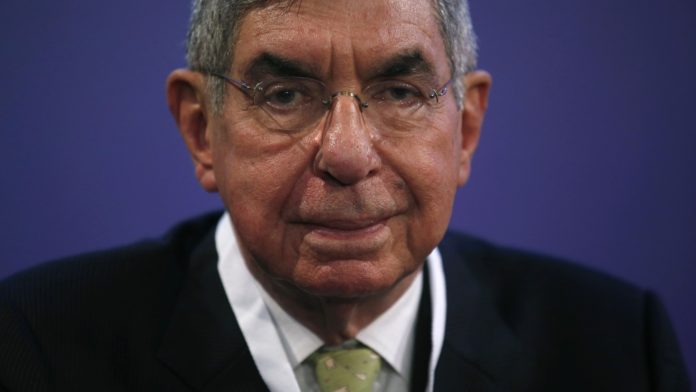
Nobel Peace Prize laureate and two-time Costa Rican President Oscar Arias looks at the media during the opening ceremony of the XV World Summit of Nobel Peace Laureates at the University in Barcelona, Spain, Nov. 13, 2015.

Manu Fernandez/AP


hide caption

toggle caption

Manu Fernandez/AP

Former Costa Rica president Óscar Arias Sánchez – a Nobel Peace Prize winner – had his U.S. visa revoked by President Trump’s U.S. State Department this week.

Arias Sánchez, 84, said in an interview with Morning Edition that U.S. Embassy workers in Costa Rica told him his visa was revoked due to his close ties with the Chinese government. Arias Sánchez served as president of Costa Rica from 1986 to 1990 and then again from 2006 to 2010. Costa Rica formalized relations with China in 2007.

Earlier this year, the Nobel Laureate criticized President Trump on social media, comparing him to a “Roman emperor” telling the rest of the world what to do. Arias Sánchez told NPR he worries those comments influenced the decision to revoke his visa.

“The president has a personality that is not open to criticism or disagreements,” Arias Sánchez said.

A State Department spokesperson provided the following statement when NPR asked for comment about Arias Sánchez’s revoked visa: “Visa records are confidential under U.S. law; therefore, we cannot discuss the details of individual visa cases.”

Arias Sánchez spoke to NPR’s Leila Fadel about his visa cancellation, Trump and how the U.S. is treating the rest of the world.

Editor’s note: Arias Sánchez spoke through an interpreter and in English. This interview has been edited for length and clarity. 

Arias Sánchez: So I received an email on Tuesday, April 1, that was a very short one that said that my B1/B2 visa had been revoked. I called the embassy to ask what had happened.

Leila Fadel: And what did they say?

Arias Sánchez: They asked me to come into the embassy. Fortunately, I live about five minutes away, so I was able to be there in person where they somewhat explained what happened.

They told me my visa was revoked because of my close ties to China. During my second administration from 2006 to 2010, I established diplomatic relations with China, and that’s because it has the second largest economy in the world. Costa Rica has a very open economy, and its growth relies on international trade. And so in 2007 is when we formally established diplomatic relations.

Fadel: How much do you think your public statements criticizing President Trump, comparing him to a Roman emperor played in them, suspending your visa?

Arias Sánchez: I don’t know. The embassy workers didn’t say that was specifically why my visa was revoked and they cited my relationship with China. But I have to imagine that my criticism of President Trump might have played a role. The president has a personality that is not open to criticism or disagreements.

Fadel: The Trump administration says it’s targeting anyone they deem as having what they define as a “hostile attitude” to the U.S. What do you make of that policy?

Arias Sánchez: I don’t have a hostile attitude towards the United States. Friends sometimes agree, sometimes disagree. And concerning U.S. policy towards Central America, supporting the Contras militarily affected my own country.

During the Reagan administration, I had a strong disagreement with his policy towards the region. But concerning my feelings towards the U.S. – you know, my two children were educated in the U.S. My son went to Harvard and my daughter went to Boston College. I received more or less 85 honorary degrees from the best universities in the U.S.

I am a good friend, but I also have fought for noble causes.

Note: Throughout the 1980s, the U.S. backed Contra rebels against the left-wing Nicaraguan government, an action Arias Sánchez opposed. As president, he did not allow the U.S.-backed Contras to operate in Costa Rica.

Fadel: I think there’s so much fascination with your case because you’re such a known figure and yet your visa was revoked. So what does that say about the policy of the U.S. today under this administration?

Arias Sánchez: Well, I don’t agree with it. For a Democrat – and I am a true Democrat – criticism is welcome. It’s the only way you can build agreements. This happened to me when I met with the five Central American presidents in August of ’87. I had introduced my peace plan in the U.S. In a negotiation, you never get what you want. You always get what you can.

And with criticism from adversaries or from the press and freedom of the press and freedom of opinion, freedom of expression is a prerequisite for any democratic government. So I have benefited myself with criticism from all those sources. And it seems to me that nowadays, one shouldn’t dare to criticize the U.S. because you could be punished.

This article was edited by Treye Green. The radio version of this story was edited by Reena Advani and produced by Julie Depenbrock.
What to Know About South Korea President Yoon’s Impeachment Over Martial Law

0

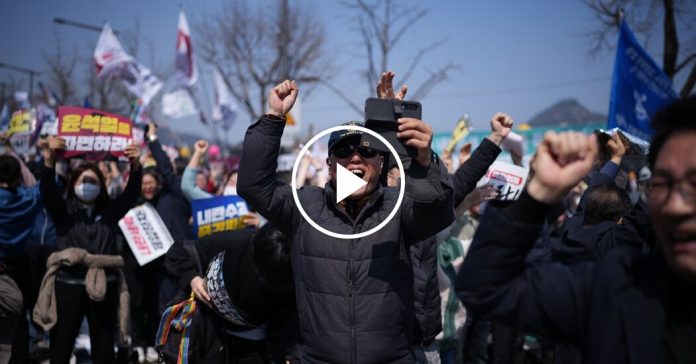
South Korea’s Constitutional Court on Friday upheld the impeachment of President Yoon Suk Yeol, removing him from office four months after his short-lived imposition of martial law on Dec. 3.

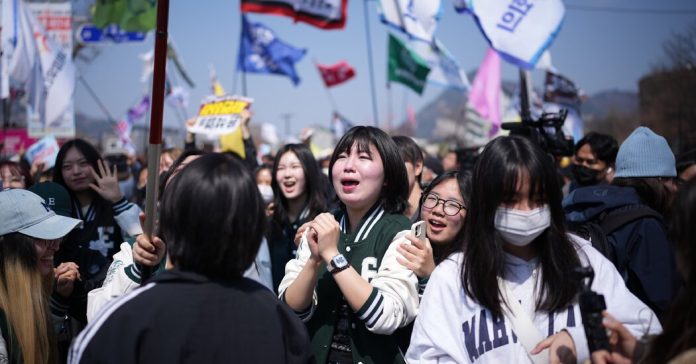
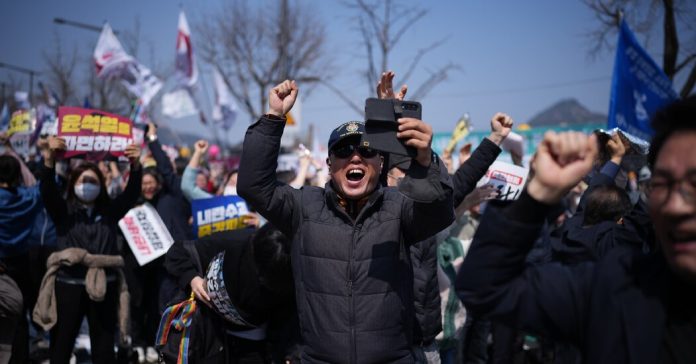
Protesters who have been demanding his ouster erupted in cheers at the ruling, waving flags and pumping their fists in the air. For weeks leading up to the ruling, hundreds of thousands of people protesting for and against Mr. Yoon have lined the streets of Seoul, often enduring freezing temperatures, rain and snow.

At 11 a.m. local time, the court’s acting chief justice, Moon Hyungbae, began reading the ruling, which came after months of deliberation. Some 22 minutes later, he announced that all eight of the court’s justices had voted to remove Mr. Yoon from office. The now ex-president had “betrayed the trust of the people” and “severely violated the law,” Mr. Moon said.

“It has been a great honor for me to work for the country,” Mr. Yoon said in a statement released through his lawyers. “I and regretful and sorry that I could not live up to your expectations.”

The court ruling is effective immediately and cannot be appealed.

Late on Dec. 3, Mr. Yoon stunned the country when he declared martial law, but it lasted only six hours because lawmakers quickly voted to overturn it.

Shortly after he made the announcement on live television, troops stormed the National Assembly building under orders to “break down the door and drag out” lawmakers gathering inside to vote down the martial law decree and arrest key figures, including the speaker of the floor. Crowds of citizens confronted the troops, and some lawmakers scaled fences to get into the assembly and vote.

On the same night, Mr. Yoon also sent troops to the National Election Commission who attempted to search and confiscate its database. This violated the agency’s constitutionally guaranteed independence, the court ruled.

Delivering the ruling, Justice Moon said Mr. Yoon had abused his duties as the nation’s commander in chief. The martial law decree did not meet the constitutional requirement for a national crisis which Mr. Yoon repeatedly said was one of the reasons he had made the extraordinary declaration.

The judges said that Mr. Yoon rushed his idea for imposing martial law through a hurriedly convened Cabinet meeting on the night of Dec. 3. without proper deliberation, and that he failed to notify the National Assembly, as was required by law.

Only six of the eight members on the bench needed to vote in favor to uphold the impeachment, but the decision was unanimous.

Acting president Han Duck-soo will continue in his role until the nation elects a new president through a snap election. This must take place within 60 days from Friday, meaning early June at the latest. The National Election Commission is expected to announce the date in the coming days.

Political parties will select their candidates through primary elections.

Lee Jae-myung is the expected front-runner to lead the opposition Democratic Party. He has been Mr. Yoon’s political rival since the last presidential elections in 2022 when he lost to the former president by less than 1 percent of the votes. Mr. Lee has been at the helm of the political push to remove the now-impeached president.

It’s less clear who will come out in front of the race to lead the ruling People Power Party. Its former leader, Han Dong-hoon, resigned in December after disagreement with both Mr. Yoon and his party over the martial law issue.

Oh Se-hoon, the mayor of Seoul, and Hong Joon-pyo, the mayor of Daegu, are others who have been suggested as potential candidates.

President Trump downplays the role of far-right activist in firings of NSC staff

0

President Trump is downplaying reports that right wing provocateur Laura Loomer influenced the firing of multiple National Security Council officials.

Yoon Ejected as South Korean Court Upholds Impeachment

0

South Korea’s Constitutional Court ruled unanimously to remove former President Yoon Suk Yeol. Protesters reacted to the decision, some cheered while others showed their disappointment.

Oaklee, Cohen, & Mateo: why are these Gen-Alpha's hottest names?

0

Baby names tell a story – about a family’s unique history, about a specific moment in time, and even about politics. A survey tracking the top 500 names in states that went red or blue in the 2020 election recently went viral, highlighting popular names like Oakleigh and Stetson in red states, and Santino and Liana in blue states. Brittany is joined by Neda Ulaby, NPR Culture Correspondent, and Naftali Bendavid, Senior National Political Correspondent for the Washington Post to reflect on what popular baby names in red and blue states say about our current political moment.

Support public media and receive ad-free listening & bonus content. Join NPR+ today.

Australia’s Relationship with United States Gets a Second Look

0

Australia is one of America’s closest allies; the two countries have fought alongside each other in every major conflict since World War I. Jake Sullivan, former President Joe Biden’s national security adviser, said in January that the two had effectively entered a “strategic marriage.”

Lately, though, Australians have been feeling rather like a spouse who awoke one morning to find a complete stranger lying next to them. Many have watched, aghast, how President Trump has treated other longstanding allies such as Canada and Europe, cavalierly threatening their economies with hefty tariffs and casting doubt on the U.S. commitment to protect NATO members.

Australia itself was hit this week with a 10 percent tariff on its exports to the United States, in addition to a 25 percent tariffs on its steel and aluminum. Prime Minister Anthony Albanese on Thursday said the moves would “have consequences for how Australians see this relationship.”

All this has Australians taking a hard look their own heavily intertwined and dependent military relationship with the United States — even as China is making its growing military might felt in the region — and asking if they are in need of a “Plan B.”

“We are dealing with a very different America,” Malcolm Turnbull, a former conservative prime minister, said in an interview. “We’re dealing with an America whose values no longer align with ours.”

As a nation of 27 million stretched over a geographical expanse that rivals the continental United States, Australia has always relied on a powerful partner for its defense — first Britain, then the United States.

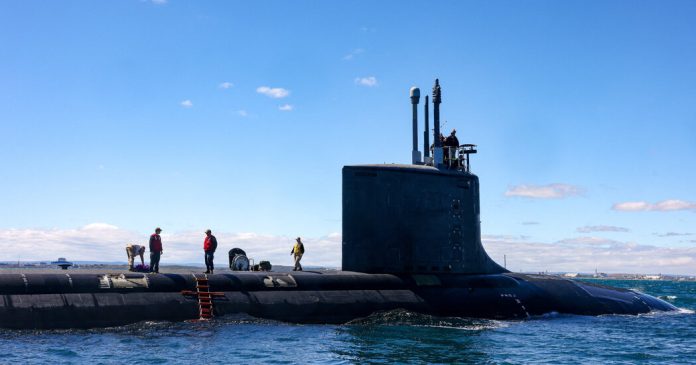
In recent years, Australia became an integral part of the U.S. military posture in the region to counter China’s increased assertiveness. U.S. Marines regularly rotate through northern Australia, U.S. submarines dock in its west, and the government signed a 2021 deal with Washington and London, known as AUKUS, to equip Australia with nuclear-powered submarines over the coming decades.

But now, some question whether the assumptions underlying those arrangements still hold, given Mr. Trump’s “America First” stance. Can Australia rely on the United States to come to its aid in a time of need, and can Australia continue to stand militarily by its American ally if it fundamentally disagrees with its view of the world?

“We really have to revise our thinking about the United States as a country,” said John McCarthy, formerly Australia’s ambassador to the United States.

Mr. Turnbull, whose tenure overlapped with part of Mr. Trump’s first term, convened a forum this week in the capital, Canberra, to discuss the U.S. alliance. He said he did so because he felt Australia’s political parties were not paying enough attention to the changes in and challenges to the alliance, focusing instead on domestic issues in the lead-up to next month’s federal election.

Politicians on both sides of the aisle have said Australia needs to do more for its own defense. Mr. Albanese’s Labor government has announced plans to increase military spending to 2.3 percent of gross domestic product over the next decade, while the opposition leader, Peter Dutton, has pledged to invest about $1.9 billion in a squadron of fighter jets.

At the center of Australia’s plans for long-term security is the AUKUS deal for nuclear-powered submarines, which was heralded as an unprecedented partnership involving the sharing of sensitive American nuclear technology.

Under the agreement, Australia will first acquire secondhand U.S. Virginia-class submarines, and eventually build its own, as a response to growing Chinese military influence in the Asia Pacific. Nuclear-fueled propulsion would allow them to stealthily cover vastly longer distances without having to surface.

Since its signing, however, the agreement has faced questions in Australia about whether the United States could speed up its shipbuilding enough to hand over the used submarines on time, and whether it would automatically draw the country into conflicts involving the United States, such as over Taiwan.

The volatility of the Trump administration and its relationships with allies has amplified the skepticism.

“Donald Trump’s doing us a favor by making clear to us things we’ve been determined not to recognize for ourselves,” said Hugh White, an emeritus professor of strategic studies at the Australian National University and a former intelligence and defense official, who has been critical of the deal.

But as much as Australians may feel the need for a more independent defense, the country’s politicians have not communicated to the public the resources that would need to be redirected, said Charles Edel, Australia chair at the Center for Strategic and International Studies in Washington.

Ultimately Australia may have too much to gain from the alliance and need it for the balance of power in the region, he said after the forum.

Dennis Richardson, a former secretary of foreign affairs and defense who also served as Australia’s ambassador to Washington, said as much at Mr. Turnbull’s forum.

“I don’t think we need to waste time on a Plan B,” he said, referring to the AUKUS deal. “The worst possible thing we could do at this point would be to change horses.”

Seoul Reacts As Impeached President Yoon Is Removed from Office

0

For hours, the atmosphere in the streets surrounding South Korea’s Constitutional Court in downtown Seoul had been tense. Dozens had camped out overnight in the early spring chill in the lead-up to the court’s historical decision on Friday.

The crowds for and against the dismissal of the country’s impeached president, Yoon Suk Yeol, were separated by police buses and metal barriers up to 13 feet in height.

As the acting chief justice began reading out the decision, filled with technical legal jargon, the crowds grew quieter, straining to hear from outdoor loudspeakers the outcome that would determine Mr. Yoon’s fate — and that of the country. Some people opposed to Mr. Yoon cheered and applauded intermittently as the reading went on. Protesters on both sides clasped their hands together in prayer. Many held up their phones to record the moment.

And then, the crowd erupted.

Those supporting Mr. Yoon’s impeachment reacted with hugs, screams and fists pumped in the air to the unanimous decision to remove him from office. At a rally of supporters of Mr. Yoon near his residence, there was loud booing. Some people folded over in dismay, and others loudly cursed.

“It’s been so hard, but now my heart is relieved,” said Kim Ji-seon, 55, who brought her daughter to witness the verdict in the hopes that Mr. Yoon’s impeachment would be upheld. “I hope they can create a country where people can be happy.”

Soon after the decision was announced, only a handful of people, some wearing “Make Korea great again” and “stop the steal” hats, were left at a pro-Yoon demonstration that was scheduled to last all day outside the presidential office. Construction workers were taking down scaffolding, and dozens of chairs had been stacked and pushed to the side.

Jang Jaeeuk, 21, said he had stayed out on the street near the court overnight along with other students from his university, getting only three hours of sleep, because it was such an important day for his country.

“I’m happy that the hardships of the past four months haven’t gone to waste,” he said after crying and hugging his fellow students upon hearing the verdict. “Now I feel that we can change the world and, in that sense, I’m hopeful for the future.”

Supporters of Mr. Yoon near the court, who were predominantly men, said that they were deeply disappointed that the president was removed and went home.

Yoon Seo-jun, 18, sitting on the edge of a sidewalk, said he was distrustful of the system that led to the impeachment and dismayed about the future of the country.

“South Korea’s democracy is dead,” he said, adding that he hoped the National Assembly, which had impeached Mr. Yoon, would be dissolved.

After the decision, some South Koreans expressed apprehension about what might come next and the possibility of further political upheaval.

Lee Yongseok, 27, who watched the court’s televised decision at a screen at Seoul’s main railway station, said that although he supported the verdict, he knew that others would be skeptical of the ruling and of the judges who made it.

“I feel like something big is going to come to my country,” he said.

Even as supporters and opponents of Mr. Yoon tried to grasp what comes next for their country, government officials were taking steps to move on.

In a gesture that underlined the finality of the court’s ruling, the officials removed the presidential emblem in front of the building where Mr. Yoon used to work as president. The emblem bears the image of a mythical bird, the phoenix.

Choe Sang-Hun, Chang W. Lee, Jun Michael Park and Victoria Kim contributed reporting.

Ignoring Protests, Thailand Opens Door to Myanmar’s Military Leader

0

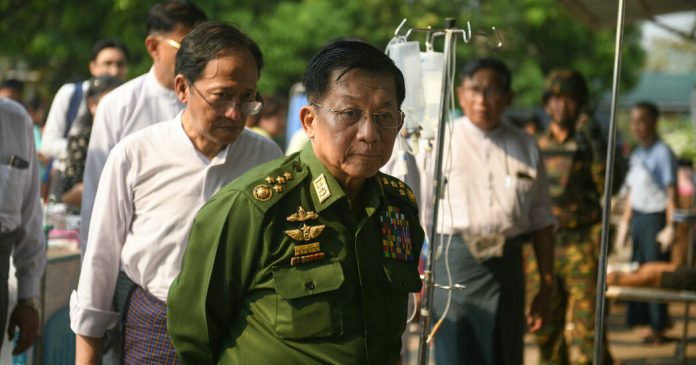
For years, Myanmar’s army chief, Senior Gen. Min Aung Hlaing, has been treated like a pariah on the global stage.

General Min Aung Hlaing has made few overseas trips, other than to Russia and China, since he seized power in a coup in 2021. Long the subject of Western sanctions, he has been barred from attending meetings of the Association of Southeast Asian Nations, of which Myanmar is a member, because of his military’s failure to implement an agreed peace plan in the country’s civil war. An arrest warrant by the International Criminal Court last November accusing him of crimes against humanity was supposed to isolate him further.

But on Friday, General Min Aung Hlaing began talks in Bangkok at a regional summit of a group of seven countries around the Bay of Bengal that also includes India and Thailand. He had planned to discuss ways that other countries could provide relief for the March 28 earthquake in Myanmar that killed over 3,000 people.

On Thursday, the day of his arrival in Bangkok, his military launched multiple airstrikes in Kachin State, Karenni State and the Sagaing region in Myanmar despite his call for a cease-fire, according to a spokesman for the Kachin Independence Army rebel group, an activist in Sagaing and an aid worker in Karenni.

Myanmar’s military has come under fierce criticism for continuing its airstrikes in the ongoing civil war and impeding the flow of aid in the days after the quake.

For the general, the Bangkok visit — his first to a Southeast Asian nation since April 2021 — will give his regime the international attention it has long desired. For the Thai government, which is already sheltering tens of thousands of refugees from Myanmar in camps along the border, stable relations with the military government could be aimed at trying to manage the flow of new arrivals.

But critics say the visit is the latest indication that Bangkok views human rights as irrelevant in foreign policy.

“They don’t care,” said Kasit Piromya, a former Thai foreign minister.

“It’s an insult to ASEAN — that’s what it is all about,” he said, referring to the 10-member Southeast Asian regional grouping by its acronym. “It’s the fear of the Burmese army, the greed, and because all of them are not democratic.”

Thailand has said little about General Min Aung Hlaing’s visit beyond confirming that it was taking place.

Justice for Myanmar, a watchdog group, and 318 other organizations called on Thailand to disinvite the general, saying he had no legitimacy to represent the people of Myanmar. When foreign governments and international organizations engage with the military junta, the organizations said in a statement, it “causes significant harm for the people of Myanmar” by legitimizing the junta and assisting it in its war against its people.

“Senior General Min Aung Hlaing is grandstanding with Asian leaders in Bangkok following a devastating earthquake because he doesn’t care about Myanmar’s people,” Elaine Pearson, Asia director for Human Rights Watch, said in a statement. “What he cares about is garnering some legitimacy through high-level visits because ever since the February 2021 coup, he has been rightly ostracized by most of the international community.”

Leaders of India, Sri Lanka, Bangladesh, Bhutan and Nepal were scheduled to attend the summit, along with those of Thailand and Myanmar.

On Wednesday, the Myanmar military declared a 21-day cease-fire to support relief and reconstruction efforts, a day after it fired on a Chinese Red Cross convoy trying to deliver food and medicine to desperate survivors.

The military launched an airstrike in Karenni State on Thursday, according to David Eubank from the Free Burma Rangers, an aid organization in Myanmar. Soldiers targeted a checkpoint run by the Karenni rebels, killing one person and wounding four others, he said.

In Kachin State, the military dropped bombs with jet fighters. “Since they are the ones attacking, we have no choice but to fight a defensive war,” said Colonel Naw Bu, a spokesman for the Kachin Independence Army.

“They claim that armed groups should not take political advantage, yet they are the ones exploiting the situation for their own gain,” he added. “They are breaking the very rules that they set.”

Later on Thursday night, the military used heavy artillery to shell the towns of Monywa and Chaung-U in Sagaing, near the epicenter of the earthquake, according to Ma May, an activist based in Sagaing. It also targeted Kani township in the Sagaing region with airstrikes, she said.

General Min Aung Hlaing, a deeply unpopular leader, became even more disliked after he overthrew a democratically elected government led by Daw Aung San Suu Kyi, the Nobel Peace Prize laureate, in the coup.

Since then, the country has been at war, with groups of armed protesters and powerful ethnic armies fighting the junta. In response, the military launched a scorched-earth campaign against its own citizens with multiple airstrikes, killing thousands of people. At least three million are displaced. Myanmar’s economy has been wrecked following the coup, with millions of people thrown into extreme poverty, and criminality, such as the online scam centers that are flourishing in the country, has been exacerbated.

Verena Hölzl contributed reporting.

Israeli Strike Kills Dozens at Gaza City Shelter, Officials Say

0

Dozens of people were killed on Thursday in an Israeli strike on a school-turned-shelter in Gaza City, according to local health authorities.

The deadly strike took place as Israel was ramping up its offensive in the Gaza Strip to pressure Hamas to release more hostages being held in its captivity.

The Israeli military said that it was looking into reports about the incident and could not immediately provide a comment.

The bodies of 27 people killed in the strike arrived at Al Ahli Arab Hospital in Gaza City, the health ministry said. The ministry does not distinguish between civilians and combatants in its casualty counts.

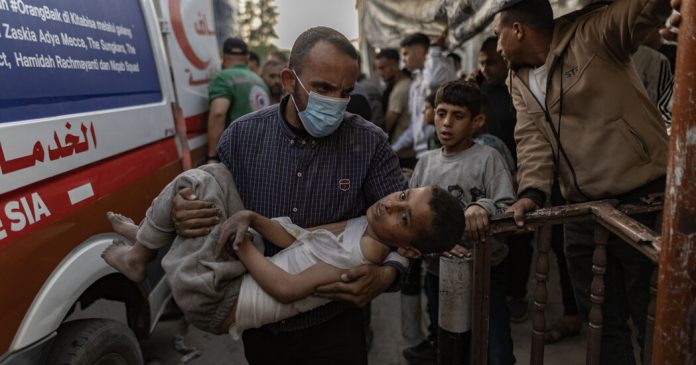
Multiple videos verified by The New York Times show an explosion and its chaotic aftermath at the Dar al-Arqam school in the Tuffah neighborhood of Gaza City, where civilians were sheltering. In the videos, people can be seen carrying victims, including children, to ambulances as fires burn in the background.

A video filmed by Anas al-Sharif, a reporter for Al Jazeera, shows more than a dozen wounded children at the Ahli Arab hospital, including some covered in dust.

Israel has accused Hamas of embedding its forces in civilian spaces, including schools and hospitals.

Mohammed al-Najjar, 32, had been sheltering at the school when a series of airstrikes pounded into the building, he said.

“We were surprised when the school was bombed,” he said in a voice message, adding that a second round of airstrikes was carried out later.

On Wednesday, Avichay Adraee, an Arabic-language spokesman for the Israeli military, called on residents of the Tuffah neighborhood to evacuate the area.

While many people have complied with such evacuation orders from the military during the most recent Israeli campaign, others have chosen to stay in their homes or shelters, saying they can’t bear being displaced — many of them have already been uprooted several times during the war — or that they have nowhere else to go.

A two-month-old cease-fire between Israel and Hamas collapsed in mid-March after the two sides failed to reach an agreement to extend it. The Israeli military has since embarked on a major bombing campaign throughout Gaza that Israeli officials have said was meant to compel Hamas to release more hostages.

More than 1,000 people in Gaza have been killed since the collapse of the cease-fire on Mar. 18, according to the Gaza health ministry.

Javier Milei, Trump’s ‘Favorite President,’ Has Few Deals to Offer — but Lots of Adoration

0

The day after President Trump antagonized world leaders across the globe with his most sweeping set of tariffs yet, he was scheduled to fly to Florida and potentially see the one leader he has called his “favorite president.”

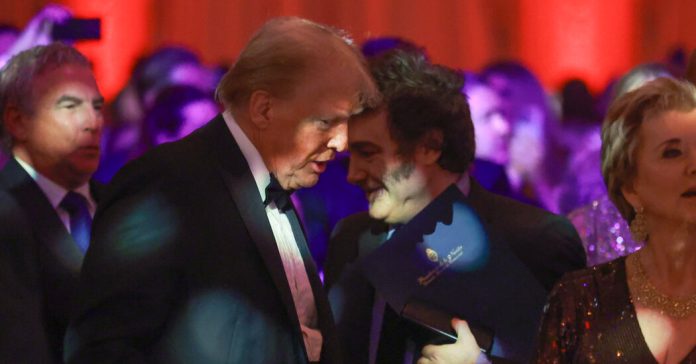
That leader, President Javier Milei of Argentina, had flown overnight to receive an award on Thursday at a right-wing gala at Mar-a-Lago. Mr. Trump was scheduled to also be there late Thursday — Mr. Milei said Mr. Trump would receive an award, too — and Mr. Milei said he hoped the two would meet.

It was Mr. Milei’s 10th trip to the United States in 15 months as president, and nearly every time, he has met Mr. Trump or Elon Musk.

Mr. Trump has posited that he is reshuffling U.S. foreign policy strictly around what is good for the United States.

So what can be puzzling about his elevation of Argentina to the front row of America’s allies — Mr. Milei and Prime Minister Giorgia Meloni of Italy were the only world leaders onstage at Mr. Trump’s inauguration — is that the chronically distressed South American nation is not particularly important as an economic or geopolitical partner.

Instead, through Mr. Milei, Argentina has offered Mr. Trump something else he appears to crave: adoration.

“I love him because he loves Trump,” Mr. Trump said of Mr. Milei in a speech last year. “Anybody that loves me, I like them.”

Mr. Milei has repeatedly and publicly lauded Mr. Trump. He has posted doctored images of them embracing. He has gifted Mr. Musk a custom chain saw. And when Mr. Milei became the first world leader to visit Mr. Trump after the U.S. election, he danced around Mar-a-Lago and told the crowd, “Today the world is a much better place.”

Carlos Kikuchi, a conservative talk radio host in Argentina who helped run Mr. Milei’s campaign, said that, to the Argentine leader, “having such a smooth relationship with Trump and Musk is like touching heaven.”

Mr. Milei has translated his devotion into policy. Weeks after Mr. Trump said he would pull the United States from the World Health Organization, Mr. Milei did the same with Argentina.

After Mr. Trump exited the Paris Climate Agreement, Mr. Milei’s government said it was looking into doing so, too. Mr. Milei fired his first foreign minister because she voted at the United Nations — as Argentina always had — against the U.S. embargo on Cuba.

And after Mr. Trump began criticizing Ukraine — a nation Mr. Milei had steadfastly supported for years — Argentina abstained from a U.N. vote to condemn Russia for its invasion.

Mr. Milei has also become one of the loudest voices in the culture wars, going on a global speaking tour of sorts to attack leftists, feminists and transgender people, and to laud Mr. Trump as the champion who will, in Mr. Milei’s telling, save the West from “woke ideology.”

“Every time we meet with President Trump, he always says, ‘I like this guy,’” Gerardo Werthein, Argentina’s new foreign minister, said this week. “He always says, ‘He is MAGA like me: Make Argentina Great Again.’”

Mr. Trump has praised Mr. Milei’s work in stabilizing Argentina’s economy. Indeed, Mr. Milei has succeeded in lowering inflation, increasing growth and balancing the budget.

Yet, for the United States, Argentina remains an awkward fit as a strategic partner. The nation of 46 million is geographically separated from much of the world and has been stuck for decades in cycles of economic crisis.

The two countries also sell many of the same things: corn, wheat, soybeans, meat, oil. Trade between them fell 8.6 percent to $16.3 billion last year. Argentina ranks 36th globally in buying American exports, according to the Observatory of Economic Complexity, a research group.

On Wednesday, Argentina, was still hit with the 10 percent minimum levy applied to nearly every country.

But Mr. Milei, who describes himself as a radical libertarian, found a bright side. “Friends will be friends,” he wrote on social media, linking to the Queen song and then sharing posts arguing that Argentina had gained an advantage over countries hit with higher tariffs.

Arguably the biggest potential prize for the United States is Argentina’s large stockpiles of strategic minerals, including lithium, a necessary component of renewable batteries. American and Chinese companies are major players in Argentina’s expanding lithium mines, and Tesla — run by Mr. Musk — buys Argentine lithium for its electric-car batteries.

U.S. diplomats have urged the Milei administration to move away from China, including by restricting China’s access to lithium and rare-earth elements, according to a former senior Milei administration official and senior U.S. diplomat who spoke anonymously to discuss private talks.

Yet Argentina’s trade with China has increased under Mr. Milei, and China remains a larger trading partner than the United States, buying soybeans, silver and beef.

So far, then, it may be Mr. Milei who has gained the most from the new friendship.

Argentina is seeking a $20 billion loan from the International Monetary Fund and, as the fund’s biggest stakeholder, Washington holds the key vote. Argentine officials have said they expect to have Mr. Trump’s support.

Lucía Cholakian Herrera contributed reporting.