Thursday, November 12, 2026
Home Blog Page 56

Protesters Amass in Seoul Ahead of Court Ruling on South Korea’s Yoon

0

The authorities in South Korea were expecting tens of thousands of protesters to descend on central Seoul on Friday as the nation’s Constitutional Court decides the fate of President Yoon Suk Yeol.

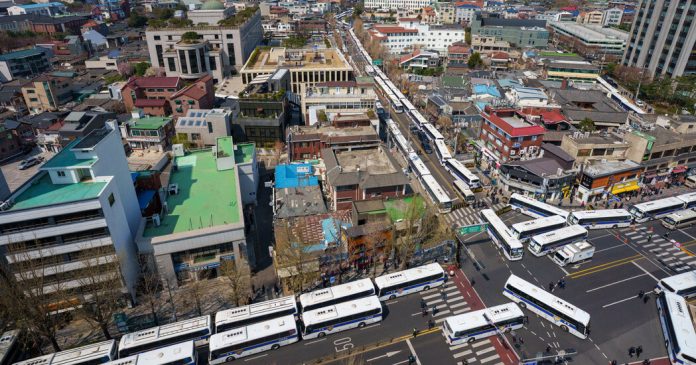
At least 14,000 police had been deployed to the area around the court, closing subway stations and locking down an area near a former royal palace that is popular with tourists and home to major businesses. Drones have been banned from the area, and schools, vendors and businesses have been ordered to close.

The first protests were set to start at 10 a.m. local time, ahead of a possible decision by the court that could come as early as 11 a.m. Mr. Yoon was not expected to attend the reading of the decision, which will determine whether he will be formally removed from office or returned to power.

Millions of South Koreans have protested, mostly peacefully, since Mr. Yoon briefly declared martial law on Dec. 3, plunging the nation into political upheaval and prompting lawmakers to impeach him. Mr. Yoon was detained in January on insurrection charges but released unexpectedly last month after a Seoul court said his detention was procedurally flawed.

Ahead of the Constitutional Court’s decision, which cannot be appealed, there have been growing worries that Mr. Yoon’s supporters will clash with those demanding he be removed from office. After his arrest in January, some of Mr. Yoon’s supporters overran a local court, breaking windows and threatening the judge hearing his case.

The police have created a fortresslike environment outside the Constitutional Court, placing 15-foot-tall metal barriers on either side of the main avenue approaching the complex in an effort to keep the two camps from confronting each other. Between the added security gates, police have parked dozens of buses and put up smaller metal fences to deter people from occupying the area.

The police response is not without precedent. In 2017, thousands of people tried to cross the police barricade near the court after it ruled that the president, Park Geun-hye, should be removed from office. At least four people died during the protests.

On the eve of the Constitutional Court’s ruling this time, South Korea’s interim leader, Han Duck-soo, called on the nation to respect the decision “with calm.”

“The government will not tolerate any illegal or violent acts,” he said on Wednesday, urging politicians not to incite violence. “This is a time to put the stability and fate of our community ahead of political interests.”

Consider This from NPR : NPR

0

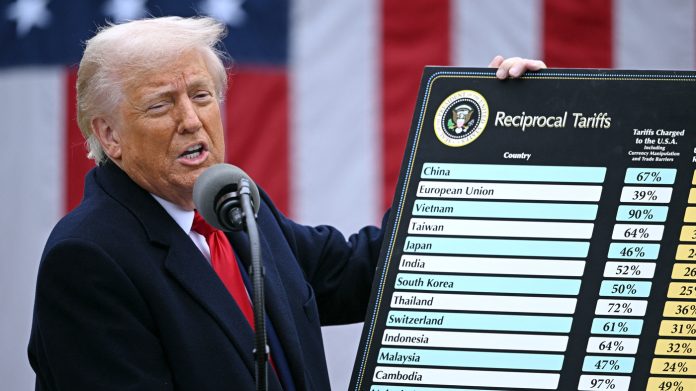
US President Donald Trump holds a chart as he delivers remarks on reciprocal tariffs during an event in the Rose Garden entitled “Make America Wealthy Again” at the White House on Wednesday.

BRENDAN SMIALOWSKI/AFP via Getty Images


hide caption

toggle caption

BRENDAN SMIALOWSKI/AFP via Getty Images


US President Donald Trump holds a chart as he delivers remarks on reciprocal tariffs during an event in the Rose Garden entitled “Make America Wealthy Again” at the White House on Wednesday.

BRENDAN SMIALOWSKI/AFP via Getty Images

Whatever you think of President Trump’s tariffs, there’s one point you have to concede: his interest in them is not a passing whim.

He noted that on Wednesday, in the Rose Garden, when he was announcing the latest, massive round of tariffs. “I’ve been talking about this for 40 years,” he said.

The use of tariffs are a core belief for Donald Trump. Trade deficits are bad, other countries take advantage of the U.S. and tariffs are the way to fix this.

Since the Rose Garden announcement, markets have plunged, other countries have promised to retaliate, and members of his own party have spoken out against the tariffs.

Trump’s tariff plan is designed to eliminate U.S. trade deficits. Are trade deficits actually bad?

For sponsor-free episodes of Consider This, sign up for Consider This+ via Apple Podcasts or at plus.npr.org.

Email us at [email protected].

This episode was produced by Connor Donevan.

It was edited by Courtney Dorning.

Our executive producer is Sami Yenigun.

Workers at Wilson Center Put on Leave as Trump Seeks Shutdown

0

Almost all the employees of the Wilson Center, a prominent nonpartisan foreign policy think tank in Washington, were placed on leave on Thursday and blocked from their work email accounts as Elon Musk’s task force quickly shut down most of the center.

About 130 employees received orders telling them not to return to the office after the end of the day, according to an email reviewed by The New York Times and people with direct knowledge of the actions.

The employees are to be paid while on leave but will be fired soon, in line with what has happened at other institutions that Mr. Musk’s workers have dismantled in recent weeks.

Only five employees will remain — a president, two federal employees and two researchers on fellowships. Those positions are mandated in the center’s congressional charter. The cuts align with an executive order President Trump signed in March.

Private donations to the center will be returned to the donors, according to a person familiar with the center who spoke on the condition of anonymity to avoid retribution. It was not clear what would be done with the center’s endowment.

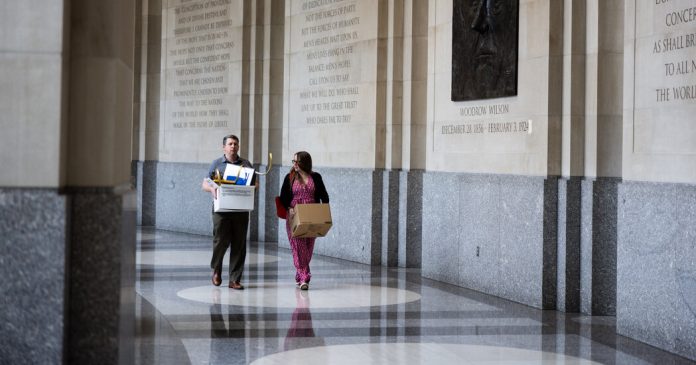
On Thursday afternoon, dozens of employees carried boxes and bags filled with papers, plants and posters out of the center’s offices in the Ronald Reagan Building, which houses several government agency offices.

Tears glistened on the face of one woman as she departed. Workers wheeled out carts full of documents.

It was not clear on Thursday how the offices will be used, but the center’s charter requires the space to be part of the Woodrow Wilson Memorial.

On Monday, four members of the Musk team entered the center’s offices and began taking over its systems. The next day, the center’s president, Mark Green, resigned.

The Trump White House fired the center’s board members in recent weeks, one person briefed on the events said. Mr. Green, a former Republican congressman and ambassador, was told this week he would be fired if he did not resign, another person said. The White House declined to comment.

Mr. Musk’s government-overhauling workers have gutted several other institutions in Washington, including at the United States Agency for International Development.

They have shut down centers that receive federal funding but that have done independent research for decades with the goal of giving nonideological expert assessments to policymakers, lawmakers and people outside government.

The Wilson Center, created in 1968 as a working memorial to honor the 28th president, Woodrow Wilson, receives about 30 percent of its funding from Congress; the rest comes from private donations.

The center has been run by former Democratic and Republican officials appointed by the board. Before Mr. Green, who led U.S.A.I.D. in the first Trump administration, became president and chief executive of the center in 2021, Jane Harman, a former Democratic congresswoman from California, ran the think tank.

The center has been a gathering place for scholars in all areas of foreign policy over the decades. It houses the personal library of George F. Kennan, the diplomat and policymaker who studied the Soviet Union. On Thursday, the director of the Wilson Center’s Kennan Institute, Michael Kimmage, posted photos of the library online and compared it to the library of ancient Alexandria, which “fell victim to political vicissitudes and war,” he wrote.

One question is what will happen to those materials and extensive digital archives that the Wilson Center has compiled. Researchers from around the world have used the archives for projects, and scholars especially value the center’s records of documents from the Cold War era.

A person familiar with the center said that it also housed historical records from Wilson’s campaign and presidency.

The center’s more than 50 fellows were expected to be paid until the end of their program, but those who are foreign citizens expect to have their visas canceled. Two of the fellows are at the center through a program for scholars whose work endangers them in their home countries, according to a person familiar with the center.

Each class of fellows is usually made up of academic researchers and one or more journalists working on book projects. Reporters from The New York Times have received fellowships.

A Trump administration official said that Natasha Jacome, a senior adviser to Mr. Green, was the center’s new president.

19 states sue over Trump’s voting executive order : NPR

0

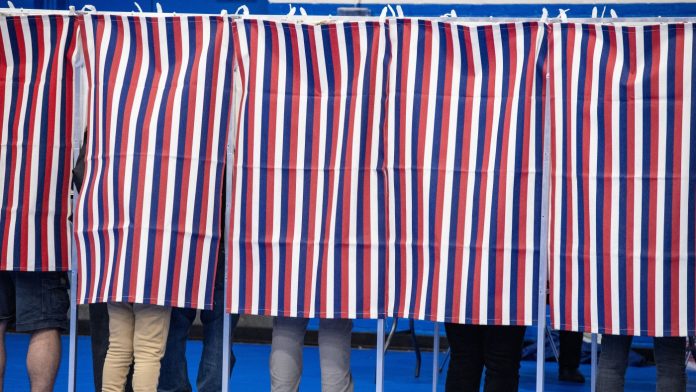
People fill out their ballots in voting booths at the Green Street Community Center in Concord, N.H., on Nov. 5, 2024.

Joseph Prezioso/AFP via Getty Images


hide caption

toggle caption

Joseph Prezioso/AFP via Getty Images

Nineteen states are suing over President Donald Trump’s sweeping executive order on voting that he signed last week, saying it is “an unconstitutional attempt to seize control of elections” that will create barriers to voting that could disenfranchise millions.

The lawsuit, which is the fourth legal challenge so far against the executive order, calls on a federal district court in Massachusetts to block several provisions of the executive order, which the attorneys general argue “usurps the States’ constitutional power and seeks to amend election law by fiat.”

The lawsuit is filed by Democratic attorneys general from Arizona, California, Connecticut, Colorado, Delaware, Hawaii, Illinois, Maryland, Maine, Massachusetts, Michigan, Minnesota, Nevada, New Mexico, New Jersey, New York, Rhode Island, Vermont, and Wisconsin.

“We are a democracy — not a monarchy — and this Executive Order is an authoritarian power grab,” said New York Attorney General Letitia James in a statement. “With this Order, this President is prioritizing his own quest for unchecked power above the rights and will of the public.”

Trump’s March 25 order seeks to make dramatic changes to voting and election administration and threatens that if states do not comply they could lose federal funds and face potential action from the U.S. attorney general.

Among the changes, the executive order directs the Election Assistance Commission – an independent, bipartisan body — to rewrite the federal voter registration form to include a requirement that Americans must show a copy of a proof of citizenship document to register to vote in federal races. It also aims to prevent states from counting mailed ballots that are postmarked by Election Day but arrive after the election, which 18 states currently allow.

The lawsuit argues that these changes cannot be ordered by a president, since it is up to states and Congress to decide how elections should be run. It also argues the president cannot direct the Election Assistance Commission to take actions since it is an independent body, and that adding a proof of citizenship requirement on the federal registration form conflicts with existing federal law.

The suit says the executive order “sows confusion and sets the stage for chaos” since states will have to divert staff and resources toward implementing new training, testing, voter education and coordination “at breakneck pace” to comply with the order – or risk losing needed funds if they don’t comply.

Three other federal lawsuits have already been filed this week against the executive order. All are assigned to U.S. District Court Judge Colleen Kollar-Kotelly in Washington, D.C. who ordered Thursday that the three suits will be consolidated and will proceed together.

Two of those lawsuits were brought by voting rights groups on behalf of organizations that assist voters with registration. The other was brought by Democratic election attorney Marc Elias’ law firm on behalf of Democrats.

Trump has said his executive order is necessary to stop fraud and “straighten out our elections.”

False claims about election fraud have become part of Trump’s brand, the most notable example being his denial of his 2020 election loss.

In the leadup to the 2024 election, Trump promoted the bogus theory that Democrats would attempt to steal the election by helping noncitizens vote in large numbers. There is no evidence of such a plot.

In fact, past audits have shown that cases of noncitizens voting are rare. Under current federal law, voters must attest, under penalty of perjury, that they are U.S. citizens when they register to vote, and some states take additional steps to verify citizenship. Those who try to vote illegally can face prison time and deportation.

Still, in response to the lawsuit filed by Democrats challenging the executive order, U.S. Senator Mike Lee, R-Utah, posted to X, “Why are top Democrats suing to allow non-citizens to vote in American elections? You know why.” Billionaire Elon Musk, who owns X and is a top adviser to Trump, shared Lee’s post with one word, “Fraud.”

The lawsuits challenging the executive order argue that requiring voters to show a copy of a proof of citizenship document to register to vote would create an unlawful burden on voters, and conflicts with the 1993 federal law, the National Voter Registration Act, that spells out registration requirements.

More than 21 million American adults do not have a proof of citizenship document like a birth certificate or passport, or do not have easy access to one, according to a survey commissioned by voting rights advocates. Furthermore, Trump’s executive order only names a limited number of documents that can be used to prove citizenship: a U.S. passport, military ID cards that state citizenship, or a government-issued photo ID that lists citizenship, though most states do not offer IDs that list citizenship. It remains unclear if birth certificates are a valid way to prove citizenship under the executive order. Only half of Americans have a passport.

Meanwhile, Republican lawmakers are backing federal legislation that will change federal law to require proof of citizenship to register to vote. Republican House leaders said in a statement on Monday that the Safeguard American Voter Eligibility Act, known as the SAVE Act, “cements into law President Trump’s executive action to secure our voter registration process and protect the voices of American voters.”


Friday Briefing: Trump’s Tariffs Rattle the Markets

0

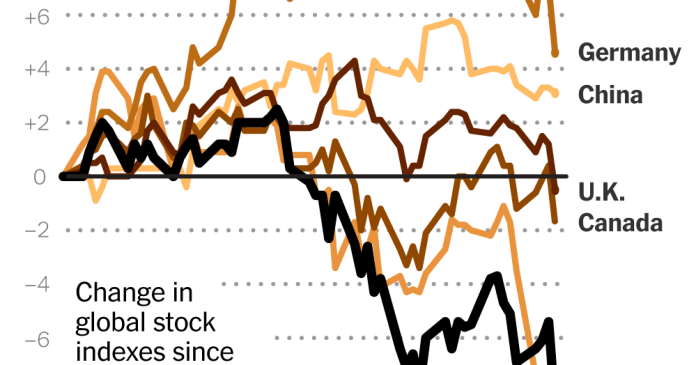
Wall Street tumbled to its worst day since the pandemic yesterday in response to President Trump’s major round of tariffs on U.S. imports, as countries reeling from the blow weighed countermeasures. Stocks in Asia and Europe also fell.

Some European leaders vowed to retaliate after Trump slapped a 20 percent tariff on the E.U. “If you take on one of us, you take on all of us,” Ursula von der Leyen, the European Commission president, said. Here’s the latest.

China, which faces a new 34 percent tariff on top of the blanket import tax imposed earlier this year, vowed to respond to “safeguard its own rights and interests.” Britain said that negotiations with the U.S. would continue.

The S&P 500 fell 4.8 percent, its worst drop since June 2020, at the height of the coronavirus pandemic. The reaction suggested that the scale of the tariffs had come as a surprise. Apple led a tech sell-off, falling about 9 percent.

Credit…Source: FactSet • By The New York Times

Reactions: Prime Minister Mark Carney said that Canada introduced a 25 percent tariff on cars and trucks and called for a new global trading order without the U.S. President Claudia Sheinbaum of Mexico announced plans to increase domestic production of food, energy, textiles and other items in a bid to blunt the impact of tariffs. France’s president, Emmanuel Macron, called on European companies to suspend all investments in the U.S. “until things have been clarified.”

Asia hard hit: The punishing tariffs on Vietnam, Cambodia, Thailand and others in the region threaten their position as manufacturing hubs for the U.S. market and an alternative to China. Trump’s tariffs also hit garment makers in Bangladesh and Sri Lanka hard. See which countries have the highest tariff rates.

Vehicles: New tariffs of 25 percent on all automobiles made outside the U.S. took effect yesterday. Trump said the tariffs would encourage investment in U.S. factories, but analysts said car buyers would end up paying more. Here’s what else to know about the tariffs.


An Israeli airstrike yesterday on a school-turned-shelter in Gaza City killed dozens of people, local health authorities said. The Israeli military said it was looking into reports about the incident and could not immediately provide a comment.

The deadly strike took place as Israel was ramping up its offensive in Gaza. The health ministry of the territory said the bodies of 27 people had arrived at a hospital after the strike, which hit a school in the Tuffah neighborhood of Gaza City, where civilians had been sheltering. Videos verified by The Times showed people carrying victims, including children, to ambulances as fires burned in the background.

Syria: Israel carried out what appeared to be one of its deepest and deadliest raids into the country.


The Constitutional Court will decide today whether to formally remove from office or reinstate President Yoon Suk Yeol, who was impeached in December over his failed attempt to impose martial law.

Removing him would require the votes of six or more of the court’s eight justices; otherwise, he will return to office.

If ​the court dismisses Yoon, the country will quickly shift gears toward a new election. A successor must be chosen within 60 days. If Yoon is reinstated, South Korea’s political crisis could deepen.


The surf scene in Hong Kong — a territory that includes more than 250 islands — is not ideal. Surfers ride waves called slabs, which quickly break on rocks. They coast on them for a few seconds and take what they can get. One surfer said it was all about “turning nothing into something.”

Lives lived: Richard Bernstein, a Times correspondent, critic and author, died at 80.

Fans have long known that Bruce Springsteen withheld songs throughout his career. Now, he is opening his vault.

Springsteen announced yesterday that he would release “Tracks II: The Lost Albums” in June. Of the 83 songs featured on these seven albums, 74 have never been released in any form. Among them are working tapes from Springsteen’s fruitful period before “Born in the U.S.A.” and a hip-hop-influenced album from the early 1990s.

Some federal employees fired under anti-DEI orders weren't doing DEI work

0

Some of the first people fired by the Trump administration are fighting back, including those targeted for work they’d done promoting diversity, equity and inclusion under the Biden administration.

Why Did Trump Impose Tariffs, and What’s Next? Everything to Know.

0

President Trump announced what could be one of the most drastic economic policy changes in decades on Wednesday, when he substituted America’s longstanding system of taxing imports with a new tariff system of his own devising.

The president said the tariffs would reverse decades of what he called unfair treatment by the rest of the world and result in factories and jobs moving back to the United States.

“The markets are going to boom” and “the country is going to boom,” Mr. Trump said on Thursday, as global financial markets suffered their biggest rout in years. He added that other countries “have taken advantage of us for many, many years.”

Economists’ estimates have been far more grim, with most predicting that the president’s sweeping tariffs and likely retaliation will slow U.S. economic growth, push up costs for consumers and make life difficult for businesses that depend on international supply chains.

The president’s measure is both consequential and complicated. Here’s what you need to know.

Mr. Trump announced two big tariff plans that apply to most of the world. One component is a “base line” tariff of 10 percent that will apply broadly to nearly all U.S. imports, except for products coming from Canada and Mexico.

The second measure is what the president is calling a “reciprocal” tariff. That levy will apply to 57 countries that Mr. Trump says have high tariffs and other unfair economic practices that have hurt American exporters. He said this is a reciprocal tariff because it will match the way other countries treat the United States.

But the tariff that Mr. Trump announced is not actually based on other countries’ tariffs or other economic barriers to U.S. trade. The number is calculated based on the U.S. trade deficit, which is a measure of the difference between what the United States sells to a country and what it buys from it.

The reciprocal tariffs range from 1 percent to 40 percent and will be added to the 10 percent base line tariff.

The 10 percent tariffs will go into effect on Saturday, and the reciprocal rates next Wednesday.

The tariffs put a heavy burden on some of America’s biggest trading partners, including China, Japan, Germany, India, South Korea, Taiwan and Vietnam.

Notably, Canada and Mexico were not included. Mr. Trump hit those countries with a 25 percent tariff on many of their exports last month, though he also provided an exception for products that qualify for the trade agreement he signed in 2020, the United States-Mexico-Canada Agreement. The countries are also subject to tariffs Mr. Trump has applied globally on cars, steel and aluminum, and the administration appears to have decided that America’s closest neighbors did not need further tariffs.

But the new tariffs will hit other allies with substantial levies. European goods will face a 20 percent tariff, Japanese goods will face 24 percent and South Korean products 26 percent.

Because of the way the tariff was calculated, Asian countries that send the United States a lot of exports but don’t buy much in return will see some of the highest rates.

Chinese exports face an extra 34 percent tariff. That is on top of a 20 percent tariff Mr. Trump applied in recent months and other levies from his first term. As a result, some products from China will face a tariff of 79 percent.

Vietnam — where many companies moved their factories after Mr. Trump put tariffs on China in his first term — will now face a 46 percent tariff on its exports, while Cambodian exports will be taxed at 49 percent.

The White House also did not apply tariffs to Russia, North Korea, Cuba and Belarus, arguing that these countries are already subject to heavy sanctions. But U.S. imports from Russia were $3 billion last year; small compared to many countries, but far larger than tiny countries like Lesotho and the Falkland Islands, which Mr. Trump chose to hit with substantial tariffs.

The president and his advisers say their goal is to make the tariffs so painful that they force companies to make their products in the United States. They argue that this will create more American jobs and push up wages.

“If you want your tariff rate to be zero,” Mr. Trump said outside the White House on Wednesday, “then you build your product right here in America.”

One of the biggest questions is whether the president sees these tariffs as a negotiating tactic, and would be willing to remove them in return for concessions from other countries.

The administration has given mixed signals on that front. It seems unlikely that the president will remove the 10 percent base line tariff he has issued globally. And if the administration is truly looking for U.S. trade deficits with other countries to be eliminated, that may be difficult, if not impossible.

But in the executive order he signed, the president said that if countries eliminate their unfair trade practices, or the U.S. trade deficit with them drops, the reciprocal tariffs could be rolled back.

Howard Lutnick, the commerce secretary, described other countries’ trade barriers as “the monster that needs to be slayed.”

“Our teams are talking to all the great trading partners today,” Mr. Lutnick said Thursday on Bloomberg Television. “It is time for them to do deep soul-searching on how they treat us poorly and how to make it right.”

Mr. Trump said Wednesday that each nation’s tariff rate would be calculated based on “the combined rate of all their tariffs, non-monetary barriers and other forms of cheating.” But it turned out that their methodology revolved around something more straightforward: the gap between what America exports to a country and what it imports.

The White House put out a complicated-looking formula, but it boiled down to a simple ratio. Countries that send the U.S. more goods than they buy were deemed to have “unbalanced” trade and will face higher tariffs.

This formula doesn’t account for any comparative advantage, or the idea that countries trade goods because some are better at making some products than others, and that countries can trade to maximize their benefits. Instead, the administration’s point of view appears to be that any trade deficit is bad, and tariffs will be applied until it is eliminated.

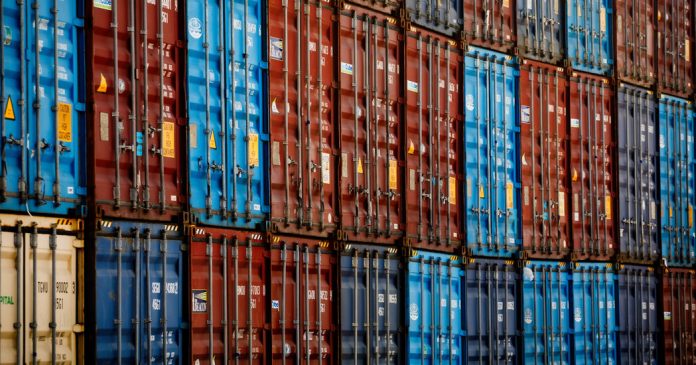
As they go into effect over the next week, the tariffs will immediately increase the cost for importers bringing goods into the country. Typically, those importers are U.S. companies.

For example, if Walmart brings in a $10 shoe from Vietnam — which faces a 46 percent tariff — Walmart will owe $4.60 in additional tariffs to the U.S. government.

It’s less clear what happens next. Walmart could try to force the cost onto the Vietnamese shoe manufacturer, by telling it Walmart will pay less for the product. Walmart could cut into its own profit margins and absorb the cost of the tariff. Or, it could raise the price it sells shoes for at its stores, to make up the cost.

Economists found that, when Mr. Trump put tariffs on China in his first term, most of that cost was passed on to consumers. But economic studies found that the tariffs on steel were a bit different; only about half of those costs were passed on to customers.

Estimates vary, but given the scale of Mr. Trump’s new tariffs, American households could see thousands of dollars of additional costs annually. An estimate released by the Yale Budget Lab, a research group, found that American households on average would pay an additional $2,100 because of the April 2 announcement, with poorer households paying a larger share of their income.

The particularly high tariffs that the Trump administration applied to many Asian countries means that the price of many consumer items will likely increase, including shoes, clothing and electronics.

The government will earn a lot more revenue from tariffs that the Trump administration has promised to channel into tax cuts. The value of tariffs for all the goods imported by the United States last year was $78 billion. With the new tariffs announced on Wednesday, the figure would skyrocket to more than $1 trillion, according to an analysis by Trade Partnership Worldwide, a research firm based in Washington.

The tariff announcement triggered a global meltdown in stock markets, indicating that investors see it as significantly harmful for listed companies.

It is not yet clear whether, or how, other countries will retaliate. But if they impose their own tariffs on U.S. products, that will likely hurt U.S. exporters and could spark escalating trade wars.

Many analysts quickly downgraded their forecasts for economic growth, saying that tariffs would push up prices for consumers and costs for businesses, slowing demand and economic activity.

Nancy Lazar, chief global economist at Piper Sandler, estimated the U.S. economy might contract 1 percent in the second quarter. She had previously expected a flat quarter. “It’s an immediate hit to the economy,” she said.

Economists at Fitch Ratings said in a note Thursday that the tariffs had significantly raised the risk for a recession in the United States. It said that tariffs would result in higher consumer prices that would squeeze real wages and weigh on consumer spending.

The tariffs would also lead to lower corporate profits, which, along with policy uncertainty, would drag on business investment in the United States. Altogether, the effect would “likely outweigh the benefits U.S. companies might gain from increased protection against foreign competition,” Fitch economists said.

Lazaro Gamio and Colby Smith contributed reporting.

HHS ordered to cut 35% of spending on contracts : Shots

0

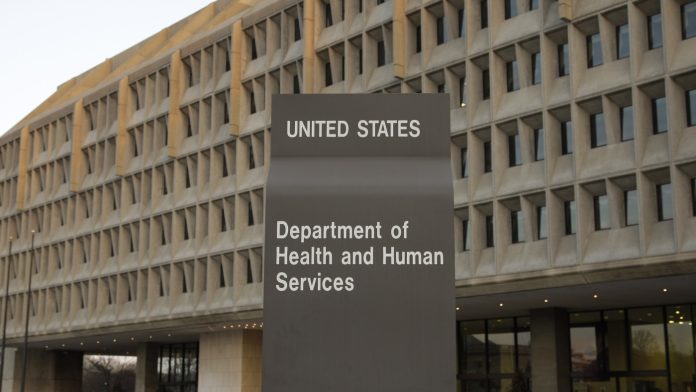
The Department of Health and Human Services is facing spending as well as staffing cuts.

Alex Brandon/AP


hide caption

toggle caption

Alex Brandon/AP

The Trump administration is requiring the Department of Health and Human Services to cut spending on contracts by 35%, HHS spokesperson Andrew Nixon confirmed to NPR.

The spending cut is across all divisions of HHS – which includes the Centers for Disease Control and Prevention, the National Institutes of Health, the Food and Drug Administration, the Centers for Medicare and Medicaid Services and other agencies.

This comes on the heels of a nearly 25% staff reduction at HHS.

“The 35% reduction in HHS contracts is a strategic initiative across all divisions of HHS, with the goal of cutting unnecessary spending, saving taxpayer dollars, and streamlining operations,” Nixon wrote in a statement.

“Every agency within HHS is committed to reducing contract expenditures by this target. These cuts are designed to ensure that every dollar is used more efficiently while continuing to focus on our core mission of improving public health and services,” he added.

Spending on contracts can include a wide range of functions, including some that are specialized or not large enough to require full-time staff, said Dr. Robert Steinbrook, health research group director at the consumer rights advocacy group Public Citizen. This could include mundane things like cleaning services or computer support, or specialized equipment for medical research such as freezer storage for bio-specimens or work with outside laboratories for tests.

With health agencies reeling from layoffs, these spending cuts will further weaken public health in this country, said Steinbrook, via e-mail. He called the cut “arbitrary and senseless.”

“Amid the disorganized mass layoffs of HHS staff and the reorganization of the agency, the rushed cuts are more likely to cause problems than to accomplish anything constructive,” he added.

“This is at best getting water from a stone,” said Dr. Georges Benjamin, executive director of the American Public Health Association, via e-mail. “They seem to be on a quest to totally destroy the infrastructure of the nation’s public health system. It’s amazing that they are looking to cut the parts of our health system that give the best value for prevention and wellness.”

HHS fired thousands of staffers this week, acting on its plan to dismiss 10,000 people, on top of around 10,000 people already leaving the agencies under the Trump administration’s Fork in the Road offer and early retirement.

Have information you want to share about the layoffs and restructuring across federal health agencies? Reach out to these authors via encrypted communications: Selena Simmons-Duffin @selena.02, Sydney Lupkin @sydneylupkin.36, and Rob Stein @robstein.22.

Two Top Organizers of Canada’s Freedom Convoy Found Guilty of Mischief

0

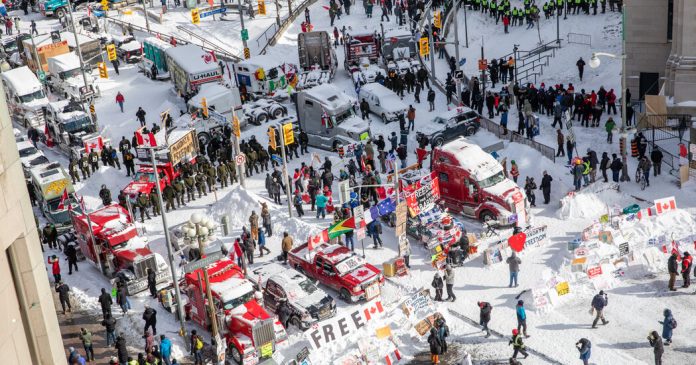
Two main architects of protests that gridlocked Canada’s capital for weeks were found guilty on Thursday in one of the last legal cases stemming from the demonstrations that convulsed the country and disrupted billions of dollars in trade with the United States.

A judge convicted the protest’s top organizers, Tamara Lich and Chris Barber, in an Ottawa courthouse not far from Parliament Hill, the site of a four-week blockade in 2022 that saw demonstrators park long-haul trucks on major streets to protest pandemic-era mandates.

Ms. Lich and Mr. Barber were found guilty of mischief, according to The Canadian Press, a national newswire agency, an offense involving damaging public property or disrupting people from using public property and carries a maximum 10-year prison penalty. Ms. Lich and Mr. Barber will be sentenced at another hearing.

The two were acquitted of other charges, including obstructing justice, intimidating the public and counseling others to commit offenses, according to the Justice Center for Constitutional Freedoms, a nonprofit that has helped in Mr. Barber’s defense.

The group has criticized the length of the proceedings against the two defendants.

“If Tamara Lich and Chris Barber had played a leadership role in organizing protests against racism, transphobia or climate change, they would not have faced 45 days of trial over a period of 31 months,” John Carpay, the center’s president, said in a statement.

The protests were known in Canada as the “Freedom Convoy” and attracted a groundswell of support, particularly from the Western province of Alberta.

It began as a grass-roots movement by truckers who faced vaccination requirements to cross the U.S. border. Mr. Barber owns a trucking company in Swift Current, Saskatchewan, while Ms. Lich describes herself as a political activist from Medicine Hat, Alberta, who helped raise funds to support the effort.

“I love Canada, and no matter the outcome today, that will never change,” Ms. Lich said in a post on X on Thursday morning before the verdict.

Former Prime Minister Justin Trudeau invoked a rare emergency order that allowed the authorities to take stronger measures against the protesters, including freezing their bank accounts and deploying immense police resources in Ottawa.

Pat King, another key organizer, was convicted of mischief last year and was ultimately sentenced to three months of house arrest.

Similar blockades formed at border crossings in cities like Windsor, Ontario, across from Detroit, preventing trucks from carrying commerce across the bridges that link the two cities.

At another obstructed border crossing in Coutts, Alberta, the police found a cache of weapons and two men were later sentenced to six years in prison for firearm possession and other charges.

Trump administration warns K-12 schools over DEI : NPR

0

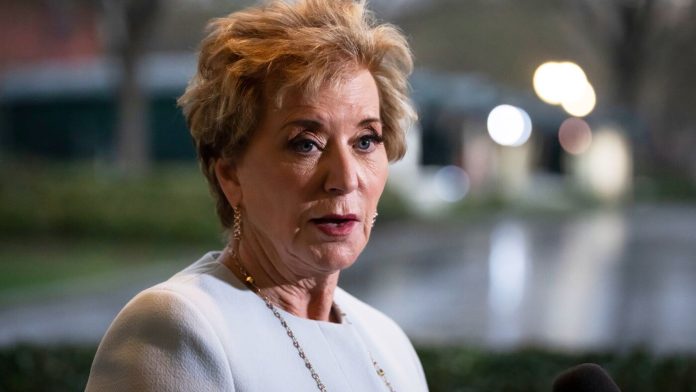
Secretary of Education Linda McMahon speaks to reporters at the White House. The Education Department sent a letter to state leaders warning of the potential loss of funds for K-12 schools that don’t follow its interpretation of civil rights laws.

Ben Curtis/AP


hide caption

toggle caption

Ben Curtis/AP

The Trump administration has threatened to withhold federal funds from public schools that have diversity, equity and inclusion programs.

In a letter to state leaders across the country, the U.S. Education Department said Title I funding, which is targeted to schools with a high proportion of low income students, would be threatened if schools failed to follow its interpretation of civil rights laws.

Any violation of civil rights law, it says, “including the use of Diversity, Equity, & Inclusion (‘DEI’) programs to advantage one’s race over another—is impermissible.”

School and state officials are required to sign a certification letter attached to the memo and return it to the department within 10 days, proving that they are complying with the directive.

This is the latest in a series of letters the department has issued to state and local school leaders: one focused on student privacy, another abruptly ending COVID relief funding promised to schools, and another issuing guidance on how to use federal funds to support parent choice in public education.

While Secretary of Education Linda McMahon has not clearly defined what the administration considers a violation of civil rights law, the agency issued a letter in February that notified educational institutions that they must “cease using race preferences and stereotypes as a factor in their admissions, hiring, promotion, scholarship.”

In a related document addressing frequently asked questions about how the administration would interpret Title VI of the Civil Rights Act of 1964, the agency said: “Many schools have advanced discriminatory policies and practices under the banner of ‘DEI’ initiatives.” The document went on to say that schools could engage in historical observances like Black History Month “so long as they do not engage in racial exclusion or discrimination.”

While the federal government is only responsible for about 10% of money that goes to schools, Title I is one of the largest federal grants overseen by the Education Department: In the current fiscal year, the federal government set aside more than $18.38 billion for Title I. Nearly 90% of U.S. school districts benefit from the program.

“Federal financial assistance is a privilege, not a right,” Craig Trainor, the department’s acting assistant secretary for civil rights, said in a statement. “When state education commissioners accept federal funds, they agree to abide by federal antidiscrimination requirements. Unfortunately, we have seen too many schools flout or outright violate these obligations, including by using DEI programs to discriminate against one group of Americans to favor another based on identity characteristics.”

Many educators worry that the removal of this money could have significant impacts, especially to rural and low income communities that rely heavily on federal funding.

The American Federation of Teachers, with 1.8 million members the nation’s second largest teachers union, is part of a lawsuit aimed at blocking the department’s recent civil rights guidelines.

“In the middle of a school year, the president is trying to bully the very same school districts that he insisted, just a few weeks ago, should be in charge of education,” the AFT’s president, Randi Weingarten said in a statement. “He’s wielding a cudgel of billions in federal aid to tens of millions of children, of all races and ethnicities, to force educators to kowtow to his politics and ideology.”

In the rural Lucerne Valley Unified School District in the high desert of California, Superintendent Peter Livingston says he’s still digesting the latest civil rights guidelines. He says about 90% of his district’s students are considered economically disadvantaged, and all of its schools rely on Title I.

“If the money were to be threatened, that would have a huge impact,” he says.

But he also favors the efforts to reduce the role of the Education Department in local schools, especially if it means federal dollars could be used more efficiently.

He says his district uses Title I funds to hire staff, to keep class sizes smaller and for academic programs that help “level the playing field” for students regardless of their income.

“If the regulations are in place that we have to follow,” he adds, “that’s what we’d be doing in order to ensure that we had the money to serve our students.”