Thursday, November 12, 2026
Home Blog Page 58

Insulin Test Used to Convict Lucy Letby of Murder Was Unreliable, Experts Say

0

Seven pediatric doctors and toxicology experts said on Thursday that jurors were misled by prosecutors who cited unreliable insulin tests during the trial of Lucy Letby, a nurse convicted of murdering seven babies at a British hospital.

The doctors made their assertions in a new report that Ms. Letby’s lawyer submitted to Britain’s Criminal Cases Review Commission, which is responsible for investigating possible miscarriages of justice, in the hopes of being allowed to pursue a full appeal of her 15 life sentences.

Ms. Letby, who worked as a nurse in a neonatal unit at a hospital in northern England, was found guilty in 2023 of deliberately harming — and in seven cases, murdering — babies by injecting them with air, overfeeding them with milk, infusing air into their gastrointestinal tracts or poisoning them with insulin.

In the new report, the experts, who include a forensic toxicologist, a professor of forensic science and an endocrinologist who has written multiple peer-reviewed papers on medical test errors, attacked the validity of the evidence of insulin poisoning used by the prosecution at trial.

“Our inescapable conclusion is that this evidence significantly undermines the validity of the assertions made about the insulin and C-peptide testing presented in Court,” they wrote in a summary of the report provided to reporters by her legal team.

Ms. Letby has always maintained her innocence. Since her two trials, serious questions have been raised about her guilt, including in a 13,000-word New Yorker article last May. But efforts by her lawyers to reopen the case with a full appeal have been repeatedly denied.

The new report focuses on two babies — known as babies F and L — whose blood sugar levels dropped to low levels, but who later recovered. Ms. Letby was convicted of trying to murder the two babies by adding insulin to their food, causing a condition called hypoglycemia.

Tests suggested that the babies had high levels of insulin but only a negligible amount of C-peptide, a substance detected when insulin is produced by the body. The prosecution argued the insulin must therefore have been administered externally.

In the new report, the experts present what they describe as “convincing new evidence from multiple sources” showing serious problems with the test results used to demonstrate that Ms. Letby poisoned two of the babies with insulin.

They said the test, called “the Roche immunoassay,” was known to result in “falsely high insulin results.” They also argued that there were other ways for infants to receive insulin, including through the placenta while they are in their mother’s womb.

The experts said that when evidence was presented to jurors about the levels of insulin found in the small infants, the prosecution referred to the wrong data.

“Studies in adults and older children were quoted which are not relevant, and the limited appropriate information was not referred to,” they wrote.

They said the testing “did not meet acceptable forensic standards” and that the results of the Roche test, in particular, should not have been relied on without being confirmed by more precise laboratory tests.

The Royal Liverpool Hospital laboratory where the tests were conducted explicitly warns in its online guidance that they are “not suitable” for investigating low blood sugar created by an insulin injection. “If exogenous insulin administration is suspected as the cause of hypoglycemia, please inform the laboratory so that the sample can be referred externally for analysis,” it says. But both babies recovered, so their samples were never referred anywhere else.

The experts said that prosecutors and the police had not considered other ways that the babies became hypoglycemic besides foul play.

“There are alternative medical explanations which explain the hypoglycemia in both babies, such as line failure, sepsis and perinatal stress-induced hyperinsulinism,” they wrote. “These alternative possibilities were not considered.”

Questions about the accusations of insulin poisoning have been raised publicly by doctors in the months since the trial. Thursday’s 86-page report is an effort by Mark McDonald, Ms. Letby’s lawyer, to present those questions to the commission in a formal way.

“The conclusions of the report on Babies F and L clearly demonstrate that the case must go back to the Court of Appeal as a matter of urgency,” Mr. McDonald said in a statement.

He added: “Lucy Letby is currently serving 15 whole life terms in prison, when overwhelming independent expert evidence indicates that no babies were murdered.”

In a statement to a public inquiry last month, lawyers representing some of the families of babies who died or were harmed at the Countess of Chester Hospital said: “The families have no doubts about Letby’s guilt.”

Mr. McDonald also submitted to the Criminal Cases Review Commission a full 698-page examination of Ms. Letby’s case by a separate panel of experts, led by the renowned Canadian neonatologist Dr. Shoo Lee, who previewed their findings in February. That report concluded that “there was no medical evidence to support malfeasance causing death or injury in any of the 17 cases in the trial.”

As Elon Musk's popularity declines, what is his likely future in GOP politics?

0

Recent polls show public opinion of Elon Musk is declining. Jonathan Martin, senior political columnist at Politico, discusses Musk’s possible future in Republican politics.

Britain Tried Everything, Including a Royal Invite. It Got a 10% Tariff.

0

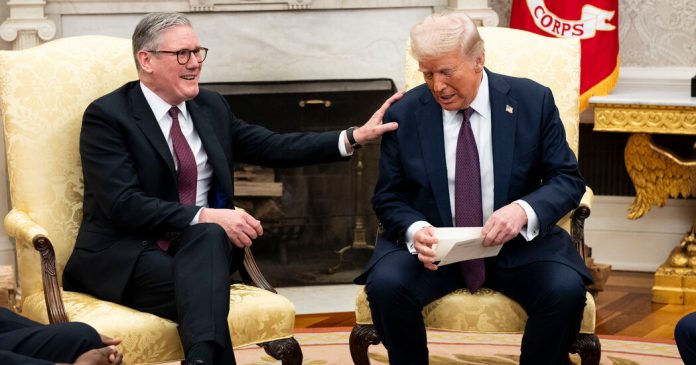
After all that — the chummy Oval Office meeting, the extraordinary royal invitation, the paeans to the “special relationship” — Britain and its solicitous prime minister, Keir Starmer, still got swept into President Trump’s tariffs, along with the European Union and other major American trading partners.

Mr. Trump imposed his basic tariff of 10 percent on Britain, while hitting the European Union with 20 percent. That drew sighs of relief from Mr. Starmer’s aides, who said the difference would protect thousands of British jobs. They claimed vindication for Mr. Starmer’s charm offensive toward the American president; others said it was a dividend of Britain’s decision to leave the European Union in 2016.

Yet in another sense, it was a Pyrrhic victory: Britain was subject to the same blanket tariff as dozens of countries, even though the United States runs a trade surplus with Britain, according to U.S. statistics.

Britain clearly hopes to strike some kind of trade deal with Mr. Trump down the road, which could spare it the tariffs’ lasting effect. On Thursday, Mr. Starmer told business executives that the British would react with “cool and calm heads.”

The question is whether he will stick to his strategy — resisting pressure to impose retaliatory tariffs, for example — or fall into line with other countries, like Canada, in striking back against the United States. Downing Street said it would not impose tit-for-tat measures while trade talks were underway.

“His strategy up till now has been perfectly understandable,” said Jonathan Portes, a professor of economics and public policy at King’s College London. “If I were him, I would have done the same. Now he needs to avoid confrontation for the sake of it, but there’s no point in appeasement either.”

Professor Portes said targeted retaliatory moves might make sense as a negotiating tactic. But an across-the-board tariff on American goods, he said, would only deepen the damage to Britain’s economy, which was sputtering even before Mr. Trump announced his measures on Wednesday.

Britain has bargaining chips at its disposal, including reducing an existing 2 percent tax on digital services. Professor Portes said Britain could play hardball in other ways — for example, acting against X, the social media platform owned by Elon Musk, Mr. Trump’s ally. Critics have accused the platform of fomenting hate speech, while Mr. Musk has used X to campaign against Mr. Starmer’s government.

If Mr. Starmer fails to extract anything more from Mr. Trump after all his efforts, it could embarrass him politically. But analysts said the bigger threat was the impact on Britain’s slow-growing economy. The Office for Budget Responsibility, an independent fiscal watchdog, said tit-for-tat 20 percent tariffs could shrink the British economy by 1 percent next year. It had forecast growth of 1.9 percent.

Britain’s finances are already under extreme pressure. The chancellor of the Exchequer, Rachel Reeves, increased taxes on employers and is planning large welfare cuts to cover spending on depleted services and to meet her promise to balance the budget and get debt levels down.

Britain, with its small, open economy, is deeply vulnerable to the effects of a trade war. British officials, led by the ambassador to Washington, Peter Mandelson, have negotiated energetically with the White House to avert these tariffs. They did not retaliate against previous tariffs on steel and aluminum, or on vehicles, which came into effect Thursday.

Jonathan Reynolds, the business and trade minister who has been involved in the talks, said the watchword was “pragmatism.” On Tuesday, he told the BBC that Britain was in the “best possible position of any country” to reverse tariffs.

Britain runs either an $89 billion trade surplus or a $14.5 billion deficit with the United States, depending on whether one cites British or American statistics. (The difference rests in part on how the two sides treat offshore financial centers like Jersey and Guernsey, which are crown dependencies.) Trade in goods, with which Mr. Trump is most fixated, is relatively in balance.

Among the British exporters facing upheaval is the luxury auto industry, as carmakers like Jaguar, Bentley, Rolls-Royce and Aston Martin do not have assembly plants in the United States. More than 40,000 British businesses exported goods to the United States in 2023, according to customs data.

Mr. Starmer faces a delicate calculation in deciding how to respond to Mr. Trump. Given the president’s unpopularity in Britain, analysts said Mr. Starmer and his Labour Party could reap a short-term benefit by retaliating.

“Standing up to Trump might suit what he’s been trying to do, which is make Labour the patriotic party,” said Steven Fielding, an emeritus professor of political history at the University of Nottingham.

It would also distance Labour from Reform U.K., an anti-immigrant party whose leader, Nigel Farage, has close ties to Mr. Trump. And it would allow Mr. Starmer to draw closer to the European Union, which is expected to impose its own countermeasures.

Responding to Mr. Trump “could be a short-term political gain,” Professor Fielding said, but for Mr. Starmer in the longer-term, “any kind of tariff war could damage the economy, which will hurt his prospects for re-election.”

Trump tariffs spark ire and dismay from international leaders : NPR

0

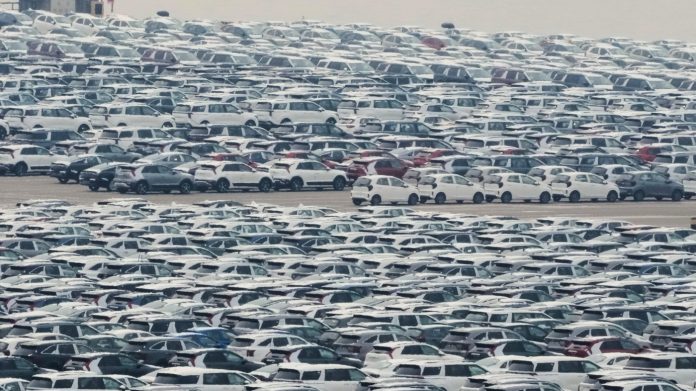
Vehicles for export are parked at a port in Pyeongtaek, South Korea on Wednesday.

Ahn Young-joon/AP


hide caption

toggle caption

Ahn Young-joon/AP

Political leaders from around the world have reacted with shock and – in some cases – apparent anger at President Trump’s announcement of tariffs from between 10% and 54% against products from countries across the globe.

Traditional allies, including the European Union, South Korea and Japan, face tariffs as high as 20%, while China confronts a 34% tariff on top of an existing 20% tax on imports to the U.S. Here is a summary of global reaction to the tariffs Trump outlined Wednesday in the White House Rose Garden.

European Union

Ursula von der Leyen, president of the European Commission, the EU’s executive body, said the tariffs were a “major blow to the world economy.” She said the move will saddle global consumers with higher inflation, medical costs and grocery bills and damage businesses through greater uncertainty, disrupted supply chains and more bureaucracy.

“There seems to be no order in the disorder, no clear path through the complexity and chaos that is being created as all U.S. trading partners are hit,” von der Leyen said in a video statement. She said the EU was in negotiations with the U.S., and that the bloc — with its 450 million consumers — would continue to stand up for a rules-based worldwide trading system. But she also warned that the EU was finalizing a series of countermeasures to impose on American products to protect European interests and businesses “if negotiations fail.”

The European Commission had already planned to announce a list of American products, worth $26 billion, that will be slapped with tariffs starting April 12, to maximize the impact on the U.S. while minimizing consequences for the EU. These are in response to previously implemented U.S. tariffs on European steel and aluminum.

Olaf Scholz, the chancellor of Germany, the largest economy in the EU, said the new tariffs will damage U.S. exports because of “complex supply chain dependencies that send parts back and forth a hundred times.”

Ireland has Europe’s biggest trade surplus with the U.S., and the country’s prime minister, Micheál Martin, said Wednesday night that the 20% tariffs on imports from the EU was “deeply regrettable.”

Italian Prime Minister Giorgia Meloni, the only European leader to attend Trump’s inauguration, called the 20% placed on EU goods “wrong” and said they will “not benefit any of the parties involved.”

Italy’s wine growers union said the tariffs could force many producers out of business.

“This will be difficult for many,” said Lamberto Frescobaldi, president of Unione Italiana Vini in a press release. “But what worries us even more is the risk of an escalating conflict between the American and European administrations.”

United Kingdom

British Prime Minister Keir Starmer said the U.K. will take a “calm and pragmatic approach to the tariffs,” opting not to impose retaliatory measures while continuing to engage in “positive discussions” with the U.S. administration on a future trading agreement. The country was hit with the minimum 10% tax on exports to the U.S.

Starmer met business leaders in Downing Street Thursday morning, and acknowledged that “clearly there will be an economic impact” from the tariffs on the UK, albeit a smaller one than if tariffs had been higher. He said President Trump had “acted for his country, and that is his mandate,” and that he would do the same by redoubling efforts to strike a trade deal with the U.S. He warned that “nothing is off the table” when it comes to potential British retaliation.

“One of the great strengths of this nation is our ability to keep a cool head,” Starmer said.

China and Taiwan

The Trump administration had previously imposed a 20% across-the-board tariff on all Chinese exports to the U.S, hitting Chinese exporters — who have seen orders fall — as well as small American businesses and consumers that must shoulder much of the extra costs.

The Chinese government has already sanctioned several U.S. companies and imposed its own tariffs of between 10 and 15% on a variety of U.S. agricultural imports, including chicken, pork, soy and beef.

Beijing has threatened further retaliatory measures, and said it would work more closely with neighbors Japan and South Korea.

“History shows that increasing tariffs cannot solve the United States’ own problems,” a spokesperson from China’s Ministry of Commerce said in a statement, according to state news agency Xinhua. “There is no winner in a trade war, and protectionism leads nowhere.”

Trump imposed a 32% tariff on imports from Taiwan, though he exempted the high-tech economy’s semiconductor industry. In a statement, President Lai Ching-te said Taiwan’s “national strength” makes it an “indispensable and important member in the global supply chain and in maintaining regional security.”

Trump had earlier threatened tariffs as high as 100% on semiconductor chips made in Taiwan. The country is the world leader in chip manufacturing that provides much of the chips American carmakers and tech companies, including Apple, rely on.

In March, Taiwan’s top chipmaker TSMC announced an additional $100 billion investment to build new chip facilities in Arizona.

South Korea and Japan

Leaders of South Korea and Japan, top U.S. allies in Asia, reacted with alarm to the 25% and 24% tariffs, respectively, imposed on them by the U.S., after failing to lobby the Trump administration for exemptions.

“As the situation is very grave with the approach of the reality of a global tariff war, the government must pour out all of its capabilities at its disposal to overcome this trade crisis,” South Korea’s acting president Han Duck-soo told a meeting of the nation’s economic and security strategy task force.

Japan’s Prime Minister Shigeru Ishiba said the tariffs were “extremely regrettable and against our wishes,” adding that Japan will “strongly demand a review.”

Japan’s top government spokesman questioned whether the tariffs flouted Japan’s trade agreement with the United States, as well as rules promulgated by the World Trade Organization, while the country’s trade minister insisted the measures would make it more difficult for Japanese companies to invest in the U.S.

South Asia

A representative to the southern Indian state of Tamil Nadu, who spoke on condition of anonymity because he wasn’t authorized to speak to the media, said the 26% tariff on Indian goods was “a little bit reassuring.”

“Although there are more high tariffs now, we are glad other countries will suffer more,” he said, in reference to the fact that other Asian nations faced even higher tariffs: Vietnam at 46%, Thailand at 36%, and Indonesia at 32%.

Elsewhere in the region, Bangladesh — and its sizable garment manufacturing sector that sells to U.S. consumers — will face severe challenges, with the imposition of 37% tariffs on an industry that generates the bulk of the country’s export revenues. Meanwhile Pakistan may see its crucial cotton exports struggle under the weight of tariffs of 29%.

Israel

And even Israel, another close ally of the Trump administration, will have to wrangle with a 17% tariff on exports to the U.S. The Israeli government had canceled all of its own tariffs on U.S. imports Tuesday, in an apparent attempt to gain exemptions from the latest round of American tariffs.

The U.S. is Israel’s most significant trading partner. In 2024, the country exported $17.3 billion worth of goods to the U.S.

“The president’s decision to apply tariff policy to Israel could harm Israel’s economic stability, deter foreign investment, and weaken the competitiveness of Israeli companies in the U.S. market,” said Ron Tomer, president of the Manufacturers Association of Israel, in a statement published in Israeli media.

South Africa

The office of South African President Cyril Ramaphosa said the “unilaterally imposed and punitive tariffs are a concern and serve as a barrier to trade and shared prosperity,” but he remained committed to a “mutually beneficial trade relationship with the United States.”

When Trump announced the 30% tariffs on South African goods Wednesday afternoon, he twice stated an allegation that “bad things” are happening in the country, a likely reference to what he falsely claims is the persecution of white farmers.

In February, Trump’s administration cut all financial aid to the country, citing South Africa’s case against Israel at the International Court of Justice. In the same executive order, the U.S. also offered refuge to white Afrikaners, whom Washington has repeatedly said face persecution.

Elsewhere on the continent, some of Africa’s poorest countries were hit by some of the highest U.S. tariffs, including Lesotho at 50%.

Canada

Canada was spared from President Trump’s list of retaliatory tariffs, however the U.S. is still pushing ahead with a 25% tariff on all foreign-made vehicles that could impact Canada’s auto industry which is heavily intertwined with the U.S. auto sector.

Canada’s new Prime Minister Mark Carney said Trump’s global tariffs fundamentally changed the international trading system and that Ottawa would with “purpose and with force.” He added that a course of action would be hammered out after meeting Thursday with Canada’s premiers.

Trump Tariffs Live Updates: Global Powers Warn of Trade War Over New Tariffs

0

Laptop computers from Taiwan, wine from Italy, frozen shrimp from India, Nike sneakers from Vietnam and Irish butter.

These products are found in homes across the United States, a testament to America’s enduring role as a champion of free trade and its standing as the most lucrative market for goods from around the world.

They are now among the vast categories of goods subject to additional taxes after President Trump, on Wednesday, imposed universal tariffs on all U.S. trade partners as well as additional, heavier duties on 60 countries he deemed the “worst offenders” of unfair trade practices.

In a sharp shift away from decades of trade policy, Mr. Trump instituted a 10 percent base line duty on all goods imported into the United States. In addition, other nations will be charged a so-called reciprocal tariff at an even higher rate next week.

For the European Union and China, the two largest U.S. trading partners, the White House imposed tariffs of 20 percent and 34 percent. The additional levy on China will be added to a 20 percent tariff previously imposed by Mr. Trump.

Even close allies such as Japan and South Korea were not spared. Neither were countries like Australia and Brazil that buy more from America than they sell to it.

President Trump announcing tariffs at the White House on Wednesday.Credit…Haiyun Jiang for The New York Times

The announcement, which Mr. Trump had hailed as America’s “Liberation Day,” sent shock waves across the world and raised the specter of a global trade war. Stock markets tumbled on the news, as investors were surprised at the size and scope of the tariffs.

In less than three months, Mr. Trump has pronounced tariffs on Canada, Mexico and China along with import duties on steel, aluminum, cars and car parts. The executive order on Wednesday included exemptions for semiconductors, pharmaceuticals and lumber. But analysts think those are not reprieves; they are products next to be targeted.

Allies and adversaries are scrambling to make sense of Mr. Trump’s tariff barrage, which has lifted U.S. import duties to their highest levels in more than a century and showed no sign of relenting. Some threatened to retaliate. Others openly pressed for negotiations, while some quietly pushed for concessions through back channels.

China accused America of “unilateral bullying,” pledging to take “firm countermeasures to safeguard its own rights and interests.” South Korea convened an emergency task force and vowed to “pour all government resources to overcome a trade crisis.” In Brazil, the government of President Luiz Inácio Lula da Silva said it was evaluating retaliatory measures.

Brazil’s Congress approved legislation on Wednesday to empower the country’s president to retaliate.Credit…Evaristo Sa/Agence France-Presse — Getty Images

In an early morning address on Thursday, Ursula von der Leyen, president of the European Commission, said that the global economy will “massively suffer” from the tariffs. While urging negotiation, she said the bloc is preparing further countermeasures in addition to the retaliatory tariffs it had already prepared for the earlier tax on foreign steel and aluminum.

Asia was particularly hard hit by Mr. Trump’s plan. Vietnam, a beneficiary of companies moving production out of China during the first Trump presidency, got slapped with a 46 percent levy. Taiwan, Thailand and Indonesia were all dealt import duties of more than 30 percent. The White House put a 26 percent tariff on imports from India.

For decades, exports have served as a pathway to economic prosperity for developing Asian countries emerging from conflict, crisis or poverty. The latest tariffs punished countries like Taiwan and Japan that have succeeded in modernizing their economies through trade, and they also darkened the prospects for poorer nations like Cambodia and Bangladesh still looking to follow that route.

Cambodia, a producer of clothing and footwear, was hit with a 49 percent tariff. The United States is the country’s largest export market.

“As a small country, we just want to survive,” said Sok Eysan, a spokesman for Cambodia’s ruling Cambodian People’s Party.

A Chinese-funded textile factory in Cambodia, which faces a 49 percent tariff.Credit…Yang Qiang/China News Service/VCG, via Getty Images

Mr. Trump has blamed the sale of inexpensive goods from these countries for the hollowing out of America’s manufacturing sector. But they have also helped to keep inflation at bay, lowering prices for U.S. consumers.

Sarang Shidore, director of the Global South program at the Quincy Institute for Responsible Statecraft in Washington, D.C., said the tariffs would hit several developing countries hardest, while encouraging much of the world to move more quickly toward an order without the United States at its center.

“When it comes to trade, we are very much in a multipolar world, and alternative markets exist. Though of course there will be pain and transaction costs in diversification,” he said.

Anthony Albanese, the prime minister of Australia, said his country would not respond with retaliatory tariffs, vowing Australia would not “join a race to the bottom that leads to higher prices and slower growth.”

In Japan, officials and trade experts were caught off guard by the size of the new tariff the country will face — 24 percent. It was particularly jarring given Japan’s average tariff on nonagricultural goods is among the lowest globally. Japan called the tariff “extremely regrettable” and vowed to continue seeking an exemption.

Prime Minister Shigeru Ishiba has pledged to increase Japanese investment to roughly $1 trillion, focusing on purchasing more U.S. products like liquefied natural gas.

A distillery in Yamazaki, Japan, for Suntory, whose chief executive said he believes Japan will be able to lower tariffs in negotiations with the Trump administration.Credit…Richard A. Brooks/Agence France-Presse — Getty Images

Speaking before the latest tariffs were announced, Takeshi Niinami, chief executive of Suntory Holdings, a Japanese beverage giant known for premium whiskey brands, said he believed the tariffs could be negotiated down because Japan is the biggest foreign investor in the United States.

“A period of chaos may ensue,” he said. “But ultimately, the situation will stabilize.”

Exiger, a data analytics firm, calculated that Trump’s announcements would result in $600 billion of new U.S. tariffs per year. The bulk of the levy would come from 10 countries, with Chinese exports accounting for a quarter of the additional tariffs at $149 billion. Vietnamese goods would face $63 billion, Taiwanese products $37 billion, and Japanese exports $36 billion in tariffs. German and Irish goods combined would face $41 billion in additional levies.

During the first Trump presidency, tech companies moved some production to Vietnam to protect against a possible trade war with China. One-third of Vietnam’s exports are now electronics.

Apple moved manufacturing of AirPods, watches and iPads over the last several years to Vietnam. It also shifted some iPhone production to India, after years of relying solely on Chinese factories.

South Korean conglomerate Samsung Electronics has invested more than $20 billion in Vietnam since it started opening factories there nearly two decades ago. It now produces more goods in Vietnam than China. Last year, it produced roughly $70 billion worth of goods at its Vietnamese factories, most of it for export.

An electronics factory in Hai Phong, Vietnam.Credit…Linh Pham for The New York Times

Mr. Trump’s policies are also complicating decisions for smaller American businesses. Brenden McMorrow, co-founder of Move2Play, a toymaker based in Torrance, Calif., said the company built all of its products in China since it started about nine years ago. But it began to consider factories in Vietnam or India to protect against Chinese import tariffs.

In Vietnam, it found that the factories run by Chinese companies using materials from China were not much cheaper. Instead, it decided to try a test run of manufacturing one of its toys in India — a decision that Mr. McMorrow said looks better with the lofty tariff imposed on Vietnam. It studied whether it could manufacture in the United States, but he said that the costs were roughly five times higher than in China.

And despite the higher cost of tariffs, he doesn’t see U.S. production as any more viable now.

“I don’t think it really makes sense to invest in trying to do a lot of this manufacturing in the U.S. If the next president comes in and just reverses course on all these tariffs, then you’re going to be in a terrible spot,” he said. “It makes more sense to just kind of stick to where we’re currently manufacturing and not make big risky moves.”

Damien Cave, Jack Nicas, Victoria Kim, Alex Travelli, Choe Sang-Hun, Sui-Lee Wee and David Pierson contributed reporting.

Tariffs threaten to upend markets American farmers depend on : NPR

0

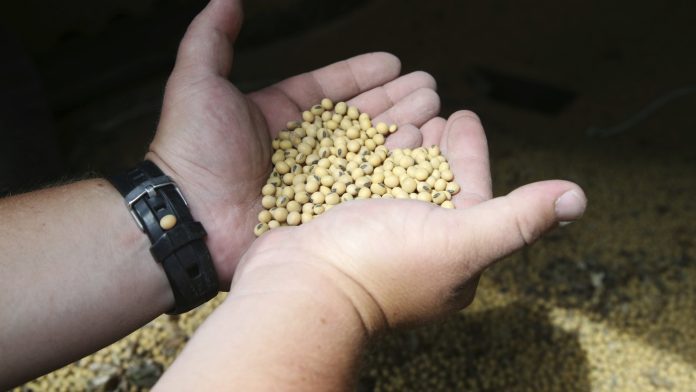
IN this 2018 photo Minnesota soybean farmer Michael Petefish holds soybeans from his farm in southern Minnesota. At that time American farmers, like now, were worried about the possibility of an escalating trade war after tariffs were imposed on imports during the first Trump administration.

Jim Mone/AP


hide caption

toggle caption

Jim Mone/AP

U.S. row crop farmers produce enormous quantities of food, and they depend on selling lots of it overseas. They thrive under free trade policies.

They’re also big spenders, laying out billions on the heavy equipment, seed and fertilizer they use.

Which makes them doubly vulnerable to tariffs.

“These tariffs are just absolutely bad news,” said Vance Ehmke from the western Kansas farm his ancestors homesteaded in 1885. “They cause the prices for everything that we buy to go up, and the price for everything that we sell to go down. I mean, it is being economically drawn and quartered.”

Lots of farmers say they were stretched to the breaking point before the tariffs took hold. The price of tractors has jumped 50% in five years, according to Successful Farming magazine; fertilizer has more than doubled, but commodity prices are low. Ehmke said the price of wheat started to climb earlier this year but plummeted when Trump began talking about broad tariffs.

“I mean, that was a $30,000, $35,000, $40,000 hit that we’ve taken, and I’m laying a huge amount of that right at Trump’s feet,” said Ehmke.

Large-scale American farmers depend on exports to make a living. About half of Ehmke’s wheat is sold overseas. But Ehmke and the markets assume that countries recently hit with export tariffs will retaliate by taxing U.S. food exports, which will cut demand and drive prices even lower.

The big, conservative farm trade groups fear the same thing.

“More than 20% of farm income comes from exports,” said American Farm Bureau Federation President Zippy Duvall in a statement responding to the latest round of tariffs. “Tariffs will drive up the cost of critical supplies, and retaliatory tariffs will make American-grown products more expensive globally. The combination not only threatens farmers’ competitiveness in the short-term, but it may cause long-term damage by leading to losses in market share,” said Duvall.

Loss of market share is a big deal. It takes decades to build trading relationships. The U.S. has long enjoyed a good reputation as a reliable food supplier. Farmers don’t want to throw that away. But Kenneth Hartman, Jr., president of the National Corn Growers Association, worries that his best export partner, Mexico, will soon be looking elsewhere for corn.

“If we get tariffs for too long, these other countries are going to start talking to Brazil and Argentina, and they can take a lot of our markets away,” said Hartman. “And when you lose a market, it’s hard to get them back.”

Hartman, is a farmer himself with 4,000 acres of corn and soybeans south of St. Louis. He’s concerned but holding out hope that Trump will use tariffs to pry open more overseas markets to U.S. food.

“Trump’s a negotiator,” said Hartman. “We’re hoping that he can come up with some negotiations that work on building markets. We think there’s some opportunities in the Asian area, when it comes to Vietnam, when it comes to the Philippines,”

Trump’s new tariffs, though, fix a 46% tax on all goods coming from Vietnam and a 17% levy on products from the Philippines, which could make it harder for U.S. farmers to break into those markets.

During his first term, when a trade war he started with China cut deeply into U.S. agricultural exports, Trump’s Department of Agriculture compensated farmers with $28 billion in aid. Many farmers believe Trump will take care of them again this time.

Not Vance Ehmke. He said he “wouldn’t bet 5 cents” on a bailout, given all the budget cuts in Washington.

“The only way I put a happy face on this is to think of all the income tax we’re going to be saving,” said Ehmke with a chuckle. “That’s it.”

What is ‘Qatargate,’ the Latest Furor Embroiling Israel?

0

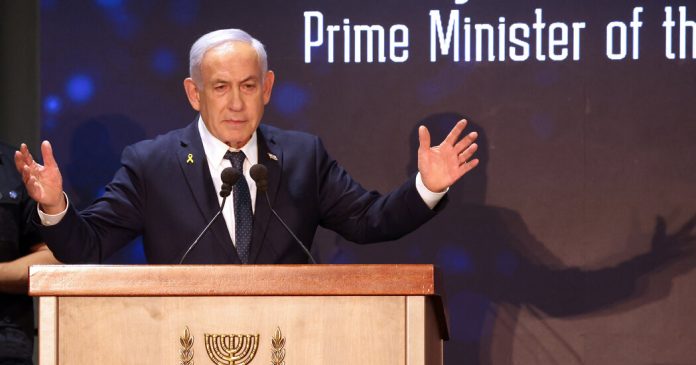
For years, Prime Minister Benjamin Netanyahu of Israel has been standing trial for corruption, even as he oversees conflicts in Gaza, Lebanon and Syria.

Now, he is locked in a separate standoff with Israel’s law enforcement authorities, a police investigation that has renewed opposition calls for his resignation.

Known as “Qatargate,” the case hinges on the claim that Mr. Netanyahu’s media advisers were paid by a representative of Qatar to promote Qatari interests in the Israeli news media. That claim has angered many Israelis because it created the perception of a conflict of interest; for years, Qatar has hosted leaders of Hamas.

Mr. Netanyahu’s recent efforts to fire the head of the Shin Bet, the Israeli internal security agency, has compounded the furor. It was the Shin Bet that first instigated the investigations into Mr. Netanyahu’s aides.

Mr. Netanyahu has dismissed the case as a “political manhunt” aimed at toppling him from power. A Qatari government official said it was a “smear campaign” aimed at distracting from Qatar’s efforts to mediate between Israel and Hamas.

According to court records, police officers are investigating whether Jonatan Urich and Eli Feldstein, two aides to Mr. Netanyahu, tried to promote a favorable image of Qatar in the Israeli news media. They are said to have worked alongside a third person who is not named in the records.

In particular, the records say, the three men are suspected of trying to foster the idea that Qatar played a more important role than Egypt in diplomatic efforts to secure a cease-fire in the Gaza Strip. Both Egypt and Qatar have mediated between Hamas and Israel since late 2023 and have not always worked in lockstep.

Mr. Urich and Mr. Feldstein were arrested on Monday and a judge extended their detention by three days on Tuesday. Lawyers for both men declined to comment.

Mr. Urich is a former media officer for the Israeli military who has become one of Mr. Netanyahu’s most trusted strategists. He helped mastermind the prime minister’s communications strategy through several recent elections. In his autobiography, Mr. Netanyahu described him as “kind of family.”

In addition to his government job, Mr. Urich also works for Perception, a public relations firm owned by another sometime adviser to the prime minister, Srulik Einhorn. Asked for comment, Mr. Einhorn said that Perception had never worked for Qatar.

Mr. Feldstein is also a former military press officer, and began working as a liaison between military correspondents and the prime minister’s office at the start of the war. He was arrested in a separate case last fall, on suspicion that he leaked classified information to a foreign newspaper.

The court records do not suggest that Qatar worked directly with Mr. Netanyahu’s aides.

Instead, the records state that the aides were directed by ThirdCircle, a U.S.-based lobbying group that represents Qatar in various countries, including the United States. Court records show that ThirdCircle paid Mr. Feldstein via an Israeli intermediary. The records do not clarify if or how Mr. Urich was compensated.

Jay Footlik, ThirdCircle’s founder and a former aide to Bill President Clinton, declined to comment.

The prime minister is not a suspect in the case, but he was questioned by police officers for more than an hour on Monday evening.

To make that meeting, Mr. Netanyahu was forced to depart early from his separate corruption trial. In that case, he is accused of granting regulatory favors to businessmen and media executives in exchange for bribes and positive coverage. He denies those charges.

Israel’s domestic intelligence agency, the Shin Bet, has been closely involved with the investigations into the aides.

When Mr. Netanyahu tried last month to fire the agency’s director, Ronen Bar, it fueled accusations that he was punishing Mr. Bar for pursuing the cases.

Mr. Netanyahu denied the claim. He said that Mr. Bar was being fired because of a breakdown of trust between the two men and because of lapses by the Shin Bet in the hours preceding Hamas’s attack on Israel in October 2023.

For years, Qatar has hosted senior members of Hamas. Since 2018, Qatar has also sent more than $1 billion in aid money to civilians in Gaza.

U.S. officials quietly supported the first arrangement and the Israeli government directly requested the second. Still, Mr. Netanyahu’s opponents are furious that officials privy to Israeli state secrets might simultaneously represent a country that works so closely with an Israeli enemy.

Mr. Netanyahu’s clash with the Shin Bet has also created the perception of a conflict of interest. More generally, the case has amplified criticism that he is fighting too many personal battles to govern effectively. And it has exacerbated fears that Mr. Netanyahu’s broader effort to overhaul the judiciary is rooted in personal grievance.

Myra Noveck contributed reporting from Jerusalem, and Gabby Sobelman from Rehovot, Israel.

Public records offices gutted in HHS layoffs : Shots

0

Among the thousands of layoffs at the U.S. Department of Health and Human Services this week were many staff who handled public records requests under the Freedom of Information Act.

Kayla Bartkowski/Getty Images


hide caption

toggle caption

Kayla Bartkowski/Getty Images

Teams that fulfilled requests for government documents lost their jobs on Tuesday as part of the Trump administration’s 10,000-person staff cuts at the Department of Health and Human Services. Their work, mandated by Congress since the 1960s under the Freedom of Information Act or FOIA, gives the public a view of the inner workings of federal health agencies.

Some public records teams were entirely cut at the Centers for Disease Control and Prevention, the Food and Drug Administration, the National Institutes of Health and other agencies on Tuesday, according to multiple current and former staffers who did not want to be named because of fears of retribution. A few people have been left standing on other FOIA teams within these agencies, for now.

Health Secretary Robert F. Kennedy Jr. has promised “radical transparency,” but the firings suggest that promise is a “lie,” says Jason R. Baron, a former director of litigation at the National Archives and Records Administration and current professor at the College of Information at the University of Maryland.

The layoffs of FOIA staff will “exponentially” increase backlogs and delays for health-related public records requests, he predicts.

“They are the American people’s records, and there should be adequate FOIA staff to make sure that record requests are answered promptly,” he says. “Firing your staff is antithetical to openness and transparency.”

In response to a request for comment, HHS emailed NPR the following: “The FOIA offices throughout the Department were previously siloed, and did not communicate with one another. Under Secretary Kennedy’s vision for a more efficient HHS, these offices will be streamlined, and the work will continue.”

Congress passed the Freedom of Information Act to increase government transparency. It mandates that federal agencies allow members of the public to request and receive records created and maintained by government agencies.

This can mean documents involving the safety and efficacy of new drugs, for example, or it can mean emails sent and received by agency workers. Members of the public may also want these records to help with their injury lawsuits, for example.

Reporters often use FOIA requests to shine a light on government activities that happen behind closed doors. For example, NPR obtained the government’s $5.3 billion contract to purchase Paxlovid in 2021 this way and reported on some surprises contained within the deal. NPR also reported on problems with other COVID contracts using documents published proactively to HHS’s online FOIA reading room.

“This move is honestly outrageous,” Gunita Singh, an attorney at the Reporters Committee for Freedom of the Press, told NPR in an email. “Why anyone would think putting transparency on the chopping block is a good idea is beyond me.”

Sometimes, organizations – including NPR – have to sue to get public records released under the law. This week, Singh got an email from an attorney representing HHS in one such case. She read the email to NPR but didn’t forward it because it includes other information that is privileged between her and her client:

“I had a good call with the agency on Monday and was anticipating having answers for you shortly. However, I was just informed that [Administration for Children and Families’] entire FOIA office is currently on administrative leave. I don’t have further information at this point and will keep you apprised as I learn more. I appreciate your patience.”

Although Singh couldn’t say what records she was trying to get, she called getting the email “devastating,” in a phone call to NPR.

“So a direct effect of these layoffs is that FOIA litigation squarely in the public interest is being stymied,” Singh says. “Journalists and other members of the public will be left without information on the processing of their requests; and government records to which the press and public are entitled will take much longer to get in our hands.”

FOIA offices were already understaffed, according to Singh, who says she often hears this from FOIA officers and litigators for the government. That’s why records are rarely produced in the 20 days required under the law. The staff cuts would likely exacerbate these delays, she wrote in an email to NPR, adding “FOIA is a law – not a mere suggestion,” and it requires compliance.

She and her colleague wrote a research paper about how when the FBI shut down its FOIA office during COVID, it made it much harder to submit requests and get documents – even after the office reopened.

Baron of the University of Maryland says firing HHS FOIA staff will only lead to more litigation and stricter judicial scrutiny of how agencies are adhering to public records laws. “HHS may be able to fire FOIA staff, but this Administration can’t wish away its FOIA obligations under present law.”

Rob Stein and Selena Simmons-Duffin contributed to this report.

Hungary Announces ICC Withdrawal as Netanyahu Visits

0

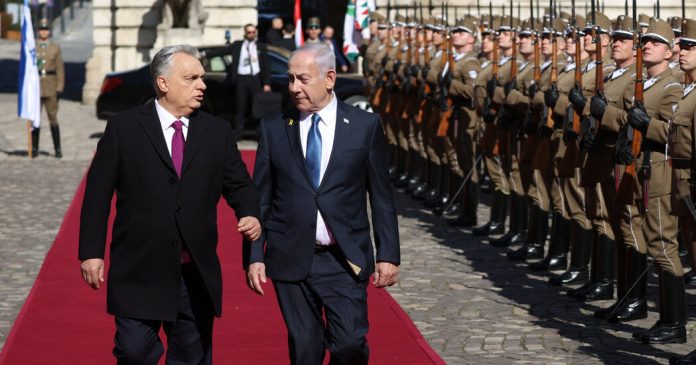
Hungary said on Thursday that it would pull out of the International Criminal Court, announcing its decision just hours after Prime Minister Benjamin Netanyahu of Israel arrived there for a visit despite facing an international arrest warrant.

The government of Prime Minister Viktor Orban had made clear that it would ignore its obligations to act on the I.C.C. warrant as a party to a 1998 treaty that established the court.

Instead of arresting Mr. Netanyahu upon his arrival in Budapest early Thursday morning, Hungary rolled out the red carpet, welcoming the Israeli leader at Buda Castle overlooking the Danube River with a military honor band.

In a message on Facebook, Gergely Gulyas, Mr. Orban’s chief of staff, said Hungary would begin the withdrawal process on Thursday “in accordance with constitutional and international law frameworks.”

The International Criminal Court issued arrest warrants in November for Mr. Netanyahu and his former defense minister, Yoav Gallant, accusing them of war crimes and crimes against humanity in the Gaza Strip.

This is a developing story. Please check back for updates.

How the Education Department helps enforce special education laws : NPR

0

Kellen Hedler leads his fellow classmates at Frontier Elementary School near Oklahoma City. Kellen has Down syndrome, a genetic condition that causes a range of physical and developmental challenges.

Katrina Ward for NPR


hide caption

toggle caption

Katrina Ward for NPR

Sueli Gwiazdowski, 24, says she switched high schools three times when she was growing up.

She wanted to stay at her first school because she loved being on the speech and debate team – but the campus wasn’t wheelchair accessible. Her second school forced her to learn in a separate room, away from her non-disabled friends.

“I had to fight my way out of that by going to a lot of…meetings and asserting that I was capable and able to participate in the general education setting,” she says.

Gwiazdowski has medical and physical disabilities and was, for many years, a full-time wheelchair user.

A federal law protects against the kind of discrimination Gwiazdowski says she experienced, and she invoked that law – the Individuals with Disabilities Education Act (IDEA) – throughout her schooling to advocate for herself.

“Quite frankly, had it not been for the publicly accessible resources that the Department of Education has provided to students with disabilities like myself, I probably would not have gone to college,” says Gwiazdowski, who is now both a college graduate and an advocate for disability rights.

“And I definitely wouldn’t be waiting for law school to start this fall had it not been for those resources.”

But the U.S. Education Department’s role in helping students with disabilities may be changing soon.

President Trump has said his administration is going to move “special needs” to the U.S. Department of Health and Human Services (HHS), an agency that recently announced its own drastic cuts. His administration hasn’t specified exactly which programs will be moved, and whether IDEA is among them, but the conservative policy playbook Project 2025 does propose moving IDEA to HHS.

Secretary of Education Linda McMahon and President Donald Trump depart after the president signed an executive order, on March 20, aimed at closing the Education Department.

Secretary of Education Linda McMahon and President Donald Trump depart after the president signed an executive order, on March 20, aimed at closing the Education Department.

Jabin Botsford/The Washington Post via Getty Images


hide caption

toggle caption

Jabin Botsford/The Washington Post via Getty Images

Department of Education spokesperson Madi Biedermann said, “The Department is actively reviewing where [Education Department] programs can be responsibly managed to best serve students and families. This will be done in partnership with Congress, other agencies, and national and state education leaders.”

Experts tell NPR any such move would be incredibly complicated. Special education laws are “intertwined” with the Education Department, says Katy Neas, a former deputy assistant secretary in the department’s Office of Special Education and Rehabilitative Services.

“To have the separation away from a broader institution of education just seems misguided to me,” says Neas, who now leads The Arc, an advocacy organization for people with disabilities. Neas says moving some of the legally protected programs to another agency would also require an act of Congress.

But some conservatives wonder if the federal government has even been that helpful when it comes to special education.

“I mean, parents make their [education plans] with their local educators, right? With their school and their school district. They don’t make it with Washington,” says Jonathan Butcher, an education researcher at the Heritage Foundation, which helped shape Project 2025.

With so many questions swirling around the future of federal involvement in special education, here’s a look at how the Department of Education traditionally contributes to the schooling of students with disabilities.

Helping schools follow federal laws aimed at students with disabilities

The Department of Education oversees many federal laws that govern how students with and without disabilities experience school.

But IDEA is one of the primary ways the federal government contributes to educating disabled students. The law enshrines the right of every child to “a free and appropriate public education,” and it says students with disabilities have a right to individual education programs (IEPs) that lay out the services each child is entitled to. IDEA is also the vehicle through which the federal government sends money to schools to help pay for those services.

“Not only does the Department of Education provide funding for staffing and resources to the individual school divisions, but IDEA, I mean, that’s your accountability framework,” says Mark Burnette, superintendent of Carroll County Public Schools in rural southwestern Virginia. He says nearly a fifth of his students qualify for services under IDEA.

Special education teacher Vivien Henshall walks with student Scarlett Rasmussen, 8, as Scarlett's mother, Chelsea, follows with a service dog. Because of her disabilities, Scarlett needs regular access to a nurse at school.

Special education teacher Vivien Henshall walks with student Scarlett Rasmussen, 8, as Scarlett’s mother, Chelsea, follows with a service dog. Because of her disabilities, Scarlett needs regular access to a nurse at school.

Lindsey Wasson/AP


hide caption

toggle caption

Lindsey Wasson/AP

Nationwide, IDEA serves about 7.5 million students, or 15% of the K-12 student population. In fiscal year 2024, Congress set aside $15.4 billion for IDEA. The Education Department is in charge of distributing that money to states, which then pass those funds on to qualifying school districts.

IDEA funds are used to pay for special education teachers and staff, technology to meet students’ individual needs, instructional materials, transportation and more.

“A child who has a hearing impairment may need a sign language interpreter or captioning to really follow what’s going on in class,” says Neas. “It’s those things that allow a child with a disability to really learn the same material as their non-disabled peers.”

The Department of Education is responsible for monitoring whether states and school districts are following IDEA, and other laws aimed at students with disabilities. That includes Section 504 of the Rehabilitation Act, which says students are entitled to reasonable accommodations, such as scheduled breaks for a child with diabetes to have a snack or check their insulin levels.

The department also provides IDEA guidance to state leaders, and collect data that help determine eligibility for IDEA funds.

Enforcing special education law and the civil rights of students with disabilities

The Office for Civil Rights, or OCR, is the Education Department’s enforcement arm. When students face discrimination at school, they can file a complaint with OCR, which could lead to a federal investigation.

This office is responsible for discrimination complaints on the basis of race, sex, national origin and other categories, but OCR data shows disability discrimination has historically made up the largest share of complaints.

In 2023, the Education Department’s Office for Civil Rights opened an investigation into the Four Rivers Special Education District, in Jacksonville, Ill., for allegedly leaning on law enforcement to discipline students with disabilities, ProPublica reported. This photo shows a hallway at the Garrison School, which is part of that district.

In 2023, the Education Department’s Office for Civil Rights opened an investigation into the Four Rivers Special Education District, in Jacksonville, Ill., for allegedly leaning on law enforcement to discipline students with disabilities, ProPublica reported. This photo shows a hallway at the Garrison School, which is part of that district.

Armando L. Sanchez/Chicago Tribune/Tribune News Service via Getty Images


hide caption

toggle caption

Armando L. Sanchez/Chicago Tribune/Tribune News Service via Getty Images

Sueli Gwiazdowski wishes she would have taken advantage of OCR during her schooling.

“The formal complaint process would have allowed me to be a kid,” she says.

It would have let her put the responsibility of enforcement “in the laps of the attorneys and investigators who are paid to do that at the Office for Civil Rights.”

In recent years, the number of OCR complaints has reached record highs, and many have dragged through the system for months on end. But recently, OCR’s capacity to handle all those cases was further strained: When U.S. Secretary of Education Linda McMahon slashed the Education Department’s workforce nearly in half, OCR also lost more than 40% of its staff, along with seven of its 12 regional offices.

The Trump administration promised it would preserve “resources for children with special disabilities.” But the mass layoffs also affected the Office of Special Education and Rehabilitation Services, where Neas used to work. The teams that conduct research on special education, help determine eligibility for IDEA funds and those who provide legal guidance to state and local leaders were also impacted.

“If you don’t have any type of accountability standards or someone to report to, then that leaves room for people to take advantage of programs and not provide the services that they need to provide,” says Burnette, the superintendent.

Michael Gilberg, a special education attorney in New York and Connecticut who also has autism, says one of his disabled clients recently filed a complaint with OCR.

“With no Department of Education functioning in that area, that puts [their case] to a standstill,” he says.

Gilberg notes that without OCR, “The only recourse a family would have would, in theory, be to sue the school district in either federal court or state court…and that takes a lot of time and a lot of money.”

The future role of the federal government in special education

Several of the experts NPR spoke with expressed concern about moving special education programs to HHS, and away from the Education Department, an institution that specializes in helping all students learn.

Alison Barkoff, who led disability programs at HHS until last year, says splintering special education programs into different agencies “is really counterproductive to what IDEA and the goals of special education are about, which is students with disabilities as students first, as part of their schools, part of their classrooms. And that can’t happen if it’s separated from general education.”

Kellen Hedler and his classmates, including his best friend, Nolan Robbins (left), learn about the structure of the U.S. government with teacher Robyn Fox.

Kellen Hedler and his classmates, including his best friend, Nolan Robbins (left), learn about the structure of the U.S. government with teacher Robyn Fox.

Katrina Ward for NPR


hide caption

toggle caption

Katrina Ward for NPR

Jonathan Butcher of the Heritage Foundation sees the proposed moves as an opportunity to improve the role of the federal government in the lives of students.

“I think that moving it to another agency is an appropriate move because I don’t think that we have evidence that the U.S. Department of Education has effectively served these families,” he says.

“Change is difficult and that’s why it doesn’t happen very often at the federal level, but this is an opportunity to streamline federal processes.”

Disability advocate Sueli Gwiazdowski says history has shown the dangers of separating the rights of disabled students from non-disabled students.

“When educating disabled students has not been considered part of normative general education, that has looked like what? It’s looked like institutionalization.”

She worries if special education were to move to HHS, disability could be categorized as a health concern rather than an integrated part of public life, including in schools.

Reporting contributed by: Dylan Peers McCoy
Digital story edited by: Nicole Cohen
Radio story edited by: Steve Drummond
Visuals by: Mhari Shaw