A 2024 file photo of TikTok’s offices in Culver City, Calif. The popular social app’s fate could be decided in the coming days as it seeks a buyer to comply with a federal law that it divest itself of Chinese ownership.
Mario Tama/Getty Images
hide caption
toggle caption
Mario Tama/Getty Images
The Trump administration is considering a deal to potentially resolve TikTok’s legal uncertainty that involves leasing the app’s algorithm from Beijing-based owner ByteDance, according to a person directly involved in the talks who is not authorized to speak publicly.
Under the plan, a new U.S. entity would be created led by software giant Oracle. ByteDance is expected to retain a minority stake.
The algorithm leasing proposal has been controversial in the White House, according to the source. There is debate among China hawks about whether the plan truly removes ByteDance from having operational control of the app. But the move could circumvent the need for China to approve the deal at a moment when the Trump administration has announced a 34% tariff on Chinese goods.
Trump imposed a sell-by date of Saturday for the hugely popular video service.
Ahead of the deadline, a flurry of new bidders have shown interest, including one led by tech giant Amazon, but negotiators in the White House say the offer is not being taken seriously.
Oracle, which already provides TikTok with most of its backend technical support, would be tasked with supervising the new entity to ensure there are no backdoors for the Chinese government to access the data of millions of Americans. The person involved in the negotiations with TikTok said the safety of users’ personal data, rather than the algorithm, has been the dominant focus of the talks.
“I don’t think the algorithm is as scary to people in Washington as it used to be. The bigger concern is data security,” the person said last week, adding on Wednesday that, “it looks a whole lot like Project Texas 2.0.”
That is a reference to a plan that first took shape in Trump’s first term in which Austin-based Oracle was tapped to be a custodian of TikTok’s data, and would conduct regular audits of the app’s algorithm. The plan, which stalled out without ever receiving final approval during the Biden administration, included a “kill switch” that would allow U.S. officials to shut down the platform if national security benchmarks were not satisfied.
The new version of the Oracle-led arrangement involving leasing the algorithm, which was first reported by the Washington Post, does not include the kill switch option.
White House press secretary Karoline Leavitt would not comment on the Oracle plan, but told NPR in a statement that “if and when a TikTok deal is announced, it will come directly from President Trump.”
A deal would provide relief to TikTok in what has been a bumpy year. A federal law took effect in January that bans the viral video app nationwide unless it splits from Beijing tech giant ByteDance.
Congress passed the ban in 2024 with overwhelming bipartisan support over national security fears that an app used by more than half of Americans should not be controlled by China, a foreign adversary of the U.S. TikTok fought the ban all the way to the Supreme Court, calling it a violation of free speech rights — but the court upheld the law in early 2025.
Starting the evening of Jan. 18, just before the ban was planned to take effect, the app went dark for 14 hours. But it flickered back on the next day after Trump promised to sign an order delaying the ban once he was sworn into office.
On Inauguration Day, Trump signed an executive order pushing back the start of the ban by 75 days, and promising immunity for other tech companies that provide back end services for the app, such as Apple and Google, which host it in their appstores. That extension is set to expire on April 5.
Legal experts say Trump’s delays do not halt the ban, meaning it is still technically illegal for TikTok to operate in the U.S. with ties to China. Yet moves by Trump and his administration assuring TikTok and its service providers that U.S. authorities will not prosecute anyone under the law have been enough for the popular app to stay online, despite operating in violation of a federal statute.
Since January, Trump has said there has been “tremendous interest” from potential buyers of TikTok, an app used by more than 170 million Americans and a valuable asset for anyone who might want to influence a whole generation of young internet users who flock to the service every day.
NPR reported in January that cloud computing company Oracle has been tapped by the White House as a top contender to lead a coalition of other investors to acquire a sizable stake in TikTok’s U.S. operation.
Oracle is run by Larry Ellison, a billionaire Republican donor who has long been a close ally of Trump.
Days after the United Nations accused Israel of killing 15 humanitarian workers in Gaza, officials who recovered the bodies or carried out the autopsies said some of the rescue workers were shot multiple times before beingburied in a mass grave.
The Palestine Red Crescent Society, which had eight of its members killed and carried out the recovery mission, said that nearly all 15 bodies showed gunshot wounds, according to a spokeswoman, Nebal Farsakh. One paramedic was found with his hands and feet tied toward his body, Ms. Farsakh said.
“My colleagues were shot; the bodies who were retrieved, many of them have multiple gun shots. We found all of them thrown in a mass grave, the bodies were put next to each other and covered with sand,” said Ms. Farsakh in a telephone interview from Ramallah.
The deaths of the aid workers, who first went missing on March 23, have drawn international condemnation in recent days.
On that day, in the southern Gaza city of Rafah, ambulances and a U.N. vehicle came under attack from Israel’s military, then went silent. On Sunday, rescue teams found 15 bodies, most in a shallow mass grave along with their crushed ambulances and the vehicle marked with the U.N. logo. The United Nations, which is typically cautious about assigning blame, accused Israel of killing them.
An Israeli military spokesman, Lt. Col. Nadav Shoshani, said on X on Monday that nine of those killed were Palestinian militants. He said Israeli forces “did not randomly attack” an ambulance, but that several vehicles “were identified advancing suspiciously” without headlights or emergency signals toward Israeli troops, prompting them to shoot.
“When Hamas terrorists operate in active combat zones — while using humanitarian vehicles as cover, launching rockets from hospitals and stealing aid — Israel will do whatever it takes to protect its soldiers and citizens,” said Jonathan Harounoff, a spokesman for Israel’s mission to the U.N.
Dr. Ahmad Dhair, a forensic expert at the Nasser hospital in the Gazan city of Khan Younis, examined five bodies belonging to the humanitarian workers on Monday. He said in a telephone interview from Gaza that he had found multiple bullet wounds in four of the bodies and some appeared shot at close range. The fifth was decomposed beyond recognition, Dr. Dhair said.
He plans to examine the rest of the bodies on Thursday. One of the four had bruises on the wrist with linear marks on the skin, Dr. Dhair said, adding that further investigations were required to determine if any of the victims had been tied up.
“Some of them were shot in the head from behind,” Dr. Dhair said. He said he also saw gunshot wounds in the torso and the chest, adding that the shoulder and elbow joints were also targeted.
Dr. Dhair’s assessment was first reported in The Guardian.
Two senior U.N. officials and a senior official from the International Federation of Red Cross and Red Crescent Societies confirmed they had seen reports from colleagues on the ground who took part in the recovery mission that indicated the humanitarian workers had been shot. The officials asked not to be named because they were not authorized to comment publicly.
The United Nations in New York on Wednesday also gave more details of what occurred on March 23, saying the attack was a grave violation of laws protecting humanitarian workers in conflict zones. The organization called for an independent investigation.
Jonathan Whittall, the head of U.N.’s humanitarian agency for the Palestinian territories, said that all the paramedics, members of the Palestine Red Crescent Society and the Civil Defense, were still wearing their uniforms and gloves when they were found. They had been traveling in marked vehicles and had not posed a threat to anyone, he added.
“They were being dispatched into Rafah as Israeli forces were advancing into the area. The ambulances were hit one by one as they advanced, as they entered into Rafah,” said Mr. Whittall, who participated in the rescue operation and was among the team who found the bodies.
Ms. Farsakh said the humanitarian workers had not carried any weapons and had been dispatched to aid wounded civilians caught in Israeli strikes.
One member of the Palestine Red Crescent Society is still missing. And one other, who was riding in the first ambulance, was detained by the Israeli military and later released, Ms. Farsakh said. He recounted that Israel sprayed the ambulances with heavy gunfire, and two of his colleagues sitting in the front were killed, Ms. Farsakh said.
Ms. Farsakh said in addition to their field findings and witness testimony indicating that Israel killed the aid workers, one of the paramedics in an ambulance called the dispatch center while they were under attack, reporting that the Israeli military had opened fire on their convoy and all of them were injured.
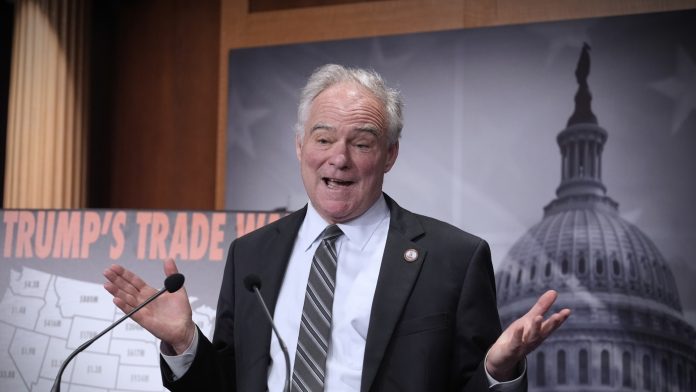
The Senate has approved a measure pushing back on President Trump’s tariffs. The measure, sponsored by Sen. Tim Kaine, D-Va., was approved with GOP support but is not expected to ever come up for a vote in the House.
J. Scott Applewhite/AP/AP
hide caption
toggle caption
J. Scott Applewhite/AP/AP
The Senate voted to undo the 25 percent tariffs that President Trump imposed on Canadian goods — a bipartisan but largely symbolic rebuke, with four Republicans joining all Senate Democrats.
The action on a joint resolution came shortly after President Trump announced a 10 percent tariff on all imports coming into the United States.
The resolution is nonbinding and House Republicans are not expected to bring the policy up for a vote. The bill aims to end an emergency statute invoked by an Executive Order signed by President Trump. The order justified the new tariff by arguing that fentanyl is flowing into the U.S. from the northern border, posing a domestic national emergency.
The Republicans joining Democrats to approve the measure were Sen. Susan Collins of Maine, Mitch McConnell of Kentucky, Lisa Murkowski of Alaska and Rand Paul of Kentucky.
Supporters of the Senate resolution argued that that law was meant to use against adversaries, not Canada, a longtime U.S. ally.
“Tariffs are a tax. Tariffs will hurt our families. Canada is not an enemy. Let’s act together to fight fentanyl. We can do that,” Senator Tim Kaine, the lead sponsor of the resolution said.
Trump preemptively criticized Republicans for supporting the measure in an early morning post on his social media site, Truth Social. He also vowed he would never sign the bill if it cleared Congress.
“Mitch McConnell of Kentucky, Susan Collins of Maine, Lisa Murkowski of Alaska, and Rand Paul, also of Kentucky, will hopefully get on the Republican bandwagon, for a change, and fight the Democrats wild and flagrant push to not penalize Canada for the sale, into our Country, of large amounts of Fentanyl, by Tariffing the value of this horrible and deadly drug in order to make it more costly to distribute and buy,” Trump wrote. “
“They are playing with the lives of the American people, and right into the hands of the Radical Left Democrats and Drug Cartels. The Senate Bill is just a ploy of the Dems to show and expose the weakness of certain Republicans, namely these four, in that it is not going anywhere because the House will never approve it and I, as your President, will never sign it.”
Kaine held a press conference with business owners from his home state on Tuesday, arguing they and their customers would be hit hard. He said the reason for the executive order was “so they can use the tariff revenue to give a tax cut to billionaires.”
At that event Bill Butcher, the president of Port City Brewing, a craft beer company in Alexandria, Virginia, said he expected he would have to raise the price of a six pack of beer from $12.99 to $18.99. He said he expects customers will look for lower priced alternatives. “We fear it’s going to slow our business down and we’re trying to grow our business.”
Maine Sen. Susan Collins, a Republican supporter of the resolution, argued on the Senate floor that there was a strong case for tariffs against Mexico and China “But I don’t see the case for Canada.”
She outlined the wide range of Maine industries that would be harmed by tariffs on its neighbor across the border — tourism, farming, lobster processing. “The Maine economy is integrated with Canada – our most important trading partner,” Collins said. She warned the tariffs would be detrimental to families and the economy.
Most Senate Republicans oppose the measure and emphasized that removing the emergency would impact the U.S. effort to combat the influx of fentanyl, which continues to impact communities across the country.
Majority Leader John Thune, R-S.D. argued against the bill in a speech on the Senate floor.
“If we are serious about ending the fentanyl crisis in American we need to address the entirety of the crisis,” he said. “We’re not going to solve the problem by going after just part of it. Ending this emergency would tell the cartels that they should shift their focus to the southern border.”
Democrats framed new tariffs as taxes on the American consumers. And Kentucky GOP Sen. Rand Paul, who voted for the resolution, argued it’s Congress’ job to determine tax policy, not the president, as set out in the Constitution.
“This isn’t about political party. I voted for and supported President Trump, but I don’t support the rule of one person,” Paul said. “This is a tax, plain and simple on the American people, but one person can’t do that. Our Founding Fathers said it would be illegal for one person to raise taxes. It has to come to Congress.”
The U.S Chamber of Commerce endorsed the bill on Wednesday, joining several unions, the conference of U.S. mayors, and groups representing retailers and manufacturers. “Tariffs are taxes — paid by Americans – and they will quickly increase prices at a time when many are struggling with the cost of living,” Neil Bradley, CEO of the U.S. Chamber wrote in a letter to the bill’s sponsor, Sen. Tim Kaine. He also argued the tariffs violated the trade deal negotiated with Canada and Mexico during the first Trump administration.
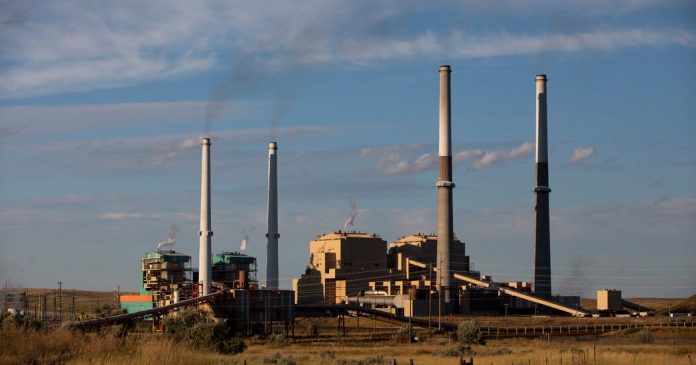
The nation’s most polluting coal-burning power plant has asked President Trump to exempt it from stricter limits on hazardous air pollution after the administration recently invited companies to apply for presidential pollution waivers by email.
The aging Colstrip power plant in Colstrip, Mont., emits more harmful fine particulate matter pollution, or soot, than any other power plant in the nation, Environmental Protection Agency figures show. A new rule adopted by the Biden administration in 2023 would have compelled the facility — the only coal plant in the country to lack modern pollution controls — to install new equipment.
Now, the Colstrip plant has applied for a two-year exemption to those rules, according to Montana’s congressional delegation, which backed the request.
The new pollution standard “endangers the economic viability of the plant, which if closed, would undermine the region’s electric grid,” Senator Steve Daines and other members of the delegation wrote in a letter sent on Monday to the E.P.A. administrator, Lee Zeldin. “Without Colstrip, consumers would bear the burden of higher energy costs and grid unreliability, and its closure would stymie economic development in the region.”
Health experts noted that the letter didn’t address the health effects of the fine pollution particles. Numerous studies have shown the particles are small enough to penetrate deep into the lungs and enter the bloodstream, where they can travel to the heart and other organs, increasing mortality from cardiovascular and respiratory diseases.
A 2023 study showed that coal-burning power stations, in particular, emit fine particulates containing sulfur dioxide linked with higher mortality than other types of pollution.
This pollution “can be very damaging to young kids in particular, who have developing lungs,” said Robert Merchant, a pulmonologist in Billings, Mont. The delegation’s letter, he said, shows “a complete indifference to the health harms.”
The Colstrip plant’s request for an exemption from stricter pollution rules came after the E.P.A. told companies last month that they could apply for waivers to major clean-air rules by emailing the agency. The E.P.A. pointed to a section of the Clean Air Act that enables the president to temporarily exempt industrial facilities from new rules if the technology required to meet those rules isn’t available, and if it’s in the interest of national security.
The Trump administration has also announced its intention to roll back a slew of rules entirely, which could eventually mean that plants like the one in Colstrip would not have to meet new pollution standards at all.
The move was part of a wider effort by Mr. Zeldin to steer the agency away from its original role of environmental protection and regulation and toward making energy and cars more affordable.
NorthWestern Energy Group and Talen Energy, which operate the plant along with other minority owners, did not immediately respond to comment.
Any exemption granted by the Trump administration is likely to face legal challenges from environmental groups. In drawing up the new rules, the Biden administration had identified technology already available that would allow the Colstrip facility to meet stricter standards, and that had been widely adopted by other coal plants in the country.
The Biden administration also estimated that the new pollution control technology would cost far less to install than the $500 million the Colstrip plant has said it would take.
“These technologies are available,” said Amanda Levin, director of policy analysis at the Natural Resources Defense Council, an environmental advocacy group, “but Colstrip decided not to invest when every other coal plant in the nation did.”
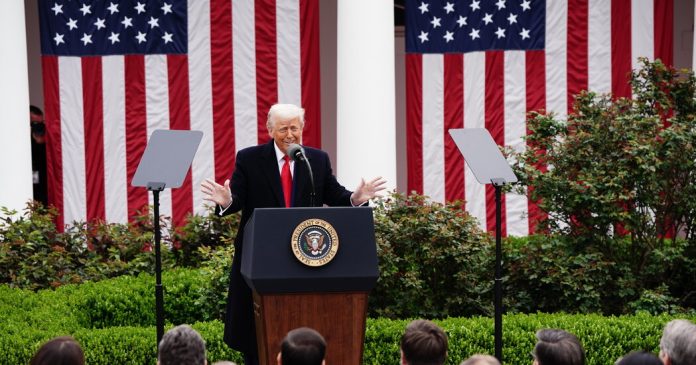
President Trump’s announcement of sweeping tariffs on America’s trading partners has widened the rift between the United States and some of its closest allies while reconfiguring the global economic order.
Mr. Trump’s plan, which he unveiled on Wednesday and is calling “reciprocal,” would impose a wave of tariffs on dozens of other countries. Among major economies hardest hit were the European Union, which will face 20 percent tariffs under the plan, and China, which will absorb an additional 34 percent on top of existing levies.
“The scope and size of tariffs are both substantial and confirm the worst fears of the proponents of free trade,” said Eswar Prasad, professor in the Dyson School at Cornell University. “Trump is setting off a new era of protectionism that will reverberate worldwide.”
Mexico and Canada, two of the United States’ biggest trading partners, would not be subject to any new tariffs beyond the levies the president had previously announced, on imported vehicles, vehicle parts, steel, aluminum, and any other goods not traded under the rules of the U.S.-Mexico-Canada Agreement.
The new levies include a base line 10 percent tariff on all countries except Canada and Mexico, as well as additional tariffs based on the tariffs other nations apply to U.S. exports and other barriers the administration has deemed unfair.
The announcement Wednesday was the latest step in a trade war that has been developing for weeks. Mr. Trump has already imposed steel and aluminum tariffs, announced car tariffs and threatened retaliatory tariffs on European alcohol. He has threatened — and then backed away from — steep levies on goods coming from Canada and Mexico, while imposing a different set on China.
The many-fronted assault has left global partners reeling.
“It is forcing U.S. allies, which have taken for granted for decades that they can count on the U.S., to re-evaluate,” said Adam Posen, president of the Peterson Institute for International Economics in Washington, which supports free trade. “It is already changing America’s role in the world.”
European allies have announced plans to retaliate to an earlier wave of steel and aluminum tariffs, and they have been clear that they could respond to the growing trade conflict by creating barriers for services like big technology companies. Others, like Australia and Britain, have chosen a more wait-and-see approach.
The common thread is that many of America’s friends increasingly find themselves playing defense against Washington, a posture that could change international relations and the global order for years to come.
For countries like the E.U., “it is a very high number,” said Jorn Fleck, senior director with the Europe Center at the Atlantic Council, explaining that the adjustment to such tariffs would be very painful for consumers, workers and businesses.
“These supply chains, you can’t shift them over night,” Mr. Fleck said. “This ignores how a highly integrated trans-Atlantic relationship works.”
Many are questioning what the end goals might be. Mr. Trump has at times argued that he wants to force companies including automakers and drugmakers to produce in the United States. He has also said that the point is simply to rectify unfairness. And he has said tariffs will help to pay for tax cuts.
For America’s global partners, the purpose matters. If the point is to make the trading system more fair, that would suggest an openness to negotiation. Europe could fiddle with any tariffs on cars, for instance, to try to press the Trump administration to take a less aggressive stance.
If the point is to raise money for American coffers, that’s a more difficult starting point for trading partners. In that case, finding an agreement that reduces the planned tariffs would mean reducing any potential revenues.
Given the uncertainty, America’s partners have been trying to learn as much as they can about what’s coming, while rolling out measured responses.
Europe, for instance, has taken a more aggressive posture than many individual nations — announcing plans for retaliatory tariffs on whiskey, motorcycles, farm goods and a wide range of other products in response to steel and aluminum levies. But it has already delayed those measures until the middle of April, and policymakers have yet to announce exactly how they will react to the latest round of tariffs.
Instead, officials have made it clear that they are willing to respond forcefully — including, perhaps, by using a recently created tool that would allow them to relatively quickly place penalties like tariffs or market access restrictions on American technology companies like Google. The tool could also be used to hit other service firms, like banks and other financial services providers, outside lawyers and analysts have suggested.
“Europe holds a lot of cards,” Ursula von der Leyen, president of the European Commission, said earlier this week. “From trade to technology to the size of our market.”
The goal would be to gain leverage. E.U. nations are trying to throw around the weight of the 27-nation bloc’s consumer market to force Washington to negotiate.
That is also why the bloc is, so far, sticking together. Many European nations have made the calculus that, with their combined populations and markets, they are more powerful united.
Still, plans to push back have been made more difficult because other geopolitical topics have become closely interlinked to the trade conflict.
For Europe, military goals and technology regulation have become caught in the dispute. The United States wants the European Union to shoulder more of the burden for its own defense while also dialing back restrictions on large technology companies, including regulations meant to ensure that they are enforcing content standards.
For instance, a White House memo from February suggested that the Trump administration would “consider responsive actions like tariffs” to combat European taxes on digital services and said that two key European technology regulations — the Digital Markets Act and the Digital Services Act — would “face scrutiny.”
The question is how quickly a response will come. European leaders, for instance, have made it clear that they first want to digest the details of the latest round of tariffs.
“They don’t want to escalate — the desire is to do deals,” said Mujtaba Rahman, managing director for Europe at the Eurasia Group, a political research firm. But, he added, there is a risk that the situation escalates and that Europe could be coming after American services within the coming weeks and months.
“You’ve got to flex economic muscle to be credible with this administration,” he noted.
Paulina Villegas contributed reporting from Mexico City.
People walk through the gate on Harvard Yard at the Harvard University campus in Cambridge, Massachusetts.
Scott Eisen/Getty Images
hide caption
toggle caption
Scott Eisen/Getty Images
People walk through the gate on Harvard Yard at the Harvard University campus in Cambridge, Massachusetts.
Scott Eisen/Getty Images
Eight-point-seven billion.
Four-hundred million.
One-hundred-seventy-five million.
These are just some examples of the money the federal government has withheld or is threatening to withhold from various colleges and universities, including the University of Pennsylvania, Columbia University and Harvard University.
That $8.7 billion figure was announced earlier this week by the Trump administration, which said that it’s reviewing federal grants and contracts awarded to Harvard because Harvard has not done enough to curb antisemitism on campus.
Some educators say the administration’s moves to cut funding at colleges and universities amounts to a war on higher education. But the loss of those funds will be felt far beyond the college campuses.
For sponsor-free episodes of Consider This, sign up for Consider This+ via Apple Podcasts or at plus.npr.org.
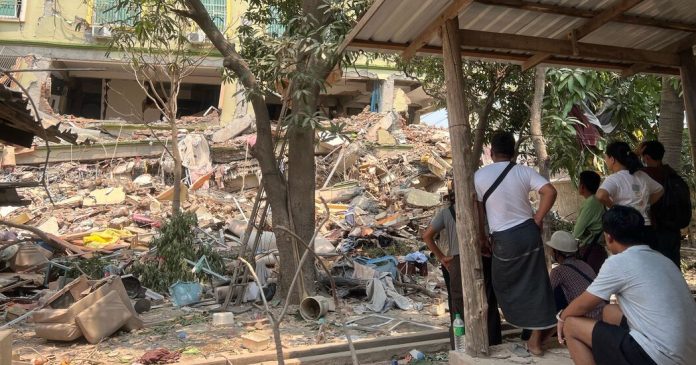
Democratic senators sent a letter to the Trump administration on Wednesday criticizing what they called the paltry U.S. aid response to the earthquake in Myanmar, where China and Russia have sent rescue and relief teams.
The six senators said in the letter that the United States appeared to be failing the first test of its ability to respond to a humanitarian crisis in the wake of the Trump administration’s drastic cuts to foreign aid and dismantling of the United States Agency for International Development, the main aid agency.
“We are deeply concerned that the administration’s response is failing to meet both our moral and strategic objectives — sending a signal to countries around the world that our adversaries are more reliable and trustworthy than the United States,” the senators wrote.
The New York Times obtained a copy of the letter, which was organized by the offices of Senator Elizabeth Warren of Massachusetts, the ranking member on the Banking Committee, and Senator Chris Coons of Delaware, who is on the Foreign Relations Committee. The other senators who signed were Tim Kaine of Virginia, Tammy Duckworth of Illinois, Chris Van Hollen of Maryland and Jeff Merkley of Oregon. The senators sent it to Secretary of State Marco Rubio and Treasury Secretary Scott Bessent.
Mr. Rubio and a political appointee at the State Department, Pete Marocco, oversaw the slashing of foreign aid, and Mr. Bessent’s agency oversees financial sanctions on Myanmar. The senators said in the letter that the U.S. government should grant sanctions waivers to any earthquake relief going into Myanmar.
The United States did not send any specialist aid teams to Myanmar after the earthquake hit on Friday. More than 2,700 people have died as buildings there and in neighboring Thailand collapsed, according to the ruling authoritarian military leaders of Myanmar. The junta asked other nations for help. China, Russia and India sent teams and supplies, as did Thailand, Malaysia and Vietnam.
As of this past weekend, the United States had not even managed to get a three-person assessment team into the country, The New York Times reported on Sunday.
The State Department spokesman said on Friday that crisis teams were on standby, but the severe cuts since late January have decimated the infrastructure for the U.S. government’s Disaster Assistance Response Teams. Many of the contractor specialists for those teams were fired in the U.S.A.I.D. cuts, and the agency’s offices in Washington that would help with transportation and payment logistics have been hobbled.
Two agency employees who had expected to be posted this winter to Myanmar and Thailand as humanitarian advisers were told by senior officials weeks ago to stay in Washington because the positions had been cut. On Friday, as those two employees and other colleagues were coordinating responses to the earthquake, they received agencywide emails telling them they would be laid off. The emails told everyone to go home that day.
The Trump administration has also cut contracts for transportation used to send firefighters and rescue workers in Virginia and Southern California to global disaster zones when requested by other countries.
The total US. government annual spending on foreign aid had been less than one percent of the federal budget.
The United States Embassy in Myanmar announced on Sunday that it would send up to $2 million in aid, much less than recent American administrations have sent for similar disasters.
The senate letter cited the Times story from Sunday that revealed the shortcomings of the Trump administration’s response.
“Even as the administration has wittingly undercut our ability to efficiently save lives and promote U.S. interests, we call on the State Department and U.S.A.I.D. to rapidly assess what the United States can still do for people in Burma, including with resources already in the region,” the senators said, using the U.S. government’s preferred name for Myanmar.
They added that the Treasury Department should authorize “all transactions related to earthquake relief efforts in Burma that would otherwise be prohibited by U.S. sanctions.”
On Monday, Tammy Bruce, the State Department spokeswoman, said the U.S. government’s assessment team was “in the process of being present right there,” and that disaster experts in Washington, Manila and Bangkok were trying to help.
In Wisconsin, liberal judge Susan Crawford beat conservative judge Brad Schimel for the state Supreme Court by 10 points. A margin much wider than expected in the most expensive court race on record.
The human costs of Russia’s war in Ukraine are enormous, measured in mass graves, nightly missile attacks, traumatized children and hundreds of thousands of soldiers dead or wounded.
But Ukraine’s environment is also being devastated. The war may end, but damage from artillery shells, mines, drones and missiles will endure for decades, experts say, degrading industries like farming and mining, introducing health risks and eroding natural beauty.
Fields are pocked with shell craters, their soil contaminated with the residue of explosives. Burning fuel tanks spew pollution into the air and wildfires burn unchecked in combat zones. Water from reservoirs has poured through destroyed dams, causing droughts upstream and damaging floods below.
A burned pine forest in Sosnove, in Ukraine’s Donbas region. Some of the region’s fiercest fighting has taken place in tinder-dry pine plantations.
As the war enters its fourth year, Ukrainian authorities are carefully collecting evidence of a new type of war crime known as ecocide.
As genocide is to people, ecocide is to the environment. Ukraine is mounting an extensive legal effort to seek justice for ecological harm, in Ukrainian courts and the International Criminal Court. Prosecutors are pursuing 247 cases of environmental war crimes against Russia. These are rare legal efforts. “Nobody has done it before,” said Maksym Popov, special adviser on environmental crimes in the prosecutor general’s office.
Prosecutors classify 14 of the 247 cases as ecocide under Ukraine’s criminal code because of the specifics of the damage, such as mass destruction of flora and fauna. Ukrainian officials put the total environmental cost at more than $85 billion.
The chances of prosecuting Russians in person seem small, since there is almost no prospect Russia would cooperate. But Ukraine is determined to establish accountability. “Evidence collected within criminal cases and court verdicts, even if issued in absentia, will strengthen Ukraine’s compensation claims,” said Andriy Kostin, who was a driving force behind the effort as Ukraine’s prosecutor general from 2022 to 2024.
Russia’s defense ministry did not immediately respond to a request for comment.
“We want the war to end,” said Olena Zaitseva, right, outside her home in Borova, in Ukraine’s Kharkiv region, last fall. “We’ll endure whatever the state of our environment is, as long as things get better.”
To report the ecological damage caused by Russia’s invasion of Ukraine, New York Times journalists visited the front line and the surrounding areas over four months, interviewing more than three dozen people including military officials, environmental experts and local administrators.
The picture is inevitably incomplete. It was not possible to visit Russian-occupied areas of Ukraine, for instance. And Ukraine is not trying to document the environmental damage its military has caused in Russia, where it has targeted oil refineries, setting off infernos that send plumes of black smoke into the sky.
One of the war’s most devastating blows to Ukraine’s environment occurred in June 2023 when the Kakhovka dam, holding back a reservoir almost as large as Utah’s Great Salt Lake, was blown up. The breach unleashed a deluge down the Dnipro River, sending toxic sediments and trillions of gallons of fresh water into the salty Black Sea, and wrecking coastal ecosystems during a peak reproductive period for marine organisms.
The reservoir had provided irrigation for much of southern Ukraine. Soon, farmland in the region began to dry up.
The Kakhovka dam breach deprived nearby Apostolove of its primary water source. A year after, residents still had to fill bottles at a central distribution point.
An abandoned house in Afanasiivka, a village that was cut off and partially flooded when the dam was destroyed.
“It was beautiful,” said Serhii Buhay, 52, from his back patio in the village of Malokaterynivka, where he used to enjoy a view of the reservoir. “One day everything changed. There’s nothing left.”
Sunflower harvests produced only a 10th of what they had delivered the previous year, said Serhii Verhovskyi, 38, a farmer in the village of Pershe Travnya, about 10 miles from the reservoir. “We really need water, we need it badly. This season has brought many farmers to their knees.”
Native vegetation quickly reclaimed the barren basin of the Kakhovka reservoir. It is now largely covered by poplar and willow trees, some more than 10 feet high.
From an ecological perspective, the dam has long been considered controversial. The filling of the reservoir in 1956, and subsequent transformation of arid grasslands into fertile farmland, disrupted native ecosystems, some experts contend, and many ecologists say the dam should not now be rebuilt.
Elsewhere in eastern Ukraine, it is the groundwater that is at risk from the war.
The region is dotted with coal mines, dozens of which have fallen under Russia’s control as its forces advanced across the Donbas. Occupation authorities mostly shuttered the outdated mines rather than continue to subsidize them.
Anatoliy Ovchar, 54, operating pumps that remove water from a coal mine in eastern Ukraine. The flooding of mines risks contaminating groundwater.
Farmers who grew sunflowers were harvesting only a tenth of what they grew the previous year, said Serhii Verhovskyi, 38, center, a farmer in a village near the former reservoir.
Experts fear those mines were closed haphazardly, allowing groundwater to flood their tunnels and caverns and leach toxins. Such damage makes groundwater from wells undrinkable and eventually reaches rivers, polluting surface water and then soil.
The collapse of water infrastructure in the Donbas in the earlier phase of the war from 2014 to 2022 — evident in damaged pipes and water treatment plants — led people to drill backyard wells. Hundreds of these now mix water layers, spreading contaminants from the mines.
Ukraine boasts some of the world’s most fertile soil, called “chernozem,” black earth. The black earth is “the king of soils,” says Sviatoslav Baliuk, director of the O.N. Sokolovsky Institute for Soil Science and Agrochemistry Research in Kharkiv. This soil lies under much of the battlefield.
Olena Nevoyt, left, an engineer, and Nadiia Vinakurova, a soil scientist, testing soil samples in Kharkiv, in northeastern Ukraine.
Kharkiv’s Yuriev Plant Production Institute has a seed bank with 156,000 samples.
Millions of artillery shells release explosive residue into the air and soil. It has been a problem in past wars. “Even a century after World War I, soil in France is still contaminated with heavy metals above safe levels for humans,” Naomi Rintoul-Hynes, a soil expert at Canterbury Christ Church University in England, said in an email, “particularly if crops are grown” on sites of major battles.
Of the 247 cases against Russia for environmental damage, prosecutors classify 14 as ecocide.
The risk of contamination in food crops will linger from heavy metals and other pollutants, harming Ukraine’s agriculture, one of its most important businesses.
More ecological fallout comes from the disturbance of the soil caused by powerful explosives and the digging of trenches and other fortifications. In one zone, 30,000 artillery shell craters pocked a 150-square mile area southeast of Kharkiv. Scientists use the term “bombturbation” to describe this process of mechanical damage.
Stanislav Kovalenko, 32, a soil scientist, climbing into a bomb crater dating to 2022 to test for contamination.
Markers in a mass grave that was discovered after Ukraine regained control of the town of Izium in 2022.
About 10 percent of a Ukrainian national park, the Chalk Flora Reserve, is damaged by trenchwork dug by Ukrainian soldiers. “It will take more than 100 years” to restore it to its previous state, said Serhii Lymanskyi, director of the park.
At a military checkpoint in eastern Ukraine last fall, a soldier gestured toward smoke rising beside the road ahead: A wildfire was burning through a minefield. At closer range you could hear the crackling of the flames mixed with pops and bangs of exploding mines.
Some of the fiercest fighting that has swept through the Donbas has taken place amid tinder-dry pine forests. While explosives spark some fires accidentally, others are intentionally set to flush soldiers from hiding places. The presence of mines means that leaving paved roads to fight fires is out of the question, so the blazes burn uncontrolled.
Ukrainian soldiers from the Third Assault Brigade training in the Kharkiv region.
A T-72 tank belonging to the Ukrainian military in woodland in the Donetsk region.
Centuries of forestry mismanagement, allowing logging and replanting of tightly spaced trees, are exacerbating the blazes, said Brian Milakovsky, an American forestry expert who lived in eastern Ukraine for years before the invasion. “Without exaggeration pine forests are disappearing,” from parts of the east because of wildfires, he said.
Studies show that hundreds and possibly thousands of square miles of forest have burned since Russia’s invasion. One report estimated the damage at $18 billion.
After a hot, dry summer, Ukraine’s 2024 fire season was the worst on record, with more than 7,000 active fires recorded just on Sept. 7.
Nuclear contamination is another concern. Early in the invasion, an attack on a nuclear research center in the eastern city of Kharkiv led to what is so far the only case of ecocide filed against named Russian commanders — five colonels and generals accused of ordering the missile strikes. The facility sustained damage from more than 100 points of impact, but no radiation leaked, officials said.
A Ukrainian air defense unit illuminating the hole that a drone left in the shield over Chernobyl’s nuclear disaster site. Ukraine says it was a deliberate Russian strike.
Serhii Chuzhdan demonstrating how nuclear waste is separated and prepared for long-term storage.
In February, a drone struck a protective shield at the Chernobyl nuclear facility. Ukraine described it as a deliberate Russian attack, an accusation the Kremlin denied. No radiation leaks were detected but experts are studying the damage before undertaking repairs.
As a cold drizzle fell one early December morning, about two dozen men donned fluorescent vests, split into two groups, and fanned out through the forest.
Despite the congenial atmosphere, their mission was serious: to cull wild boar, roe deer, foxes, and wolves, all of which have proliferated during three years of war because of tight restrictions on hunting. The population explosions helped spread diseases such as rabies.
Despite being heavily stacked in the hunters’ favor, the attempt at culling that morning was not successful. Few shots were even fired.
Three Ukrainian hunters with a culled deer. With hunting largely ceased, wildlife populations have exploded, leading to increased risk of disease, especially rabies.
Oleksandr Radchenko, 69, a zoologist, holding a collection of ant specimens.
Viktor Chervonyi, President of the All-Ukrainian Association of Hunters and Hunting Grounds, cited statistics showing a fivefold increase in the fox population in one region.
A recent cull there showed 20 percent were rabid, the result of a breakdown in rabies control efforts.
Ukrainian news outlets have reported on both civilians and soldiers dying of rabies, though official statistics are unavailable. Rabies vaccination campaigns for wildlife have been limited by wartime hindrances such as mined forests and grounded flights.
The fate of a colony of flamingos provides another cautionary tale. After fighting disturbed their nesting grounds in the Kherson region and Crimea, they settled in 2023 in the Tuzlovsky Lagoons National Nature Park along the Black Sea coast.
“Last year was relatively successful, with about 200 chicks” born in the park, said Ivan Rusev, the head of the park’s scientific department, referring to the 2023 nesting season. He was optimistic about 2024 after spotting more than 1,500 flamingos and 400 nests.
Ivan Rusev observing flamingos. Low-flying drones have reduced their numbers.
A flock of flamingos searching for a meal in the skies above the park.
Their new home, however, was underneath an area where low-flying Russian drones zoomed into Ukraine from the Black Sea.
“When flamingos hear these drones, they leave their nests,” Mr. Rusev said. “During this time, the yellow-legged gulls, which are very aggressive birds, come in and steal the eggs, ultimately destroying the colony. Not a single chick survived.”
It was not only flamingos that suffered. Extrapolating from his findings and data shared by colleagues in other Black Sea countries, Mr. Rusev estimated up to 50,000 dolphins may have been killed in 2022. He blamed sonar from Russian warships.
“How much does the destruction of endemic species cost?” asked Ruslan Strilets, a former environment minister. “We can’t calculate the price.”
Even after the war, there will be an environmental cost to disposing of rubble from the more than 210,000 buildings that have been destroyed. Early efforts are being made at rubble recycling in several cities near Kyiv.
The programs, however, remain small-scale and have been complicated by bureaucratic hurdles and difficulties separating reusable debris from unexploded ordnance or asbestos. Asbestos was built into an estimated 70 percent of Ukraine’s public and residential buildings.
Ukraine wants environmental protections included in any peace agreement, but the Trump administration’s friendlier ties with Moscow leave Kyiv little leverage.
Iryna Vykhrystiuk, the director of Tuzlovsky Lagoons National Park, worries that an end to the war would bring a different set of economic and environmental problems. “There will be cries of, ‘We lost some areas, we have mined territories, let us plow everything up,’” she said.
“Against the backdrop of these immense losses,” she added, “we need to seek out any fragments of living nature and protect them.”
A firefighter approaching a wildfire probably caused by shelling in the northeastern town of Lyman.