Thursday, November 12, 2026
Home Blog Page 61

5 takeaways from Tuesday’s elections, including bad news for Elon Musk : NPR

0

Elon Musk, chief executive officer of Tesla Inc., wears a cheese head hat while arriving for an America PAC town hall ahead of the Wisconsin Supreme Court election at the KI Convention Center in Green Bay, Wisc., on March 30.

Jamie Kelter Davis/Bloomberg via Getty Images


hide caption

toggle caption

Jamie Kelter Davis/Bloomberg via Getty Images

Democrats won a judicial election in Wisconsin that saw a record amount of money spent, national attention and was something of a referendum on Elon Musk, who played a big role, as well as President Trump’s agenda by extension.

They also won a state schools superintendent race there, but Republicans got a win on a voter ID measure. And, in Florida, Republicans won two special elections by double-digits.

So what should be made of all that 19 months from the 2026 midterm elections?

Here are five takeaways:

1. The results show some political headwinds for Trump and Republicans.

Susan Crawford, a liberal judge, helped keep the state Supreme Court leaning in Democrats’ direction in a race that saw nearly $70 million in advertising, according to the ad-tracking firm AdImpact, the most ever for a judicial race. That included some $20 million from Musk (more on him below).

It was the marquee race of the elections Tuesday in a state that was decided by 1 point in the 2024 presidential election, and Crawford won it handily, by 10 points with more than 95% of the vote in.

Republicans, on the other hand, won the two special elections in Florida by roughly 14 points each. But these are very red districts. Republican members of Congress, who had represented these seats before being plucked for the Trump administration, won them by more than 30 points in November, so Democrats ate into the margins significantly there as well — though indications were they might do even better. (These are the seats that were held by Mike Waltz, now the national security adviser, and Matt Gaetz, whom Trump wanted to be attorney general before his nomination was pulled over concerns that he lacked sufficient Republican support to be confirmed.)

There were 60 Republican House members who won in 2024 by 15 points or less — and they might be concerned after these results, according to Ballotpedia. The conservative Wall Street Journal editorial board, well read in Trump world, is calling the results a “MAGA backlash.”

It’s important to be careful to not overread the results of off-year elections — and Democrats did win a Wisconsin judicial seat in 2023, but lost the state in the presidential election. But there are early warning signs here for the GOP and a reminder that the energy is often with the out-party, which is why they have historically done so well in presidents’ first midterms. And these elections can be breadcrumbs on the path to success in midterms, especially if a president continues with a bold and divisive agenda.

2. It was a very bad night for Elon Musk — and his days may be numbered as Trump’s right hand.

Musk went all in in the Wisconsin judicial race. Groups with the world’s richest man’s backing spent some $20 million. He also made an appearance in the state (wearing a cheese hat), offered $1 million checks to voters and even said “the entire destiny of humanity” could rest on the race.

Talk about raising the stakes.

Trump is likely to do what he does — put a positive spin on the results or say everything is fine and point to the Florida elections (as he did in an ALLCAPS social media post Tuesday night without mentioning the Wisconsin judicial result). But it likely isn’t making him happy, especially considering how much heat Musk and his DOGE group have taken. Musk’s favorability ratings have been a net-negative nationally — and were in Wisconsin too. Musk represented something of a heat shield for Trump on an unpopular way of making sweeping cuts to the government, but, after Tuesday’s results, how long can he remain in the public eye and not start to affect Trump’s political standing?

So far, Trump’s overall approval rating has been marginally higher than during his first term because of strong GOP backing and because of men. But an AP-NORC poll out this week showed Trump’s approval rating falling to 42%, and his economic approval only at 40%, compared to better marks he received on immigration. That’s especially telling on this day of reciprocal tariffs as his trade war is unpopular.

If Musk does start to lose luster in Trump’s eyes, it could be a result congressional Republicans are quietly happy about. After all, they won their two House seats in Florida, helping shore up their majority, and Wisconsin’s outcome might help move Musk and his blunt, unpopular agenda out of the spotlight.

By the way, Musk may be new to politics, but he violated a key rule of it — never put anything on your head you don’t normally wear, even Trump, who likes a good hat, knows about that one.

3. Signs of how Democrats combat Trump — and what the base wants. 

An easy — and somewhat lazy — framing of the internal battle within the Democratic Party is “progressive vs. moderate.” Largely, many in the party agree on the issues, with obvious exceptions on how far to go on certain things or when to push for them or not.

Right now, it is more fighting vs. acquiescence, of standing up vs. complacency.

That was clear with how angry the “do something” Democratic base was when Senate leader Chuck Schumer allowed a GOP-led spending bill to pass last month to keep the government open. It’s also why so many on the left liked Sen. Cory Booker holding the floor of the Senate with an anti-Trump speech. It is now the longest speech ever in the chamber, more than 24 straight hours, breaking the record held by the late Strom Thurmond, a racist South Carolina senator, a fact Booker, who is Black, said he was “very aware” of.

The chairman of the Wisconsin Democratic Party summed up the split among Democrats.

“I don’t think that the most meaningful distinction within Democrats now is left versus center,” state party chair Ben Wikler said in MSNBC’s Morning Joe. “I think it’s actually going on your front foot and fighting back versus rolling over and playing dead.”

He noted that Crawford was against an abortion ban at the court, that Jill Underly, the state schools chief, ran against the dismantling of Department of Education, and that they both were against Musk casting “aside any check and balance.”

“These are broadly held by progressives, by centrists, by everything in between,” Wickler said. “The critical thing is to go out there and fight. It is to make the case to voters; it is to be omnipresent, to communicate, travel everywhere, and I think the Democrats who do that in the big-tent coalition that makes up the Democratic Party, the anti-MAGA coalition, you’re going to see a lot of success from people who have that energy and that conviction. That’s what voters are looking for right now.”

4. The political realignment is helping Democrats in off-year elections.

Both parties poured millions of outside dollars into these races, and that’s because off-year and special elections are hard to mobilize voters.

The $70 million spent on ads alone in Wisconsin was the most ever for a judicial race and lots of it came from outside the state.

In Florida, the 6th congressional district election for Waltz’s seat — the one Trump and the GOP were most concerned about — would have been in the top 20 for most spending by a single candidate for any House race the entire 2024 cycle, and that was over 20 months. This was two. The Democrat raised about $10 million in that time and spent more than $8 million, while the Republican spent less than $1 million, as of the candidates’ March 12 filings.

Turnout wasn’t bad. It’s always lower in those kinds of races than in presidential elections — and that, of course, was the case in both states. In Wisconsin, roughly 2.4 million ballots were cast (with 95% in), about 30% less than in November. In Florida, fewer than 200,000 voters went to the polls in each congressional district. In 2024, it was more than double that. So money isn’t everything.

But it’s a reminder that firing up the bases is key in off-year and midterm elections —and that the realignment of college-educated voters, who have higher turnout rates, toward Democrats is helping them in these kinds of elections.

5. Voter ID is an issue that continues to heavily lean right. 

It should be noted that the same voters who voted for a liberal judge in Wisconsin also overwhelmingly approved a measure requiring voter ID.

It’s something that’s already state law; this enshrined it in the state constitution.

A Pew poll last year found 81% in favor of requiring people to show government-issued photo ID to vote. That included 69% of Democrats. Few things get that level of bipartisan support.

So, yes, Democrats can take Tuesday as one of the first bits of good news they’ve had since the 2024 presidential election. But they also have to be aware that there are lots of issues that are still center-right, including voter ID and many measures meant to curb immigration — especially when the party is seeing record lows in favorability.

A Remote Spot in Saudi Arabia Won’t be Remote for Long

0

Many travelers are driven by a desperate desire to reach the last great undiscovered place before the rest of the tourist hordes. In 2025, though, that elusive location is becoming something of a mirage.

That is particularly apparent in Saudi Arabia, which opened itself to tourism nearly six years ago (before, only Muslims, traveling for religious reasons, had been allowed to enter). Things now are changing so fast in the desert kingdom that there has been a Dubai-esque feeling to its warp-speed transformation. My online visa application was approved in less than three hours. I almost thought it was a hoax.

Nowhere is this “get there before it’s ruined” feeling more urgent than in Al-Ula, a vast desert landscape of towering sandstone and granite rock formations in the northwest of the country that is, for now, barely untouched by time. The wind- and human-sculpted tombs chiseled into these mountains were the southernmost reaches of the Nabatean empire, which famously built Petra, some 550 kilometers, or about 340 miles, to the north, in Jordan.

But Petra now offers a glimpse of what Al-Ula will no doubt become in the next 10 to 20 years: dozens, if not hundreds, of hotels; donkey rides to overcrowded ruins; and tourists vying for the perfect Instagram shot.

That is, of course, if Saudi Arabia’s efforts to modify its global public image are successful. Its human rights violations, religious extremism and history of oppressing women already keep many travelers from even considering a visit. And alcohol still is banned, although there have been whispers that restriction is being reconsidered in light of the country’s role as host of the 2034 World Cup and as part of Saudi Vision 2030, the country’s ambitious project to diversify its economy.

Much of the rest of the kingdom has been moving forward, regardless. Riyadh, the country’s capital, and Jeddah, its major port, are both bustling modern cities, and women are now allowed to drive and travel freely around the country without a male escort, which was unthinkable even a decade ago.

While the Red Sea coastline outside Jeddah is virtually undeveloped for more than 1,100 miles, a resort area known as the Red Sea Project has several new five-star resorts, including the Nujuma Ritz-Carlton with its over-the-water podlike villas.

The Red Sea Airport, built in 2023, serves this area (Al-Ula has its own airport), as well as resorts farther inland, including the utterly isolated and pricey Six Senses Southern Dunes, with its mirage-like views of the rolling desert as it blends into the Red Sea about 45 minutes away. And the Desert Rock resort has villas with pools built into the sides of giant rock formations with views across seemingly endless valleys. Many of these resorts are not exactly packing in tourists yet, but they clearly are ready.

For now, however, Al-Ula might as well be on Mars. It’s far less developed than anything I have seen in the most remote parts of the Middle East, including the rugged mountainous villages of Oman, which now offer five-star resorts and hiking tours. The region is 22,550 square kilometers, or 8,700 square miles, though most of the 111 tombs are packed into an area of about six square kilometers.

Here, there are glamping sites under glittering stars at night, and morning treks to the massive tombs where only a dozen or so other visitors may have gathered. Travel Weekly magazine recently described the rock formations: “A gigantic elephant glows enchantingly at dusk, a guitar takes shape in the narrow crevice between two mountain peaks, a bowling pin juts over a sandstone outcrop.”

The area has had a bit of a spooky reputation, though. Many Muslims consider it to be cursed since the Thamud people of the region, who flourished there from as early as the eighth century B.C., were later denounced by the Prophet Muhammad as “wrongdoers.” The fact that Muslims have avoided the area for centuries, many local tour guides say, is exactly why it is so well preserved and seemingly trapped in time.

The Nabateans were a nomadic Arab tribe that flourished for centuries before being conquered by the Romans in the second century A.D. — and the nearby region, called Hegra, is where they carved huge tombs into the sides of enormous rocks. One of the most famous is the so-called Lonely Castle, or Qasr al-Farid, a meticulously sculpted facade of four columns that is a dramatic entrance to a 72-foot-high boulder. Coming to the site offers a glimpse of what visiting Egypt might have felt like when the Western world was first learning about the buried treasures of an ancient kingdom.

While Al-Ula offers a glimpse into a mysterious past, it already is focusing on the future. It has become an arts destination, with several galleries and public art spaces. A massive public art project of site-specific art and open-air sculptures is being created, scheduled to open sometime after 2027. It coincides with many celebrity architect-designed resorts in the works, including Sharaan by the French architect Jean Nouvel, which is being built into the side of a mountain. The current offerings of glamping — let’s just call them luxury hotels with a tentlike appearance and swimming pools that cozy up to the giant rocks around them — include the Banyan Tree and Our Habitas.

I stayed two nights at Our Habitas, which also offers what it calls a more “rustic” experience in luxuriously appointed Airstream travel trailers that are parked even farther into the sprawling valleys for that true sense of getting away from your fellow tourists. All of these glamping sites are nestled among the boulders and the thin, dry air that seems to hold the silence naturally.

An early morning “run” to the rock formations, which is standard before the heat of the day sets in (temperatures from May to October can reach 40 Celsius, or 104 degrees Fahrenheit), sort of reclaims that old safari term.

Morning runs in Africa have morphed into traffic jams of all-terrain vehicles trying to get close to a lion or giraffe. Here, there is a sense of being a charter member of the Al-Ula Tourism Club. No tacky trinket shops, no groups of tourists flocking to get photos. Just a stillness among the Nabatean tombs as the morning light turns the beige rocks ever-shifting shades of orange.

And there is nothing more refreshing than tomblike silence when discovering what could be the last great unexplored tourist spot just waiting to be developed.

As ICE arrests international students, a legal scholar weighs in : NPR

0

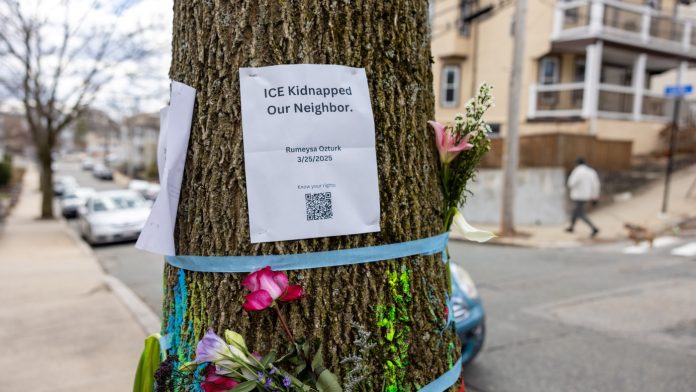
Signage and flowers are placed on a tree next to where ICE agents apprehended Tufts University graduate student Rumeysa Öztürk on March 25 in Somerville, Mass.

Scott Eisen/Getty Images


hide caption

toggle caption

Scott Eisen/Getty Images

On March 25, Rumeysa Öztürk, a 30-year-old Turkish doctoral student at Tufts University, had just stepped out for dinner when she was arrested on the street by six federal agents in masks and plain clothes. Though Öztürk held a valid F-1 student visa, it had been revoked, reportedly without warning. A judge ordered her to be detained in Massachusetts, but authorities moved her to a detention center in a remote part of Louisiana.

Öztürk’s case is not an isolated one. After last year’s protests over the war in Gaza, the Trump administration said it would crack down on “Hamas sympathizers on college campuses.” And ICE agents have descended on college towns across the country in recent weeks. Students have been arrested at Columbia, the University of Minnesota and the University of Alabama.

Boston College law professor Daniel Kanstroom has studied the impact of immigration policy over the last 25 years. He says that the rounding up of students who are here legally is designed to “send a message, … to scare people.”

“This is a horrible thing to see,” Kanstroom says of Öztürk’s arrest. “One would think that tactics like this would be limited to the most extreme cases — SWAT teams or hostage situations — but to see a graduate student in Somerville, Mass., pulled off the street; it had to be terrifying.”

Kanstroom is the founder of the Boston College Immigration and Asylum Clinic, where law students advocate for indigent noncitizens and asylum-seekers. He also directs the Post-Deportation Human Rights Project, which explores the long-term impacts of deportation on families and communities. He says that while the government has the right to control its borders, when that power is exercised, “it has to respect the dignity of the person who is the object of [the government’s] exercise of massive power.”

And, he adds, while this moment is particularly fraught for many, it’s helpful to remember that “we have seen moments like this in U.S. history before.”
 
“[These moments] tend to inspire great solidarity and great forms of activism and resistance, which ultimately have led to legal reforms, important court decisions and a greater understanding of the rights of all of us,” he says. “Not to be too grand about it, but I do think it’s a recurring struggle for the soul of the country. These issues are really fundamental. What kind of a country are we?”

Interview highlights

On the case of Kilmar Armando Abrego Garcia, a Maryland man who the Trump administration mistakenly sent to a prison in El Salvador

[Abrego Garcia] had been under an order from an immigration judge specifically not to be sent to El Salvador. The government has admitted that it was a mistake. And yet they say, well, but there’s nothing we can really do about it because now he’s in the custody of El Salvador. It’s hard to imagine a more terrifying set of facts than that.

And again, although we have seen episodes of massive deportation enforcement throughout the history of this country … it is hard to think of an episode that has been marked by this kind of intimidation and, as I say, needless cruelty. These things can be done in an orderly way. They can be done with respect for human dignity and with respect for the law — and they’re not being done that way now.

On the political strategy to target documented immigrants

It would be basically impossible to round up and deport 10 to 15 million people without establishing a massive and extremely expensive and extremely brutal police state. You would have to have massive raids, you would have to be stopping people all over on the streets. I mean, that sort of enforcement is exceptionally difficult, in large part, because people don’t come with their immigration status stamped on their foreheads. And many of the people who have been living in this country undocumented have been here for decades, or certainly many years. …

But what we’re actually seeing is something quite different. … The goals here seem to be political, not really aimed at immigration enforcement for the undocumented. It’s aimed at the documented. It’s aimed at people here who are students, people here with green cards. I would expect that the next step will be people who have been naturalized citizens. In this sense, it also dovetails with the executive order that was designed to try to overturn the 14th Amendment grant of birthright citizenship. So you would see a tremendous expansion of government power over the bodies and the minds and the words and the writings of many, many millions of people.

On whether or not non-citizens have First Amendment rights

It is both yes and no. And the provision at issue here goes back quite a long way and gives specific authority to the secretary of state with a very vague set of standards [if] the non-citizens’ activities or actions or speech in the United States would have potentially serious foreign policy consequences, and then there’s an even higher standard if they’re trying to deport somebody for things that would be protected under the Constitution if done by a U.S. citizen. So it hasn’t been invoked much, precisely because the courts have never really clarified the exact relationship here. But to the extent that there is precedent for this, I think the precedent is rather strong that the First Amendment does not use the word “citizen.”

On the protections for people with green cards 

I get calls from people all the time asking if they should leave the country. I don’t think we’re at a moment where I’m advising people to leave the country … But I’m certainly advising people to think hard before traveling, and that includes people with green cards, which is pretty unique in my experience. … People who have green cards … have lawful permanent resident status, which, by the way, is status that a person is completely entitled to hold for their whole life, if they want to, or for some reason they can’t naturalize and become a U.S. citizen. That was designed to be a stable, protected status, and it is extremely unusual for the government to start digging around in a person’s past to find reasons to deport a person with a green card.

On why a deportation mistake is hard to fix 

The system is set up in such a way that if once a person is deported, it’s extremely difficult to question that or challenge it. And that’s why judges try to prevent what they think may be wrongful deportations before they happen. That’s what all these temporary restraining orders and injunctions are about. The courts are saying, we need to preserve jurisdiction. There’s an entity called the Board of Immigration Appeals that for many years took the position that once a person has been deported, they said this in one major case, “they have passed beyond our aid.” Now, for a human rights lawyer, that’s a very difficult proposition to accept.

On the recurring immigration debate, going back to the nation’s founding

This debate is very old in this country. It goes back to the founding generation. One of the laws that’s being used now by the Trump administration — again, I would argue in ways that will ultimately be challenged, if not overruled completely by courts — was something called the Alien Enemies Act. And that came from a time when the government, in that case, it was the John Adams administration, had great fear about French revolutionaries and Irish revolutionaries. …

But even at that time, Thomas Jefferson, who opposed this sort of enforcement, said and wrote that “the friendless alien has been selected as the safest subject of a first experiment, but the citizen will soon follow,” or, in fact, has already followed because they were using the so-called Sedition Act against citizens. And every time we’ve seen these episodes, they tend to have a metastatic quality. They expand in dangerous ways because once you let this sort of government power take root, it can be very hard to uproot it.

Monique Nazareth and Thea Chaloner produced and edited this interview for broadcast. Bridget Bentz and Molly Seavy-Nesper adapted it for the web.

Entire Staff Is Fired at LIHEAP

0

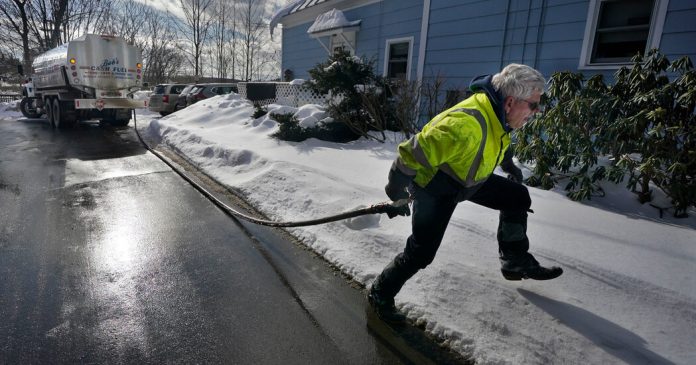
The Trump administration has abruptly laid off the entire staff running a $4.1 billion program to help low-income households across the United States pay their heating and cooling bills.

The firings threaten to paralyze the Low Income Home Energy Assistance Program, which was created by Congress in 1981 and helps to offset high utility bills for roughly 6.2 million people from Maine to Texas during frigid winters and hot summers.

“They fired everybody, there’s nobody left to do anything,” said Mark Wolfe, executive director of the National Energy Assistance Directors Association, which works with states to secure funding from the program. “Either this was incredibly sloppy, or they intend to kill the program altogether.”

The layoffs were part of a broader purge on Monday of approximately 10,000 employees from the Department of Health and Human Services on Monday, as Health Secretary Robert F. Kennedy Jr. moved to drastically reorganize the agency. Roughly 25 employees had been overseeing the energy assistance program, which is also known as LIHEAP. All had been laid off, Mr. Wolfe said.

Congress had approved $4.1 billion for the program for fiscal year 2025, and about 90 percent of that money had already been sent to states in October to help households struggling with high heating costs. There is still about $378 million left to assist with summer cooling as households crank up their air-conditioners. Heat waves in the United States are growing more intense and lasting longer as a result of climate change.

Normally, the federal government sends the money to state agencies after allocating the funds using a complicated formula and performing various reviews and audits. Some states, like Maine, use the money to help low-income families to offset the cost of buying fuel oil to heat their homes in the winter. States also use the money to weatherize homes and provide emergency assistance to households at risk of being disconnected from their utility.

Now, it’s not clear how the remaining funds could be disbursed to the states, even though Congress has explicitly ordered the federal government to spend the money.

“If there’s no staff, how do you allocate the rest of this money?” Mr. Wolfe said. “My fear is that they’ll say we’ve got this funding, but there’s nobody left to administer it, so we can’t send it out.”

In an emailed statement, Emily Hilliard, a spokeswoman for the Department of Health and Human Services, said the agency “will continue to comply” with federal law “and as a result of the reorganization, will be better positioned to execute on Congress’s statutory intent.”

Over the past two months, the Trump administration has repeatedly tried to freeze or withhold spending authorized by Congress. Those moves have triggered a growing number of legal challenges and judicial rulings that say doing so is unconstitutional.

The firings at the energy assistance office triggered a furious response from several Democratic lawmakers.

“What ‘efficiency’ is achieved by firing everyone in Maine whose job is to help Mainers afford heating oil when it’s cold?,” Representative Jared Golden, a Democrat who represents a largely rural district in Maine that voted for President Trump, wrote in a social media post.

Senator Edward Markey, Democrat of Massachusetts, said he would work to try to unlock the program’s funding. “Eliminating the entire federal staff responsible for LIHEAP — a program that millions of households depend on to stay warm in the winter and cool in the summer — isn’t reform,” he said in a statement. “It’s sabotage.”

The office of Senator Susan Collins, Republican of Maine, issued a statement saying: “Senator Collins has been a longtime advocate for LIHEAP and the critical financial assistance it provides to lower income families to help ensure that they can stay warm during the winter months. It is unclear how, and if, the administration of this program will be affected by the HHS staffing changes.”

A study published in The Economic Journal last year found that roughly 17 percent of U.S. households spend more than one-tenth of their income on energy, a threshold that researchers often define as a “severe” energy burden. The study also found a strong relationship between energy affordability and winter mortality.

“When home heating is less affordable, more people die each winter,” Seema Jayachandran, an economist at Princeton and one of the authors of the study, wrote on Monday. “That’s what our analysis found for a period when LIHEAP was in place. Without LIHEAP, the effect would presumably much larger.”

Cory Booker’s record-breaking moment : NPR

0

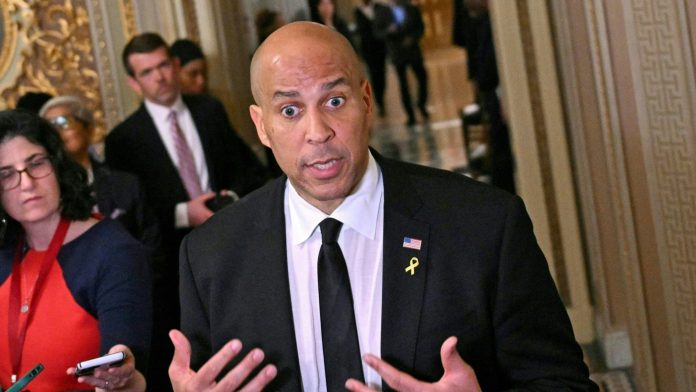
Sen. Cory Booker, D-N.J., speaks to journalists at the Capitol on Tuesday. Booker obliterated a record long held by the late Strom Thurmond, speaking out for more than 25 hours in protest against President Trump’s actions since taking office in January.

Roberto Schmidt/AFP via Getty Images


hide caption

toggle caption

Roberto Schmidt/AFP via Getty Images

Sen. Cory Booker’s marathon speech against President Trump’s economic and social policies set a new record Tuesday night, as Booker, a Democrat, held the floor and spoke for more than 25 hours.

Loud applause filled the chamber as Booker surpassed the record set by Sen. Strom Thurmond in 1957. Senate Minority Leader Chuck Schumer marked the moment by interrupting Booker with a question: “Do you know you have just broken the record?”

“I know now,” Booker said after a lengthy ovation. But he wasn’t done: “I want to not quite wrap this up yet.”

So Booker kept talking, discussing what he repeatedly called “a moral moment” for America. He urged his Republican and Democratic colleagues to protect what Booker said are successful investments and agencies doing vital social and scientific work for the public — but which are targeted for deep cuts by the Trump administration.

“I want to go a little bit past this,” Booker said as he resumed his remarks, sparking laughter as he added, “and then I’m going to deal with some of the biological urgencies I’m feeling.”

Booker’s speech, measured at a few minutes over 25 hours, eclipsed Thurmond’s stand against the Civil Rights Act of 1957 that lasted 24 hours, 18 minutes, according to the Senate Historical Office. In this century, it also surpassed Sen. Ted Cruz’s speech against Obamacare in 2013, which lasted 21 hours, 19 minutes.

During his remarks, the New Jersey Democrat read aloud from messages sent by Americans, stressing the pain they expressed over economic challenges — and their fears that Medicaid and other key programs will face debilitating budget cuts.

Booker called for Republicans who don’t agree with Trump’s economic plans to resist them, citing positions by conservative groups such as the Cato Institute and the Manhattan Institute. He spoke of reading from the Federalist Papers, urging his Senate colleagues to fulfill their role in the system of checks and balances and provide oversight over executive power. 

“This is going to define the character of our country for years and years to come,” he said.

Booker also spoke about two figures who were on opposite sides during the Civil Rights Era: Thurmond and the late Georgia congressman Rep. John Lewis, who urged people to insist on justice by stirring up “good trouble.”

“There’s a room here in the Senate named after Strom Thurmond,” Booker said moments before setting the new record.

“To hate him is wrong. And maybe my ego got too caught up — that if I stood here, maybe, maybe, just maybe I could break this record,” he said of Thurmond.

“The man who tried to stop the rights upon which I stand. I’m not here, though, because of his speech,” Booker said. “I’m here despite his speech. I’m here because as powerful as he was, the people were more powerful.”

Booker then relayed a story Lewis told him when the two were in Georgia, about meeting a man who, years ago, had beaten him up when Lewis was an activist protesting segregation and racial discrimination.

“Decades later, he was a congressman,” Booker said of Lewis. “That man brought his grandson with him to ask for forgiveness from John Lewis.”

“What did you do?” Booker recalled asking.

“And a good Christian man, man of faith, simply said, ‘Every one of us needs mercy. Every one of us needs redemption. I forgave him. I hugged him, we wept and I looked at the boy. This nation needs you too.’ “

As Booker paused, Schumer asked him to yield for a question, confirming that he had just moved past Thurmond’s mark.

Afterward, Booker said it had bothered him that Thurmond held a high-profile Senate record for nearly seven decades.

“I just found it strange that he had the record,” Booker said. “And as a guy who grew up with legends of the Civil Rights Movement myself — my parents and their friends — it just seemed wrong to me, always seemed wrong.”

Desperation Grows in Gaza as U.N. Shutters Bakeries

0

Bilal Mohammad Ramadan AbuKresh has lost his home, his job, his wife and seven other relatives during the war in Gaza. Now, as the United Nations closes 25 bakeries across the territory, he is also losing his only reliable source of food.

Before Wednesday, Mr. AbuKresh, 40, said he would leave his tent in a camp for displaced people in northern Gaza at dawn and stand in line for hours at one of the bakeries, waiting for bread for his four children.

“The line was unimaginable, like the Day of Judgment,” Mr. AbuKresh said on Wednesday, the day after the World Food Program, a U.N. agency, said it had run out of the flour and fuel needed to keep the bakeries in Gaza open.

But at least it was affordable, compared to the $30 he paid for a bag of pasta that he bought recently to feed his family.

The lack of humanitarian aid deliveries to Gaza over the past month has prompted violent competition for food and driven up prices.

Mr. AbuKresh said he has resorted to selling his children’s jewelry and collecting trash to sell to scrounge up enough money just to buy a bit of food. “To secure a bag of bread for my children, I risk death a hundred times,” he said.

As well as the bakery closures, the World Food Program said on Tuesday that it would distribute its last food parcels by Thursday, and that its remaining supplies in Gaza were expected to run out within two weeks.

The announcement prompted desperate Gazans to rush to U.N. warehouses this week to haul away heavy bags of flour that were being handed out.

The decision to close the bakeries came almost a month after Prime Minister Benjamin Netanyahu of Israel ordered a halt to all humanitarian aid into Gaza, in an attempt to pressure Hamas into accepting a new hostage release deal as cease-fire negotiations have stalled.

The aid has not resumed and a fragile two-month truce between Israel and Hamas collapsed two weeks later, when Israel launched new airstrikes on the territory.

The bakeries used as much as 300 tons of flour each day, producing enough bread to supply about 70 percent of Gaza’s population, Abdel Nasser al-Ajrami, head of the enclave’s bakers’ association, said in an interview. Five other bakeries in Gaza had already closed last month, he said, when they ran out of supplies.

“Where will people get their food from?” Mr. al-Ajrami said, worrying aloud that Gaza was headed toward an even deeper humanitarian crisis. The United Nations has said the escalating war in Gaza has led to “unprecedented” need for aid, estimating 91 percent of its population is facing acute food insecurity.

Nearly one-third of the bread made at the U.N.-funded bakeries was distributed for free, he said, and much of the rest was sold as packets of pita for as little as 50 cents.

“It was a way to support thousands of Gazans who lost their jobs and a source of income during the war,” Mr. al-Ajrami said, voicing concern that food shortages could lead to unrest.

“This might cause chaos again across Gaza as people would start fighting for a piece of bread. There might be looting again,” he said.

For weeks, the United Nations has sounded the alarm that humanitarian aid supplies were dwindling, and that attempts to gain access for aid convoys lined up at the border crossings had failed. It has accused Israel of routinely denying U.N. requests for broader efforts to coordinate humanitarian movement inside the enclave, and has said the Israeli army’s no-go zones and evacuation order areas covered more than half of Gaza.

COGAT, the Israeli military unit responsible for coordinating aid deliveries to Palestinian territories, said in a social media post on Tuesday that 450,000 tons of assistance was delivered to Gaza during the two-month cease-fire, and less than 30 percent of it was from the United Nations.

“Meaning, when the U.N. say they have 2 weeks worth of aid left in Gaza, there are plenty of other aid organizations and other actors with food aid,” COGAT said. “Much of the aid was diverted and available on the markets,” it added. “There is enough food for a long period of time, if Hamas lets the civilians have it.”

In a sharp response to Israel, U.N. spokesman Stéphane Dujarric said aid must be allowed into Gaza immediately and called claims that Gaza had enough food “ridiculous.”

“W.F.P. doesn’t close its bakeries for fun,” he told reporters at the U.N. headquarters in New York. “If there’s no flour, if there’s no cooking gas, the bakeries cannot open.”

During the cease-fire, “we saw humanitarian aid flood Gaza,” he said. “We saw markets come back to life. We saw prices going down. We saw hostages released, we saw Palestinian detainees released. We need to go back to that.”

Mr. AbuKresh said his family was living in “unimaginable circumstances” and barely surviving.

“This is beyond description,” he said. “We’ve surrendered to death.”

Farnaz Fassihi contributed reporting.

Congress grinds to a halt as uprisings in both chambers derail GOP legislative agenda

0

Congress ground to a halt due to uprisings in both chambers. Sen. Cory Booker gave a record-breaking speech, and a fight in the House over remote voting for new parents brought work to a standstill.

Shingles Vaccine Can Decrease Risk of Dementia, Study Finds

0

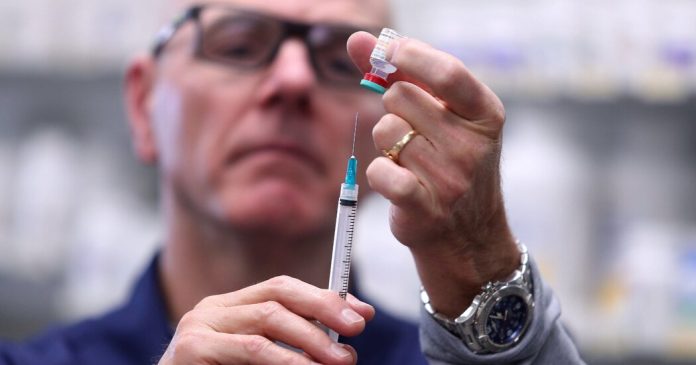
Getting vaccinated against shingles can reduce the risk of developing dementia, a large new study finds.

The results provide some of the strongest evidence yet that some viral infections can have effects on brain function years later and that preventing them can help stave off cognitive decline.

The study, published on Wednesday in the journal Nature, found that people who received the shingles vaccine were 20 percent less likely to develop dementia in the seven years afterward than those who were not vaccinated.

“If you’re reducing the risk of dementia by 20 percent, that’s quite important in a public health context, given that we don’t really have much else at the moment that slows down the onset of dementia,” said Dr. Paul Harrison, a professor of psychiatry at Oxford. Dr. Harrison was not involved in the new study, but has done other research indicating that shingles vaccines lower dementia risk.

Whether the protection can last beyond seven years can only be determined with further research. But with few currently effective treatments or preventions, Dr. Harrison said, shingles vaccines appear to have “some of the strongest potential protective effects against dementia that we know of that are potentially usable in practice.”

Shingles cases stem from the virus that causes childhood chickenpox, varicella-zoster, which typically remains dormant in nerve cells for decades. As people age and their immune systems weaken, the virus can reactivate and cause shingles, with symptoms like burning, tingling, painful blisters and numbness. The nerve pain can become chronic and disabling.

In the United States, about one in three people develop at least one case of shingles, also called herpes zoster, in their lifetime, the Centers for Disease Control and Prevention estimates. About a third of eligible adults have received the vaccine in recent years, according to the C.D.C.

Several previous studies have suggested that shingles vaccinations might reduce dementia risk, but most could not exclude the possibility that people who get vaccinated might have other dementia-protective characteristics, like healthier lifestyles, better diets or more years of education.

The new study ruled out many of those factors.

“It’s pretty strong evidence,” said Dr. Anupam Jena, a health economist and physician at Harvard Medical School, who was not involved in the study but reviewed it for Nature.

The study emerged from an unusual aspect of a shingles vaccine rollout in Wales on Sept. 1, 2013. Welsh officials established a strict age requirement: people who were 79 on that date were eligible for the vaccine for one year, but those 80 and older, were ineligible. As younger people turned 79, they became eligible for the vaccine for one year.

The age cutoff — imposed because of a limited supply and because the vaccine was then considered less effective for people over 80 — set up a “natural experiment,” said Dr. Pascal Geldsetzer, an assistant professor of medicine at Stanford and the study’s senior author.

It allowed scientists to compare relatively equal groups: people eligible for the vaccine with people just slightly older who couldn’t get it. “If I take 1,000 people born one week and 1,000 people born one week later, there shouldn’t be any difference between them, except for the large difference in the vaccination uptake,” Dr. Geldsetzer said.

Researchers tracked health records of about 280,000 people who were age 71 to 88 and without dementia when the rollout began. Over seven years, nearly half of those eligible for the vaccine received it, while only a tiny number from the ineligible group were vaccinated, providing a clear before-and-after distinction.

To limit the likelihood of differences between the groups, researchers used statistical analysis to more heavily weigh data from people just one week on either side of the cutoff: those who turned 80 in the week before rollout and those who turned 80 in the week after.

They also examined medical records for possible differences between the vaccinated and unvaccinated. They evaluated whether unvaccinated people received more diagnoses of dementia simply because they visited doctors more frequently, and whether they took more medications that could increase dementia risk.

“They do a pretty good job at that,” said Dr. Jena, who wrote a commentary about the study for Nature. “They look at almost 200 medications that have been shown to be at least associated with elevated Alzheimer’s risk.”

He said, “They go through a lot of effort to figure out whether or not there might be other things that are timed with that age cutoff, any other medical policy changes, and that doesn’t seem to be it.”

The study involved an older form of shingles vaccine, Zostavax, which contains a modified version of the live virus. It has since been discontinued in the United States and some other countries because its protection against shingles wanes over time. The new vaccine, Shingrix, which contains an inactivated portion of the virus, is more effective and lasting, research shows.

A study last year by Dr. Harrison and colleagues suggested that Shingrix may be more protective against dementia than the older vaccine. Based on another “natural experiment,” the 2017 shift in the United States from Zostavax to Shingrix, it found that over six years, people who had received the new vaccine had fewer dementia diagnoses than those who got the old one. Of the people diagnosed with dementia, those who received the new vaccine had nearly six months more time before developing the condition than people who received the old vaccine.

There are different theories about why shingles vaccines might protect against dementia. One possibility is that by preventing shingles, vaccines reduce the neuroinflammation caused by reactivation of the virus, Dr. Geldsetzer said. “Inflammation is a bad thing for many chronic diseases, including dementia,” he said, so “reducing these reactivations and the accompanying inflammation may have benefits for dementia.”

Both the new study and the Shingrix study provide support for that theory.

Another possibility is that the vaccines rev up the immune system more broadly. The new study offers some evidence for that theory too. It found that women, who have more reactive immune systems and larger antibody responses to vaccination than men, experienced greater protection against dementia than men, Dr. Geldsetzer said. The vaccine also had a bigger protective effect against dementia among people with autoimmune conditions and allergies.

Dr. Maria Nagel, a professor of neurology at University of Colorado School of Medicine, who was not involved in the study, said both theories could be true. “There’s evidence for a direct effect as well as an indirect effect,”, said Dr. Nagel, who has consulted for the manufacturer of Shingrix, GSK.

She said some studies have found that other vaccines, including those against flu, create a generalized neuroprotective effect, but that because the shingles virus hides in nerves, it makes sense that a shingles vaccine would be particularly protective against cognitive impairment.

The study did not distinguish between types of dementia, but other research suggests that “the effect of the shingles vaccine for Alzheimer’s disease is much more pronounced than for another dementia,” said Svetlana Ukraintseva, a biologist at Duke who coauthored a recent study on Alzheimer’s and other dementias and vaccines. She said that might be because some Alzheimer’s cases are associated with compromised immunity.

The Welsh population in the study was mostly white, Dr. Geldsetzer said, but the report also suggested similar protective effects by analyzing death certificates in England for deaths caused by dementia. His team has also replicated the results in Australia, New Zealand and Canada.

Dr. Jena said the connection should be studied further and noted that reducing dementia risk is not the same as preventing all cases. Still, he said, the evidence suggests that “something about the exposure or access to the vaccine has this effect on dementia risk years later.”

Trump endorsement and Musk's money not enough to flip Wisconsin Supreme Court

0

President Trump’s endorsement and Elon Musk’s money weren’t enough to flip the Wisconsin Supreme Court, which liberals will hold onto. Abortion, redistricting and Tesla could come before the court.

Death Sentences Commuted for 3 Americans Over Failed Congo Coup

0

Three American citizens who were sentenced to death over a failed coup attempt in the Democratic Republic of Congo have had their sentences commuted to life imprisonment, according to a spokeswoman for the Central African country’s president.

The three Americans were among 37 people condemned to death last September after taking part in a May 2024 attack on the government that was streamed live and included a gun battle near the presidential palace.

Security forces killed the coup leader, Christian Malanga, a minor opposition politician. But his son, Marcel Malanga, was arrested along with his high school friend Tyler Thompson and Benjamin Zalman-Polun, a business associate of Christian Malanga’s.

Those three men — who are all American citizens — were singled out and granted “individual clemency,” Tina Salama, the Congolese president’s spokeswoman, said in a post late Tuesday on X. There was no immediate comment from the U.S. State Department.

Congo has been trying to enlist American support against neighboring Rwanda and a rebel militia that Rwanda directs and arms, M23. Since January, M23 has torn through eastern Congo, seizing vast tracts of land and major cities. Thousands of civilians, soldiers and allied militia fighters have been killed in the rebel offensive, which has also left millions destitute.

In an interview with The New York Times in February, Congo’s president, Felix Tshisekedi, offered the United States a stake in his country’s vast mineral wealth, saying that such a deal would bring his country more security and stability. Experts agree that U.S. pressure on Rwanda could be one of the few things that might induce M23 to pull back.

But later that month, President Trump’s special envoy for hostages, Adam Boehler, linked the conflict to the fate of the three American citizens.

“The President of Congo is holding 3 Americans now,” he wrote on X. “Perhaps it would be better if Rwanda won the war?”

Marcel Malanga has denied involvement in planning the coup, saying that he and Mr. Thompson were forced to join in while visiting his father.

At around the same time that Ms. Salama announced clemency for the men on Tuesday, the U.S. State Department released a statement saying that it had appointed a senior adviser for Africa, Massad Boulos. It said that Mr. Boulos would travel to Congo on Thursday and then to neighboring countries, including Rwanda, “to advance efforts for durable peace in eastern Democratic Republic of the Congo and to promote U.S. private-sector investment in the region.”

Mr. Boulos — whose son is married to one of Mr. Trump’s daughters — has spent much of his career in Nigeria, where he is chief executive of a family business that sells trucks and heavy machinery. He was previously named as the president’s senior adviser on Arab and Middle Eastern Affairs after helping persuade Arab American voters in Michigan to support Mr. Trump, though it was unclear what exactly that role entails.

Since taking office, Mr. Trump has taken a transactional approach to foreign policy, seeking deference and business deals from U.S. allies in return for help.

Some Congolese observers said that in the context of a possible minerals deal, the clemency granted to the three Americans was to be expected. But others criticized their president for applying double standards to Americans and Congolese.

“When we say that in Congo foreigners are treated better than citizens, here is the proof,” Sylvain-Parizel Kapay, a lawyer based in Kinshasa, wrote on social media.