Thursday, November 12, 2026
Home Blog Page 63

What does Trump’s Liberation Day mean for tariffs and prices : NPR

0

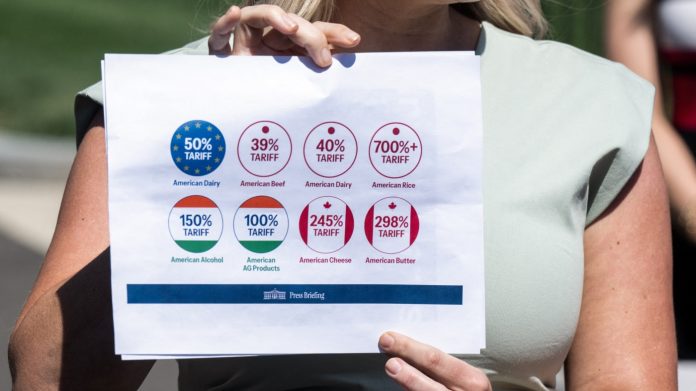
White House press secretary Karoline Leavitt holds up a chart showing tariffs on American goods as she speaks with reporters at the White House on March 31, 2025.

Saul Loeb/AFP


hide caption

toggle caption

Saul Loeb/AFP

On Wednesday, President Trump is set to unveil what he has been calling “reciprocal tariffs” — taxes on imported goods from a broad range of countries aimed at penalizing them for their trade barriers.

It’s a push he is branding as “Liberation Day,” promising it will bring in foreign tariff revenues to be put toward U.S. tax cuts and deficit reduction, and spur a renaissance in U.S. manufacturing.

But the pledge has glossed over the pain expected to be felt by U.S. consumers who economists expect will end up paying higher prices — and by U.S. farmers and exporters targeted for retaliation by other countries.

Some U.S. manufacturers will be hurt by higher costs for imported materials. And mainstream economists are skeptical that the tariffs will bring in as much revenue as Trump has promised.

While details on his plans are sketchy, the Yale Budget Lab estimated the scheme could cost the average American consumer $2,700-$3,400 per year.

The uncertainty over the policy has roiled the economy. The S&P 500 stock index just closed out its worst quarter since 2022, and consumer confidence recently hit a 12-year low.

Trump had vowed that the tariffs will mirror what other countries impose on U.S. goods. But lately, he has appeared to moderate his tone.

“They took advantage of us,” Trump told reporters on Monday. “And we are going to be very nice by comparison to what they were. The numbers will be lower than what they’ve been charging us and, in some cases, maybe substantially lower.”

The Canadian government has placed anti-tariff billboards in numerous American cities, including this one in Miramar, Fla.

The Canadian government has placed anti-tariff billboards in numerous American cities, including this one in Miramar, Fla.

Joe Raedle/Getty Images


hide caption

toggle caption

Joe Raedle/Getty Images

Few details about what countries, what products will be hit

Trump’s economic policy has been unique not only in his aggressive rhetoric around tariffs but also in the vagueness and unpredictability surrounding his policy announcements.

Thus far, he has imposed tariffs on steel and aluminum, Chinese goods, and some goods from Mexico and Canada. But he has also threatened, delayed, or withdrawn tariffs on an array of other goods, often telegraphing new potential moves while providing few to no details.

The reciprocal tariffs are another example in this pattern. A February 13 memo laid out the start of the process, instructing Cabinet members and advisers to study how “non-reciprocal” trade relationships might be harming the U.S. economy, then submit reports that propose ways to make trade with any given country “reciprocal.”

At the time, Commerce Secretary Howard Lutnick said those studies would be done by April 1. “We will hand the president the opportunity to start on April 2, if he wants,” Lutnick said.

That still leaves flexibility in the timing of imposing the tariffs. While it’s not clear when specific tariffs will come into effect, White House press secretary Karoline Leavitt said on Tuesday that they would be imposed “immediately.”

Traders work on the floor of the New York Stock Exchange on March 28, 2025. President Trump's escalating tariff threats have hit stock prices hard.

Traders work on the floor of the New York Stock Exchange on March 28, 2025. President Trump’s escalating tariff threats have hit stock prices hard.

Spencer Platt/Getty Images


hide caption

toggle caption

Spencer Platt/Getty Images

Trump’s tone on tariffs has softened recently

The White House has not given any details on which countries Trump plans to tariff first. However, while speaking to reporters this week, Leavitt may have provided some clues, holding up a chart showing steep tariffs that Japan, Mexico, Canada, and the European Union impose on certain American goods.

Trump also has said at times that the tariffs will take into account “non-tariff barriers” like subsidies and regulations. But he hasn’t mentioned that lately.

“In fact, I’ll probably be more lenient than reciprocal because if I was reciprocal, that would be — that would be very tough for people,” Trump said in an interview last week with Newsmax.

Trump has left the door open to negotiations, though he has insisted he wants “not too many” exemptions from the reciprocal tariffs.

Will the tariffs be broad or targeted?

A more conventional approach to pressuring other countries to lower their tariffs might be to specifically target a country or a good, said Doug Irwin, professor of economics at Dartmouth College.

“What’s less normal is when you have a much more vague objective, a broad-brush approach to many countries, many possible sectors,” he said. “Things are unfair in different ways with different countries. And it’s very hard to have a uniform, blanket approach to all of that.”

John Veroneau, a deputy U.S. Trade Representative in the George W. Bush administration, agreed that targeted tariffs are more effective.

“There are some unfair trade practices out there. So to the extent that you threaten tariffs … that would call for a very surgical approach,” Veroneau said. “These tariffs presumably will far exceed the number of U.S. exporters that are complaining to this administration or previous administrations about very specific trade barriers.”

Veroneau added that this is symptomatic of a bigger problem with how Trump talks about tariffs as a solution to a wide range of policy problems, some of which conflict with each other.

“The problem that I think surrounds so many of Trump’s commentary and comments about tariffs is, what is the goal of the tariff?” he said.

Fire Briefly Disrupts Heathrow Airport Train Service

0

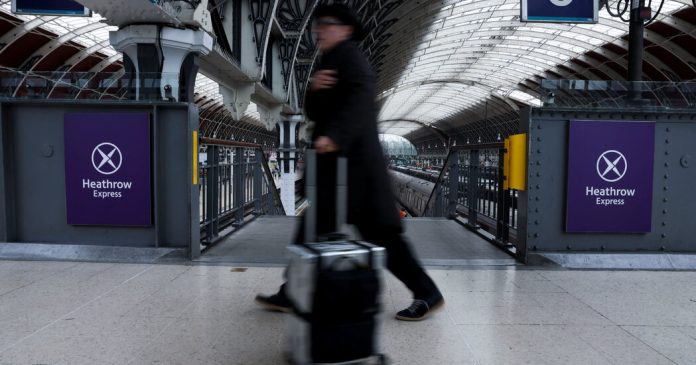
Train service between Heathrow Airport and central London was briefly disrupted on Wednesday morning because of a fire next to a track.

Trains linking Paddington Station with Heathrow’s Terminal 5 may be canceled or face delays of up to 30 minutes because of the fire, National Rail said in an incident report. It did not provide the exact location of the fire or what caused it.

Rail lines had reopened but the disruption was expected to last until 12 p.m. local time, National Rail said in an update.

Last month, a fire at an electrical substation knocked out power at Heathrow and forced the airport, one of the world’s busiest, to shut down for almost a whole day. The closure disrupted air travel for tens of thousands of passengers around the world.

There was no immediate comment from the London Fire Brigade and Heathrow Airport on the disruption reported by National Rail on Wednesday.

Danish prime minister heads to Greenland as Trump seeks control of the territory : NPR

0

A boat rides through a frozen sea inlet outside of Nuuk, Greenland on March 6.

Evgeniy Maloletka/AP


hide caption

toggle caption

Evgeniy Maloletka/AP

NUUK, Greenland — Danish Prime Minister Mette Frederiksen is traveling to Greenland on Wednesday for a three-day trip aimed at building the trust of Greenlandic officials at a time that the Trump administration is seeking control of the vast Arctic territory.

Prime Minister Mette Frederiksen announced plans for her visit after U.S. Vice President JD Vance visited a U.S. air base in Greenland last week and accused Denmark of underinvesting in the territory.

Greenland is a mineral-rich, strategically critical island that is becoming more accessible due to climate change. Trump has said that the landmass is critical to U.S. security. It is part of North America but is a semiautonomous territory belonging to the Kingdom of Denmark.

Frederiksen is due to meet the incoming Greenlandic leader, Jens-Frederik Nielsen, after an election last month that produced a new government. She is also to meet with the future Naalakkersuisut, the Cabinet, in a visit due to last through Friday.

“It has my deepest respect how the Greenlandic people and the Greenlandic politicians handle the great pressure that is on Greenland,” she said in government statement announcing the visit.

On the agenda are talks with Nielsen about cooperation between Greenland and Denmark.

For years, the people of Greenland, with a population of about 57,000, have been working toward eventual independence from Denmark.

The Trump administration’s threats to take control of the island one way or the other, possibly even with military force, have angered many in Greenland and Denmark. The incoming government wants to take a slower approach on the question of eventual independence.

The political group in Greenland most sympathetic to the U.S. president, the Naleraq party that advocates a swift path toward independence, was excluded from coalition talks to form the next government.

Peter Viggo Jakobsen, associate professor at the Danish Defense Academy, said last week that Trump administration’s aspirations for Greenland could backfire and push the more mild parties closer to Denmark.

He said that “Trump has scared most Greenlanders away from this idea about a close relationship to the United States because they don’t trust him.”

Angola Rail Line Offers Clues to Trump’s Africa Policy

0

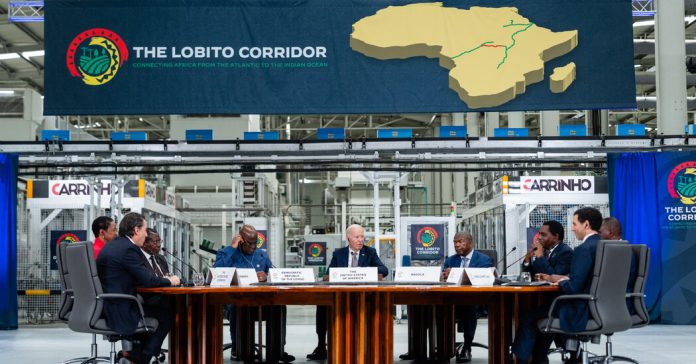
An 800-mile rail corridor stretching from Angola’s northern border to the Atlantic Ocean was former President Joseph R. Biden Jr.’s signature project in Africa, meant to counter Chinese influence and reshape America’s engagement with the continent.

When President Trump came into office this year, he quickly moved to dismantle decades of American aid to Africa, raising fears that the United States was pulling back from its commitments. The future of America’s involvement in the rail project was an open question.

But this week, the acting U.S. ambassador in Angola, James Story, gave the first indication that the Trump administration was on board with the project, the Lobito Corridor, which is expected to improve America’s access to minerals like cobalt and copper that are critical to the clean-energy transition.

Mr. Story, who arrived in Angola last October, is leading a delegation of more than a dozen, mostly Western envoys on a three-day publicity tour along the rail line, including visits with local politicians.

As Mr. Trump continues to craft his own Africa team, the tour offered clues to how he plans to shape his policy on the continent, and the ways in which it may align with or depart from Mr. Biden’s approach.

“The Trump administration is all about making business to favor the United States,” said Osvaldo Mboco, a professor of international relations at the Technical University of Angola in the capital, Luanda.

Although no Trump officials from Washington came on the tour, Mr. Story said the administration supported the effort. The purpose, he added, was to show international solidarity, look for investment opportunities and make clear that the United States and its Western allies are not walking away from the project.

The railway was initially completed in 1931, running from Angola’s border with the Democratic Republic of Congo — home to the world’s largest cobalt reserves — to the port city of Lobito on the west coast. China funded the rehabilitation of the line a little more than a decade ago.

Under the Biden administration, the United States committed about $4 billion to various projects along the corridor, including refurbishing the rail line, and developing mining and agricultural projects.

Mr. Biden pitched the corridor as part of America’s new approach to engaging with Africa — focusing more on commercial partnerships, rather than just aid and extracting natural resources. He saw it as an answer to China’s longtime engagement with African nations, which has resulted in the construction of new cities, airports, highways and shopping centers.

Biden administration officials said the railway would entice companies to build manufacturing plants nearby so they could transport goods, and would give local farmers a way to ship their produce.

It is unclear if the Trump administration will champion those broader economic benefits of the rail line or focus squarely on increasing American access to minerals.

“Is this just about the refurbishment of a rail or is it about investing in telecoms and alternative energy sources and food security,” said Judd Devermont, who was one of Mr. Biden’s top advisers on Africa.

The project’s ambitions already have been affected by some of Mr. Trump’s policies. An initiative meant to teach women better farming techniques, with the hope of increasing agricultural production along the rail line, was shut down after Mr. Trump defunded the United States Agency for International Development.

There are some early indications, however, that the Trump administration might be looking for business investments in Africa.

Ben Black, the president’s nominee to run the U.S. International Development Finance Corporation, which lends billions to overseas projects and has been one of America’s main funders along the Lobito Corridor, has said he wants to take an “investment-driven” approach to overseas spending.

Adam Cortese, the chief executive of Sun Africa, an American solar energy company with U.S. government-backed projects along the corridor and in Nigeria, said his engagements with Trump officials had been encouraging. The officials have expressed a desire to invest in developing Africa’s energy infrastructure, he said.

“They support production as long as it has to do with U.S. companies,” he said, adding that his company’s primary competitors in Africa are Chinese state-owned entities. “There certainly seems to be a lot of support for increasing U.S. competition with China.”

Although Mr. Trump has not explicitly expressed support for the Lobito Corridor project, Ricardo Viegas D’Abreu, Angola’s transportation minister, said this week’s diplomatic mission was a positive signal. Angola’s president has said that strengthening economic ties with the United States is essential to help his oil-rich country grow and diversify its economy.

“We feel that no major disruption has happened even on the transition to this new administration,” Mr. D’Abreu said of the progress on the Lobito project.

Ultimately, the benefit that Angola and other African nations get from doing business with Mr. Trump will come down to how those countries position themselves, said Mr. Mboco, the international relations professor. They will need to strike deals that include U.S. investment in manufacturing in Africa, rather than allowing Americans to just extract natural resources, he said.

“Africa needs to stop being the poor family member,” Mr. Mboco said.

Military Fires on Chinese Red Cross Aid Convoy in Myanmar, Rebels Say

0

Soldiers in Myanmar opened fire on a convoy of vehicles carrying relief supplies from the Chinese Red Cross for earthquake victims in the badly hit city of Mandalay, according to a rebel armed group in Myanmar.

The attack was the latest indication that the military, which seized power in a coup four years ago and is fighting a fierce civil war that has caused widespread suffering, would not stop hostilities despite last Friday’s devastating earthquake that killed at least 2,700.

In a statement on Tuesday night, Myanmar’s junta chief, Senior Gen. Min Aung Hlaing, said military operations will continue as “necessary protective measures” despite the earthquake.

The convoy came under attack by military forces using machine guns at 9:21 p.m. on Tuesday at Ummati village in Naung Cho township as it was traveling toward the central city of Mandalay, the Ta’ang National Liberation Army (TNLA) said in a post on its Telegram channel late on Tuesday. It did not say how many people were in the convoy or whether there were any fatalities or injuries.

As a result of the attack, the convoy had to retreat to Naung Cho, according to the TNLA. It said that it has stepped in to protect the convoy, ensuring that it continues its journey to deliver aid to those in need.

Myanmar’s military and the Red Cross Society of China did not immediately respond to requests for comment. China, which has close relations with Myanmar, was one of the first countries to respond to the earthquake, deploying search-and-rescue teams and sending about $14 million in emergency aid.

In the wake of the disaster, the National Unity Government, the shadow government in exile, and the Three Brotherhood Alliance, made up of three rebel groups including the TNLA, announced cease-fires.

But the army has continued to bomb parts of the country since the disaster. On Tuesday around 5.30 p.m., 38 young trainees of the Kachin Independence Army (K.I.A.), an armed group battling the military in northern Myanmar, were killed in an airstrike in Kachin State, according to Colonel Naw Bu, the spokesman of the K.I.A.

It is unclear why the Chinese Red Cross vehicles were targeted. But the attack underscores the chaos and challenges of delivering aid in a war zone. Since the coup, a total of 6,476 people, including pro-democracy activists and civilians, have been killed by the junta and pro-military groups, according to the Assistance Association for Political Prisoners, an advocacy group.

In recent days, international aid groups such as the World Food Program and UNICEF have entered Mandalay and the neighboring war-torn region of Sagaing, a stronghold of the resistance where desperate people say food and water are running out fast.

But locals in both places have said their attempts to help with search and rescue have been stymied by the military, which has blocked them from entering collapsed buildings and imposed curfews.

Wednesday Briefing

0

Election results in the U.S.

China’s New Barges Reveal How it Might Try to Seize Taiwan

0

In recent weeks, China has been practicing unusual maneuvers off its southern coast involving three special barges. The vessels have linked up one behind another, forming a long bridge that extends from deeper waters onto the beach.

That feat has been a warning to Taiwan.

The vessels’ debut suggests that China’s People’s Liberation Army may be a step closer to being able to land tens of thousands of troops and their weapons and vehicles on Taiwan’s shores, experts say. Developing that capability has been a priority of China’s leader, Xi Jinping, in his quest to absorb Taiwan — either by negotiations or by war.

China has been conducting military exercises around Taiwan for years, including a new surge this week. But even as China’s drills have intensified, and its missiles, warships and fighter jets have advanced, many experts have doubted that the Chinese military could cross the Taiwan Strait with the speed and numbers needed for a successful invasion. Strong winds and currents for much of the year add to the dangers of trying to land on Taiwan.

If the new barges go into service, they could expand China’s options for where and when to land on Taiwan, making Mr. Xi’s threat of a possible invasion more plausible.

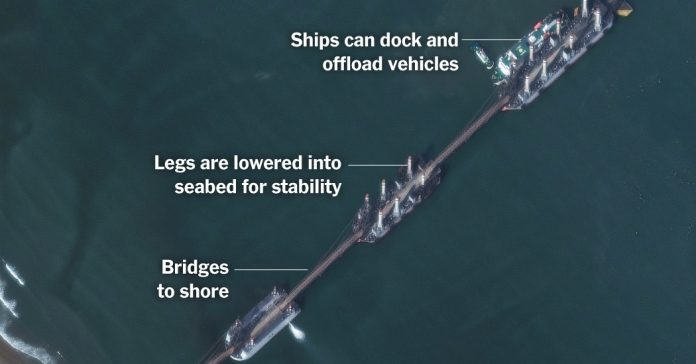
The vessels have been practicing in waters about 220 miles southwest of Guangzhou, the city where they were built. The barges have retractable, heavy-duty legs that work like giant stilts. The legs protrude from the deck when in transit and are lowered, when the vessels are in position, onto the seabed to steady the vessels against the waves. The barges then thrust out long extendable bridges, forming a 2,700-foot causeway that links the vessels together and connects to the shore.

Pictures from foreign satellites have shown the barges practicing with civilian Chinese cargo ships and ferries that could carry vehicles and people to be offloaded onto the causeway. China featured the barges on a recent program about military rivalry with Taiwan, warning that they could play a potential role in an attack.

“This equipment is a bridge and a port combined into one,” Wei Dongxu, a CCTV commentator on the show, said of the barges. Once China gains dominance in the skies and seas, he said, ships loaded with military vehicles could dock with the barges and unload the vehicles, enabling heavy combat equipment to land without touching the water. He said of the barges: “Once they appear, that means that the landing has scored a major victory.”

Some American commanders and officials have said that Mr. Xi has ordered the People’s Liberation Army to be able to take Taiwan by 2027. Mr. Xi has not said that China would definitely invade Taiwan, and there is debate about Beijing’s intentions, urgency and capabilities.

Crossing the Taiwan Strait could be perilous for China’s forces, even with more options for getting ashore. The United States could send forces to help Taiwan against China, raising the risk of war between two nuclear powers. Before any attempt by China to land in large numbers — possibly with the barges — the first wave of invading troops could face fierce fighting in the strait and on Taiwan.

But the three landing barges showed that China’s armed forces were rapidly developing ways to get over logistical hurdles of a possible invasion, said J. Michael Dahm, a retired U.S. Navy intelligence officer and co-author of a study of the new barges.

The barges work in sets of three — the longest barge, at 607 feet long, the shortest, 361 feet. The vessels’ legs, when lowered, pin the barges in place and can push the hulls up and above the water, for stability. Each barge also has a tower at the front, which can telescope out a bridge, connecting it to the next barge or to the shore.

The barges form a pier onto which ships that line up alongside the barges could disgorge vehicles. The vehicles could then drive directly along the pier to the shore.

Mr. Dahm said that he used to doubt that the Chinese military would meet Mr. Xi’s goal of readiness by 2027.

“I will tell you my mind has really been changed over just the last 12 to 18 months, seeing the scale of infrastructure and capability improvements that the Chinese have made,” such as the landing barges, he said.

The barges first came to public attention early this year, after H.I. Sutton, a defense analyst, reported that they were being built in a shipyard in Guangzhou.

The Times analyzed satellite imagery and marine traffic data that showed that several commercial ferries and cargo ships took part in the exercises. The commercial ships sidled up to the two larger barges farthest from shore, apparently practicing how to get in place to offload vehicles.

The satellite images did not show any vehicles actually being unloaded. But ferries and cargo ships that took part were of a kind built or modified to handle heavy armed vehicles, like armored personnel vehicles or even tanks, said Jason Wang, the chief operating officer of ingeniSPACE, a company that analyzes satellite images and other data, including about the Chinese military.

Taiwan’s western coastline, facing the Chinese mainland, has relatively few beaches or ports where landing is easy, and those areas are relatively well guarded. The barges would theoretically enable China to pick other areas on Taiwan’s coast that might be more difficult to land on but are less defended, from which to come ashore, several experts said.

“These barges will open up new locations to deliver troops and material for Xi Jinping to choose from” along Taiwan’s coast, Mr. Wang said. He estimated that in one day the barges could offload hundreds of armored vehicles.

“China still doesn’t have enough gray hull naval ships to assault Taiwan’s main island on their own,” Mr. Wang said, referring to the typical color of warships. But when you add specialized dual-use ferries and cargo ships, “then that becomes a different story,” he said.

“You’re then starting to have enough vessels to be able to deliver a battalion on shore quickly,” he said.

Chinese military planners have closely studied previous wars involving amphibious landings, including Britain’s war to retake the Falkland Islands in 1982, and the D-Day landings at Normandy in 1944.

China may be some way from having a surefire solution to landing on Taiwan. The People’s Liberation Army seems likely to further test the new barges in larger military drills, possibly later this year, said Chieh Chung, a researcher at Taiwan’s Institute for National Defense and Security Research, a government-funded group in Taipei.

“They usually carry out testing through exercises before officially entering into mass production,” he said of China’s military. “Their direction is set — how to overcome all the difficulties that could trouble a joint landing operation.”

During the recent practice runs, it took several hours for the transport ships to dock at the mobile pier, even with help from tugboats. On March 25, one ship appeared to abandon its effort to dock at the pier where two other ships were already berthed. It succeeded the next day and was joined by a small tanker used to refuel the self-propelled barges, making for a total of four ships moored at the same time — a first for the formation.

Mr. Wang, the expert on satellite image analysis, said that at the shipyard in Guangzhou that built the new barges, another set of three was nearly finished and had entered the water for initial tests.

Robin Stein contributed reporting from New York.

Liberals keep Wisconsin Supreme Court despite Trump and Musk : NPR

0

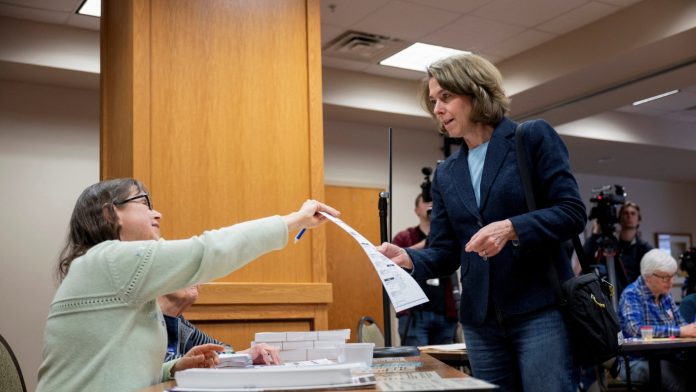
Susan Crawford, Wisconsin Supreme Court candidate, receives her ballot to cast her vote in the Wisconsin Supreme Court election in Madison, Wisconsin Tuesday.

Vincent Alban/Reuters


hide caption

toggle caption

Vincent Alban/Reuters

MADISON, Wisc. – County judge Susan Crawford has won election to the Wisconsin Supreme Court, according to a race call by the Associated Press.

Crawford defeated Brad Schimel, who received financial support from Elon Musk and an endorsement from President Donald Trump. Her victory means that the nonpartisan court’s 4-3 liberal majority will remain in place.

The race was projected to be the most expensive state supreme court election ever by The Brennan Center for Justice, a think tank and democracy advocacy group. Spending by the candidates and their supporters reportedly topped $100 million.

The money fueled a bruising election cycle. That’s in part because of the national stakes in the race, which was seen as a measure of voter sentiment and an early indication of how one swing state would respond to the involvement of Trump-aligned figures.

Shortly after 9:30 p.m. local time Crawford addressed cheering supporters and said Schimel had called her to concede the race. She referenced the money Musk had given in support of her opponent.

“As a little girl growing up in Chippewa Falls, I never could have imagined that I’d be taking on the richest man in the world for justice in Wisconsin — and we won,” Crawford said, vowing to be a “fair, impartial and common sense justice.”

Schimel told his supporters he accepted the results.

Abortion, unions and maybe redistricting could be decided by the court

Among the issues before the court is abortion — and whether a pre-Civil War ban supersedes state law allowing abortion in Wisconsin up to about 20 weeks of pregnancy. Another case covers a landmark 2011 law that banned most Wisconsin public employees from collective bargaining.

Musk injected himself into the race saying the court could end up redrawing voting districts in a way that might cost Republicans their majority in the U.S. House of Representatives. He and groups aligned with him gave some $20 million to support Schimel, a conservative. He also offered $100 to people who signed a petition against “activist judges.” At a rally on Sunday, he gave out $1 million each to two attendees.

Musk’s company, Tesla, has sued the state of Wisconsin for the right to sell cars directly to consumers. Current state law says most cars must be sold through dealerships.

Crawford has worked on reproductive rights and voting rights as a private attorney

Born and raised in northwestern Wisconsin, Crawford shaped her early career alongside former Wisconsin Democratic Gov. Jim Doyle, first as his assistant attorney general, and later as his general counsel. She later worked as a private attorney on cases representing Planned Parenthood, unions, and challenging Wisconsin’s voter ID law. She was elected as a circuit court judge in Dane County, home to the capital city of Madison, in 2018.

Schimel, a Waukesha County judge, is a former Republican state attorney general who has backed the voter ID law and said the old abortion law was valid, but the issue should be subject to the “will of the people.”

Crawford and her backers sought to paint Schimel as an extension of the Trump White House and herself as the more measured jurist with a stronger record on women’s issues.

Crawford was supported by the Wisconsin Democratic Party, which contributed at least $10 million to her race. National megadonors like Illinois Gov. JB Pritzker, George Soros and the Schusterman family also contributed to the party.

She was also endorsed by former President Barack Obama, several labor unions, Planned Parenthood, and EMILYs List, a Washington, D.C.-based group that supports abortion rights candidates.

Schimel received huge sums from conservative backers including owners of the UIine packaging company, Richard and Elizabeth Uihlein, and their Fair Courts America PAC. Schimel also received at least $9 million from the Wisconsin GOP.

Neither Schimel nor Crawford would commit to recusing from hearing cases involving the state parties or other prominent donors. Both sought to portray the other as uniquely beholden to their donors, even as state law offers judges wide latitude when it comes to deciding how and when to recuse.

Crawford is to be sworn in on Aug. 1, to serve a term of ten years.

Anya van Wagtendonk is the state capitol reporter for Wisconsin Public Radio. Rich Kremer of Wisconsin Public Radio also contributed to this story.

Venezuelan Migrants Ask Supreme Court to Block Deportations

0

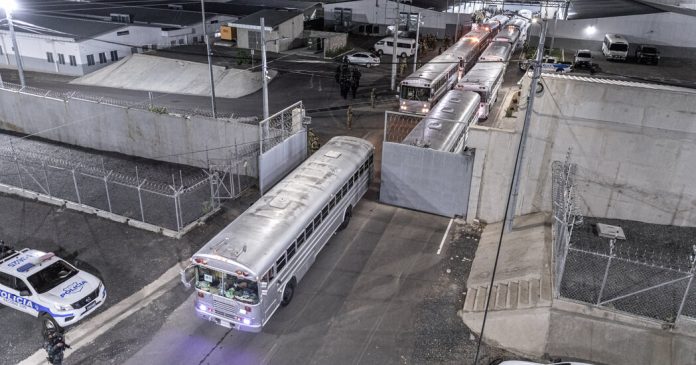
Lawyers for Venezuelan migrants accused of being members of a violent street gang asked the Supreme Court on Tuesday to continue a temporary block on President Trump’s use of a wartime powers law to send hundreds of people to a prison in El Salvador.

The Trump administration has asked the justices to intervene and lift a block on the deportations imposed by a lower court. But a brief filed on behalf of the immigrants by the American Civil Liberties Union and Democracy Forward said that block is now “the only thing” preventing the Trump administration from sending immigrants “to a prison in El Salvador, perhaps never to be seen again, without any kind of procedural protection, much less judicial review.”

The government has already sent more than 130 Venezuelan men from the United States to El Salvador, according to the court filing, where the migrants “have been confined, incommunicado, in one of most brutal prisons in the world, where torture and other human rights abuses are rampant.”

The legal battle over the deportations of the Venezuelan migrants is one of the first major tests of Mr. Trump’s flurry of executive orders to reach the high court. It is perhaps the most high-profile of the eight emergency applications filed by the administration, focusing squarely on a collision between the judicial and executive branches.

There are typically no hearings or oral arguments for cases on the Supreme Court’s emergency docket, and there is no public schedule for a decision.

The 514-page filing, which included documents from the lower court and declarations from human rights experts, marks the latest turn in the legal fight over Mr. Trump’s efforts to remove immigrants accused of being members of Tren de Aragua, a street gang with roots in Venezuela’s northern Aragua state.

The Trump administration asked the Supreme Court on March 28 to to vacate a decision by Judge James E. Boasberg in the Federal District Court in Washington to temporarily pause deportations under the Alien Enemies Act of 1798, a law that gives the president sweeping authority to remove citizens of foreign countries determined to be “alien enemies” in cases of war or invasion.

In its application to the justices, lawyers for the Trump administration argued that the president was authorized to use the act to deport the Venezuelans because he had determined that thousands of gang members had “illegally ‘infiltrated’ the country” as part of a plan by the Venezuelan government to destabilize democracies.

Lawyers for the immigrants sharply disputed this, arguing that Mr. Trump was contorting the law in an “effort to shoehorn a criminal gang” into the wartime law “on a migration-equals-invasion theory,” which they argued “is completely at odds with the limited delegation of wartime authority Congress chose to give him through the statute.”

Last month, the Trump administration ordered the deportation of more than 100 people who the government argues are members of the gang. Since then, they have been denied any due process to challenge the allegations against them.

In their court filing, lawyers for the Venezuelans argued that keeping Judge Boasberg’s temporary block on the deportations would not present a risk to public safety, since the judge had not ordered anyone to be released nor prevented the government from deporting migrants under normal processes.

They cited a March 31 social media post by Secretary of State Marco Rubio stating that the U.S. military had sent another 17 people, some of whom he said were members of Tren de Aragua, to El Salvador. The Trump administration has claimed that those men had been deported under regular U.S. immigration law, not the Alien Enemies Act.

If the court were to lift the block and allow deportations to resume under the Alien Enemies Act, lawyers for the immigrants argued, the consequences could be severe. They said their clients would “suffer extraordinary and irreparable harms — being sent out of the United States to a notorious Salvadoran prison, where they will remain incommunicado, potentially for the rest of their lives, without having had any opportunity to contest their designation as gang members.”

GOP retains two House seats in Florida congressional election : NPR

0

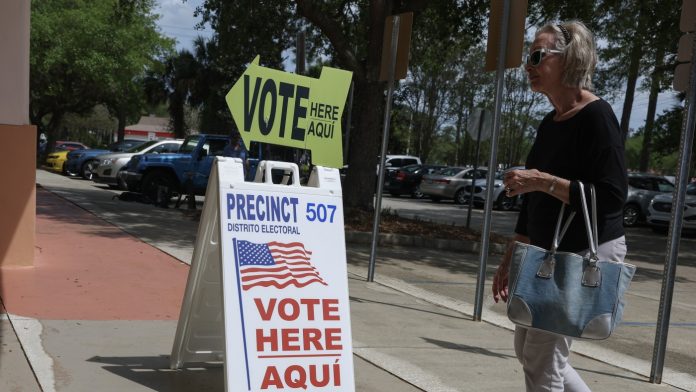
A sign directs voters to cast their ballots at a polling station set up at the Flagler County Public Library on Tuesday. Republicans won special elections in two Florida Congressional districts. The margins of victory in the heavily-Republican districts were significantly narrower than in November.

Joe Raedle/Getty Images


hide caption

toggle caption

Joe Raedle/Getty Images

MIAMI — Republican candidates have won in two special Congressional elections in Florida, helping the GOP retain its narrow majority in the U.S. House.

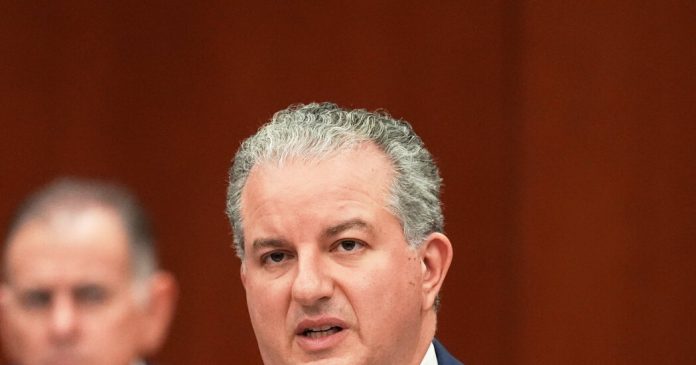
In the First Congressional District in Florida’s panhandle, the state’s former chief financial officer, Jimmy Patronis, defeated Democrat Gay Valimont. In the Sixth District, along Florida’s east coast, former state senator Randy Fine beat Democrat Josh Weil.

Republicans have a substantial registration edge in both districts. But the results were far closer than those seen in November, suggesting voters may be unhappy with Republicans, President Trump and his agenda.

In the First district in the area around Pensacola, Republican Congressman Matt Gaetz defeated Valimont by 32 points in November. President Trump nominated Gaetz to be his Attorney General. Gaetz later withdrew and left Congress, leaving his seat open. Patronis jumped into the race but was heavily outraised by Valimont, who drew support from Democrats across the country. Patronis’ margin of victory was about 15 percentage points, 17 points lower than that seen by Gaetz in November.

In the Sixth district in central Florida, Fine beat Weil by about 14 points. That’s a significantly narrower margin than that seen by then-Congressman Mike Waltz in November. Waltz defeated his Democratic opponent by 33 points. He left the seat vacant when he was named Trump’s national security adviser. Weil raised ten times more money for his campaign than Fine and Democrats hoped they could pull out a victory in a red district.

Despite the losses, Democrats are celebrating what they’re calling “historic performances.”

The chair of the state’s Democratic party, Nikki Fried said, “Florida Democrats just put the Republican Party on notice. Tonight’s results represent a historic overperformance for Democrats and show that voters are already rejecting Trump’s extreme agenda.”

President Trump endorsed both Republican candidates. On Tuesday night, Fine highlighted Trump’s social media post on the victory, adding, “Because of you, Mr. President. I won’t let you down.”