Thursday, November 12, 2026
Home Blog Page 65

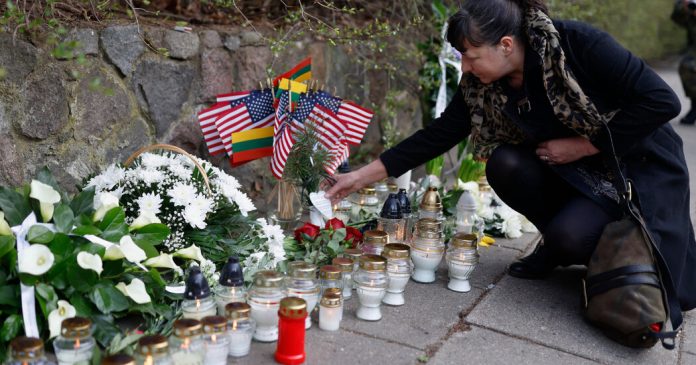
Fourth U.S. Soldier Is Found Dead in Lithuania

0

The body of a fourth U.S. Army soldier was found on Tuesday in Lithuania, a week after the soldier and three others were reported missing when the armored vehicle they were riding in sank in a bog, the U.S. military said.

The Army did not immediately release the name of the fourth soldier, whose body was found a day after the three other soldiers were found dead following an extensive international search effort that has involved hundreds of personnel from Lithuania, the United States, Poland and Estonia.

The four U.S. soldiers, from the 1st Armored Brigade Combat Team, 3rd Infantry Division, were reported missing early on March 25, when they did not return from a training mission in an M88A2 Hercules, a 70-ton vehicle that is essentially a giant military tow truck.

They had been sent out to extract another Army vehicle, the military said. But the soldiers may have driven off the road and into a deep bog, and they appeared to have been trapped inside as the vehicle sank, according to an Army official in Europe. The U.S. Army is investigating the cause of the accident.

Rescue workers located the vehicle on March 26, but extracting it from the mud proved to be a daunting engineering challenge. Heavy equipment was brought in to dredge the bog, and divers, dogs, and drones — including one equipped with ground-penetrating radar — were deployed in the recovery effort.

The U.S. Army did not announce where the body of the fourth soldier had been found although a senior U.S. Army official in Europe said it was recovered near the M88. The soldiers had been training near Pabrade, a city in eastern Lithuania near the border with Belarus.

The Army identified the three soldiers whose bodies were found on Monday as Sgt. Jose Duenez, Jr., 25, of Joliet, Ill.,; Sgt. Edvin F. Franco, 25, of Glendale, Calif.; and Pfc. Dante D. Taitano, 21, of Dededo, Guam. All three were M1 Abrams tank system maintainers.

“This loss is simply devastating,” Maj. Gen. Christopher Norrie, the commanding general of the Third Infantry Division, said in a statement. “These men were honored soldiers of the Marne Division. We are wrapping our arms around the families and loved ones of our soldiers during incredibly difficult time.”

Sergeant Duenez had been in the Army for more than seven years and had previously served in Poland and in Germany. Sergeant Franco had served in the Army for over six years, and had previously deployed to Korea and Germany. Private Taitano had served in the Army for nearly two years and had arrived at Fort Stewart in Georgia, the home of the Third Infantry Division, in October 2023.

American military leaders praised the Lithuanians and others who helped search for the soldiers.

“I can’t say enough about the support our Lithuanian allies have provided us,” Gen. Christopher Donahue, commander of U.S. Army Europe and Africa, said in a statement. “We have leaned on them, and they, alongside our Polish and Estonian allies — and our own sailors, airmen and experts from the Corps of Engineers — have enabled us to find and bring home our soldiers.”

Lithuanian leaders have pointed to the international recovery effort to underscore the value of NATO allies working together amid rising alarm in Lithuania and other Baltic countries that President Trump will weaken the NATO alliance.

On Tuesday, President Gitanas Nauseda of Lithuania, who had visited the site of the accident, said the country’s “heartfelt condolences go to our U.S. allies and their people.”

“Lithuania has been praying for all four missing soldiers, and now, with all our hearts, we stand with their families,” he said on social media. “We are deeply grateful to everyone who dedicated immense efforts to find the one remaining soldier still missing under such challenging conditions.”

Eric Schmitt contributed reporting.

Plan to allow proxy voting for new parents brings House to a halt : NPR

0

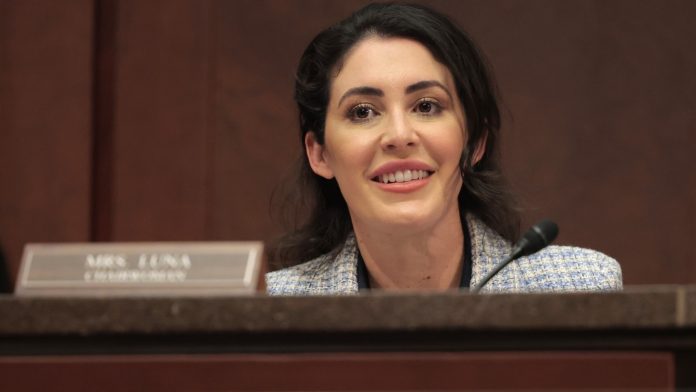
Rep. Anna Paulina Luna, R-Fla., looks on during a hearing at the U.S. Capitol on Tuesday. Luna has been leading a push in the House to allow proxy voting for new parents.

Anna Moneymaker/Getty Images


hide caption

toggle caption

Anna Moneymaker/Getty Images

Two moms brought business on the floor of the House of Representatives to a grinding halt on Tuesday over their push to allow remote voting for new parents.

“We said don’t f*** with moms,” Rep. Brittany Pettersen, D-Colo., said on the steps of the U.S. Capitol alongside Rep. Anna Paulina Luna, R-Fla.

“We worked as a team,” Luna said. “And I think that today is a pretty historical day for the entire conference and showing that the body has decided that parents deserve a voice in Washington and also to the importance of female members having a vote in Washington, D.C.”

Luna and Pettersen have been working to pass legislation that would allow new parents to vote by proxy for 12 weeks around the birth of a new child. Luna tried several different tactics to get the bipartisan bill to the floor. House Speaker Mike Johnson, R-La., originally refused to put the bill on the floor. So Luna teamed up with Democrats to bypass the speaker and force a vote.

When it became clear they had the 218 votes needed to do that, Johnson still tried to stop them. He took the unusual step of designing a special rule to prevent a vote, but nine Republicans voted alongside Democrats to block it.

Rep. Brittany Pettersen, D-Colo., holds her one-month old baby as she departs during a series of votes at the Capitol on March 11. Petterson has been working with Rep. Anna Paulina Luna, R-Fla., to pass legislation to allow proxy voting for up to 12 weeks for members who have recently given birth or whose spouse has.

Rep. Brittany Pettersen, D-Colo., holds her one-month old baby as she departs during a series of votes at the Capitol on March 11. Petterson has been working with Rep. Anna Paulina Luna, R-Fla., to pass legislation to allow proxy voting for up to 12 weeks for members who have recently given birth or whose spouse has.

Anna Moneymaker/Getty Images


hide caption

toggle caption

Anna Moneymaker/Getty Images

Afterwards, Johnson told reporters that votes for the rest of the week were canceled.

“The agenda has been taken off the table,” Johnson said on his way out of the Capitol.

In the hours leading up to the vote, Johnson argued that proxy voting “would do great violence to the institution — to reopen Pandora’s box.”

He maintained that proxy voting is “unconstitutional and there’s no limiting principle.”

“If you allow it for some situations, you’re ultimately going to have to allow it for all,” he said. “And I think that destroys the deliberative nature of the body.”

More than 230 People Infected With Norovirus on Luxury Cruise Ship

0

More than 230 passengers and crew members have been sickened in an outbreak of norovirus during a 29-day round-trip luxury cruise from England to the Eastern Caribbean, according to the Centers for Disease Control and Prevention.

The Queen Mary 2, the flagship ocean liner of Cunard Lines, left from Southampton, England, on March 8, according to Cruise Mapper, a tracking site. An outbreak was reported on March 18, the C.D.C. said, after the ship had stopped in New York City. Passengers and crew had reported symptoms of diarrhea and vomiting, the agency said.

The C.D.C. said the outbreak spread to 224 passengers, out of 2,538 onboard, and 17 crew members. The ship has isolated them and has taken sanitizing measures, it said.

In addition to New York, the ship had stops in St. Maarten, St. Lucia, Grenada, Barbados, Dominica, St. Kitts and Tortola. On Tuesday, the Queen Mary, or QM2 as it’s known, was traveling through the Atlantic Ocean on its way back to Southampton, where it was scheduled to arrive on April 6, Cruise Mapper shows.

Cunard said in a statement on Tuesday that the guests were being closely monitored and the ship deep cleaned. “Thanks to the swift response from our crew and the additional measures that we have in place, we are already seeing a reduction in reported cases,” the statement said.

The vessel, launched in 2004, is 1,132 feet long, one of the world’s largest ocean liners. In 2013, a Times reporter described his voyage on the QM2, which included a departure delay triggered by a “near-military-level” eradication operation after a norovirus outbreak sickened more than 200 people.

Norovirus, a gastrointestinal illness, thrives in closed areas such as health care facilities, dormitories and cruise ships, where people are traveling and working in close quarters. The illness infects up to 21 million Americans a year, according to the C.D.C. It spreads by contact or through contaminated food or water. There is no treatment, and most people recover in a few days.

Cruise ships are required to report to the C.D.C. when there is an outbreak, which refers to the total number of people sickened throughout the voyage, not the number of sick people at the same time.

The C.D.C. has reported other cases of norovirus outbreaks on cruise ships. Twelve of 461 passengers and 22 crew members of a Seabourn Encore cruise were sickened on a voyage that left Japan on March 16 and was scheduled to dock in the United States on April 9, it said.

Last month, a Holland America ship reported a norovirus outbreak affecting 89 of its 2,670 passengers and four of its crew during a nine-day cruise from Fort Lauderdale, Fla., to the southern Caribbean.

Rubio Orders U.S. Diplomats to Scour Student Visa Applicants’ Social Media

0

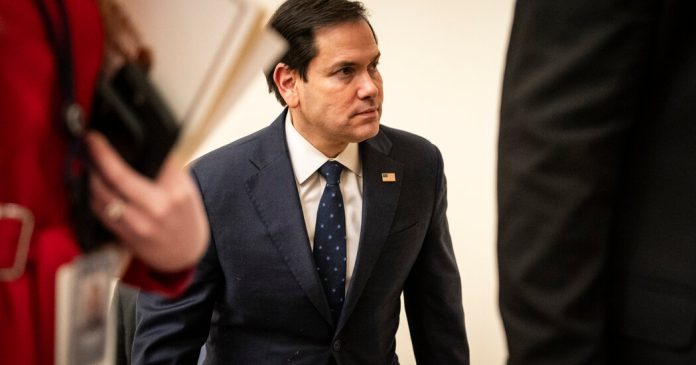
Secretary of State Marco Rubio has ordered diplomats overseas to scrutinize the social media content of some applicants for student and other types of visas, in an effort to ban those suspected of criticizing the United States and Israel from entering the country, U.S. officials say.

Mr. Rubio laid out the instructions in a long cable sent to diplomatic missions on March 25.

The move came nine weeks after President Trump signed executive orders to start a campaign to deport some foreign citizens, including those who might have “hostile attitudes” toward American “citizens, culture, government, institutions or founding principles.”

Mr. Trump also issued an executive order to begin a crackdown on what he called antisemitism, which includes deporting foreign students who have taken part in campus protests against Israel’s war in Gaza.

Mr. Rubio’s directive said that starting immediately, consular officers must refer certain student and exchange visitor visa applicants to the “fraud prevention unit” for a “mandatory social media check,” according to two American officials with knowledge of the cable.

The fraud prevention unit of an embassy’s or consulate’s section for consular affairs, which issues the visas, helps screen applicants.

The cable described the broad parameters that diplomats should use to judge whether to deny a visa. It cited remarks that Mr. Rubio made in an interview with CBS News on March 16: “We don’t want people in our country that are going to be committing crimes and undermining our national security or the public safety,” he said. “It’s that simple, especially people that are here as guests. That is what a visa is.”

The cable specifies a type of applicant whose social media posts should be scrutinized: someone who is suspected of having terrorist ties or sympathies; who had a student or exchange visa between Oct. 7, 2023, and Aug. 31, 2024; or who has had a visa terminated since that October date.

Hamas attacked southern Israel on Oct. 7, 2023, killing 1,200 Israelis and taking about 250 hostages. That ignited a war in which Israel has carried out airstrikes and a ground invasion of Gaza that have killed more than 50,000 Palestinians, according to Gazan health ministry estimates.

The dates specified by Mr. Rubio in the cable indicate that one of the main aims of the social media searches is to reject the applications of students who have expressed sympathy for Palestinians during the war.

The cable also states that applicants can be denied a visa if their behavior or actions show they bear “a hostile attitude toward U.S. citizens or U.S. culture (including government, institutions, or founding principles).”

Such wording could spur foreign citizens to self-censor many kinds of speech to avoid jeopardizing their chances of getting a visa.

And U.S. consular officers could find it difficult to judge an applicant’s past statements and social media posts, especially if they do not know the proper context.

Some foreign citizens who have a critical view of U.S. policies might forgo applying for a visa, which is a stated preferred outcome of Mr. Rubio’s.

The requested visa types that would set off extra scrutiny are F, M and J — student and exchange visitor visas, the cable said.

The details of the cable were first reported by The Handbasket, an independent news site.

A State Department spokesperson, when asked for comment, said the agency did not discuss internal deliberations. They pointed out that in 2019, the department changed visa application forms to ask for information about social media accounts.

As a senator from Florida, Mr. Rubio pressed the Biden administration’s State Department, run by Antony J. Blinken, to cancel the visas of students involved in campus protests against Israel’s military campaign in Gaza. Since becoming secretary of state in late January, Mr. Rubio has revoked perhaps 300 or more visas, many of them belonging to students, he told reporters last Thursday. He said he had been signing letters daily revoking visas.

“My standard: If we knew this information about them before we gave them a visa, would we have allowed them in?” he said. “And if the answer is no, then we revoke the visa.”

Earlier that day, responding to a reporter’s question, Mr. Rubio said the students were “going beyond demonstration. They are going and they are creating a ruckus. They are creating riots, basically, on campus.”

“Every one of them I find, we’re going to kick them out,” he added.

A State Department spokesperson said in an email in mid-March that “all available technology” was being used to screen visa applicants and visa holders. The spokesperson was replying to a question from The New York Times about whether the department was using artificial intelligence to scan databases and social media posts to find holders of visas that, in the eyes of Trump aides, should be revoked.

After signing the revocation letters, Mr. Rubio sends them to the Department of Homeland Security. The department has dispatched agents to detain some of the foreign citizens who have been stripped of their visas or, in a few cases, their status as a permanent U.S. resident, commonly known as a green card holder.

In early March, Mr. Rubio notified homeland security officials that he had revoked the permanent residency status of Mahmoud Khalil, 30, who had recently earned a graduate degree from Columbia University and was born in Syria, and Yunseo Chung, 21, an undergraduate at Columbia who was born in South Korea. He cited a statute of immigration law that allows him to recommend for deportation anyone whose presence would have “potentially serious adverse foreign policy consequences for the United States.”

Mr. Khalil is married to an American citizen, and Ms. Chung has lived in the United States since she was 7.

Last week, a half-dozen federal agents clad in black, some wearing masks, snatched Rumeysa Ozturk, a Turkish graduate student at Tufts University, off a street in Somerville, Mass., and took her to a detention center. Mr. Rubio said afterward that he had revoked her student visa.

Ms. Ozturk wrote an essay for a student newspaper last year calling for university support of Palestinian rights and divestment from Israel.

“At some point I hope we run out because we’ve gotten rid of all of them,” Mr. Rubio said last Thursday. “But we’re looking every day for these lunatics that are tearing things up.”

He added, “I encourage every country to do that, by the way, because I think it’s crazy to invite students into your country that are coming onto your campus and destabilizing it.”

Michael Crowley contributed reporting.

Trump administration admits Maryland man sent to El Salvador prison by mistake : NPR

0

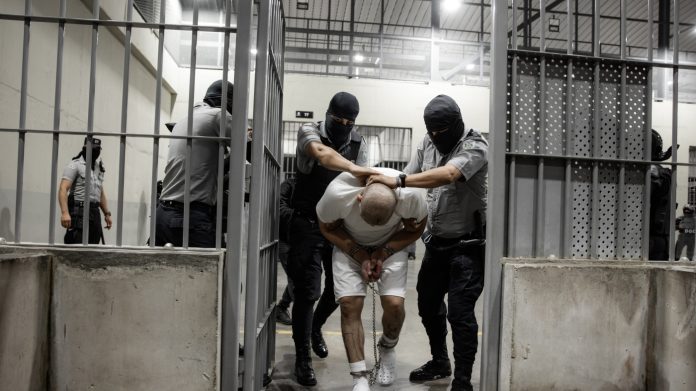
In this handout photo provided by the Salvadoran government, guards escort a newly admitted inmate inside a cell at CECOT on March 16, 2025 in Tecoluca, El Salvador.

Handout/Salvadoran Government via Getty


hide caption

toggle caption

Handout/Salvadoran Government via Getty

The Trump administration is getting blowback for confirmed and potential errors in its rush to deport hundreds of men to El Salvador last month.

On Monday night, immigration officials admitted to deporting a Maryland man to El Salvador due to an “administrative error.”

Kilmar Armando Abrego Garcia, who lived with his U.S. citizen wife and child, was identified as being on one of the three deportation flights to El Salvador last month that are the subject of several lawsuits. Immigration advocates claim those flown to El Salvador did not receive due process.

The administration used the three flights to quickly deport over three hundred men it accused of being members of MS-13, a gang with connections to El Salvador that originated in Los Angeles, and Tren de Aragua, a Venezuelan gang. They were later moved to CECOT, a notorious mega-prison in El Salvador.

One of them was Abrego Garcia, who his wife identified through photos released by the El Salvadoran government.

“The government’s filing was pretty shocking because they admitted everything that we alleged,” Simon Sandoval-Moshenberg, the lawyer representing Abrego Garcia and his family, told NPR.

Although Justice Department lawyers acknowledge the mistake in Abrego Garcia’s case, they say there is nothing federal officials can do because he is now in custody of another country.

And White House press secretary Karoline Leavitt on Tuesday doubled down on his deportation, pointing to his links to MS-13 — which Abrego Garcia’s lawyers dispute.

This latest case adds to the growing judicial scrutiny about the deportations, and has even prompted some consternation from one of Trump’s allies. Joe Rogan, the popular host of The Joe Rogan Experience podcast who endorsed Trump last year, this week raised concerns with potential errors in the El Salvador deporations.

“It’s hard to know what’s real and what’s not real, but if it is real this is f****** horrible,” Rogan said in his latest episode, when discussing the case of Venezuelan makeup artist Andry. Andry’s lawyer argues he was a legal asylum seeker who was deported.

His lawyers want him brought back

Abrego Garcia first fought accusations that he was a member of MS-13 under the first Trump administration.

According to court documents, Abrego Garcia in 2019 he was served a notice to appear in immigration court. An immigration judge did find him to be removable from the U.S. — but granted him a withholding of removal, which barred the U.S. government from deporting him to El Salvador specifically.

The Board of Immigration Appeals, which handles appeals from both immigrants and the U.S. government, later upheld Abrego Garcia’s block on being deported to El Salvador.

Abrego Garcia’s lawyers and Robert Cerna, acting field office director for Enforcement Removal Operations, both agree that these prior court decisions mean that Abrego Garcia should not have been deported to El Salvador last month.

Court documents detail that when Abrego Garcia was detained last month, he was questioned once more about any gang affiliations and told that he would be brought before a judge.

Sandoval-Moshenberg said he has previously dealt with wrongful deportation cases, during which the U.S. does try to bring people back. He filed a petition to have Abrego Garcia released from CECOT and returned to the United States.

“In this case, they don’t claim that they’re taking any steps whatsoever to rectify the mistake that they made,” he said.

U.S. Homeland Security Secretary Kristi Noem visits the cells at the Confinement Center against Terrorism (CECOT), in Tecoluca, San Vicente, El Salvador on March 26, 2025.

U.S. Homeland Security Secretary Kristi Noem visits the cells at the Confinement Center against Terrorism (CECOT), in Tecoluca, San Vicente, El Salvador on March 26, 2025.

El Salvador Press Presidency Office/Anadolu via Getty Images


hide caption

toggle caption

El Salvador Press Presidency Office/Anadolu via Getty Images

He said they filed the case last week, days before Secretary of Homeland Security Krisi Noem visited the El Salvador prison. “They knew about this case. They put Kristi Noem inside the secret jail. And now they’re saying that we can’t do anything about it. I’m not willing to accept that,” he said.

A response from the Justice Department argues that although officials mistakenly deported Abrego Garcia, there is nothing they can do now.

“The heavy interest in the President’s primacy in foreign affairs outweigh the interests on the Plaintiffs’ side of the scale. Although the Defendants recognize the financial and emotional hardships to Abrego Garcia’s family, the public interest in not returning a member of a violent criminal gang to the United States outweighs those individual interests.” Tthe Justice Department wrote in its filing on Monday.

“They have made no showing that the removal of Abrego Garcia to El Salvador was something other than an administrative error.”

Vice President JD Vance also posted on the social media platform X about the case, accusing Abrego Garcia of being a “convicted member of MS-13.”

“My further comment is that it’s gross to get fired up about gang members getting deported while ignoring citizens they victimize,” Vance said in the post.

Government says it’s doing due diligence

During a Monday interview on Fox News’ Special Report, Noem said that she trusts the government’s intelligence agencies and personnel to target members of the gangs.

“We are doing due diligence to make sure that we’re going after these criminals [who] have perpetrated violence on American citizens, and we’re removing them from our country,” Noem said.

And Leavitt, the White House press secretary, spoke specifically about Abrego Garcia’s case on Tuesday, saying “The administration maintains the position that this individual, who was deported to El Salvador and will not be returning to our country, was a member of the brutal, vicious MS-13 gang.” She also accused Abrego Garcia of being involved in human trafficking and that he was a gang leader.

In the filing, Abrego Garcia’s attorney pushes back on claims of a criminal history, noting that he has never been convicted of a crime in the U.S. or any other country.

“Although he has been accused of general ‘gang affiliation,’ the U.S. government has never produced an iota of evidence to support this unfounded accusation,” the suit said.

His lawyers say law enforcement in Prince George’s County in Maryland where he lived never again questioned him regarding MS-13 or accused him of membership in MS-13 after his initial arrest in 2019.

“Should Defendants wish to remove Plaintiff Abrego Garcia to any other country, they would have no legal impediment in doing so,” lawyers said in filings. “But Defendants found those legal procedures bothersome, so they merely ignored them and deported Plaintiff Abrego Garcia to El Salvador anyway, ripping him away from his U.S.-citizen wife, Plaintiff Vasquez Sura, and his disabled U.S.-citizen child.”

Sandoval-Moshenberg and DOJ attorneys will appear at the federal district court in Maryland on April 4 for a hearing over the case. Abrego Garcia’s lawyers plan to use that as another opportunity to request that the administration ask the El Salvadoran government to return him to U.S. custody.

“If they’re allowed to get away with this, then it means that the immigration laws are meaningless, all of them,” Sandoval-Moshenberg said. “It means that immigration courts and their orders are meaningless because the government can just violate those orders by means of force or simply putting someone on a plane. That can’t be the case.”


‘I Am Disgusted’: Le Pen Voters Voice Outrage Over Her Conviction

0

When the verdict from a Paris criminal court flashed across screens in Hénin-Beaumont, many customers in the Café de la Paix received it with the outrage and disappointment Marine Le Pen predicted.

The far-right political leader was found guilty of embezzlement, sentenced to four years in prison — two years suspended, two in a form of house arrest — and fined more than $100,000.

But most stinging was the decision barring her from running for public office for five years, rendering her ineligible to run in France’s 2027 presidential election.

For people here, Ms. Le Pen is not just the leader of the National Rally, and three-time presidential candidate. She is their local lawmaker in the lower house of Parliament.

“I am disgusted,” said Jean-Marc Sergheraert, 70, a retired charity manager, craning up at a big television screen. There, Ms. Le Pen was denouncing the decision as politically motivated and unjust because, she said, her sentence would be enforced even as she appealed it, which is often not the case in France.

“She is right,” added Mr. Sergheraert. “She must defend herself and go right to the end. If they want us to take the Capitol like they did in Washington, I will go to the Élysée,” he said, referring to the presidential palace in Paris.

Nearby, Arlette Banderlique, 86, concurred over her flute of light beer. “Forbidding French to do something just pushes us more to do it,” she said. “She will get millions more votes.”

Ms. Le Pen said she would appeal the ruling, though it would be difficult to resolve her challenge in time for 2027. She was convicted of diverting European Parliament funds to her party.

“This decision should disgust everyone. It’s totally arbitrary,” said Steeve Briois, the National Rally mayor of Hénin-Beaumont, handing out fliers encouraging locals to stand up, peacefully, against “those who would circumvent democracy.”

If any place in France would shake with fury over the ruling, it would be Hénin-Beaumont, a town of 26,000 in France’s northern former industrial heartland, ravaged first by coal mines closing in the 1980s and then by many factories closing, victims of globalization.

The unemployment rate in the area was more than double the national average in 2021, the last census.

Considering this “forgotten territory,” Ms. Pen’s party has made this one of its strongholds. Though she has never lived in the region, Ms. Le Pen chose it as her political heartland, running first in 1998, and continuing to represent the area in regional and European politics. In 2017, she successfully campaigned for a seat in the National Assembly.

During the last presidential election in 2022, she garnered 67 percent of the local vote. In legislative elections last summer, many locally expected her party to win in a landslide, and run the government. Instead, a left-wing coalition and President Emmanuel Macron’s ruling party formed a “dam” by asking candidates in runoffs around the country to form a single anti-National Rally vote.

Still, in Hénin-Beaumont Ms. Le Pen won re-election in the first round by a large margin.

“They want to eliminate her from the presidency,” said Karen Huret, 57, arriving Tuesday morning to the market to pick up supplies for her elderly mother. “Last time, they used the dam. This is another tactic.”

For many locals, fidelity to Ms. Le Pen’s party is less ideological than an appreciating her party’s retail politics. They cite the new aquatic center in town and the Christmas market. They feel respected by her and the party.

“She is nice. I took photos of her with my kids at the flea market,” said Ms. Huret, a stay-at-home mom. “I don’t believe she is racist. I’m from the inner-city — I believe everyone should be respected.”

The town had a history of corruption preceding Ms. Le Pen’s conviction. The Socialist former mayor, Gérard Dalongeville, was convicted of stealing 4 million euros with phony invoices and sentenced to four years in prison. For some locals, the latest court ruling deepened their cynicism.

“We’ve had Communists, Socialists, the National Rally — they are all the same,” said Mohamed Oussedrat, 60, enjoying a diabolo menthe at a bar, after his shift working maintenance at a hospital.

Marine Tondelier, an elected councilor in Hénin-Beaumont and leader of the national Green Party took to the news channels to point out that the National Rally calls for strict law enforcement and tougher sentences — except, it seemed, when it came to its own members.

“It shows you their hypocrisy,” she said. “I’ve been hearing about ‘systems put in place against them.’ The only system put in place is the one they set to divert public funds.”

She was not the only one in town who thought that way — though perhaps in a more quiet tone.

“She denigrates foreigners all the time. She says they don’t respect the law,” said Karim Zoui, 29. “Well, there you go. She doesn’t respect the law.”

Then he used a term often applied by the far right to migrants — voyou, or thug.

“If they are thugs,” he said, “they should pay.”

Layoffs begin at HHS, affecting thousands of staff and leadership : Shots

0

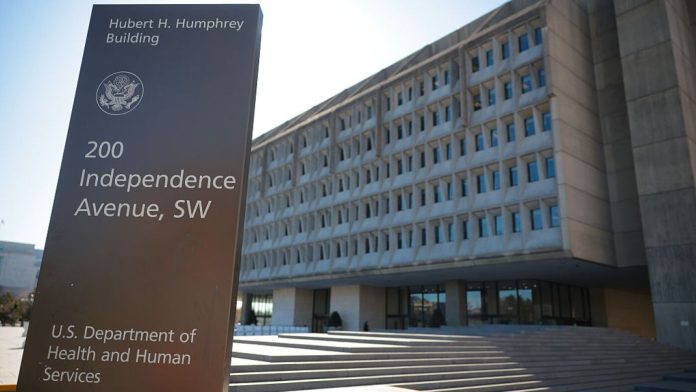
The U.S. Department of Health and Human Services is cutting 10,000 jobs. Employees started getting termination notices Tuesday.

Kayla Bartkowski/Getty Images


hide caption

toggle caption

Kayla Bartkowski/Getty Images

The Trump administration began sending notices of termination to thousands of staffers at federal health agencies Tuesday, according to interviews with employees at multiple agencies and e-mails reviewed by NPR.

The Department of Health and Human Services last week announced it planned to dismiss 10,000 people. These cuts come on top of around 10,000 people already leaving the agencies under the Trump administration’s Fork in the Road offer and early retirement.

Termination emails went out Tuesday morning to employees and leadership of agencies within HHS, the Food and Drug Administration, the National Institutes of Health, the Centers for Disease Control and Prevention as well as several smaller agencies.

On Thursday, HHS Secretary Robert F. Kennedy Jr. said in a statement that the layoffs were intended to reduce “bureaucratic sprawl.” “We are realigning the organization with its core mission and our new priorities in reversing the chronic disease epidemic,” he said.

But agency staff and leaders in the field say the cuts are a blow to public health, medicine and biomedical research in the U.S.

“We’ve never seen anything like this before,” Dr. Ashish Jha, the dean of the Brown University School of Public Health, who served as President Biden’s COVID-19 Response Coordinator, told NPR in an interview.

“We rely on our CDC for things like tracking down disease outbreaks. We rely on NIH for research into new treatments and tests and vaccines. At this moment, whether those will continue to be effective has really been put into question. We don’t know what the implications of all of this will be. I’m worried that what we’re going to see is more people getting sick, more disease outbreaks and infrastructure that is going to be less and less capable of responding to those threats.”

HHS, FDA and NIH did not immediately respond to NPR’s request for comment.

FDA sees major changes

At the FDA, the entire team that handles communications for the agency lost their jobs, according to staffers who were among those fired. They spoke on condition of anonymity for fear of retaliation for publicly criticizing the administration. According to an HHS fact sheet, 3,500 FDA jobs are being eliminated. The FDA’s top vaccine regulator, Dr. Peter Marks, revealed on Friday that he’s been forced out.

At the FDA’s Center for Drug Evaluation and Research, more than 800 people lost their jobs, according to an official who was laid off and fears retribution for sharing information. This part of the agency is responsible for new drug approvals as well as monitoring unexpected side effects after approval and making label changes.

Former FDA leaders who served under presidents from both parties took to social media to voice their concerns about the cuts.

“The FDA as we’ve known it is finished,” Dr. Robert Califf, who served as FDA commissioner twice, and stepped down in January, wrote on LinkedIn. He explained that he was “overwhelmed” with messages about the staff cuts and that the agency’s leaders who know the most about product development and safety had been let go.

“I believe that history will see this [as] a huge mistake,” he wrote. “I will be glad if I’m proven wrong, but even then there is no good reason to treat people this way. It will be interesting to hear from the new leadership how they plan to put ‘Humpty Dumpty’ back together again.”

Dr. Scott Gottlieb, who served as FDA commissioner during Trump’s first term from May 2017 through April 2019, wrote on X Tuesday that he fears the United States will no longer be the first to get access to new drugs and treatments as a result of the FDA staff cuts.

NIH leaders get reassigned

Hundreds of staffers at the National Institutes of Health have received notices. About 1,200 jobs were expected to be cut at the agency. Many of the NIH cuts appear to involve communications, IT and other support staff. But at least several high-ranking NIH officials also appear to be on their way out.

Dr. Jeanne Marrazzo, who took over as the director of the National Institute of Allergy and Infectious Diseases after Dr. Anthony Fauci departed, was offered reassignment to the Indian Health Service elsewhere in the country, according to an e-mail shared with NPR.

Several other leaders received the same offer including Renate Myles, director of communication for NIH, Dr. Eliseo J. Pérez-Stable, director of the National Institute on Minority Health and Health Disparities, Dr. Shannon Zenk, director of the National Institute of Nursing Research, and Dr. Diana Bianchi, the director of the Eunice Kennedy Shriver National Institute of Child Health and Human Development, according to several NIH employees who were not authorized to speak publicly.

“Despair, I think, is the only fitting word,” said one NIH employee describing the mood at the agency Tuesday. The person, who was not fired, asked not to be identified because of fear of losing her job.

The cuts prompted widespread condemnation outside the agency.

“The level of cuts at NIH I am hearing about today is truly mind-boggling,” wrote Jeremy Berg of the University of Pittsburgh, who served as the director of the National Institute of General Medical Sciences, part of the National Institutes of Health, from 2003 to 2011, wrote NPR. ” I try not to be hyperbolic but this seems to be a massacre. … I honestly don’t know where this leads.”

Some members of Congress have raised alarm about the cuts at HHS.

“The Trump Administration has launched an unprecedented attack on the federal health workforce,” said House Energy and Commerce Committee Ranking Member Frank Pallone, Jr., D-NJ, during remarks he made Tuesday at an oversight and investigations hearing on technology and cybersecurity related to medical devices.

“[Sec.] Kennedy claims that health care services will not be harmed by the dramatic downsizing, but he is wrong, and everyone who is paying any attention knows it,” he said.

U.N. Accuses Israel of Killing 15 Rescue Workers in Gaza

0

As Israeli forces advanced on the southern Gaza city of Rafah before dawn last Sunday, an ambulance crew set out to evacuate civilians wounded by Israeli shelling. But the ambulance was hit on the way, and its crew injured.

Several more ambulances and a fire truck headed to the scene, according to the Palestine Red Crescent Society, as did a U.N. vehicle, the United Nations said. Seventeen people were dispatched in total.

Then they all went silent.

It took five days for the United Nations and Red Crescent to negotiate with the Israeli military for safe passage to search for the missing people. After receiving clearance, U.N. officials said, the retrieval team found 15 dead over the weekend, most of their bodies dumped in a mass grave.

On Monday, the United Nations said Israel had killed them — a rare accusation by the organization, which is typically cautious about assigning clear blame.

“They were killed by Israeli forces while trying to save lives,” the U.N. humanitarian chief, Tom Fletcher, said on X. “We demand answers & justice.”

The Red Crescent, the International Committee of the Red Cross and the United Nations said all of those killed were humanitarian workers who should never have come under attack. The Red Crescent called the killings a war crime and demanded accountability.

An Israeli military spokesman, Lt. Col. Nadav Shoshani, said on X on Monday that nine of those killed were Palestinian militants. He said Israeli forces “did not randomly attack” an ambulance, but that several vehicles “were identified advancing suspiciously” without headlights or emergency signals toward Israeli troops, prompting them to shoot.

U.N. officials said the vehicles were clearly marked as rescue vehicles.

Colonel Shoshani said that during the attack, Israeli forces killed a Hamas military operative, Mohammad Amin Ibrahim Shubaki, who participated in the Oct. 7, 2023 assault on Israel that sparked the war in Gaza.

He said Israeli forces had also killed eight other operatives from Hamas and Palestinian Islamic Jihad, another militant group. He accused militants of “once again exploiting medical facilities and equipment for their activities.”

He did not directly say whether the militants were in the emergency vehicles or address the identities of the other six people killed.

After the vehicles were fired on, U.N. officials said, the ambulances, a fire truck and the U.N. vehicle were then bulldozed and crushed by Israeli forces.

The Red Crescent said one medic was still missing. The lone survivor, a Red Crescent crew member, was detained, beaten and released by Israeli forces the same day, according to the aid group. He told colleagues that Israeli forces had killed both of the other crew members in his ambulance, the Red Crescent and U.N. officials said.

Of the 17 people involved, 10 were Red Crescent workers, six were emergency responders from Gaza’s civil defense and one was a U.N. worker, U.N. officials said.

The top U.N. humanitarian official in Gaza, Jonathan Whittall, joined the retrieval team and posted photos on X showing the crumpled vehicles — husks of mangled metal jutting from the sand. The large navy-blue “N” on the U.N. vehicle was still visible on it.

“One by one, they were hit, they were struck. Their bodies were gathered and buried in this mass grave,” he said in a video message shared by the United Nations.

On Friday, the U.N. team that went in search of the missing people witnessed new scenes of chaos and violence in Rafah, including “hundreds of civilians fleeing under gunfire,” Mr. Whittall said on X. One woman was shot in the back of the head, he said.

He posted a video showing what he said came next: Two men walked toward the road, apparently to retrieve the woman’s body. Then one of them was shot, too. Mr. Whittall did not say who fired the shots.

On Saturday, the U.N. convoy found the crumpled vehicles. Hours of digging yielded one body, a civil defense worker buried beneath his firetruck, Mr. Whittall said. They returned for the remaining bodies on Sunday.

Mr. Whittall narrated the search for the bodies in the video message.

“We’re digging them out in their uniforms, with their gloves on,” he said. “They were here to save lives. Instead, they ended up in a mass grave.”

The grave, he said, was marked with the emergency light from one of the destroyed ambulances.

Colonel Shoshani, the Israeli military spokesman, said the vehicles, unlike others along the same route earlier that day, had not received permission from Israeli forces to be there.

Nebal Farsakh, a Palestine Red Crescent Society spokeswoman, said that when the ambulances set out around 3:30 a.m. on March 23, Israeli forces had not yet closed off the area as a “red zone,” where ambulances must clear their movements with Israel.

Israel did not immediately address the accusations of burying people in mass graves or crushing their vehicles.

In all, the Red Crescent said, 27 of its medics have been killed since the war began.

A cease-fire paused fighting in Gaza from January until March 18, when Israel broke it.

Rawan Sheikh Ahmad and Aaron Boxerman contributed reporting from Jerusalem.

Trump Aid Cuts End Contraception Access for Millions of Women

0

The United States is ending its financial support for family planning programs in developing countries, cutting nearly 50 million women off from access to contraception.

This policy change has attracted little attention amid the wholesale dismantling of American foreign aid, but it stands to have enormous implications, including more maternal deaths and an overall increase in poverty. It derails an effort that had brought long-acting contraceptives to women in some of the poorest and most isolated parts of the world in recent years.

The United States provided about 40 percent of the funding governments contributed to family planning programs in 31 developing countries, some $600 million, in 2023, the last year for which data is available, according to KFF, a health research organization.

That American funding provided contraceptive devices and the medical services to deliver them to more than 47 million women and couples, which is estimated to have averted 17.1 million unintended pregnancies and 5.2 million unsafe abortions, according to an analysis by the Guttmacher Institute, a sexual health research organization. Without this annual contribution, 34,000 women could die from preventable maternal deaths each year, the Guttmacher calculation concluded.

“The magnitude of the impact is mind-boggling,” said Marie Ba, who leads the coordination team for the Ouagadougou Partnership, an initiative to accelerate investments and access to family planning in nine West African countries.

The funding has been terminated as part of the Trump administration’s disassembling of the United States Agency for International Development. The State Department, into which the skeletal remains of U.S.A.I.D. was absorbed on Friday, did not reply to a request for comment on the decision to stop funding family planning. Secretary of State Marco Rubio has described the terminated aid projects as wasteful and not aligned with American strategic interest.

Support for family planning in the world’s poorest and most populous countries has been a consistent policy priority for both Democratic and Republican administrations for decades, seen as a bulwark against political instability. It also lowered the number of women seeking abortions.

Among the countries that will be significantly affected by the decision are Afghanistan, Ethiopia, Bangladesh, Yemen and the Democratic Republic of Congo.

The money to support international family planning programs is appropriated by Congress and was extended in the most recent spending bill that keeps the government operating through September. The move by the State Department to cut these and other aid programs is the subject of multiple lawsuits currently before federal courts.

The Trump administration has also terminated American funding for the United Nations’ sexual and reproductive health agency, U.N.F.P.A., which is the world’s largest procurer of contraceptives. The United States was the organization’s largest donor.

Although the United States was not the sole supplier of contraception in any country, the abrupt termination of American funding has created chaos in the system and has already caused clinics to run out of products.

An estimated $27 million worth of family planning products already procured by U.S.A.I.D. are stuck at different points in the delivery system — on boats, in ports, in warehouses — with no programs or employees left to unload them or hand them over to governments, according to a former U.S.A.I.D. employee who was not authorized to speak to a reporter. One plan proposed by the new U.S.A.I.D. leadership in Washington is for remaining employees to destroy them.

Supply chain management was a major focus for U.S.A.I.D., across all areas of health, and the United States paid to move contraceptive supplies such as hormonal implants, for example, from manufacturers in Thailand to the port in Mombasa, Kenya, from where they were taken by trucks to warehouses across East Africa and then to local clinics.

“To put the pieces back together is going to be very difficult,” said Dr. Natalia Kanem, executive director of U.N.F.P.A. “Already this has had a catastrophic impact — it’s literally affecting millions of women and families. The poorest countries don’t have the resilient buffer.”

The United States also paid for data and information systems that helped governments track what was in stock and what they needed to order. None of those systems have operated since the Trump administration sent a stop-work order to all programs that received U.S.A.I.D. grants.

Bellington Vwalika, a professor of obstetrics and gynecology at the University of Zambia, said that contraceptives had already begun to run short in some parts of the country, where the United States supplied a quarter of the national family planning budget.

“The affluent can buy the commodity they want — it is the poor people who have to think, ‘Between food and contraception, what should I get?’” he said.

Even before the United States pulled out of family planning programs, surveys found that globally, a billion women of reproductive age wished to avoid pregnancy but did not have access to a modern contraceptive method.

At the same time, there had been great progress. Demand for contraception has been rising steadily — with long-acting methods that offer women greater privacy and secure protection — in Africa, the region of the world with the lowest coverage. Supply has improved with better infrastructure that helped get products to rural areas. And “demand creation” projects, of which the United States was a major funder, used advertisements and social media to inform people about the range of contraceptive choices available and the advantages of spacing or delaying pregnancies. Women’s rising levels of education boosted demand, too.

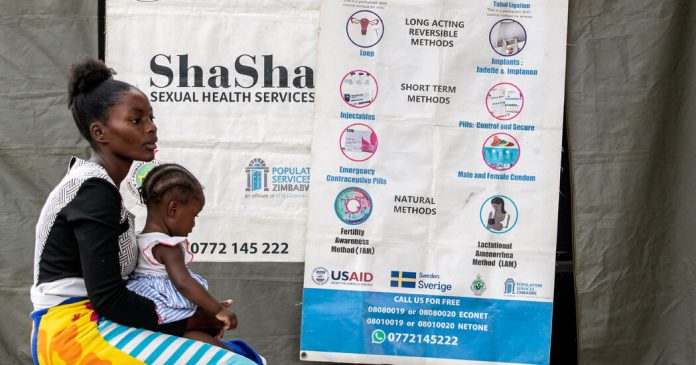
Thelma Sibanda, a 27-year-old engineering graduate who lives in a low-income community on the edge of the Zimbabwean capital, Harare, two weeks ago received a hormonal implant that will prevent pregnancy for five years, at a free pop-up clinic run by Population Services Zimbabwe, which had a multiyear U.S.A.I.D. grant to deliver free family planning services.

Ms. Sibanda has a 2-year-old son and says she cannot afford more children: She can’t find a job in Zimbabwe’s fractured economy, and neither can her husband. They subsist on the $150 he earns each month from a vegetable stand. She had been relying on “hope and faith and natural methods” to prevent another pregnancy since her son was born, Ms. Sibanda said, and had wished for something more reliable, but it simply wasn’t possible in her family’s budget — until the free clinic came to her neighborhood.

With its U.S.A.I.D. funding, the Zimbabwean organization that provided her implant last year was able to buy six sturdy Toyota vehicles and camping equipment so that an outreach team could travel to the most remote regions of the country, delivering vasectomies and IUDs in pop-up clinics. Since the Trump executive order, they have had to stop using all of that equipment.

The international nonprofit MSI Reproductive Choices has stepped in with temporary funds so the teams can continue to provide free care for the women they can reach, such as Ms. Sibanda.

Ms. Sibanda said her priority was providing the best possible education for her son, and because school fees are costly, that means no more children. But many African women have no way to make this kind of choice. In Uganda, while the national fertility rate is 4.5 children per woman, it’s not unusual to meet women in rural areas with limited education who have eight or 10 children, said Dr. Justine Bukenya, a lecturer in community health and behavioral science at Makerere University in Kampala. These women become pregnant for the first time as teenagers and have little space between pregnancies.

“By the time they are 30 they could have their 10th pregnancy — and these are the women who will be affected,” she said. “We are losing the opportunity to make progress with them. The United States was doing a very strong job here of creating demand for contraception with these women, and mobilizing young men and women to go for family planning.”

Some women who have relied on free or low-cost service through public health systems may now try to buy contraceptives in the private market. But prices of pills, IUDs and other devices will most likely rise significantly without the guaranteed, large-volume purchases from the United States.

“As a result, women who previously relied on free or affordable options through public health systems may now be forced to turn to private sector sources — at prices they cannot afford,” said Karen Hong, chief of U.N.F.P.A.’s supply chain unit.

The next largest donors to family planning after the United States are the Netherlands, which provided about 17 percent of donor government funding in 2023, and Britain, with 13 percent. Both countries recently announced plans to cut their aid budgets by a third or more.

Ms. Ba said the focus in the West African countries where she works was mobilizing domestic resources and figuring out how governments can try to reallocate money to cover what the United States was supplying. Philanthropies such as the Gates Foundation and financial institutions including the World Bank, which are already significant contributors to family planning, may offer additional funding to try to keep products moving into countries.

“We were getting so optimistic — even with all the political instability in our region, we were adding millions more women using modern methods in the last few years,” Ms. Ba said. “And now all of it, the U.S. support, the policies, it’s all completely gone. The gaps are just too huge to fill.”

The Irving Family Provides Many Jobs to a Canadian Province, But Also Draws Concerns

0

Even in a frequently fogbound port city along the Atlantic Ocean, the billowing clouds of steam rising from Canada’s largest oil refinery over Saint John, New Brunswick, are impossible to miss.

On a ridge overlooking the refinery sit six enormous tanks, each containing one million barrels of crude oil. Letters painted in dark blue spell “Irving,” the family whose businesses dominate not only Saint John, but most of New Brunswick.

The larger of the Irvings’ two local paper mills looms above the Saint John River like a medieval fortress. Irving-owned railway tracks crisscross the city, linking smaller factories owned by the family to ports under Irving control. Irving-owned building-supply stores and gas stations dot the streets in this city of 78,000 people, where park signs honor Irving contributions to their upkeep.

The family’s four radio stations in New Brunswick fill the airwaves. And Irving-owned transport trucks carry Irving-made goods, like structural steel and frozen French fries. An Irving-owned security company provides guards for Irving-owned properties.

Canada has many families that have built business empires, most notably the Thomson family, which controls Thomson-Reuters, the media, financial and legal information company.

But the Irvings stand out for their command of a single region. Starting in the 1920s with a general store and gas station that sold Ford Model Ts, Kenneth Colin Irving, who was known as K.C., established a privately owned family business now worth an estimated 14.5 billion Canadian dollars, or about $10.1 billion.

The family’s legacy in Canada is complicated. Its companies have brought employment to a region where jobs are scarce. By some estimates, one out of every 10 people in New Brunswick works for an Irving company. Still, the province consistently ranks at or near the bottom in Canada for family income.

And while Irving companies have created large industries, its factories have also brought pollution to Saint John and blighted its neighborhoods, according to residents and former government officials.

But the family’s economic power and political influence have made many people in Saint John reluctant to openly criticize the Irvings. The family’s decision in 2003 to close its shipyard in Saint John, which once employed 4,000 people, to concentrate on its operation in Halifax, Nova Scotia was widely seen as a consequence of fractious labor relations.

“There is a culture in Saint John of keeping your head down and keeping your mouth shut,” said Don Darling, the city’s mayor from 2016 to 2021.

He said he believed that Saint John’s strong industrial base should make the local economy stronger, but that the relatively low taxes on many Irving-owned businesses have made it difficult to support needed social services.

“I don’t blame the Irvings necessarily,’’ he added. “But everybody has to play a role and everyone should take responsibility for their part in the community.”

The Irving family did not respond to a list of questions about its effect on the city.

Today the Irving empire mainly consists of two large conglomerates, both still owned and controlled by the Irving family.

The companies have not always been easy neighbors. In 2018, the residents of Pleasant City Street in Saint John East were twice jolted by the Irving refinery. First, a leaky pipe led to an explosion that injured 36 workers. Then the neighborhood was evacuated after a rusty pipeline carrying toxic and explosive butane burst.

Irving Oil was fined 200,000 Canadian dollars, about $140,000, for the explosion, and Pleasant City Street was forever changed. Irving bought about 20 houses near the pipeline and demolished them, apparently to create a buffer between the refinery and residents. The abandoned neighborhood is now blocked off by concrete barriers and patrolled by Irving-employed guards.

Like other people in Saint John, Lisa Crandall, who lives near the barriers, said she knew of family members and pets that had died from unusual cancers.

But there has been little scrutiny of any health issues related to the Irving company by local government agencies or private groups. A 2009 study for the Conservation Council of New Brunswick, an advocacy group, found that lung cancer rates for women in Saint John were 82 percent higher than national rates and 98 percent higher for men.

There have been no known studies directly linking health problems to Irving-owned businesses.

The refinery has dusted neighborhoods with chemical particulate. The provincial government has declared these releases of dust and soot to be low risk to residents, but that has failed to reassure them. Fine particles have been linked to asthma, lung disease and bronchitis.

Ms. Crandall said she was frustrated by the lack of communications from the company. To date, she said, it has offered no information about the bulldozing of houses on her street.

“They don’t talk about it,” she said. “They just always send out a letter saying: Hi, we’re your neighbor. Sorry for the inconvenience.”

K.C. Irving began the family’s empire by adding an oil company to his car dealership and gas station. During the Great Depression, he took over failing bus and truck companies, and after World War II expanded to paper, ships and lumber.

The company’s growing influence brought concessions and tax breaks from government. In 1951, the province passed a law, which is no longer in force, allowing the Irving pulp mill to pour waste into the Saint John River. And Irving Oil was given a 42-year property tax exemption that ended in 2023.

“The level of access to elected officials that they have is like that given to no one else,” said Mr. Darling, the former mayor. “Show us if it makes sense to give special tax treatment to any business — to the Irvings or anyone else.’’

Back on Pleasant City Street, Ms. Crandall said she wished there was some way to diminish Irving’s outsize presence in Saint John.

“I would love to see them just sell everything and have different companies come in,” she said. (Irving has not announced any such plans.)

“It would be really good for the city,” she added. “I know a lot of people would hate me for saying that.”