Thursday, November 12, 2026
Home Blog Page 67

China’s Military Drills Around Taiwan Are a Warning to Its President

0

China launched military exercises pressing in on Taiwan on Tuesday, in what Beijing said was a warning to the island-democracy’s president, Lai Ching-te, after he called China a “foreign hostile force.”

Chinese land, navy, air and missile forces would “approach close” to Taiwan and practice “seizure of overall control, strikes on sea and land targets, and the blockade and control of key areas and lanes” at sea, Senior Col. Shi Yi, a spokesman for the People’s Liberation Army command that oversees Taiwan, said in a statement issued on Chinese state-run media.

Sometimes, China’s military does not spell out why it holds drills. This time, officials and state media reports were clear: “This is firm punishment for the Lai Ching-te administration’s rampant ‘pro-independence’ provocations,” Zhu Fenglian, a spokeswoman for the Chinese government’s office on Taiwanese affairs, said in a statement.

Ms. Zhu singled out a speech by Mr. Lai on March 13 in which he described China as a “foreign hostile force” and laid out 17 measures that Mr. Lai said would combat deepening Chinese subversion and spying in Taiwan. Those included restoring military tribunals for cases against military personnel who spy, and strengthening oversight of cultural, political and religious exchanges with China. Beijing says that Taiwan is its territory, and that it will eventually absorb the island, by force if Chinese leaders deem that necessary.

But despite Beijing’s fiery language, it was unclear how long the exercises would last, or how close they would approach Taiwan. Military analysts said the exercises appeared intended to intimidate Taiwan, without tipping over into a wider confrontation or crisis. Mr. Lai and his Democratic Progressive Party deny that Taiwan is a part of China — a key premise of Beijing’s claim that the island is its territory — and officials in Beijing have already vehemently denounced Mr. Lai’s recent speech.

Taiwan’s Ministry of National Defense said that by early Tuesday morning, 19 Chinese military vessels were operating around the main island of Taiwan, and China’s Shandong aircraft carrier had moved toward it. Taiwan’s premier, Cho Jung-tai, told journalists that the island’s forces were closely monitoring the Chinese military.

“This time, the political symbolism stands out more,” Su Tzu-yun, a researcher at the Institute for National Defense and Security Research, an organization in Taipei supported by Taiwan’s Ministry of National Defense, said of China’s latest exercises. “It’s trying to get in closer to Taiwan to exert more psychological pressure.”

While, publicly, China has linked the exercises to Mr. Lai’s comments, Mr. Su and other experts said, China’s leaders also appeared to be sending an implicit message to the Trump administration. Mr. Lai has sought to maintain U.S. support for Taiwan during President Trump’s term, including by promising to raise its military spending to more than 3 percent of the island’s economic output this year.

“The publicity around the exercise likely also has the U.S. in mind — they want to persuade the Trump administration that Lai is a troublemaker and to deter the U.S. from maintaining high levels of support to Taiwan,” said Amanda Hsiao, an analyst for the Eurasia Group who monitors Chinese foreign policy and China-Taiwan tensions.

The exercises came days after the U.S. defense secretary, Pete Hegseth, visited Tokyo to discuss strengthening military ties with Japan. Mr. Hegseth said there that the Trump administration would focus on countering Chinese power, including its efforts to squeeze Taiwan.

“America is committed to sustaining robust, ready and credible deterrence in the Indo-Pacific, including across the Taiwan Strait,” Mr. Hegseth said in a news conference with Japan’s defense minister, Gen Nakatani. Mr. Hegseth has also issued internal guidelines in the Pentagon that say U.S. forces must focus on deterring China from trying to seize Taiwan by force, the Washington Post reported.

Still, China may not have an appetite right now for extended military exercises that may deepen the divisions between the Trump administration and China’s leader, Xi Jinping. Mr. Xi is already squaring off with Mr. Trump over additional U.S. tariffs on Chinese goods that were imposed last month, with possibly more tariffs to come this week. The official Chinese statements about the latest exercises did not mention the United States.

“China is definitely interested in not showing weakness,” Wen-Ti Sung, a researcher in Taiwan and a nonresident fellow with the Atlantic Council’s Global China Hub, said of Mr. Xi’s approach to the Trump administration. “But China will respond with just enough firmness to make sure that an off ramp for it still remains.”

Taiwan’s share market indicated that for now the island’s investors were not too worried about China’s menacing military steps. Taipei’s stock exchange rose on Tuesday morning, after the People’s Liberation Army had announced the exercises.

Tuesday Briefing

0

President Trump’s talk of a third term.

There’s No Party Like an Iftar Party for Bangladesh’s Aspiring Leaders

0

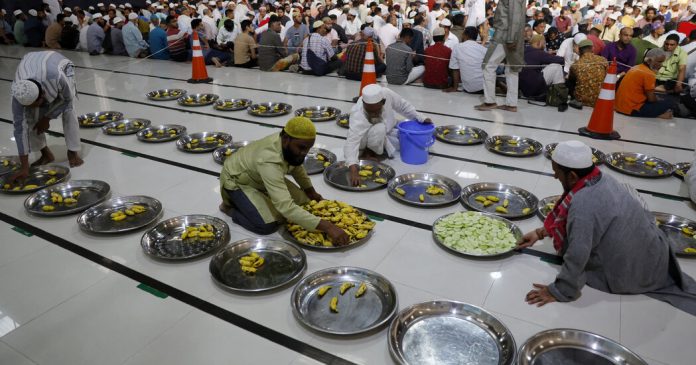
Around sunset during the Muslim fasting month of Ramadan, something remarkable happens in the Bangladeshi capital, Dhaka. The streets in this city of more than 10 million people, known for its hectic bustle and choking traffic, turn quiet and empty.

But for political parties, which know well the persuasive powers of full bellies, sunset is their high time.

Iftar parties, where the faithful break their fast, were closely watched through the end of Ramadan last week for what direction Bangladesh could take after the overthrow of its authoritarian leader last summer.

Who was attending which party? Who was seated next to whom? In Bangladesh’s political vacuum, the answers to those questions offered clues to how new alliances could form and even the direction of changing geopolitical winds.

To gauge the political temperature, we got ourselves invited to one.

It was hosted at a rooftop restaurant by Gono Odhikar Parishad, a small party born of an earlier wave of student protests in 2018, before the one last year that toppled Prime Minister Sheikh Hasina.

The party had made arrangements for 600 people, and 900 showed up. Plates of fried snacks and sweets were passed around. Waiters kept the yogurt drinks flowing.

There was one thing no one seemed to have thought about: How do you get hundreds of people who have not eaten or hydrated for 15 hours to the top floor? Definitely not by climbing eight flights of stairs.

The crowd, teeming in the tiny lobby painted like van Gogh’s “Starry Night,” tried to squeeze into one elevator with a capacity of 18 people.

The elevator’s operator — which remains a thing in this part of the world — had a difficult job. A gentle man with a beard dyed red, he sat on a plastic stool by the buttons. He loaded every trip with the precision of a shopkeeper weighing grapes, offloading bodies one by one until the elevator was no longer over capacity.

At the top, the restaurant heaved with people.

Dozens of tables were marked RESERVED FOR POLITICAL PARTIES or RESERVED FOR JOURNALISTS. It was mostly men, with a sprinkling of women.

Sangeeta Huq, a leader of the young party’s youth division, said she had attended five iftar parties in the first two weeks of Ramadan.

“Each wing, each division of our own party has an iftar party — youth wing, labor wing, human rights wing,” she said.

From the podium in front of her, speech after speech was directed less at the fasting guests and more at the couple dozen cameras. The theme was clear: The country needed an election.

The timing of that election is at the heart of a political divide. Some want it right away. Others want reforms first, to avoid a repeat of past rigged votes.

Dominating the news, and naturally the chatter at iftar parties, was the unease between Bangladesh’s military and the student-driven interim government.

The students are increasingly suspicious of the army chief, Gen. Waker-uz-Zaman. Some think that the general, a relative of Ms. Hasina, the ousted prime minister, is trying to open space for a revival of her deposed party.

Others suspect that the army chief is pressing for early elections because he has cut a deal with Ms. Hasina’s longtime opposition, the Bangladesh Nationalist Party, or B.N.P.

Leaders of that party, on the other hand, suspect that the students are using their sway over the government, and on the streets, to delay the election in order to buy time and organize as a political force themselves.

Another big topic in Dhaka was where India — the giant neighbor that long supported Ms. Hasina and has now given her shelter — stood in all the political jostling.

New Delhi broadly pinned Ms. Hasina’s downfall on what it called a conspiracy between the B.N.P. and Jamaat-e-Islami, the main Islamist party, painting them both as extremist.

But in a sign of changing times, Indian diplomats showed up at iftar gatherings for both parties.

“Very busy time,” said Mia Golam Parwar, Jamaat’s general secretary, whose schedule during Ramadan revolved around iftar parties. “We feel like this is our high time.”

He boasted that 39 diplomatic missions had been represented at Jamaat’s iftar party.

Just around the corner from Gono Odhikar’s rooftop event, a local branch of the B.N.P. was hosting its own iftar party under a tent in a schoolyard.

People sat at round tables as biryani boxes and soda cans were unloaded from a truck. A loudspeaker on the main road blared the names of the dozens of dignitaries in attendance.

When the local B.N.P. leader, Ariful Islam Arif, took his turn at the mic on a crowded stage decked out in flowers, he got emotional.

“I missed this for seven years because I was in jail,” he said.

Saif Hasnat contributed reporting.

Israel’s Military Says It Struck Beirut’s Suburbs

0

The Israeli military said early Tuesday that it had conducted a strike on the southern outskirts of Beirut, the second attack near Lebanon’s capital in less than a week.

Israel and Hezbollah agreed to a cease-fire in November, raising hopes that Lebanon’s deadliest war in decades could be over. But the recent strikes have prompted fears that the truce could unravel.

The Israeli military said the latest strike, in the Dahiya area in Beirut’s southern suburbs, had targeted a Hezbollah operative who had directed and assisted Hamas in planning a “significant and imminent” attack against Israel.

Israel acted to eliminate the operative because he posed an “immediate threat,” the military said on social media. It added that the Dahiya area was a key stronghold for Hezbollah, a Lebanese militant group and political party backed by Iran.

Hezbollah made no immediate comment on the strikes on its semiofficial page on Telegram, a social media platform.

On Friday, the Israeli military launched airstrikes in the same area, and ordered residents in a densely populated neighborhood to evacuate. The attack was hours after rockets were fired at northern Israel from Lebanese territory.

Hezbollah denied any involvement in that attack on Israel and said it remained committed to the cease-fire. The Israeli military said it had targeted a site that stored Hezbollah’s drones.

Also on Friday, at least three people were killed in separate Israeli airstrikes in southern Lebanon, according to Lebanon’s Health Ministry, which does not distinguish between civilians and combatants.

Hezbollah began firing rockets and drones at Israeli positions, in solidarity with its Palestinian ally, after Hamas led an attack on Israel on Oct. 7, 2023, igniting the war in Gaza. The fighting escalated into full-scale war between Israel and Hezbollah, with an Israeli ground invasion of Lebanon.

A third Trump term? End runs around limits are possible, experts say : NPR

0

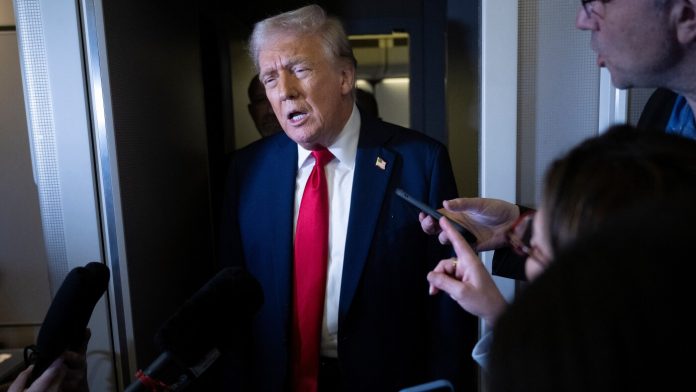
President Trump speaks to members of the press aboard Air Force One on Sunday.

Brendan Smialowski/AFP via Getty Images


hide caption

toggle caption

Brendan Smialowski/AFP via Getty Images

President Trump has once again floated the idea of testing the Constitution’s presidential term limits by seeking a third term, as his administration continues to challenge constitutional provisions and push an expansive view of executive power.

After telling NBC News that he’s “not joking” about the possibility and that there are “methods” that would allow him to serve a third time, Trump declined to confirm to reporters aboard Air Force One on Sunday that he’s planning to leave the White House after his second term ends on Jan. 20, 2029.

The 22nd Amendment prohibits a person from being elected U.S. president more than twice. The states ratified the restriction in 1951 in the wake of President Franklin D. Roosevelt’s controversial third and fourth terms during World War II, which bucked a two-term norm set by George Washington.

Changing presidential term limits with a new constitutional amendment would need support from three-fourths of the states.

But some legal experts point to plausible strategies for attempting end runs around the 22nd Amendment under unusual scenarios.

What Trump has said, and what the 22nd Amendment says

While Trump regularly spins up news cycles with surprising or unprecedented comments, his latest public remarks are not the first time the 78-year-old president has mentioned a potential pursuit of a third term.

“I suspect I won’t be running again,” Trump reportedly told a group of House Republicans last November, after he won the election — that is, he added to laughs, unless the lawmakers say he’s “good” enough for them to “figure” out a way.

Trump’s remark drew swift pushback from Democratic Rep. Dan Goldman of New York, who quickly introduced a House resolution to reaffirm that the Constitution’s term limits for elected presidents apply to Trump and his nonconsecutive terms.

The 22nd Amendment’s words would undermine any argument that Trump’s nonconsecutive terms grant him an exception to the two-term limit, says William Baude, a professor who leads the Constitutional Law Institute at the University of Chicago Law School.

“There is no wiggle room” on the rule that a president can’t be elected more than twice, Baude says. “That’s a clear statement of the Constitution, and I don’t think any serious person is going to interpret it otherwise.”

Three days after Trump’s second inauguration, however, Republican Rep. Andy Ogles of Tennessee introduced a joint resolution to propose a change to the Constitution so that a person could be elected president three times if they had not been previously elected to two consecutive terms.

But winning an election is not the only way a person can become president. And there are hypothetical situations involving presidential succession, Baude adds, that are “not addressed as fully” by the Constitution’s text. They reveal ways in which the common understanding of the 22nd Amendment’s presidential term limits could be challenged in court.

One theory: Trump could become vice president and then president in 2029

Asked by NBC News about a scenario involving Vice President Vance, Trump said that “that’s one” method.

A 1999 Minnesota Law Review article called “The Twice and Future President” explains that a twice-elected president could become vice president and then — if the current president were to be removed from office, resign or die — return as commander-in-chief.

The federal government-sanctioned record of interpretations of the Constitution also points to the possibility of a former two-term president serving as speaker of the House of Representatives or as another federal officer who could become president through the Presidential Succession Act of 1947.

All of these hypothetical situations get around a key word in the 22nd Amendment’s restriction — “elected.” Bruce Peabody, one of the law review article’s co-authors, who is now a professor of government and politics at Fairleigh Dickinson University, says Congress chose that term after considering proposals that would have made a twice-elected president not eligible to “hold” the office again.

“There definitely was awareness that the more narrow language they’d come up with was not going to cover every scenario,” explains Peabody, adding that it can be difficult to make sense of the lawmakers’ intent.

Their word choice, however, has given rise to what Brian Kalt — a law professor at Michigan State University who wrote about a hypothetical two-term president getting nominated to run for vice president in Constitutional Cliffhangers: A Legal Guide for Presidents and Their Enemies — calls a loophole in the 22nd Amendment’s two-term limit.

Dwight Eisenhower, the first U.S. president to be constitutionally barred from running for a third term, alluded to it in 1960.

Asked whether he wanted to formally declare support for then-Vice President Richard Nixon as the Republican presidential nominee, Eisenhower drew laughter at a news conference when he replied: “You know, the only thing I know about the presidency the next time is this: I can’t run. But someone has raised the question that were I invited, could I constitutionally run for vice president, and you might find out about that one. I don’t know.”

In the decades since then, similar chatter about the loophole in legal and political circles has surrounded other twice-elected presidents, including Ronald Reagan, Bill Clinton and Barack Obama.

“That talk never was all that serious. But in a certain situation where the president is sort of more popular than the common understanding of the Constitution, you better believe people will jump all over any loophole they can and allow that person to flout term limits. And we’ve seen it in other countries. Everywhere there are term limits, there are vulnerabilities,” Kalt says.

Other legal experts, however, point to the last sentence of the 12th Amendment, which covers the Electoral College, as a roadblock for any twice-elected president attempting to return to the White House through the vice presidency. It says that “no person constitutionally ineligible to the office of President shall be eligible to that of Vice-President of the United States.”

Still, in court, a lawyer could try to argue that being a “natural born” citizen, at least 35 years old and a resident within the U.S. for at least 14 years are the only presidential eligibility requirements specified in the Constitution, says Stephen Gillers, a professor emeritus at New York University School of Law, who proposed in 2004 that Clinton run for vice president.

“I want to make it very clear that I’m identifying an argument that Trump could make in order to get back into the White House. I’m not endorsing it,” Gillers says. “But we know from experience that even if it’s far-fetched and it offers the possibility of a third presidential term, Trump will make it. If his health holds up, he will make the argument he likes the job. Whether or not it succeeds in court is another matter.”

Gillers posits that Trump “could make a deal” with Vance that, ahead of the 2028 election, they switch places on the Republican ticket, and if they win the White House again, Vance resigns and Trump becomes president.

To avoid any debate about whether the 12th Amendment forbids presidential electors from choosing a twice-elected president as vice president, Gillers says there could be a similar arrangement in which Trump does not run on the winning Republican ticket but, after the newly elected vice president resigns, becomes vice president with congressional approval.

“It is not implausible. And just the existence of the possibility of it in the next four years gives Trump power that enhances his position,” Gillers says. “The members of Congress in 2027 will know that they’re not dealing with a lame duck necessarily because Trump could still hold out, through 2027 and 2028, the possibility of his return to power and the power that that possibility gives him — to get Congress to bend to his will.”

How would the U.S. Supreme Court react to any attempt at a third Trump term?

A more straightforward possibility that some constitutional scholars have not ruled out is Trump running for a third term as president regardless of what the 22nd Amendment says.

“If you think about it, the 22nd Amendment assumes that one would follow the Constitution,” says Gloria Browne-Marshall, a constitutional law professor at the John Jay College of Criminal Justice. “But if one is not going to follow the Constitution, what difference does it make what’s written there?”

Any attempt at a third Trump administration would likely spark lawsuits that end up before the U.S. Supreme Court. And in this polarized political environment, it’s difficult to predict how the court’s conservative supermajority would rule, says Aziz Huq, a constitutional law professor at the University of Chicago Law School, who has been focusing on democratic backsliding.

“The court has ways of ducking the 22nd Amendment question. And if the court ducks the question, then it would be up to other actors — whether in the states, for example, in the process of nominations and primary votes or Congress at the moment at which it determines who won the Electoral College — to decide on whether the 22nd Amendment had the force of law,” Huq says.

Browne-Marshall warns that such a test of the Constitution’s presidential term limits could further destabilize the U.S. political landscape at a time when the ability of the courts and Congress to serve as checks and balances to the White House is under question.

“I don’t think everyone is going to sit back and let him become a king without fighting back through protest,” Browne-Marshall says. “We’re looking at a lot of the weight to fall on the regular people if we don’t have the checks and balances of the other two branches.”

The timing of Trump’s latest comments — more than three years before the 2028 election — leaves open the possibility of a new constitutional amendment that definitively blocks a potential third Trump term, points out Peabody, the Fairleigh Dickinson University professor.

“The nation is on notice, and it has the power to act if it doesn’t like this possibility,” Peabody says.

Edited by Benjamin Swasey

Le Pen’s Embezzlement Charges and What They Mean for France’s Democracy

0

Last year, Marine Le Pen spoke menacingly of the possible fallout from her trial on embezzlement charges. “Tomorrow, potentially, millions and millions of French people will see themselves deprived of their candidate for the presidency.”

After a court disqualified her on Monday from running for public office for five years, those millions of French voters are adrift and angry. France is a democracy governed by the rule of law, as the verdict demonstrated. But it is unclear how far its troubled Fifth Republic can resist an inevitable gale of political protest before the 2027 election.

Unlike President Trump, who met with convictions, indictments and criminal cases on the way to his election last year, possibly even benefiting from perceived persecution, Ms. Le Pen could find no political path past the verdict of the French legal system.

“The independence of our justice system and the separation of powers stand at the heart of our democracy,” said Valérie Hayer, a centrist lawmaker in the European Parliament. “Nobody is above the law.”

That view is certain to come under sustained attack in a global environment where questioning of the legitimacy of legal systems has become frequent — across Europe, but particularly in Mr. Trump’s United States. Mr. Trump has called for the impeachment of judges who rule against him and called them “lunatics.”

“When the radical left can’t win via democratic vote, they abuse the legal system to jail their opponents,” Elon Musk, Mr. Trump’s billionaire aide, said after the verdict.

European societies, given their history, are sensitive to the revival of far-right movements. France, like Germany, has a visceral memory of how fragile democratic institutions are and how once the rule of law goes, the way is open to dictatorial power.

“After Ms. Le Pen, the next direct target of a big political battle is going to be the rule of law,” said Alain Duhamel, a prominent political scientist. “There will be accusations that this is a government of judges, attacks on our highest court, not just from the National Rally but the center right,” he said, naming Ms. Le Pen’s party.

But, he added, “French magistrates are resolutely independent.”

Jordan Bardella, Ms. Le Pen’s carefully groomed protégé, pronounced French democracy dead, killed by the court. It is not; and to Mr. Bardella will no doubt fall the task of leading the anti-immigrant party into the election, unless Ms. Le Pen’s appeal overturns her ban in time.

At 29, he is young to aspire to the highest office, but he has demonstrated broad appeal and a near-unflappable command of detail. Just how he disentangles his ambitions from Ms. Le Pen’s remains to be seen. Up to now, they have avoided conflict.

Across Europe, the far right leaped on the court’s decision.

Matteo Salvini, Italy’s hard-right deputy prime minister, said those “who are afraid of voters’ judgment” often seek reassurance from courts’ judgment. Viktor Orban, the Hungarian prime minister, said that he stood with Ms. Le Pen.

In Moscow, Dmitri Peskov, the Kremlin’s spokesman, said, “More and more European capitals have opted for the violation of democratic norms.”

Of course, critiques of democracy from President Vladimir V. Putin’s Russia are hardly persuasive. But in this case they overlap significantly with those of the U.S. vice president, JD Vance, who in February attacked European states for trying to stifle the far right in the name of saving democracy.

Ms. Le Pen, like it or not, may now become another element in the Vance-Musk case for European democratic failure. The fact is, however, she was convicted, after prolonged investigation and on detailed evidence, of embezzling millions of dollars of European Union funds to pay party staff members with money intended for aides to European lawmakers.

Over the past decade, Ms. Le Pen led a campaign of “de-demonization,” shifting her National Rally party from its fascist antisemitic roots to an anti-immigrant mainstream party that has more seats in the National Assembly than any other.

She could now direct the party to make trouble.

The most direct means would be to overturn the centrist government of Prime Minister François Bayrou by supporting a no-confidence motion this year, in effect saying to the French people that they should be the judges and issue their verdict in a parliamentary election.

A major swing to the National Rally would not open the way for Ms. Le Pen to become president, but it would be a powerful statement.

If there is a parliamentary election, which can be held after June, Ms. Le Pen could not defend her current seat, but nothing would prevent her from becoming prime minister if the National Rally won big.

“The tribunal demonstrated its political will, not legal but political,” said Wallerand de Saint-Just, a former party treasurer who was also convicted.

Not so, said a host of centrist politicians, who have made their pride in the French legal system clear as Mr. Trump attacks a supposedly “weaponized” American judiciary.

“Madame Le Pen, whether elected or a candidate, is a French citizen,” said Sacha Houlié, a center-left lawmaker. “The law of the Republic applies.”

Judge pauses Trump administration plans to end TPS for Venezuelans : NPR

0

Venezuelan migrants deported from the United States peer through windows of an Eastern Airlines plane upon arriving at Simon Bolivar International Airport in Maiquetia, Venezuela, on Sunday, March 30, 2025.

Cristian Hernandez/AP


hide caption

toggle caption

Cristian Hernandez/AP

SAN FRANCISCO (AP) — A federal judge on Monday paused plans by the Trump administration to end temporary legal protections for hundreds of thousands of Venezuelans, a week before they were scheduled to expire.

The order by U.S. District Judge Edward Chen in San Francisco is a relief for 350,000 Venezuelans whose Temporary Protected Status was set to expire April 7 after Homeland Security Secretary Kristi Noem reversed protections granted by the Biden administration.

Chen said in his ruling that the action by Noem “threatens to: inflict irreparable harm on hundreds of thousands of persons whose lives, families, and livelihoods will be severely disrupted, cost the United States billions in economic activity, and injure public health and safety in communities throughout the United States.”

He said the government had failed to identify any “real countervailing harm in continuing TPS for Venezuelan beneficiaries” and said plaintiffs will likely succeed in showing that Noem’s actions “are unauthorized by law, arbitrary and capricious, and motivated by unconstitutional animus.”

Chen, who was appointed to the bench by President Barack Obama, a Democrat, said his order in the lawsuit brought by the National TPS Alliance applies nationally. Noem had also announced the end of TPS for an estimated 250,000 additional Venezuelans in September.

The judge gave the government one week to file notice of an appeal and the plaintiffs one week to file to pause for 500,000 Haitians whose TPS protections are set to expire in August. Alejandro Mayorkas, the previous secretary, had extended protections for all three cohorts into 2026.

“Today is a good day for the migrant community in this country,” said Pablo Alvarado, co-executive director of the National Day Laborer Organizing Network.

He said that people fleeing war-torn El Salvador who initially benefited from the TPS program fought to maintain protections that came to include countries such as Ukraine, Sudan and Syria — and the broader community must continue fighting.

“It takes so much courage to come forward and say, ‘Here I am, and I’m going to fight for this,'” Alvarado said. “We’re not going to throw anyone under the bus. We’re going to fight for everyone because everyone is deserving.”

The Department of Homeland Security did not immediately respond to a request for comment.

Congress created TPS, as the law is known, in 1990 to prevent deportations to countries suffering from natural disasters or civil strife, giving people authorization to live and work in the U.S. in increments of up to 18 months if the Homeland Security secretary deems conditions in their home countries are unsafe for return.

The reversals are a major about-face from immigration policies under former President Joe Biden, a Democrat, and come as Republican President Donald Trump and his top aides have ratcheted up attacks on judges who rule against them, with immigration being at the forefront of many disagreements.

At a hearing last Monday, lawyers for TPS holders said that Noem has no authority to cancel the protections and that her actions were motivated in part by racism. They asked the judge to pause Noem’s orders, citing the irreparable harm to TPS holders struggling with fear of deportation and potential separation from family members.

Government lawyers for Noem said that Congress gave the secretary clear and broad authority to make determinations related to the TPS program and that the decisions were not subject to judicial review. Plaintiffs have no right to thwart the secretary’s orders from being carried out, they said.

But Chen found the government’s arguments unpersuasive and said that numerous derogatory and false comments by Noem — and by Trump — against Venezuelans as criminals show that racial animus was a motivator in ending protections.

“Acting on the basis of a negative group stereotype and generalizing such stereotype to the entire group is the classic example of racism,” he wrote.

Biden sharply expanded use of TPS and other temporary forms of protection in a strategy to create and expand legal pathways to live in the United States while suspending asylum for those who enter illegally.

Trump has questioned the the impartiality of a federal judge who blocked his plans to deport Venezuelan immigrants to El Salvador, levelling his criticism only hours before his administration asked an appeals court to lift the judge’s order.

The administration has also said it was revoking temporary protections for more than 530,000 Cubans, Haitians, Nicaraguans and Venezuelans who have come to the U.S. since October 2022 through another legal avenue called humanitarian parole, which Biden used more than any other president. Their two-year work permits will expire April 24.

Tuesday Briefing: A Shock Ruling in France

0

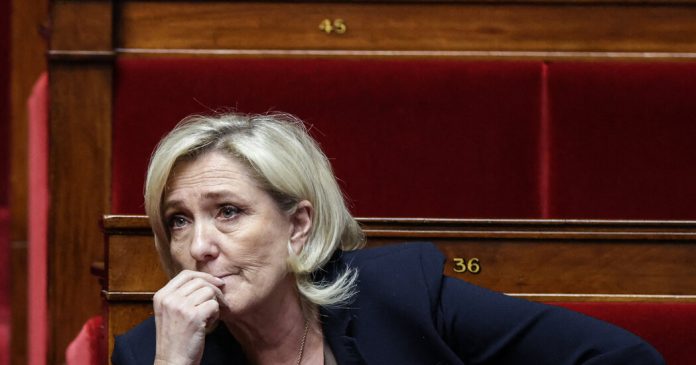
Marine Le Pen, the far-right leader, was found guilty of embezzlement yesterday and disqualified from running for public office for five years.

The verdict set off a crisis that could lead to new political turmoil in France. It effectively knocked Le Pen, France’s most popular politician, according to the polls, out of the 2027 presidential election.

The decision infuriated Le Pen, an anti-immigrant, nationalist politician who has already mounted three failed presidential bids. She claimed that the ruling was a “political” attempt to thwart her and vowed to fight back despite slim chances of legal success. “I’m not going to submit to a democratic denial so easily,” she said angrily.

Context: The court ruled that Le Pen played a “central role” in an illegal scheme to use millions of euros of European Parliament funds for party expenses from 2004 to 2016. Le Pen was a member of the European Parliament from 2004 to 2017.

Analysis: Millions of Le Pen supporters are now adrift and angry, our Paris bureau chief, Roger Cohen, writes. France could see a gale of political protests, as well as an attack from the global far right.

Reactions: Across Europe, hard-right leaders sharply criticized the court’s decision. Viktor Orban, the Hungarian prime minister, posted “Je suis Marine!” (“I am Marine!”) on social media.


World markets tumbled yesterday as investors braced for President Trump’s new round of tariffs that would affect the U.S.’s biggest trading partners. Trump has promised to overhaul the global trading system and plans to unveil tomorrow what he is calling “reciprocal tariffs” that would match the import taxes and other policies that other countries impose on American exports.

Trump has taken to calling April 2, when the tariffs are supposed to go into effect, “Liberation Day,” arguing that their imposition will end years during which other countries have been “ripping us off.” The White House press secretary Karoline Leavitt said yesterday that there would be “no exemptions at this time” as some foreign nations tried to negotiate a last-minute reprieve. On Thursday, a separate 25 percent tariff is set to be imposed on all cars and car parts that are shipped into the U.S.

Asian markets tumbled, with the Nikkei 225 index in Japan falling into a correction. The S&P 500 recorded its worst month since 2022. European stocks slumped.

Mixed messages: A White House trade adviser said that tariffs would raise about $6 trillion over the next decade. But experts say that using tariffs to increase revenue conflicts with the administration’s goal of bringing manufacturing back to the U.S. This is why.

At home: The tariffs are expected to raise the cost of cars, electronics and other products that American consumers buy from overseas. But Trump and his aides are betting they can convince Americans to swallow higher prices. It could backfire.

As the death toll from the earthquake rose to more than 2,000 people, help was just starting to trickle in yesterday to the remote city of Sagaing in Myanmar, where monasteries and apartments were razed. Over 80 percent of the city was destroyed in the quake that hit Friday, residents said.

The military has been battling rebel forces for control of Sagaing since it seized power in a coup four years ago. Doctors said they had been blocked from entering, and volunteers said their rescue efforts were stopped. The authorities also closed a vital bridge because of safety concerns, further isolating the area.

Thailand: The Bangkok building razed by the quake employed men and women who had found love at work. Despite glimmers of hope, many yesterday were still beneath the rubble.


The Atlantique 2 plane of the French Navy was designed to hunt submarines and other enemy craft, but now one aircraft’s goal is to observe — and to be seen observing. The plane is part of a NATO program aimed at suspected Russian sabotage in the Baltic Sea.

A reporter and a photographer spent 14 hours aboard the plane. Read about it here.

Lives lived: Joe Harris, thought to be the oldest World War II U.S. paratrooper, died at 108.

  • The Essential Tanith Lee: The author wrote over 90 books. Here’s where to start.

  • Not getting over it: Joost Klein found success since getting thrown out of last year’s Eurovision. He’s still upset.

  • A small screen megastar: Richard Chamberlain, who died at 90, was the most compelling face of a maximalist, soapy television era.

Finland has topped the World Happiness Report for the past eight years, owed in part to its welfare state, a closeness with nature and three million saunas. One anxious American, Britta Lokting, went to Helsinki to see if she could bring some of that joy home with her.

Lokting sampled local food, confessed emotions to the trees and plunged into cold waters. On her return to America, she still found happiness to be a luxury. But maybe the answer wasn’t to recreate a dopamine rush, she writes, but something altogether more simple.

Trump explores third term

0

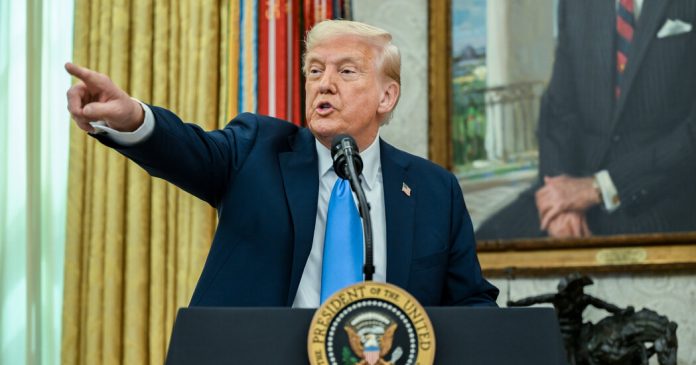
President Trump declined to rule out running for a third term, setting up questions about the 22nd Amendment to the Constitution which implements a two-term limit for the presidency.

Search and Recovery Continue for a Missing U.S. Soldier in Lithuania

0

Three U.S. Army soldiers were found dead and a fourth was missing on Monday, nearly a week after their armored vehicle became stuck in a deep and muddy bog during a training mission, the Army said.