

Lawmakers with young children are trying to change House rules to allow new parents up to 12 weeks to vote remotely around the birth of a child
U.A.E. Sentences Three People to Death for Killing an Israeli Rabbi

The United Arab Emirates on Monday sentenced three people to death for the abduction and killing of an Israeli Moldovan rabbi last November, a case that raised concerns about the safety of the country’s small but growing Jewish community.
The U.A.E.’s state news agency, WAM, reported that the Abu Dhabi Federal Court of Appeals’ State Security Chamber decided on the death penalty for the “premeditated murder with terrorist intention” of Rabbi Zvi Kogan.
A fourth person was sentenced for aiding in the crime — in what way the government did not say — to a prison term, followed by deportation from the country. The defendant was sentenced to life in prison, but typically that means being released after 20 years or more.
The authorities did not disclose the identities of those sentenced, but the U.A.E. Interior Ministry previously identified three people accused of murder as Olimboy Tohirovich and Makhmudjon Abdurakhim, both 28, and Azizbek Kamilovich, 33, all Uzbek nationals. State media released photos of them, blindfolded and shackled at the wrists and ankles, after their extradition from Turkey.
“The defendants had tracked and murdered the victim,” WAM said in its report on Monday. “The evidence presented by the State Security Prosecution to the court included the defendants’ detailed confessions to the crimes of murder and kidnapping, along with forensic reports, post-mortem examination findings, details of the instruments used in the crime and witness testimonies.”
The report did not quote the authorities offering a motive for the murder of Rabbi Kogan, 28, or any further details about how he was kidnapped and later killed.
The rabbi disappeared on Nov. 21 and was last reported seen in Dubai, the most populous of the nation’s seven emirates, according to an Israeli official who spoke to The New York Times at the time. Israeli news outlets reported that his car had been found abandoned in Al Ain, a city in the adjacent emirate of Abu Dhabi, on the border with Oman. His body was found three days later.
The office of Prime Minister Benjamin Netanyahu of Israel denounced the killing at the time as an “antisemitic terrorist act.”
Rabbi Kogan was a dual citizen of Israel and Moldova and had worked in the Emirates as part of the Chabad-Lubavitch movement, a Hasidic branch of Orthodox Judaism that conducts Jewish outreach around the world. He also helped manage the Rimon kosher supermarket in Dubai’s affluent Al Wasl Road neighborhood. This month, the supermarket announced that it was moving and would accept only delivery orders for the time being.
The Israeli Embassy and Consulate in the Emirates did not immediately respond to requests for comment on the sentences.
The kidnapping and killing of the rabbi rattled the small Jewish population of the Emirates; estimates of its number ranges from hundreds to a few thousand. More Israelis and Jews have made the Emirates their home since the country formally established ties with Israel in the 2020 Abraham Accords.
Emirati authorities said on Monday that the capital sentences “are automatically subject to appeal” to the criminal division of the Federal Supreme Court. Cases of capital punishment are rare in the Emirates, but executions are carried out promptly after defendants exhaust their appeals.
IMLS staff put on administrative leave : NPR

The Institute of Museum and Library Services is the main source of federal funding for libraries.
Shannon Finney/Institute of Museum and Library Services
hide caption
toggle caption
Shannon Finney/Institute of Museum and Library Services
The Institute of Museum and Library Services has placed its entire staff on administrative leave.
The IMLS is a relatively small federal agency, with around 70 employees, that awards grant funding to museums and libraries across the United States.
This month, President Trump named Keith E. Sonderling — the deputy secretary of labor — the new acting director of IMLS. This followed Trump’s previous executive order shrinking seven federal agencies, including the Institute of Museum and Library Services.
According to a statement from AFGE Local 3403, which represents IMLS workers, the agency’s staff was notified by email about being placed on paid administrative leave for 90 days after a “brief meeting between DOGE staff and IMLS leadership.” Employees had to turn in government property, and email accounts were disabled.

What is the IMLS?
The IMLS is an independent federal agency that provides grants to libraries and museums across the country. According to the American Library Association, the IMLS provides “the majority of federal library funds.” The IMLS says it awarded $266 million in grants and research funding to cultural institutions last year. This money goes to help staff, fund maintenance and create new programs. In comparison, the projected 2025 budget for the National Endowment for the Arts was $210 million.
For instance, in 2023 the IMLS funded projects such as a workforce training program at the Museum of Discovery and Science in Orlando, a pilot program in Iowa to help library staff address patrons’ psychological needs and basic library functions (books, computers, internet) for various Native American tribes. You can find programs that the IMLS has funded to libraries and museums in your state through its dashboard.
According to the advocacy group EveryLibrary, public libraries are primarily funded by city and county taxes. And federal funds account for a much smaller portion of a library’s budget. However, the group issued a statement following Trump’s executive order, saying that “without this core federal funding for state libraries, museums, and archives, we risk losing critical programs and services in every state.”

According to AFGE Local 3403, the status of grants that were previously awarded is unclear. And, the union statement said, without staff to administer the programs, it’s likely most grants will be terminated.
Steve Potash is the CEO of OverDrive, which distributes digital products such as audiobooks, e-books and movies to libraries. He said in an interview that small and rural libraries will be most affected by cuts to federal funding.
“When a public library which has growing demand for their online and digital materials is getting any kind of budget cuts, hard decisions have to be made,” said Potash.
Meghan Collins Sullivan edited this story.
Palestinians Flee Southern Gaza Amid New Evacuation Order

Gazans were seen fleeing Rafah on Monday after the Israeli military issued a wide evacuation order for the southern Gaza Strip.
The Picture Show : NPR

For Women’s History Month, I wanted to highlight Victoria Woodhull, who wrote a letter to the New York Herald in 1870 announcing that she was running for president. At the time, women were not allowed to vote, but there were no laws against launching a presidential campaign — perhaps because no one could have imagined that a woman ever would.
Woodhull was a passionate suffragist who has mostly been forgotten by history. The suffragists of her time kept their distance because she had other “scandalous” views they didn’t want to tarnish their cause. She was also a divorced woman with a controversial past, as a Spiritualist clairvoyant and the daughter of a conman who had roped his family into numerous criminal schemes.
However, as someone who went from uneducated bumpkin to one of the richest and most controversial people of her era, and someone who was not afraid to take action against injustices, and who went from riches back to rags in order to promote her ideas for a better nation, she ought to stand amongst the most iconic Americans in history.


Jackie Lay works on the Visuals team at NPR. She’s an animator and illustrator who has been published at The Atlantic, Vox and The Washington Post. Find more of her work online, at JackieLay.com.
A Quarter-Billion Dollars for Defamation: Inside Greenpeace’s Huge Loss
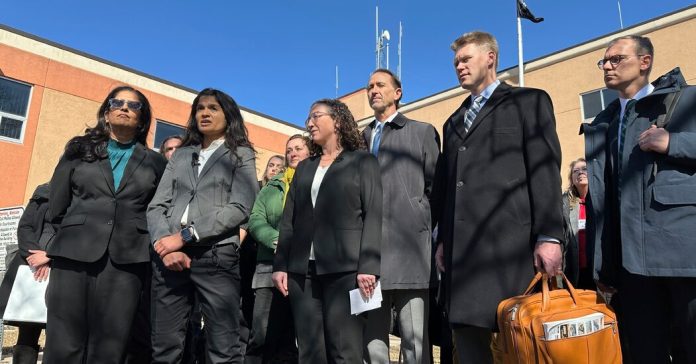
When the environmental group Greenpeace lost a nearly $670 million verdict this month over its role in oil pipeline protests, a quarter-billion dollars of the damages were awarded not for the actual demonstrations, but for defaming the pipeline’s owner.
The costly verdict has raised alarm among activist organizations as well as some First Amendment experts, who said the lawsuit and damage awards could deter free speech far beyond the environmental movement.
The verdict “will send a chill down the spine of any nonprofit who wants to get involved in any political protest,” said David D. Cole, a professor at Georgetown Law and former national legal director of the American Civil Liberties Union. “If you’re the Sierra Club, or the N.A.A.C.P., or the N.R.A., or an anti-abortion group, you’re going to be very worried.”
The lawsuit, filed by Energy Transfer in 2019, accused Greenpeace of masterminding an “unlawful and violent scheme” to harm the company’s finances, employees and infrastructure and to block the construction of the Dakota Access Pipeline. Greenpeace countered that it had promoted peaceful protest and had played only a minor role in the demonstrations, which were led by the Standing Rock Sioux Tribe over concerns about its ancestral land and water supply.
A key part of Energy Transfer’s case relied on defamation claims. For example, the jury found that Greenpeace defamed the company by saying it had “damaged at least 380 sacred and cultural sites” during pipeline work, the first of nine statements found defamatory.
Greenpeace called Energy Transfer’s lawsuit an attempt to muzzle the company’s critics. “This case should alarm everyone, no matter their political inclinations,” said Sushma Raman, interim executive director of Greenpeace USA. “We should all be concerned about the future of the First Amendment.”
Greenpeace has said it will appeal to the Supreme Court in North Dakota, the state where the trial was held. Free-speech issues are widely expected to figure prominently in that filing.
But Greenpeace was not the only party invoking the First Amendment.
Upon leaving the courtroom, the lead lawyer for Energy Transfer, Trey Cox of Gibson, Dunn & Crutcher, called the verdict “a powerful affirmation” of the First Amendment. “Peaceful protest is an inherent American right,” he said. “However, violent and destructive protest is unlawful and unacceptable.”
Vicki Granado, a spokeswoman for Energy Transfer, described the verdict as “a win for all law-abiding Americans who understand the difference between the right to free speech and breaking the law.”
The clashing comments shine a light on a central tension in the debate: Where do you draw the line between peaceful protest and unlawful activity?
“If people are engaged in non-expressive conduct, like vandalism, like impeding roadways such that cars and passers-by can’t use those roadways, the First Amendment is not going to protect that,” said JT Morris, a senior supervising attorney at the Foundation for Individual Rights and Expression, a nonprofit that defends free speech across the ideological spectrum. “But peaceful protest, criticism of companies on matters of public concern, those are all protected.”
The verdict landed in the midst of a larger debate over the limits of free speech. President Trump has accused news outlets of defaming him, and he has been found liable for defamation himself. His administration has targeted law firms he perceives as enemies, as well as international students deemed too critical of Israel or of U.S. foreign policy. Conservatives have accused social media platforms of suppressing free speech and have vowed to stop what they call online censorship.
“There’s nothing in this particular political climate that’s shocking anymore,” said Jack Weinberg, who in the 1960s was a prominent free-speech activist and later worked for Greenpeace. (He’s also known for the phrase “Don’t trust anyone over 30,” although that’s not exactly how he said it.) “But it’s wrong,” he said of the verdict, “and it will have profound consequences.”
There has long been a high bar for defamation lawsuits in the United States.
The First Amendment protects free speech and the right to protest, and a landmark 1964 Supreme Court decision, New York Times v. Sullivan, strengthened those protections. To prevail in a defamation suit, a public figure must prove that the statement was false and was made with “actual malice,” meaning knowledge that the statement was false, or reckless disregard for its veracity.
Carl W. Tobias, a professor at the University of Richmond School of Law, said that ruling intentionally raised the bar to win a defamation suit. “It’s extreme,” he said. “It’s meant to be.”
Eugene Volokh, a senior fellow at the Hoover Institute at Stanford University, pointed to the history of that famous case. It concerned a 1960 ad in The Times that described police actions against civil rights demonstrators in Alabama as “an unprecedented wave of terror.”
A police official sued the paper and won. But the Supreme Court overturned the verdict. The court ruled that protecting such speech was necessary, even if it contained errors, in order to ensure robust public debate.
In a Greenpeace appeal, Mr. Volokh said, the evidence demonstrating whether Greenpeace’s statements were true or false would be crucial in evaluating the verdict, as would the question of whether Greenpeace’s statements were constitutionally protected expressions of opinion.
Other issues that loom: What was permitted to be entered into evidence in the first place, and whether the instructions to the jury were sufficient. Then, he said, if the statements are found to be clearly false, is there enough evidence to show that Greenpeace engaged in “reckless falsehood, acts of so-called actual malice?”
Any award for defamation chills free speech, Mr. Volokh added, whether against Greenpeace or against the Infowars host Alex Jones, who was found liable for more than $1 billion over his false statements about the murder of children at the Sandy Hook school shooting.
In the Greenpeace case, the nine statements found by the jury to be defamatory referred to Energy Transfer and its subsidiary Dakota Access. One statement said that Dakota Access personnel had “deliberately desecrated burial grounds.” Another said that protesters had been met with “extreme violence, such as the use of water cannons, pepper spray, concussion grenades, Tasers, LRADs (Long Range Acoustic Devices) and dogs, from local and national law enforcement, and Energy Transfer partners and their private security.”
Other statements were more general: “For months, the Standing Rock Sioux have been resisting the construction of a pipeline through their tribal land and waters that would carry oil from North Dakota’s fracking fields to Illinois.”
The protests unfolded over months, from mid-2016 to early 2017, attracting tens of thousands of people from around the world, and were widely documented by news crews and on social media.
Janet Alkire, chairwoman of the Standing Rock Sioux Tribe, argued that Greenpeace’s statements were true and not defamatory. “Energy Transfer’s false and self-serving narrative that Greenpeace manipulated Standing Rock into protesting DAPL is patronizing and disrespectful to our people,” she said in a statement, using an abbreviation for the Dakota Access Pipeline.
She said that “scenes of guard dogs menacing tribal members” were publicly available “on the news and on the internet.”
Videos of the incidents in question weren’t shown at the trial. Everett Jack Jr. of the firm Davis, Wright Tremaine, the main lawyer for Greenpeace, declined to discuss why.
The 1,172-mile pipeline, priced at $3.7 billion when announced, has been operating since 2017. It carries crude oil from North Dakota to Illinois.
During the trial, some arguments hinged on whether the pipeline crossed Standing Rock’s land, or how to define tribal land. The pipeline is just outside the borders of the reservation but crosses what the tribe calls unceded land that it had never agreed to give up.
There was also debate about whether tribal burial grounds were harmed during construction. Experts working for the tribe found that was the case, but experts brought in by Energy Transfer did not.
Even if a statement was false, Mr. Cole said, a defendant cannot be held liable if they had a basis for believing it. He also predicted that the penalty would likely be reduced on appeal if not overturned.
Martin Garbus, a veteran First Amendment lawyer, led a delegation of lawyers to North Dakota to observe the trial. The lawyers have said that the jury was biased against the defendants and that the trial should have been moved to another county. He expressed concern that an appeal to the U.S. Supreme Court could be used to overturn Times v. Sullivan. He noted that Justice Clarence Thomas has called for the Supreme Court to reconsider that case.
But Mr. Cole, Mr. Tobias and other experts said they did not expect the court to reconsider Times v. Sullivan.
Greenpeace has said previously that the size of the damages could force the organization to shut down its U.S. operations.
The lawsuit named three Greenpeace entities, but it centered on the actions of Greenpeace Inc., based in Washington, which organizes campaigns and protests in the United States and was found liable for more than $400 million.
A second organization, Greenpeace Fund, a fund-raising arm, was found liable for about $130 million. A third group, Greenpeace International, based in Amsterdam, was found liable for the same amount. That group said its only involvement was signing a letter, along with several hundred other signatories, calling on banks to halt loans for the pipeline.
Earlier this year, Greenpeace International filed a countersuit in the Netherlands against Energy Transfer. That lawsuit was brought under a European Union directive designed to fight what are known as SLAPP suits, or strategic lawsuits against public participation — legal actions designed to stifle critics. (State law in North Dakota, where Energy Transfer brought its case against Greenpeace, doesn’t have anti-SLAPP provisions.)
The next hearing in the Netherlands case is in July.
All eyes on special congressional elections in Florida Tuesday

Florida’s first and sixth Congressional districts are holding special elections this Tuesday.
U.S. Has Spent $40 Million to Jail About 400 Migrants at Guantánamo

Five senators who visited the U.S. base at Guantánamo Bay, Cuba, criticized the migrant mission there over the weekend as a waste of resources, after the Pentagon estimated that the operation had cost $40 million in its first month.
The Senate delegation on Friday toured Immigration and Customs Enforcement facilities where about 85 migrants were being held, including in a prison that for years housed wartime detainees linked to Al Qaeda.
The senators also spoke with officials from the Defense and Homeland Security Departments. About 1,000 government employees, mostly from the military, are staffing the migrant operation.
The administration has sent fewer than 400 men, at least half of them Venezuelans, to the base since February as part of President Trump’s crackdown on illegal immigration. The authorities returned about half of them to facilities in the United States without explaining why scores of people needed to be housed at Guantánamo for short stays.
As of Sunday, there were 105 immigration detainees at the base.
Senator Jack Reed of Rhode Island, who was part of the delegation, faulted the administration on Sunday for “diverting troops from their primary missions” to Guantánamo.
Mr. Reed, the ranking Democrat on the Armed Services Committee, said in an interview that he was provided with an estimate that the operation had cost $40 million in the first month.
“All of that is extraordinarily expensive and unnecessary,” he said. Instead, the administration should “try to enhance ICE facilities in the United States.”
The others on the trip were Senators Jeanne Shaheen of New Hampshire, the top Democrat on the Foreign Relations Committee; Gary Peters of Michigan, the top Democrat on the Homeland Security Committee; Alex Padilla, Democrat of California; and Angus King, independent of Maine.
The Defense Department advised Congress that as of March 12, the Guantánamo migrant operation had cost $39.3 million, according to congressional aides, who spoke on the condition of anonymity because Pentagon and congressional communications are considered sensitive. That estimate covered a six-week period when the Trump administration had moved 290 migrants there, including 177 Venezuelans who were repatriated.
The daylong Senate trip on Friday was a low-profile event compared with ones by Defense Secretary Pete Hegseth and Kristi Noem, the homeland security secretary, who each brought news photographers with them. But just like during their visits, the senators were there when the administration flew in a small number of migrants: 13 Nicaraguans from an ICE facility in Louisiana. Tricia McLaughlin, a spokeswoman for the Department of Homeland Security, described them as “gang members.”
On Saturday, hours after the delegation issued a statement urging the administration to “immediately cease this misguided mission,” an Air Force C-130 cargo plane from San Antonio brought 12 more migrants to the operation.
It was the first military shuttle carrying migrants to Guantánamo since ICE began using less costly charter planes to transport migrants to and from the base on Feb. 28.
“After examining the migrant relocation activities at Guantánamo Bay, we are outraged by the scale and wastefulness of the Trump administration’s misuse of our military,” the five senators said in the statement.
They called the migrant operation “unsustainably expensive, operating under questionable legal authority, and harmful to our military readiness.”
Guantánamo is a particularly expensive place because it is cut off from the rest of the island by a Cuban minefield. The base produces its own energy and water, and supplies are shipped in from Florida by barge and aircraft.
The delegation was critical of the mission but not of the estimated 900 military members and 100 homeland security employees who had been mobilized to the base to carry it out.
Some troops “were rushed to Guantánamo Bay without notice, leaving their critical day-to-day military missions behind in order to build tents that should never be filled and guard immigrants who should never be held there,” the statement said.
“This would be better both economically and also in terms of legal clarity if the military were not involved,” it continued.
ICE decides when it needs military aircraft and the Pentagon provides them, according to two government officials who spoke on the condition of anonymity because they were not authorized to discuss the arrangements.
The congressional aides said the operation was governed by a secret memorandum of understanding between the Defense and Homeland Security Departments that says only migrants with ties to transnational criminal organizations be sent to Guantánamo Bay.
Mr. Hegseth said on Jan. 30 that Guantánamo would serve as a temporary transit point for “violent criminal illegals as they are deported out of the country.”
But the administration has declined to provide evidence that foreign nationals held at the base had violent criminal records. Checks of some whose identities have been made public showed their crimes amounted to illegally entering the United States, sometimes more than once.
The Department of Homeland Security has housed 395 migrants at Guantánamo Bay, some for just days, since the first 10 were brought there on Feb. 4, according to New York Times tracking of the transfers.
On Feb. 20, the United States sent 177 Venezuelans from Guantánamo to Honduras, where they were put on a Venezuelan plane and flown home.
All the others were returned to ICE facilities in the United States and in a few known instances were deported from there.
White House says it’s ‘case closed’ on the Signal group chat review : NPR
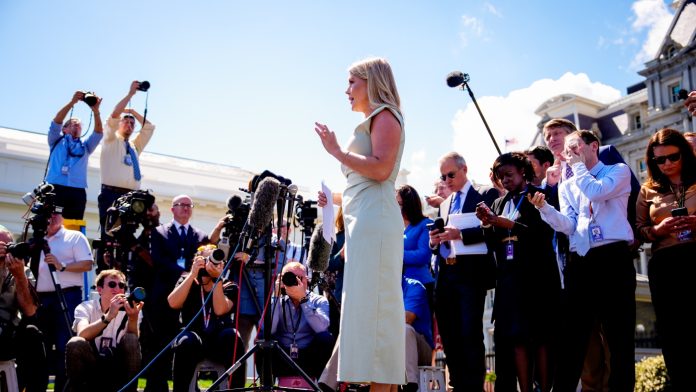
White House press secretary Karoline Leavitt speaks to reporters on the White House driveway on March 31, 2025.
Andrew Harnik/Getty Images
hide caption
toggle caption
Andrew Harnik/Getty Images
The White House has concluded its review of how Atlantic editor Jeffrey Goldberg was inadvertently included on a Signal message group chat of high-ranking officials discussing impending strikes in Yemen.

The Atlantic story, published one week ago, stunned Washington because of the sensitive nature of the information disclosed on the app. The White House has said none of the information was classified.
“This case has been closed here at the White House as far as we are concerned,” press secretary Karoline Leavitt told reporters on Monday. “There have been steps made to ensure that something like that can obviously never happen again, and we’re moving forward,” she said.
Leavitt did not offer details about what steps the White House is taking after its review. Last week, she had told reporters that the National Security Council, the White House counsel’s office and Trump adviser Elon Musk were all looking into how the mishap happened.
Leavitt said Trump’s national security adviser Mike Waltz — who created the group chat and added Goldberg to it — “continues to be an important part of (Trump’s) national security team.”
NPR disclosure: Katherine Maher, the CEO of NPR, chairs the board of the Signal Foundation.
Uncertainty Torments Afghan Refugees Facing Deportation from Pakistan

In a refugee settlement on the outskirts of Karachi, Pakistan, Afghan families gathered on Sunday to observe the festival of Eid al-Fitr — not in joyous celebration, but in quiet apprehension. On Monday, thousands who have called Pakistan home for generations face a deportation deadline and an uncertain, possibly dangerous future.
Since the Soviet invasion of Afghanistan in 1979, millions of Afghans have sought refuge in neighboring Pakistan, fleeing waves of violence and instability. Over the decades, many have returned home, but conflict and political upheaval continue to send hundreds of thousands back.
The latest wave of displacement followed the Taliban’s takeover of Afghanistan in August 2021, after the collapse of Ashraf Ghani’s U.S.-backed government. They included refugees who were promised resettlement in the United States.
Many now face mandatory repatriation, with a March 31 deadline — a decision that was announced only last month, sparking widespread fear.
“As a fellow Muslim nation and a neighbor, Pakistan should show compassion and grant refugees more time to prepare,” said Haji Abdullah Bukhari, a community leader in Karachi. “Uprooting their lives in just a few days is impossible. Many have spent decades here, and now they are being forced to return to a country they barely know.”
Pakistan’s ongoing deportation of Afghan refugees stems from growing frustration with the Taliban administration, which it accuses of sheltering Pakistani militants, particularly Tehreek-e-Taliban Pakistan or T.T.P., responsible for deadly attacks inside Pakistan. The Taliban deny these allegations, but tensions continue to rise.
In 2023, Pakistan expelled hundreds of thousands of Afghans — both documented and undocumented. However, most refugees awaiting resettlement in Western countries were largely spared thanks to diplomatic interventions.
Their fate, however, became increasingly uncertain in January when President Trump issued an executive order suspending all refugee admissions to the United States. This decision left thousands of Afghans stranded in Pakistan.
In February, Pakistan announced its plans to repatriate Afghans awaiting resettlement by March 31, along with 800,000 Pakistan-issued Afghan Citizenship Card holders and an unknown number of undocumented Afghan migrants.
The decision has caused widespread unease, particularly among those most vulnerable to Taliban persecution, including former Afghan government and security officials, women’s rights activists and journalists.
“Many have told us they fear prison, torture, or even execution if Pakistan forcibly sends them back to Afghanistan,” said Moniza Kakar, a lawyer with the Joint Action Committee for Refugees, a Pakistani civil society network that advocates for international intervention and support to safeguard lives.
Avaaz, a global campaign working to secure humanitarian visas for a group of 60 Afghan women’s rights activists stuck in Pakistan, has also voiced deep concern over the deportation drive.
Among those affected is Samia Hamza, a women’s rights activist and former law and international relations student under the U.S.-funded Denton Program. After the Taliban seized power, she protested against the ban on girls’ education, further endangering herself.
As conditions worsened in late 2021, she fled to Pakistan. However, she has since faced severe discrimination and economic hardship while awaiting U.S. resettlement through the special immigration visas for Afghans program.
Like many Afghans, she was devastated by the Trump administration’s decision to halt new immigrants. “We have heard nothing about our case since then,” said Hamza, who lives with her husband and four children in Islamabad. “With the threat of deportation, returning to Afghanistan means facing grave danger.”
The Pakistani government has ruled out extending the deportation deadline despite appeals from international organizations and the Taliban administration. Justifying its crackdown on Afghans, the government has drawn parallels to ongoing deportation efforts in the United States and various European countries.
Meanwhile, Philippa Candler, the Pakistan representative at the United Nations refugee agency, urged Pakistan and Afghanistan to ensure voluntary, safe returns. “Forced returns help no one and aren’t sustainable — many deported in 2023 have already returned.”
Many Afghans remember terrifying scenes of the 2023 expulsions, dreading the moment when police contingents might arrive — knocking on doors, rounding up families into trucks and transferring them to detention centers before forcing them into Afghanistan.
“We are all praying for a miracle that Pakistan will stop the deportations to a country my children have never seen,” said Naik Bakht, an Afghan refugee who arrived in Karachi in 1996. A father of three, all born in Pakistan, he said he fears for their future.
“I am terrified. What will we do in Afghanistan? Where will we go? How will we survive?”