Thursday, November 12, 2026
Home Blog Page 70

Expert breaks down Tesla’s brand baggage : NPR

0

Protesters rally against Tesla CEO Elon Musk outside a Tesla store in San Francisco on Saturday.

Noah Berger/AP


hide caption

toggle caption

Noah Berger/AP

Protests against Tesla and its CEO Elon Musk took place across the country over the weekend and are spreading globally. The Tesla Takedown movement is urging people to sell their Tesla cars and stock.

Many are upset with Musk for his unelected but powerful role in the Trump administration. He heads the Department of Government Efficiency — DOGE, which has been making aggressive cuts across government. Both President Trump and Musk say the cuts are important to combat bureaucracy and fraud.

Tesla has experienced a decline in global sales, particularly in Europe and China. Since Musk’s political turn, investors have grown uneasy. But market analysts also question how much of the drop in Tesla sales and shares can be attributed to Musk’s actions alone.

Morning Edition spoke with branding expert Allen Adamson about Tesla’s struggles, which he attributes to several factors: Musk’s lack of focus on the company and innovation, the brand’s shifting public perception and the increasing role of politics in consumer decisions.

Adamson is the co-founder and managing partner of Metaforce, a marketing consultancy, and the author of Seeing the How: Transforming What People Do, Not Buy, To Gain Market Advantage, which is about consumer behavior, behavioral psychology and marketing analysis.

The interview has been lightly edited for length and clarity.

A Martínez:  So, Allen, why are Tesla sales falling right now in particular? Is it about Elon Musk’s work at DOGE or is it maybe something else?

Whenever a business fails, it’s never about one thing. Or a brand gets into trouble. It’s usually about many things. So the brand problems now are: his DOGE issue, his Cybertruck recall… lots of things. It’s having a cumulative effect and it’s reached the tipping point.

Martínez: Have there been other examples that you could point to in the past where something that a CEO has said or done affected their company sales? 

Not in the car industry, for sure. There are smaller examples, but nothing at this scale.

Martínez: Allen, what is it about cars that make it such a different market than other products? Is it one of those things where, when you buy a car, it says something about you, without saying anything at all, necessarily?

Most people think, ‘I bought the car because it has good acceleration. I like the way it steers.’ But when you look at car performance, there’s no difference between cars. They all get roughly the same mileage, either electric or gas. You look inside, they all hook up to your smartphone. In fact, when you get in many cars, and if you don’t look at the brand, you have no idea what car you’re in. And so cars are what we call badge brands. They are identity signals. They say, ‘I’m driving a BMW, I’m driving a Ford pickup truck,’ because it says something about you. It’s more like a beer brand and a fashion brand. You park it in a driveway to say, ‘Look at me. I’m a green person. I’m driving a Tesla, or look at me, I’m a real macho person, I’m driving this big pickup truck.’ And so cars are always about the brand image and once the brand image is not something you want to say to your neighbors, you’re in big trouble in a category that’s brand-driven.

Martínez: But would it be easy if, say, for some reason, he divests in Tesla, sells every bit of stock and ownership stake that he has in Tesla, and then all of a sudden, has nothing to do with the brand?

That would probably be the best thing for the brand. That’s the only easy fix, which is, ‘I’m selling it, I’m going to focus on other things I’m interested in.’ And the new ownership team is going to keep their eye on the ball. Because I think the issue is focus. If you’re building a car that has your life at stake when you drive it, you don’t want a brand perception that the people at a company are moving fast and breaking things. You want somebody you can trust to say, ‘when I get in this car, the wheels aren’t going to fall off or I’m not going to get killed.’ So having this sort of erratic personality is probably a more damaging brand attribute than helping the government try to save money on federal employees. 

Martínez: So I think the lesson here for any current CEO or aspiring CEO is maybe don’t ever talk politics publicly.

That’s always been a lesson, and now, the more polarized the country is, the more true it is. And it will be a good lesson for other CEOs to say, ‘look, as much as my employees want me to speak out or I want to speak out, less is more.’

Israel Issues Evacuation Order for Southern Gaza

0

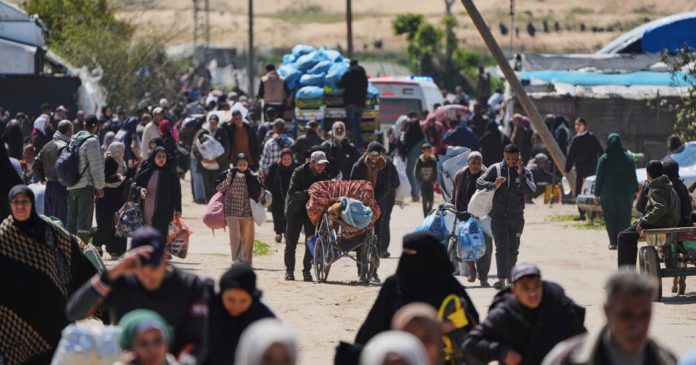
The Israeli military issued a sweeping evacuation order for the southern Gaza Strip on Monday, signaling it could relaunch intensive operations in the area.

The order — which came during the Eid al-Fitr holiday — heralded renewed hardship for Palestinians in the southernmost city of Rafah, which has been battered by the war between Israel and Hamas. The war restarted two weeks ago after a monthslong cease-fire collapsed.

In the past, the Israeli military has ordered evacuations ahead of both aerial attacks and ground maneuvers that it has said were targeting Hamas.

Avichay Adraee, the Israeli military’s Arabic-language spokesman, on Monday posted a map of the affected areas on his social media accounts, including Rafah and parts of neighboring Khan Younis. He said Palestinians must relocate to shelters in a costal region to the north.

Israel’s military “is returning to fighting with great force to take out the capabilities of terrorists organizations in these areas,” he wrote.

Earlier this month, Mr. Adraee announced an evacuation order for some neighborhoods in Rafah, and the maps he posted on Monday again included those.

It was not clear how many people were still in Rafah when Mr. Adraee made his post and how many intended to follow his instructions. While hundreds of thousands of people lived there before the war, wide swathes of the city have since been reduced to rubble.

Over the past two weeks, Mr. Adraee has issued evacuations orders for other parts of Gaza, but many residents of those areas have seemingly ignored them.

Since the start of the war ignited by the Hamas-led October 2023 attack on Israel, Palestinians in Gaza have been repeatedly displaced by the fighting — a miserable experience that has forced many people to live in crowded makeshift shelters next to strangers.

The Israeli military resumed its operations against Hamas in Gaza on March 18 after Israel and Hamas failed to reach an agreement to extend a cease-fire that started in January.

Israel and Hamas have been speaking to mediators about a potential deal to restore the cease-fire, but a breakthrough has not yet been achieved.

Trump on seeking 3rd term; Myanmar earthquake : NPR

0

Good morning. You’re reading the Up First newsletter. Subscribe here to get it delivered to your inbox, and listen to the Up First podcast for all the news you need to start your day.

Today’s top stories

President Trump says he isn’t ruling out the possibility of seeking a third term in office. Yesterday, Trump told NBC News he “was not joking” about serving another term and that “there are methods” that would allow him to do so. He did not elaborate on those methods. The Constitution mandates a two-term limit for the president.

President Donald Trump arrives on Air Force One at Palm Beach International Airport, Friday, March 28, 2025, in West Palm Beach, Fla. (AP Photo/Manuel Balce Ceneta)

Manuel Balce Ceneta/AP/AP


hide caption

toggle caption

Manuel Balce Ceneta/AP/AP

  • 🎧 There is something of a movement among Trump’s most avid supporters promoting the idea of a third term, NPR’s Tamara Keith tells Up First. A Republican congressman even introduced a constitutional amendment three days into Trump’s second term to pave the way for a third. Keith says there’s a political reason for Trump to pursue this. Unless something dramatic happens, the clock is ticking on his power. Members of his party will soon run to replace him and he will be seen as a lame duck, she says. Teasing a third term could potentially extend his influence.

Trump has issued an executive order targeting the Smithsonian Institution, aiming to restore the “truth and sanity to American history.” The order includes provisions seeking to reinstate monuments, memorials and statues that were removed or altered since January 2020. In response, Smithsonian Secretary Lonnie Bunch told staff in an email that it would continue to employ internal review processes and that their work “will be shaped by the best scholarship, free of partisanship, to help the American public better understand the nation’s history, challenges and triumphs.”

  • 🎧 NPR’s Isabella Gomez Sarmiento says one big question is which monuments would be put back up. Many of the sites that saw changes to monuments were on land controlled by municipalities and state governments, according to Seth Levi of the Southern Poverty Law Center, a legal and advocacy group. This land isn’t controlled by the Department of the Interior, which is tasked with reviewing monuments by Trump’s executive order.

Myanmar’s military authorities say the death toll from Friday’s 7.7 magnitude earthquake has climbed to over 1,700. That number is expected to rise as the window to find survivors is closing. Foreign assistance has started to arrive, but efforts have been stifled by buckled roads, collapsed bridges and downed cell towers.

  • 🎧 Lack of heavy equipment and personnel has hampered efforts to rescue those trapped underneath the rubble, says NPR’s Michael Sullivan. Rescue workers say the smell of death is overpowering. Rescue teams from China, India and Russia have arrived in the country, but the airport is closed to large aircraft and much of the foreign assistance is being flown around 350 miles south to Yangon. Trump said on Friday that the U.S. would also help in assistance efforts. The USAID, which played a large role in disaster relief in the past, has been gutted by the Trump administration in recent weeks.
  • ➡️ See photos of the aftermath of the earthquake in Myanmar and Thailand.

Picture show

Gabriella Cardenas of North Potomac, Md., wears her quinceañera dress as she and her father, Boris Cardenas (holding dress), brother Jason Cardenas and mother Patty Cardenas move to a new spot along the Tidal Basin for a photo.

Gabriella Cardenas of North Potomac, Md., wears her quinceañera dress as she and her father, Boris Cardenas (holding dress), brother Jason Cardenas and mother Patty Cardenas move to a new spot along the Tidal Basin for a photo.

Tyrone Turner/WAMU


hide caption

toggle caption

Tyrone Turner/WAMU

The cherry blossoms in the nation’s capital reached peak bloom this weekend, attracting scores of people to the approximately 3,800 cherry trees near the National Mall. But even two days before peak bloom, droves of people came out to see the spectacle. Last Wednesday, D.C.’s Tidal Basin was packed with a mixed scene of special occasions and everyday moments. People posed for photoshoots, families pushed their strollers along the blossoms and joggers weaved through the crowd. Check out these photos of the blossoms and see how people have been enjoying them.

From our hosts

by Steve Inskeep, Morning Edition and Up First host

During a week in China, we glimpsed the high and low ends of its economy.

Global business leaders spoke at the China Development Forum. China’s premier, or prime minister, told them China is now a stable country that follows global rules — a dig at the United States with its near-weekly changes in tariff policy. He also promoted China’s progress in building humanoid robots.

The lobby of the Xiaomi auto plant in Beijing.

The lobby of the Xiaomi auto plant in Beijing.

Steve Inskeep/NPR


hide caption

toggle caption

Steve Inskeep/NPR

An executive at the Forum spoke of artificial intelligence. To the layman, AI means ChatGPT, but he said the real money was in AI’s application to manufacturing.

We sensed what the executive meant when we toured a factory making trendy Xiaomi electric cars. Robotic machinery did most of the work: Crane-like arms moved parts around on the assembly line while self-driving vehicles moved items around the factory floor. A century ago, Henry Ford’s famous River Rouge auto plant employed 100,000 people; this plant employs 2,000.

At the low end, we toured a factory consisting of 4,000 3-D printers, the kind you can buy on Amazon and use in your home. The printers are cranking out millions of plastic animals and other toys for the global market. The factory owner contends he’s creating opportunities for young people like himself who are adrift in China’s high-tech, high-powered economy, which faces high youth unemployment.

3 things to know before you go

Elizabeth Kenward, left, and “Rosie” Maxine Boeve giggle together during the Rosie the Riveter Congressional Gold Medal Commemoration at the World War II Museum in New Orleans, La., on Friday, March 21, 2025.

Elizabeth Kenward, left, and “Rosie” Maxine Boeve giggle together during the Rosie the Riveter Congressional Gold Medal Commemoration at the World War II Museum in New Orleans, La., on Friday, March 21, 2025.

Emily Kask/for NPR


hide caption

toggle caption

Emily Kask/for NPR

  1. Eighteen Rosie the Riveters were honored as Congressional Gold Medal recipients at the National WWII Museum. The women were trailblazers, proving women could succeed in what was considered a man’s job at the time.
  2. In a break with tradition, this year’s White House Correspondents’ dinner will not include a featured comedian. Amber Ruffin’s appearance was canceled.
  3. A babysitter in Kansas was checking for a “monster” under a child’s bed and came face-to-face with a male suspect hiding there.

This newsletter was edited by Suzanne Nuyen.

Uncertainty Torments Afghan Refugees Facing Deportation from Pakistan

0

In a refugee settlement on the outskirts of Karachi, Pakistan, Afghan families gathered on Sunday to observe the festival of Eid al-Adha — not in joyous celebration, but in quiet apprehension. On Monday, thousands who have called Pakistan home for generations face a deportation deadline and an uncertain, possibly dangerous future.

Since the Soviet invasion of Afghanistan in 1979, millions of Afghans have sought refuge in neighboring Pakistan, fleeing waves of violence and instability. Over the decades, many have returned home, but conflict and political upheaval continue to send hundreds of thousands back.

The latest wave of displacement followed the Taliban’s takeover of Afghanistan in August 2021, after the collapse of Ashraf Ghani’s U.S.-backed government. They included refugees who were promised resettlement in the United States.

Many now face mandatory repatriation, with a Monday, March 31 deadline — a decision that was announced only last month, sparking widespread fear.

“As a fellow Muslim nation and a neighbor, Pakistan should show compassion and grant refugees more time to prepare,” said Haji Abdullah Bukhari, a community leader in Karachi. “Uprooting their lives in just a few days is impossible. Many have spent decades here, and now they are being forced to return to a country they barely know.”

Pakistan’s ongoing deportation of Afghan refugees stems from growing frustration with the Taliban administration, which it accuses of sheltering Pakistani militants, particularly Tehreek-e-Taliban Pakistan or T.T.P., responsible for deadly attacks inside Pakistan. The Taliban deny these allegations, but tensions continue to rise.

In 2023, Pakistan expelled hundreds of thousands of Afghans — both documented and undocumented. However, most refugees awaiting resettlement in Western countries were largely spared thanks to diplomatic interventions.

Their fate, however, became increasingly uncertain in January when President Trump issued an executive order suspending all refugee admissions to the United States. This decision left thousands of Afghans stranded in Pakistan.

In February, Pakistan announced its plans to repatriate Afghan nationals awaiting resettlement by March 31, along with 800,000 Pakistan-issued Afghan Citizenship Card holders and an unknown number of undocumented Afghan migrants.

The decision has sparked widespread unease, particularly among those most vulnerable to Taliban persecution, including former Afghan government and security officials, women’s rights activists and journalists.

“Many have told us they fear prison, torture, or even execution if Pakistan forcibly sends them back to Afghanistan,” said Moniza Kakar, a lawyer with the Joint Action Committee for Refugees, a Pakistani civil society network that advocates for international intervention and support to safeguard lives.

Avaaz, a global campaign working to secure humanitarian visas for a group of 60 Afghan women’s rights activists stuck in Pakistan, has also voiced deep concern over the deportation drive.

Among those affected is Samia Hamza, a women’s rights activist and former law and international relations student under the U.S.-funded Denton Program. After the Taliban seized power, she protested against the ban on girls’ education, further endangering herself.

As conditions worsened in late 2021, she fled to Pakistan. However, she has since faced severe discrimination and economic hardship while awaiting U.S. resettlement through the special immigration visas for Afghans program.

Like many Afghans, she was devastated by the Trump administration’s decision to halt new immigrants. “We have heard nothing about our case since then,” said Hamza, who lives with her husband and four children in Islamabad. “With the threat of deportation, returning to Afghanistan means facing grave danger.”

The Pakistani government has ruled out extending the deportation deadline despite appeals from international organizations and the Taliban administration. Justifying its crackdown on Afghans, the government has drawn parallels to ongoing deportation efforts in the United States and various European countries.

Meanwhile, Philippa Candler, the Pakistan representative the U.N. refugee agency, urged Pakistan and Afghanistan to ensure voluntary, safe returns. “Forced returns help no one and aren’t sustainable — many deported in 2023 have already returned.”

Many Afghans remember terrifying scenes of the 2023 expulsions, dreading the moment when police contingents might arrive — knocking on doors, rounding up families into trucks and transferring them to detention centers before forcing them into Afghanistan.

“We are all praying for a miracle that Pakistan will stop the deportations to a country my children have never seen,” said Naik Bakht, an Afghan refugee who arrived in Karachi in 1996. A father of three, all born in Pakistan, he said he fears for their future.

“I am terrified. What will we do in Afghanistan? Where will we go? How will we survive?”

Trump renews order to reveal health care prices but consumers hardly use it : Shots

0

President Donald Trump, joined by Health and Human Services Secretary Robert F. Kennedy Jr. (L) and Commerce Secretary Howard Lutnick (R), signs an executive order on February 25, 2025 on price transparency requirements for the health care industry.

Alex Wong/Getty Images North America


hide caption

toggle caption

Alex Wong/Getty Images North America

It’s a holy grail of health care: forcing the industry to reveal prices negotiated between health plans and hospitals — information that had long been treated as a trade secret. And among the flurry of executive orders President Donald Trump signed during his first five weeks back in office was a promise to “Make America Healthy Again” by giving patients accurate health care prices.

The goal is to force hospitals and health insurance companies to make it easier for consumers to compare the actual prices of medical procedures and prescription drugs. Trump gave his administration until the end of May to come up with a standard and a mechanism to make sure the health care industry complies.

But Trump’s 2025 order is also a symbol of how little progress the country has made since he issued a similar directive nearly six years ago. Consumers find it only partially useful, and the quality of the information is spotty.

A “bold” first step that fizzled

The 2019 order was “pretty bold,” said Gary Claxton, a senior vice president at KFF, a health information nonprofit that includes KFF Health News. “They basically went at the providers and the plans and said, ‘All this data you think is confidential we’re not going to make confidential anymore.’ “

What followed was, to consumer advocacy groups, a disappointment. Hospitals and insurers posted on websites voluminous, complex, and confusing data about their prices. The information has been a challenge for even experts in health care pricing to navigate, let alone consumers. Some members of Congress filed legislation to put the force of law behind price transparency requirements; those bills died. And President Joe Biden’s administration was criticized for not more stringently enforcing the regulations, with one consumer advocacy group even buying a Super Bowl ad featuring the rapper Fat Joe alleging that “hospitals and insurers hide their prices.”

Trump’s new order, signed in February, said that hospitals and health plans “were not adequately held to account when their price transparency data was incomplete or not even posted at all.”

The Government Accountability Office reported in October that the Centers for Medicare & Medicaid Services didn’t know whether prices reported by the health care industry were correct or complete. But CMS, which regulates hospitals, now plans to “systematically monitor compliance” and help institutions understand the requirements, said Catherine Howden, an agency spokesperson.

Howden did not answer questions about whether CMS staffers overseeing price transparency compliance have been fired as part of the Trump administration’s wide-ranging effort to cut the federal workforce.

“Zombie” rates and other inconsistencies

Meanwhile, independent researchers have found numerous problems with the quality of price data both hospitals and health insurers do share with consumers.

A recent report from the Peterson-KFF Health System Tracker found that data reported by four health insurers in New York City often included prices that they say they pay hospitals for services that those health providers don’t — or can’t — provide. These are called “ghost” or “zombie” rates. For example, the health plans reported dentists, optometrists, and audiologists receiving payments for knee replacements, gastrointestinal exams, and other procedures unrelated to their specialties.

In other cases, the data included different prices for the same service paid for by the same insurer at the same hospital. UnitedHealthcare, for example, reported paying New York-Presbyterian/Weill Cornell Medical Center three rates — $47,000, $64,000, and $70,000 — to treat a heart attack.

Or, the insurers reported paying the same price for vastly different services. Aetna, for example, said it paid exactly $6,292 to Mount Sinai Beth Israel hospital for the treatment of respiratory infections, heart attacks, cancers of the digestive tract, kidney and urinary tract infections, and psychosis.

Neither UnitedHealthcare nor Aetna addressed the discrepancies in the data. Cole Manbeck, a spokesperson for UnitedHealthcare, said the insurer has met price transparency requirements and urged members “to use our cost-estimator tools for exact costs based on their specific health plan.” Aetna spokesperson Shelly Bendit referred questions to AHIP, a lobbying and trade association for insurers.

Health insurers have “strongly supported” price transparency, said Chris Bond, a spokesperson for AHIP. The group will work with the Trump administration to provide transparency “in a way that is meaningful for the end user, while also promoting a competitive private market,” Bond said.

What’s a consumer to do?

Estimates and total prices aren’t very useful for consumers, who are mainly interested in what they’ll ultimately have to pay out-of-pocket, said David Cutler, a professor of applied economics at Harvard University. That can vary by health plan, depending on deductibles, copayments, and other fees.

“Most of the price transparency information doesn’t have that,” he said.

It also doesn’t give consumers information about the quality of care, Cutler added, which can lead to an old bias. “It’s kind of like wine when you go to the restaurant,” he said. “People assume that the more expensive wine is better.”

Cutler said he’s skeptical that price transparency will lower costs for patients. But he said it may offer insight to hospitals and health plans about what their competitors are charging and paying for services — knowledge that could inadvertently lead to price increases if hospitals that receive a lower rate than a competitor demand higher reimbursement from health plans.

Trump’s recent executive order notes that the top quarter of the most expensive health service prices have dropped by 6.3% a year since his 2019 order.

However, the same research referenced in the executive order showed that the bottom quarter of services got more expensive, at a rate of about 3.4% per year, according to the analysis by Turquoise Health, a health care price data firm that examined rates at more than 200 hospitals in the 10 largest U.S. markets.

Some patients say that with research and persistence, they’ve been able to make price transparency work for them.

Theresa Schmotzer, 50, of Goodyear, Arizona, said she used hospital price data to save nearly $3,000 on outpatient surgery to have a fibroid removed last year.

Schmotzer, who has health insurance, said the hospital first told her she would owe $3,700 for the procedure and wanted the payment upfront. But she was skeptical.

She said her health insurer was unable to quote a price for the procedure or specify how much she would owe. The morning of the surgery, Schmotzer said, she found a spreadsheet online at PatientRightsAdvocate.org that included different prices paid by insurers, including hers. The reported price for the procedure was closer to $700, she said.

Schmotzer said she took a printout of the spreadsheet to the hospital and presented it during preadmission. She paid her $300 deductible and told the hospital to bill her for the rest.

A few months later, she said, the bill arrived in the mail for the remaining $400, which she paid.

When people go for surgery and aren’t clear upfront what the cost will be, it stokes fear, she said. “Because they’re going in blind.”

Next steps

Hospitals say they want to work with federal regulators and comply with reporting requirements, said Ariel Levin, director of coverage policy for the American Hospital Association, which represents about 5,000 institutions. Levin said consumers should be given the price of services and “a more comprehensive estimate” that represents an entire episode of care and the amount they’ll owe out-of-pocket, based on their health plan.

CMS has developed rules since Trump’s 2019 order to make price information reported by hospitals and health plans easier to understand, and the agency has fined more than a dozen hospitals for failing to comply.

Federal rules allow hospitals to report an estimate, a price range, or a historical rate for their services, while health plans can adjust prices based on factors like the severity of the case, the length of treatment, and a patient’s age.

KFF’s Claxton said that such flexibility doesn’t allow for “apples-to-apples comparisons” and that the data must be reliable before researchers can use it to better understand health care costs. “It doesn’t seem to be that yet,” he said.

Much remains to be done before price transparency lives up to expectations that it will increase competition and lower costs, said Katie Martin, chief executive of the Health Care Cost Institute, a nonprofit research group.

Price transparency alone is not a silver bullet, Martin said. It’s “a critical first step” for employers, lawmakers, regulators, and others to better understand how money flows through the health care system and how to make it more efficient, she said. “It’s not the whole thing.”

KFF Health News is a national newsroom that produces in-depth journalism about health issues and is one of the core operating programs at KFF — the independent source for health policy research, polling, and journalism.

Marine Le Pen Found Guilty of Embezzlement by French Court

0

Marine Le Pen, the French far-right leader, was found guilty of embezzlement by a criminal court in Paris on Monday, jeopardizing her plans to compete in France’s 2027 presidential election.

The verdict was a major blow to the perennial presidential ambitions of Ms. Le Pen, an anti-immigrant, nationalist politician who was widely seen as a front-runner in the 2027 race, despite three past failed bids.

Ms. Le Pen, 56, has long denied any wrongdoing in the case, which involved accusations that her party, the National Rally, illegally used several million euros in European Parliament funds for party expenses between 2004 and 2016.

Her political fate remained unclear as she awaited sentencing from the judge.

This is a developing story. Please check back for updates.

Here’s where things stand with federal student loan forgiveness : NPR

0

Eight million federal student loan borrowers are waiting for the courts to decide if their repayment plan is legal, while another 9 million are late on their payments and may be plunging toward default.

Illustration by Annelise Capossela for NPR


hide caption

toggle caption

Illustration by Annelise Capossela for NPR

The federal student loan system is a mess right now.

“Unprecedented uncertainty,” says Beth Akers, a higher education researcher at the conservative-leaning American Enterprise Institute (AEI).

“Total disarray,” says Michele Zampini with the left-leaning Institute for College Access and Success.

They’re talking about the fact that 8 million federal student loan borrowers are waiting for the courts to decide if their repayment plan is legal at the same time another 9 million are late on their payments and may be plunging toward default. All while the federal office that oversees student loans has been cut in half, and may be moving to a different federal agency.

NPR has spent the past few weeks catching up with student loan experts and asking the Trump administration for clarity on some of borrowers’ biggest questions.

Here are six takeaways from our effort to clear up some of their confusion.

1. 9 million borrowers may be heading for default

When the U.S. Department of Education paused federal student loan payments at the beginning of the COVID-19 pandemic, it paused the threat of default too. And the era of leniency that followed lasted so long – nearly the entire Biden administration – that many borrowers are now being caught off-guard by the loan system’s slow return to business-as-usual.

On Oct. 1, 2024, the system’s master clock resumed its telltale ticking toward default for millions of borrowers who fail to make their required payments.

When a borrower goes more than 90 days without a payment, a cascade of consequences kicks in, beginning with reporting that delinquency to the national credit bureaus. Weakened credit can make it harder to do all sorts of things, including buy a car or rent a place to live.

It gets worse. After 270 days without making a payment, a borrower is considered in default, which means wages and tax refunds can be seized by the U.S. government.

Translation: Borrowers who don’t pay upfront still end up paying.

According to internal department data obtained by NPR, as of March 7, 4.2 million borrowers were more than 90 days late on their payments. And nearly 5 million borrowers were between one and 90 days late.

That’s more than 1 in 5 of the country’s roughly 43 million borrowers potentially on their way to default.

“I think we’re absolutely going to see an explosion of delinquency and defaults,” says Wil Del Pilar of the left-leaning EdTrust.

Scott Buchanan is the executive director of the Student Loan Servicing Alliance, which represents the companies that manage student loans for the federal government. He says many borrowers would have gone into default over the past four years but were saved by the pandemic safety net. Now, “that wave is hitting the shores all at once.”

Buchanan points out that the law requires servicers to warn borrowers – repeatedly – before they plunge into default. He has a simple message: Do not ignore these warnings.

If your phone rings and the Caller ID says it’s your loan servicer, Buchanan says, “We’re not trying to upsell you on anything. We have no product to offer. When you see us calling, it’s probably because there’s a problem. You need to answer.”

You might be on the verge of default and not even know it.

NPR sent the department a list of more than 10 questions related to this article, including asking it to confirm its delinquency numbers. The department responded to one question – about why borrowers haven’t been able to enroll in income-driven repayment plans (see takeaway No. 3).

2. The SAVE repayment plan is as good as dead

Former President Joe Biden’s Saving on a Valuable Education (SAVE) repayment plan was so generous with its payment terms and promise of forgiveness that federal courts are currently debating whether it’s even legal. Before the courts put SAVE on hold, 8 million people had enrolled.

Now, these SAVE borrowers who are in legal limbo don’t have to make monthly payments. But if you’re a borrower hoping for someone to save SAVE, it’s time for your Plan B.

“There isn’t going to be a SAVE plan,” says Jason Delisle, a nonpartisan higher education researcher with the Urban Institute. “It’s either going down under legislation or it’s going down by the judge’s ruling.”

Delisle and other experts tell NPR that Congressional Republicans would benefit from the courts not killing SAVE because they want to kill it themselves, as part of their budget reconciliation bill. If they can use that bill to end SAVE, AEI’s Akers says they can use the savings to help pay for an extension of the Trump tax cuts. If the courts end SAVE first, Republicans’ legislative savings evaporate.

3. Income-driven repayment plans are finally back open

The judge’s order freezing the SAVE plan has raised legal questions about the department’s other income-driven repayment plans: Pay As You Earn (PAYE) and Income-Contingent Repayment (ICR).

The online form to enroll in these plans was removed from the Education Department’s website more than a month ago, which means borrowers haven’t been able to enroll in them.

Without access to any of the department’s income-driven plans, “essentially, the system has frozen in time,” says Zampini with the Institute for College Access and Success.

In a Wednesday statement, the department told NPR: “The Department is working to ensure these [IDR] programs conform with the 8th Circuit’s ruling.”

The online form was restored soon after on Wednesday.

The month-long lapse caused headaches for borrowers who were already in an income-driven plan and had been asked to re-certify their income, which they couldn’t do while the enrollment form was down. This led to horror stories of rising monthly payments.

One borrower in Austin, Texas, told member station KUT that she saw her monthly payments more than quadruple because she couldn’t recertify her income.

Scott Buchanan, with the Student Loan Servicing Alliance, says, there’s nothing nefarious behind the Trump administration’s freeze.

“Biden took [the enrollment form] down [too]. And again, not because of some malintent on the policy. It’s just a practical issue.” The form needed to be changed because of the court ruling and that takes time, Buchanan says.

4. Public Service Loan Forgiveness remains unchanged for now

The Public Service Loan Forgiveness Program (PSLF), which promises student loan forgiveness for any borrower who works 10 years in public service, was created by an act of Congress and only an act of Congress can shut it down.

The Trump administration recently issued an executive action calling for restrictions on who qualifies for PSLF. The plan is to exclude borrowers who work for organizations “that engage in activities that have a substantial illegal purpose” including:

Violating federal immigration law; “supporting terrorism”; “the trafficking of children to so-called transgender sanctuary States for purposes of emancipation from their lawful parents”; “engaging in a pattern of aiding and abetting illegal discrimination”; or violating state laws against “trespassing, disorderly conduct, public nuisance, vandalism, and obstruction of highways.”

Many Republicans argue the Biden administration went too far in expanding who qualifies for PSLF and that the Trump administration is justified in imposing limits. These changes cannot be implemented immediately, though, and will need to go through a rulemaking process.

In the meantime, the Federal Student Aid website makes clear, “There are no changes to PSLF currently, and borrowers do not need to take any action.”

Borrowers in the SAVE legal limbo should know that the months they’re spending in an administrative forbearance, not making payments, will not count toward PSLF.

5. There’s likely more confusion ahead

The amount of complexity in the loan program right now, given the legal battles and change in administrations, has made the program even harder for borrowers to understand, says Urban’s Delisle. “I mean, it’s hard for me to understand what’s happening.”

And AEI’s Akers says, “there’s just this sort of overload of information that these changes are happening and maybe no specific sense of how it’s going to affect [borrowers].”

Soon, it may be even harder for borrowers to get their questions answered.

The office of Federal Student Aid, or FSA, which oversees the entire federal student loan portfolio, has been cut in half by recent Trump administration efforts to shrink the government. The experts NPR spoke with generally agreed those cuts will eventually complicate borrowers’ lives.

According to recent internal FSA data obtained by NPR – data that was also shared with select members of Congress – the five major loan servicers have been doing a pretty good job over the past year of answering their phones when borrowers have questions – with one exception.

MOHELA took an average of 2 hours and 24 minutes to answer borrowers’ calls. The other four servicers all averaged answer times under 6 minutes. Not surprisingly, just over half of borrowers who called MOHELA with questions gave up before getting through.

In a statement, a MOHELA spokesperson explained that the servicer’s complex portfolio “has disproportionately more borrowers working toward Public Service Loan Forgiveness, more borrowers are on the SAVE repayment plan, as well as other income-driven repayment plans, and more borrowers are in repayment.” And that, MOHELA says, means more questions.

“Further, [this data] represents a small snapshot in time, and MOHELA has a long track record of providing excellent customer service,” the statement says.

Buchanan, of the Student Loan Servicing Alliance, points out that FSA was also flat-funded in the recent short-term funding bill and says Congress will need to send FSA more money if it doesn’t want service to get worse across the board.

Zampini, of the Institute for College Access and Success, is more direct: “The system cannot hold. The system will not function properly and borrowers will pay the price.“

6. With student loans potentially moving agencies, borrowers need to be their own advocates

Trump recently made the surprise announcement that the student loan program would move “immediately” to the U.S. Small Business Administration (SBA) – one day after the White House press secretary assured reporters the loan program would stay at the Education Department.

The SBA has also said it plans to cut its workforce by more than 40%.

When asked for clarity, the SBA press office told NPR:

“The SBA is working closely with the White House, Department of Education, and Congress to finalize a plan for the strategic transfer of responsibilities related to the student loan program.”

The “and Congress” there is key because the Education Department’s role in administering the student loan program is baked into law, and only Congress can unbake it.

The point here is, the office responsible for managing the $1.6 trillion student loan portfolio on behalf of roughly 43 million borrowers has lost half its staff, been flat-funded and is being told they may need to pull up stakes and, at no additional cost, move the program to the SBA.

Our experts say every borrower needs to be their own expert and advocate. Get reacquainted with your loans. Spend time at FSA’s website or elsewhere, researching your options.

Clarity from the department and its servicers may soon be at a premium. But know this:

The age of leniency is over. The default clock is ticking.

Lithuania Recovers Vehicle That Carried 4 Missing U.S. Soldiers

0

Lithuania’s Defense Ministry said on Monday that it had pulled a U.S. military vehicle out of a deep and muddy bog, nearly a week after the American soldiers riding it went missing.

The vehicle was pulled out of the bog on Sunday night, the Defense Ministry said on social media. It did not provide an update on the missing soldiers.

The soldiers were reported missing on Tuesday after they did not return from a training mission, according to the U.S. military. Their vehicle, an M88 Hercules, was discovered submerged in a muddy bog on Wednesday.

The missing soldiers, from the First Brigade, Third Infantry Division, were training near the border with Belarus, a close ally of Russia and a stalwart supporter of its war in Ukraine.

The soldiers had been sent out in the M88 Hercules, essentially a giant armored tow truck, to extract another Army vehicle, the military said. They may have driven off the road and into the bog, and the soldiers appeared to have been trapped inside, according to a U.S. Army official in Europe.

To lift the vehicle out, U.S. Navy divers swam into the bog to attach two cables to the sunken vehicle, the U.S. Army said on social media. The divers had difficulty reaching the vehicle because of the dense mud, and rescue crews excavated and pumped water out of the bog, the army said.

On Sunday, rescue efforts were also hampered by a landslide, Dovile Sakaliene, the Lithuanian defense minister, said on social media. She described the effort as an “exhausting fight with the power of the deep swamp.”

The initial search for the soldiers, through thick forests and swampy terrain, involved Lithuanian military helicopters and dive teams, and hundreds of American and Lithuanian soldiers and law enforcement officers, the U.S. Army said.

Both Belarus and Russia have frequently criticized Lithuania, a member of NATO that used to be part of the Soviet Union, for hosting American and other allied troops.

Lithuania and other former Soviet states in Eastern Europe are growing worried that President Trump will weaken NATO. Their participation in recovery efforts to find the missing U.S. soldiers showcased what President Gitanas Nauseda of Lithuania said was the value of allies acting together. Poland, Lithuania’s neighbor and another member of NATO, has also sent military engineers to help.

Tesla hurt by lack of innovation and Musk's political activity, brand consultant says

0

The Tesla brand is in trouble, according to branding consultant Allen Adamson, who says the car company is facing headwinds due to a lack of innovation and the political activity of CEO Elon Musk.

Netanyahu Names New Israel Spy Chief Despite Showdown With Court

0

Prime Minister Benjamin Netanyahu of Israel named a new chief of the domestic intelligence service on Monday, moving his government closer to a showdown with the Supreme Court, which temporarily suspended the dismissal of the current spy chief earlier this month.

Mr. Netanyahu’s office announced that Eli Sharvit, a former head of the Navy, would succeed Ronen Bar, the current head of the Shin Bet, Israel’s domestic spy agency. Mr. Netanyahu’s cabinet decided earlier in March that Mr. Bar would be dismissed early from his post, as soon as a successor was installed.

The prime minister’s move on Monday narrowly averted a constitutional crisis. Officials clarified that Mr. Sharvit’s installation in the role would be delayed until the Supreme Court holds a hearing on April 8 about the legality of Mr. Bar’s dismissal.

But the episode has already heightened fears among Mr. Netanyahu’s critics that he is trying to expand his power beyond constitutional norms.

Mr. Netanyahu’s critics have accused him of firing Mr. Bar for investigating the prime minister’s aides, accused of leaking state secrets to a foreign newspaper and working for people connected to a foreign government.

Mr. Netanyahu has said Mr. Bar was fired because of a breakdown of trust between the two men. Mr. Netanyahu’s office has also blamed Mr. Bar for lapses early on the morning of Oct. 7, 2023, that allowed Hamas to launch its attack on Israel that day and ignite the war in Gaza.

The dismissal of Mr. Bar came amid a wider effort by Mr. Netanyahu to diminish the influence of state watchdogs.

Last week, Israel’s governing coalition passed a law in Parliament that gives politicians more control over the selection of Supreme Court justices. And, earlier in March, the cabinet began the process of firing the government’s top lawyer, Gali Baharav-Miara, who has angered Mr. Netanyahu by questioning the legality of government decisions and overruling them.