Thursday, November 12, 2026
Home Blog Page 72

Marine Le Pen Could Be Banned From France Election if She’s Found Guilty of Embezzlement

0

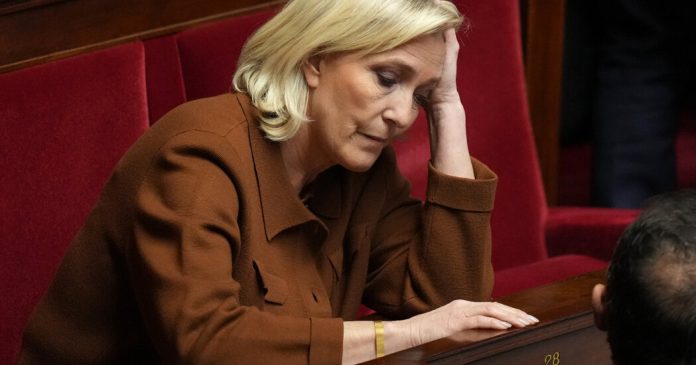
Marine Le Pen, the French far-right leader, has tried and failed three times to become president. Now, even as her popularity rises, she may be barred from taking part in an election to lead France if she is found guilty of embezzlement on Monday.

Such a verdict, far from certain, has been equated by Ms. Le Pen with a “political death” sentence and a “very violent attack on the will of the people.” It would ignite a major political storm at a time when the French Fifth Republic has appeared increasingly dysfunctional.

On the one hand stands the principle, as Nicolas Barret, one of the prosecutors, put it in closing arguments last year, that “We are not here in a political arena but a legal one, and the law applies to all.”

On the other hand lies the fear, expressed by some leading politicians, that a ban would undermine French democracy by feeding a suspicion that it is skewed against the growing forces of the hard right.

“Madame Le Pen must be fought at the ballot box, not elsewhere,” Gérald Darmanin, a former center-right interior minister, wrote on X in November. He is now the justice minister.

Ms. Le Pen, 56, has steered her anti-immigrant party from its antisemitic roots toward the mainstream. The party, whose name she changed from the National Front to the National Rally, is now the largest single party in the National Assembly with 123 seats.

Prosecutors have accused Ms. Le Pen and other members of the National Rally of embezzling some $4.8 million in European Union funds, essentially through no-show jobs at the European Parliament for lawmaker “assistants,” who were rarely there and worked as party staff.

Ms. Le Pen has denied the charges.

Her lawyers argue that the 2016 law under which she can be automatically banned from running for office was not in place at the time of the alleged scheme, and that the people involved were political aides, not European Parliament employees. Ms. Le Pen was a member of that assembly from 2004 to 2017.

The prosecution, led by Mr. Barret and Louise Neyton, has requested a five-year sentence for Ms. Le Pen, with three of those suspended; a 300,000-euro, or $325,000, fine; and a five-year ban with immediate effect on running for public office.

The objective of Ms. Le Pen and her co-defendants was “bluntly put, to turn the European Parliament into their cash cow,” Ms. Neyton said last year.

Even if Ms. Le Pen is convicted, the judges could waive any ban on running for office.

If imposed, however, the disqualification would exclude her from the 2027 presidential election in which President Emmanuel Macron, a centrist, cannot run because he is term-limited. Ms. Le Pen ran in 2012, 2017 and 2022, steadily increasing her share of the vote to 41.45 percent.

An ineligibility verdict against Ms. Le Pen could be appealed. But the appeals process is slow, and it is far from clear that a new trial would take place before the 2027 election, or that the prosecution’s case would be overturned.

The National Rally has been reluctant to speculate on the consequences of a possible ban. Ms. Le Pen’s natural successor is Jordan Bardella, 29, a smooth-talking, unflappable protégé who Ms. Le Pen has said would be her prime minister if she were president.

When asked in a recent TV interview if he would run for president, absent Ms. Le Pen, Mr. Bardella punted: “She won’t be ineligible, so I don’t ask myself the question.”

With the forces of the anti-immigrant right rising in Europe, now encouraged by the Trump administration, Ms. Le Pen is widely regarded as a strong candidate, perhaps even the favorite, for the 2027 vote, if eligible.

Mr. Macron has not built a strong party, so his departure will create a vacuum that more than a half-dozen men — including Mr. Darmanin and former Prime Minister Gabriel Attal — are scrambling to fill with their presidential ambitions.

A chaotic snap parliamentary election last year, four prime ministers in the past 15 months, and a parliament paralyzed by its divisions have given the impression of a Fifth Republic hard pressed to provide coherent governance.

Disqualification of Ms. Le Pen would inevitably intensify criticism from leading American officials, including Vice President JD Vance, of a supposed campaign by European states to stifle the far right and so quash democracy in the name of saving it.

Hungarian and Italian democracies have delivered current leaders of, or descended from, the far right.

But of course Europe has a visceral memory of just how fragile democratic institutions are, and how authoritarian extreme-right movements destroyed them not so long ago, precipitating a blood bath.

Jean-Marie Le Pen, the founder of the National Front and Ms. Le Pen’s father, repeatedly called the Holocaust a “detail” of history. She eventually expelled him from the party. Mr. Le Pen died in January.

If the verdict goes against Ms. Le Pen, the 2027 presidential election would be the first in almost 40 years that has not had a Le Pen on the ballot.

Aurélien Breeden contributed reporting.
Hegseth Pledges to Step Up Military Cooperation With Japan and Deter China

0

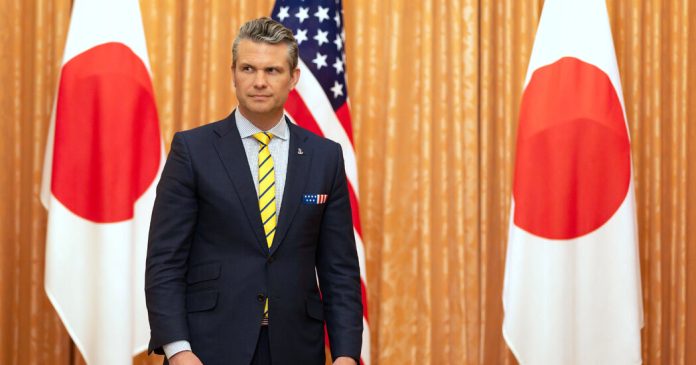
Secretary of Defense Pete Hegseth wrapped up his first official visit to Asia on Sunday by offering reassurances to Japan that President Trump wants a stronger military alliance in the region to deter an increasingly assertive China.

Following an 85-minute meeting in Tokyo with his Japanese counterpart, Mr. Hegseth said the Trump administration would abide by promises to increase security cooperation with its staunch ally. This would include speeding up a Biden administration-era plan to create a new joint U.S.-Japan military command in Tokyo that he called a “war-fighting headquarters,” although Mr. Hesgeth did not say when it would become operational. He also said there would be more joint military exercises in the Okinawa islands near Taiwan, a self-ruled island that China says is part of its territory and has threatened to take by force.

Mr. Hegseth arrived in Japan from the Philippines, another U.S. ally, where the defense secretary also sought to allay anxiety about the Trump administration’s commitment to the region. Japan has watched with concern as the United States has broken with traditional allies in Europe to seek a deal that might allow Russia to keep territory seized from Ukraine.

Japanese officials have worried in private that such concessions might encourage China to make a move on Taiwan. After the meeting with Gen Nakatani, the Japanese defense minister, Mr. Hegseth struck a strident tone about the alliance, proclaiming that the United States would work with Japan to secure “peace through strength” that will deter the Chinese from taking action.

“America first does not mean America alone,” Mr. Hegseth told reporters. “America and Japan stand firmly together in the face of aggressive and coercive actions by the communist Chinese.” Mr. Hegseth did not address concerns about his sharing of military information on the Signal chat app that included a journalist.

Mr. Hegseth’s visit to Japan included a stop on the island of Iwo Jima, where American and Japanese forces fought one of the bloodiest battles of World War II. The U.S. defense secretary attended a ceremony to mark the 80th anniversary of the battle, where he briefly met Prime Minister Shigeru Ishiba of Japan.

The symbolism of the island visit was significant. It showed how two wartime foes had become close partners and came at a time that many Japanese feel the country is facing its most adverse security environment since 1945.

Mr. Nakatani said he explained to Mr. Hegseth how Japan is responding to the challenges with a plan, which predates the Trump administration, to double its defense and other security spending by 2027. He told reporters that the two did not discuss new targets for Japan to further increase spending or step up contributions to pay for the 50,000-strong U.S. military presence in the nation.

“I shared how Japan is, through our own part, making efforts to drastically strengthen our defense capabilities,” Mr. Nakatani said.

After the meeting, Japanese defense ministry officials, who spoke on condition of anonymity since they were not authorized to discuss these matters in public, said they were pleased with the talks. They said Mr. Hegseth had gone far in dispelling their concerns that President Trump might not honor commitments made by the previous administration.

They said their biggest worry had been the fate of the joint command, a more than $1 billion project that some U.S. media had reported would be axed as part of the Trump administration’s cost cutting. The new headquarters will allow the two nations’ militaries to work more closely together during a crisis in the region around Japan.

Mr. Hegseth called Japan “a model ally” that would work closely with the United States while building up its own military.

“We’re confident that Japan will make the correct determination of what capabilities are needed,” he said.

Analysts said the level of agreement reflected the extent to which Japan has shed its postwar pacifism in recent years, driven by the growing Chinese military presence in the region as well as the nuclear buildup by North Korea.

Mr. Ishiba, the Japanese prime minister, has long called for the country to become a more fully-fledged military partner of the United States.

“Trump wants Japan to do more, and Ishiba wants Japan to do more,” said Masato Kamikubo, a professor of international policy studies at Ritsumeikan University. “There’s a meeting of the minds between these two.”

What We Know About Talks for a Renewed Gaza Cease-Fire

0

Israel and Hamas both signaled over the weekend that efforts for a renewed cease-fire in Gaza were underway, less than two weeks after the breakdown of a temporary truce and the resumption of Israel’s air and ground campaign against the militant group in the enclave.

Hamas said on Saturday that it had accepted a proposal for a new cease-fire, which would see some hostages released from captivity in Gaza. Israel said it, too, had received a proposal via third-party mediators and had responded with a counterproposal in coordination with the United States.

“The military pressure is working,” Prime Minister Benjamin Netanyahu of Israel said on Sunday in remarks at the start of his weekly cabinet meeting, adding that Israel was “suddenly seeing cracks” in Hamas’s position.

Neither side published details of the proposal or the counterproposal, but an official briefed on the talks suggested that they broadly echoed previous proposals floated in recent weeks. While there was no indication that a breakthrough was imminent, the public statements suggested that after weeks of fruitless negotiations, contacts over a deal were proceeding even as the war continued.

On Sunday, the Palestine Red Crescent Society said it had recovered the bodies of eight emergency medical technicians, five Civil Defense personnel and a United Nations employee in Rafah in southern Gaza. The medical organization said it had lost contact with nine of its crew members more than a week ago after they were directly fired upon by Israeli forces. The Israeli military did not immediately respond to a request for comment.

Khalil al-Hayya, a senior Hamas official and negotiator, said in a speech on Saturday that his group had received a proposal two days earlier from Egyptian and Qatari mediators for a renewed cease-fire, adding that Hamas had “responded positively and approved it.”

He did not detail the terms, but recent negotiations, including an unusual round of direct talks between U.S. and Hamas officials, had focused on securing the release of Edan Alexander, the only Israeli American hostage still believed to be alive, as well as the bodies of four other Israeli Americans.

That was a nonstarter for Israel, which had demanded the release of 10 or 11 living hostages for a seven-week extension of the temporary cease-fire, based on an earlier proposal it attributed to the White House Middle East envoy, Steve Witkoff.

After Mr. al-Hayya’s speech on Saturday, Mr. Netanyahu said he had held a series of consultations on Friday after receiving the proposal, according to a statement from his office. Israel had sent a counterproposal to mediators a few hours earlier, the statement added.

The official briefed on the talks, who was speaking on the condition of anonymity to discuss delicate diplomacy, said that Israel still sought the release of 10 living hostages for any resumption of the cease-fire and that Egypt was behind the latest proposal.

Up to 24 living hostages remain in Gaza, according to Israel, along with the remains of 35 others. They were among the roughly 250 people taken captive during the deadly Hamas-led attack on Israel in October 2023 that ignited the war.

Beyond agreeing on the numbers of hostages and Palestinian prisoners to be released, any renewed cease-fire will most likely be elusive so long as the two sides remain at odds over more fundamental issues — including irreconcilable demands about the future of Gaza.

Mr. al-Hayya said Hamas was committed to reaching an agreement that would guarantee a permanent cease-fire and the complete withdrawal of Israeli forces from the Gaza Strip, general terms that the sides had already agreed upon to extend the truce that ultimately collapsed.

“We do not want anything new,” Mr. al-Hayya said on Saturday. “We want to respect what was signed, what the guarantors guaranteed, and what the international community approved.”

Israel has conditioned ending the war on Hamas’s laying down its arms and relinquishing control in Gaza. Mr. al-Hayya said the group’s “weapons of resistance” were a “red line” as long as Israel occupies Palestinian land.

Israel and Hamas have each blamed the other for the collapse of the first phase of the cease-fire that went into effect in mid-January.

But both are now facing heightened pressure to renew the truce.

More than 50,000 Gazans have been killed so far in the war, according to Gaza’s health ministry, which does not distinguish between civilians and combatants, and much of the enclave is in ruins.

Protests have since broken out against Hamas in Gaza. An activist in the protest movement said he was worried that Hamas may accept another temporary cease-fire so that its security forces can come out of hiding and crack down on the protesters without fear of being attacked by Israel.

Mr. Netanyahu has also come under domestic pressure. Many Israelis have accused him of failing to prioritize the hostages and prolonging the war in Gaza to keep far-right members of his governing coalition on board to ensure his political survival.

“We are committed to bringing the hostages home,” Mr. Netanyahu said on Sunday, rejecting the popular criticism. “The combination of military pressure and diplomatic pressure is the only thing that will bring the hostages back,” he added.

After Bangkok Building Collapse, Fearing High-Rises

0

When the earth started rocking beneath her home in Bangkok on Friday, Kanittha Thepasak thought she was simply dizzy. Then she heard an odd creaking sound, saw a lamp moving and threw aside a curtain to find cars swaying like boats at sea.

The streets were filled with people who had rushed outside, staring up at the apartment buildings, glass office towers and unfinished construction all around them. Now Ms. Kanittha can barely imagine returning to the office where she spends most of her days. It’s on the 29th floor.

“I’m freaked out, I’m worried,” she said. “Thai people have no basic understanding of earthquakes because we never really experience them.”

The quake that devastated Myanmar on Friday did far less damage in neighboring Thailand, but the sheer force of it — with a magnitude of 7.7 — emptied Bangkok, a city of towers, into the streets. On Sunday, two days later, as the Thai government and engineers inspected hundreds of damaged structures to ensure they could be occupied, it was still darkening thoughts of routines that increasingly include living and working dozens of stories above ground.

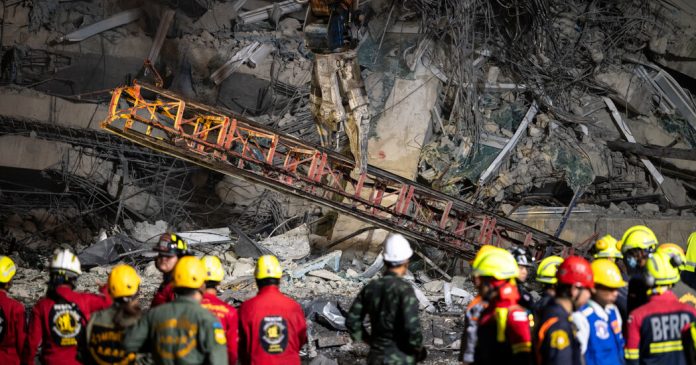
The disaster’s most devastating scene in Thailand came from the complete collapse of a Bangkok building that had been under construction. At least 11 workers were reported dead as of Sunday, and with about 75 still unaccounted for, rescue crews continued to pull carefully at the rubble with a dozen excavators and eight dogs trained to find the dead and the living.

Andy Redmond, a member of the K9 team, said all the signals on Sunday pointed to cadavers, with a scent so overwhelming that the dogs struggled to locate individual remains.

“It’s a learning curve,” he said, resting between search missions that had kept him at the site since Friday afternoon. “You can’t train for this.”

Video of the building’s dramatic fall seems etched in the minds of many, altering how residents see their city. For about a decade, Bangkok has been on the move, upward and outward, with a construction boom fueled by the expansion of its subway and Skytrain.

But now, with at least a dozen cranes hovering over the skyline, gray skeletons of steel and concrete that once signaled economic growth have taken on an ominous quality.

Somreutal Nilbanjong, 34, found herself gazing at one such building downtown on Sunday afternoon as she walked home. Asked what she was thinking, she said, “It scares me just to look at it.”

A small construction elevator climbed up the exterior through pink scaffolding. She scrolled through her phone until she found a photo of the mountain of rubble a few miles away — the collapsed building, Bangkok’s ground zero.

Goose bumps appeared on her arms, and she shuddered.

“I’m afraid it’s going to happen again,” she said.

Government officials have tried to calm people’s nerves and keep people updated.

Immediately after Friday’s quake, Thailand’s prime minister, Paetongtarn Shinawatra, issued an urgent alert warning people to be wary of aftershocks for the next 24 hours.

By that evening, she sought to reassure the public by announcing that the situation had stabilized and that residents could return to their homes.

On Saturday, she rode on Bangkok’s elevated railway, known as the Skytrain, to show that the trains were safe. The system had been shut down after the quake and inspected before most of the lines were reopened.

But even as the city has re-emerged toward normalcy — malls and markets full, trains rumbling over streets packed with motorbikes — many people are struggling to process something they had thought happened only in other places, like Japan or Taiwan.

Ms. Kanittha said the experience was so confounding that her mind raced to memories of what she had seen in Japanese comics or manga, with animated disasters.

Many people said they weren’t necessarily scared, but that they were forced to ask unexpected questions: Behind glass facades, are buildings really secure? What if there are cracks that cannot be seen? What if there’s a giant aftershock?

Jiraporn Jaichob, 41, a drink stall owner who was having lunch when the temblor struck, said she was making plans for future disasters.

She was thinking of buying a transistor radio since she’d seen cellphone coverage go down. She also created a go bag for family with key documents and supplies.

“With this earthquake we learned that we don’t know what might happen in a given day,” she said.

“We can die anytime, anywhere, I know, it’s our fate,” she added. “But at least we take care of our lives where we can.”

Thailand upgraded its earthquake-resistant building code in 2007, and experts said the vast majority of the city’s buildings were clearly strong enough to withstand what should still be considered a rare seismic event. Still, some engineers called for greater scrutiny and a potential upgrade in standards and enforcement.

“Look at Japan — they keep developing their laws and design,” said Suchatvee Suwansawat, a professor of civil engineering at King Mongkut University and a former president of the Council of Engineers Thailand. “We should do that as well.”

The collapse of the 30-story building, which had been going up beside a mall and popular weekend market, could be a turning point. It never should have buckled, said Dr. Suchatvee, suggesting that something went wrong in design, execution or oversight.

Four years into construction, it was being built by a Chinese state-owned company, the China Railway 10th Engineering Group. The Thai government has promised to investigate and report early findings in a week.

But like other frightening building collapses — the condo tower in Surfside, Fla., which killed 98 people in 2021; or the downing of the World Trade Center from terrorist attacks on Sept. 11, 2001 — the toll of destruction seems likely to linger.

By dusk Sunday, shock, grief and dust mingled in the air at the collapse site, where a sizable crowd was gathered. Volunteer rescuers from the police and the military wearing jumpsuits cycled in and out of the area. At one point, a crane held two observers over the top of the rubble mountain as men in yellow hats stared up from below.

At the perimeter, the father of a Pakistani worker told reporters people were praying at temples all over Thailand, and that he hoped at least half the workers would come out alive.

Aubonrat Setnawet was also still hoping for good news about her husband. He had been on the 23rd floor of the building when the earthquake hit; she had been there too, working, but on the ground floor, not far from where she sat on Sunday in a soft plastic chair near a hard metal fence.

“No updates,” she said quietly. All she could point to were more relatives beside her, as the noisy grind of diggers and dump trucks filled the air.

At the market across the street, Jatupol Sawangphanich, 42, put tape over the slits of a metal grate protecting his tropical fish business.

“Every time they lift the rubble, the dust flies in this direction,” he said.

Beside him, the lights of a usually busy mall had gone dark. Its structural integrity still needed to be tested.

“This happened all over Bangkok,” he said. “I’d rather not go into tall buildings at all.”

Map: 7.0-Magnitude Earthquake Near Tonga Promps Brief Tsunami Alert

0

Note: Map shows the area with a shake intensity of 4 or greater, which U.S.G.S. defines as “light,” though the earthquake may be felt outside the areas shown. The New York Times

A major, 7.0-magnitude earthquake struck in the South Pacific Ocean on Monday, according to the United States Geological Survey. The quake prompted a brief “Tsunami Threat” for Tonga.

Preliminary reports from the U.S. Tsunami Warning System said tsunami waves were possible for coastlines within about 190 miles of the earthquake’s epicenter, including those on Tonga. The system issued an all-clear notice about an hour later, after a tsunami would have struck had one materialized.

Tsunamis are a series of long waves caused by a large and sudden displacement of water in the ocean, usually from a large earthquake on or below the ocean floor. Tsunamis radiate in all directions from the epicenter and can cause dangerous coastal flooding and powerful currents that can last for hours or days.

The temblor happened at 1:18 a.m. Tonga time about 49 miles southeast of Pangai, Tonga, data from the U.S.G.S shows.

U.S.G.S. data earlier reported that the magnitude was 7.1.

As seismologists review available data, they may revise the earthquake’s reported magnitude. Additional information collected about the earthquake may also prompt U.S.G.S. scientists to update the shake-severity map.

Aftershocks in the region

An aftershock is usually a smaller earthquake that follows a larger one in the same general area. Aftershocks are typically minor adjustments along the portion of a fault that slipped at the time of the initial earthquake.

Quakes and aftershocks within 100 miles

Source: United States Geological Survey | Notes: Shaking categories are based on the Modified Mercalli Intensity scale. When aftershock data is available, the corresponding maps and charts include earthquakes within 100 miles and seven days of the initial quake. All times above are Tonga time. Shake data is as of Monday, March 31 at 2:33 a.m. Tonga time. Aftershocks data is as of Monday, March 31 at 2:48 a.m. Tonga time.

Politics chat: Trump withdraws Elise Stefanik nomination, special elections coming up

0

A thin GOP House majority keeps Rep. Elise Stefanik from joining the Trump administration, Elon Musk’s involvement in Wisconsin’s special election, and fallout from the Signal app scandal.

Prince Harry Accused of ‘Bullying’ by Chair of Charity He Co-founded

0

An ugly rift between Prince Harry and a leader of a charity he co-founded escalated on Sunday after the leader, Sophie Chandauka, accused the prince of engaging in harassment and bullying to try to force her out of her post.

Ms. Chandauka said that when Harry abruptly resigned last week as the patron of the charity, Sentebale, it was calculated to damage the organization after he failed to oust her from her post as the chair of its board of trustees.

“Can you imagine what that attack has done for me, on me, and the 540 individuals in the Sentebale organizations and their family?” Ms. Chandauka said in an interview with the British broadcaster Sky News. “That is an example of harassment and bullying at scale.”

A spokesman for Harry and his wife, Meghan, declined to comment on Ms. Chandauka’s latest claims, which she made on the Sky News program “Sunday Morning with Trevor Phillips.”

Sentebale was co-founded by the prince in 2006 to honor his late mother, Diana, Princess of Wales, and to raise money to help young victims of the H.I.V. pandemic in Lesotho. It has expanded operations to nearby Botswana and works on issues ranging from substance abuse and gender-based violence to climate change, and how they affect young people.

Harry, who is also known as the Duke of Sussex, announced his resignation, alongside the charity’s co-founder, Prince Seeiso of Lesotho, last Wednesday, saying that the relationship between the board of trustees and Ms. Chandauka had ruptured irretrievably. Five of the board’s nine members had resigned earlier in the week.

Their departures followed a mounting series of conflicts between the board and Ms. Chandauka. The five board members had asked her to resign, saying they had lost “trust and confidence” in her.

“It is devastating that the relationship between the charity’s trustees and the chair of the board broke down beyond repair, creating an untenable situation,” Harry and Prince Seeiso said in a joint statement when they announced their resignation. “We are in shock that we have to do this, but we have a continued responsibility to Sentebale’s beneficiaries.”

The dispute between board members and Ms. Chandauka has landed in an English court and with Britain’s Charity Commission, which regulates charities in England and Wales. Both sides have filed claims of wrongdoing. Although Sentebale operates in southern Africa, it is registered in Britain.

Ms. Chandauka, a Zimbabwe-born lawyer who has worked for Morgan Stanley and the technology company Meta, was named as Sentebale’s chair in July 2023 and had previously served as a trustee from 2009 to 2015.

Among the examples of mistreatment cited by Ms. Chandauka on Sky was an awkward incident, caught on video, after a polo match to raise money for the charity in Miami last April. During the presentation of awards onstage, Meghan appeared to ask Ms. Chandauka to switch places from her position next to Harry. That required her to duck under a trophy as she moved to stand next to Meghan, also known as the Duchess of Sussex, prompting news organizations to raise questions about Meghan’s behavior.

“Prince Harry asked me to issue some sort of a statement in support of the duchess, and I said I wouldn’t,” Ms. Chandauka said. “Not because I didn’t care about the duchess, but because I knew what would happen if I did so, No. 1. And No. 2, because we cannot be an extension of the Sussexes.”

Ms. Chandauka said the site of the polo match had already been moved because Harry insisted on bringing a camera crew that was filming a documentary for Netflix, with which the couple has a production deal.

Ms. Chandauka said that the drama surrounding the split between Harry and Meghan and the British royal family had become the greatest risk to the charity. As tensions with Sussexes mounted, she said, she had been a victim of “this unleashing of the Sussex machine,” referring to Harry’s public relations team.

For all her charges, Ms. Chandauka said her relationship with Harry had generally been “fantastic.” But she said, “There are some individuals on the board who thought they could get away with mistreating a woman.”

Democrats far out-raise Republicans in Florida's special elections but are likely to lose

0

Two special elections to replace GOP congressmen tapped to serve in the Trump Administration are on Tuesday. Democrats have out-raised the Republican candidates in both red districts.

Syrians Wake Up to a New Government

0

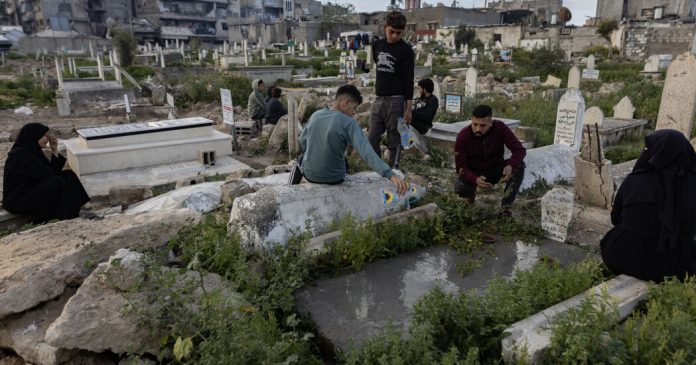
Syrians on Sunday were digesting the overnight announcement of a caretaker government that will be in power for the next five years, accepting with some resignation the continued dominance of the rebel group that seized power in December but welcoming its representation of the country’s main ethnic minorities.

The rebels who overthrew President Bashar al-Assad in December have since been acting as Syria’s de facto authorities, naming their leader, Ahmed al-Shara, interim president to oversee a transitional government.

Mr. al-Shara announced the much anticipated new government late on Saturday night, swearing in 23 cabinet ministers in a ceremony that ran into the early hours of Sunday — the last day of the fasting month of Ramadan before the Muslim festival of Eid al-Fitr.

The government appears to be a studied compromise between meeting calls for a more diverse cabinet that could unite the war-scarred and deeply divided country, while keeping Mr. al-Shara’s allies in the most powerful ministries.

Among Mr. al-Shara’s appointees are seven ministers affiliated with the provincial administration he once led in the rebel-held city of Idlib. But he also appointed nine independent ministers, among them technocrats and former activists, and included five ministers who served in the early years of the Assad regime before the country descended into civil war.

He named ministers from each of the main ethnic minorities, Kurds, Druze, Christians and Alawites, the sect of Mr. al-Assad. Among them was the lone woman minister, Hind Kabawat, who is Christian, to lead the Ministry of Social Affairs.

“No doubt some voices will feel excluded still,” Abdy Yeganeh, policy director at the Independent Diplomat, a London-based nonprofit advisory group, said ahead of the swearing-in ceremony. But overall, he said, “there is a sense of cautious optimism with the transition in Syria, including with the announcement of the new government.”

Mr. al-Shara had been under pressure from Western countries and from members of Syria’s civil society to form an inclusive government. Those calls took on greater urgency after sectarian violence erupted this month among Alawite communities in Syria’s coastal region.

“There is a need to widen the circle,” Ibrahim al-Assil, a senior fellow at the Middle East Institute in Washington, D.C., said ahead of the announcement, referring to Mr. al-Shara’s small circle of allies that had been running the transitional government since December. “There is a need to be more inclusive, from one perspective to reflect Syrian society, and from another because they need them. They cannot run the show on their own.”

Muhammad Haj Kadour contributed reporting from Damascus.

Trump won’t rule out military force to take Greenland : NPR

0

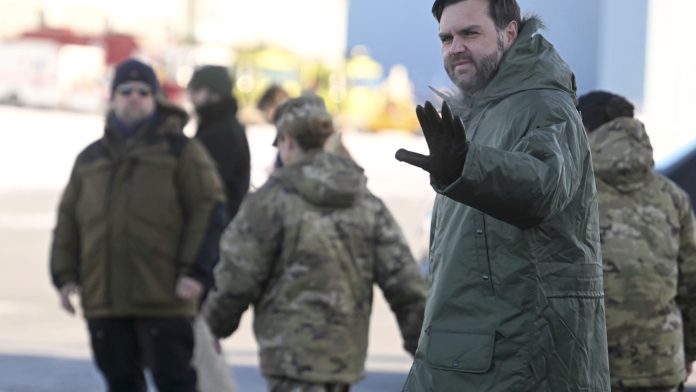
Vice President JD Vance arrives at Pituffik Space Base in Greenland, Friday, March 28, 2025.

Jim Watson/AP/POOL AFP


hide caption

toggle caption

Jim Watson/AP/POOL AFP

NUUK, Greenland — The Danish foreign minister on Saturday scolded the Trump administration for its “tone” in criticizing Denmark and Greenland, saying his country is already investing more into Arctic security and remains open to more cooperation with the U.S.

Foreign Minister Lars Løkke Rasmussen made the remarks in a video posted to social media after U.S. Vice President JD Vance’s visit to the strategic island. Later Saturday, though, U.S. President Donald Trump maintained an aggressive tone, telling NBC News that “I never take military force off the table” in regards to acquiring Greenland.

“Many accusations and many allegations have been made. And of course we are open to criticism,” Rasmussen said speaking in English. “But let me be completely honest: we do not appreciate the tone in which it is being delivered. This is not how you speak to your close allies. And I still consider Denmark and the United States to be close allies.”

Greenland is a territory of Denmark, which is a NATO ally of the United States. Trump wants to annex the territory, claiming it’s needed for national security purposes.

In Saturday’s interview, Trump allowed that “I think there’s a good possibility that we could do it without military force.”

“This is world peace, this is international security,” he said, but added: “I don’t take anything off the table.”

Trump also said “I don’t care” when asked in the NBC interview what message it would send to Russian President Vladimir Putin, who is trying to solidify his hold on Ukrainian territory three years after his invasion.

Vance on Friday said Denmark has “underinvested” in Greenland’s security and demanded that Denmark change its approach as Trump pushes to take over the Danish territory.

Vance visited U.S. troops on Pituffik Space Base on mineral-rich Greenland alongside his wife and other senior U.S. officials for a trip that was ultimately scaled back after an uproar among Greenlanders and Danes who were not consulted about the original itinerary.

“Our message to Denmark is very simple: You have not done a good job by the people of Greenland,” Vance said Friday. “You have underinvested in the people of Greenland, and you have underinvested in the security architecture of this incredible, beautiful landmass filled with incredible people. That has to change.”

Trump on Friday released a video on his social networking site Truth Social entitled “America Stands With Greenland,” showing footage of U.S. troops there during World War II.

In Greenland, Vance said the U.S. has “no option” but to take a significant position to ensure the security of the island as he encouraged a push in Greenland for independence from Denmark.

“I think that they ultimately will partner with the United States,” Vance said. “We could make them much more secure. We could do a lot more protection. And I think they’d fare a lot better economically as well.”

The reaction by members of Greenland’s parliament and residents has rendered that unlikely, with anger erupting over the Trump administration’s attempts to annex the vast Arctic island. Danish Prime Minister Mette Frederiksen pushed back on Vance’s claim that Denmark isn’t doing enough for defense in the Arctic, calling her country “a good and strong ally.”

And Greenlandic lawmakers on Thursday agreed to form a new government, banding together to resist Trump’s overtures. Four of the five parties elected to Greenland’s parliament earlier this month have agreed to form a coalition that will have 23 of 31 seats in the legislature.

The following day, Danish King Frederik X posted on Facebook: “We live in an altered reality. There should be no doubt that my love for Greenland and my connectedness to the people of Greenland are intact.”

Hundreds of protesters demonstrated Saturday outside the U.S. Embassy in the Danish capital Copenhagen with some lifting signs saying, “back off, USA” Danish broadcaster TV2 reported.

Even Greenland’s national dogsled race – Avannaata Qimussersu – which kicked off Saturday with some 37 mushers and 444 dogs was not left unaffected. Usha Vance, the vice president’s wife, who was originally scheduled to attend the race opted out when her husband decided to join the trip and visit the military base instead, reducing the likelihood that they would cross paths with Greenlanders.

Løkke Rasmussen, in his video, reminded viewers of the 1951 defense agreement between Denmark and the United States. Since 1945, the American military presence in Greenland has decreased from thousands of soldiers over 17 bases and installations on the island, he said, to the remote Pituffik Space Base in the northwest with some 200 soldiers today.

The 1951 agreement “offers ample opportunity for the United States to have a much stronger military presence in Greenland,” the foreign minister said. “If that is what you wish, then let us discuss it.”

Løkke Rasmussen added that Denmark has increased its own investment into Arctic defense. In January, Denmark announced 14.6 billion Danish kroner (US$2.1 billion) in financial commitments for Arctic security covering three new naval vessels, long-range drones and satellites.