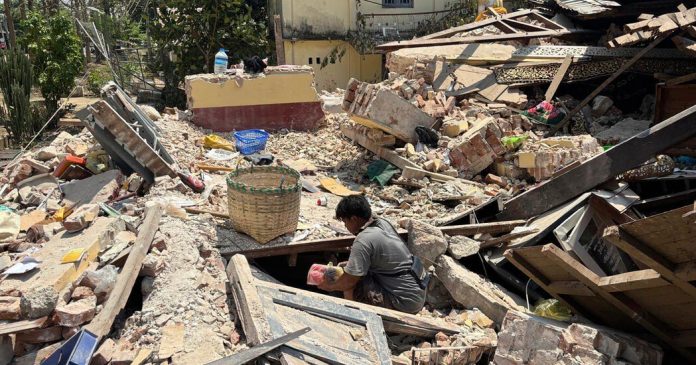
Myo Zaw and his team of volunteer rescue workers were the first to arrive at the site where a three-story house had collapsed in Mandalay, a little after 8 p.m. on Saturday. They were digging through the rubble with their bare hands when they heard the voice of a girl.
It was faint but clear. “Help me, I’m here,” she said.
It took them three or four hours to pull out the 12-year-old, who had survived despite the house toppling around her. But in the early hours of Sunday morning, there was only silence as the rescuers continued to work in nearly 100-degree heat. They eventually unearthed three bodies: the girl’s mother and her grandparents.
“Sadly, I fear we will find more bodies than survivors,” Mr. Myo Zaw said. “The heat in Mandalay is intense, causing rapid decomposition. In some cases, we locate the bodies only because of the smell.”
Time is running short in Mandalay, Myanmar’s second-largest city with about 1.5 million people, which is near the epicenter of Friday’s devastating earthquake. In one neighborhood in Mandalay, countless buildings were reduced to rubble, satellite images showed.
Across the country, over 1,600 people were confirmed dead, as of Saturday night, and over 3,000 injured in the worst earthquake to hit Myanmar in more than a century. Many fear that the number of people who can be rescued will dwindle after Monday evening, the crucial 72-hour mark after which experts say the chances of survival drop sharply.
Even as volunteer rescuers scoured the ruins of homes, monasteries and mosques, and hospitals overflowed with patients, aftershocks — including a strong one on Sunday — kept residents on edge. Several buildings in Mandalay that had survived Friday’s powerful earthquake toppled on Sunday.
And the military made clear it would not stop a brutal bombing campaign in a civil war that has ravaged the country despite the urgent need for relief efforts, with reports of an airstrike on Sunday afternoon in Pakokku Township in Magway Region in the country’s northwest that killed two women and injured seven others.
How the military government and its commander in chief, Senior Gen. Min Aung Hlaing, an already deeply unpopular leader who ousted a civilian government four years ago, responds in the coming days and weeks could determine the junta’s hold on power. The military government has already lost ground to rebels in the civil war, which had left nearly 20 million of the country’s roughly 54 million people in need of shelter and food even before the quake, according to U.N. officials.
In the early hours after the earthquake, a lack of machinery and personnel severely hampered rescue operations. But the arrival of Chinese rescue teams with heavy equipment on Saturday night has given volunteers a glimmer of hope.
On Sunday, volunteers rescued 29 people from a collapsed apartment building in Mandalay and recovered eight bodies, according to Soe Paing, a rescue worker from the Myanmar fire service department. He said the help from the Chinese had sped up the work.
“Right now, we believe around 90 people are still trapped inside,” he said, “and we are doing everything we can to get them out alive.”
Later in the day, an aftershock struck Mandalay, sending residents into the streets, screaming in fear.
Many are confronting an uncertain future, rationing food, and wondering how they can get by without any power and scarce water. Volunteers asked for more body bags for the corpses that they are pulling out by the hour. Many have said that the army has done little to help.
Aid from other countries has also begun arriving, but questions remain about how the Myanmar army would distribute the much-needed relief. At least half a dozen nations, including India, Malaysia, Russia, Singapore and Thailand, have sent teams and supplies. Some of the aid, such as a group from Singapore as well as supplies from India, has gone to Naypyidaw, the capital, where the military’s generals live and which was less affected than Mandalay.
“They have a long track record of using aid as a weapon,” said Scot Marciel, the U.S. ambassador to Myanmar from 2016 to 2020, said of the military government. “I would think that they would try to use it to funnel aid to their supporters and prevent it from getting to people in the areas controlled by the resistance. I don’t have faith in them that they would do the right thing.”
Padoh Saw Taw Nee, the spokesman for the rebel Karen National Union, said the group welcomed the support of foreign countries but warned them to be “aware of the nature of the military in our country.”
He pointed out that the military had not refrained from attacks even after the earthquake, saying: “They might use the money for the war. We worry about this issue.”
Control of Myanmar is now divided between the military regime, which governs the urban areas, and the ethnic armies, who hold the borderlands. Since the 2021 coup, Sagaing — another region that has been hit hard by the earthquake — has also emerged as a center of resistance and is home to a patchwork of rebel groups. (Internet access has been cut off in Sagaing, making it difficult to get reports from there.)
An hour after Friday’s earthquake, a military paramotor, or motor-powered paraglider, dropped bombs in Chaung Oo village in Sagaing, said Phyu Win, a resident. “People were already terrified from the quake, and with the chaos, it was impossible to take cover in bomb shelters,” she said.
The army’s airplanes have continued to fly overhead since the earthquake. “The junta has no interest in helping people,” Ms. Phyu Win said. “They only want to kill.”
At one point last year, the rebels had advanced close to Mandalay, which was seen by many to be a potential tipping point in the war.
Experts say the earthquake could change the trajectory of the civil war. The National Unity Government, the shadow government in exile, has called for a two-week pause in fighting, but it does not speak for the multiple rebel groups and ethnic armies fighting government forces. The powerful Arakan Army, which has won control of large parts of Rakhine State in Myanmar, could exploit this moment to wrest the south of the country away from the junta.
Much will also depend on how General Min Aung Hlaing and his military view this moment.
“Their backs are to the wall and they can’t cope,” Khin Zaw Win, a political analyst and director of the Tampadipa Institute, a research group in Yangon, said of the military rulers. “We have come to the point where the military will be forced to relent.”
Richard Horsey, a senior adviser on Myanmar for the International Crisis Group, called the earthquake “a moment of jeopardy for Min Aung Hlaing.”
“It’s really a critical moment for him, his legacy, but also his current regime,” Mr. Horsey said. “He doesn’t exactly know how this is going to play out — it’s difficult to guess — but he knows that there will be huge political aftershocks.”
A video that circulated widely on the internet recently showed a Haitian gang leader, Joseph Wilson, shirtless, happily showing off belts of .50 caliber ammunition, mockingly saying he used the armor-piercing bullets to groom his hair.
“We have enough combs for our hair to last a year,” he joked.
So how did he get them?
Guns are not manufactured in Haiti, and it’s illegal to ship any there, but the gangs terrorizing the country’s capital, Port-au-Prince, never seem to be short of them — or of ammunition.
Experts estimate that there are about 20 armed groups operating in Port-au-Prince, some who carry AR-15 and Galil assault rifles, shotguns and Glock handguns. The U.N. estimates that between 270,000 and 500,000 firearms are circulating illegally in Haiti, with most weapons in the hands of gangs.
Their superior fire power has overwhelmed the thin ranks of Haiti’s ill-equipped police and contributed to an astonishing death toll last year of more than 5,600 homicide victims, a jump of more than 1,000 from the year before.
The United Nations imposed an arms embargo on Haiti three years ago, yet most weapons on Haiti’s streets are from the United States, where they are purchased by straw buyers and smuggled into the country by sea or sometimes by land through the Dominican Republic, according to the United Nations.
The issue has become so serious that Haiti’s government has restricted imports along its land border with the Dominican Republic. Only goods that were originally produced there are allowed; any products that didn’t originate in the D.R. have to enter through Haiti’s gang-infested seaports.
As Haiti’s capital grapples with a violent crisis that threatens its very existence, questions remain about whether Haiti and other nations — including the United States — are doing enough to control the tide of weapons.
“If you stop the flow of guns and bullets, the gangs eventually, literally, run out of ammunition,” said Bill O’Neill, the U.N.’s independent human rights expert for Haiti. “That’s a quicker, faster, safer way to dismantle them.”
Where are the weapons coming from?
In short, Florida.
South Florida, including the ports of Miami and Fort Lauderdale, was the point of origin for 90 percent of Caribbean-bound shipments of illicit firearms reported between 2016 and 2023, according to the United Nations Office on Drugs and Crime.
Gangs sometimes acquire guns and ammunition by attacking police stations in Haiti or by bribing local police into providing weapons. Nearly 1,000 police guns were diverted in the past four years, the U.N. said this week, and police officers have been reported to sell them on the black market.
But weapons are more typically smuggled in shipping containers and aboard freighters leaving South Florida, hidden among tightly packed jumbles of bicycles, cars, electrical goods, clothing and food.
U.N. officials and private security experts say traffickers altered their tactics in recent months to avoid increased inspections on the Miami River, a five-mile waterway that cuts through the city of Miami and has long been a hotbed for contraband.
Smugglers expanded their operations to new routes between Florida and the Dominican Republic, including Port Everglades in Fort Lauderdale, a large cruise ship and cargo facility, the U.N. said in a recent report.
What guns are being smuggled?
So far this year, Dominican officials have made two large seizures of smuggled firearms at the port of Haina, near the capital, Santo Domingo.
In February,Dominican Customs agents made what they described as the country’s largest seizure of weapons destined for Haiti.
Nearly two dozen firearms, including a Barrett .50 caliber semiautomatic rifle and 15 AK-47-style assault rifles, as well as 36,000 rounds were inside a container on the Sara Express, a 35-year-old freighter that runs a regular route between Miami and the Dominican Republic.
The owner of the Miami company listed on the bill of lading was arrested in the Dominican Republic.
A second shipment from New York seized in January at the same Dominican port may also have been bound for Haiti, investigators said. That shipment included 37 guns, and several Kalashnikov-style rifles with labels showing they were manufactured in Vermont and Georgia.
In November, Dominican authorities arrested several Dominican police officers accused of smuggling nearly one million rounds of ammunition from a police depot. At least one of the buyers was from Haiti, Dominican court records show.
Has law enforcement had any success?
In response to a September letter from several members of Congress who asked for more to be done to address weapons smuggling to Haiti, the U.S. Commerce Department, which regulates firearms exports, said in December that none of its 11 foreign-based export control officers were posted in the Caribbean because of a lack of funds.
Still, the agency said that during the Biden administration, nine Haiti-related investigations resulted in convictions.
More recently, other federal law enforcement agencies have pursued several Haiti weapons cases.
Last month, a 31-year-old police officer in St. Cloud, Florida, pleaded guilty to purchasing and reselling at least 58 firearms as part of a scheme that sent hundreds of weapons to the Dominican Republic, Puerto Rico and Haiti.
In January, a 34-year-old undocumented migrant from Guatemala, Ricardo Sune-Girón, pleaded guilty to firearms trafficking in Tampa. According to a plea agreement, Mr. Sune-Girón recruited straw purchasers to illegally buy 900 firearms — including assault rifles — that he then transported from Florida to the Dominican Republic and Haiti.
A former security officer for Haiti’s chief of police was arrested in Florida in December after investigators linked him to nearly 90 firearms.
How is law enforcement tackling the problem?
Haiti has few resources like scanners and border guards to tackle the problem of smuggled firearms at its borders and ports, while experts say the United States has limited capability to search exported goods at domestic ports and typically performs only random cargo inspections.
Ships sailing to Haiti from the United States are often jammed with assorted cargo, from second hand clothing to household appliances, bicycles and cars, making it easy to hide contraband.
In one case, disassembled guns discovered aboard a freighter on the Miami River bound for Haiti were hidden in shipments that included tennis rackets, fruit juice, rice and clothing.
“We show up unannounced,” said Anthony Hernandez, a Customs and Border Protection agent who testified at the federal trial in Miami in January of an accused smuggler. “We do our best to get to as much as we can.”
Haiti’s law enforcement authorities did not respond to repeated requests for comment.
What about the Dominican Republic?
In the Dominican Republic, the United States supports a special unit of 30 local Customs agents, with another 20 currently being vetted to work on U.S.-related cases.
The authorities have tightened controls, including adding eight new X-ray scanners at main ports, where all cargo destined for Haiti is examined, the Dominican foreign ministry said.
Dominican Customs officials track all suspicious shipments to catch and prosecute traffickers, a U.S. embassy representative who was not authorized to speak publicly said, questioning whether the Dominican Republic was an important source of illegal guns to Haiti.
Dominican Customs authorities referred questions to prosecutors, who declined to comment.
So what can be done to stop it?
Critics say not enough is done to regulate the sale of weapons in the United States to straw buyers, an illegal practice in which people buy guns on behalf of another person, including traffickers. The practice is responsible for a large number of the arms that wind up used in crimes in Mexico and throughout Latin America.
Dealers often ignore easily detectable purchasing patterns by gun traffickers posing as legitimate customers and repeatedly buying multiple weapons, experts say.
“That’s where you can stop this,” Jonathan Lowy, founder of Global Action on Gun Violence said. “It’s very difficult to stop once the guns are in the hands of the trafficker. They can be broken down and put in a crate of breakfast cereal or fruit juices.”
A New York Times investigation reveals that the United States was much more involved in Ukrainian military operations than publicly disclosed. Adam Entous, a Times investigative reporter, breaks down a key moment in the war when the Biden administration changed its policy on the war in Ukraine.
Students in France will learn about something new starting in September: sex, gender stereotypes and consent.
Nearly a quarter-century after the French government passed a law mandating — but never putting in place — sex education for every student, it has finally developed and approved a curriculum for sex education classes, with a plan for teacher training and course materials.
“We have been waiting 25 years for this,” said Sarah Durocher, president of Le Planning Familial, a French equivalent of Planned Parenthood — one of three nonprofit organizations that sued the government in 2023 for not implementing its own law.
More than 100 senators with the conservative party Les Républicains signed an op-ed, published in Le Figaro newspaper, opposing the program’s “woke ideology” and demanding all mentions of “gender identity” be removed.
But Elisabeth Borne, the education minister, called the new program “absolutely essential.”
Although the curriculum is set to take effect in September, opponents are still fighting; a coalition of a few groups have filed a lawsuit to stop it before France’s top administrative court.
Activists and experts say adoption of the curriculum was propelled by changing attitudes in France about sex since the #MeToo movement.
“Public opinion now understands it’s necessary to talk to children about this kind of thing, because otherwise they will stay silent,” said Yves Verneuil, a professor of education at the University of Lyon. “The ministry, consequently, saw this change of mentality.”
The highly publicized trial last fall of dozens of men, found guilty of raping a woman named Gisèle Pelicot while she was deeply sedated, also had an effect, experts say. The case ignited discussions across the country about the casual banality of rape, the objectification of women and the lack of understanding of what consent is, and how it should be given before sex.
“How could those men have said they got consent when seeing a drugged, passed-out woman?” Ms. Durocher said. “It raised the question of how we teach consent.”
On paper, the French government has offered sex education since 1973. But the courses were optional and parents could pull their children from them, explained Mr. Verneuil, the professor, who has written a book on the history of sex education in France.
In 2001, the government introduced a law specifically requiring three annual sessions of sexual education for every student. Subsequent governments expanded the course contents to include not just classes on STDs and the risks of pregnancy, but sexism, homophobia, sexual violence and the concept of consent, Mr. Verneuil said.
However, no specific curriculum was developed, no budget or specialized training introduced and no personnel put in place to teach the classes, said Audrey Chanonat, a leader of the French union representing the principals of middle and high schools.
At the middle school in Cognac where she is a principal, those courses required more than 100 hours of staff time.
“I don’t have the personnel for it,” she said, noting that the staff did cover some of the topics in ninth-grade biology.
“A real education program for sexual and intimate relationships with three hours per class? That exists almost nowhere,” Ms. Chanonat said.
A 2021 report by the auditing department of the Ministry of Education, Sport and Research confirmed Ms. Chanonat’s point: Only 15 to 20 percent of French students were offered those three classes a year.
“It is clear that many students go through their entire schooling without having benefited from a single lesson,” the report stated
The French feminist philosopher Camille Froidevaux-Metterie said the failure to put sex education in schools reveals a deep social conservatism in France.
“Education about sex, but also about emotional and sexual relations, is learning to respect others and the difference between genders and sexualities,” she said. “And that pushes against a Conservative tradition that has always existed in France.”
The government did keep trying to implement its law, but each time, it was met by fierce opposition, Ms. Froidevaux-Metterie said.
After one teacher was targeted on social media with personal threats, the program was cut, said Najat Vallaud-Belkacem, who was the country’s minister of women’s rights at the time.
The same opponents protested and circulated petitions this past fall and winter, opposing teaching on gender identity.
Ludovine de la Rochère, the co-founder of France’s major anti-gay marriage movement in the early 2010s that later led the opposition to the sex education program, told a Catholic radio station the program would introduce to children the possibility of gender transition. Her organization is part of the coalition that has sued to stop the first sex education classes this fall.
The new curriculum, published last month in the official bulletin of the Ministry of Education, focuses on the themes of equality between men and women, the fight against discrimination, the principle of consent, and the prevention of sexism and sexual violence.
Though they consider the curriculum cause for celebration, the activists who have been fighting for it have not withdrawn their lawsuit against the government. Essential to its success, they say, is funding — up to 620 million euros annually, or 52 euros per student, by one estimate, which is about $67 million, or about $56 per student.
So far the education ministry has committed no money.
“We know the implementation will be difficult,” Ms. Durocher said. “It will be a new feminist battle.”
The war in Ukraine is at an inflection point, with President Trump seeking rapprochement with the Russian leader, Vladimir V. Putin, and pressing for an end to the fighting.
But for nearly three years before Mr. Trump’s return to power, the United States and Ukraine were joined in an extraordinary partnership of intelligence, strategy, planning and technology whose evolution and inner workings have been known only to a small circle of American and allied officials.
With remarkable transparency, the Pentagon has offered a public accounting of the $66.5 billion in weaponry it has supplied to Ukraine. But a New York Times investigation reveals that America’s involvement in the war was far deeper than previously understood. The secret partnership both guided big-picture battle strategy and funneled precise targeting information down to Ukrainian soldiers in the field.
Here are five takeaways from the investigation.
A U.S. base in Wiesbaden, Germany, supplied the Ukrainians with the coordinates of Russian forces on their soil.
The idea behind the partnership was that America’s close cooperation with Ukraine would compensate for Russia’s vast advantages in manpower and weaponry. To guide the Ukrainians as they deployed their ever-more-sophisticated arsenal, the Americans created an operation called Task Force Dragon.
The secret center of the partnership was at the U.S. Army garrison in Wiesbaden, Germany. Each morning, U.S. and Ukrainian military officers set targeting priorities — Russian units, pieces of equipment or infrastructure. American and coalition intelligence officers searched satellite imagery, radio emissions and intercepted communications to find Russian positions. Task Force Dragon then gave the Ukrainians the coordinates so they could shoot at them.
Military officials worried that it might be unduly provocative to call the targets “targets.” Instead they were referred to as “points of interest.”
U.S. intelligence and artillery helped Ukraine quickly turn the tide against the Russian invasion.
In spring 2022, the Biden administration agreed to send High Mobility Artillery Systems, or HIMARS, which used satellite-guided rockets for strikes up to 50 miles distant.
In the war’s first year, the Ukrainians were extremely dependent on the Americans for intelligence, and Task Force Dragon vetted and oversaw virtually every HIMARS strike.
The strikes caused Russian casualty rates to soar, and Ukraine’s 2022 counteroffensive was largely successful: By December, the Ukrainians held an unlikely, David-versus-Goliath upper hand against their Russian foe.
The Biden administration kept moving its red lines.
From the first, administration officials sought to lay down a red line: America was not fighting Russia; it was helping Ukraine. Still, they worried that steps taken to accomplish that might provoke Mr. Putin to attack N.A.T.O. targets or perhaps make good on his nuclear threats. Even as the administration developed an ever-greater tolerance of risk to help Ukraine meet the evolving threat, many of the most potentially provocative steps were taken in secret.
Easing a prohibition against American boots on Ukrainian ground, Wiesbaden was allowed to put about a dozen military advisers in Kyiv. To avoid drawing public attention to their presence, the Pentagon initially called them “subject matter experts.” Later the team was expanded, to about three dozen, and the military advisers were eventually allowed to travel to Ukrainian command posts closer to the fighting.
In 2022, the U.S. Navy was authorized to share targeting information for Ukrainian drone strikes on warships just beyond the territorial waters of Russian-annexed Crimea. The C.I.A. was allowed to support Ukrainian operations within Crimean waters; that fall, the spy agency covertly helped Ukrainian drones strike Russian warships in the port of Sevastopol.
In January 2024, U.S. and Ukrainian military officers in Wiesbaden jointly planned a campaign — using coalition-supplied long-range missiles, along with Ukrainian drones — to attack about 100 Russian military targets across Crimea. The campaign, named Operation Lunar Hail, largely succeeded in forcing the Russians to pull equipment, facilities and forces in Crimea back to the Russian mainland.
Ultimately, the U.S. military and C.I.A. were allowed to help with strikes into Russia.
The hardest red line was the Russian border. But in spring 2024, to protect the northern city of Kharkiv against a Russian assault, the administration authorized the creation of an “ops box” — a zone of Russian territory within which U.S. officers in Wiesbaden could provide the Ukrainians with precise coordinates. The box’s first iteration extended across a wide swath of Ukraine’s northern border. The box was expanded after North Korea sent troops to help fight the Ukrainians’ incursion into Russia’s Kursk region. The U.S. military was later allowed to enable missile strikes in an area of southern Russia where the Russians staged forces and equipment for their offensive in eastern Ukraine.
Longstanding policy barred the C.I.A. from providing intelligence on targets on Russian soil. But the C.I.A. could request “variances,” carve-outs to support strikes for specific objectives. Intelligence had identified a vast munitions depot in Toropets, 290 miles north of the Ukrainian border. On Sept. 18, 2024, a swarm of drones slammed into the munitions depot. The blast, as powerful as a small earthquake, opened a crater the width of a football field. Later, the C.I.A. was allowed to enable Ukrainian drone strikes in southern Russia to try to slow advances in eastern Ukraine.
Political disagreements in Ukraine contributed to the 2023 counteroffensive’s collapse.
The 2023 counteroffensive was meant to build momentum after the first year’s triumphs. But after the partners held war games in Wiesbaden and agreed on a strategy, the plan ran headlong into Ukrainian politics.
The Ukrainian armed forces chief, Gen. Valery Zaluzhny, embraced the plan, whose centerpiece was an assault in the direction of the southern city of Melitopol that would cut off Russian supply lines. But his rival and subordinate, Col. Gen. Oleksandr Syrsky, had his own plan — to impale Russian forces in the occupied eastern city of Bakhmut. The Ukrainian president, Volodymyr Zelensky,sided with him and divided up the ammunition and forces between two main fronts instead of one. The Ukrainians never did reclaim Bakhmut, and within months, the counteroffensive ended in failure. Russia now had the upper hand.
When she finds it hard to focus, Nilab jots down her worries on slips of paper and pins them to her wall, a strategy she picked up in a seminar on mental health at the American University of Afghanistan in Kabul.
She makes a mental note to deal with the issues at a scheduled time and then gets back to studying. That kept her sane when the U.S.-backed Afghan government was overthrown in 2021, when the Taliban made it illegal for women to receive an education and when she left in July 2023 to study at the university’s campus-in-exile in Qatar.
Now, in Nilab’s dorm room in Doha, the little notes are stacking up. The Trump administration’s shutdown of foreign aid and refugee admissions has left her terrified that she will be forced to return to Afghanistan.
There, she would be alone and deprived of any rights as a woman. Her hard-earned American-style education would be all but worthless.
She imagines the worst. “How can girls go back to Afghanistan?” said Nilab, 30, who asked that only her first name be used to protect her identity. “What will happen to us? Rape, forced marriage and death.”
On Jan. 20, just as Nilab was planning her final project for her cybersecurity degree, President Trump signed an executive order suspending refugee resettlement. The U.S. government had promised refugee status for her and her classmates, but Nilab’s hopes of rejoining her family, who received asylum in the United States after the Taliban took over, were shattered.
A month later, her university lost most of its funding when Mr. Trump dismantled American foreign aid programs, to reorient spending in line with the administration’s foreign policy goals. Funding was partly restored on March 16, the university’s administration said, but only enough to operate into June. If the university closes, students will lose their housing, cafeteria meal plans and Qatari student visas.
A third thunderbolt came on March 15, with word that Mr. Trump was considering putting Afghanistan on a list of countries whose citizens would be barred from entering the United States. Nilab does not know when she will ever see her family again, much less resettle with them.
As she and other Afghan students find their lives thrown into chaos, they are caught between the infinite possibilities promised by a university education and a crushing sense that there are no doors left to open.
“I thought this long journey was finished,” she said. “I was wrong.”
With midterms approaching, Nilab has little time for her concerns. She has a presentation on arrays and algorithms due soon.
So she writes down her fears and pins them to her bulletin board.
Piece of America
The American University of Afghanistan was established in 2006 as a coed liberal arts college, with instruction in English. It was designed to educate the next generation of Afghan leaders and innovators, imbued with Western ideals of justice, freedom and democracy. Students called their campus “Little America.”
The U.S. government has invested more than $100 million in the university, and until last month, funding from the United States Agency for International Development, or U.S.A.I.D., covered more than half of its operating costs.
(The agency has also provided scholarships for more than 100 Afghan women — including Nilab’s sister — to study at universities in Oman and Qatar, among them the American University, and those students face a similar budget freeze.)
When the American military hastily withdrew from the country in August 2021 and the Taliban returned to power, the American University was an obvious target. Militants rampaged through its buildings, scrawling graffiti that derided students as “U.S.-trained infidel spies” and “wolves in sheep’s skin.”
Administrators worked to get more than 1,000 students out of the country as quickly as possible. Nearly 700 were evacuated to sister universities in Iraq, Kazakhstan and the United States.
The government of Qatar agreed to host a temporary campus-in-exile. One hundred students arrived for the term starting in August 2022, and another 100 — Nilab’s group — landed a year later.
Most of the students eventually left for the United States on so-called Priority 1 visas. When Mr. Trump took office in January, the remaining 35 were waiting for their final interviews and pre-departure medical checkups. Some already had airplane tickets.
They now wander the near-empty halls of their temporary campus in a stunned daze, not knowing what will happen next.
“We thought all our traumas were finally coming to an end, so we could start to breathe again,” said Waheeda Babakarkhail, 23, a programmer who dreams of working as a white hat hacker, testing computer programs for security flaws.
“I had accepted that I couldn’t stay in Afghanistan,” she said, “but now even the future I thought I would have has been lost.”
Aspirations have been derailed across the campus. Abbas Ahmadzai, 24, a business major, had a job in event management lined up in New York. Faisel Popalzai, 23, was hoping to get a job at Microsoft. He developed an A.I.-assisted computer program that can identify potentially fraudulent financial transactions. The app, called Hawks.Ai, won the Microsoft Hackathon last year in Doha.
He said it made no sense for the United States to slam its doors shut.
“Trump complains that the Americans left valuable military equipment behind when they left Afghanistan,” Mr. Popalzai said. “Well, he’s about to leave another valuable investment behind: our minds, paid for by the American people.”
Sense of Dread
If the university is forced to close in June, the students face an alarming prospect.
They will lose their student visas and their right to stay in Qatar within weeks. If they cannot find a Qatari employer to sponsor them, or obtain a job or scholarship offer in another country, they will have to return to Afghanistan.
They are keenly aware that “the way we were educated is in contradiction to everything the Taliban represent,” said Hashmatullah Rahimi, 24, a business major. “We were taught to speak freely, to be independent. Not a single person in the Taliban government wants that.”
The university’s administrators say there has been no documented persecution of its graduates since the Taliban takeover. But students fear they would be viewed as a threat.
“If we go back,” Mr. Popalzai said, “they will label us as spies, sent to infect Afghans against the Taliban with our American ideology.”
For female students, the risks are obvious. The Taliban have banned education for women and girls after sixth grade and barred women from most forms of employment. They cannot travel without a male relative, they are required to cover their faces outside the home, and their voices must not be heard in public.
“Maybe we won’t be killed if we go back,” said Rawina Amiri, 24, a business major who dreams of becoming a professional volleyball player.
“Does that mean we should accept having our rights violated?” she added. “We have the right to learn, to contribute, to work. Do people in the United States expect us to give up those rights because the Americans promised us a visa, then changed their mind?”
Nilab remains in limbo in the U.S. visa process. On Tuesday, a U.S. Court of Appeals panel ruled that the Trump administration must admit thousands of people granted refugee status before Jan. 20, which could include several of the university’s students. But the ruling is preliminary and could be reversed.
What has really thrown Nilab for a loop is the potential for Afghans to be included in a travel ban.
She has not seen her parents and younger siblings since they moved to Northern Virginia. They were granted asylum because her parents had worked for the U.S. government in Afghanistan. But because she was an adult, she was not eligible to join them.
Nilab tries to hold on to hope, relying on the coping skills she picked up as a freshman four years ago. She is applying for scholarships in Europe even as she studies for her exams.
“The Quran says that when one door is shut, another opens,” she said. “But if you don’t knock, the doors won’t open.”
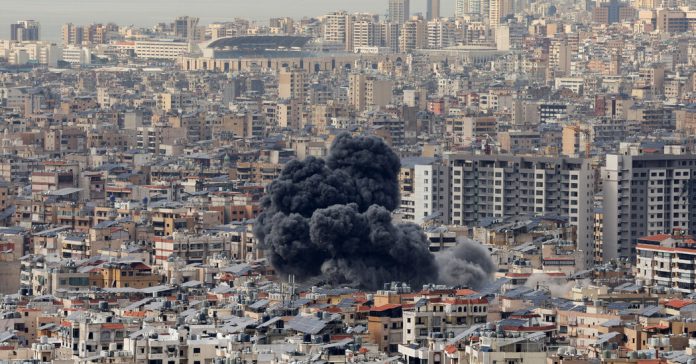
The Israeli military launched airstrikes in the southern outskirts of Beirut on Friday for the first time since a U.S.-brokered cease-fire came into effect in November, shattering months of tense calm in the Lebanese capital and stoking fears of a further escalation.
The bombardment came after rockets were fired at northern Israel from Lebanese territory earlier in the day, setting off air-raid sirens in three communities near the border. The Israeli military subsequently ordered residents of the densely populated Hadath neighborhood of Dahiya, an area on the southern edges of Beirut, to evacuate from the vicinity of a building there.
Less than two hours later, the airstrikes began.
The Israeli military said it had targeted a site that stored Hezbollah’s drones, but did not explicitly blame the Lebanese militant group for the rocket fire earlier in the day. Hezbollah denied any involvement in the attack on Israel and said it remained committed to the cease-fire.
But this was the second such exchange of fire in less than a week, prompting fears that the truce between Israel and Hezbollah could unravel. At least three people were killed in separate Israeli airstrikes in southern Lebanon on Friday, according to Lebanon’s health ministry, which does not distinguish between civilians and combatants.
The Lebanese military said it was investigating who had fired the rockets. Hezbollah, which is struggling to recover from the devastating 14-month conflict with Israel, has little desire to risk reigniting a conflict, according to experts.
But Palestinian armed groups like Hamas also maintain a sizable presence in Lebanon, operating mostly from decades-old refugee camps. During the war in Gaza, these groups have intermittently launched rockets from Lebanon into northern Israel.
After the Hamas-led Oct. 7, 2023 attack ignited the war in Gaza, Hezbollah began firing rockets and drones at Israeli positions in solidarity with its Palestinian ally. After nearly a year of low-level violence, the fighting escalated into full-scale war and an Israeli ground invasion before the two sides agreed to a cease-fire.
It marked Lebanon’s deadliest and most destructive conflict since the country’s 15-year civil war, which ended in 1990.
Despite the truce, Israeli forces have regularly attacked in southern and eastern Lebanon, leading Hezbollah to accuse Israel of breaking the cease-fire. But Dahiya, which is traditionally a bastion of support for Hezbollah, had not been targeted since the cease-fire went into effect.
Benjamin Netanyahu, the Israeli prime minister, said that the country was determined to “strongly enforce” the cease-fire, which obligated the Lebanese government to prevent militant groups from attacking Israel from its territory.
“The equation has changed,” Mr. Netanyahu said. “We will not allow firing at our communities — not even a trickle.”
After the Israeli military issued the evacuation warnings, surveillance drones began to whir above Beirut and gunfire erupted in the Dahiya as residents attempted to alert neighbors to an imminent Israeli strike. The Lebanese authorities also ordered all schools in the area to close, and parents rushed to collect screaming children. Students who spoke to The New York Times reported being ordered by teachers to move away from the windows, and said their classmates broke down in fear.
The pandemonium was reminiscent of the most intense days of the war, when Israeli airstrikes pounded Beirut’s southern outskirts on a near daily basis.
“People are panicking,” said Elie Hachem, the director of the St. Therese hospital, about 600 meters from the targeted building. “I can hear cars honking like crazy outside on the street.”
The hospital, which had been badly damaged in the war, was left unscathed by the strike, but casualties soon began arriving into the emergency room, said Mr. Hachem.
Air-raid sirens warning of incoming rocket fire had rung out earlier on Friday in northern Israel, including in the city of Kiryat Shmona. The Israeli military later said one of the projectiles was intercepted and another fell inside Lebanese territory.
Lebanon’s prime minister, Nawaf Salam, ordered the country’s security forces to arrest those responsible for the rocket fire, calling it “irresponsible” and a threat to “Lebanon’s stability and security,” according to a statement.
The Lebanese government is distinct from Hezbollah, an Iran-backed militia and political party that wielded enormous influence in Lebanon before the war. The new government has pledged to bring all weapons under the state’s control — including Hezbollah’s — but it remains unclear exactly when and how they will do that.
The U.N. special coordinator for Lebanon, Jeanine Hennis-Plasschaert, called for restraint, warning that a “a return to wider conflict in Lebanon would be devastating.”
Hwaida Saad and Dayana Iwaza contributed reporting from Beirut.
For months, French businesses have been bracing for the fallout of trade wars and tariff threats from the United States as the effects of President Trump’s “America First” policies ripple out. But this past week, the French corporate world was roiled by another type of Trump missive.
In a terse three-paragraph letter sent by the American Embassy in France to French companies, executives were told that President Trump’s moves to eliminate diversity, equity and inclusion policies would apply to any firm doing business with the U.S. government. It said it was giving them five days to sign a form indicating that they would comply.
An executive order that Mr. Trump signed the day after taking office instructs federal contractors not to engage in D.E.I., which the order described as “illegal discrimination.” The letter to French businesses said the order “applies to all suppliers and contractors of the U.S. government, regardless of their nationality and the country in which they operate.”
“If you do not agree to sign this document, we would appreciate it if you could provide detailed reasons, which we will forward to our legal services,” the letter said. The accompanying form added that companies must certify “that they do not operate any programs promoting D.E.I.”
The notice caused a sensation in the French corporate world and drew a curt reply from the French government.
“This practice reflects the values of the new American government. They are not ours,” the economy ministry said in a statement late Friday. France’s economy minister, Eric Lombard, “will remind his counterparts within the American government of this,” the statement said.
It was not immediately clear how many companies received the letter or how enforceable it was. But several members of the French Association of Private Enterprises, which include French CAC-40 listed companies and dozens of other major French firms, expressed their dismay over it during a meeting with French government officials this week.
Mr. Trump’s D.E.I.-quashing orders have sown fear and confusion among corporate leaders in the United States and led companies such as Google, as well as American law firms and some universities, to roll back diversity goals. But the Trump administration’s efforts to impose its policies on Europe-based workforces have been met with resistance in places like Italy that have long had strong labor laws favoring workers’ rights.
In France, companies have worked for years to increase the presence of women, members of minority groups and employees with disabilities, generally broadening their workforces to reflect the makeup of French society.
Unlike in the United States, French diversity policies officially bar the consideration of race in hiring. Even so, French companies have moved in practice to increase employee diversity and communicate their efforts to shareholders. In addition, companies with more than 250 employees are legally required to have more than 40 percent of women on their executive boards.
A spokesperson for the French Association of Private Enterprises said the group was waiting for the government to make a “coordinated response” to the Trump administration’s letter.
Syria’s interim president, Ahmed al-Shara, announced late Saturday the formation of a caretaker government that will lead the country through a crucial transition as it emerges from more than 50 years of dictatorship under the Assad family’s iron-fisted rule.
Mr. al-Shara, who led the coalition of rebel forces that overthrew the Assad regime, appointed a bevy of new ministers, swearing in each before an audience of several hundred dignitaries in a brightly lit hall in the presidential palace on a hill above Damascus.
His government included some experienced officials, and one woman — but he appointed close allies to the important ministries of defense, foreign affairs and interior.
Among Mr. al-Shara’s early promises was to form a caretaker government by March that would run the country until elections can be held. He has said that it could take up to four years to hold elections because the country is in disarray.
The makeup of the new government announced on Saturday, including key cabinet positions, was widely seen as a litmus test for whether Mr. al-Shara would extend any real power beyond his tight-knit circle of allies and make good on his pledge to create an inclusive government that represents all of Syria’s disparate religious and ethnic groups.
The caretaker government will be in power for five years, allowing for a permanent constitution to be adopted and elections to be held, as detailed in an interim constitution adopted this month.
The announcement on Saturday suggested that Mr. al-Shara was partially bowing to pressure from Syrian society and minority groups, as well as to demands from foreign governments that are considering lifting sanctions.
In a clear nod to those critics, Mr. al-Shara replaced his brother as minister of health, and appointed two popular activists to lead ministries. Raed al-Saleh, the head of the White Helmets civil defense organization, was made minister of disasters and emergencies, and Hind Kabawat, who helped organize a recent national dialogue conference, was named minister of social affairs — the lone woman appointee.
And in an important gesture to the country’s Kurdish minority, Mr. al-Shara appointed a Kurd as minister of education, a ministry that will be closely watched for how it handles the rewriting of the Assad regime’s education system.
Many Arab and Western leaders have said the restoration of full ties with Syria’s new government — including relief from punishing Western sanctions — would happen only if a political process that reflected the country’s ethnic and religious diversity was created.
While leading the transitional authority, Mr. al-Shara had placed allies in key government positions, effectively transplanting the provincial administration he once led in the rebel-held city of Idlib.
The announcement of the new government comes a monthafter Mr. al-Shara convened a conference for Syrians from across the country to share input and recommendations for an interim administration.
Pressure on Mr. al-Shara to make changes to his government grew at home and abroad after violence in Syria’s coastal region this month. Clashes erupted between remnants of the Assad regime and government security forces. More than 1,000 people were killed, many of them civilians, according to the war monitoring group, the Syrian Observatory for Human Rights.
Mr. al-Shara has also secured important agreements with the Kurdish-led militia, which is backed by the United States and controls much of northeastern Syria, and with Druse leaders in the south of the country.
The constitutional declaration that was announced this month was drawn up by a committee of experts led by a constitutional law professor. It retains the strong presidential system, granting executive power to the president and the power to appoint judges of the Supreme Court and a third of the members of parliament.
But it also set out a separation of branches of government and an independent judiciary that is “subject only to the law,” representing a break from the authoritarian state run by Mr. al-Assad.
The constitutional declaration also keeps a stipulation from the old constitution that the president must be a Muslim. It also guarantees freedom of opinion, expression, information, publication and press.
Some groups have criticized the temporary constitution for not recognizing Syria’s range of ethnic and religious groups or laying out a system of power sharing. But other analysts and democracy activists have described it as a good interim document that would maintain stability and allow time to debate further changes.
Ibrahim Draji, a law professor at Damascus University, said recently in a public discussion in the city that a three-month limit for a state of emergency and other restrictions on the military and security services were new safeguards against a return to dictatorship.
But another lawyer at the event, Faeq Huaiji, a co-founder of a Syrian nongovernmental organization, the Equal Citizenship Center, raised several concerns, including that the temporary constitution did not provide for adequate checks on the president.
Adam Entous conducted more than 300 interviews over more than a year with government, military and intelligence officials in Ukraine, the United States, Britain, Germany, Poland, Belgium, Latvia, Lithuania, Estonia and Turkey.
On a spring morning two months after Vladimir Putin’s invading armies marched into Ukraine, a convoy of unmarked cars slid up to a Kyiv street corner and collected two middle-aged men in civilian clothes.
Leaving the city, the convoy — manned by British commandos, out of uniform but heavily armed — traveled 400 miles west to the Polish border. The crossing was seamless, on diplomatic passports. Farther on, they came to the Rzeszów-Jasionka Airport, where an idling C-130 cargo plane waited.
The passengers were top Ukrainian generals. Their destination was Clay Kaserne, the headquarters of U.S. Army Europe and Africa in Wiesbaden, Germany. Their mission was to help forge what would become one of the most closely guarded secrets of the war in Ukraine.
One of the men, Lt. Gen. Mykhaylo Zabrodskyi, remembers being led up a flight of stairs to a walkway overlooking the cavernous main hall of the garrison’s Tony Bass Auditorium. Before the war, it had been a gym, used for all-hands meetings, Army band performances and Cub Scout pinewood derbies. Now General Zabrodskyi peered down on officers from coalition nations, in a warren of makeshift cubicles, organizing the first Western shipments to Ukraine of M777 artillery batteries and 155-millimeter shells.
Then he was ushered into the office of Lt. Gen. Christopher T. Donahue, commander of the 18th Airborne Corps, who proposed a partnership.
Its evolution and inner workings visible to only a small circle of American and allied officials, that partnership of intelligence, strategy, planning and technology would become the secret weapon in what the Biden administration framed as its effort to both rescue Ukraine and protect the threatened post-World War II order.
Behind the story with Adam Entous
How the promise of Texas barbecue led to a meeting with a key Ukrainian general.
Today that order — along with Ukraine’s defense of its land — teeters on a knife edge, as President Trump seeks rapprochement with Mr. Putin and vows to bring the war to a close. For the Ukrainians, the auguries are not encouraging. In the great-power contest for security and influence after the Soviet Union’s collapse, a newly independent Ukraine became the nation in the middle, its Westward lean increasingly feared by Moscow. Now, with negotiations beginning, the American president has baselessly blamed the Ukrainians for starting the war, pressured them to forfeit much of their mineral wealth and asked the Ukrainians to agree to a cease-fire without a promise of concrete American security guarantees — a peace with no certainty of continued peace.
Mr. Trump has already begun to wind down elements of the partnership sealed in Wiesbaden that day in the spring of 2022. Yet to trace its history is to better understand how the Ukrainians were able to survive across three long years of war, in the face of a far larger, far more powerful enemy. It is also to see, through a secret keyhole, how the war came to today’s precarious place.
With remarkable transparency, the Pentagon has offered a public inventory of the $66.5 billion array of weaponry supplied to Ukraine — including, at last count, more than a half-billion rounds of small-arms ammunition and grenades, 10,000 Javelin antiarmor weapons, 3,000 Stinger antiaircraft systems, 272 howitzers, 76 tanks, 40 High Mobility Artillery Rocket Systems, 20 Mi-17 helicopters and three Patriot air defense batteries.
But a New York Times investigation reveals that America was woven into the war far more intimately and broadly than previously understood. At critical moments, the partnership was the backbone of Ukrainian military operations that, by U.S. counts, have killed or wounded more than 700,000 Russian soldiers. (Ukraine has put its casualty toll at 435,000.) Side by side in Wiesbaden’s mission command center, American and Ukrainian officers planned Kyiv’s counteroffensives. A vast American intelligence-collection effort both guided big-picture battle strategy and funneled precise targeting information down to Ukrainian soldiers in the field.
One European intelligence chief recalled being taken aback to learn how deeply enmeshed his N.A.T.O. counterparts had become in Ukrainian operations. “They are part of the kill chain now,” he said.
The partnership’s guiding idea was that this close cooperation might allow the Ukrainians to accomplish the unlikeliest of feats — to deliver the invading Russians a crushing blow. And in strike after successful strike in the first chapters of the war — enabled by Ukrainian bravery and dexterity but also Russian incompetence — that underdog ambition increasingly seemed within reach.
Ukrainian, American and British military leaders during a meeting in Ukraine in August 2023.
Valerii Zaluzhnyi
An early proof of concept was a campaign against one of Russia’s most-feared battle groups, the 58th Combined Arms Army. In mid-2022, using American intelligence and targeting information, the Ukrainians unleashed a rocket barrage at the headquarters of the 58th in the Kherson region, killing generals and staff officers inside. Again and again, the group set up at another location; each time, the Americans found it and the Ukrainians destroyed it.
Farther south, the partners set their sights on the Crimean port of Sevastopol, where the Russian Black Sea Fleet loaded missiles destined for Ukrainian targets onto warships and submarines. At the height of Ukraine’s 2022 counteroffensive, a predawn swarm of maritime drones, with support from the Central Intelligence Agency, attacked the port, damaging several warships and prompting the Russians to begin pulling them back.
But ultimately the partnership strained — and the arc of the war shifted — amid rivalries, resentments and diverging imperatives and agendas.
The Ukrainians sometimes saw the Americans as overbearing and controlling — the prototypical patronizing Americans. The Americans sometimes couldn’t understand why the Ukrainians didn’t simply accept good advice.
Where the Americans focused on measured, achievable objectives, they saw the Ukrainians as constantly grasping for the big win, the bright, shining prize. The Ukrainians, for their part, often saw the Americans as holding them back. The Ukrainians aimed to win the war outright. Even as they shared that hope, the Americans wanted to make sure the Ukrainians didn’t lose it.
As the Ukrainians won greater autonomy in the partnership, they increasingly kept their intentions secret. They were perennially angered that the Americans couldn’t, or wouldn’t, give them all of the weapons and other equipment they wanted. The Americans, in turn, were angered by what they saw as the Ukrainians’ unreasonable demands, and by their reluctance to take politically risky steps to bolster their vastly outnumbered forces.
On a tactical level, the partnership yielded triumph upon triumph. Yet at arguably the pivotal moment of the war — in mid-2023, as the Ukrainians mounted a counteroffensive to build victorious momentum after the first year’s successes — the strategy devised in Wiesbaden fell victim to the fractious internal politics of Ukraine: The president, Volodymyr Zelensky, versus his military chief (and potential electoral rival), and the military chief versus his headstrong subordinate commander. When Mr. Zelensky sided with the subordinate, the Ukrainians poured vast complements of men and resources into a finally futile campaign to recapture the devastated city of Bakhmut. Within months, the entire counteroffensive ended in stillborn failure.
A Ukrainian soldier fired at Russian positions near Bakhmut.
Tyler Hicks/The New York Times
The partnership operated in the shadow of deepest geopolitical fear — that Mr. Putin might see it as breaching a red line of military engagement and make good on his often-brandished nuclear threats. The story of the partnership shows how close the Americans and their allies sometimes came to that red line, how increasingly dire events forced them — some said too slowly — to advance it to more perilous ground and how they carefully devised protocols to remain on the safe side of it.
Time and again, the Biden administration authorized clandestine operations it had previously prohibited. American military advisers were dispatched to Kyiv and later allowed to travel closer to the fighting. Military and C.I.A. officers in Wiesbaden helped plan and support a campaign of Ukrainian strikes in Russian-annexed Crimea. Finally, the military and then the C.I.A. received the green light to enable pinpoint strikes deep inside Russia itself.
In some ways, Ukraine was, on a wider canvas, a rematch in a long history of U.S.-Russia proxy wars — Vietnam in the 1960s, Afghanistan in the 1980s, Syria three decades later.
It was also a grand experiment in war fighting, one that would not only help the Ukrainians but reward the Americans with lessons for any future war.
During the wars against the Taliban and Al Qaeda in Afghanistan and against the Islamic State in Iraq and Syria, American forces conducted their own ground operations and supported those of their local partners. In Ukraine, by contrast, the U.S. military wasn’t allowed to deploy any of its own soldiers on the battlefield and would have to help remotely.
Would the precision targeting honed against terrorist groups be effective in a conflict with one of the most powerful militaries in the world? Would Ukrainian artillery men fire their howitzers without hesitation at coordinates sent by American officers in a headquarters 1,300 miles away? Would Ukrainian commanders, based on intelligence relayed by a disembodied American voice pleading, “There’s nobody there — go,” order infantrymen to enter a village behind enemy lines?
The answers to those questions — in truth, the partnership’s entire trajectory — would hinge on how well American and Ukrainian officers would trust one another.
“I will never lie to you. If you lie to me, we’re done,” General Zabrodskyi recalled General Donahue telling him at their first meeting. “I feel the exact same way,” the Ukrainian replied.
A Ukrainian soldier keeps watch in Kharkiv on Feb. 25, 2022, the day after Russia invaded Ukraine.
Tyler Hicks/The New York Times
Building Trust — and a Killing Machine
Held by Russia since 2014
U.S. & Allies
David S. Baldwin General
Joseph R. Biden Jr.President
Lloyd J. Austin IIIDefense Sec.
Christopher G. Cavoli General
Christopher T. Donahue General
Mark A. Milley General
Ukraine
In mid-April 2022, about two weeks before the Wiesbaden meeting, American and Ukrainian naval officers were on a routine intelligence-sharing call when something unexpected popped up on their radar screens. According to a former senior U.S. military officer, “The Americans go: ‘Oh, that’s the Moskva!’ The Ukrainians go: ‘Oh my God. Thanks a lot. Bye.’”
The Moskva was the flagship of Russia’s Black Sea Fleet. The Ukrainians sank it.
The sinking was a signal triumph — a display of Ukrainian skill and Russian ineptitude. But the episode also reflected the disjointed state of the Ukrainian-American relationship in the first weeks of the war.
For the Americans, there was anger, because the Ukrainians hadn’t given so much as a heads-up; surprise, that Ukraine possessed missiles capable of reaching the ship; and panic, because the Biden administration hadn’t intended to enable the Ukrainians to attack such a potent symbol of Russian power.
The Ukrainians, for their part, were coming from their own place of deep-rooted skepticism.
Their war, as they saw it, had started in 2014, when Mr. Putin seized Crimea and fomented separatist rebellions in eastern Ukraine. President Barack Obama had condemned the seizure and imposed sanctions on Russia. But fearful that American involvement could provoke a full-scale invasion, he had authorized only strictly limited intelligence sharing and rejected calls for defensive weapons. “Blankets and night-vision goggles are important, but one cannot win a war with blankets,” Ukraine’s president at the time, Petro O. Poroshenko, complained. Eventually Mr. Obama somewhat relaxed those intelligence strictures, and Mr. Trump, in his first term, relaxed them further and supplied the Ukrainians with their first antitank Javelins.
Then, in the portentous days before Russia’s full-scale invasion on Feb. 24, 2022, the Biden administration had closed the Kyiv embassy and pulled all military personnel from the country. (A small team of C.I.A. officers was allowed to stay.) As the Ukrainians saw it, a senior U.S. military officer said, “We told them, ‘The Russians are coming — see ya.’”
When American generals offered assistance after the invasion, they ran into a wall of mistrust. “We’re fighting the Russians. You’re not. Why should we listen to you?” Ukraine’s ground forces commander, Col. Gen. Oleksandr Syrsky, told the Americans the first time they met.
General Syrsky quickly came around: The Americans could provide the kind of battlefield intelligence his people never could.
In those early days, this meant that General Donahue and a few aides, with little more than their phones, passed information about Russian troop movements to General Syrsky and his staff. Yet even that ad hoc arrangement touched a raw nerve of rivalry within Ukraine’s military, between General Syrsky and his boss, the armed forces commander, Gen. Valery Zaluzhny. To Zaluzhny loyalists, General Syrsky was already using the relationship to build advantage.
Further complicating matters was General Zaluzhny’s testy relationship with the his American counterpart, Gen. Mark A. Milley, chairman of the Joint Chiefs of Staff.
In phone conversations, General Milley might second-guess the Ukrainians’ equipment requests. He might dispense battlefield advice based on satellite intelligence on the screen in his Pentagon office. Next would come an awkward silence, before General Zaluzhny cut the conversation short. Sometimes he simply ignored the American’s calls.
To keep them talking, the Pentagon initiated an elaborate telephone tree: A Milley aide would call Maj. Gen. David S. Baldwin, commander of the California National Guard, who would ring a wealthy Los Angeles blimp maker named Igor Pasternak, who had grown up in Lviv with Oleksii Reznikov, then Ukraine’s defense minister. Mr. Reznikov would track down General Zaluzhny and tell him, according to General Baldwin, “I know you’re mad at Milley, but you have to call him.”
Ragtag alliance coalesced into partnership in the quick cascade of events.
In March, their assault on Kyiv stalling, the Russians reoriented their ambitions, and their war plan, surging additional forces east and south — a logistical feat the Americans thought would take months. It took two and a half weeks.
Unless the coalition reoriented its own ambitions, General Donahue and the commander of U.S. Army Europe and Africa, Gen. Christopher G. Cavoli, concluded, the hopelessly outmanned and outgunned Ukrainians would lose the war. The coalition, in other words, would have to start providing heavy offensive weapons — M777 artillery batteries and shells.
The Biden administration had previously arranged emergency shipments of antiaircraft and antitank weapons. The M777s were something else entirely — the first big leap into supporting a major ground war.
The defense secretary, Lloyd J. Austin III, and General Milley had put the 18th Airborne in charge of delivering weapons and advising the Ukrainians on how to use them. When President Joseph R. Biden Jr. signed on to the M777s, the Tony Bass Auditorium became a full-fledged headquarters.
A Polish general became General Donahue’s deputy. A British general would manage the logistics hub on the former basketball court. A Canadian would oversee training.
The auditorium basement became what is known as a fusion center, producing intelligence about Russian battlefield positions, movements and intentions. There, according to intelligence officials, officers from the Central Intelligence Agency, the National Security Agency, the Defense Intelligence Agency and the National Geospatial-Intelligence Agency were joined by coalition intelligence officers.
The 18th Airborne is known as Dragon Corps; the new operation would be Task Force Dragon. All that was needed to bring the pieces together was the reluctant Ukrainian top command.
At an international conference on April 26 at Ramstein Air Base in Germany, General Milley introduced Mr. Reznikov and a Zaluzhny deputy to Generals Cavoli and Donahue. “These are your guys right here,” General Milley told them, adding: “You’ve got to work with them. They’re going to help you.”
Bonds of trust were being forged. Mr. Reznikov agreed to talk to General Zaluzhny. Back in Kyiv, “we organized the composition of a delegation” to Wiesbaden, Mr. Reznikov said. “And so it began.”
At the heart of the partnership were two generals — the Ukrainian, Zabrodskyi, and the American, Donahue.
General Zabrodskyi would be Wiesbaden’s chief Ukrainian contact, although in an unofficial capacity, as he was serving in parliament. In every other way, he was a natural.
Lt. Gen. Mykhaylo Zabrodskyi, a key Ukrainian figure in the Wiesbaden partnership.
Nicole Tung for The New York Times
Like many of his contemporaries in the Ukrainian military, General Zabrodskyi knew the enemy well. In the 1990s, he had attended military academy in St. Petersburg and served for five years in the Russian Army.
He also knew the Americans: From 2005 to 2006, he had studied at the Army Command and General Staff College at Fort Leavenworth, Kan. Eight years later, General Zabrodskyi led a perilous mission behind lines of Russian-backed forces in eastern Ukraine, modeled in part on one he had studied at Fort Leavenworth — the Confederate general J.E.B. Stuart’s famous reconnaissance mission around Gen. George B. McClellan’s Army of the Potomac. This brought him to the attention of influential people at the Pentagon; the general, they sensed, was the kind of leader they could work with.
General Zabrodskyi remembers that first day in Wiesbaden: “My mission was to find out: Who is this General Donahue? What is his authority? How much can he do for us?”
General Donahue was a star in the clandestine world of special forces. Alongside C.I.A. kill teams and local partners, he had hunted terrorist chiefs in the shadows of Iraq, Syria, Libya and Afghanistan. As leader of the elite Delta Force, he had helped build a partnership with Kurdish fighters to battle the Islamic State in Syria. General Cavoli once compared him to “a comic book action hero.”
Lt. Gen. Christopher T. Donahue, center, no helmet, in Afghanistan circa 2020.
Now he showed General Zabrodskyi and his travel companion, Maj. Gen. Oleksandr Kyrylenko, a map of the besieged east and south of their country, Russian forces dwarfing theirs. Invoking their “Glory to Ukraine” battle cry, he laid down the challenge: “You can ‘Slava Ukraini’ all you want with other people. I don’t care how brave you are. Look at the numbers.” He then walked them through a plan to win a battlefield advantage by fall, General Zabrodskyi recalled.
The first stage was underway — training Ukrainian artillery men on their new M777s. Task Force Dragon would then help them use the weapons to halt the Russian advance. Then the Ukrainians would need to mount a counteroffensive.
That evening, General Zabrodskyi wrote to his superiors in Kyiv.
“You know, a lot of countries wanted to support Ukraine,” he recalled. But “somebody needed to be the coordinator, to organize everything, to solve the current problems and figure out what we need in the future. I said to the commander in chief, ‘We have found our partner.’”
Soon the Ukrainians, nearly 20 in all — intelligence officers, operational planners, communications and fire-control specialists — began arriving in Wiesbaden. Every morning, officers recalled, the Ukrainians and Americans gathered to survey Russian weapons systems and ground forces and determine the ripest, highest-value targets. The priority lists were then handed over to the intelligence fusion center, where officers analyzed streams of data to pinpoint the targets’ locations.
Inside the U.S. European Command, this process gave rise to a fine but fraught linguistic debate: Given the delicacy of the mission, was it unduly provocative to call targets “targets”?
Some officers thought “targets” was appropriate. Others called them “intel tippers,” because the Russians were often moving and the information would need verification on the ground.
The debate was settled by Maj. Gen. Timothy D. Brown, European Command’s intelligence chief: The locations of Russian forces would be “points of interest.” Intelligence on airborne threats would be “tracks of interest.”
“If you ever get asked the question, ‘Did you pass a target to the Ukrainians?’ you can legitimately not be lying when you say, ‘No, I did not,’” one U.S. official explained.
Each point of interest would have to adhere to intelligence-sharing rules crafted to blunt the risk of Russian retaliation against N.A.T.O. partners.
There would be no points of interest on Russian soil. If Ukrainian commanders wanted to strike within Russia, General Zabrodskyi explained, they would have to use their own intelligence and domestically produced weapons. “Our message to the Russians was, ‘This war should be fought inside Ukraine,’” a senior U.S. official said.
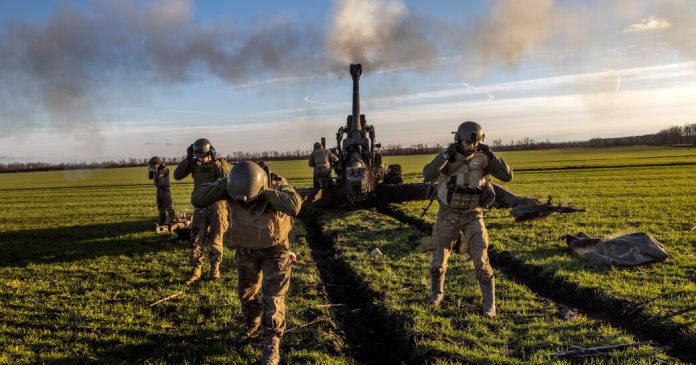
Ukrainian soldiers preparing to fire an M777 howitzer at Russian forces in the Donetsk region.
Ivor Prickett for The New York Times
The White House also prohibited sharing intelligence on the locations of “strategic” Russian leaders, like the armed forces chief, Gen. Valery Gerasimov. “Imagine how that would be for us if we knew that the Russians helped some other country assassinate our chairman,” another senior U.S. official said. “Like, we’d go to war.” Similarly, Task Force Dragon couldn’t share intelligence that identified the locations of individual Russians.
The way the system worked, Task Force Dragon would tell the Ukrainians where Russians were positioned. But to protect intelligence sources and methods from Russian spies, it would not say how it knew what it knew. All the Ukrainians would see on a secure cloud were chains of coordinates, divided into baskets — Priority 1, Priority 2 and so on. As General Zabrodskyi remembers it, when the Ukrainians asked why they should trust the intelligence, General Donahue would say: “Don’t worry about how we found out. Just trust that when you shoot, it will hit it, and you’ll like the results, and if you don’t like the results, tell us, we’ll make it better.”
The systemwent live in May. The inaugural target would be a radar-equipped armored vehicle known as a Zoopark, which the Russians could use to find weapons systems like the Ukrainians’ M777s. The fusion center found a Zoopark near Russian-occupied Donetsk, in Ukraine’s east.
The Ukrainians would set a trap: First, they would fire toward Russian lines. When the Russians turned on the Zoopark to trace the incoming fire, the fusion center would pinpoint the Zoopark’s coordinates in preparation for the strike.
On the appointed day, General Zabrodskyi recounted, General Donahue called the battalion commander with a pep talk: “You feel good?” he asked. “I feel real good,” the Ukrainian responded. General Donahue then checked the satellite imagery to make sure the target and M777 were properly positioned. Only then did the artilleryman open fire, destroying the Zoopark. “Everybody went, ‘We can do this!’” a U.S. official recalled.
But a critical question remained: Having done this against a single, stationary target, could the partners deploy this system against multiple targets in a major kinetic battle?
That would be the battle underway north of Donetsk, in Sievierodonetsk, where the Russians were hoping to mount a pontoon-bridge river crossing and then encircle and capture the city. General Zabrodskyi called it “a hell of a target.”
The engagement that followed was widely reported as an early and important Ukrainian victory. The pontoon bridges became death traps; at least 400 Russians were killed, by Ukrainian estimates. Unspoken was that the Americans had supplied the points of interest that helped thwart the Russian assault.
In these first months, the fighting was largely concentrated in Ukraine’s east. But U.S. intelligence was also tracking Russian movements in the south, especially a large troop buildup near the major city of Kherson. Soon several M777 crews were redeployed, and Task Force Dragon started feeding points of interest to strike Russian positions there.
With practice, Task Force Dragon produced points of interest faster, and the Ukrainians shot at them faster. The more they demonstrated their effectiveness using M777s and similar systems, the more the coalition sent new ones — which Wiesbaden supplied with ever more points of interest.
“You know when we started to believe?” General Zabrodskyi recalled. “When Donahue said, ‘This is a list of positions.’ We checked the list and we said, ‘These 100 positions are good, but we need the other 50.’ And they sent the other 50.”
The M777s became workhorses of the Ukrainian army.But because theygenerally couldn’t launch their 155-millimeter shells more than 15 miles, they were no match for the Russians’ vast superiority in manpower and equipment.
To give the Ukrainians compensatory advantages of precision, speed and range, Generals Cavoli and Donahue soon proposed a far bigger leap — providing High Mobility Artillery Rocket Systems, known as HIMARS, which used satellite-guided rockets to execute strikes up to 50 miles away.
The ensuing debate reflected the Americans’ evolving thinking.
Pentagon officials were resistant, loath to deplete the Army’s limited HIMARS stocks. But in May, General Cavoli visited Washington and made the case that ultimately won them over.
Celeste Wallander, then the assistant defense secretary for international security affairs, recalled, “Milley would always say, ‘You’ve got a little Russian army fighting a big Russian army, and they’re fighting the same way, and the Ukrainians will never win.’” General Cavoli’s argument, she said, was that “with HIMARS, they can fight like we can, and that’s how they will start to beat the Russians.”
At the White House, Mr. Biden and his advisers weighed that argument against fears that pushing the Russians would only lead Mr. Putin to panic and widen the war. When the generals requested HIMARS, one official recalled, the moment felt like “standing on that line, wondering, if you take a step forward, is World War III going to break out?” And when the White House took that step forward, the official said, Task Force Dragon was becoming “the entire back office of the war.”
Wiesbaden would oversee each HIMARS strike. General Donahue and his aides would review the Ukrainians’ target lists and advise them on positioning their launchers and timing their strikes. The Ukrainians were supposed to only use coordinates the Americans provided. To fire a warhead, HIMARS operators needed a special electronic key card, which the Americans could deactivate anytime.
HIMARS strikes that resulted in 100 or more Russian dead or wounded came almost weekly. Russian forces were left dazed and confused. Their morale plummeted, and with it their will to fight. And as the HIMARS arsenal grew from eight to 38 and the Ukrainian strikers became more proficient, an American official said, the toll rose as much as fivefold.
“We became a small part, maybe not the best part, but a small part, of your system,” General Zabrodskyi explained, adding: “Most states did this over a period of 10 years, 20 years, 30 years. But we were forced to do it in a matter of weeks.”
Together the partners were honing a killing machine.
Russian forces collapsed in the Oskil river valley, abandoning their equipment as they fled.
Nicole Tung for The New York Times
‘When You Defeat Russia, We Will Make You Blue for Good’
U.S. & Allies
Ukraine
Oleksandr Syrsky General
Oleksandr Tarnavskyi General
Mykhaylo Zabrodskyi General
Volodymyr Zelensky President
At their first meeting, General Donahue had shown General Zabrodskyi a color-coded map of the region, with American and NATO forces in blue, Russian forces in red and Ukrainian forces in green. “Why are we green?” General Zabrodskyi asked. “We should be blue.”
In early June, as they met to war-game Ukraine’s counteroffensive, sitting side by side in front of tabletop battlefield maps, General Zabrodskyi saw that the small blocks marking Ukrainian positions had become blue — a symbolic stroke to strengthen the bond of common purpose. “When you defeat Russia,” General Donahue told the Ukrainians, “we will make you blue for good.”
It was three months since the invasion, and the maps told this story of the war:
In the south, the Ukrainians had blocked the Russian advance at the Black Sea shipbuilding center of Mykolaiv. But the Russians controlled Kherson, and a corps roughly 25,000 soldiers strong occupied land on the west bank of the Dnipro River. In the east, the Russians had been stopped at Izium. But they held land between there and the border, including the strategically important Oskil river valley.
The Russians’ strategy had morphed from decapitation — the futile assault on Kyiv — to slow strangulation. The Ukrainians needed to go on the offensive.
Their top commander, General Zaluzhny, along with the British, favored the most ambitious option — from near Zaporizhzhia, in the southeast, down toward occupied Melitopol. This maneuver, they believed, would sever the cross-border land routes sustaining Russian forces in Crimea.
In theory, General Donahue agreed. But according to colleagues, he thought Melitopol was not feasible, given the state of the Ukrainian military and the coalition’s limited ability to provide M777s without crippling American readiness. To prove his point in the war games, he took over the part of the Russian commander. Whenever the Ukrainians tried to advance, General Donahue destroyed them with overwhelming combat power.
What they ultimately agreed on was a two-part attack to confuse Russian commanders who, according to American intelligence, believed the Ukrainians had only enough soldiers and equipment for a single offensive.
The main effort would be to recapture Kherson and secure the Dnipro’s west bank, lest the corps advance on the port of Odesa and be positioned for another attack on Kyiv.
General Donahue had advocated a coequal second front in the east, from the Kharkiv region, to reach the Oskil river valley. But the Ukrainians instead argued for a smaller supporting feint to draw Russian forces east and smooth the way for Kherson.
That would come first, around Sept. 4. The Ukrainians would then begin two weeks of artillery strikes to weaken Russian forces in the south. Only then, around Sept. 18, would they march toward Kherson.
And if they still had enough ammunition, they would cross the Dnipro. General Zabrodskyi remembers General Donahue saying, “If you guys want to get across the river and get to the neck of Crimea, then follow the plan.”
That was the plan until it wasn’t.
Mr. Zelensky sometimes spoke directly with regional commanders, and after one such conversation, the Americans were informed that the order of battle had changed.
Kherson would come faster — and first, on Aug. 29.
General Donahue told General Zaluzhny that more time was needed to lay the groundwork for Kherson; the switch, he said, put the counteroffensive, and the entire country, in jeopardy. The Americans later learned the back story:
Mr. Zelensky was hoping to attend the mid-September meeting of the United Nations General Assembly. A showing of progress on the battlefield, he and his advisers believed, would bolster his case for additional military support. So they upended the plan at the last minute — a preview of a fundamental disconnect that would increasingly shape the arc of the war.
The upshot wasn’t what anyone had planned.
The Russians responded by moving reinforcements from the east toward Kherson. Now General Zaluzhny realized that the weakened Russian forces in the east might well let the Ukrainians do what General Donahue had advocated — reach the Oskil river valley. “Go, go, go — you have them on the ropes,” General Donahue told the Ukrainian commander there, General Syrsky, a European official recalled.
The Russian forces collapsed even faster than predicted, abandoning their equipment as they fled. The Ukrainian leadership had never expected their forces to reach the Oskil’s west bank, and when they did, General Syrsky’s standing with the president soared.
In the south, U.S. intelligence now reported that the corps on the Dnipro’s west bank was running short on food and ammunition.
The Ukrainians wavered. General Donahue pleaded with the field commander, Maj. Gen. Andrii Kovalchuk, to advance. Soon the American’s superiors, Generals Cavoli and Milley, escalated the matter to General Zaluzhny.
That didn’t work either.
The British defense minister, Ben Wallace, asked General Donahue what he would do if General Kovalchuk were his subordinate.
“He would have already been fired,” General Donahue responded.
“I got this,” Mr. Wallace said. The British military had considerable clout in Kyiv; unlike the Americans, they had placed small teams of officers in the country after the invasion. Now the defense minister exercised that clout and demanded that the Ukrainians oust the commander.
Perhaps no piece of Ukrainian soil was more precious to Mr. Putin than Crimea. As the Ukrainians haltingly advanced on the Dnipro, hoping to cross and advance toward the peninsula, this gave rise to what one Pentagon official called the “core tension”:
To give the Russian president an incentive to negotiate a deal, the official explained, the Ukrainians would have to put pressure on Crimea. To do so, though, could push him to contemplate doing “something desperate.”
The Ukrainians were already exerting pressure on the ground. And the Biden administration had authorized helping the Ukrainians develop, manufacture and deploy a nascent fleet of maritime drones to attack Russia’s Black Sea Fleet. (The Americans gave the Ukrainians an early prototype meant to counter a Chinese naval assault on Taiwan.) First, the Navy was allowed to share points of interest for Russian warships just beyond Crimea’s territorial waters. In October, with leeway to act within Crimea itself, the C.I.A. covertly started supporting drone strikes on the port of Sevastopol.
That same month, U.S. intelligence overheard Russia’s Ukraine commander, Gen. Sergei Surovikin, talking about indeed doing something desperate: using tactical nuclear weapons to prevent the Ukrainians from crossing the Dnipro and making a beeline to Crimea.
Until that moment, U.S. intelligence agencies had estimated the chance of Russia’s using nuclear weapons in Ukraine at 5 to 10 percent. Now, they said, if the Russian lines in the south collapsed, the probability was 50 percent.
That core tension seemed to be coming to a head.
In Europe, Generals Cavoli and Donahue were begging General Kovalchuk’s replacement, Brig. Gen. Oleksandr Tarnavskyi, to move his brigades forward, rout the corps from the Dnipro’s west bank and seize its equipment.
In Washington, Mr. Biden’s top advisers nervously wondered the opposite — if they might need to press the Ukrainians to slow their advance.
The moment might have been the Ukrainians’ best chance to deal a game-changing blow to the Russians. It might also have been the best chance to ignite a wider war.
In the end, in a sort of grand ambiguity, the moment never came.
To protect their fleeing forces, Russian commanders left behind small detachments of troops. General Donahue advised General Tarnavskyi to destroy or bypass them and focus on the primary objective — the corps. But whenever the Ukrainians encountered a detachment, they stopped in their tracks, assuming a larger force lay in wait.
General Donahue told him that satellite imagery showed Ukrainian forces blocked by just one or two Russian tanks, according to Pentagon officials. But unable to see the same satellite images, the Ukrainian commander hesitated, wary of sending his forces forward.
To get the Ukrainians moving, Task Force Dragon sent points of interest, and M777 operators destroyed the tanks with Excalibur missiles — time-consuming steps repeated whenever the Ukrainians encountered a Russian detachment.
Ukrainians celebrated the recapture of Kherson.
Lynsey Addario for The New York Times
The Ukrainians would still recapture Kherson and clear the Dnipro’s west bank. But the offensive halted there. The Ukrainians, short on ammunition, would not cross the Dnipro. They would not, as the Ukrainians had hoped and the Russians feared, advance toward Crimea.
And as the Russians escaped across the river, farther into occupied ground, huge machines rent the earth, cleaving long, deep trench lines in their wake.
Still the Ukrainians were in a celebratory mood, and on his next Wiesbaden trip, General Zabrodskyi presented General Donahue with a “combat souvenir”: a tactical vest that had belonged to a Russian soldier whose comrades were already marching east to what would become the crucible of 2023 — a place called Bakhmut.
Ukrainian soldiers in Bakhmut, a site of prolonged combat that President Volodymyr Zelensky called the “fortress of our morale.”
Tyler Hicks/The New York Times
The Best-Laid Plans
November 2022–November 2023
U.S. & Allies
Antonio A. Aguto Jr.General
Lloyd J. Austin IIIDefense Sec.
Christopher G. Cavoli General
Christopher T. Donahue General
Mark A. Milley General
Ukraine
Oleksandr Syrsky General
Oleksandr Tarnavskyi General
Mykhaylo Zabrodskyi General
Volodymyr Zelensky President
The planning for 2023 began straightaway, at what in hindsight was a moment of irrational exuberance.
Ukraine controlled the west banks of the Oskil and Dnipro rivers. Within the coalition, the prevailing wisdom was that the 2023 counteroffensive would be the war’s last: The Ukrainians would claim outright triumph, or Mr. Putin would be forced to sue for peace.
“We’re going to win this whole thing,” Mr. Zelensky told the coalition, a senior American official recalled.
To accomplish this, General Zabrodskyi explained as the partners gathered in Wiesbaden in late autumn, General Zaluzhny was once again insisting that the primary effort be an offensive toward Melitopol, to strangle Russian forces in Crimea — what he believed had been the great, denied opportunity to deal the reeling enemy a knockout blow in 2022.
And once again, some American generals were preaching caution.
At the Pentagon, officials worried about their ability to supply enough weapons for the counteroffensive; perhaps the Ukrainians, in their strongest possible position, should consider cutting a deal. When the Joint Chiefs chairman, General Milley, floated that idea in a speech, many of Ukraine’s supporters (including congressional Republicans, then overwhelmingly supportive of the war) cried appeasement.
In Wiesbaden, in private conversations with General Zabrodskyi and the British, General Donahue pointed to those Russian trenches being dug to defend the south. He pointed, too, to the Ukrainians’ halting advance to the Dnipro just weeks before. “They’re digging in, guys,” he told them. “How are you going to get across this?”
What he advocated instead, General Zabrodskyi and a European official recalled, was a pause: If the Ukrainians spent the next year, if not longer, building and training new brigades, they would be far better positioned to fight through to Melitopol.
The British, for their part, argued that if the Ukrainians were going to go anyway, the coalition needed to help them. They didn’t have to be as good as the British and Americans, General Cavoli would say; they just had to be better than the Russians.
There would be no pause. General Zabrodskyi would tell General Zaluzhny, “Donahue is right.” But he would also admit that “nobody liked Donahue’s recommendations, except me.”
And besides, General Donahue was a man on the way out.
The 18th Airborne’s deployment had always been temporary. There would now be a more permanent organization in Wiesbaden, the Security Assistance Group-Ukraine, call sign Erebus — the Greek mythological personification of darkness.
That autumn day, the planning session and their time together done, General Donahue escorted General Zabrodskyi to the Clay Kaserne airfield. There he presented him with an ornamental shield — the 18th Airborne dragon insignia, encircled by five stars.
The westernmost represented Wiesbaden; slightly to the east was the Rzeszów-Jasionka Airport. The other stars represented Kyiv, Kherson and Kharkiv — for General Zaluzhny and the commanders in the south and east.
And beneath the stars, “Thanks.”
“I asked him, ‘Why are you thanking me?’” General Zabrodskyi recalled. “‘I should say thank you.’”
General Donahue explained that the Ukrainians were the ones fighting and dying, testing American equipment and tactics and sharing lessons learned. “Thanks to you,” he said, “we built all these things that we never could have.”
Shouting through the airfield wind and noise, they went back and forth about who deserved the most thanks. Then they shook hands, and General Zabrodskyi disappeared into the idling C-130.
The “new guyin the room” was Lt. Gen. Antonio A. Aguto Jr. He was a different kind of commander, with a different kind of mission.
General Donahue was a risk taker. General Aguto had built a reputation as a man of deliberation and master of training and large-scale operations. After the seizure of Crimea in 2014, the Obama administration had expanded its training of the Ukrainians, including at a base in the far west of the country; General Aguto had overseen the program. In Wiesbaden, his No. 1 priority would be preparing new brigades. “You’ve got to get them ready for the fight,” Mr. Austin, the defense secretary, told him.
That translated to greater autonomy for the Ukrainians, a rebalancing of the relationship: At first, Wiesbaden had labored to win the Ukrainians’ trust. Now the Ukrainians were asking for Wiesbaden’s trust.
An opportunity soon presented itself.
Ukrainian intelligence had detected a makeshift Russian barracks at a school in occupied Makiivka. “Trust us on this,” General Zabrodskyi told General Aguto. The American did, and the Ukrainian recalled, “We did the full targeting process absolutely independently.’’ Wiesbaden’s role would be limited to providing coordinates.
A satellite image of a school in occupied Makiivka where Russians had established a barracks.
Maxar Technologies
The site after a strike that was aided by U.S. intelligence.
Maxar Technologies
In this new phase of the partnership, U.S. and Ukrainian officers would still meet daily to set priorities, which the fusion center turned into points of interest. But Ukrainian commanders now had a freer hand to use HIMARS to strike additional targets, fruit of their own intelligence — if they furthered agreed-upon priorities.
“We will step back and watch, and keep an eye on you to make sure that you don’t do anything crazy,” General Aguto told the Ukrainians. “The whole goal,” he added, “is to have you operate on your own at some point in time.”
Echoing 2022, the war games of January 2023 yielded a two-pronged plan.
The secondary offensive, by General Syrsky’s forces in the east, would be focused on Bakhmut — where combat had been smoldering for months — with a feint toward the Luhansk region, an area annexed by Mr. Putin in 2022. That maneuver, the thinking went, would tie up Russian forces in the east and smooth the way for the main effort, in the south — the attack on Melitopol, where Russian fortifications were already rotting and collapsing in the winter wet and cold.
But problems of a different sort were already gnawing at the new-made plan.
General Zaluzhny may have been Ukraine’s supreme commander, but his supremacy was increasingly compromised by his competition with General Syrsky. According to Ukrainian officials, the rivalry dated to Mr. Zelensky’s decision, in 2021, to elevate General Zaluzhny over his former boss, General Syrsky. The rivalry had intensified after the invasion, as the commanders vied for limited HIMARS batteries. General Syrsky had been born in Russia and served in its army; until he started working on his Ukrainian, he had generally spoken Russian at meetings. General Zaluzhny sometimes derisively called him “that Russian general.”
The Americans knew General Syrsky was unhappy about being dealt a supporting hand in the counteroffensive. When General Aguto called to make sure he understood the plan, he responded, “I don’t agree, but I have my orders.”
The counteroffensive was to begin on May 1. The intervening months would be spent training for it. General Syrsky would contribute four battle-hardened brigades — each between 3,000 and 5,000 soldiers — for training in Europe; they would be joined by four brigades of new recruits.
The general had other plans.
In Bakhmut, the Russians were deploying, and losing, vast numbers of soldiers. General Syrsky saw an opportunity to engulf them and ignite discord in their ranks. “Take all new guys” for Melitopol, he told General Aguto, according to U.S. officials. And when Mr. Zelensky sided with him, over the objections of both his own supreme commander and the Americans, a key underpinning of the counteroffensive was effectively scuttled.
Now the Ukrainians would send just four untested brigades abroad for training. (They would prepare eight more inside Ukraine.) Plus, the new recruits were old — mostly in their 40s and 50s. When they arrived in Europe, a senior U.S. official recalled, “All we kept thinking was, This is not great.”
The Ukrainian draft age was 27. General Cavoli, who had been promoted to supreme allied commander for Europe, implored General Zaluzhny to “get your 18-year-olds in the game.” But the Americans concluded that neither the president nor the general would own such a politically fraught decision.
A parallel dynamic was at play on the American side.
The previous year, the Russians had unwisely placed command posts, ammunition depots and logistics centers within 50 miles of the front lines. But new intelligence showed that the Russians had now moved critical installations beyond HIMARS’ reach. So Generals Cavoli and Aguto recommended the next quantum leap, giving the Ukrainians Army Tactical Missile Systems — missiles, known as ATACMS, that can travel up to 190 miles — to make it harder for Russian forces in Crimea to help defend Melitopol.
ATACMS were a particularly sore subject for the Biden administration. Russia’s military chief, General Gerasimov, had indirectly referred to them the previous May when he warned General Milley that anything that flew 190 miles would be breaching a red line. There was also a question of supply: The Pentagon was already warning that it would not have enough ATACMS if America had to fight its own war.
The message was blunt: Stop asking for ATACMS.
Underlying assumptions had been upended. Still, the Americans saw a path to victory, albeit a narrowing one. Key to threading that needle was beginning the counteroffensive on schedule, on May 1, before the Russians repaired their fortifications and moved more troops to reinforce Melitopol.
But the drop-dead date came and went. Some promised deliveries of ammunition and equipment had been delayed, and despite General Aguto’s assurances that there was enough to start, the Ukrainians wouldn’t commit until they had it all.
At one point, frustration rising, General Cavoli turned to General Zabrodskyi and said: “Misha, I love your country. But if you don’t do this, you’re going to lose the war.”
“My answer was: ‘I understand what you are saying, Christopher. But please understand me. I’m not the supreme commander. And I’m not the president of Ukraine,’” General Zabrodskyi recalled, adding, “Probably I needed to cry as much as he did.”
At the Pentagon, officials were beginning to sense some graver fissure opening. General Zabrodskyi recalled General Milley asking: “Tell me the truth. Did you change the plan?”
“No, no, no,” he responded. “We did not change the plan, and we are not going to.”
When he uttered these words, he genuinely believed he was telling the truth.
In late May, intelligence showed the Russians rapidly building new brigades. The Ukrainians didn’t have everything they wanted, but they had what they thought they needed. They would have to go.
General Zaluzhny outlined the final plan at a meeting of the Stavka, a governmental body overseeing military matters. General Tarnavskyi would have 12 brigades and the bulk of ammunition for the main assault, on Melitopol. The marine commandant, Lt. Gen. Yurii Sodol, would feint toward Mariupol, the ruined port city taken by the Russians after a withering siege the year before. General Syrsky would lead the supporting effort in the east around Bakhmut, recently lost after months of trench warfare.
Then General Syrsky spoke. According to Ukrainian officials, the general said he wanted to break from the plan and execute a full-scale attack to drive the Russians from Bakhmut. He would then advance eastward toward the Luhansk region. He would, of course, need additional men and ammunition.
The Americans were not told the meeting’s outcome. But then U.S. intelligence observed Ukrainian troops and ammunition moving in directions inconsistent with the agreed-upon plan.
Soon after, at a hastily arranged meeting on the Polish border, General Zaluzhny admitted to Generals Cavoli and Aguto that the Ukrainians had in fact decided to mount assaults in three directions at once.
“That’s not the plan!” General Cavoli cried.
What had happened, according to Ukrainian officials, was this: After the Stavka meeting, Mr. Zelensky had ordered that the coalition’s ammunition be split evenly between General Syrsky and General Tarnavskyi. General Syrsky would also get five of the newly trained brigades, leaving seven for the Melitopol fight.
“It was like watching the demise of the Melitopol offensive even before it was launched,” one Ukrainian official remarked.
Fifteen months into the war, it had all come to this tipping point.
“We should have walked away,” said a senior American official.
But they would not.
“These decisions involving life and death, and what territory you value more and what territory you value less, are fundamentally sovereign decisions,” a senior Biden administration official explained. “All we could do was give them advice.”
The leader of the Mariupol assault, General Sodol, was an eager consumer of General Aguto’s advice. That collaboration produced one of the counteroffensive’s biggest successes: After American intelligence identified a weak point in Russian lines, General Sodol’s forces, using Wiesbaden’s points of interest, recaptured the village of Staromaiorske and nearly eight square miles of territory.
For the Ukrainians, that victory posed a question: Might the Mariupol fight be more promising than the one toward Melitopol? But the attack stalled for lack of manpower.
The problem was laid out right there on the battlefield map in General Aguto’s office: General Syrsky’s assault on Bakhmut was starving the Ukrainian army.
General Aguto urged him to send brigades and ammunition south for the Melitopol attack. But General Syrsky wouldn’t budge, according to U.S. and Ukrainian officials. Nor would he budge when Yevgeny Prigozhin, whose Wagner paramilitaries had helped the Russians capture Bakhmut, rebelled against Mr. Putin’s military leadership and sent forces racing toward Moscow.
U.S. intelligence assessed that the rebellion could erode Russian morale and cohesion; intercepts detected Russian commanders surprised that the Ukrainians weren’t pushing harder toward tenuously defended Melitopol, a U.S. intelligence official said.
But as General Syrsky saw it, the rebellion validated his strategy of sowing division by impaling the Russians in Bakhmut. To send some of his forces south would only undercut it. “I was right, Aguto. You were wrong,” an American official recalls General Syrsky saying and adding, “We’re going to get to Luhansk.”
Mr. Zelensky had framed Bakhmut as the “fortress of our morale.” In the end, it was a blood-drenched demonstration of the outmanned Ukrainians’ predicament.
Though counts vary wildly, there is little question that the Russians’ casualties — in the tens of thousands — far outstripped the Ukrainians’. Yet General Syrsky never did recapture Bakhmut, never did advance toward Luhansk. And while the Russians rebuilt their brigades and soldiered on in the east, the Ukrainians had no such easy source of recruits. (Mr. Prigozhin pulled his rebels back before reaching Moscow; two months later, he died in a plane crash that American intelligence believed had the hallmarks of a Kremlin-sponsored assassination.)
Which left Melitopol.
A primary virtue of the Wiesbaden machine was speed — shrinking the time from point of interest to Ukrainian strike. But that virtue, and with it the Melitopol offensive, was undermined by a fundamental shift in how the Ukrainian commander there used those points of interest. He had substantially less ammunition than he had planned for; instead of simply firing, he would now first use drones to confirm the intelligence.
This corrosive pattern, fueled, too, by caution and a deficit of trust, came to a head when, after weeks of grindingly slow progress across a hellscape of minefields and helicopter fire, Ukrainian forces approached the occupied village of Robotyne.
American officials recounted the ensuing battle. The Ukrainians had been pummeling the Russians with artillery; American intelligence indicated they were pulling back.
“Take the ground now,” General Aguto told General Tarnavskyi.
But the Ukrainians had spotted a group of Russians on a hilltop.
In Wiesbaden, satellite imagery showed what looked like a Russian platoon, between 20 and 50 soldiers — to General Aguto hardly justification to slow the march.
General Tarnavskyi, though, wouldn’t move until the threat was eliminated. So Wiesbaden sent the Russians’ coordinates and advised him to simultaneously open fire and advance.
Instead, to verify the intelligence, General Tarnavskyi flew reconnaissance drones over the hilltop.
Which took time. Only then did he order his men to fire.
And after the strike, he once again dispatched his drones, to confirm the hilltop was indeed clear. Then he ordered his forces into Robotyne, which they seized on Aug. 28.
The back-and-forth had cost between 24 and 48 hours, officers estimated. And in that time, south of Robotyne, the Russians had begun building new barriers, laying mines and sending reinforcements to halt Ukrainian progress. “The situation was changed completely,” General Zabrodskyi said.
An abandoned Ukrainian military vehicle near the front line of Robotyne.
Reuters
General Aguto yelled at General Tarnavskyi: Press on. But the Ukrainians had to rotate troops from the front lines to the rear, and with only the seven brigades, they weren’t able to bring in new forces fast enough to keep going.
The Ukrainian advance, in fact, was slowed by a mix of factors. But in Wiesbaden, the frustrated Americans kept talking about the platoon on the hill. “A damned platoon stopped the counteroffensive,” one officer remarked.
The Ukrainians would not make it to Melitopol. They would have to scale back their ambitions.
Now their objective would be the small occupied city of Tokmak, about halfway to Melitopol, close to critical rail lines and roadways.
General Aguto had given the Ukrainians greater autonomy. But now he crafted a detailed artillery plan, Operation Rolling Thunder, that prescribed what the Ukrainians should shoot, with what and in what order, according to U.S. and Ukrainian officials. But General Tarnavskyi objected to some targets, insisted on using drones to verify points of interest and Rolling Thunder rumbled to a halt.
Desperate to salvage the counteroffensive, the White House had authorized a secret transport of a small number of cluster warheads with a range of about 100 miles, and General Aguto and General Zabrodskyi devised an operation against Russian attack helicopters threatening General Tarnavskyi’s forces. At least 10 helicopters were destroyed, and the Russians pulled all their aircraft back to Crimea or the mainland. Still, the Ukrainians couldn’t advance.
The Americans’ last-ditch recommendation was to have General Syrsky take over the Tokmak fight. That was rejected. They then proposed that General Sodol send his marines to Robotyne and have them break through the Russian line. But instead General Zaluzhny ordered the marines to Kherson to open a new front in an operation the Americans counseled was doomed to fail — trying to cross the Dnipro and advance toward Crimea. The marines made it across the river in early November but ran out of men and ammunition. The counteroffensive was supposed to deliver a knockout blow. Instead, it met an inglorious end.
General Syrsky declined to answer questions about his interactions with American generals, but a spokesman for the Ukrainian armed forces said, “We do hope that the time will come, and after the victory of Ukraine, the Ukrainian and American generals you mentioned will perhaps jointly tell us about their working and friendly negotiations during the fighting against Russian aggression.”
Andriy Yermak, head of the presidential office of Ukraine and arguably the country’s second-most-powerful official, told The Times that the counteroffensive had been “primarily blunted” by the allies’ “political hesitation” and “constant” delays in weapons deliveries.
But to another senior Ukrainian official, “The real reason why we were not successful was because an improper number of forces were assigned to execute the plan.”
Either way, for the partners, the counteroffensive’s devastating outcome left bruised feelings on both sides. “The important relationships were maintained,” said Ms. Wallander, the Pentagon official. “But it was no longer the inspired and trusting brotherhood of 2022 and early 2023.”
President Volodymyr Zelensky and Gen. Christopher G. Cavoli in Wiesbaden in December 2023.
Susanne Goebel/U.S. European Command
Breaches of Trust, and of Borders
December 2023–January 2025
U.S. & Allies
Antonio A. Aguto Jr.General
Lloyd J. Austin IIIDefense Sec.
David S. Baldwin General
Joseph R. Biden Jr.President
Christopher G. Cavoli General
Christopher T. Donahue General
Donald J. Trump President
Ukraine
Shortly before Christmas, Mr. Zelensky rode through the Wiesbaden gates for his maiden visit to the secret center of the partnership.
Entering the Tony Bass Auditorium, he was escorted past trophies of shared battle — twisted fragments of Russian vehicles, missiles and aircraft. When he climbed to the walkway above the former basketball court — as General Zabrodskyi had done that first day in 2022 — the officers working below burst into applause.
Yet the president had not come to Wiesbaden for celebration. In the shadow of the failed counteroffensive, a third, hard wartime winter coming on, the portents had only darkened. To press their new advantage, the Russians were pouring forces into the east. In America, Mr. Trump, a Ukraine skeptic, was mid-political resurrection; some congressional Republicans were grumbling about cutting off funding.
A year ago, the coalition had been talking victory. As 2024 arrived and ground on, the Biden administration would find itself forced to keep crossing its own red lines simply to keep the Ukrainians afloat.
But first, the immediate business in Wiesbaden: Generals Cavoli and Aguto explained that they saw no plausible path to reclaiming significant territory in 2024. The coalition simply couldn’t provide all the equipment for a major counteroffensive. Nor could the Ukrainians build an army big enough to mount one.
The Ukrainians would have to temper expectations, focusing on achievable objectives to stay in the fight while building the combat power to potentially mount a counteroffensive in 2025: They would need to erect defensive lines in the east to prevent the Russians from seizing more territory. And they would need to reconstitute existing brigades and fill new ones, which the coalition would help train and equip.
Mr. Zelensky voiced his support.
Yet the Americans knew he did so grudgingly. Time and again Mr. Zelensky had made it clear that he wanted, and needed, a big win to bolster morale at home and shore up Western support.
Just weeks before, the president had instructed General Zaluzhny to push the Russians back to Ukraine’s 1991 borders by fall of 2024. The general had then shocked the Americans by presenting a plan to do so that required five million shells and one million drones. To which General Cavoli had responded, in fluent Russian, “From where?”
Several weeks later, at a meeting in Kyiv, the Ukrainian commander had locked General Cavoli in a Defense Ministry kitchen and, vaping furiously, made one final, futile plea. “He was caught between two fires, the first being the president and the second being the partners,” said one of his aides.
As a compromise, the Americans now presented Mr. Zelensky with what they believed would constitute a statement victory — a bombing campaign, using long-range missiles and drones, to force the Russians to pull their military infrastructure out of Crimea and back into Russia. It would be code-named Operation Lunar Hail.
Until now, the Ukrainians, with help from the C.I.A. and the U.S. and British navies, had used maritime drones, together with long-range British Storm Shadow and French SCALP missiles, to strike the Black Sea Fleet. Wiesbaden’s contribution was intelligence.
But to prosecute the wider Crimea campaign, the Ukrainians would need far more missiles. They would need hundreds of ATACMS.
At the Pentagon, the old cautions hadn’t melted away. But after General Aguto briefed Mr. Austin on all that Lunar Hail could achieve, an aide recalled, he said: “OK, there’s a really compelling strategic objective here. It isn’t just about striking things.”
Mr. Zelensky would get his long-pined-for ATACMS. Even so, one U.S. official said, “We knew that, in his heart of hearts, he still wanted to do something else, something more.”
General Zabrodskyi was in the Wiesbaden command center in late January when he received an urgent message and stepped outside.
When he returned, gone pale as a ghost, he led General Aguto to a balcony and, pulling on a Lucky Strike, told him that the Ukrainian leadership struggle had reached its denouement: General Zaluzhny was being fired. The betting was on his rival, General Syrsky, to ascend.
The Americans were hardly surprised; they had been hearing ample murmurings of presidential discontent. The Ukrainians would chalk it up to politics, to fear that the widely popular General Zaluzhny might challenge Mr. Zelensky for the presidency. There was also the Stavka meeting, where the president effectively kneecapped General Zaluzhny, and the general’s subsequent decision to publish a piece in The Economist declaring the war at a stalemate, the Ukrainians in need of a quantum technological breakthrough. This even as his president was calling for total victory.
General Zaluzhny, one American official said, was a “dead man walking.”
General Syrsky’s appointment brought hedged relief. The Americans believed they would now have a partner with the president’s ear and trust; decision-making, they hoped, would become more consistent.
General Syrsky was also a known commodity.
Part of that knowledge, of course, was the memory of 2023, the scar of Bakhmut — the way the general had sometimes spurned their recommendations, even sought to undermine them. Still, colleagues say, Generals Cavoli and Aguto felt they understood his idiosyncrasies; he would at least hear them out, and unlike some commanders, he appreciated and typically trusted the intelligence they provided.
For General Zabrodskyi, though, the shake-up was a personal blow and a strategic unknown. He considered General Zaluzhny a friend and had given up his parliamentary seat to become his deputy for plans and operations. (Soon he would be pushed out of that job, and his Wiesbaden role. When General Aguto found out, he called with a standing invitation to his North Carolina beach house; the generals could go sailing. “Maybe in my next life,” General Zabrodskyi replied.)
And the changing of the guard came at a particularly uncertain moment for the partnership: Goaded by Mr. Trump, congressional Republicans were holding up $61 billion in new military aid. During the battle for Melitopol, the commander had insisted on using drones to validate every point of interest. Now, with far fewer rockets and shells, commanders along the front adopted the same protocol. Wiesbaden was still churning out points of interest, but the Ukrainians were barely using them.
“We don’t need this right now,” General Zabrodskyi told the Americans.
The red lines kept moving.
There were the ATACMS, which arrived secretly in early spring, so the Russians wouldn’t realize Ukraine could now strike across Crimea.
And there were the SMEs. Some months earlier, General Aguto had been allowed to send a small team, about a dozen officers, to Kyiv, easing the prohibition on American boots on Ukrainian ground. So as not to evoke memories of the American military advisers sent to South Vietnam in the slide to full-scale war, they would be known as “subject matter experts.” Then, after the Ukrainian leadership shake-up, to build confidence and coordination, the administration more than tripled the number of officers in Kyiv, to about three dozen; they could now plainly be called advisers, though they would still be confined to the Kyiv area.
Perhaps the hardest red line, though, was the Russian border. Soon that line, too, would be redrawn.
In April, the financing logjam was finally cleared, and 180 more ATACMS, dozens of armored vehicles and 85,000 155-millimeter shells started flowing in from Poland.
Coalition intelligence, though, was detecting another sort of movement: Components of a new Russian formation, the 44th Army Corps, moving toward Belgorod, just north of the Ukrainian border. The Russians, seeing a limited window as the Ukrainians waited to have the American aid in hand, were preparing to open a new front in northern Ukraine.
The Ukrainians believed the Russians hoped to reach a major road ringing Kharkiv, which would allow them to bombard the city, the country’s second-largest, with artillery fire, and threaten the lives of more than a million people.
The Russian offensive exposed a fundamental asymmetry: The Russians could support their troops with artillery from just across the border; the Ukrainians couldn’t shoot back using American equipment or intelligence.
Yet with peril came opportunity. The Russians were complacent about security, believing the Americans would never let the Ukrainians fire into Russia. Entire units and their equipment were sitting unsheltered, largely undefended, in open fields.
The Ukrainians asked for permission to use U.S.-supplied weapons across the border. What’s more, Generals Cavoli and Aguto proposed that Wiesbaden help guide those strikes, as it did across Ukraine and in Crimea — providing points of interest and precision coordinates.
The White House was still debating these questions when, on May 10, the Russians attacked.
This became the moment the Biden administration changed the rules of the game. Generals Cavoli and Aguto were tasked with creating an “ops box” — a zone on Russian soil in which the Ukrainians could fire U.S.-supplied weapons and Wiesbaden could support their strikes.
At first they advocated an expansive box, to encompass a concomitant threat: the glide bombs — crude Soviet-era bombs transformed into precision weapons with wings and fins — that were raining terror on Kharkiv. A box extending about 190 miles would let the Ukrainians use their new ATACMS to hit glide-bomb fields and other targets deep inside Russia. But Mr. Austin saw this as mission creep: He did not want to divert ATACMS from Lunar Hail.
Instead, the generals were instructed to draw up two options — one extending about 50 miles into Russia, standard HIMARS range, and one nearly twice as deep. Ultimately, against the generals’ recommendation, Mr. Biden and his advisers chose the most limited option — but to protect the city of Sumy as well as Kharkiv, it followed most of the country’s northern border, encompassing an area almost as large as New Jersey. The C.I.A. was also authorized to send officers to the Kharkiv region to assist their Ukrainian counterparts with operations inside the box.
The box went live at the end of May. The Russians were caught unawares: With Wiesbaden’s points of interest and coordinates, as well as the Ukrainians’ own intelligence, HIMARS strikes into the ops box helped defend Kharkiv. The Russians suffered some of their heaviest casualties of the war.
The unthinkable had become real. The United States was now woven into the killing of Russian soldiers on sovereign Russian soil.
Summer 2024: Ukraine’s armies in the north and east were stretched dangerously thin. Still, General Syrsky kept telling the Americans, “I need a win.”
A foreshadowing had come back in March, when the Americans discovered that Ukraine’s military intelligence agency, the HUR, was furtively planning a ground operation into southwest Russia. The C.I.A. station chief in Kyiv confronted the HUR commander, Gen. Kyrylo Budanov: If he crossed into Russia, he would do so without American weapons or intelligence support. He did, only to be forced back.
At moments like these, Biden administration officials would joke bitterly that they knew more about what the Russians were planning by spying on them than about what their Ukrainian partners were planning.
To the Ukrainians, though, “don’t ask, don’t tell,” was “better than ask and stop,” explained Lt. Gen. Valeriy Kondratiuk, a former Ukrainian military intelligence commander. He added: “We are allies, but we have different goals. We protect our country, and you protect your phantom fears from the Cold War.”
In August in Wiesbaden, General Aguto’s tour was coming to its scheduled end. He left on the 9th. The same day, the Ukrainians dropped a cryptic reference to something happening in the north.
On Aug. 10, the C.I.A. station chief left, too, for a job at headquarters. In the churn of command, General Syrsky made his move — sending troops across the southwest Russian border, into the region of Kursk.
For the Americans, the incursion’s unfolding was a significant breach of trust. It wasn’t just that the Ukrainians had again kept them in the dark; they had secretly crossed a mutually agreed-upon line, taking coalition-supplied equipment into Russian territory encompassed by the ops box, in violation of rules laid down when it was created.
The box had been established to prevent a humanitarian disaster in Kharkiv, not so the Ukrainians could take advantage of it to seize Russian soil. “It wasn’t almost blackmail, it was blackmail,” a senior Pentagon official said.
The Americans could have pulled the plug on the ops box. Yet they knew that to do so, an administration official explained, “could lead to a catastrophe”: Ukrainian soldiers in Kursk would perish unprotected by HIMARS rockets and U.S. intelligence.
Kursk, the Americans concluded, was the win Mr. Zelensky had been hinting at all along. It was also evidence of his calculations: He still spoke of total victory. But one of the operation’s goals, he explained to the Americans, was leverage — to capture and hold Russian land that could be traded for Ukrainian land in future negotiations.
Provocative operations once forbidden were now permitted.
Before General Zabrodskyi was sidelined, he and General Aguto had selected the targets for Operation Lunar Hail. The campaign required a degree of hand-holding not seen since General Donahue’s day. American and British officers would oversee virtually every aspect of each strike, from determining the coordinates to calculating the missiles’ flight paths.
Of roughly 100 targets across Crimea, the most coveted was the Kerch Strait Bridge, linking the peninsula to the Russian mainland. Mr. Putin saw the bridge as powerful physical proof of Crimea’s connection to the motherland. Toppling the Russian president’s symbol had, in turn, become the Ukrainian president’s obsession.
It had also been an American red line. In 2022, the Biden administration prohibited helping the Ukrainians target it; even the approaches on the Crimean side were to be treated as sovereign Russian territory. (Ukrainian intelligence services tried attacking it themselves, causing some damage.)
But after the partners agreed on Lunar Hail, the White House authorized the military and C.I.A. to secretly work with the Ukrainians and the British on a blueprint of attack to bring the bridge down: ATACMS would weaken vulnerable points on the deck, while maritime drones would blow up next to its stanchions.
But while the drones were being readied, the Russians hardened their defenses around the stanchions.
The Ukrainians proposed attacking with ATACMS alone. Generals Cavoli and Aguto pushed back: ATACMS alone wouldn’t do the job; the Ukrainians should wait until the drones were ready or call off the strike.
In the end, the Americans stood down, and in mid-August, with Wiesbaden’s reluctant help, the Ukrainians fired a volley of ATACMS at the bridge. It did not come tumbling down; the strike left some “potholes,” which the Russians repaired, one American official grumbled, adding, “Sometimes they need to try and fail to see that we are right.”
The Kerch Bridge episode aside, the Lunar Hail collaboration was judged a significant success. Russian warships, aircraft, command posts, weapons depots and maintenance facilities were destroyed or moved to the mainland to escape the onslaught.
For the Biden administration, the failed Kerch attack, together with a scarcity of ATACMS, reinforced the importance of helping the Ukrainians use their fleet of long-distance attack drones. The main challenge was evading Russian air defenses and pinpointing targets.
Longstanding policy barred the C.I.A. from providing intelligence on targets on Russian soil. So the administration would let the C.I.A. request “variances,” carve-outs authorizing the spy agency to support strikes inside Russia to achieve specific objectives.
Intelligence had identified a vast munitions depot in the lakeside town of Toropets, some 290 miles north of the Ukrainian border, that was providing weapons to Russian forces in Kharkiv and Kursk. The administration approved the variance. Toropets would be a test of concept.
C.I.A. officers shared intelligence about the depot’s munitions and vulnerabilities, as well as Russian defense systems on the way to Toropets. They calculated how many drones the operation would require and charted their circuitous flight paths.
On Sept. 18, a large swarm of drones slammed into the munitions depot. The blast, as powerful as a small earthquake, opened a crater the width of a football field. Videos showed immense balls of flame and plumes of smoke rising above the lake.
A munitions depot in Toropets, Russia.
Maxar Technologies
The depot after a drone strike assisted by the C.I.A.
Maxar Technologies
Yet as with the Kerch Bridge operation, the drone collaboration pointed to a strategic dissonance.
The Americans argued for concentrating drone strikes on strategically important military targets — the same sort of argument they had made, fruitlessly, about focusing on Melitopol during the 2023 counteroffensive. But the Ukrainians insisted on attacking a wider menu of targets, including oil and gas facilities and politically sensitive sites in and around Moscow (though they would do so without C.I.A. help).
“Russian public opinion is going to turn on Putin,” Mr. Zelensky told the American secretary of state, Antony Blinken, in Kyiv in September. “You’re wrong. We know the Russians.”
Mr. Austin and General Cavoli traveled to Kyiv in October. Year by year, the Biden administration had provided the Ukrainians with an ever-more-sophisticated arsenal of weaponry, had crossed so many of its red lines. Still, the defense secretary and the general were worrying about the message written in the weakening situation on the ground.
The Russians had been making slow but steady progress against depleted Ukrainian forces in the east, toward the city of Pokrovsk — their “big target,” one American official called it. They were also clawing back some territory in Kursk. Yes, the Russians’ casualties had spiked, to between 1,000 and 1,500 a day. But still they kept coming.
Mr. Austin would later recount how he contemplated this manpower mismatch as he looked out the window of his armored S.U.V. snaking through the Kyiv streets. He was struck, he told aides, by the sight of so many men in their 20s, almost none of them in uniform. In a nation at war, he explained, men this age are usually away, in the fight.
This was one of the difficult messages the Americans had come to Kyiv to deliver, as they laid out what they could and couldn’t do for Ukraine in 2025.
Mr. Zelensky had already taken a small step, lowering the draft age to 25. Still, the Ukrainians hadn’t been able to fill existing brigades, let alone build new ones.
Mr. Austin pressed Mr. Zelensky to take the bigger, bolder step and begin drafting 18-year-olds. To which Mr. Zelensky shot back, according to an official who was present, “Why would I draft more people? We don’t have any equipment to give them.”
“And your generals are reporting that your units are undermanned,” the official recalled Mr. Austin responding. “They don’t have enough soldiers for the equipment they have.”
That was the perennial standoff:
In the Ukrainians’ view, the Americans weren’t willing to do what was necessary to help them prevail.
In the Americans’ view, the Ukrainians weren’t willing to do what was necessary to help themselves prevail.
Mr. Zelensky often said, in response to the draft question, that his country was fighting for its future, that 18- to 25-year-olds were the fathers of that future.
To one American official, though, it’s “not an existential war if they won’t make their people fight.”
General Baldwin, who early on had crucially helped connect the partners’ commanders, had visited Kyiv in September 2023. The counteroffensive was stalling, the U.S. elections were on the horizon and the Ukrainians kept asking about Afghanistan.
The Ukrainians, he recalled, were terrified that they, too, would be abandoned. They kept calling, wanting to know if America would stay the course, asking: “What will happen if the Republicans win the Congress? What is going to happen if President Trump wins?’”
He always told them to remain encouraged, he said. Still, he added, “I had my fingers crossed behind my back, because I really didn’t know anymore.”
Mr. Trump won, and the fear came rushing in.
In his last, lame-duck weeks, Mr. Biden made a flurry of moves to stay the course, at least for the moment, and shore up his Ukraine project.
He crossed his final red line — expanding the ops box to allow ATACMS and British Storm Shadow strikes into Russia — after North Korea sent thousands of troops to help the Russians dislodge the Ukrainians from Kursk. One of the first U.S.-supported strikes targeted and wounded the North Korean commander, Col. Gen. Kim Yong Bok, as he met with his Russian counterparts in a command bunker.
The administration also authorized Wiesbaden and the C.I.A. to support long-range missile and drone strikes into a section of southern Russia used as a staging area for the assault on Pokrovsk, and allowed the military advisers to leave Kyiv for command posts closer to the fighting.
In December, General Donahue got his fourth star and returned to Wiesbaden as commander of U.S. Army Europe and Africa. He had been the last American soldier to leave in the chaotic fall of Kabul. Now he would have to navigate the new, unsure future of Ukraine.
General Cavoli, center, passed the colors to General Donahue in a ceremonial change of command in Wiesbaden.
Volker Ramspott/U.S. Army
So much had changed since General Donahue left two years before. But when it came to the raw question of territory, not much had changed. In the war’s first year, with Wiesbaden’s help, the Ukrainians had seized the upper hand, winning back more than half of the land lost after the 2022 invasion. Now, they were fighting over tiny slivers of ground in the east (and in Kursk).
One of General Donahue’s main objectives in Wiesbaden, according to a Pentagon official, would be to fortify the brotherhood and breathe new life into the machine — to stem, perhaps even push back, the Russian advance. (In the weeks that followed, with Wiesbaden providing points of interest and coordinates, the Russian march toward Pokrovsk would slow, and in some areas in the east, the Ukrainians would make gains. But in southwest Russia, as the Trump administration scaled back support, the Ukrainians would lose most of their bargaining chip, Kursk.)
In early January, Generals Donahue and Cavoli visited Kyiv to meet with General Syrsky and ensure that he agreed on plans to replenish Ukrainian brigades and shore up their lines, the Pentagon official said. From there, they traveled to Ramstein Air Base, where they met Mr. Austin for what would be the final gathering of coalition defense chiefs before everything changed.
With the doors closed to the press and public, Mr. Austin’s counterparts hailed him as the “godfather” and “architect” of the partnership that, for all its broken trust and betrayals, had sustained the Ukrainians’ defiance and hope, begun in earnest on that spring day in 2022 when Generals Donahue and Zabrodskyi first met in Wiesbaden.
Mr. Austin is a solid and stoic block of a man, but as he returned the compliments, his voice caught.
“Instead of saying farewell, let me say thank you,” he said, blinking back tears. And then added: “I wish you all success, courage and resolve. Ladies and gentlemen, carry on.”
Oleksandr Chubko and Julie Tate contributed research. Produced by Gray Beltran, Kenan Davis and Rumsey Taylor. Maps by Leanne Abraham. Additional production by William B. Davis. Audio produced by Adrienne Hurst.