Thursday, November 12, 2026
Home Blog Page 74

White House Correspondents’ dinner cancels comedian Amber Ruffin’s appearance : NPR

0

Comedian, writer and actress Amber Ruffin was scheduled to perform at the upcoming White House Correspondents’ Dinner on April 26 in Washington, D.C., but the group that runs the event has canceled her appearance.

Richard Shotwell/Invision/AP


hide caption

toggle caption

Richard Shotwell/Invision/AP

In a break with tradition, this year’s White House Correspondents dinner will not include a featured comedian.

The White House Correspondents’ Association, which represents journalists who cover the White House including those at NPR, has canceled writer and comedian Amber Ruffin’s scheduled appearance at the high-profile event.

In a statement emailed to its members on Saturday, WHCA President Eugene Daniels said his organization’s board unanimously decided to do without a comedian at this year’s April 26 dinner in Washington, D.C.

“At this consequential moment for journalism, I want to ensure the focus is not on the politics of division, but entirely on awarding our colleagues for their outstanding work and providing scholarship and mentorship to the next generation of journalists,” he said. 

The decision comes nearly two months after Daniels announced Ruffin’s appearance in an email to members, stating the entertainer was “the ideal fit for this current political and cultural climate.”

Previous entertainers include Trevor Noah, Roy Wood Jr. and Colin Jost. The event also went without a comedian in 2019, when historian Ron Chernow gave the keynote speech.

Ruffin’s representatives did not immediately respond to a request for comment.

The annual White House dinner has been going since 1921. U.S. presidents usually attend, though President Trump chose not to during his first term in office. In 2019, Trump instead hosted a political rally in Wisconsin.

It remains unclear as to whether Trump will make an appearance this time around. In February, White House press secretary Karoline Leavitt announced she doesn’t plan to attend.

The WHCA has had a longstanding role in managing the presidential “pool” — the group of journalists who regularly cover the president. In late February, the White House announced it would bypass the association and manage the pool unilaterally.

The event has become controversial for the appearance of coziness between the White House and the media. Demonstrators have staged protests outside the venue in recent years, including over the war in Gaza in 2024 and over fossil fuel drilling in 2023.

In a statement on the WHCA website following the announcement, Daniels said: “The WHCA will never stop advocating for comprehensive access, full transparency and the right of the American public to read, listen to and watch reports from the White House, delivered without fear or favor.”
Taliban Appears to Free American Woman Detained in Afghanistan

0

An American woman detained in Afghanistan has been released by the Taliban, according to a social media post on Saturday by a former U.S. ambassador to Afghanistan and Iraq, just days after the United States removed multimillion-dollar bounties from the heads of three senior Taliban officials.

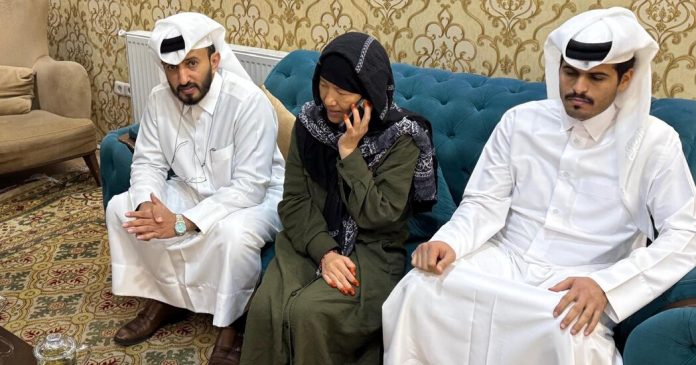
Faye Hall, the released American citizen, was pictured sitting on a couch between two men and smiling in a social media post on X by Zalmay Khalilzad, the former ambassador. Mr. Khalizad said that Ms. Hall “is now in the care of our friends, the Qataris in Kabul, and will soon be on her way home.”

He also shared what he said was a video of Ms. Hall professing support for President Trump and thanking the president for her release.

President Trump reposted the video on Saturday on his social media site, Truth Social, adding that he was “so honored” by her words.

Ms. Hall was arrested in early February, British media reported, along with a British couple and an interpreter. The couple, Peter and Barbie Reynolds, who were both in their seventies, had run educational and training projects in the country for eighteen years, according to British media. Ms. Hall was said to be a friend of the couple.

The British couple has not been released, according to British media. A daughter of the Reynolds said that Afghan guards had to use force to separate Ms. Hall from Ms. Reynolds when they removed Ms. Hall from detention because the two women had vowed that all four in their group would be released together.

The White House and the State Department did not immediately respond to a request for comment.

Earlier this month, a U.S. hostage envoy, Adam Boehler, made the first known visit by a high-ranking American diplomat to Kabul, the Afghan capital, since the Taliban seized power in 2021. His talks with Taliban representatives led to the release of George Glezmann, an American citizen who had been detained in Afghanistan for more than two years.

Days later, the United States lifted multimillion-dollar bounties on three leaders of the Haqqani network, the only wing of the Taliban to be classified by the United States as a foreign terrorist organization. Members of the Haqqani network were behind some of the deadliest attacks during the U.S.-led war in Afghanistan, but they have refashioned themselves as a more moderate voice within the Taliban.

Many Taliban officials saw Mr. Boehler’s visit and the bounty lifting as a significant victory for Afghanistan’s government, which was almost totally shut out by the Biden administration. The new measures also benefit a Taliban faction that has pushed to curtail extreme and inflexible policies to achieve more global acceptance.

In the video posted by Mr. Trump, Ms. Hall also said other women detained in the Afghanistan jail saw Mr. Trump as a “savior,” adding in her address to him, “they’re waiting for you to come and set them free.”

Mr. Trump’s post did not include any details about the release, but he thanked Ms. Hall and said he was “so honored” by her statement.

Erica L. Green and Christina Goldbaum contributed reporting.

This week in politics: Signal saga, Trump executive orders and more

0

We catch up on what’s happened this week with the Signal chat group controversy, immigration enforcement actions, and new executive orders.

No Second Lady, No Problem: Greenland’s Dog Sled Race Goes Barking On

0

At the foot of glistening Mount Nasaasaaq — “the king of the mountains” — in Sisimiut, Greenland, hundreds of spectators bundled in bright jackets, insulated pants and heavy boots lined a snow-packed trail on Saturday waiting for the racers to glide past.

The low sun glinted off the ice. The snow squeaked underfoot, fine and dry like sifted flour. Red and white Greenlandic flags popped up everywhere — from poles, tucked into hoods, flapping in mittened hands.

For more than three decades, Greenland has held a national dog sledding championship — the Avannaata Qimussersua, which means, in Greenlandic language, “The Great Race of the North.” This year the event brought together more than 25 mushers — including a pretty tough 14-year-old boy — and at least 400 dogs. It’s a tradition deeply rooted in the country’s culture, where dogs are not just animals, but partners in survival. And usually, the race doesn’t attract much international attention.

But this year it was swept into a major geopolitical storm when the White House announced that Usha Vance, the wife of Vice President JD Vance, and one of their sons would attend. With Greenlanders gearing up to protest, Ms. Vance ended up canceling her trip.

Ms. Vance had tried to frame her visit as a gesture of cultural appreciation. The Greenlanders didn’t buy it. President Trump has been fixated on taking over Greenland — a semiautonomous territory of Denmark — and has steadily ratcheted up his talk to “get it, one way or the other,” as he has said.

Many Greenlanders (and Danes) saw the visit as a threat. The race organizers quickly issued a pointed statement saying the Vances had not been invited. A spokeswoman for Ms. Vance denied this, saying the second lady had received “multiple invitations.”

Ms. Vance, along with her husband and some other officials, did come to Greenland, but ending up spending less than three hours on Friday at the Pituffik Space Base, a remote American missile defense station on Greenland’s northern coast, miles from any town.

The race, though, went on, just as planned. For the competitors, it was the culmination of years of daily care, discipline and deep mutual understanding between human and dog.

On Saturday afternoon, a voice crackled over the loudspeaker with updates on the competitors’ progress as they cut across the grueling 26-mile course. Children bounced to stay warm. In the distance, sharp barks echoed across the mountain.

“We’re not trying to impress anyone,” said Inuna Davidsen, a spectator who was alertly waiting for the sleds to appear. “We just want to stay close to nature and to each other.”

Like many others here, she saw the event not only as a competition but as a gathering — a space where people from distant settlements meet, celebrate and reconnect in the snow. Sisimiut, which hosted the race this year, is the second largest town in Greenland, with a population of around 5,000.

Mikaela Eliassen, an entrepreneur from Sisimiut, was standing by the finish line with her children. She said she was a little disappointed that the Vances didn’t come.

“We never get visitors,” she said. “So when we finally heard someone important was coming here, I was excited.”

Greenlanders have been working with sled dogs for hundreds of years. They used them to travel to faraway villages and to hunt seals and reindeer.

In 1968 when a U.S. nuclear-armed bomber crashed through the ice near what is now the Pituffik base, sled dog teams were called in to help with the cleanup. The dogs’ ability to move across the fragile ice made them essential to the efforts.

Today, dogs are still important, assisting Greenlanders in ice fishing, hauling supplies, taking tourists for a ride and even delivering mail.

Only one breed is permitted in the Arctic region of Greenland: the purebred Greenlandic sled dog. This breed has evolved over centuries to work in the cold, and, the thinking goes, any mixing could hurt its hardiness.

A former musher herself, Ms. Eliassen started driving sleds at age 6.

“Dog sledding is not just a sport,” she said. “It teaches responsibility, patience and respect.”

“They say the musher whose dogs respect him most is the one who wins,” she added.

As the first sled crested the final ridge and came into view, the crowd erupted. Henrik Jensen, a 26-year-old musher from Ilulissat in northern Greenland, broke the finish line — his face wind-burned, his dogs frosted with ice and foam but still pulling strong.

His supporters surged forward. Some were dressed in matching black jackets with “Team Henrik” emblazoned across their backs.

As he sat on his sled, grinning and stunned, a group of fans lifted the wooden sled high into the air — dogs still barking and twisting in their harnesses, energized by the roar of the crowd.

“I’ve been preparing for this for years,” he said, his father smiling proudly with a hand on his shoulder.

And if any Americans were tuning in, he said, that’s a good thing.

“It’s great that you’re following along,” he said. “There should be room for everyone here.”

Volunteer Rescuers in Mandalay Sift Through Earthquake Rubble

0

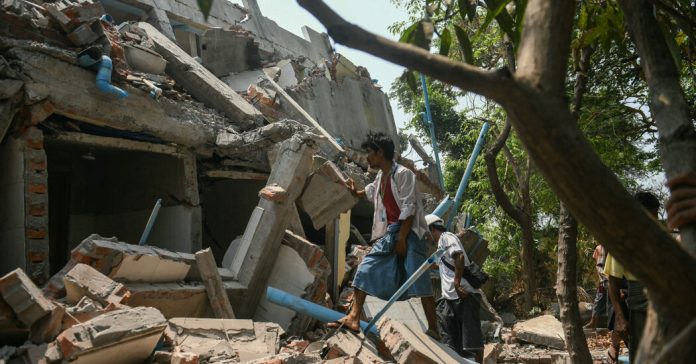
In Mandalay, near the epicenter of the quake that rocked the region, volunteer rescue workers raced against time as they combed through the ruins of apartments, monasteries and mosques to find survivors. Others struggled to come to terms with all they had lost.

Downed power lines, destroyed roads and a lack of equipment made rescue work even harder in a city already enduring a repressive military government and a civil war that is now in its fourth year.

“There are at least a hundred people still trapped inside,” said Thaw Zin, a volunteer who was sitting in front of a destroyed condominium. “We are trying our best with what we have.”

The earthquake, which struck at about 12:50 p.m. Friday local time, was only the third of such magnitude to hit the region in the past century. The extent of the catastrophe remains enormous: the Myanmar military junta declared a state of emergency in six regions. These include rebel-controlled areas where there is little internet and millions of displaced people.

Su Wai Lin managed to escape with her husband and mother-in-law when the earthquake struck, but her husband ran back into their apartment building in Mandalay to save their 90-year-old neighbor.

Then the building collapsed, killing her husband and the neighbor.

“I can’t put into words the pain I feel,” said Ms. Su Wai Lin, who is six months pregnant, weeping as she spoke at a hospital. “My child will be born without a father. We may have survived physically, but our hearts and emotions are shattered.”

On Saturday, the streets were jammed with ambulances that were heading to Pyin Oo Lwin, a town about a two-hour drive from Mandalay. The overcrowded hospitals in Mandalay were unable to accept more patients.

Tay Zar Lin was picking mangoes when the ground started shaking. He fell from the tree he was in, breaking his leg. At a hospital in Mandalay on Friday, no doctors were available, so he waited all night, in pain, and finally saw a doctor Saturday morning.

Mr. Tay Zar Lin, who got married last month, said he had just learned that his wife was still trapped inside a collapsed building that houses the tailor shop where she works.

“I don’t know if she’s alive or not,” said Mr. Tay Zar Lin, whose leg is in a cast. “I pray that yesterday morning wasn’t the last time I saw her.”

He said that if Daw Aung San Suu Kyi, Myanmar’s ousted and imprisoned civilian leader, were in charge now, “many trapped people would have been rescued, and unnecessary deaths could have been prevented.”

There was growing anger against the military, which seized power in a coup in February 2021. Mr. Thaw Zin, the volunteer rescuer, said soldiers and police officers had turned up but did nothing to help.

“They are here hanging around with their guns,” he said. “We don’t need guns, we need helping hands and kind hearts.”

By Saturday morning, dozens of ordinary people from other cities in Myanmar had packed their cars and vans with supplies and headed into Mandalay, hoping to pitch in. Doctors from the nationwide Civil Disobedience Movement — the resistance movement against the junta — traveled from the rebel-held areas of Kayin, Tanintharyi and Lashioto to help, many of them returning to their hometown. Several international aid groups said they were rushing to the disaster sites.

“None of us are trained for earthquake rescues,” said Ko Thein Win, a volunteer rescue worker who had rushed to the site of a destroyed condominium. “Yesterday, we found some survivors, but today, the chances are much lower.”

He said they urgently needed skilled rescue workers and heavy machinery such as excavators.

Eaint Thadar Phyu, 18, an English teacher in Mandalay, said she was on the second floor of the hostel where she was staying when the earthquake struck. She was hurrying to pack up some basic items such as her identification card when an aftershock hit.

“I thought I was going to die,” she said.

Ms. Eaint Thadar Phyu said she couldn’t sleep Friday night because of a series of aftershocks. “I was scared they would turn into a huge one again.”

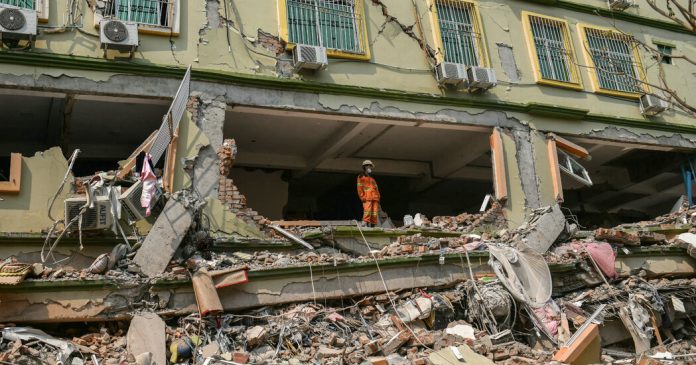
The scope of the death toll was still unclear, but the scale of the disaster was stark: heaps of collapsed rubble, from monasteries to condominiums, dotted the landscape.

Mandalay, with a population of about 1.5 million, is Myanmar’s second-largest city. A former royal capital, it is known as a center for Burmese culture and Buddhism, home to numerous temples, monasteries and pagodas.

On Saturday morning, shaken residents gathered at hospitals and relief centers, and contemplated all that they had lost. Red tents were set up for rescue workers to rest in 100-degree heat. Residents talked about how their home had become a ruined city. Many were still walking around in tears.

Long lines formed at gas stations as people stocked up on fuel, preparing for days without power.

Verena Hölzl contributed reporting.

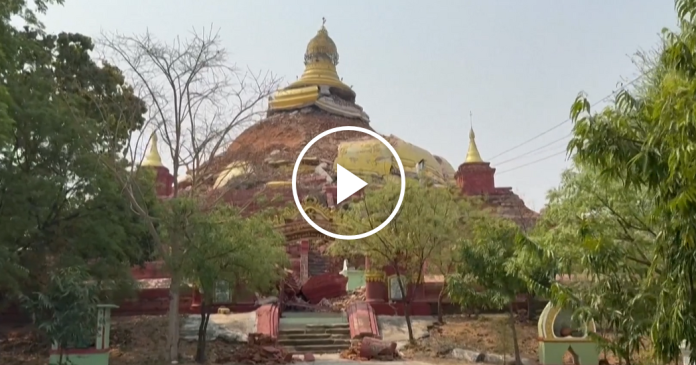
Earthquake Damages Myanmar’s Religious and Heritage Sites

0

The deadly quake in Myanmar damaged over 3,000 buildings, including about 150 mosques and pagodas, in the government’s latest count on Saturday morning.

Myanmar Earthquake Toll Surpasses 1,600 Dead Amid Search for Survivors

0

The official death toll of the earthquake that shattered central Myanmar surpassed 1,600 people, the country’s military leaders said on Saturday, as desperate rescue workers raced to find survivors and began grappling with a monumental disaster in a nation already racked by civil war.

The powerful earthquake struck on Friday near Mandalay, the country’s second-largest city, and volunteer emergency workers there combed through the ruins of apartments, monasteries and mosques in search of anyone left alive. The quake toppled power lines and caused roads to buckle. Workers lacked equipment like excavators and toiled as the repressive military authorities kept a watchful eye.

“There are at least a hundred people still trapped inside,” said Thaw Zin, a volunteer who was sitting in front of a destroyed condominium. “We are trying our best with what we have.”

The death toll is expected to rise steeply, although Myanmar’s military junta, which overthrew an elected government in 2021, has sought to restrict what information leaves the country. Modeling by the United States Geological Survey suggested the number of deaths will likely surpass 10,000.

The earthquake has raised questions about whether Myanmar’s military rulers can manage to stay in power, having already lost ground to rebels amid a bloody civil war that has left nearly 20 million of the country’s roughly 54 million people without enough food or shelter even before the quake, according to U.N. officials.

Even after the disaster struck, Myanmar military jets dropped bombs on Friday evening on a rebel-held village, Naung Lin, in northern Shan State. “I just can’t believe they did airstrikes at the same time as the earthquake,” said Lway Yal Oo, a Naung Lin resident.

Anger against the military was rising in the wake of the disaster on Saturday. Mr. Thaw Zin, the volunteer in Mandalay, said that soldiers and police officers had turned up at disaster sites but did nothing to help. “They are here hanging around with their guns,” he said. “We don’t need guns, we need helping hands and kind hearts.”

But the junta has also acknowledged the enormous extent of the catastrophe, which caused the collapse of a building 600 miles away in Bangkok and sent shock waves around Southeast Asia. The military government declared a state of emergency in six regions of Myanmar, including rebel-controlled areas where millions of displaced people live with scarce internet.

The army’s leader, Senior Gen. Min Aung Hlaing, surveyed disaster sites on Friday and visited a makeshift hospital in Naypyitaw, about 170 miles south of Mandalay, state media showed.

The junta, although isolated and under sanctions from much of the world, also made an extraordinary appeal for help — a call that some began to answer despite the dizzying logistical obstacles in getting that aid to survivors.

Aid workers will have to traverse collapsed roads and devastated regions, in a country divided by full-blown civil war and competing warlords, arms dealers, human traffickers and drug syndicates. There are risks that the military could interfere in the delivery of aid, experts said, and even transferring funds into Myanmar are complicated by the rules involving sanctions and the movement of money.

India, which shares a long border with Myanmar, sent 15 tons of aid and more than 100 medical specialists, its foreign minister said, and Prime Minister Narendra Modi said he had spoken to the junta’s chief, offering help to “a close friend and neighbor.”

China, which also borders Myanmar and which has supplied the junta weapons even as evidence grew of its military atrocities, flew dozens of search and rescue workers into the country on Saturday. Beijing also planned to send nearly $14 million in aid, including tents, first aid kits and drinking water, according to Chinese state media.

South Korea promised $2 million in aid, shipped through international humanitarian agencies, and Malaysia’s government said it would send two teams of 50 people to support relief work.

But it remained far from clear what kind of response some of the world’s wealthiest nations would provide, or how. Although President Trump said the United States would “be helping,” his administration has moved to all but eliminate the main U.S. agency for distributing aid, and the United States, Britain and other countries have imposed heavy sanctions on the junta.

Even for countries friendlier to Myanmar’s military rulers, there are major hurdles. The early deliveries of help sent by India and China went to Myanmar’s biggest city, Yangon. They would have to drive hundreds of miles north to reach Mandalay and other areas most affected by the earthquake.

In the disaster area, where roads are damaged and destroyed and power is largely gone, people tried to stock up on fuel and food. Dozens of people from other cities in Myanmar also packed their cars and vans with supplies and headed into Mandalay, hoping to pitch in.

Ambulances jammed Mandalay’s streets on Saturday, heading to a hospital two hours away that had more room. Among the mounds of brick, cement and metal where buildings had stood two days earlier, some people began to lose hope.

“Yesterday we found some survivors, but today the chances are much lower,” said Ko Thien Win, who had rushed to the site of a destroyed apartment building in Mandalay.

At hospitals, many others were left in a kind of purgatory, dealing with their own injuries and fearing for the fate of their loved ones. Tay Zar Lin had been picking mangoes when the ground started shaking on Friday and he fell, breaking his leg. He reached a hospital, where he could not see a doctor until Saturday morning.

He then discovered that his wife was still trapped inside the tailor shop where she worked, he said. “I pray that yesterday morning wasn’t the last time I saw her,” he said.

The uncertainty extended far outside Myanmar, into the diaspora of people who have migrated out of the country in past decades. Richard Nee, one of tens of thousands now living in Taiwan, said he and other former residents of Mandalay were waiting for word from friends and family. He knew the wife of one friend had died, apparently in a building collapse, but that sporadic communication had made it hard to learn more.

An engineer, he said many buildings in Myanmar, which lies on one of the world’s most active seismic zones, had been built to endure earthquakes. “Many buildings were strong enough for maybe a magnitude 6 earthquake,” he said. “But anything above magnitude 6, like this time, was too much.”

And many survivors of the earthquake already know their loved ones’ fates.

When the earthquake struck and her apartment in Mandalay began to heave, Su Wai Lin, who is six months pregnant, managed to escape the building with her husband and mother-in-law. But she said her husband ran back inside to save their 90-year-old neighbor. Then the building collapsed, killing them.

“I can’t put into words the pain I feel,” she said, weeping as she spoke at a hospital. “My child will be born without a father.”

David Pierson contributed reporting from Hong Kong, Mujib Mashal from New Delhi, Choe Sang-Hun and Shawn Paik from Seoul, Chris Buckley from Taiwan, Jenny Gross from London and Hannah Beech from Boston.

Search for Survivors at Collapsed Bangkok Building

0

Aubonrat Setnawet, an electrician’s helper, was working with her husband on the 23rd floor of a new office tower on the northern edge of Bangkok moments before disaster struck.

She needed to get some equipment, so she took the construction elevator to the ground floor. Suddenly, she felt the ground sway beneath her and, with two sharp cracking sounds, the unfinished building began to collapse.

With her cellphone in hand, she ran to escape the falling debris as a huge dust cloud rose. She tried calling her husband, Nuguy Setnawet, an electrician, but her calls did not go through.

Since then, she has remained at the site, watching quietly as rescuers search for survivors. The news has been grim. Eight bodies were recovered from the scene on Friday but only one on Saturday.

“I am still here waiting, waiting for a miracle,” Ms. Aubonrat said.

About 80 people believed to have been in the 30-story building at the time of the collapse remain unaccounted for.

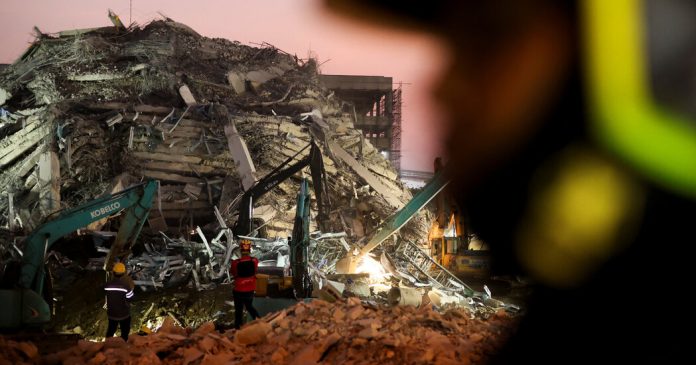
Rescuers using heavy equipment and canine search teams spotted only the one body during the search on Saturday. The pile of rubble — seven stories high — is so unstable that it took them hours to recover the body.

That brought to 10 the number of known fatalities in Bangkok from the quake, including a crane operator who fell to his death from a different building under construction.

The epicenter of the quake was more than 600 miles to the north near Mandalay, Myanmar’s second largest city, where the devastation was far worse. More than 1,600 were reported dead and the number is expected to rise considerably.

At the site of the collapsed Bangkok building, the search continued into the evening under bright lights. Heavy equipment operators moved large chunks of metal from the rubble in the hope of finding survivors.

Hundreds of rescuers from the military, the police and volunteer groups helped with the search. Dozens of relatives and friends of the missing workers watched from behind a barrier.

In addition to search dogs, rescue teams used heat sensors to try to detect people who were still alive.

Periodically, all work stopped so the searchers could listen for the sounds of survivors. But by Saturday evening, they had not heard any cries of help from within the mountain of debris.

Piyalux Thinkaew, a rescuer from the Ruamkatanyu Foundation, said heavy equipment that arrived Saturday was being used to clear away large pieces of metal and concrete while workers tried carefully not to destabilize the mountain of debris.

“This is to open a path for us to be able to see underneath and check for any signs of life,” he said. “It’s a very difficult task and it’s risky work for the rescuers as well.”

Suchatvee Suwansawat, a professor of civil engineering at King Mongkut University and a former president of the Council of Engineers Thailand, said experts must determine whether the collapse was caused by a design flaw or a construction error.

An unfinished building should be in no more danger of collapsing during an earthquake than a completed structure, he said.

“It has to be 100 percent safe,” he said. “There was something wrong. This is like the building exploded. It’s not normal.”

He said Thailand had never experienced the collapse of a building this size. Previously, he said, two six-story buildings collapsed, one in 2014 and one in 1993.

“We really have no experience with this,” he said. “We cannot say much yet because we have to look at the calculations and collect samples and evidence. Everything collapsed at the same time. And from the video, we saw the columns burst.”

The building was to be an officer tower for Bangkok’s auditor-general.

A Chinese state-owned company, the China Railway 10th Engineering Group, was part of a consortium awarded the contract to build the high-rise, according to an article in the People’s Daily, the Chinese Communist Party’s mouthpiece, that was published in 2021. The consortium also included a Bangkok-based builder, Italian-Thai Development Plc.

Neither company could be immediately reached for comment.

The project, which broke ground in April 2021, was one of the tallest buildings China Railway 10th Engineering Group had constructed, the People’s Daily said at the time.

The company is a subsidiary of a state-owned giant, China Railway Group, which is heavily involved in China’s Belt and Road Initiative, a global infrastructure project intended to deepen China’s supply chain networks and expand the country’s influence.

Among those waiting at the site for word of their missing relatives was Saifon Thongsuk, 36, whose aunt and uncle and two adult children were all working on the office tower.

They had been working at a different construction project on Bangkok’s outskirts but had recently been sent to the site because of an urgent need for workers, she said.

“I don’t know how long they had been working here,” she said. “I only know they were working on the top floor.”

Naruemol Thonglek, 44, came to the site seeking word of six people including her husband, his son and four co-workers.

Ms. Naruemol had been working at the site, too, until recently, but quit because her husband worried that it was leaving her too exhausted.

“I rushed here as soon as I heard about the earthquake,” she said. “I tried to get hold of him. Messages were not delivered. Calls were not connected. I cannot contact any of them.”

She continued, “I guess he is in the middle of that pile of rubble. Maybe there’s some space for air, I don’t know. I can only hope for miracles.”

Thurian Pheungrod, 47, also hurried to the site on Friday after learning that his brother and sister-in-law were buried in the collapsed building. They had been working at the site for several months.

“At first, I still believed there could be a miracle,” he said. “I still had hope. But I don’t hope for miracles anymore.”

Berry Wang and David Pierson contributed reporting from Hong Kong.

Found: British Military Documents, Scattered on the Street

0

As he was rushing to attend a soccer match in Newcastle, England, Michael Gibbard stepped on a pile of sensitive military documents.

At first, he thought the papers scattered along a street near the stadium were trash, dumped there from a nearby office building. But when he bent down and examined them closely, he was stunned by what he saw.

Names and ranks of soldiers. Detailed base patrols. Drug test results. Codes to weapon armories.

“I thought, bloody hell, this shouldn’t be here,” said Mr. Gibbard, a 41-year-old owner of a delivery service.

Mr. Gibbard’s accidental discovery this month of what appeared to be hundreds of military documents on an industrial street in Northern England has shocked a country known for zealously protecting state secrets. It also comes as the United States, Britain’s close military ally, has been facing its own crisis over the handling of sensitive national security information, after battle plans in Yemen were discussed in a group chat that included a journalist.

But while the United States’ security breach came about because of a technological blunder on the encrypted app Signal, the apparent error in the United Kingdom was much more analog.

“I thought a lot of this would be online, and there would be military software you’d need to access it,” Mr. Gibbard said. “But here it was, printed off for all the world to see. It was very old-school.”

As he picked documents off the street and out of the gutter, he became aware of just how much material, from threat assessments to mundane requests for leave, he had stumbled upon. “It was like a library of information,” he said.

A Ministry of Defense spokesperson said that the incident was being investigated and that “no sensitive operational defense information is contained within the documents.”

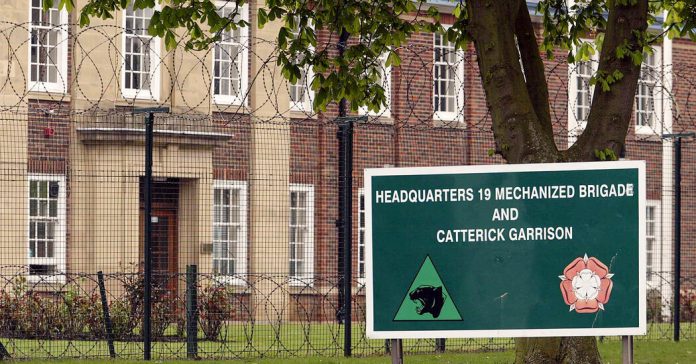
The papers appeared to originate from a black trash bag slumped against a nearby brick wall. As Mr. Gibbard dug through the bag, he noticed a name repeated on the top of some documents: Catterick Garrison.

Mr. Gibbard, who said he had no interest in the military, didn’t know what that was, so he typed the term into Google.

The garrison, he discovered, is a major military base in North Yorkshire, about 50 miles south of Newcastle. It’s the largest garrison in the British Army, and home to more than 13,000 people.

“I was like, How on earth has this bag traveled like 50 minutes away?” Mr. Gibbard said.

More surprising, he added, was that the documents had been printed at all.

“You put your safety in the hands of the military and the government to make sure that this information is kept away from us, so it doesn’t potentially get in the wrong hands,” he said. “And they’re still printing loads and loads of paperwork out, explaining everything.”

After spending a few minutes reading through lists of weapons and phone numbers of high-ranking officers, Mr. Gibbard began to feel uneasy about the position he had found himself in.

He decided to take a photograph — but only one, he said, because he didn’t know if it was legal to have images of the documents. “I can’t imagine the army would let me into the base and start taking photos of all their paperwork, would they?” he said. “So this felt no different.”

After he snapped an image, he called the police.

When no one arrived after about 15 minutes — and with the kickoff to the soccer match moments away — he collected what he judged to be the most sensitive documents and took them to the police at the soccer arena. They found his tale highly suspicious.

“Their reaction was like, ‘Riiiiiight,’” he said. “I said, ‘Wait a minute, I’ve done nothing wrong here, I’m just passing on the information.’”

A Northumbria Police spokesperson confirmed that the department had received a report on March 16 that potentially confidential documents had been found near the center of Newcastle, and said that they had been given to the Ministry of Defense.

When Mr. Gibbard left the soccer match about four hours later, he said, many of the papers were gone, but some remained scattered in the area.

“The timing is quite ironic,” Mr. Gibbard said, pointing to the leaked Signal conversation in the United States.

“I mean, you’ve got these two powerhouses, the U.K. and America,” who, he said, love to “brag about how great they are at everything.”

If that’s true, he added, then “we’re a country that should know how to handle our military paperwork better — same with America.”

Susan C. Beachy contributed research.

Photos: Partial Solar Eclipse Captivates Much of the Northern Hemisphere

0

As the sun rose in the Northern Hemisphere on Saturday, the moon cut across Earth’s orbit and took a bite out of the sun.

The partial solar eclipse, which occurs when the moon moves between the Earth and the sun, casting a shadow on our planet, was the first of the year and was visible in parts of the United States, Canada, the Caribbean, Europe, Russia and Africa.

Unlike a total solar eclipse, when the entire sun is covered, a partial solar eclipse creates a crescent sun.

The event had already begun when dawn broke in the Northeastern United States, which had the best view in the country. People in northern and western Europe, as well as on the northwestern coast of Africa, were treated to the celestial show during the late morning and early afternoon.

If you missed it, the next partial solar eclipse will be in September, and the best view will be in Australia.

Jonathan Wolfe contributed reporting.