Tuesday, November 10, 2026
Home Blog Page 8

5 things to know after Trump’s trip to the Middle East : NPR

0

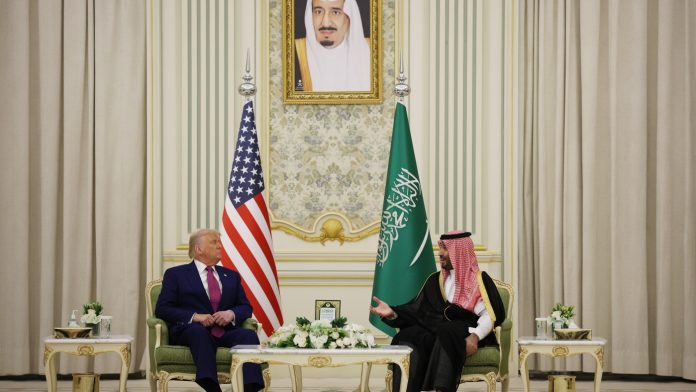
President Trump and Saudi Crown Prince Mohammed bin Salman attend a bilateral meeting at the Saudi Royal Court on May 13 in Riyadh, Saudi Arabia.

Win McNamee/Getty Images


hide caption

toggle caption

Win McNamee/Getty Images

President Trump was greeted like royalty during his four-day trip to the Middle East.

There were opulent palaces, fighter jet escorts, a parade of camels and much more.

It was exactly the kind of pomp that makes Trump, with his love of a gold-plated lifestyle, envious.

His focus, he said, was on securing money and deals for the United States. The Gulf states obliged, trying to curry favor with the president through investments, arms deals and buying Boeing planes while giving a very lavish one away.

Here are five takeaways from Trump’s trip:

1. A trip that played to Trump’s ego

Trump is someone who values fealty, power and glitz. He has gotten the fealty from staff and Cabinet appointees in this second term. He has ogled at the power of autocrats, like Viktor Orban of Hungary and Russia’s Vladimir Putin. He spends lots of time at his glitzy Palm Beach, Fla. home, Mar-a-lago, and redecorated the Oval Office with lots of gold.

“You see the new and improved Oval Office,” Trump boasted earlier this month during a meeting with Canada’s new prime minister, Mark Carney. “As it becomes more and more beautiful with love, you know, we handle it with great love and 24-karat gold — that always helps, too.”

He got much the same during this trip to the Middle East — genuflecting, leaders who rule with iron fists and marbled, golden glamour.

2. A trip focused on deals, but overshadowed by a plane

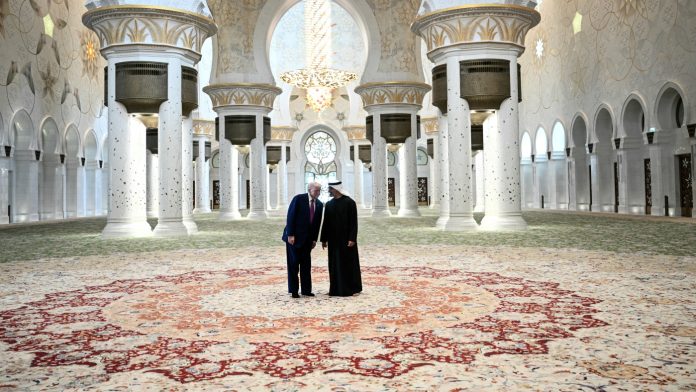
President Trump tours the Sheikh Zayed Grand Mosque, including the mausoleum of the late founder Sheikh Zayed bin Sultan al Nahyan, with UAE President Sheikh Mohamed bin Zayed Al Nahyan and Dr. Yousef Al-Obaidi, Director-General of the Sheikh Zayed Grand Mosque Center (SZGMC) and Ameena Alhammadi, Acting Director of Culture and Knowledge Department of Sheikh Zayed Grand Mosque Centre on May 15 in Abu Dhabi, United Arab Emirates. Trump is on the third day of his visit to the Gulf to underscore the strategic partnership between the United States and regional allies including the UAE, focusing on security and economic collaboration.

President Trump tours the Sheikh Zayed Grand Mosque, including the mausoleum of the late founder Sheikh Zayed bin Sultan al Nahyan, with UAE President Sheikh Mohamed bin Zayed Al Nahyan and Dr. Yousef Al-Obaidi, Director-General of the Sheikh Zayed Grand Mosque Center (SZGMC) and Ameena Alhammadi, Acting Director of Culture and Knowledge Department of Sheikh Zayed Grand Mosque Centre on May 15 in Abu Dhabi, United Arab Emirates. Trump is on the third day of his visit to the Gulf to underscore the strategic partnership between the United States and regional allies including the UAE, focusing on security and economic collaboration.

Win McNamee/Getty Images


hide caption

toggle caption

Win McNamee/Getty Images

There were lots of financial agreements struck between the United States, Qatar, Saudi Arabia and the United Arab Emirates, including: Qatar’s state-backed airline buying Boeing jets, Qatar taking billions in U.S. arms, UAE building an artificial intelligence campus, Saudi Arabia investing in medical and military research, as well as other deals on oil.

But Qatar’s gift to Trump of a 747 to replace Air Force One has been the thing that has gotten the most attention and drawn criticism — for different reasons — left, right and MAGA.

Described as a “flying palace” worth some $400 million, Trump is enamored with the jet. He called it a great “gesture,” noted, “I would never be one to turn down that kind of an offer” and said: “I could be a stupid person, saying, ‘No, we don’t want a free, very expensive airplane.'”

Trump called it a gift to the Defense Department, but it’s not a plane that would be sticking around after Trump leaves office. He said it would be decommissioned and sent to his presidential library.

There are already newly designed Air Force One jets that Boeing is building, but Trump has been frustrated with delays.

“I’ve been doing this for four days,” Trump said on his last day of the trip. “I leave now and get onto a 42-year-old Boeing. But new ones are coming, new ones are coming.”

3. Even many Republicans think accepting the plane would be a bad idea

Accepting the plane would seem to violate the Emoluments Clause of the Constitution that bars such gifts from foreign leaders and could also only get a couple years of use.

It would also need to be refurbished to check for listening devices, as well as broken down and put back together to meet the security requirements of a presidential aircraft. That could take years and has a significant additional cost.

Trump may just ignore all that and fly it anyway — above strenuous objections even from within his own party.

“There are lots of issues around that that will attract serious questions,” Senate Republican leader John Thune of South Dakota told reporters of the plane.

Sen. Mike Rounds, R-S.D. used an ancient metaphor on CNN, warning against the gift. “It seems to me the Greeks had something like that a long, long time ago,” he said, “and somebody happened to bring a golden horse inside of a community.”

The ever-colorful Republican Sen. John Kennedy of Louisiana delivered this on Fox News: “I trust Qatar like I trust a rest stop bathroom. … With those guys, trust in God, but tie up your camel.”

Trump is coming back from his trip facing lots of pushback for many reasons about the gift, including for wanting to accept a $400 million plane while urging doll-and-pencil austerity on other Americans.

4. Trump got what he wanted — without any public conversations about democracy or human rights

President Trump meets with business leaders at the Ritz Carlton Hotel on May 15 in Doha, Qatar on the third day of his visit to the Gulf to underscore the strategic partnership between the United States and Qatar, focusing on regional security and economic collaboration.

President Trump meets with business leaders at the Ritz Carlton Hotel on May 15 in Doha, Qatar on the third day of his visit to the Gulf to underscore the strategic partnership between the United States and Qatar, focusing on regional security and economic collaboration.

Win McNamee/Getty Images


hide caption

toggle caption

Win McNamee/Getty Images

Normally, American presidents who visit the Middle East talk of forging new relationships, but also are closely watched for how they talk about encouraging democracy. Trump, though, talked about a Middle East he sees as evolving beyond “tired divisions” and “defined by commerce not chaos,” “technology not terrorism.”

“The gleaming marvels of Riyadh and Abu Dhabi were not created by the so-called nation-builders, neocons or liberal nonprofits like those who spent trillions and trillions of dollars failing to develop Kabul, Baghdad, so many other cities,” Trump contended in remarks from Riyadh, Saudi Arabia.

“Instead, the birth of a modern Middle East has been brought by the people of the region themselves. The people that are right here, the people that have lived here all their lives, developing your own sovereign countries, pursuing your own unique visions and charting your own destinies in your own way,” Trump continued. It’s really incredible what you’ve done.”

Trump’s reductive and sanitized version of the region ignores, for example, the “sportswashing” of countries like Qatar, which won the right to host the 2022 FIFA soccer World Cup, through bribes, according to the U.S. government. It also built stadiums with international workers that saw dangerous working conditions and deaths.

It ignores the UAE trying to show itself as progressive on the world stage, while suppressing dissent and imprisoning dissidents, as well as its treatment of migrant workers and more.

It ignores that a Washington Post columnist disappeared from a Saudi embassy in Turkey. It was later discovered he had been killed in a gruesome attack that U.S. intelligence says was ordered by the country’s de facto leader Mohammed bin Salman.

That’s to say nothing of women’s rights, the lack of free elections and concentrations of wealth passed down through a select few royal families.

For Trump, it seems that none of that matters. It’s transactions over principle, a pivot away from American moral leadership.

Taking a shot at former presidents, Trump said, “In recent years, far too many American presidents have been afflicted with the notion that it’s our job to look into the souls of foreign leaders and use US policy to dispense justice for their sins.”

5. The trip’s focus was deals — with a little learned about his stances on Syria, Iran, Gaza and Ukraine

Trump was on this trip to get signatures on the dotted line at the bottom of the page. But it was impossible to totally escape some of the major international flashpoints.

He made news by lifting sanctions against Syria that have been in place for decades. He gripped and grinned with the country’s new leader, Ahmed al-Sharaa, someone who until recently had a $10 million bounty on his head for his arrest by the United States for his past association with Al Qaeda.

Though Trump was critical of past American presidents, who have gauged foreign leaders by looking into their “soul” — a reference to George W. Bush and Vladimir Putin — Trump heaped praise on Syria’s new leader.

He judged him to be “attractive” and “tough” with a “very strong past. Fighter.”

“He’s got a real shot at holding it together,” Trump surmised. “He’s a real leader. He led a charge, and he’s pretty amazing.”

On Iran, Trump continued to be eager to forge a nuclear deal, saying the U.S. was “in very serious negotiations with Iran for long-term peace.” He added, “It’ll be taken care of 100%, it’ll be done nicely or not nicely and the not nicely is not a good thing for them. We’re talking to them and I think they’ve come a long way.”

Publicly, there was no serious in-depth discussion of Gaza, and Trump again floated the idea of the U.S. taking over the strip and making it a “freedom zone.” But it also seemed that Gulf leaders may have said something behind closed doors, because Trump noted, “We have to help also out the Palestinians. You know, a lot of people are starving in Gaza, so we have to look at both sides.”

Trump also talked about the Ukraine-Russia talks taking place in Turkey. Ukrainian President Volodymyr Zelenskyy was in Turkey, Trump wanted to attend, but Putin was a no-show. Not only that, but Russia sent a low-level diplomatic delegation.

Russia watchers see what Putin is doing as another delay tactic, as he continues to try and advance in Ukraine.

At some point, Trump has to make the choice — whether he will continue this dance with Putin or if he loses patience.

The fact is Trump made a lot of big promises about ending the wars in Gaza and Ukraine, but has so far not been able to deliver. He’s running into some big personalities with Putin and Israeli Prime Minister Benjamin Netanyahu, who, so far, are not bending to Trump’s will.
NRLB watchdog probes DOGE’s data access after NPR reporting : NPR

0

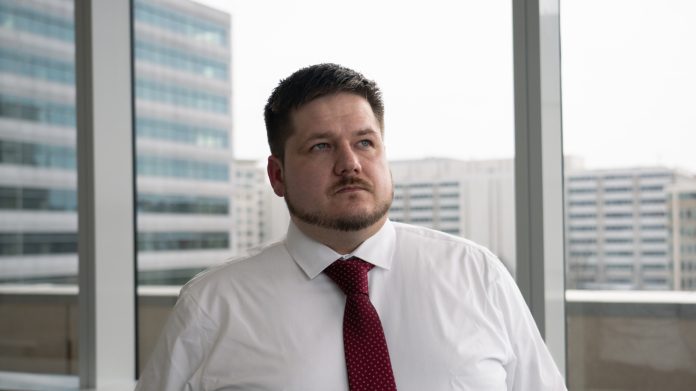
Daniel Berulis filed a whistleblower disclosure with Congress claiming that DOGE staffers compromised the NLRB’s computer networks and may have taken sensitive data in the process.

Grace Raver/NPR


hide caption

toggle caption

Grace Raver/NPR

The inspector general for the National Labor Relations Board is investigating the ad hoc Department of Government Efficiency’s interaction with the NLRB following NPR’s exclusive reporting about sensitive data leaving the agency.

The investigation was first reported by FedScoop, which filed records requests for information related to allegations made by IT staffer Daniel Berulis in an official whistleblower disclosure last month.

FedScoop reported Thursday that the outlet’s requests were denied “based on an exemption that allows agencies to withhold records that are ‘included in an open investigatory file where disclosure could reasonably be expected to interfere with law enforcement proceedings.'”

The OIG’s inquiry comes after the top Democrat on the House Oversight Committee wrote to the acting Inspector General at the Department of Labor Luiz Santos and Ruth Blevins, inspector general at the NLRB, expressing concern that DOGE “may be engaged in technological malfeasance and illegal activity.”

A spokesperson for the House Oversight Committee Democrats confirmed in a statement to NPR that an NLRB OIG investigation was launched “related to the Committee’s concerns about whistleblower allegations.”

More than 50 House Democrats in the Congressional Labor Caucus also signed a letter asking the NLRB for more information about DOGE’s activities at the independent agency that is in charge of investigating and adjudicating complaints about unfair labor practices and protecting U.S. workers’ rights to form unions.

“These revelations from the whistleblower report are highly concerning for a number of reasons,” the lawmakers wrote in the letter to acting NLRB general counsel William Cowen. “If true, these revelations describe a reckless approach to the handling of sensitive personal information of workers, which could leave these workers exposed to retaliation for engaging in legally protected union activity.”

Tim Bearese, the NLRB’s spokesperson, did not respond to a request for comment about the investigation.

But when NPR’s story was first published, Bearese denied that the agency granted DOGE access to its systems and said DOGE had not requested access to the agency’s systems. Bearese said the agency conducted an investigation after Berulis raised his concerns but “determined that no breach of agency systems occurred.”

According to the whistleblower disclosure and reporting from NPR, DOGE employees demanded the highest level of access to NLRB systems and disabled tracking measures. Berulis, the IT worker, tracked sensitive data leaving the agency’s NxGen case management system, followed by an unusually large spike in outbound traffic leaving the network itself.

Just one day after NPR reported on the whistleblower disclosure and allegations, DOGE also detailed two staffers to the agency to work “part-time for several months.”

More than a dozen federal court cases allege DOGE staffers have unlawfully gained access to sensitive data maintained by federal agencies across the government, like Social Security data, with little explanation about who has access to that data and how that access complies with privacy laws.

Have information or evidence to share about DOGE’s access to data inside the federal government? Reach out to the authors through encrypted communications on Signal. Stephen Fowler is available on Signal at stphnfwlr.25.  Jenna McLaughlin is at jennamclaughlin.54. Please use a nonwork device.

Why UnitedHealth’s terrible year is hurting the Dow : NPR

0

A trader on the floor of the New York Stock Exchange.

TIMOTHY A. CLARY/AFP via Getty Images/AFP


hide caption

toggle caption

TIMOTHY A. CLARY/AFP via Getty Images/AFP

UnitedHealth Group’s deepening problems are affecting the company’s executives, investors, and the tens of millions of people who rely on it for health insurance and medical care.

Now they’re also hurting one of the top gauges of the U.S. stock market, as UnitedHealth’s plunging shares weigh down the Dow.

UnitedHealth is one of the 30 companies that makes up the Dow Jones Industrial Average, the powerful stock market index that aims to represent some of the most important companies in the U.S. economy. Because of this, the Dow is viewed as a key bellwether that represents the overall health of the economy and markets at a glance.

A month ago, UnitedHealth was the highest-priced stock in the Dow — but now its shares have lost more than 50% of their value.

The Dow is up almost 5% in the same period. That’s seemingly good news, especially as U.S. markets recover from the widespread selloff and volatility sparked by President Trump’s sweeping and chaotic new tariffs.

But in comparison to the other major U.S. indices, the Dow’s rally has been muted. The benchmark S&P 500, which tracks many more of the largest U.S. companies, is up almost 10% from a month earlier. The tech-heavy Nasdaq has soared even more, gaining almost 14%.

UnitedHealth’s terrible year got a lot worse this week

UnitedHealth is one of the largest companies in the world, and controls vast swaths of how Americans get and pay for health care. It employs tens of thousands of doctors; processes payments and claims for hospitals and pharmacies; and owns the largest U.S. health insurer, UnitedHealthcare.

But for more than a year, the company has been facing mounting business and reputational problems, including widespread consumer anger over denied claims and the high costs of U.S. health care. That fury gained public visibility after UnitedHealthcare’s top executive, Brian Thompson, was shot and killed on a Manhattan street in December.

This week, UnitedHealth’s business problems dramatically worsened: Its shares plunged on Tuesday after the company abruptly replaced CEO Andrew Witty and suspended its 2025 financial guidance.

Then the Wall Street Journal reported on Wednesday evening that the U.S. Department of Justice is investigating the company “for possible criminal Medicare fraud.”

The company said in a statement that it has “not been notified” by the DOJ “of the supposed criminal investigation.” It also called the WSJ‘s reporting “deeply irresponsible” and said it “stand[s] by the integrity” of its Medicare business.

But investors are still spooked. On Thursday, UnitedHealth shares fell another 11%.

“The bad news is hitting fast and furious,” analysts at CreditSights wrote in a research report on Thursday.

They added that UnitedHealth could possibly face “penalties in the multi-billion dollar area” from a potential DOJ investigation.

There seems to be a silver lining for the Dow, however. UnitedHealth’s ongoing selloff means that its shares now play a much smaller role in the overall index than they did a month ago.

Despite their plunge on Thursday, the Dow edged up for the day, closing up less than 1%.

Officials fired by Trump challenge his power in appeals court : NPR

0

Merit Systems Protection Board member Cathy Harris (left) and National Labor Relations Board member Gwynne Wilcox (right) were fired by President Trump earlier this year.

Mike Scarcella/REUTERS; FM Archive/Alamy Stock Photo


hide caption

toggle caption

Mike Scarcella/REUTERS; FM Archive/Alamy Stock Photo

Appellate judges in Washington, D.C., will consider a key question on Friday: Does the president have the Constitutional authority to fire board members at agencies created by Congress to be independent of the White House?

More specifically: Did President Trump overstep when he removed National Labor Relations Board member Gwynne Wilcox and Merit Systems Protection Board member Cathy Harris from their positions without cause?

Already, lower court judges have said yes, citing a 1935 Supreme Court decision known as Humphrey’s Executor that upheld limits Congress placed on the president’s removal powers. The judges ordered Wilcox and Harris temporarily returned to their seats.

But the Trump administration appealed those decisions, arguing that the lower court judges erred in their interpretation of that 1935 decision and that they exceeded their authority in ordering reinstatement. After some back and forth involving emergency motions at the D.C. Circuit Court of Appeals, the Supreme Court stepped in on April 9, with Chief Justice John Roberts issuing an order clearing the way for Wilcox and Harris to be removed again until the merits of their cases could be considered.

Of the three D.C. Circuit Court judges who will hear those merit arguments Friday, two are Trump appointees who — in this case and a related one — have supported the government’s stance that the Constitution gives Trump the power to control the executive branch as he sees fit. The third judge, a Biden appointee, sees it differently.

Agency independence at stake

At stake in this case are not just Wilcox and Harris’ jobs, but the jobs of people Trump has fired elsewhere in a similar fashion, including at the Federal Trade Commission and the Equal Employment Opportunity Commission.

Congress created these “independent agencies” with some protections from political interference written into law. They are led by boards or commissions whose members are nominated by presidents and confirmed by the Senate.

Congress required that these boards or commissions be bipartisan, with Democratic and Republican members serving staggered terms. By law, the president can only fire members for cause, such as neglect of duty or malfeasance.

Now, the Trump administration says such restrictions are unconstitutional, while Congress has been largely silent on the issue.

“Article II of the U.S. Constitution vests the entire executive power in a single President, who alone is accountable to the people,” Trump wrote in his letter to Wilcox, terminating her.

Wilcox and Harris have warned that a ruling in the president’s favor would put the independence of other government boards, including the Federal Reserve, at risk. If the court finds that Trump has the Constitutional authority to fire them, they warn, then nothing will stand in the way of his firing Fed Chair Jerome Powell, something Trump has threatened but recently said he had “no intention” of doing.

The Trump administration has tried to quell those fears, writing in court filings that the Federal Reserve is “a unique institution with a unique history and background,” affording it a degree of insulation from presidential control.

“That does not hold up,” wrote Harris’ attorneys in their reply. “There is no coherent way to create a special ‘Federal Reserve exception’ that cabins the destructive effects of the government’s theory.”

Competing interpretations of the Constitution

Wilcox and Harris have argued that overturning Humphrey’s Executor would create chaos. The Trump administration contends it is not trying to overturn the legal precedent.

Rather, the government’s attorneys have argued that Humphrey’s Executor does not apply to Wilcox and Harris given the “substantial executive power” that their agencies wield today — power the Trump administration says the Supreme Court did not consider 90 years ago.

The way the Trump administration lawyers describe it: The Constitution vests executive power — all of it — in the president. A court can’t force the president to retain someone he doesn’t trust to carry out his policies, they argue.

“Heads of agencies within the Executive Branch must share the objectives of my administration and its commitment to serving the will of the American people,” Trump wrote in his letter to Wilcox.

Wilcox’s attorneys call this an aggressive new interpretation of the Constitution. They’ve argued that the National Labor Relations Board’s powers — which include hearing appeals over labor disputes, issuing remedies, and making rules pertaining to how federal labor law is carried out — are not nearly as broad as the government makes them out to be, noting that the board must go to court to have its decisions enforced.

Harris’ attorneys, meanwhile, charge the government is attempting to narrow Humphrey’s Executor “into oblivion” in arguing that it doesn’t apply to the Merit Systems Protection Board, which hears employment-related complaints brought by federal workers against their agencies.

“If this Board is not constitutional under Humphrey’s Executor, nothing is,” they write.

Trump isn’t the first president to denounce ‘activist’ judges : NPR

0

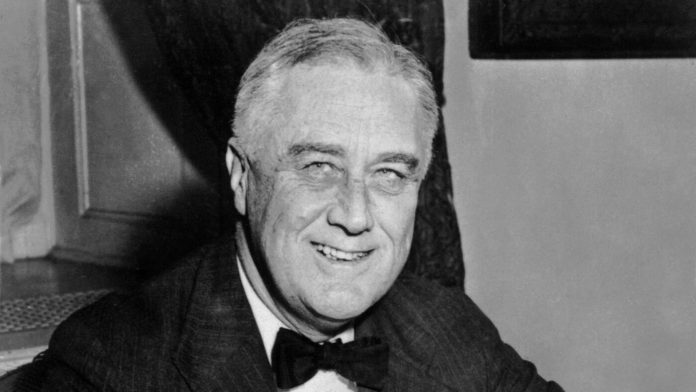
President Franklin Delano Roosevelt circa 1930 at the White House. In the 1930s, FDR’s “court packing” plan brought the U.S. to the brink of a constitutional crisis.

‎/AFP via Getty Images


hide caption

toggle caption

‎/AFP via Getty Images

Donald Trump is not the first U.S. president to criticize “activist judges” for allegedly obstructing his agenda — but he may be the most vocal.

Since the start of his second term, President Trump and his allies have repeatedly criticized judges who rule against his administration, often accusing them of political bias and judicial overreach. “We cannot allow a handful of communist radical-left judges to obstruct the enforcement of our laws and assume the duties that belong solely to the president of the United States,” Trump told supporters late last month.

The Constitution enshrines the bedrock principle of an independent judiciary and the separation of powers, but that hasn’t stopped presidents and members of Congress from criticizing the federal courts — including the U.S. Supreme Court — when they disagree with their decisions.

“The complete independence of the courts of justice is peculiarly essential in a limited Constitution,” Alexander Hamilton wrote in the Federalist Papers in 1788.

The term judicial activism was coined in 1947 by historian Arthur M. Schlesinger Jr. in an article for Fortune magazine. He used it to describe certain Supreme Court justices during the Roosevelt and Truman administrations — particularly in the context of New Deal reforms — who, in his view, saw the judiciary as a tool for advancing social justice. In contrast, Schlesinger praised other justices as “champions of self-restraint.”

However, criticism of activist judges predates the term and has come from both ends of the political spectrum. Democratic and Republican presidents alike have accused the courts of exceeding their constitutional role. “Judicial activism largely exists in the eye of the beholder,” says Barry Friedman, a law professor at New York University and author on the subject. “One person’s activism is another’s sound decision-making.”

What is judicial activism?

Cornell University’s Legal Information Institute defines judicial activism as “the practice of judges making rulings based on their policy views rather than their honest interpretation of the current law.” It stands in contrast to judicial restraint, which emphasizes deference to precedent and reluctance to reinterpret established law.

“Judging is supposed to be a relatively conservative — with a small ‘c’ — endeavor,” Friedman says. “If a judge is overturning precedent too easily or stretching legal reasoning too far, you might call that activism.”

In politics, though, the label is often used more loosely. “It’s become a way to say, ‘We don’t like what the court just did,’ ” says Keith Whittington, a Yale Law School professor. “It was originally a term used by left-leaning critics in the early 20th century, but by mid-century it had been embraced by conservatives. Now it’s a bipartisan complaint.”

How has the term been used?

Friedman says there are distinct phases in how Americans reacted to Supreme Court decisions: In the early years of the court, it wasn’t uncommon to ignore its rulings. A case in point, he says, is Georgia v. Tassel, dating from 1830. In it, a Cherokee man was convicted of murder, but the conviction was later appealed to the Supreme Court. However, the state of Georgia refused to recognize the high court’s authority to examine the case and executed Tassel anyway.

“Then came the era of judicial supremacy, where court decisions were accepted as final,” Friedman says.

The infamous and far-reaching 1857 case, Dred Scott v. Sandford, in which the Supreme Court ruled that African Americans were not citizens and that Congress had no authority to ban slavery, is a prime example from this era, he says.

“When Dred Scott was handed down, we moved into this period of supremacy,” Friedman says. “And so, people reading the decision who disagreed violently with it, engaged in a number of dodges to try to explain why, even though it looked like it said one thing, it really didn’t.”

By the early 20th century, President Franklin D. Roosevelt grew increasingly frustrated with the Supreme Court after it struck down several key New Deal programs, mostly in 5-4 decisions. In response, he proposed expanding the number of justices — a move that became known as “court packing.” In a 1937 fireside chat defending the proposal, Roosevelt accused the high court of “acting not as a judicial body, but as a policy-making body.”

“We have reached the point as a nation where we must take action to save the Constitution from the Court and the Court from itself,” Roosevelt said.

Even prior to the court-packing plan, a series of cases challenging Roosevelt’s plan to take the U.S. off the gold standard and prohibit payment of debts brought the country to the verge of a constitutional crisis. The administration, Yale’s Whittington says, “really took the view that we cannot tolerate any dissent.”

“There were rumors in Washington at the time that judges would be arrested … that the court would just be disbanded,” he says.

During the Nixon era, “the term pretty consistently meant judges who were invalidating government policies,” according to Richard Fallon Jr., a professor at Harvard Law School.

Richard Nixon’s 1968 campaign positioned him as an opponent of the Supreme Court then headed by Chief Justice Earl Warren. The Warren Court is often viewed by historians as the most liberal.

President Nixon accused the Warren Court of coddling criminals, says Laura Kalman, a research professor at the University of California, Santa Barbara. “His rhetoric painted the court as too lenient on criminals and obstructive to law enforcement.”

As an alternative to what he deemed judicial activism, Nixon advocated “strict constructionism” — a conservative legal philosophy of interpreting the law as closely as possible to the original intent of the Constitution — Kalman says.

By President Ronald Reagan’s time, however, “judicial activism” came to refer to judges who failed to strike down policies that conservatives saw as “inconsistent with original constitutional meaning,” Fallon says.

On a number of occasions during his presidency, Reagan complained about activist judges. In a 1987 address on proposed criminal justice reform, for example, he decried the “liberal phenomenon” that produced “judges who thought it was their right to make the law, not just interpret it.”

And now Trump’s criticism appears to be the most vociferous, marking “a highly politicized phase, where judicial rulings are frequently contested and used as political fodder,” Friedman says.

How have the courts responded?

With a strong Democratic majority in Congress, Roosevelt’s court-packing threat was real. But a confrontation with the courts was averted by an ideological shift. Justice Owen J. Roberts made what came to be known as “the switch in time that saved nine,” a reference to his sudden change in voting patterns that meant Roosevelt wouldn’t need to pursue his court-packing proposal in order to protect his policy programs.

“There’s extensive scholarly debate as to what exactly explains the switch in time … but certainly the timing of the conversion suggests that the court-packing plan played a role,” Whittington says.

In 2018, Chief Justice John Roberts felt compelled to defend judicial independence against a first-term Trump’s criticism of a decision by an “Obama judge” that went against the administration. “We do not have Obama judges or Trump judges, Bush judges or Clinton judges,” Roberts said in a statement. “What we have is an extraordinary group of dedicated judges doing their level best to do equal right to those appearing before them. That independent judiciary is something we should all be thankful for.”

More recently, Roberts has responded to Trump’s criticism of U.S. District Judge James Boasberg, who blocked the deportation of Venezuelan migrants. In a March post on social media, the president said that Boasberg was an unelected “troublemaker and agitator” who should be impeached.

Trump’s remarks drew another rare rebuke from the chief justice: “For more than two centuries, it has been established that impeachment is not an appropriate response to disagreement concerning a judicial decision,” Roberts said. “The normal appellate review process exists for that purpose.”

Whittington says the chief justice is “doing something that the justices traditionally were pretty reluctant to do.”

“But, you know, I think he clearly also thinks that in the current environment … [the court] needs to be defended,” he says.

Hospital tells family brain-dead Georgia woman must carry fetus due to abortion ban : NPR

0

Emory University Hospital Midtown is seen on Thursday in Atlanta.

Brynn Anderson/AP


hide caption

toggle caption

Brynn Anderson/AP

ATLANTA — A pregnant woman in Georgia who was declared brain dead after a medical emergency has been on life support for three months to let the fetus grow enough to be delivered, a move her family says a hospital told them was required under the state’s strict anti-abortion law.

With her due date still more than three months away, it could be one of the longest such pregnancies. Her family is upset that Georgia’s law that restricts abortion once cardiac activity is detected doesn’t allow relatives to have a say in whether a pregnant woman is kept on life support.

Georgia’s so-called “heartbeat law” is among the restrictive abortion statutes that have been put in place in many conservative states since the Supreme Court overturned Roe v. Wade three years ago.

Adriana Smith, a 30-year-old mother and nurse, was declared brain-dead — meaning she is legally dead — in February, her mother, April Newkirk, told Atlanta TV station WXIA.

Newkirk said her daughter had intense headaches more than three months ago and went to Atlanta’s Northside Hospital, where she received medication and was released. The next morning, her boyfriend woke to her gasping for air and called 911. Emory University Hospital determined she had blood clots in her brain and she was declared brain-dead.

Newkirk said Smith is now 21 weeks pregnant. Removing breathing tubes and other life-saving devices would likely kill the fetus.

Northside did not respond to a request for comment Thursday. Emory Healthcare said it could not comment on an individual case because of privacy rules, but released a statement saying it “uses consensus from clinical experts, medical literature, and legal guidance to support our providers as they make individualized treatment recommendations in compliance with Georgia’s abortion laws and all other applicable laws. Our top priorities continue to be the safety and wellbeing of the patients we serve.”

Georgia’s abortion ban

Smith’s family says Emory doctors have told them they are not allowed to stop or remove the devices that are keeping her breathing because state law bans abortion after cardiac activity can be detected — generally around six weeks into pregnancy.

The law was adopted in 2019 but not enforced until after Roe v. Wade was overturned in the 2022 Dobbs v. Jackson Women’s Health Organization ruling, opening the door to state abortion bans. Twelve states are enforcing bans on abortion at all stages of pregnancy and three others have bans like Georgia’s that kick in after about six weeks.

Like the others, Georgia’s ban includes an exception if an abortion is necessary to maintain the woman’s life. Those exceptions have been at the heart of legal and political questions, including a major Texas Supreme Court ruling last year that found the ban there applies even when there are major pregnancy complications.

Smith’s family, including her five-year-old son, still visit her in the hospital.

Newkirk told WXIA that doctors told the family that the fetus has fluid on the brain and that they’re concerned about his health.

“She’s pregnant with my grandson. But he may be blind, may not be able to walk, may not survive once he’s born,” Newkirk said. She has not said whether the family wants Smith removed from life support.

Who has the right to make these decisions?

Monica Simpson, executive director of SisterSong, the lead plaintiff in a lawsuit challenging Georgia’s abortion law, said the situation is problematic.

“Her family deserved the right to have decision-making power about her medical decisions,” Simpson said in a statement. “Instead, they have endured over 90 days of retraumatization, expensive medical costs, and the cruelty of being unable to resolve and move toward healing.”

Thaddeus Pope, a bioethicist and lawyer at Mitchell Hamline School of Law in St. Paul, Minnesota, said while a few states have laws that specifically limit removing treatment from a pregnant woman who is alive but incapacitated, or brain dead, Georgia isn’t one of them.

“Removing the woman’s mechanical ventilation or other support would not constitute an abortion,” he said. “Continued treatment is not legally required.”

Lois Shepherd, a bioethicist and law professor at the University of Virginia, also said she does not believe life support is legally required in this case.

But she said whether a state could insist Smith remains on life support is uncertain since the overturning of Roe, which found that fetuses do not have the rights of people.

“Pre-Dobbs, a fetus didn’t have any rights,” Shepherd said. “And the state’s interest in fetal life could not be so strong as to overcome other important rights, but now we don’t know.”

What is the fetus’ prognosis?

The situation echoes a case in Texas more than a decade ago when a brain-dead woman was kept on life support for about two months because she was pregnant. A judge eventually ruled that the hospital was misapplying state law, and life support was removed.

Brain death in pregnancy is rare. Even rarer still are cases in which doctors aim to prolong the pregnancy after a woman is declared brain-dead.

“It’s a very complex situation, obviously, not only ethically but also medically,” said Dr. Vincenzo Berghella, director of maternal fetal medicine at Thomas Jefferson University in Philadelphia.

A 2021 review that Berghella co-authored scoured medical literature going back decades for cases in which doctors declared a woman brain-dead and aimed to prolong her pregnancy. It found 35.

Of those, 27 resulted in a live birth, the majority either immediately declared healthy or with normal follow-up tests. But Berghella also cautioned that the Georgia case was much more difficult because the pregnancy was less far along when the woman was declared brain dead. In the 35 cases he studied, doctors were able to prolong the pregnancy by an average of just seven weeks before complications forced them to intervene.

“It’ s just hard to keep the mother out of infection, out of cardiac failure,” he said.

Berghella also found a case from Germany that resulted in a live birth when the woman was declared brain dead at nine weeks of pregnancy — about as far along as Smith was when she died.

A spotlight on Georgia’s abortion law

Georgia’s law confers personhood on a fetus. Those who favor personhood say fertilized eggs, embryos and fetuses should be considered people with the same rights as those already born.

Georgia state Sen. Ed Setzler, a Republican who sponsored the 2019 law, said he supported Emory’s interpretation.

“I think it is completely appropriate that the hospital do what they can to save the life of the child,” Setzler said. “I think this is an unusual circumstance, but I think it highlights the value of innocent human life. I think the hospital is acting appropriately.”

Setzler said he believes it is sometimes acceptable to remove life support from someone who is brain dead, but that the law is “an appropriate check” because the mother is pregnant. He said Smith’s relatives have “good choices,” including keeping the child or offering it for adoption.

Georgia’s abortion ban has been in the spotlight before.

Last year, ProPublica reported that two Georgia women died after they did not get proper medical treatment for complications from taking abortion pills. The stories of Amber Thurman and Candi Miller entered into the presidential race, with Democrat Kamala Harris saying the deaths were the result of the abortion bans that went into effect in Georgia and elsewhere after Dobbs.

In Abu Dhabi, Trump makes first visit to a mosque as president : NPR

0

President Trump visits the Sheikh Zayed Grand Mosque with Crown Prince Sheikh Khaled bin Mohamed bin Zayed Al Nahyan in Abu Dhabi on May 15, 2025.

Brendan Smialowski/AFP


hide caption

toggle caption

Brendan Smialowski/AFP

ABU DHABI, United Arab Emirates, and RIYADH, Saudi Arabia — President Trump visited a mosque on Thursday — his first publicly known visit to a Muslim house of worship during his time in office.

His visit to the United Arab Emirates’ Sheikh Zayed Grand Mosque was just one stop on a larger diplomatic tour through the Middle East, the first major foreign trip of his second term.

Trump removed his shoes during his visit, as is customary in mosques, and was escorted by Sheikh Khalid bin Mohammed Al Nahyan, the crown prince of Abu Dhabi.

“Isn’t this beautiful? It is so beautiful,” Trump said. “This is an incredible culture.”

The landmark mosque is known for its white marble domes and Italian-marbled floors with colored flower inlays. It is a popular cultural destination for tourists, politicians and celebrity visitors to Abu Dhabi.

Yousif al-Obaidli, the director general of the Sheikh Zayed Grand Mosque, accompanies President Trump on a tour of the mosque in Abu Dhabi on May 15, 2025.

Yousif al-Obaidli, the director general of the Sheikh Zayed Grand Mosque, accompanies President Trump on a tour of the mosque in Abu Dhabi on May 15, 2025.

Brendan Smialowski/AFP


hide caption

toggle caption

Brendan Smialowski/AFP

Trump and Sheikh Mohammed bin Zayed, the UAE’s ruler who greeted Trump upon his arrival in the country, have close ties, in part built on the UAE’s decision to normalize relations with Israel in a landmark deal during Trump’s first term in office.

His visit to the UAE is the third stop on his Middle East tour that began with two days of lavish ceremonies in his honor in Saudi Arabia and Qatar. In each country, Trump was given a ceremonial welcome with Arabian horses and honor guards.

Trump has extensive family business interests in all three countries, where Trump-branded towers and golf courses are being developed. A UAE fund also used the Trump family’s cryptocurrency venture called World Liberty Financial to close a $2 billion investment in crypto exchange Binance.

President Trump tours the Sheikh Zayed Grand Mosque with UAE President Sheikh Mohamed bin Zayed Al Nahyan, and mosque officials Dr. Yousef Al-Obaidi and Ameena Alhammadi, on May 15, 2025.

President Trump tours the Sheikh Zayed Grand Mosque with UAE President Sheikh Mohamed bin Zayed Al Nahyan, and mosque officials Dr. Yousef Al-Obaidi and Ameena Alhammadi, on May 15, 2025.

Win McNamee/Getty Images Europe


hide caption

toggle caption

Win McNamee/Getty Images Europe

Trump’s daughter Ivanka Trump and her husband, Jared Kushner, each visited the mosque in 2020, during Trump’s first term while they were both working as administration officials.

Joe Biden went to the mosque on a 2016 trip, when he was vice president.

Trump is not known to have visited any mosques in the United States as president. It’s possible he has been to a mosque in his private life, though NPR was unable to confirm that.

While it’s common for U.S. presidents to visit churches, only a few have made official visits to mosques, according to the White House Historical Association. President Dwight Eisenhower opened a Washington, D.C. mosque in 1957, and former President George W. Bush spoke at the same mosque in 2001 after the 9/11 attacks. In 2016, former President Barack Obama visited a mosque near Baltimore.

Trump, running for office in 2016, suggested without evidence that hateful ideas come out of mosques and repeatedly suggested they be placed under surveillance. And when he took office, Trump made good on a promise to ban travel from some Muslim-majority countries.

But he has since moderated his tone. In the November election, Arab and Muslim voters helped deliver the key swing state of Michigan to Trump — in part by casting ballots for third-party candidates. Many of them expressed disappointment with the Biden-Harris administration’s unwavering support for Israel’s war in Gaza, despite tens of thousands of civilian causalities.

“The Muslim community was there for us in November. And while I’m president, I will be there for you,” Trump said in March at a White House iftar during Ramadan.

Since his inauguration, though, his already-fraught relationship with Muslim voters appears to have soured. A ceasefire in the Israel-Hamas war brokered in the final days of Biden administration has collapsed. Residents of the Gaza strip have not been able to receive aid for weeks because of an Israeli blockade. Domestically, the administration has detained Muslim residents as part of his larger immigration crackdown, arresting multiple Muslim college students who spoke out in support of Palestinian rights.

During his visit to the UAE, Trump again floated the idea — unpopular with Arab leaders — of taking control of the Gaza Strip.

“I’d be proud to have the United States have it, take it, make it a freedom zone, let some good things happen,” Trump said.

The president is slated to wrap up his Middle East trip on Friday.

President Trump visits the Sheikh Zayed Grand Mosque in Abu Dhabi on May 15, 2025.

President Trump visits the Sheikh Zayed Grand Mosque in Abu Dhabi on May 15, 2025.

Brendan Smialowski/AFP


hide caption

toggle caption

Brendan Smialowski/AFP

Trump revives his Gaza proposal on his Middle East trip

0

President Trump hasn’t talked about the war in Gaza much since landing in the Middle East. But on Thursday, he doubled down on his plan to develop it as a “freedom zone.”

Consider This from NPR : NPR

0

President Trump’s order that would end automatic citizenship for the children of many categories of immigrants has been blocked from going into effect by three separate federal judges. Those injunctions have been upheld by three separate appeals courts.

So Thursday’s case at the Supreme Court was really about two questions: Whether the constitution guarantees birthright citizenship and whether judges can issue nationwide injunctions against federal policies.

University of Virginia law professor Amanda Frost, author of the book You Are Not American: Citizenship Stripping from Dred Scott to the Dreamers, followed the arguments and breaks down clues that point to the Justices’ thinking.

For sponsor-free episodes of Consider This, sign up for Consider This+ via Apple Podcasts or at plus.npr.org.

Email us at [email protected].

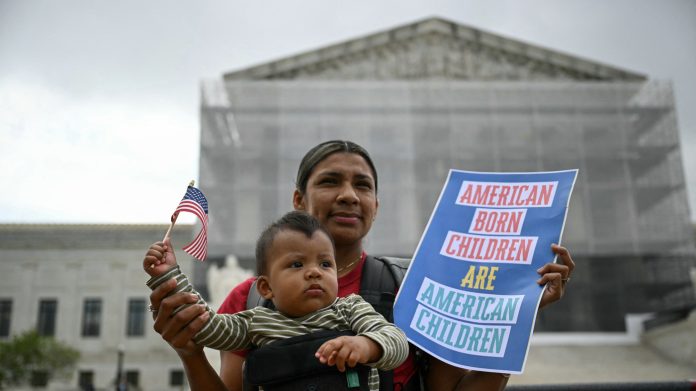
Olga Urbina and her son Ares Webster participate in a protest outside the Supreme Court as it hears arguments about President Trump’s order ending birthright citizenship for many categories of immigrants.

Drew Angerer/AFP via Getty Images


hide caption

toggle caption

Drew Angerer/AFP via Getty Images


Olga Urbina and her son Ares Webster participate in a protest outside the Supreme Court as it hears arguments about President Trump’s order ending birthright citizenship for many categories of immigrants.

Drew Angerer/AFP via Getty Images

This episode was produced by Michael Levitt and Connor Donevan with audio engineering by Hannah Gluvna. It was edited by Tinbete Ermyas. Our executive producer is Sami Yenigun.

DHS asks for 20,000 National Guard troops to assist in deportations : NPR

0

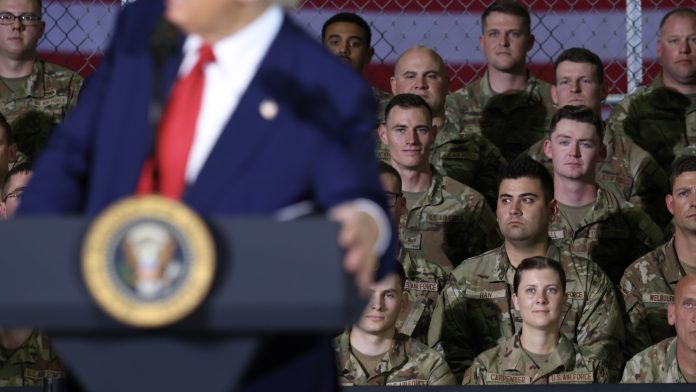
Michigan Air National Guard troops listen as President Trump speaks during a visit with Michigan Air National Guard Troops on April 29 at Selfridge Air National Guard Base, Mich.

Scott Olson/Getty Images


hide caption

toggle caption

Scott Olson/Getty Images

The Department of Homeland Security is asking the Pentagon to provide some 20,000 National Guard forces to assist in the removal of migrants in the United States without legal status.

A U.S. official with knowledge of the plan who was not authorized to talk tells NPR that military lawyers are reviewing the request from DHS. The request was first reported by The New York Times.

Under the proposal, state governors would be asked for volunteers among their Guard forces to take part in the removals. There’s no word on when this would happen, or when the call would go out for volunteers.

There’s also no sense at this point what role the Guard troops would play — whether they would provide just transportation or security, or if they would detain migrants or take part in arrests. In February, Republican Texas Gov. Greg Abbott gave Texas Guard members the authority to make immigration arrests. This would be the first time Guard troops at the national level have been asked to assist in deportations. President Trump last week ordered DHS to increase its deportation force by 20,000 officers. Using Guard forces would be the quickest way to make that happen.

There’s no indication that Trump would act to federalize the National Guard, a move that would effectively take control of the Guard troops from governors. The National Guard was last federalized in 1992 during the Los Angeles riots following the police beating of Rodney King.

The Trump administration has made greater use of active duty troops along the U.S.-Mexico border to enhance security and combat illegal immigration. There are now more than 10,000 troops along the border, a sharp increase from the estimated 2,500 who took part in that role during the Biden administration. The Pentagon also recently expanded its control of land along the border, taking over a 60-foot wide strip known as the Roosevelt Reservation. Military officials say the troops there have the power to “temporarily detain trespassers” until local law enforcement can assume custody.