Thursday, November 12, 2026
Home Blog Page 82

HHS gets restructured and loses 20,000 jobs : Shots

0

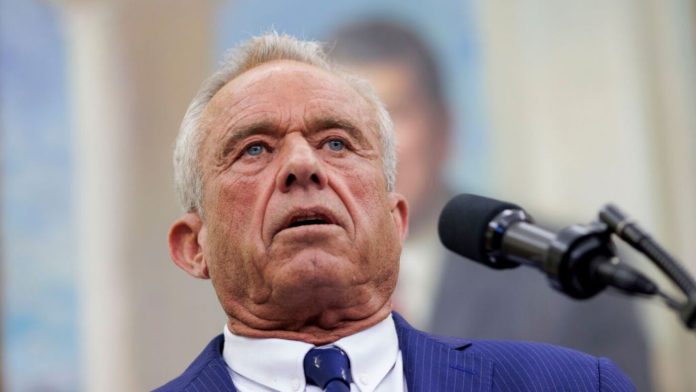
Robert F. Kennedy Jr., secretary of the Department of Health and Human Services, or HHS, announced a major restructuring and RIF of the agency he leads.

Jason C. Andrew/Bloomberg/Getty Images


hide caption

toggle caption

Jason C. Andrew/Bloomberg/Getty Images

The Trump administration Thursday announced a major restructuring of the U.S. Department of Health and Human Services that will cut 20,000 full-time jobs.

The cuts include employees who have taken the Trump administration’s Fork in the Road offer and early retirement, plus an additional reduction in force of 10,000 jobs. It will take the HHS workforce from 82,000 to 62,000, according to the HHS press release.

The restructuring also includes a reorganization of HHS’s many divisions to reduce them from 28 to 15.

“We aren’t just reducing bureaucratic sprawl. We are realigning the organization with its core mission and our new priorities in reversing the chronic disease epidemic,” HHS Secretary Robert F. Kennedy, Jr. said in the press release. “This Department will do more — a lot more — at a lower cost to the taxpayer.”

HHS is the umbrella agency that includes the Centers for Disease Control and Prevention, the Centers for Medicare and Medicaid Services, the Food and Drug Administration, the National Institutes of Health and other smaller divisions.

The restructuring will include the creation of a new Administration for a Healthy America, or AHA, intended to “more efficiently coordinate chronic care and disease prevention programs.”

The cuts include 3,500 full-time employees at the FDA, 2,400 at the CDC, 1,200 at NIH, and 300 at CMS, according to an HHS fact sheet. It states that the new job cuts at the FDA will not affect drug, medical device, or food reviewers or inspectors. The reorganization will not impact Medicare or Medicaid.

HHS states that the job cuts will save $1.8 billion. The agency currently has a budget of nearly $2 trillion, the majority of which pays for benefits for Americans covered by Medicaid and Medicare.

These cuts align with President Trump’s vision of drastically reducing the size and scope of the federal government — an effort that has been led so far by Elon Musk and his Department of Government Efficiency or DOGE.

In a social media video posted Thursday morning, Secretary Kennedy characterized HHS as a dysfunctional, sprawling bureaucracy.

In the video, he vacillated between praising his department’s staff and their work and accusing them of harming Americans’ health.

“When I arrived, I found that over half of our employees don’t even come to work,” he said. (HHS did not immediately respond to a question about whether the employees were in approved teleworking arrangements, placed on administrative leave or something else.)

“HHS has more than 100 communications offices and more than 40 IT departments and dozens of procurement offices and nine H.R. departments. In many cases, they don’t even talk to each other.”

He described “little fiefdoms” within HHS of being “so insulated and territorial that they actually hoard our patient medical data and sell it for profit to each other,” though he didn’t offer further details.

“While public health declines, a few isolated divisions are neglecting public health altogether and seem only accountable to the industries that they’re supposed to be regulating,” he said, without naming the divisions or industries he was referencing.

Senator Angela Alsobrooks, D-Md., wrote in a statement that the plan to cut 20,000 jobs from HHS was “dangerous and deadly.” Many health agencies are headquartered in Maryland, including the Food and Drug Administration, the Centers for Medicare and Medicaid Services, and the National Institutes of Health.

Alsobrooks also confronted Kennedy during his confirmation hearing about comments he’d made asserting that the childhood vaccine schedule should be adjusted depending on a child’s race. “These mass layoffs at Health and Human Services will cost human lives,” Alsobrooks said. “I will do all I can to fight this.”

“There is a benefit to occasional reorganizations of HHS. But, this is also about big staff and program reductions,” Larry Levitt of the nonpartisan health research organization KFF wrote on social media.

“A lot of what HHS employees do is behind the scenes oversight, to prevent fraud and abuse and ensure health care programs provide the services promised. Reductions in the federal workforce could result in more wasteful spending down the road.”

For John Green, It’s Tuberculosis All the Way Down

0

Nolen: The first TB patient that I sat down with in Nairobi was a man who had extensively drug-resistant tuberculosis, or XDR-TB — essentially there’s a just a very slim chance that the only drugs we know about will actually cure him. We’re out of options. And he’d come in that day, like he had very optimistically every day for a week, to pick up his delamanid. And it was out of stock.

Green: Oh my god.

Nolen: And I just was, like, “This is terrible for you, Barack. This is terrible for your wife and for your five children.” They’d all been screened, and so far everybody was TB-free. But like so many people, he had been bankrupted by his infection. He’d had to send his wife and his kids back to the village because he couldn’t afford to keep them in the city.

XDR-TB is terrifying for him and for his family and all the people who care about him. But it is also terrifying for the rest of us, for this man to be going to this clinic every day and then back to this apartment building, where he lives crammed in cheek-by-jowl with 500 other people, with TB that he can no longer treat. That is very, very bad for him. But it is also very, very bad for everybody else.

Green: Yeah. I think it’s important to understand that this is a tragedy on an individual level, on hundreds of thousands of individual levels, but it’s also — I don’t know how I feel about the phrase “global health” sometimes, because I think it sounds like we’re only talking about health in impoverished communities. The truth is, this is a crisis for human health, for humans everywhere. A person was exposed to an antibiotic that was hopefully working. And then, due to a stock-out that the United States government caused, their infection now has a chance to develop resistance to that drug, in addition to having developed resistance to so many other drugs.

We could very easily end up in a situation where we don’t have any tools to fight tuberculosis. And that takes us back to the early 20th century. It takes us back to when my great-uncle died of tuberculosis when he was 29 years old. He was working as a lineman at Alabama Power and Light. His dad was a doctor, and there was absolutely nothing that his dad or anyone else could do to save his life.

Nolen: Does anyone in the U.S. get it anymore?

Green: Yeah, we’re going to have about 10,000 cases of active tuberculosis in the United States this year. In fact, the rate of tuberculosis in the U.S. is going up.

Nolen: Why?

Green: We under-fund public health care systems, and also we do a terrible job of getting the cure to the places where the cure is needed.

Nolen: Earlier you said that we know exactly how to live in a world without tuberculosis, but we choose not to. Why do you think we’ve been so content to live in that world?

E.P.A. Offers a Way to Avoid Clean-Air Rules: Send an Email

0

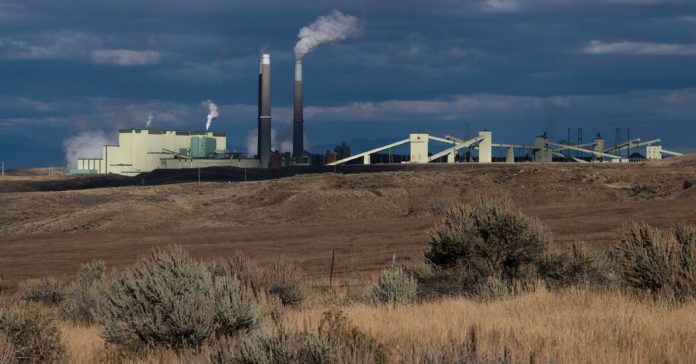
Last year, the Biden administration required coal- and oil-burning power plants to greatly reduce emissions of toxic chemicals including mercury, which can harm babies’ brains and cause heart disease in adults.

Now, the Trump administration is offering companies an extraordinary out: Send an email, and they might be given permission by President Trump to bypass the new restrictions, as well as other major clean-air rules.

The Environmental Protection Agency this week said it was invoking an obscure section of the Clean Air Act that enables the president to temporarily exempt industrial facilities from new rules if the technology required to meet those rules isn’t available, or if it’s in the interest of national security.

In its notice to companies, the agency provided a template for companies to use to get approvals, including what to write in the email’s subject line. Then “the president will make a decision on the merits,” said the notice, issued by the E.P.A. on Monday.

Joseph Goffman, former executive director of Harvard Law School’s Environmental and Energy Law Program who served as E.P.A. assistant administrator for air pollution under President Joseph R. Biden Jr., said he feared the President Trump was “setting up a rubber stamp process” that would allow companies to avoid a long list of rules on air pollution.

Normally, the agency would lay down more specific criteria for exemptions to a rule, he said. He also said that Congress had clearly intended for Clean Air Act exemptions to come with conditions that would ensure at least some pollution limits.

“Because none of that is present, it strongly suggests that the decisions will be at best ad hoc,” Mr. Goffman said. “That’s in defiance of Congress’s intent, in defiance of the public health needs of the communities that are affected, and in defiance of the E.P.A.’s past practices.”

Molly Vaseliou, a spokeswoman for the E.P.A., pushed back against that view, saying nowhere in the law was there an explicit requirement for such conditions. “This type of ‘legal analysis’ seems consistent with people who were responsible” for interpretations of laws the Supreme Court has struck down,” she said in an email.

The latest policy allows for companies to apply for exemptions of up to two years, the maximum allowed under the Clean Air Act, from numerous new restrictions on emissions of toxic chemicals like mercury and arsenic, as well as ethylene oxide, a colorless gas that is widely used to sterilize medical devices and is also a carcinogen.

Mr. Zeldin, a former member of Congress from New York, has also said he would allow coal-burning power plants to apply for exemptions from a new rule that requires them to address the health risks of coal ash, a toxic substance created by burning coal to produce electricity.

The agency has said it intends to ultimately rewrite many of these same rules, an arduous process that is expected to take time. So the E.P.A. appears to be pursuing “a two-step process where it says it’s going to take the next few years to roll back the rules,” but in the meantime avoid companies having to meet any of them, said James Pew, director of clean air practice at the environmental group Earthjustice.

“It’s hard to imagine how these exemptions could be lawful,” Mr. Pew said. For all of the new rules, for example, the Biden administration had already identified alternative technology that was available and affordable. The idea that the ability to pollute was in the national interest was also hard to buy, he said.

As of Thursday, it was unclear whether the agency had started to receive exemption applications, whether any had been granted, and if or how they would be disclosed. Companies must apply for exemptions by the end of the month, the E.P.A. said.

The National Association of Manufacturers, the American Petroleum Institute, and the American Chemistry Council, which represent major regulated industries, did not immediately respond to comment.

Deadly Wildfires Destroy Historic Landmarks in South Korea

0

Wildfires in South Korea have resulted in deaths, turned an ancient Buddhist temple into ashes and forced the evacuation of residents of a UNESCO World Heritage site.

South Korea Wildfires Raze Ancient Temples, Force Evacuations

0

South Korea’s largest wildfires on record blazed through the country’s southeast for a seventh day, with firefighters, soldiers and heritage workers racing to evacuate people and save ancient treasures from the encroaching flames.

At least 37,000 people were evacuated from their homes as the fires, which have left 27 people dead, spread in the dry and windy weather. The fires had burned over 88,000 acres of land, the biggest on record in South Korea, according to the Interior Ministry. The largest blaze in Euiseong County was only about halfway contained on Thursday.

Rescue crews were also focusing on saving as many relics and heritage buildings as possible after two 1,000-year-old Buddhist temples burned to the ground. Around two dozen buildings, trees, statues and other things with national heritage status have been lost to the flames so far, according to the Korea Heritage Service, the government body responsible for the conservation of national treasures and sites.

A statue of a seated Buddha from the early 9th century that was reduced to ashes. And the base and branches of a 400-year-old tree considered the guardian of a local village was charred in the flames.

The heritage service said it deployed around 750 people across the region to protect or remove what still remains. The southeastern region is home to a large proportion of the more than 4,000 items on the country’s national heritage list.

In the city of Andong, firefighters and officials worked to protect UNESCO Heritage sites as the inferno threatened to spread to those locations. In the 600-year-old Hahoe folk village, firefighters hosed buildings as helicopters dropped buckets of water from above. Workers relocated signage from the Byeongsanseowon Confucian Academy, a tourist attraction.

While the government has successfully evacuated tens of thousands of residents across at least eight cities and counties, thousands of others have stayed behind. Many remained to protect their homes, businesses, livestock and pets. Local residents pleaded with firefighters to put out fires near their houses or restaurants.

One Andong resident said he and his wife were at home when their house caught fire. They had tried, but failed, to stop the fire by dousing it with water and were forced to evacuate. But they wanted to stay close to their house to protect their 22 cows, which survived, so they have been sleeping inside their car since Tuesday.

Earlier this week, strong winds kept helicopters and drones grounded, officials said. One pilot died when a helicopter crashed while fighting the fire, though officials have not disclosed the cause. Smoke and smog decreased road and air visibility, making driving and flying near impossible. The Interior Ministry said a lawn mower had started the first of the fires on Friday.

Conditions had improved by Thursday, and over 100 helicopters were deployed to the missions, according to the Central Disaster and Safety Countermeasures Headquarters. At least one U.S. military helicopter joined the effort, the government said.

Emergency workers and residents are hoping the weather may turn in their favor, with light rain forecast for Thursday by the country’s meteorological agency. Government officials said this would do little to help put out the fires but could weaken the further spread of the flames.

Israeli Lawmakers Give Themselves More Power Over Choosing Judges

0

Prime Minister Benjamin Netanyahu’s coalition enacted legislation on Thursday morning that handed politicians more control over picking judges, part of a contentious effort to overhaul the Israeli judiciary that roiled the country before the war with Hamas.

Israel’s 120-seat Parliament, known as the Knesset, passed two laws after an hourslong overnight debate in a vote mostly boycotted by the opposition. The legislation revamps the committee that picks judges, including Supreme Court justices, in a way that critics say will politicize the bench.

The law marked the resumption of a two-year effort by Mr. Netanyahu’s coalition to expand its control over other branches of government. Before the Hamas-led attack in October 2023 ignited the war in Gaza, Mr. Netanyahu had attempted similar legislation in the face of mass protests. He suspended the push to preserve wartime unity.

Now, Mr. Netanyahu has returned to the judicial overhaul, along with simultaneous efforts to weaken other state watchdogs. He is trying to fire both the attorney general and the head of the domestic intelligence service.

The laws that passed on Thursday were less far-reaching than the coalition’s initial proposals. But they nonetheless threatened to reignite the uproar that swept the country before the war, even as Israel and Hamas are engaging in a new fighting in Gaza.

Crowds of protesters rallied outside the Knesset in Jerusalem on Wednesday to demonstrate against the legislation, waving Israeli flags. But in a sign of how the war has split the priorities of Mr. Netanyahu’s opponents, many showed up carrying signs calling for the government to reach an immediate deal with Hamas to free the hostages in Gaza.

Inside the Parliament building, Mr. Netanyahu gave a fiery address in which he contended that his government’s policies would serve as a long-needed corrective to an unelected “deep state,” echoing rhetoric used by President Donald J. Trump.

Trump Threatens Europe and Canada if They Band Together Against U.S.

0

President Trump said in a middle-of-the-night social media post early Thursday that he would come after the European Union and Canada if they banded together to “do economic harm” to America, opening a new front in the unfolding trade war.

“If the European Union works with Canada in order to do economic harm to the USA, large scale Tariffs, far larger than currently planned, will be placed on them both in order to protect the best friend that each of those two countries has ever had!” Mr. Trump wrote.

Mr. Trump’s post creates a new problem for the European Union, which is already trying to respond to his tariffs on steel, aluminum, autos and potentially a broader array of goods and services.

The United States is by far Europe’s most important trading partner, and the prospect of worse trading conditions has left the European Union scrambling to negotiate. But the Trump administration has showed little appetite to strike a deal so far.

“In the end, as it is said, one hand cannot clap,” Maros Sefcovic, the trade commissioner for the European Union, has said.

That has left Europeans seeking to strike new alliances and deepen existing trading relationships. And concerns about President Trump’s shifting stance on military support have driven partners like the European Union and Canada closer together. Canada is already working toward providing industrial support for Europe’s rearmament push.

European Commission officials did not immediately comment on Mr. Trump’s post.

Trump officials downplay the Signal leak. Some military members see a double standard : NPR

0

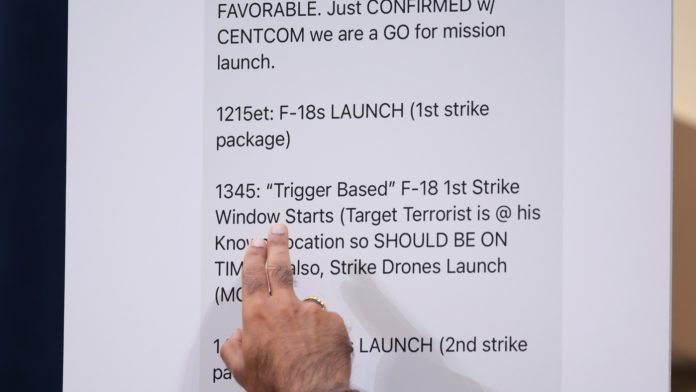
A House lawmaker points to text messages by Defense Secretary Pete Hegseth during a hearing on March 26. The hearing, held by the House Intelligence Committee, addressed Trump administration officials inadvertently including a journalist on a high-level Signal group chat in which plans to bomb Houthi targets in Yemen were discussed.

Kayla Bartkowski/Getty Images


hide caption

toggle caption

Kayla Bartkowski/Getty Images

The White House continues to largely dismiss a highly sensitive discussion by leading national security officials on the open-source encrypted Signal messaging app that leaked to a reporter.

At a White House briefing Wednesday, press secretary Karoline Leavitt said the media “continues to be focused on a sensationalized story from the failing Atlantic magazine that is falling apart by the hour.”

The Atlantic‘s editor-in-chief, Jeffrey Goldberg, who was accidentally included in the Signal discussion and exposed it, published the entire text exchange Wednesday after officials minimized their actions, maintaining that nothing classified was discussed. The Signal group included the defense secretary and top intelligence officials in the Trump administration as they discussed an ongoing military operation in Yemen earlier this month. The new details about the group’s messages confirmed that Defense Secretary Pete Hegseth described specific weapons systems that would launch strikes in Yemen and that he announced the beginning of the operation more than an hour before the strikes hit.

But the leak of operational details lands a little differently with military veterans and especially with active-duty troops, who can be discharged and prosecuted for much lower-level leaks. Security breaches like what happened in the Signal group chat are called “spillage” by the military.

“What typically happens in a spillage as serious as this is they’re immediately fired,” says Kevin Carroll, who served 30 years in the Army, and in the CIA, and at the Department of Homeland Security in the first Trump administration. He says there’s no doubt what would have happened to an active-duty officer who had participated in the Signal chat.

“They’re processed for being kicked out of the military, and they’re referred for criminal prosecution,” he says.

A lawyer himself, Carroll has defended troops who accidentally leaked information.

“I’ve defended spillage cases where people were going to be put out of the military or people were going to be turned out of their job within the military for violations that are just the smallest fraction of what just occurred,” Carroll said.

Military officers who have sent battlefield assessments that were several years old have lost their jobs for passing the information over an unsecured channel, Carroll said. He defended a junior Marine Corps officer in court who sent urgent, potentially lifesaving information to fellow officers in Afghanistan from a nonclassified email server and was relieved of duty.

Carroll says, for troops, seeing leadership share attack plans in advance on Signal but so far suffer no consequences is toxic to morale. But that double standard is so common, he adds, that there’s a phrase for it in the military: “different spanks for different ranks.”

Mick Mulroy, former deputy assistant secretary of defense for the Middle East in the first Trump administration, called the Signal chat group a significant breach of security. He says if this had been lower-level officials, the repercussions would have been swift.

“There would be an immediate investigation launched,” Mulroy told NPR’s Here & Now. “They’d be removed from any access to classified information, and if this is what they in fact did, they’d likely get court-martialed. I think everybody in the military knows that is the case. And unfortunately, instead of owning up to it and taking responsibility, it seems to be that they’re making excuses for every reason why they could be able to do this.”

“Nobody’s texting war plans,” Hegseth said as he boarded a plane in Hawaii on Wednesday afternoon.

“There’s no units, no locations, no routes, no flight paths, no sources, no methods, no classified information,” he said.

Sen. Tammy Duckworth, an Iraq War veteran, took exception to Hegseth’s comments.

“Pete Hegseth is a f***ing liar. This is so clearly classified info he recklessly leaked that could’ve gotten our pilots killed,” Duckworth said in a news release Wednesday. “He needs to resign in disgrace immediately.”

NPR disclosure: Katherine Maher, the CEO of NPR, chairs the board of the Signal Foundation.

Rattled by Trump, America’s Allies Shift to Economic Defense Mode

0

President Trump’s unexpected plan to impose a 25 percent tariff on cars and car parts being imported into the United States will not only disrupt supply chains. It will also fuel anger, alienation — and pressure to retaliate — among American allies across the globe.

Many of the countries most affected by the new levies, such as South Korea, Japan, Germany, Mexico and Canada, are already reeling from the Trump team’s wanton disregard for free trade deals already signed, and erratic threats to long-established security relationships.

Prime Minister Mark Carney of Canada said on Wednesday that Trump’s move was “a direct attack.” Other leaders reacted in muted terms, hinting that they were still considering how to respond, with another round of tariffs expected in early April.

“We need to consider what’s best for Japan’s national interest,” Prime Minister Shigeru Ishiba of Japan told Parliament on Thursday. “We’re putting all options on the table in considering the most effective response.”

The tariffs, which threaten both American and foreign carmakers, increase the likelihood of a global trade war. A chain reaction of economic nationalism with tariffs and other measures — perhaps adding costs for finance and services — could suppress economic growth globally, spread inflation, and add rancor to already testy negotiations with Washington about security.

The Trump White House has made clear that it will use every tool of American power, including its military support and consumer market, to extract what Mr. Trump sees as a better deal for Americans. Economists argue that the potential benefit of more auto factory jobs could take years to show up in the United States, and they may coincide with losses in other industries. But for countries that have spent decades trusting America and tying their economies and defense plans to Washington’s promises, this feels like a moment of reversal.

American influence, long built on pronouncements about values and the shared riches of free trade, has hardened into what many analysts describe as “all stick, no carrot.” In the Trump team’s thinking, critics argue, American gains require pain for others — friends included.

“Everything is a status competition or a dominance competition,” said Andrew Kydd, a political scientist at the University of Wisconsin who incorporates psychology into studies of international relations. “I think this is characteristic of extremists of all stripes — everything is about exploitation and domination, and to think otherwise is to be blind or naïve.”

As a result, he added, other countries “have to take seriously the articulated goals, however alarming.” That includes threats to seize Canada, Greenland and the Panama Canal, plus demands for economic submission to tariffs that weaken the economies of allies.

The pressure to resist has already become a stunning addition to Canadian politics. On Wednesday, Mr. Carney’s campaign brought him to the bridge at the border with Detroit over which $300 million worth of auto parts cross daily. He unveiled a series of promises for the auto industry including a 2 billion Canadian dollar ($1.4 billion) fund to reshape it for a future without the United States.

“We will defend our workers, we will defend our companies, we will defend our country, and we will defend it together,” he said.

In Asia, officials had hoped for softer tariff treatment based on factories already being built in the United States at great expense. “We invest in America, employ people, and pay the highest wages,” Mr. Ishiba said.

And yet, at a moment when economic and military threats seem to be converging for Japan, analysts said that his hands are tied: Because inflation is rising with a weakened Japanese yen, Japan simply cannot afford a trade spat that drives up consumer prices even further. Nor is battling the tariffs even Mr. Ishiba’s top priority.

With a more militarized China on Japan’s doorstep, sending armed ships to assert its claims to disputed islands in recent days, the prime minister is most keen to get a clear commitment from Mr. Trump to defend Japan’s security. (U.S. Defense Secretary Pete Hegseth is scheduled to arrive in Tokyo this week.)

So far, the Trump administration has sent conflicting signals to America’s largest Asian ally. While Secretary of State Marco Rubio has reaffirmed support for Japan, the president himself has publicly questioned the two nations’ security alliance.

“We are very much constrained at this moment,” said Ken Jimbo, a professor of international politics and security at Keio University.

South Korea finds itself in a similar position: It has deepened its diplomatic and military dependence on the United States in recent years, as anti-Chinese sentiment rose among its people, and to strengthen deterrence against North Korea.

South Koreans’ fundamental trust in the alliance will survive the latest tariffs, in part because the penalties didn’t target South Korea only but also hit competitors, said Park Won-gon, an expert in South Korea-U.S. relations at Ewha Womans University in Seoul.

But cars are one of South Korea’s biggest export items, totaling $71 billion last year, and the United States was the destination for nearly half. The government called for a meeting with the car industry on Thursday to discuss a response to Trump’s tariffs.

On news portals from the left and right, many Koreans expressed outraged that they were landing just a few days after Hyundai Motor, a South Korean conglomerate, said it would invest $21 billion to expand manufacturing in the United States.

William Choong, a senior fellow at the ISEAS – Yusof Ishak Institute in Singapore, said that for many Asian allies, it feels like the United States is a police commander “that sticks his Glock down the back of the junior cop — i.e. regional countries — and starts shaking him down for cash and other valuables.”

European officials and analysts have been flirting with similar sentiments. The White House’s about face on Ukraine, pressuring for peace while letting Russia win concessions, has spurred a panic over security. After the leak of a private chat among White House officials that called Europe “pathetic,” fury has risen, and the pressure to respond has been intensifying.

Europe is already facing the added expense of a military buildup. Automotive tariffs could squeeze an industry that has been struggling, especially in Germany.

European Union officials said recently that they would place new tariffs on many American goods — from lingerie to soy products — by mid-April. More potent measures could follow. Ursula von der Leyen, president of the European Commission, said Wednesday that the European Union would “continue to seek negotiated solutions, while safeguarding its economic interests.”

Ian Austen contributed reporting from Windsor, Ontario; Choe Sang-Hun from Seoul; Martin Fackler from Tokyo; Emiliano Rodríguez Mega from Mexico City, Mexico; Jeanna Smialek from Brussels, and Melissa Eddy from Berlin.

Utah governor signs bill eliminating mail ballot grace period : NPR

0

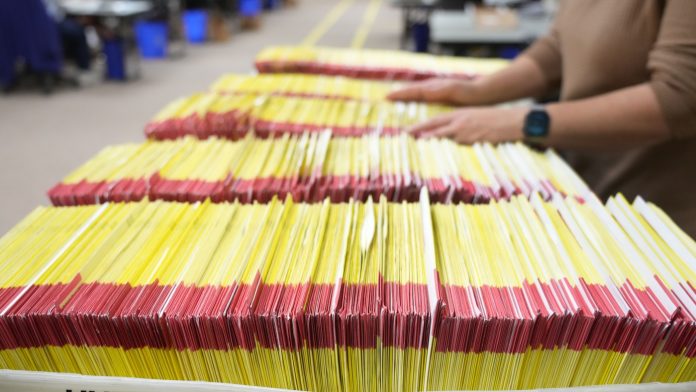
Mail ballots are processed at the Salt Lake County election headquarters on Nov. 7, 2022, in Salt Lake City, Utah.

George Frey/Getty Images


hide caption

toggle caption

George Frey/Getty Images

Utah Gov. Spencer Cox has signed a bill that makes sweeping changes to the state’s popular mail voting program, including removing a grace period for postmarked ballots that arrive after Election Day.

The new law is part of a larger effort by Republicans to limit the window in which mail ballots can be counted during an election.

Last October a U.S. appeals court sided with the GOP against a Mississippi law that allows mail ballots to be counted if they are postmarked by Election Day but arrive after it. And along with Utah, Republican lawmakers in Kansas on Tuesday limited mail ballot return windows. Other states, including West Virginia, are seeking to join them.

President Trump also signed an executive order Tuesday requiring that all states only count ballots that are received by Election Day. The order is expected to face legal challenges.

In Utah, as soon as the next election, voters casting mail-in ballots will need to make sure their ballot is received by election officials by 8 p.m. on Election Day. Previously, voters had up to two weeks to get their ballot counted if it was postmarked by the day before Election Day.

In a press conference earlier this year, Cox told reporters that these changes were needed so the state can count most of its ballots on election night and media outlets can call races sooner.

“There’s no reason we couldn’t do that,” Cox said. “That’s just a choice that we’ve made to allow a large amount of mail in ballots to come in after [Election Day] as long as they’re postmarked the day before the election, they can come in for a week or two afterwards.”

Several states this year are considering laws aimed at speeding up election results. Most proponents say faster results increase confidence in elections because they allow less time for misinformation to take hold. That’s even though there is no evidence of widespread fraud in American elections.

“I believe that that’s something that would add trust to the system,” Cox said. “I think one of the areas where we start to lose trust is when there isn’t a decision on election night and there’s lots of ballots out there and somebody may have been winning on election night and then five days later they’re losing a race. And that calls into question lots of things. Even though … we have complete integrity in our elections.”

Voting rights advocates, however, argue that many of these changes in pursuit of faster results sacrifice access to the ballot.

Barbara Smith Warner — executive director of the National Vote At Home Institute, which advocates for broader access to mail-in voting — said many states provide a grace period for voters to make sure their vote is counted, even if there are delays with the post office.

“In the 2024 election, there are about 2,000 voters [in Utah] whose ballots were indeed postmarked by Election Day and received within the three days,” Warner said. “Those folks and whoever else will no longer have that. So that’s kind of the first thing that’s going to make it harder right away for Utahns to vote.”

Utah is no longer a universal mail-voting state

The new law also makes broader changes to the state’s mail voting system.

Before the bill was signed, Utah was one of eight states, plus Washington, D.C., that automatically sent mail ballots to eligible voters. Utah was also the only fully Republican-led state to have such a program.

Voters will still be able to vote by mail, but starting in 2029 they will have to request a ballot. Voters will also be required to provide identifying information on their ballot, if they decide to mail it back or drop it off at a ballot box.

According to reporting from the Salt Lake Tribune, Utah’s vote-by-mail program was widely used in a state where many voters live hours away from a local election office or ballot box. The newspaper’s analysis of the 2024 primary election found that “96.7% of Utahns who cast a primary vote — over 400,000 people — either voted by mail or left their ballots in drop boxes.”

The bill’s proponents say it increases election security. Warner told NPR she expects there will be a dip in voter participation when the law fully goes into effect.

She said her group has found a significant increase in turnout as election officials began to automatically send out mail ballots in Utah several years ago. And, Warner said, she thinks many voters will be off-guard when they have to start requesting them again.

“I think people are going to be really unhappy,” Warner said. “What’s going to end up happening is Utah voters are going to pay the price and they are going to be the ones who are going to have a harder time voting and are going to be really unhappy with the way these policies end up impacting their ability to vote.”