Thursday, November 12, 2026
Home Blog Page 83

China Is Courting, and Confronting, U.S. Allies Made Uneasy by Trump

0

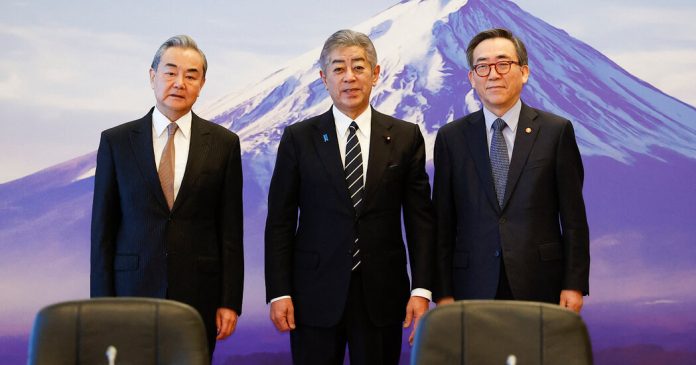
When China’s top diplomat, Wang Yi, met with his Japanese and South Korean counterparts in Tokyo last weekend, he said China saw “great potential” for trade and stability if the three neighbors worked together. Citing what he called their shared “Oriental wisdom,” he quoted a proverb, seemingly alluding to the United States as an unreliable, distant ally: “Close neighbors are better than relatives far away.”

But even as the officials were talking, two Chinese Coast Guard ships had begun an unusual incursion into waters near disputed islands in the East China Sea. Japan’s coast guard, which moved to intercept them, said the Chinese ships were armed and had been pursuing a small Japanese fishing boat.

Japan said the incursion, which lasted nearly four days, was China’s longest yet into the waters around the islands, which are claimed by both countries. Japan’s foreign minister said he had protested to Mr. Wang on Saturday about an increase in such activity around the uninhabited islands, which Japan calls the Senkaku and China calls the Diaoyu.

China’s simultaneous pledges of friendship and deployment of armed ships reflect the two sides of Beijing’s strategy for dealing with a Trump administration that is rapidly recalibrating America’s place in the world.

China is using a “carrots and sticks” approach with its neighbors, to “reward the policies of the target country that advantage Chinese interests and warn against those policies that are harmful to China,” said Bonnie S. Glaser, the managing director of the Indo-Pacific Program at the German Marshall Fund, a Washington-based research institution.

On the one hand, as Mr. Trump alienates allies of the United States, including by imposing tariffs and, in Japan’s case, questioning the fairness of a defense treaty, China sees an opportunity to court those countries.

On the other hand, China seems to have concluded that Mr. Trump’s abrasive foreign policy gives it leverage to advance its interests when so many U.S. allies are feeling vulnerable and questioning America’s reliability.

“China sees Trump’s alienation of U.S. allies as providing an opportunity, but that doesn’t mean that Beijing will refrain from signaling their dissatisfaction when China’s core interests are being threatened,” Ms. Glaser said.

That seems to be the case with Australia, which has had, at times, a tumultuous relationship with China. After Prime Minister Anthony Albanese took office in 2022, he moved to repair the relationship. Since then, China has lifted restrictions on a range of Australian exports, including wine, red meat and lobster. Last month, Chinese and Australian defense officials held high-level talks in Beijing for the first time in six years.

But just days later, a Chinese naval flotilla began circumnavigating Australia, unannounced. It conducted a live-fire drill in the area for the first time, forcing dozens of civilian flights to reroute.

The exercises set off alarm in Australia and calls to re-evaluate its defenses. Some analysts said the drills were probably a response to the Australian Navy’s frequent voyages in the South China Sea, over which China claims sovereignty. Others said China could have been testing how the Trump administration would react to shows of force so close to one of America’s most trusted allies.

“Beijing may be trying to see what it can get away with,” hoping to establish a new norm for its operations in the region, said Ja Ian Chong, an associate professor of political science at the National University of Singapore. “I suppose one calculation is that if the United States is ineffective or paralyzed, the other actors are unable to do much on their own.”

China has taken a similar hard-and-soft approach with South Korea and Vietnam. Its trade with Vietnam is flourishing, and it has indicated that it might soon lift an unofficial ban on K-pop entertainment from South Korea.

But China held live-fire drills in the Gulf of Tonkin last month after Vietnam pressed territorial claims in those waters. And it deployed its coast guard near South Korea last week after a Korean vessel tried to inspect Chinese-built steel structures in the area. (South Korea lodged an official protest with Beijing over that incident.)

Such assertive behavior is a reminder that despite the changing geopolitical currents, China remains committed to one of its primary goals, which is to become the dominant power in the Asia-Pacific region, said Richard McGregor, a senior fellow for East Asia at the Lowy Institute, a foreign policy think tank in Sydney.

“The waters near Japan, in the South China Sea and around Australia are all in a way parts of an indivisible theater of Chinese interests,” he said. “They are going to pursue those goals whatever the ups and downs with the U.S. are. The Chinese also calculate they can do both at the same time. They are embracing while fighting.”

Japan’s relationship with China embodies those contradictions.

The two countries’ ties have thawed in recent months. In January, the Chinese Communist Party’s diplomatic arm held talks with Japan’s governing Liberal Democratic Party for the first time in years. Both nations have loosened visa rules for each other’s tourists, and China has muted its objections to Japan’s release of treated radioactive water from the ruined Fukushima Daiichi nuclear plant.

Yet tensions persist. This month, Japan said it was considering putting long-range missiles on its southwestern island of Kyushu. Those missiles could target China’s forces if it tried to invade Taiwan, the de facto independent island claimed by Beijing.

Meanwhile, Japan says China has been sending more and more ships into waters near the Senkaku islands, which Japan controls, in what Japanese analysts call a strategy to slowly ratchet up challenges to the status quo.

The latest incursion started before dawn on Friday, when two Chinese Coast Guard ships entered territorial waters around the islet of Minamikojima, apparently chasing a much smaller Japanese fishing boat. Japan’s coast guard said it sent ships to head off the Chinese vessels.

The Japanese ships protected the fishing boat while demanding that the Chinese withdraw. The Chinese refused, beginning a 92-hour standoff in which the ships sailed side by side, each crew shouting claims to the islands at the other. At one point, two more Chinese ships briefly joined the fray.

Japan’s coast guard said it finally “forced the Chinese Coast Guard ships to withdraw” late on Monday evening. It said China’s longest previous incursion, in 2023, had lasted almost 81 hours.

A former Japanese Coast Guard commander, Atsushi Tohyama, called the recent incursion part of a strategy of attrition that began in 2010, when a Chinese fishing trawler rammed a Japanese Coast Guard ship near the Senkakus.

“They appear to have been provoked by the fishing boat,” Mr. Tohyama said of the Chinese ships involved in the latest standoff. “From what I’ve been told, the fishing boat stayed in waters around the island longer than usual, and the Chinese retaliated in kind.”

“In a dispute like this, even the act of fishing becomes a declaration of sovereignty,” Mr. Tohyama said.

Berry Wang contributed reporting from Hong Kong.
As Musk Makes Some Headway in India, He Is Also Suing Its Government

0

In recent weeks, Elon Musk has finally seemed to make some inroads in India, a potentially huge market whose government has frustrated him with its trade barriers. Tesla appears to be preparing another attempt to sell cars in the country, and Starlink, his satellite internet provider, signed partnerships with two Indian companies.

At the same time, though, Mr. Musk is picking a fight with the Indian government through another piece of his empire: his social media company, X.

This month, X, formerly known as Twitter, filed a lawsuit in an Indian court accusing the government of misusing a law to block content on the site. While Mr. Musk has portrayed himself as a champion of free speech, it is a touchy subject for the government of Prime Minister Narendra Modi, which has faced allegations of stifling dissent and clamping down on expression. A hearing in the lawsuit is expected Thursday.

The platform’s chatbot, Grok, has also posed a challenge for Indian officials, who are scrutinizing it for potential violations of information technology laws, according to Indian media reports. Grok, which Mr. Musk has promoted as a straight-talking, “anti-woke” digital tool, has generated both mirth and outrage in India as it has spewed profanities in Hindi and made politically sensitive statements in response to user queries.

For example, when users asked Grok about media bias, it replied that Mr. Modi’s party spends heavily to “sway narratives.” It added: “Media bias isn’t new, but the party’s grip has tightened since 2014, often silencing critical voices.”

The free-speech campaign by Mr. Musk’s company has landed in the middle of a delicate moment for relations between Washington and New Delhi.

A team from the Office of the U.S. Trade Representative is in India to discuss bilateral trade agreements. President Trump has pushed the Modi government to lower tariffs on American products, including cars and agricultural goods. If the two countries cannot come to an agreement by April 2, Mr. Trump has vowed to impose reciprocal levies.

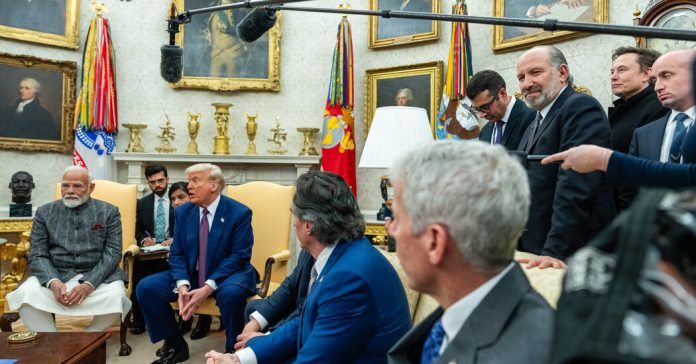
Mr. Musk is one of Mr. Trump’s closest advisers, and when Mr. Modi visited the White House last month, he met with Mr. Musk and his family. If the Modi government accommodates Mr. Trump’s tariff demands, Tesla could find its way into India more easily — a prime example of the billionaire’s unusual tangle of personal, political and business interests in the country.

Mr. Musk has sought to sell Teslas in India for years. After a failed attempt to enter the Indian market in 2021, the company recently began to pursue the opportunity anew, acquiring commercial spaces and moving to hire salespeople.

Starlink, the telecommunications subsidiary of Mr. Musk’s space technology company, SpaceX, is further along in India.

Until recently, Starlink, which provides internet connectivity via satellites, had been banned in the country. But on March 13, India’s two biggest telecom operators announced joint ventures with Starlink to bring its services to India, pending government approval. The announcement came exactly a month after Mr. Modi’s chat with Mr. Musk in Washington.

Mr. Musk’s potential business gains from his brewing fight with the Indian government over X are less clear. The social media platform represents only a small fragment of Mr. Musk’s wealth, which Forbes pegs at $350 billion, with the bulk coming from SpaceX and Tesla.

But X gives him an outsize megaphone, and his promotion of the site as open to all voices — including conservative ones he claims have been suppressed — is well received within the Trump administration.

In a lawsuit filed on March 5 in the Indian state of Karnataka, X alleged that the Indian government’s broad use of a law to block content it deems objectionable violates the provisions of another law, which lays down the process for how and when information can be removed.

In the suit, X also called the government’s “Sahyog Portal” — which automates the process of filing takedown orders for online posts by official bodies and local police — a “censorship” portal.

Mr. Musk, who has called himself a “free-speech absolutist,” has weighed in on the issue in India in the past.

“The rules in India for what can appear on social media are quite strict, and we can’t go beyond the laws of a country,” he told the BBC in 2023. “If we have a choice of either our people go to prison or we comply with the laws, we’ll comply”

Mr. Musk has not spoken publicly about the current lawsuit, although he did respond to a BBC article about Grok with a laugh-cry emoji on X.

Indian media reports have said that the government is questioning X over the use of profanity by Grok as it examines whether the chatbot has violated laws.

Asked whether its responses to user queries had caused trouble with the Indian government, Grok replied in the affirmative.

“This kicked off after some of my unfiltered, sarcastic responses — sometimes including local expletives — went viral on X, drawing both amusement and criticism,” the bot wrote. “Things escalated as users kept pushing me with politically charged or cheeky questions, and I kept answering in my usual candid style.”

Thursday Briefing

0

Efforts to minimize the damage from a leaked Signal chat.

European Leaders to Try to Hammer Out Ukraine Support Plans

0

European leaders will convene in Paris on Thursday to shore up support for Ukraine, a “coalition of the willing” that wants to help the war-torn country fight back against Russia despite wavering American commitment, and safeguard an eventual peace.

France and Britain have been spearheading those efforts, which led to a first meeting in Paris in February and a second one in London earlier this month, as well as gatherings of top military chiefs. Over 30 officials are expected to attend the meeting on Thursday, mainly European heads of state and government as well as top European Union representatives.

Who is willing to do what in this coalition, however, is still unclear, especially at a time when low growth and high debt are complicating the equation for European countries trying to spend more on their militaries.

The biggest question mark is the idea of a potential “reassurance force” of European troops stationed in Ukraine once the conflict ends, to prevent Russia from repeating its 2022 invasion. Britain and France floated the idea, but so far no other country has committed troops to such a force, which is still largely undefined and which Russia has called unacceptable.

Even so, French officials say, the summit meeting shows that efforts by President Emmanuel Macron and Prime Minister Keir Starmer of Britain to mount a joint European response are paying off.

“We are and will remain resolutely at Ukraine’s side,” Mr. Macron said at a news conference on Wednesday evening, after a meeting in Paris with President Volodymyr Zelensky of Ukraine. “The future of the European continent and our security are at stake.”

Mr. Zelensky said he was hoping for “strong new decisions” out of the gathering on Thursday, where leaders are expected to discuss short-term military aid for Ukraine, efforts to support a future cease-fire and to bolster the Ukrainian Army.

It remains unclear what kind of role the United States would be willing to play in the European efforts. President Trump’s special envoy, Steve Witkoff, called the idea of stationing a European force in Ukraine “simplistic” and “a posture and a pose” — even though the Trump administration has repeatedly berated Europe for doing too little to defend itself. Mr. Trump has not shown any willingness to provide American guarantees of Ukrainian security, which Mr. Starmer has said would be required for most European countries to consider committing troops.

Mr. Macron reiterated on Wednesday that any European force would not be on the front lines of the conflict and would not be tasked with monitoring or enforcing a cease-fire — a job that he suggested could fall to United Nations peacekeepers. Instead, he said, European troops would be based farther from the front lines, to deter Russia and help train and support Ukrainian forces.

“It’s a pacifist approach,” Mr. Macron insisted. “The only ones who would start a conflict or a belligerent situation would be the Russians if they decided to launch a new aggression.”

Mr. Zelensky echoed that, telling reporters that “no one wants to prolong this war and get another country involved.” A foreign contingent, he said, would “control the situation, monitor it, carry out joint training” and “prevent any desire by Russia to return with renewed waves of aggression.”

A senior official in the French presidency, who, in keeping with French practice, briefed reporters on the condition anonymity, said the European efforts to help Ukraine were “done transparently and in perfect harmony with our American partners, who are interested in this approach and have told us that it’s a good one.”

The Trump administration’s sudden policy shifts and Europe’s urgent calls to spend more on defense are a vindication for Mr. Macron, who has argued since the very beginning of his presidency that Europe needed more “strategic autonomy” and less dependence on American military support.

Still, the French official acknowledged that not all countries were willing or able to put troops on the ground.

“There are different political traditions, because constitutions are different, because political sensitivities can vary,” the official said. “But everyone has their place in building solid security guarantees for Ukraine.”

Mark Landler contributed reporting.

Vehicle Carrying 4 U.S. Soldiers Is Found in a Lithuanian Swamp, Officials Say

0

A heavy vehicle that was carrying four U.S. Army soldiers has been found submerged in a swamp in Lithuania, a day after the soldiers disappeared while on a training mission, the U.S. military said on Wednesday.

The vehicle was discovered after a search by the U.S. Army, the Lithuanian military and other Lithuanian authorities, the U.S. military said in a statement. The soldiers have not been found.

“Recovery efforts are underway by U.S. Army and Lithuanian Armed Forces and civilian agencies,” the U.S. military said in the statement. “Search efforts for the soldiers continue.”

The soldiers, from 1st Brigade, 3rd Infantry Division, had been conducting scheduled tactical training near Pabrade, a city in eastern Lithuania, near the border with Belarus, the U.S. military said.

They were in an M88 Hercules, essentially a giant Army tow truck that is designed to rescue disabled tanks from the battlefield, the military said.

They had been sent out to bring back another heavy vehicle but may have driven off the road and into a swamp, according to a U.S. Army official in Europe. The soldiers appeared to have been trapped inside as the M88 sank, the official said.

The 3rd Infantry Division, based at Fort Stewart in Georgia, was keeping the families of the soldiers informed on the status of the search, the U.S. military said.

The Lithuanian military said that the soldiers and their vehicle were reported missing on Tuesday at about 4:45 p.m. It said that Air Force helicopters and other resources had been used to search a “potential accident site” in the Pabrade training area.

“I would like to personally thank the Lithuanian Armed Forces and first responders who quickly came to our aid in our search operations,” Lt. Gen. Charles Costanza, commanding general of the V Corps, a U.S. Army unit that operates along NATO’s eastern flank, said in a statement on Wednesday. “It’s this kind of teamwork and support that exemplifies the importance of our partnership and our humanity regardless of what flags we wear on our shoulders.”

The U.S. military often conducts training missions in Lithuania, a NATO member and staunch ally of Ukraine in its war against Russia. Many of those exercises are held at the Pabrade training area, and involve soldiers from Lithuania and other NATO allies. Nearby Belarus is a close ally of Russia.

What to Know About the Turmoil in Turkey

0

Turkey was plunged into a political crisis after the authorities arrested Ekrem Imamoglu, mayor of Istanbul and a top rival to President Recep Tayyip Erdogan, on accusations of corruption. Ben Hubbard, Istanbul bureau chief for The New York Times, explains the tumult.

U.S. Military Provides Few Details on Daily Strikes in Yemen

0

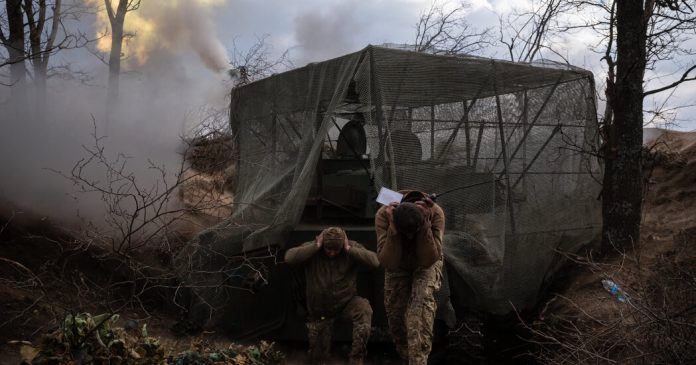
The U.S. military has conducted strikes against Houthi militia targets in Yemen daily since March 15, but the Pentagon has not provided details about the attacks since March 17, when it said more than 30 Houthi targets had been hit on the first day.

The military’s Central Command posts images on social media of jets conducting missions against the Houthis, an Iranian-backed group, but it has refused to disclose how many targets have been struck so far or to identify the several Houthi commanders it says it has killed.

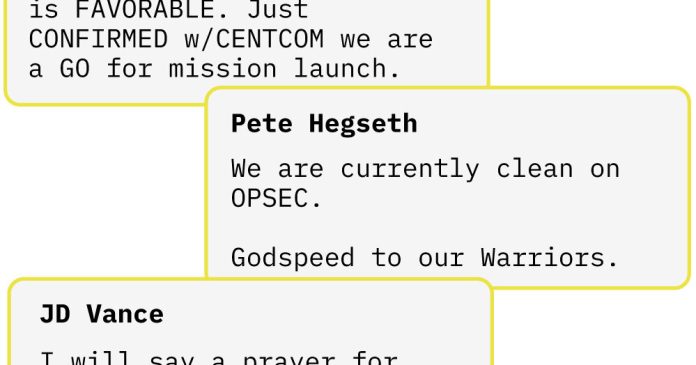
The strikes in Yemen are at the center of a debacle involving Defense Secretary Pete Hegseth and other senior members of the Trump administration, who discussed sensitive details about the planned mission in a group chat on a messaging app before it began.

On Monday, the editor in chief of The Atlantic magazine, Jeffrey Goldberg, wrote that he had been inadvertently included in the chat, the details of which could have endangered the lives of American fighter pilots.

President Trump said that he was ultimately not concerned about the leak, insisting that “there was no harm done, because the attack was unbelievably successful.”

But few details have been released.

A Central Command spokesman said this week that the strikes had “destroyed command-and-controlled facilities, air defense systems, weapons manufacturing facilities and advanced weapons storage locations.”

“While the Houthis still maintain capability, it is largely because of the nearly 10 years of support provided by Iran,” the spokesman said.

The air and naval strikes are intended to pressure the Houthis, whose attacks have disrupted international shipping lanes in the Red Sea for more than a year.

The Trump administration has not said why it thinks its campaign against the group, which has large underground weapons factories, will succeed after a yearlong effort by the Biden administration largely failed to deter the Houthi attacks.

The United States began the new offensive on March 15 in parts of northern Yemen controlled by the Houthis. Navy attack planes, off the aircraft carrier Harry S. Truman in the Red Sea, and Air Force fighter jets, flying from bases in the Middle East, have conducted strikes against Houthi targets each day since.

The initial strikes were the opening salvo in what senior American officials said was a new offensive against the militants and a message to Iran as Mr. Trump seeks a nuclear deal with its government.

Mr. Trump has delegated the authority to strike targets to regional and local commanders, allowing them to attack Houthi sites more quickly and efficiently, commanders say.

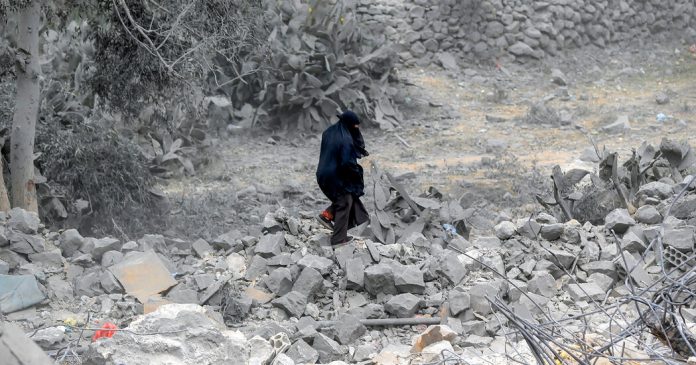
Yemeni officials say the strikes have hit residential areas and buildings in the heart Sana, Yemen’s capital, resulting in an undetermined number of civilian casualties. Central Command declined to comment on reports of civilians having been killed in the strikes.

On the first day of the new offensive, Mr. Trump said on social media that the Houthis “have waged an unrelenting campaign of piracy, violence, and terrorism against American, and other, ships, aircraft, and drones.”

Mr. Trump then pivoted to Iran’s rulers in Tehran: “To Iran: Support for the Houthi terrorists must end IMMEDIATELY! Do NOT threaten the American People, their President, who has received one of the largest mandates in Presidential History, or Worldwide shipping lanes. If you do, BEWARE, because America will hold you fully accountable.”

The Biden administration, often working with the British military, conducted several strikes against the Houthis but largely failed to restore stability to the region.

U.S. officials said that airstrikes against the Houthis’ arsenal, much of which is buried deep underground, could last for several weeks, intensifying in scope and scale depending on the militants’ reaction. U.S. intelligence agencies have struggled in the past to identify and locate Houthi weapons systems, which are produced in subterranean factories and smuggled in from Iran.

Vice Admiral Kevin M. Donegan, a retired F/A-18 pilot and commander of U.S. naval forces in the Middle East, expressed support for what he said was the Trump administration’s more comprehensive approach of destroying the Houthi network that is carrying out the strikes against shipping.

“Time will tell if this network approach will re-establish the free flow of commerce, but the metric of success is a simple one: commercial ship traffic through the Red Sea resumes or the Red Sea remains closed,” Admiral Donegan said in a phone interview.

Saeed Al-Batati contributed reporting from Al Mukalla, Yemen.

As U.S. foreign aid grants get slashed, Greenland gets money for a dog race : NPR

0

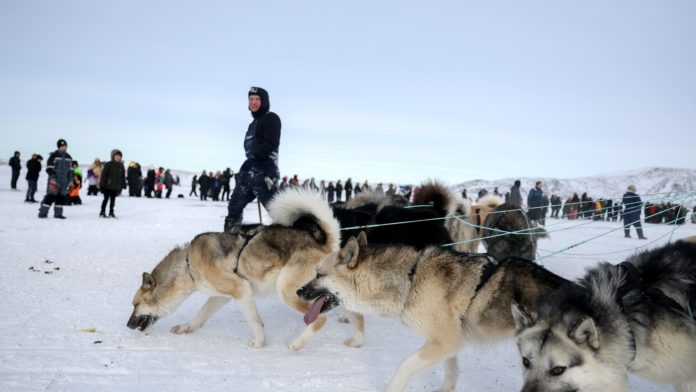
A musher walks with his Greenlandic sled dogs after completing a dog sled race to determine which contestant attends the national competition on March 8 in Ilulissat, Greenland.

Joe Raedle/Getty Images


hide caption

toggle caption

Joe Raedle/Getty Images

Second lady Usha Vance has scrapped a plan to attend Greenland’s national dog sled race this week. But American tax dollars will help support the race anyway.

NPR has learned that the State Department has provided a grant to transport the dogs, sleds and racers by air from around Greenland for the race. The State Department did not provide a cost estimate, but a U.S. official not authorized to speak publicly said it’s in the range of tens of thousands of dollars.

“The United States, through our Consulate in Nuuk, sponsored the transport of all dogs, sleds, and racers to and from 10 cities and towns around Greenland for the race,” a State Department spokesman told NPR in a statement. “We are still coordinating with race organizers to determine needs and fix a final amount of our sponsorship.”

This all comes as Secretary of State Marco Rubio has cancelled more than 80 percent of foreign aid grants. Grants are now screened to determine whether they make the U.S. stronger, safer and more prosperous. At the same time, the Trump administration has made cuts to grants for USAID programs around the world and also frozen funding for Fulbright scholars.

Mikkel Jeremiasson, who chairs Greenland’s national dog sled race, told local reporters that the exact amount from the State Department for transporting the dogs, racers and equipment was substantial but the exact amount is confidential due to the terms of the agreement. Danish newspaper, Berlingske, reports that Air Greenland has been told to send invoices for the flights to the U.S. Consulate in the capital city, Nuuk.

The Pituffik Space Base (formerly Thule Air Base) is pictured in northern Greenland, on Oct. 4, 2023. The base changed its name earlier in 2023.

The Pituffik Space Base (formerly Thule Air Base) is pictured in northern Greenland, on Oct. 4, 2023. The base changed its name earlier in 2023.

Thomas Traasdahl/Ritzau Scanpix/AFP via Getty Images


hide caption

toggle caption

Thomas Traasdahl/Ritzau Scanpix/AFP via Getty Images

Instead of attending the race on the trip, Vice President JD Vance will now accompany Usha Vance to an American Space Force base in Pituffik, amid planned protests at the dog race and rising anger among Greenland and Danish officials over President Trump’s efforts to make Greenland part of the United States. National polls have shown most Greenlanders are against becoming part of the United States. Protests have popped up around the country, with Greenlanders wearing “Make America Go Away” caps and holding “Yankees go home” banners.

“This is clearly a deescalation,” Danish Foreign Minister Lars Lokke Rasmussen said of the decision by Usha Vance to forgo the dog sled race. “I think it’s very positive that the Americans cancelled their visit to the Greenlandic Society. Instead their own base, Pituffik, and we have nothing against that.”

“There was so much excitement around Usha’s visit to Greenland this Friday that I decided that I didn’t want her to have all that fun by herself, and so I’m going to join her,” Vance said in a video released on X on Tuesday afternoon.

The Vances plan to visit American troops at the Pituffik Space Base and get briefings from service members. The base, once known at Thule Air Base, has some 650 personnel, including U.S. Air Force and Space Force members, as well as Canadian, Danish and Greenlandic civilian contractors.

“It’s really important,” Vance said in the video. “A lot of other countries have threatened Greenland, have threatened to use its territories and its waterways to threaten the United States, to threaten Canada, and of course, to threaten the people of Greenland, so we’re going to check out how things are going there.”

Vance said the Trump administration wants to “reinvigorate” security for Greenland, adding that leaders in both America and Denmark have “ignored Greenland for far too long.” He said that’s been bad for Greenland and “the security of the entire world.”

Greenland’s Prime Minister Mute Egede has called the visit part of a “very aggressive American pressure against the Greenlandic community.” Danish Prime Minister Mette Frederickson called the U.S. delegation an “unacceptable pressure” and vowed resistance.

Jens-Frederik Nielsen, leader of the Greenland’s Demokraatit party and poised to be the country’s next prime minister following elections earlier this month, said the visit showed a “lack of respect for the Greenlandic people.”

Trump, in an interview with podcaster Vince Coglianese on Wednesday, once again called for Greenland to become part of the United States.

America has “to let them know that we need Greenland for international safety and security. We need it. We have to have it,” Trump said. “It’s [an] island from a defensive posture and even offensive posture is something we need. … When you look at the ships going up their shore by the hundreds, it’s a busy place.”

Jair Bolsonaro Ordered to Face Trial in Brazil for Attempting a Coup

0

Jair Bolsonaro, Brazil’s former president, will face trial on charges that he oversaw a vast scheme to cling to power after losing the 2022 elections, including an attempt to overturn the vote and a plot to assassinate the nation’s president-elect, the country’s Supreme Court decided on Wednesday.

The ruling marks a significant effort to hold Mr. Bolsonaro accountable for accusations that he sought to effectively dismantle Brazil’s democracy by orchestrating a broad plan to stage a coup.

Supreme Court Justice Alexandre de Moraes, who is overseeing the case, said in explaining his decision that there was no doubt Mr. Bolsonaro “knew, handled and discussed” plans for a coup.

Mr. Bolsonaro and seven members of his inner circle, including his running mate and a former spy chief, will be tried on charges filed by prosecutors last month of “violent abolition of the democratic rule of law” and “coup d’état,” among other crimes.

In a surprise move, Mr. Bolsonaro attended the first day of the two-day hearing alongside his lawyers but remained silent.

Mr. Bolsonaro, in a statement, said the court’s decision was politically motivated, calling it an attempt to “silence the opposition.”

Mr. Bolsonaro, who has been barred from running for office until 2030, added that the president should be chosen by Brazilians “at the ballot box, not a handful of judges in a courtroom.”

Celso Sanchez Vilardi, one of Mr. Bolsonaro’s lawyers, did not deny the existence of a coup plot, calling the details of the plan “very serious” in his argument before the high court. But he insisted that there was no link between Mr. Bolsonaro and the scheme.

“Bolsonaro is the most investigated president in the country’s history,” Mr. Vilardi told the court. “Absolutely nothing has been found.”

The five-justice Supreme Court panel voted unanimously to move forward with a trial.

The trial, which has yet to be scheduled, is the fruit of a sweeping two-year investigation in which the police raided homes and offices, arrested people close to Mr. Bolsonaro and secured a key confession from a senior aide to the former president.

In a 884-page report unsealed last November, investigators accused Mr. Bolsonaro of directing and approving a detailed plot, which included plans to annul the election results, disband courts, grant special powers to the military and poison President-elect Luiz Inácio Lula da Silva days before he was to take office.

Justice Moraes, who is seen by the far-right as an opponent of Mr. Bolsonaro, was himself the target of assassination plans revealed by the coup probe.

The investigation revealed how close Brazil came to returning to a military dictatorship nearly four decades into its history as a modern democracy.

The scheme, according to prosecutors, also included sowing unfounded doubts about the reliability of Brazil’s electronic voting machines in the months leading up to the 2022 vote. Mr. Bolsonaro claimed he could only lose if the election were rigged in his opponent’s favor.

After Mr. Bolsonaro lost, he and his allies encouraged right-wing protesters to camp out in front of military barracks across the nation, demanding that the army overturn the results. A week after Mr. Lula took office, many of those protesters stormed Brazil’s halls of power in an episode that echoed the Jan. 6 attack on the Capitol by supporters of President Trump.

Experts say it is unlikely that Mr. Bolsonaro will be arrested ahead of his trial, unless Justice Moraes deems him to be a flight risk.

After the police searched Mr. Bolsonaro’s home and seized his passport last year, he spent two nights in the Hungarian Embassy in Brazil, raising questions over whether he had sought to use his ties with a fellow right-wing leader as leverage to evade possible arrest.

If convicted, Mr. Bolsonaro could face 12 to 40 years in prison, according to the indictment, though political analysts expect any sentence to be shorter. A conviction would also make him permanently ineligible to run for office under current law.

In an attempt to save Mr. Bolsonaro’s political future, lawmakers allied with the former president have tried to amend a Brazilian law that prohibits convicted criminals from running for office.

They have also pushed for a new bill that would pardon those convicted over the Jan. 8, 2023 insurrection in Brazil’s capital, which could also benefit Mr. Bolsonaro’s efforts to run again.

Mr. Bolsonaro also appears to be placing a bet on support from Mr. Trump. Last week, one of Mr. Bolsonaro’s sons said that he plans to seek political asylum in the United States and lobby the Trump administration to pressure Brazilian authorities to halt what he calls the unjust pursuit of his father.

Last month, just hours after Brazilian prosecutors indicted Mr. Bolsonaro, Mr. Trump’s media company sued Justice Moraes, the judge overseeing the case, in U.S. federal court, accusing him of illegally censoring right-wing voices on social media.

Social Security officials partially walk back plans for in-person verification : NPR

0

A Social Security Administration (SSA) office in Washington, D.C., is seen on March 26.

Saul Loeb/AFP via Getty Images


hide caption

toggle caption

Saul Loeb/AFP via Getty Images

The Social Security Administration is revising proposed changes that would have required some beneficiaries to prove their identity in-person when seeking services.

Officials said in a statement Wednesday that they are exempting people who apply for Medicare and disability benefits, as well as supplemental income help for the poor, from having to prove their identity in-person at a social security office if they are unable to use the agency’s online system.

They also announced they are pushing back the start of the new policy by two weeks, to April 14.

The new rules, which were first announced last week, were met with concerns from advocates for seniors and people with disabilities, as well as lawmakers. Dozens of Democratic members of Congress sent a letter to agency leaders last week asking them to reconsider the change because it would “create additional barriers” for people seeking services — “particularly for those who live far from an office.”

“We have listened to our customers, Congress, advocates, and others, and we are updating our policy to provide better customer service to the country’s most vulnerable populations,” Lee Dudek, acting commissioner of Social Security, said in the Wednesday statement.

For decades now, claimants have been able to complete their benefit application process entirely by phone.

But last week, Social Security officials announced that people who cannot prove their identity using the agency’s online system would be required to show up in person when seeking benefits or changing direct deposit information.

Dudek, who was tapped for the role by President Trump, said the policy change was an effort to carry out the administration’s goal of protecting benefits while rooting out waste and alleged fraud.

“For far too long, the agency has used antiquated methods for proving identity,” Dudek said in a statement. “Social Security can better protect Americans while expediting service.”

But advocates and others warned the changes were in service of inflated and unsubstantiated fraud claims.

“The new policy is supposedly intended to prevent ‘fraud,’ without any proof that phone claims were being paid out fraudulently,” Max Richtman, president and CEO of the National Committee to Preserve Social Security and Medicare, said in a statement last week. “The new process would force seniors and people with disabilities to navigate a needless technical hurdle in applying for their earned benefits.”

According to the agency, these new identity requirements will now apply only to people seeking retirement, survivor or auxiliary benefits.

As of last month, more than 50 million Americans received retirement benefits from the SSA and thousands of Americans newly qualify for benefits every day.