


Frustrated and angry over the collapse of a cease-fire with Israel, Palestinians took to the streets of northern Gaza to protest against the war. Many chanted anti-Hamas slogans, calling for the group to “get out.”
VP Vance and his wife change up trip to Greenland amid protests

The prospect of a visit by Vice President JD Vance and second lady Usha Vance to Greenland on Thursday is not getting a warm welcome.
Thursday Briefing: More Signal Texts Released
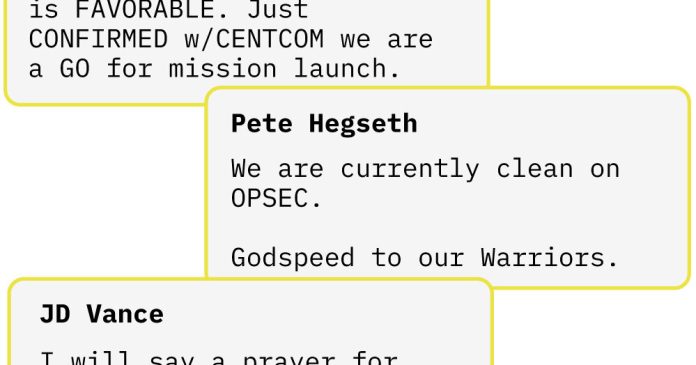
Newly released Signal texts showed what was at stake
More messages were released yesterday from a Signal group chat between President Trump’s top security officials laying out plans to strike Houthi targets in Yemen. The Atlantic — whose editor in chief had been inadvertently added to the group, and who first wrote about the leak on Monday — published a fuller transcript.
The leaked chat led to mounting calls by Democrats for Defense Secretary Pete Hegseth to step down, saying he had behaved recklessly and could have endangered American troops. Hegseth revealed the precise timing of the strikes on Houthi targets.
Tulsi Gabbard, the national intelligence director, and John Ratcliffe, the head of the C.I.A., faced intense questions during a hearing in Congress. Speaking to reporters yesterday, Hegseth did not offer an apology for the disclosures and insisted that the information shared in the chat was not “war plans.”
My colleague David Sanger, our White House correspondent who covers national security, told us that, technically, the exchanges did not include war plans. But Hegseth’s descriptions were so detailed that it may be a distinction without a difference. “Had the chat leaked,” David said, “it could have given advance warning to the Houthis, who could have simply left the site and defeated the mission. They could have also prepared to launch against the planes, which would have put the pilots’ lives at risk.”
Paramilitary fighters fled Sudan’s capital
Gen. Abdel Fattah al-Burhan, Sudan’s military chief, said yesterday that “Khartoum is now free,” as the Rapid Support Forces, a paramilitary group, withdrew in large numbers from the capital they had occupied since civil war broke out nearly two years ago.
General al-Burhan arrived by helicopter for a brief visit to the battle-ravaged presidential palace, which his forces had seized days earlier. The military announced it had captured a large R.S.F. base and was pursuing the remaining forces across the city. Drone footage from Sudan’s military showed hundreds of R.S.F. fighters fleeing across a dam south of the capital — their last remaining escape route.
Context: The capture of the capital marked a shift in Africa’s largest war, which has killed an estimated 150,000 people and displaced more than 13 million.
What’s next: Analysts said the R.S.F. was likely to regroup in Darfur, where the group’s leaders say they will establish a parallel government and continue to fight.
South Korea battled some of its worst-ever wildfires
At least 24 people in South Korea have died, and dozens have been injured, in wildfires that the acting president said yesterday appeared to be “breaking the record” for the worst ever. Fire crews continued to fight the blazes, which have been fueled by windy and dry conditions. Of the nearly 30 fires that began since Friday, eight were still burning yesterday.
Details: The fires began in the country’s southeast. Tens of thousands of acres have been scorched, the government said, and more than 27,000 people evacuated, including residents of a UNESCO World Heritage site.
On a luxurious train trip from Cape Town to Pretoria, my colleague John Eligon grappled with the whiplash of traveling through South Africa’s two worlds, from majestic mountains to struggling shantytowns.
“Few things scream excess more than a train with hot showers, air conditioning and an open bar,” John wrote, “crawling past settlements where many people live in shacks without running water or electricity.”
Lives lived: Oleg Gordievsky, who was the top K.G.B. agent in London until he defected and became a double agent for British intelligence, died at 86.
CONVERSATION STARTERS
A K-pop David and Goliath
The five-member girl group NewJeans, K-pop’s most imaginative group of the last three years, seemed invincible. But now its members are locked in a legal battle with their powerhouse label over their contract and their desire to change the group’s name.
They were recently forced to take the stage as NewJeans, but their song and wardrobe choices seemed intended to project defiance. Before the show ended, they announced an effective hiatus until legal issues were resolved. That NewJeans members spoke out on their own behalf was a rare act of boldness in the K-pop world. It might cost them their ability to perform.
RECOMMENDATIONS
Trump imposes new tariffs on imported cars : NPR

President Trump announces tariffs on auto imports in the Oval Office of the White House in Washington on Wednesday. Since returning to the presidency in January, Trump has already imposed tariffs on imports from major US trading partners Canada, Mexico and China — as well as a 25 percent duty on steel and aluminum imports. The move is set to fuel tensions with trading partners ahead of further promised levies next week.
Mandel Ngan/AFP via Getty Images
hide caption
toggle caption
Mandel Ngan/AFP via Getty Images
President Trump signed an executive order imposing 25% tariffs on imported cars on Wednesday.
“I think our automobile business will flourish like it’s never flourished before,” Trump said in remarks from the Oval Office.
The latest policy is yet another example of the president’s tariff-centric second-term economic agenda. Thus far, Trump has imposed tariffs on Chinese goods, steel and aluminum, and on some goods from Canada and Mexico. Trump also plans a wave of what he calls “reciprocal tariffs” to start April 2, which he has called “Liberation Day.” The taxes on imports have caused plummeting stock markets and consumer confidence, and have left businesses and consumers uncertain about what they want to invest in.
The Trump administration has given multiple rationales for these tariffs, but they have emphasized boosting manufacturing as the chief goal.

U.S. tariffs are paid to the government by businesses in the U.S. that are importing goods. Studies of tariffs imposed in Trump’s first term have shown they were overwhelmingly paid by U.S. businesses and consumers. The White House has said that foreign companies will lower their prices to compensate for tariffs, essentially eating the cost. However, when asked by NPR, they provided no data to support this.
Trump’s tariff policy has been chaotic throughout this presidency. In addition to the tariffs already imposed, he has threatened still more tariffs on a range of goods from around the world, at times announcing a tariff only to delay or retract that tariff.
Earlier this week, Trump floated what he called a “secondary tariff” of 25 percent on goods from any country buying oil or gas from Venezuela.

Wednesday’s auto tariffs were themselves moved up from April 2, when Trump had previously said those tariffs would begin.
On April 2, which Trump called “Liberation Day” in his remarks Wednesday, the president has said he will impose “reciprocal tariffs,” which he has described as being equal to tariffs other countries impose on U.S. goods. However, the White House has given few specific details on what those reciprocal tariffs will look like.
How Russia’s Tactics Give Them an Advantage in U.S.-led Peace Talks
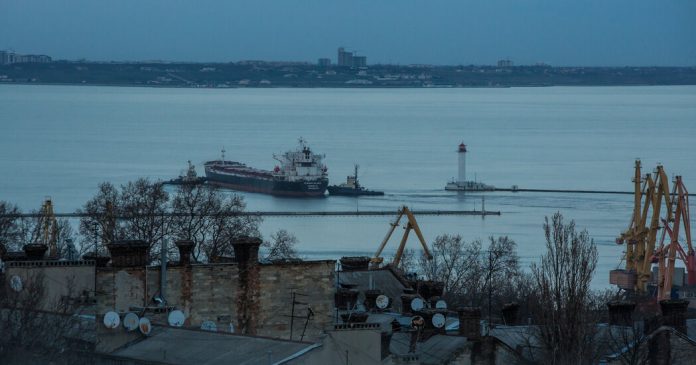
Ukraine thought it had a deal in place to suspend the fighting in the Black Sea immediately. Russia said economic sanctions would need to be lifted first. And the United States didn’t address the question of timing at all, merely repeating President Trump’s broad demand that the killing stop.
The conflicting statements released this week after midlevel cease-fire negotiations in Saudi Arabia were the latest sign of a chaotic process in which, analysts and experts said, the Kremlin appears to be playing for time and getting the upper hand.
The Trump administration has set out to secure a series of limited cease-fire deals, arguing that the modest agreements will pave the way for a broader truce and eventually a peace deal to end the conflict. But so far, these incremental deals have largely been a way for Russia to win concessions from Ukraine and good will from a White House eager to be seen as the peacemaker.
On Tuesday, Moscow said it would agree to the Black Sea truce only if sanctions on its state agriculture bank, Rosselkhozbank, and other restrictions were lifted. If Washington agrees to those terms and pressures European allies to do the same, the proposed Black Sea deal would benefit Moscow more than Kyiv, experts said.
The Black Sea negotiations followed another limited agreement brokered by Washington: a 30-day halt in strikes by Russia and Ukraine against energy targets. That deal also benefits Moscow, given the extensive damage Ukrainian strikes have inflicted on oil and gas installations across Russia, and it came with no clear enforcement mechanism. Both sides quickly accused each other of continuing such strikes.
And earlier this month, President Vladimir V. Putin of Russia effectively rejected a proposal for an overall 30-day cease-fire brokered by Washington and Kyiv. Mr. Putin set out conditions, including a freeze on Ukrainian personnel recruitment, military training and arms imports, that would have made Kyiv particularly vulnerable were fighting to resume.
“It seems clear that the Russians are stalling, and they are very good at that,” said Daniel Fried, a former top U.S. diplomat and fellow at the Atlantic Council in Washington, who has negotiated with the Russians in the past. “The Russians are drawing this out and loading it with conditions to send us down a rabbit hole of complexity.”
Mr. Trump on Tuesday acknowledged the Russian tactic without criticism. He thinks Moscow wants to see an end to the war, he said, “but it could be that they’re dragging their feet.”
He then recalled taking the same approach himself in business negotiations in the past, when he didn’t want to sign a contract but wanted to “sort of stay in the game.”
For Russia, staying in the talks has meant raising a series of demands, however unlikely some of them are to be met. Russia framed the proposed Black Sea deal as a way to revive a 2022 U.N.-backed deal that gave it some control over commercial shipping through the sea.
That deal allowed Ukraine to export its grain through an agreed-upon shipping corridor, but also permitted Russia to inspect all commercial ships to ensure they did not carry weapons. Experts say Russia exploited that provision to stall Ukrainian seaborne exports.
After the deal collapsed in 2023, Ukraine successfully pushed the Russian Navy out of the western Black Sea to secure its own shipping corridor. The operation was so successful that seaborne grain exports returned to near-prewar levels, above the levels reached during the time of the U.N.-backed deal.
Against that backdrop, Kyiv has no interest in acceding to Moscow’s demands, experts say. Mr. Fried noted that for a Black Sea deal to be seen as balanced, it would need to include a clear benefit to Kyiv, such as a commitment by the Russians to halt attacks on the southern port of Odesa or on all Ukrainian agriculture export facilities.
The White House did not explicitly refer to such a commitment in its statements on Tuesday, which referred only to the elimination of “the use of force” in the Black Sea.
The conditions set out by the Kremlin on Tuesday also introduced the possibility of the United States lifting sanctions as a precondition to Russian action — a move European Union leaders firmly oppose. Asked about the Black Sea negotiations on Wednesday, President Emmanuel Macron of France said that Mr. Trump’s concept of “peace through strength” should not “begin with removing sanctions before having received or verified anything.”
Mr. Fried said he saw no substantive concession on the Russian side that would merit such a step.
“The Russians have managed to put this on the agenda, which means they have injected sanctions lifting as part of the early negotiating process,” Mr. Fried said. “Why is it in our interest to do that? What is the reciprocal move we are going to get from the Russians?”
Mr. Trump has threatened Russia with consequences if it doesn’t pursue peace, but his administration so far hasn’t followed through. It has instead accepted and repeated Mr. Putin’s statements about wanting to end the conflict and talking up the possibilities of a renewed era of cooperation with Russia.
President Volodymyr Zelensky of Ukraine said on Tuesday that Moscow’s conditions on the Black Sea deal were further evidence of the Kremlin seeking more concessions while deceiving the United States about its real intentions.
Mr. Putin has shown few signs of backing off his aim to subdue Ukraine as a satellite nation under Russia’s thumb. He has regularly said that Russian forces are on the front foot on the battlefield and that a cease-fire would only benefit Kyiv. He does, however, want to continue the Trump administration’s rapid rapprochement with Moscow, pointing to joint economic projects that Russia and the United States could pursue.
The conditions Moscow set on the Black Sea agreement have little chance of being met anytime soon. They included a demand to reconnect the Russian state agriculture bank to the international payment system known as Swift. That would require the cooperation of European countries that have been cut out of the talks.
Alexander Kolyandr, a senior fellow at the Center for European Policy Analysis, said removing sanctions from the bank would bring significant benefit to Moscow.
“They definitely want a large state-owned bank outside of the sanctions, because the moment you have a financially kosher bank, you can do whatever you want,” he said. “They can clear transactions; they can move money between countries; they can pay for imports in dollars, which is always cheaper; and they can receive dollars for their exports.”
Even if Moscow, Washington and Kyiv resolve the differences in their statements on the Black Sea deal, the discussed cease-fire would do little more than enshrine the status quo, said Andrey Sizov, director of Sovecon, an agriculture market analysis firm.
Mr. Sizov noted that Ukraine has been exporting grain successfully through the Black Sea since late 2023, and Russia has been exporting both oil and grain, even though restrictions have made the activity more expensive for Moscow. He sees the current talks as a formalization of the existing arrangement.
“It’s not a step ahead,” he said. “In my view, it shows that progress toward a full truce, toward a full cease-fire, is quite limited, if any.”
Constant Méheut contributed reporting from Kyiv, Ukraine.
Bolsonaro must face trial over alleged coup attempt, Brazil’s top court says : NPR
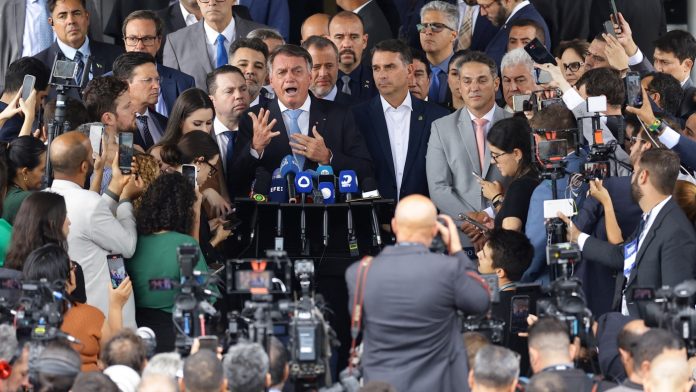
Former Brazilian President Jair Bolsonaro speaks to reporters after the Supreme Court voted that he should stand trial for allegedly attempting a coup after his 2022 electoral defeat, in Brasilia, Brazil, Wednesday.
Ueslei Marcelino/Reuters
hide caption
toggle caption
Ueslei Marcelino/Reuters
RIO DE JANEIRO, Brazil — Five Supreme Court justices ruled that former Brazilian President Jair Bolsonaro will stand trial for allegedly attempting to overturn his 2022 reelection loss and stage a violent coup.
The panel of justices voted to move forward with the trial on the second day of proceedings against the former far-right leader. They all agreed that the allegations against Bolsonaro outlined in a 884-page report by federal investigative police, made public last November, warranted the trial.
Prosecutors say Bolsonaro participated and directed a plot to overturn his reelection loss and even planned to poison his successor and current president, Luiz Inácio Lula da Silva, and kill the vice president and a supreme court justice.
That same justice, Alexandre Moraes, oversaw this week’s proceedings and said there was “reasonable evidence” that Bolsonaro “knew, handled and discussed” plans for a coup.
Bolsonaro has long denied any wrongdoing and claims his prosecution is politically motivated.
Posting on the social media site X Wednesday, he said the justices are biased against him and rushed through the proceedings so he could not run again for office in 2026. He also gave a lengthy defense following the ruling, declaring his innocence.
The five justices on the panel were unanimous in their order. They said seven close Bolsonaro allies should also stand trial on five counts: attempting to stage a coup, involvement in an armed criminal organization, attempted violent abolition of the democratic rule of law, damage characterized by violence and a serious threat against the state’s assets and deterioration of listed heritage.
The Bolsonaro allies are former defense ministers Gen. Walter Braga Netto and Gen. Paulo Sérgio Nogueira de Oliveira; Bolsonaro’s former navy commander, Adm. Almir Garnier Santos; his former security minister, Anderson Torres; his former spy chief, Alexandre Ramagem; his former minister for institutional security, Gen. Augusto Heleno and his former assistant, Lt. Col. Mauro Cid.
Cid struck a plea deal with prosecutors and will face a lighter sentence if convicted.
Although Bolsonaro attended the first day of the proceedings, he was not present when the panel ruled.
This is a major defeat for the ex-president, who held office from 2019 to the end of 2022.
After narrowly losing reelection, Bolsonaro’s supporters camped out in front of military installations around Brazil, urging the military to step in and overturn the results. Bolsonaro left for the United States before his successor took office. A week after inauguration day, his supporters ransacked government buildings in the capital Brasilia. More than 1,400 were arrested.
Bolsonaro has already been banned from running for office until 2030. He was barred by Brazil’s electoral courts for abuse of power after he made unfounded claims about Brazil’s voting system ahead of the 2022 elections.

He is also facing investigations for falsifying vaccination records and personally profiting from the illegal sale of gifts given to the president’s office from foreign governments. Police raided his home in 2023 while investigating possible falsification of COVID-19 vaccine cards, which they said was done so that unvaccinated travelers, including Bolsonaro, could enter the U.S. and skirt mandatory immunization requirements at the time.
If he is convicted on the current charges, he could be permanently banned from politics and face decades in prison.
Producer Valdemar Geo contributed to this report in Rio de Janeiro.
Oleg Gordievsky, K.G.B. Officer Turned Double Agent, Dies at 86
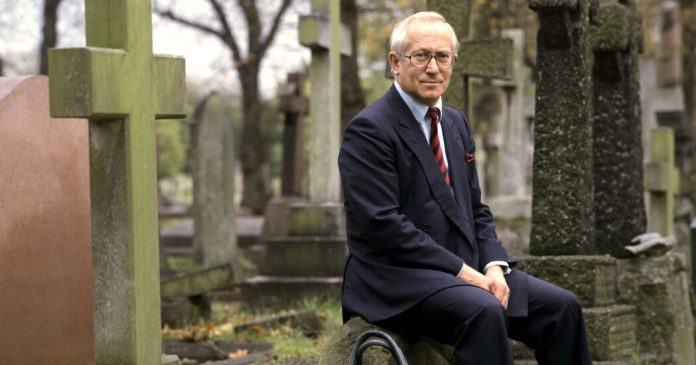
Oleg Gordievsky, who was the top K.G.B. agent in London until he defected to the West in 1985 and revealed himself as a longtime double agent for British intelligence — making him one of the most highly placed Western spies during the Cold War — was found dead at his home in Godalming, southwest of London, on March 4. He was 86.
The local police, who discovered his body, said that they did not believe foul play was involved but that an investigation was ongoing.
The British foreign intelligence agency, MI6, first recruited Mr. Gordievsky in 1974, when he was based in Copenhagen. In 1982 he moved to London, where the K.G.B. tasked him with seeding disinformation about Prime Minister Margaret Thatcher before the next year’s general election.
In practice he helped the British root out secret operatives and informants working for the Soviet Union. He kept up enough of a front to please his K.G.B. bosses in Moscow, who soon promoted him to rezident, or head agent, in Britain.
He also played a crucial role in preventing what could have become World War III.
By the early 1980s, the Soviets were convinced that the United States was planning a first-strike nuclear attack under the guise of a major NATO exercise, a suspicion underlined by President Ronald Reagan’s bellicose rhetoric.
As NATO carried out the exercise, known as Able Archer 83, the Soviets and their Warsaw Pact allies moved onto a war footing. Historians consider this to have been the closest moment to world war since the Cuban Missile Crisis in 1962.
Mr. Gordievsky was in a unique position to work both sides. He was able to persuade Moscow that an attack was not in fact imminent while also communicating Soviet fears to the British and the Americans. As a result, Mrs. Thatcher and Mr. Reagan pared back their language, and future military exercises were more limited.
All of this remained secret for years afterward, and in the meantime Mr. Gordievsky had to watch his own back. In 1985 he was recalled to Moscow, given drugs and interrogated. Someone, it seemed, had tipped off the K.G.B. to the presence of a high-ranking mole in London.
Lacking solid evidence, the Soviets placed him on leave. A few days later he appeared at 7 p.m. on a Moscow street corner, holding a shopping bag. A man soon passed, eating a candy bar. They locked eyes.
That was the signal to activate Operation Pimlico, an emergency extraction. Mr. Gordievsky shook his K.G.B. tail and then hurried to the Finnish border. Two British agents, a man and a woman, along with their baby, awaited him there in their Ford Sierra.
They placed him in the trunk, wrapped in a foil sheet to confuse heat detectors. When dogs at the border grew suspicious, the agents began to change the child’s diaper, filling the car with odors that threw the canines off Mr. Gordievsky’s scent.
When they were finally across, they played Jean Sibelius’s “Finlandia” symphony on the car’s sound system, a signal to Mr. Gordievsky that he was safe.
Back in Moscow, he was sentenced to death in absentia. That sentence has never been rescinded.
Oleg Antonovich Gordievsky was born on Oct. 10, 1938, in Moscow. His father, Anton, was an agent with the N.K.V.D., the forerunner of the K.G.B., and his mother, Olga, was a statistician. His father was a committed Communist, but his mother quietly reviled the party, an attitude that greatly influenced her son.
Still, there was no question where his future lay. He graduated from the elite Moscow State Institute of International Relations in 1961, and he joined the K.G.B. two years later.
After an initial posting in East Berlin, he did two tours at the Soviet Embassy in Copenhagen, with time in between to improve his spycraft.
But as he rose in the K.G.B. ranks, he also grew disillusioned with Communism. In Germany he had seen the newly erected Berlin Wall split families, and from afar he had watched the Soviet Union crush the Prague Spring movement of 1968.
Working on a suggestion from a double agent who was a former colleague of Mr. Gordievsky’s, British intelligence agents began to feel him out in Copenhagen. Once he turned, he was considered among the West’s prize assets — so prized that the Americans and even Mrs. Thatcher did not know his identity.
While continuing to provide intelligence to Moscow — bits of low-value information fed to him by his MI6 handlers — he helped Western governments uncover spies within their ranks. Among them were Arne Treholt, a Norwegian diplomat, and Michael Bettaney, a British counterintelligence officer who in 1983 tried to pass classified documents to Arkady Guk, the rezident at the time.
The ensuing scandal led the Soviets to recall Mr. Guk, opening the door for Mr. Gordievsky to replace him.
Both sides in the Cold War used moles like Mr. Gordievsky to hunt for spies. It was later revealed that his cover was blown by Aldrich Ames, a C.I.A. officer who began working for the Soviets in 1985. Mr. Gordievsky was one of the first double agents Mr. Ames exposed and one of the few who escaped; nearly a dozen others were executed.
After defecting, Mr. Gordievsky lived under an assumed name in Godalming but continued to advise British intelligence. As the Cold War wound down, he began writing under his own name, including articles for The Daily Telegraph and the books “KGB: The Inside Story” (1990), a collaboration with the historian Christopher Andrew, and “Next Stop Execution: The Autobiography of Oleg Gordievsky” (1995).
His story was also the subject of “The Spy and the Traitor: The Greatest Espionage Story of the Cold War” (2018), by Ben Macintyre.
Mr. Gordievsky’s first marriage, to Yelena Akopian, a fellow K.G.B. agent, ended in divorce. He married Leila Aliyeva in 1979.
After defecting, Mr. Gordievsky spent years trying to get the Soviet Union to allow his wife and their two daughters, Mariya and Anna, to join him. They arrived in Britain in 1991, but the couple soon divorced.
Mr. Gordievsky’s survivors include his daughters.
Beginning in the mid-2000s, Mr. Gordievsky raised alarms about the increasing authoritarian rule of President Vladimir V. Putin of Russia, including his deployment of a robust network of spies and subversives.
When his friend and fellow defector Alexander Litvinenko was fatally poisoned by Russian agents in London in 2006, Mr. Gordievsky began to fear for his life. When he fell ill and went into a temporary coma in 2008, he maintained that he, too, had been poisoned by Russian agents.
Mr. Gordievsky continued to warn about renewed Russian espionage, saying that Britain had naïvely lowered its defenses.
“It is easier than ever to work and recruit here,” he wrote in The Daily Telegraph in 2010. “If anything, the overall Russian espionage presence in Britain is now bigger and more active than in my time.”
Federal judge Trump wants impeached will oversee Signal case : NPR
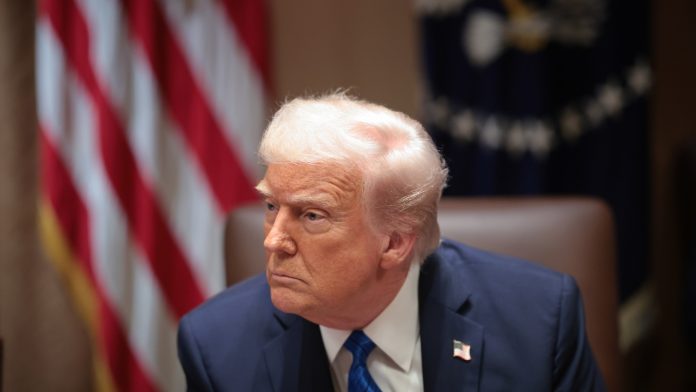
President Trump takes questions from reporters during an Ambassador Meeting in the Cabinet Room of the White House on Tuesday, where he addressed the news that Jeffrey Goldberg, the editor-in-chief of The Atlantic, was accidentally added to a Signal group chat of top administration officials, where highly sensitive national security information was discussed.
Win McNamee/Getty Images/Getty Images North America
hide caption
toggle caption
Win McNamee/Getty Images/Getty Images North America
A federal judge in Washington who has caught the ire of President Trump for his role in the case involving the deportation of alleged gang members will also preside over a case involving the administration’s use of a messaging app to discuss military operations.
Chief Judge James Boasberg will oversee a new lawsuit brought against several senior national security officials after a reporter was unintentionally added to a Signal group chat where the planned bombing of Houthi targets in Yemen was discussed. Intelligence experts say the use of the chat group to discuss such operational matters is highly unusual. The White House denies that the matters discussed were classified.

While judges typically do not have control over what cases they are assigned, this latest assignment comes shortly after Boasberg has been in the spotlight while overseeing another high-profile case involving the Trump administration’s deportation of alleged Venezuelan gang members to El Salvador.
Boasberg imposed a temporary restraining order on the action, but the administration is in the process of appealing.
Trump has criticized Boasberg’s handling of that case, calling him a “Radical Left Lunatic of a Judge” in a post on social media and arguing that the American public elected him to curb illegal immigration.
“I’m just doing what the VOTERS wanted me to do,” Trump said. “This judge, like many of the Crooked Judges’ I am forced to appear before, should be IMPEACHED!!!

The statement raised concern in the legal community and prompted Supreme Court Chief Justice John Roberts to say in a rare statement that “impeachment is not an appropriate response to disagreement concerning a judicial decision.”
As chief judge of the federal district court, Boasberg has dealt with legal matters involving Trump in the past. Notably, he ruled former Vice President Mike Pence had to testify in front of a grand jury in the Justice Department’s probe into Jan. 6.
The latest legal challenge, this time over the Signal group chat, was brought by American Oversight, a watchdog group. The group alleges that the use of Signal violates federal law that covers the preservation of government records.

The lawsuit is directed toward the National Archives as well as Secretary of Defense Pete Hegseth, Director of National Intelligence Tulsi Gabbard, Director of the Central Intelligence Agency John Ratcliffe, Treasury Secretary Scott Bessent and Secretary of State Marco Rubio — who were all present in the Signal group chat.
That discussion was first reported in The Atlantic by Jeffrey Goldberg, editor-in-chief of the magazine, who was the reporter accidentally added to the chat.
NPR disclosure: Katherine Maher, the CEO of NPR, chairs the board of the Signal Foundation.
Turkey’s Opposition Calls for Boycott and Mass Protests After Arrest of Istanbul Mayor
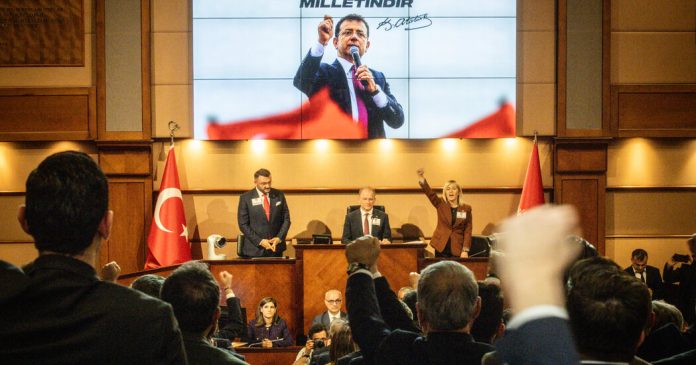
One week after the Turkish government arrested the mayor of Istanbul, who is the top rival to President Recep Tayyip Erdogan, the political opposition on Wednesday pressed new tactics to fight what it called an assault on the country’s democracy.
The arrest has set off nightly demonstrations that have drawn hundreds of thousands of antigovernment protesters to the streets of Istanbul and other cities. Now, Mr. Erdogan’s opponents are calling on Turks to boycott companies said to support Mr. Erdogan and vowing to organize a mass protest on Saturday in place of the smaller rallies.
The shift in tactics — including holding public fast-breaking meals for people observing the Muslim holy month of Ramadan — came amid a government crackdown on protesters. The government has issued protest bans in major cities and limited access to social media sites; some protesters have clashed with riot police using water cannons and pepper spray to clear them from the streets.
More than 1,300 people have been arrested in recent days in connection with the demonstrations, the Interior Ministry said, and about 170 have been jailed pending trial. Those arrested included 11 journalists, some of whom remained in custody on Wednesday, including a photographer for Agence France-Presse.
The government has accused Mr. Imamoglu, 54, of leading a criminal organization in City Hall and accepting bribes, rigging bids and misusing citizens’ personal data. He has denied the charges.
Mr. Erdogan has described the protesters, many of whom are university students, as violent vandals and has accused the country’s main opposition party of stirring up trouble to distract from the accusations against the mayor.
“A great country like Turkey has a very small, very underdeveloped, very inadequate main opposition party,” Mr. Erdogan said on Monday. “It has become clear that you cannot trust them to run even a snack shop, let alone the state or the municipalities.”
While some European leaders have called on Turkey to uphold the rule of law, senior White House officials have not publicly commented on Mr. Imamoglu’s arrest.
President Trump complimented Turkey and Mr. Erdogan in a meeting on Tuesday with ambassadorial nominees. “Good place,” Mr. Trump said. “Good leader, too.”
On Wednesday, Istanbul’s City Council elected an interim mayor — Nuri Aslan, who previously served as the council’s deputy head — to run the city of 16 million people while Mr. Imamoglu remained in detention. The opposition holds a majority on the council.
The head of Mr. Imamoglu’s Republican People’s Party, Ozgur Ozel, has criticized pro-government news outlets for not sufficiently covering the protests. And the party has called for a boycott of Turkish businesses connected to those outlets.
A website launched to coordinate the boycott lists the names and logos of 20 companies, including a number of television channels, a popular coffee chain, an online bookstore and a tour company owned by Mr. Erdogan’s tourism minister.
Criticizing the call for a boycott, Mr. Erdogan on Wednesday accused the opposition of “sinking the economy” with its protests and being “so frenzied that they would throw the country and the nation into the fire.”
Mr. Erdogan, 71, who has led Turkey as prime minister and president since 2003, is in his second presidential term, which expires in 2028. The Constitution bars him from running again unless Parliament calls for early elections, which are widely expected.
Many in Turkey say they believe that the sudden moves against Mr. Imamoglu last week sought to exclude him from the presidential race before it begins.
Gazans Protest Against Hamas and War for a Second Day
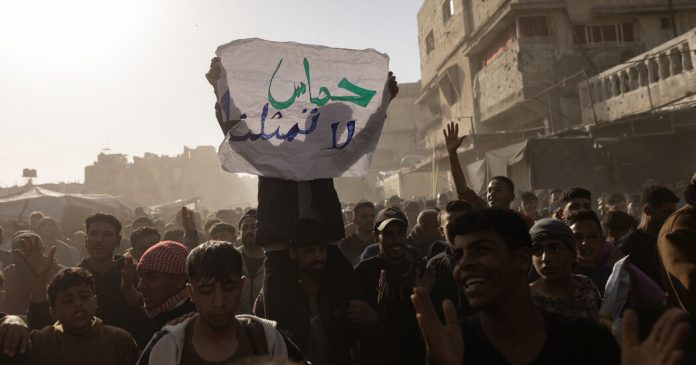
Palestinians in Gaza protested against the war for a second straight day on Wednesday and chanted slogans against Hamas, frustrated and angry over the collapse of a cease-fire with Israel that many had hoped would become permanent.
The protests were rare shows of dissent against Hamas, the armed group that has ruled Gaza for 17 years with an iron fist and which started a 15-month war by leading the Oct. 7, 2023, attack on Israel.
Most of the demonstrations have been small so far, but the main ones on Tuesday and Wednesday in the heavily damaged northern town of Beit Lahiya appear to have drawn hundreds of people, according to witnesses. The numbers could not be independently verified, though videos showed significant crowds.
Some Gazans say the protests began as a spontaneous outpouring of emotion, but there were indications on Wednesday that they were becoming more organized. Over the past two days, there has been a notable increase in calls on social media from Palestinians inside Gaza to come out into the streets and demonstrate against Hamas’s rule and its conduct of the war with Israel.
On Wednesday, hundreds of people gathered for the second straight day in Beit Lahiya, some chanting “Hamas out! Hamas is terrorism!” and “We want to live freely.” There was another smaller protest in Gaza City, also in the north, with chants against Hamas.
Videos from the Tuesday protests, verified by The New York Times, showed groups of Gazans in the half-ruined streets of Beit Lahiya. Some carried signs that opposed the continuation of the war, while others chanted slogans calling for Hamas to get out.
Said Lulu, a 38-year-old from Gaza City in the north who is now sheltering in the southern city of Khan Younis, said on Wednesday that he had heard about the protest in Beit Lahiya the day before and had begun contacting other anti-Hamas political activists to call for more social-media protest.
“I can tell you hundreds responded with ‘Yes! We are joining you,’” he said. “Many of the individuals who are members of big families are joining the protests,” he added. “If Hamas decides to use force against protesters, I am afraid protesters would use force back,” Mr. Lulu said.
“Our demands are clear: End the war at any cost,” he said. “‘We want to live’ is our slogan,” he added. “This time is different, I believe. We have absolutely nothing to lose. We have lost everything already, so we are not afraid.”
There have been few signs so far of any attempt by Hamas to crack down by force on the protests, as the group has done in the past.
Hamas, for its part, is trying to channel Palestinian anger back in the direction of Israel. In a statement posted on its Telegram channel on Wednesday, Hamas said Prime Minister Benjamin Netanyahu of Israel “bears full responsibility for the failure” of the cease-fire agreement.
A senior Hamas official, Basem Naim, said in a post on social media on Wednesday that “all people have the right to scream in pain and raise their voices.” But he warned against exploiting “tragic humanitarian conditions” for political agendas or to absolve “the criminal aggressor,” meaning Israel.
Gazans, at least publicly, tend to blame Israel for much of the death, destruction and hunger the war has brought. But at least some hold Hamas responsible, as well, for leading the attack that began the war, for holding hostages and for continuing to fight rather than giving up its power in exchange for a cease-fire.
Eslam Rafat, a 21-year-old student from Beit Lahiya, said he joined the protests “to call for an end to the war, and an end to the genocide in Gaza, and nothing more.” He said that some of those who joined the protests were making political statements, but that they went out originally to call for an end to the war.
“It pains me to see children lining up for several hours to get handout food that often runs out,” he added.
The two-month cease-fire with Israel had brought the first sustained respite from more than a year of incessant bombardment and a ground war. Almost the entire population of Gaza — more than two million people — was displaced during the war and the Israeli offensive killed tens of thousands of Palestinians.
Israel abandoned the truce last week and resumed its bombardment of Gaza in an attempt to pressure Hamas to free more of the remaining hostages still held in the territory.
Leaders of prominent Palestinian clans and families in southern Gaza who oppose Hamas issued a joint statement on Wednesday calling on Palestinians in the territory to “launch a popular uprising against injustice,” and protest against Hamas.
“Hamas must lift its hand from Gaza immediately and end this unjust blockade imposed on us due to decisions that do not represent us,” the statement said.
“We call on you all to take to the streets and make our voice heard,” it added. “Gaza is not held hostage by anyone. Gaza will be liberated by the will of its people.”
Abdel Hamid Abed al-Atti, a Palestinian journalist and former radio host who fled from Beit Lahiya to Egypt during the war, called for an end to Hamas rule in Gaza.
“Enough — after a year and a half of war,” he said in a widely viewed video.
Mr. Abed al-Atti, who said he lost many family members to Israeli attacks during the war, said Gazans were protesting out of an overwhelming sense of anger after so much loss and destruction.
“This was spontaneous,” he added in a phone call. “These days, Gazans have nothing left to lose.”
Amin Abed, a Palestinian activist from Gaza who spent the early part of the war in Gaza and was evacuated to the United Arab Emirates for medical treatment in September last year, said the protesters’ main demand was for Hamas to step down.
“People are exhausted,” Mr. Abed told The New York Times in a phone interview on Wednesday. “They want to live in peace, safety, and stability, away from war and death. They want dignity,” he added.
“This movement is proof,” Mr. Abed said. “It refutes the Israeli narrative that all of Gaza is Hamas.”
Munther al-Hayek, the Gaza-based spokesman for the Palestinian Fatah faction, a rival to Hamas, called on Hamas “to listen to the voice of our people and withdraw from the government” in Gaza. Speaking in an interview with Palestinian radio on Wednesday, he said Hamas should hand over power to the Fatah-dominated Palestinian Authority, which governs parts of the Israeli-occupied West Bank.
Mr. al-Hayek said Hamas’s presence “has become dangerous to the Palestinian cause,” adding that the movement should listen to the voices emerging in Gaza and save the devastated population.
Mr. Netanyahu also took note of the protests in Gaza.
“In recent days, we have witnessed a new shift — something we have never seen before,” he said on Wednesday in remarks to Israel’s Parliament. “We saw large, open protests in the Gaza Strip against Hamas rule.”
Nader Ibrahim contributed reporting from London.