Thursday, November 12, 2026
Home Blog Page 85

Trump cuts threaten a measurement lab critical for advanced chips and medical devices : NPR

0

Lasers shine as part of an advanced atomic clock at NIST. Precise measurements of the colors of light emitted by atoms are essential to everything from atomic clocks to medical devices.

N. Phillips/NIST


hide caption

toggle caption

N. Phillips/NIST

The Trump administration is planning to close a small, obscure laboratory whose work undergirds everything from microchip manufacturing to nuclear fusion.

The Atomic Spectroscopy Group at the National Institute of Standards and Technology (NIST) provides the definitive measurements of atomic spectra. Spectra are specific sets of colors emitted by different atomic elements. Those sets of colors act as atomic fingerprints that are used to characterize a wide variety of things — from the gases in far-off stars, to the blood in a person’s finger.

The laboratory has been in continuous operation for more than 120 years, but in mid-April it will be forced to close, according to a letter sent by the lab’s head, Yuri Ralchenko, to dozens of colleagues around the world.

“We were recently informed that unless there is a major change in the Federal Government reorganization plans, the whole Atomic Spectroscopy Group will be laid off in a few weeks,” Ralchenko wrote in the letter, which was emailed on March 18 and seen by NPR. The letter was first reported by Wired.

Ralchenko says in the letter that he was told “our work is not considered to be statutorily essential for the NIST mission.”

But thousands of scientists and engineers disagree. A petition is now circulating to reverse the closure, and it had received close to 3,000 signatures as of Wednesday. Among the signatories is Nobel Prize-winning physicist Sheldon Glashow.

“I cannot believe that the government would be stupid enough” to slash this kind of work, Glashow said in a video statement.

A section of Iron's atomic spectrum. Each element on the periodic table gives off a unique set of spectral lines that are carefully catalogued by the group.

A section of iron’s atomic spectrum. Each element on the periodic table gives off a unique set of spectral lines that are carefully cataloged by the group.

NIST


hide caption

toggle caption

NIST

Color code

The overwhelming support exists because the group’s spectral measurements get used in almost every field imaginable, according to Elizabeth Goldschmidt, a physicist at the University of Illinois, Urbana-Champaign.

“You look at the very specific color of a star, it can tell you the makeup of the star. You look at the blood in someone’s finger … and that can tell you how much oxygen is in the blood,” she says.

But to measure colors accurately, devices like telescopes and pulse oximeters must be correctly calibrated, and that’s where the Atomic Spectroscopy Group comes in. The laboratory maintains a database of atomic spectra that are the standard reference used to ensure devices are functioning correctly. Every month, the database receives around 70,000 queries from around the world and is cited in at least two scientific papers, according to a recent post about it on NIST’s website.

In addition, the laboratory conducts precise measurements of ultraviolet atomic spectra that are critical to developing advanced microchips. Ultraviolet light is used to etch tiny circuits, and advances in the field require detailed knowledge of the atomic spectra of elements in the extreme ultraviolet. There are a handful of facilities that research ultraviolet spectra, and this group is one of them, Goldschmidt says. It also studies plasmas, which are ionized gases that enshroud nuclear fusion reactions. Researchers around the world are pursuing fusion as a clean and virtually limitless form of energy, and detailed knowledge of plasmas is essential to that development.

Neither NIST nor its parent agency, the Department of Commerce, responded to NPR’s inquiries about the closure, but the savings from closing the lab would be minimal. NIST’s annual budget is just $1.5 billion, less than 0.02% of the government’s $7 trillion annual budget.

A silicon wafer with microchips etched into it. Microchips are etched using specific wavelengths of light. Better measurements of the wavelengths in ultraviolet light are required to advance chip manufacturing.

A silicon wafer with microchips etched into it. Microchips are etched using specific wavelengths of light. Better measurements of ultraviolet light are required to advance chip manufacturing.

J. Wilson/AFP via Getty Images


hide caption

toggle caption

J. Wilson/AFP via Getty Images

Within NIST, the atomic spectroscopy group is made up of seven full-time federal employees. The group’s employees even pay out of pocket for coffee and sugar used in its coffee breaks and have been doing so since 1973, according to a video celebrating its anniversary last year.

By contrast, if the spectroscopy group closes, the costs will be enormous, scientists say. Researchers around the world will waste hours on the internet hunting around for the best spectral measurements, says Evgeny Stambulchik, a physicist at the Weizmann Institute of Science in Israel.

What currently takes a couple of minutes might soon take “many hours, maybe many days,” Stambulchik says. “Multiply that several hours by several thousands of scientists and you understand the waste of work time there would be without such a centralized database,” he says.

But Goldschmidt says the real blow would be to industry. Having centralized and agreed-upon calibration and measurement standards “is what allows industries to innovate and make new products,” she says. “Everyone wins when this happens at NIST because everyone can rely on what NIST does, and they don’t have to invest their time and money in doing it themselves.”

Prince Harry Steps Down as Patron of Charity He Founded

0

Prince Harry has resigned as the patron of a charity he founded in southern Africa, his office said in a statement on Wednesday. The move followed a clash between the charity’s board of trustees and its board chair.

Harry and his fellow patron, Prince Seeiso of Lesotho, said they were quitting as faces of the charity, Sentebale, which is registered in Britain but operates in southern Africa, in solidarity with its board of trustees. Five of the board’s nine members resigned this week.

“It is devastating that the relationship between the charity’s trustees and the chair of the board broke down beyond repair, creating an untenable situation,” the two princes said in a joint statement. They added: “We are in shock that we have to do this, but we have a continued responsibility to Sentebale’s beneficiaries, so we will be sharing all of our concerns with the Charity Commission as to how this came about.”

Harry established Sentebale with Seeiso, the younger brother of King Letsie III of Lesotho, in 2006. Founded in honor of Harry’s mother, Diana, Princess of Wales, the charity raised funds for communities affected by the H.I.V. pandemic in Lesotho, a small landlocked kingdom that is one of the world’s poorest countries. In 2019, it expanded its work into nearby Botswana, and to addressing substance abuse, gender-based violence and other social ills among young people.

In recent months, the organization’s leadership has been at loggerheads. The five trustees who resigned said in a joint statement that they had called on the board’s chair, Sophie Chandauka, to resign from her position, after losing “trust and confidence” in her. They said that Ms. Chandauka had responded by filing a lawsuit in Britain “to block us from voting her out,” and that they were resigning to avoid burdening the charity with the cost of the suit.

“We could not in good conscience allow Sentebale to undertake that legal and financial burden and have been left with no other option but to vacate our positions,” they said. “This was not a choice willingly made, but rather something we felt forced into in order to look after the charity.”

Ms. Chandauka said in a statement that she had acted to expose what she described as “issues of poor governance, weak executive management, abuse of power, bullying, harassment, misogyny, misogynoir,” a term referring to pointed sexism toward Black women, “and the coverup that ensued.” In addition to filing a case in an English court, she said, she had reported the trustees to Britain’s Charity Commission.

“There are people in this world who behave as though they are above the law and mistreat people, and then play the victim card and use the very press they disdain to harm people who have the courage to challenge their conduct,” she said in her statement. Harry has previously brought high-profile legal cases against British newspapers.

Ms. Chandauka, a lawyer based in New York City, served on the Sentebale board from 2009 to 2015, and was appointed as its chair in July 2023. Her role now, she said, would focus on securing wider streams of funding for the organization.

The charity said in a statement on Wednesday that it had restructured its board under the leadership of Ms. Chandauka as part of a “transformation agenda” that would broaden the scope of its work to include business development and climate resilience in southern Africa.

The princes’ statement did not specifically address the allegations leveled by Ms. Chandauka.

“Although we may no longer be patrons, we will always be its founders, and we will never forget what this charity is capable of achieving when it is in the right care,” the princes said.

A spokeswoman for the Charity Commission said that the regulator was “assessing the issues to determine the appropriate regulatory steps.”

What to know about the ‘state secrets privilege’ : NPR

0

The Department of Justice and Trump administration officials are invoking the state secrets privilege in the case involving Venezuelans sent to El Salvador.

Patrick Semansky/AP


hide caption

toggle caption

Patrick Semansky/AP

The Trump administration says it won’t share any more information in response to a judge’s request about three recent deportation flights carrying Venezuelan migrants because it’s a state secret.

The Justice Department said in a court filing Monday that it was exercising what’s commonly called the “state secrets privilege” in the case because sharing the information would harm diplomatic relations and national security.

It’s part of a lawsuit the administration is facing after President Trump invoked the 1798 Alien Enemies Act to deport people it accuses of being members of a violent Venezuelan prison gang to El Salvador earlier this month.

Here’s what to know about the state secrets privilege — the legal doctrine now being exerted by the DOJ.

What is the state secrets privilege?

The privilege allows the U.S. government to withhold sensitive information — such as intelligence sources and methods and foreign affairs details — from becoming public as part of a court case. The government can even intervene in a case that it’s not a party to and exercise the privilege, if it believes damaging information could come out during the course of the proceedings.

“Privilege is designed or intended to navigate those areas where the tectonic plates of the executive privilege and the judicial responsibility sort of collide,” said George Croner, a non-resident senior fellow at the Foreign Policy Research Institute.

It’s often invoked in matters involving the military, national security and foreign affairs, said Croner, who is also former principal litigation counsel at the National Security Agency.

Typically the head of the federal agency that’s asserting the state secrets privilege will sign a declaration or affidavit to the judge explaining why withholding information is necessary. In this case, Attorney General Pam Bondi, Secretary of State Marco Rubio and Homeland Security Secretary Kristi Noem all submitted signed declarations to Judge James Boasberg.

Federal judges often defer to the executive branch in requests for the state secrets privilege, but sometimes they ask to review the evidence privately or reject the government’s ask.

Ashley Deeks, a University of Virginia law professor who teaches classes on national security, said critics have historically taken issue with the lack of transparency permitted by the legal maneuver.

“There has been a concern about the government invoking it to conceal illegal activities or activities that might embarrass the government,” she said.

The Center for Constitutional Rights, a nonprofit legal advocacy group, previously argued that the state secrets privilege “essentially allows the executive branch to dictate to the federal courts what cases they can and can’t hear.”

The history of the legal doctrine

Two U.S. court cases set up the framework for the state secrets privilege, according to a recent report by the Congressional Research Service.

The first dates back to 1876 and involves the case of a Union spy hired by President Abraham Lincoln to pass on information about Confederate troop movements during the Civil War. The spy’s estate later sued the government over allegedly unpaid wages.

In that case, known as Totten v. United States, the Supreme Court ruled that a court cannot hold a trial that would “inevitably lead to the disclosure of matters which the law itself regards as confidential” — in this instance a contract for espionage.

Three-quarters of a century later, the Supreme Court further distilled the reasoning behind the state secrets privilege.

In 1952, a case known as United States v. Reynolds went before the Supreme Court, in which the widows of three civilian crew members who were killed in a U.S. military airplane crash sued the government to obtain the accident investigation report.

The Air Force argued that releasing the accident report would compromise national security, since the flight was part of a mission to test secret electronic equipment.

The Supreme Court ultimately ruled for the government, declaring that it could withhold the sensitive military information. Still, Chief Justice Fred M. Vinson acknowledged in the majority opinion that such a legal doctrine could be tricky for judges, who might have to make a ruling without seeing the concealed evidence for themselves.

“Judicial control over the evidence in a case cannot be abdicated to the caprice of executive officers,” Vinson wrote. “Yet we will not go so far as to say that the court may automatically require a complete disclosure to the judge before the claim of privilege will be accepted in any case.”

How Trump and other recent presidents have used the privilege

In recent years, government lawyers under both Republican and Democratic presidents have invoked the state secrets privilege in multiple cases related to the global war on terrorism, including lawsuits over the NSA’s warrantless wiretapping program and the Central Intelligence Agency’s torture — or “enhanced interrogation” — program.

A 2010 University of Pennsylvania Law Review article found that the U.S. government had invoked the state secrets privilege in more than 100 cases between 2001 and 2009.

The American Civil Liberties Union said in 2007 that the administration of then-President George W. Bush was using the privilege “to evade accountability for torture, to silence national security whistleblowers, and even to dismiss a lawsuit alleging racial discrimination.”

In 2009, then-Attorney General Eric Holder rolled out new rules within the Justice Department dictating when the government would exert the privilege. NPR reported at the time that the Obama administration, which Holder was a part of, was criticized by the ACLU for simultaneously invoking the privilege in ongoing cases.

The Supreme Court ruled in 2022 that the federal government could invoke the privilege to block two CIA contractors from testifying about the post-9/11 torture of a prisoner named Abu Zubaydah at a “black site” in Poland in a high-profile case about the privilege’s limits.

Deeks of the University of Virginia said the Trump administration’s use of the privilege in the Venezuelans’ case was noteworthy because it wasn’t in response to a request for information from the opposing attorneys but rather from the judge himself. Judge Boasberg has been trying to determine whether the Trump administration violated his order to halt or turn around the deportation flights.

Rubio and Noem argued in their declarations that releasing information about the deportation flights could complicate diplomatic relations and compromise law enforcement methods.

If Boasberg rejects the government’s arguments, Croner said he thought the Justice Department would likely appeal.

“And eventually, somewhere down the road, you will see perhaps another decision from the U.S. Supreme Court on the parameters of the state secrets privilege in terms of how it was invoked in this case,” he said.

Sudan’s Military Is Driving Rival Fighters Out of Khartoum, a Major Shift in Civil War

0

Paramilitary fighters with Sudan’s Rapid Support Forces began withdrawing from the battle-torn capital of Khartoum in large numbers on Wednesday, fleeing a city they had occupied since a ruinous war broke out nearly two years ago.

The capture of the city by Sudan’s military marks a dramatic turning point in what is currently Africa’s largest war. The Rapid Support Forces, known as the R.S.F., is likely to withdraw to its stronghold in Darfur, in the west of the country, according to analysts.

Surveillance drone footage circulated by Sudan’s military showed hundreds of R.S.F. fighters crossing a dam on the Nile at Jebel Aulia, south of the capital — their last remaining escape route.

Brig. Gen. Nabil Abdullah, a military spokesman, said the military had captured a major R.S.F. camp near the dam. “This was their last remaining camp in Khartoum,” he said. “A few remnants remain in pockets here and there. They will soon be destroyed.”

The two generals who lead Sudan’s military and the Rapid Support Forces, once allies, went to war nearly two years ago over a dispute about a plan for the R.S.F. paramilitary troops to be absorbed by the military.

The fighting has killed an estimated 150,000 people and displaced more than 13 million, sending nearly four million fleeing to neighboring countries — amounting to the world’s largest displacement crisis. Refugees have told of fleeing rapes, massacres and starvation.

Videos posted to social media showed civilians celebrating as Sudanese military forces arrived into the south of Khartoum, hours after the paramilitaries had fled.

In Kalakla, 10 miles south of the city center, civilians poured onto the streets, whooping and cheering, to hail Sudanese military forces who arrived on motorbikes.

Similar scenes unfolded in other neighborhoods closer to the center of the city as military forces advanced, videos verified by The New York Times showed.

The sudden withdrawal comes five days after the army captured the presidential palace in central Khartoum, a key symbolic and strategic victory that signaled a momentous change in the direction of the war.

Since then, the army has steadily seized control of the capital, taking control of the devastated city center before moving toward the international airport.

Pockets of R.S.F. fighters continued to resist the military’s advance. As Times reporters walked through the deserted city center on Tuesday, explosions and bursts of gunfire rang out from sporadic fighting a few streets away.

But on Wednesday morning, the army declared that it had seized control of the airport, which is littered with the ruins of passengers jets abandoned in April 2023, at the start of the war. On Wednesday afternoon, soldiers posed on the runway for television cameras before an abandoned plane.

The last concentration of R.S.F. fighters in the capital appeared to be in the southern and western part of Omdurman, on the west bank of the Nile. The army controls the northern half of Omdurman, and army controlled areas have received sporadic shellfire from R.S.F. positions in recent years.

Abdalrahman Altayeb contributed reporting.

U.S. to End Vaccine Funds for Poor Countries

0

The Trump administration intends to terminate the United States’ financial support for Gavi, the organization that has helped purchase critical vaccines for children in developing countries, saving millions of lives over the past quarter century, and to significantly scale back support for efforts to combat malaria, one of the biggest killers globally.

The administration has decided to continue some key grants for medications to treat H.I.V. and tuberculosis, and food aid to countries facing civil wars and natural disasters.

Those decisions are included in a 281-page spreadsheet that the United States Agency for International Development sent to Congress Monday night, listing the foreign aid projects it plans to continue and to terminate. The New York Times obtained a copy of the spreadsheet and other documents describing the plans.

The documents provide a sweeping overview of the extraordinary scale of the administration’s retreat from a half-century-long effort to present the United States to the developing world as a compassionate ally and to lead the fight against infectious diseases that kill millions of people annually.

The cover letter details the skeletal remains of U.S.A.I.D. after the cuts, with most of its funding eliminated, and only 869 of more than 6,000 employees still on active duty.

In all, the administration has decided to continue 898 U.S.A.I.D. awards and to end 5,341, the letter says. It says the remaining programs are worth up to $78 billion. But only $8.3 billion of that is unobligated funds — money still available to disburse. Because that amount covers awards that run several years into the future, the figure suggests a massive reduction in the $40 billion that U.S.A.I.D. used to spend annually.

A spokesperson for the State Department, which now runs what is left of U.S.A.I.D., confirmed the terminations on the list were accurate and said that “each award terminated was reviewed individually for alignment with agency and administration priorities, and terminations were executed where Secretary Rubio determined the award was inconsistent with the national interest or agency policy priorities.”

The memo to Congress presents the plan for foreign assistance as a unilateral decision. However because spending on individual health programs such as H.I.V. or vaccination is congressionally allocated, it is not clear that the administration has legal power to end those programs. This issue is currently being litigated in multiple court challenges.

Among the programs terminated is funding for the United Nations Food and Agriculture Organization, which conducts surveillance for diseases that can be transmitted from animals to humans, including bird flu, in 49 countries. Some major programs to track and fight malaria, one of the world’s top killers of children, have also been ended.

Dr. Austin Demby, the health minister of Sierra Leone, which relies on Gavi’s support to help purchase vaccines, said he was “shocked and perturbed” by the decision to terminate U.S. funding and warned that the ramifications would be felt worldwide.

“This is not just a bureaucratic decision, there are children’s lives at stake, global health security will be at stake,” he said. “Supporting Gavi in Sierra Leone is not just a Sierra Leone issue, it’s something the region, the world, benefits from.”

In addition to trying to reach all children with routine immunizations, Sierra Leone is currently battling an mpox outbreak, for which Gavi has provided both vaccines and critical support to deliver them, he said.

“We hope the U.S. government will continue to be the global leader it always been — putting money in Gavi is not an expenditure, it’s an investment,” Dr. Demby said

Gavi is estimated to have saved the lives of 19 million children since it was set up 25 years ago. The United States contributes 13 percent of its budget.

The terminated grant to Gavi was worth $2.6 billion through 2030. Gavi was counting on a pledge made last year by President Joseph R. Biden Jr. for its next funding cycle.

New vaccines with the promise to save millions of lives in low-income countries, such as one to protect children from severe malaria and another to protect teenage girls against the virus that causes cervical cancer, have recently become available, and Gavi was expanding the portfolio of support it could give those countries.

The loss of U.S. funds will set back the organization’s ability to continue to provide its basic range of services — such as immunization for measles and polio — to a growing population of children in the poorest countries, let alone expand to include new vaccines.

By Gavi’s own estimate, the loss of U.S. support may mean 75 million children do not receive routine vaccinations in the next five years, with more than 1.2 million children dying as a result.

The U.S. has been among the top donors to the organization since its creation, and became the largest during the Covid-19 pandemic. While European countries have historically provided significant funding, many are now reducing foreign aid spending as they grapple with the change in U.S. policy on Ukraine and the U.S. demand that they increase their defense spending. Japan, another major Gavi donor, is struggling with a depreciating currency.

Dr. Sania Nishtar, Gavi’s chief executive, said that she hoped the Trump administration would reconsider the decision to end its support. Gavi’s work keeps people everywhere, including Americans, safe, she said. In addition to protecting individual children, vaccination reduces the possibility of large outbreaks. The organization maintains global stockpiles for vaccines against diseases such as Ebola and cholera, deploying them in rapid response efforts for epidemics.

Gavi’s structure requires countries to pay part of the cost of vaccines, with their share growing as income levels rise; middle-income countries are weaned from support.

The memo says that 869 U.S.A.I.D. personnel were working as of last Friday, while 3,848 were on administrative leave and 1,602 are in the process of being laid off. Of 300 probationary employees who were initially fired, 270 have returned to work following a court order prohibiting their dismissal.

U.S. intelligence leaders testify in House after Signal flap : NPR

0

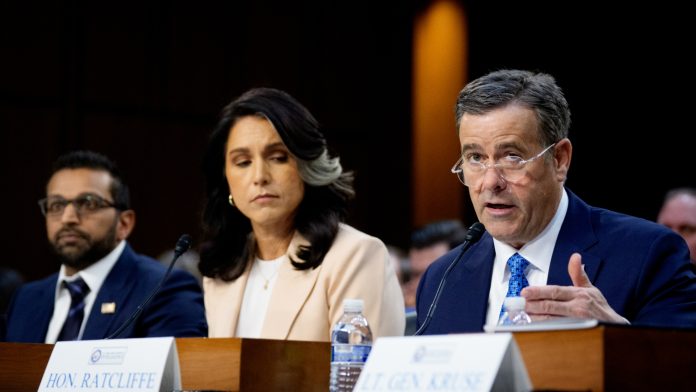
Director of National Intelligence Tulsi Gabbard, CIA Director John Ratcliffe and other top U.S. intelligence officials will testify before the House Intelligence Committee on Wednesday — in a session that’s expected to be dominated by discussion of an extraordinary breach of security.

Gabbard, who as DNI is the head of the U.S. intelligence community, was part of a high-level group chat on Signal, an open-source messaging app, where officials discussed detailed plans for a U.S. bombing campaign in Yemen earlier this month.

The use of civilian software to discuss sensitive military and government matters came to light after Jeffrey Goldberg, the editor-in-chief of The Atlantic, said the Signal account of national security adviser Michael Waltz had added him to the Principals Committee group chat.

It’s the second trip to Capitol Hill in two days for Gabbard and Ratcliffe, who were grilled about the gaffe on Tuesday by Democrats on the Senate Intelligence Committee.

The leaders told senators that they had not shared any classified information in an improper or unlawful way — prompting a challenge from the ranking Democrat, Sen. Mark Warner of Virginia.

“If there was no classified material, share it with the committee,” Warner said. “You can’t have it both ways.”

Goldberg reported that Defense Secretary Pete Hegseth sent detailed war plans in a message well before the U.S. attack began. Hegseth is not among the officials testifying on Capitol Hill.

With the officials insisting they did nothing wrong and had not shared classified information, The Atlantic has now published Signal messages that were inadvertently shared with Goldberg, in a story titled Here Are the Attack Plans That Trump’s Advisers Shared on Signal.

The story states, “The statements by Hegseth, Gabbard, Ratcliffe, and Trump—combined with the assertions made by numerous administration officials that we are lying about the content of the Signal texts—have led us to believe that people should see the texts in order to reach their own conclusions.”

Dollar Tree Is Selling Family Dollar for $1 Billion

0

Dollar Tree is selling the Family Dollar brand to two private capital firms for just over $1 billion, the company announced on Wednesday after years of struggling with Family Dollar’s operation.

The private equity firms Brigade Capital Management and Macellum Capital Management are buying Family Dollar together, according to the statement. In the announcement, Dollar Tree’s chief executive, Michael Creedon, called the sale a “major milestone in our multiyear transformation journey.”

Dollar Tree purchased Family Dollar in 2015 for about $9 billion, hoping the merger would help both stores reach more customers. But it struggled to effectively manage the Family Dollar brand. About a year ago, Dollar Tree said it would close nearly 1,000 of Family Dollar’s roughly 8,000 stores.

In June, Dollar Tree announced it was exploring plans to sell Family Dollar, citing inflation, theft and the end of pandemic-era benefits from the federal government.

Family Dollar’s stores are predominantly in urban areas and serve mostly low-income shoppers, who have been squeezed the hardest by inflation. Dollar Tree has more stores in suburban areas and caters to consumers with relatively higher incomes.

Dollar Tree also reported its latest quarterly earnings on Wednesday, noting potential drags on its sales including “tariffs or other measures that create barriers or restrictions on trade.” The company also warned in December that tariffs could affect its prices and inventory.

Other U.S. retailers have also been struggling recently. Walgreens has said it plans to close about 1,200 stores over the coming three years. The party supplies retailer Party City announced late last year that it would close all its stores. And last week, Forever 21’s operator in the United States filed for bankruptcy as its stores struggled to compete with online retailers.

DOGE can’t explain why it wants sensitive government data : NPR

0
White House adviser Elon Musk wears a red baseball cap at a Cabinet meeting at the White House.

White House adviser Elon Musk at a Cabinet meeting at the White House on Monday. Musk, who is also the CEO of SpaceX and Tesla, is leading the Department of Government Efficiency effort that is trying to get access to data from across the government to find waste, fraud and abuse.

Win McNamee/Getty Images


hide caption

toggle caption

Win McNamee/Getty Images

Fewer than 50 people have access to Social Security Administration databases containing hundreds of millions of people’s private financial and personal information.

But only one also has access to the government’s human resources and student loan files.

Akash Bobba is one of many Department of Government Efficiency staffers who have embedded in federal agencies the last few months with virtually unfettered access to the sensitive, compartmentalized sources of data collected by the government. The team, which is steered by billionaire Elon Musk, says it’s scouring government records for signs of waste, fraud and abuse.

Bobba is also one of many DOGE employees who, according to several federal judges, were inappropriately given that access in violation of privacy laws and without proper training to handle the personally identifiable information the agencies collect.

In one order last week blocking DOGE’s access to Social Security data, U.S. District Judge Ellen Lipton Hollander of Maryland said the government “never identified or articulated even a single reason for which the DOGE Team needs unlimited access to SSA’s entire record systems, thereby exposing personal, confidential, sensitive, and private information that millions of Americans entrusted to their government.”

Instead of a more narrow approach to data access and work to “modernize the system and uncover fraud,” Hollander wrote that DOGE’s unprecedented access to protected data “is tantamount to hitting a fly with a sledgehammer.”

An NPR review of thousands of pages of records across more than a dozen lawsuits in federal court finds an alarming pattern across agencies, where DOGE has given conflicting information about what data it has accessed, who has that access, and most importantly — why.

“No need to know”

When President Trump signed an order creating the DOGE initiative, it directed agencies to create dedicated teams that would have “full and prompt access to all unclassified agency records, software systems, and IT systems” that would also “adhere to rigorous data protection standards.”

Numerous court filings and affidavits paint a picture of agencies rushing to give DOGE access without accompanying rigor of protecting data or documenting the scope of its work.

On Monday, a federal judge in Maryland temporarily halted DOGE from accessing data of millions of union members in a lawsuit against the Office of Personnel Management, the Treasury Department and Education Department after finding the agencies shared private information with DOGE affiliates “who had no need to know the vast amount of sensitive personal information to which they were granted access.”

“No matter how important or urgent the President’s DOGE agenda may be, federal agencies must execute it in accordance with the law,” Judge Deborah L. Boardman wrote. “That likely did not happen in this case.”

In the Social Security Administration lawsuit, Hollander found several DOGE staffers “were granted access to SSA systems before their background checks were completed or their inter-agency detail agreements were finalized.“

One of those is Bobba, who was given access to the master data warehouse at SSA that includes the Master Beneficiary Record, Supplemental Security Record and Numident files containing “extensive information about anyone with a social security number,” according to filings in the case.

According to a memorandum of understanding detailing Bobba’s work with SSA, the Office of Personnel Management and Education Department that was improperly redacted by OPM, Bobba agreed to do any work on Social Security data from the agency headquarters.

But an affidavit from former SSA chief of staff Tiffany Flick said that Bobba was working off-site from OPM where other people “may have also had access to this protected information,” Flick wrote.

Not even lawyers for the government can account for when and how DOGE staffers received access to sensitive databases. In a Labor Department lawsuit, Judge John D. Bates notes that “defendants themselves acknowledge inconsistencies across their evidence” regarding DOGE.

Marko Elez, a DOGE employee who resigned from his post at the Treasury Department in early February after racist social media posts resurfaced, “sent an email with a spreadsheet containing PII to two United States General Services Administration officials,” according to an audit of his email account submitted in one court filing.

Government lawyers said Elez was “erroneously” and “mistakenly” given the ability to change data on Treasury’s Secure Payment System, which a judge said demonstrates DOGE access was “rushed and undertaken by political pressure.”

In a ruling blocking DOGE access to Treasury systems, Judge Jeannette Vargas warned that “a real possibility exists that sensitive information has already been shared outside of the Treasury Department, in potential violation of federal law.”

Congress warned against this — a half-century ago

When Congress passed the Privacy Act of 1974, lawmakers expressed concerns about personal information amassed in digital databases by the “omnivorous fact collectors” of federal agencies.

During the debate about the bill, Arizona Republican Sen. Barry Goldwater was worried about the possibility “that every detail of our personal lives can be assembled instantly for use by a single bureaucrat or institution.”

“I hope that we never see the day when a bureaucrat in Washington or Chicago or Los Angeles can use his organization’s computer facilities to assemble a complete dossier or all known information about an individual,” Republican Sen. Charles Percy said.

Fifty years later, the Department of Government Efficiency effort headed by Musk appears to be doing just that, bypassing the Privacy Act, agency security protocols and training for handling the most sensitive data maintained by federal agencies.

The White House did not respond to questions about DOGE following privacy laws, or whether Americans should be concerned about the level of DOGE’s access.

The federal government maintains a large amount of sensitive data, from health records of veterans and Medicare recipients to troves of information about companies being investigated by the Consumer Financial Protection Bureau and the National Labor Relations Board.

The rapid insertion of DOGE employees into the system is raising alarm bells for privacy and security advocates.

“The government has also repeatedly failed to articulate a clear purpose for the unprecedented access it seeks to deeply sensitive information, and why the data it wants access to is necessary for that purpose,” said Kristin Woelfel, a lawyer with the nonprofit Center for Democracy and Technology. “If the government cannot answer those questions, then DOGE has no business accessing that data.”

“Part of what is unnerving and is scary both to companies whose data is involved and also Americans whose most sensitive financial information is at risk, is that we don’t know what they’re doing,” former CFPB chief technologist Erie Meyer previously told NPR.

Anne Weismann, a George Washington University Law School professor who focuses on government accountability and transparency, said DOGE and its employees have control over a “staggering” amount of data about Americans.

“It’s so ironic because Trump supporters are so worried about ‘Big Brother’ and government, and they are allowing this entity to amass that data,” Weismann said. “I mean, I don’t think there’s another entity in the federal government that collectively has access to that kind of data.”

Weismann is also outside counsel for the nonprofit Project On Government Oversight, which is suing DOGE over access to records about how it operates.

Last week, Trump signed an executive action that appears to continue to push agencies toward “eliminating information silos” and sharing more sensitive data across federal agencies, including ensuring that the government has “unfettered access to all unemployment data and related payment records.”

It encourages federal agency leaders to find ways to rescind existing regulations and guidance about information sharing within and between agencies — with no mention of privacy or data security.

Have information you want to share about DOGE access to government databases and IT systems? Reach out to these authors through encrypted communication on Signal. Stephen Fowler is at stphnfwlr.25, Jenna McLaughlin is at JennaMcLaughlin.54

What to Know About the Only US Military Base in Greenland

0

Once called Thule Air Base, now known as Pituffik Space Base, this U.S.-operated installation in northwestern Greenland is one of the most strategically important military sites in the world — even if most Americans have never heard of it.

“It is quite literally the outermost eye of American defense,” said Peter Ernstved Rasmussen, a Danish defense analyst. “Pituffik is where the U.S. can detect a launch, calculate the trajectory and activate its missile defense systems. It’s irreplaceable.”

The outpost is getting new attention as President Trump, who has vowed to make Greenland part of the United States, sends a high-level delegation to the island this week. The visitors will include Vice President JD Vance, who said on Tuesday that he intended to visit “our guardians” in the Space Force while there.

About 150 U.S. Air Force and Space Force personnel are permanently stationed at Pituffik (pronounced Bee-doo-FEEK). They handle missile defense and space surveillance, and the Upgraded Early Warning Radar based here can detect ballistic missiles in their earliest moments of flight.

Each summer, about 70 members of the New York Air National Guard fly into Pituffik to support science missions. Using the U.S. military’s only ski-equipped aircraft, the LC-130, they deliver researchers and supplies to camps on the ice sheet.

Pituffik is the only U.S. military base on Greenland.

The American military presence in Greenland began during World War II, when Greenland was a Danish colony. After Nazi Germany occupied Denmark in 1940, Greenland was suddenly isolated and undefended. The United States struck a quiet deal with Denmark’s ambassador in Washington — bypassing the German-controlled government in Copenhagen — for American troops to build airfields and weather stations on the island.

By 1941, U.S. forces had landed, setting up defenses and scanning the North Atlantic for German submarines. A decade later, Denmark and the United States formalized the arrangement with a defense treaty granting Washington broad rights to operate military facilities on the island. Greenland is now a semiautonomous part of Denmark, which, like the United States, is a NATO country.

During the Cold War, Thule became a key Arctic outpost. From here, long-range American bombers could reach the Soviet Union, and massive radar systems were built to detect missiles crossing the polar route — the shortest path between the two superpowers.

One of the era’s strangest experiments was Camp Century, a nuclear-powered base built under the ice in the late 1950s as part of a secret project called Iceworm. The plan was to test whether nuclear missiles could be hidden and launched from beneath the surface.

“It was Cold War ambition at its wildest,” Mr. Rasmussen said. “They built a nuclear-powered base in one of the most hostile environments on Earth just to see if it could be done.”

The ice proved too unstable, and the base was abandoned. But the waste — including radioactive material and diesel — is still buried and scientists warn that warming temperatures could eventually expose it.

The base also left a lasting mark on Greenland’s Indigenous population. In 1953, about 130 Inuit were forcibly relocated from their homes near Thule to a harsher settlement farther north, poorly suited for traditional hunting. Compensation came decades later, but resentment remains.

The base’s name changed two year ago from Thule to Pituffik, which means in Greenlandic “the place we tie our dogs.”

Pituffik sits above the 76th parallel on Greenland’s northwest coast, about 750 miles from the North Pole. It’s one of the most remote military installations on Earth.

The nearest settlement, Qaanaaq, is more than 70 miles away and home to fewer than 650 people. Many hunt seals, walrus and, occasionally, polar bears to survive.

In winter, the sun disappears for weeks and temperatures drop below minus 30 Fahrenheit (minus 34 Celsius). Despite the conditions, Pituffik’s airfield runs year-round. Ships can reach the base only during a narrow summer window when the sea ice temporarily retreats.

Pituffik is part of a global web of U.S. defense infrastructure and a crucial station. Military experts say that as new threats like hypersonic missiles emerge, the early-warning systems at Pituffik are indispensable.

“Hypersonic missiles don’t go into space — they fly low, they maneuver, and we have no way to intercept them once they’re launched,” explained Troy J. Bouffard, a retired U.S. Army officer and Arctic defense expert. “That makes early warning more important than ever — and that’s where Pituffik comes in.”

If a missile were launched from Russia or China toward North America, it would, Mr. Bouffard said, most likely pass over the Arctic.

Pituffik’s ground-based sensors are crucial in that case, said Mr. Bouffard, because satellites don’t work well in high latitudes.

Lasers don’t work in the Arctic, either, he added. “The air columns are full of ice crystals — basically tiny mirrors — and lasers and mirrors don’t get along,” he said.

Mr. Bouffard sees Pituffik’s role expanding beyond radar.

“It could also serve as a forward staging base or a key line of communication,” he said. “The more forward these locations are, the more useful they are.”

National Security officials face tough questions over their use of Signal

0

President Trump’s top intelligence officials return to Capitol Hill for another hearing where they are likely to face questions about sensitive military information shared with a journalist in a Signal chat.