Thursday, November 12, 2026
Home Blog Page 90

Intel leaders testify in Congress amidst war group chat fallout : NPR

0

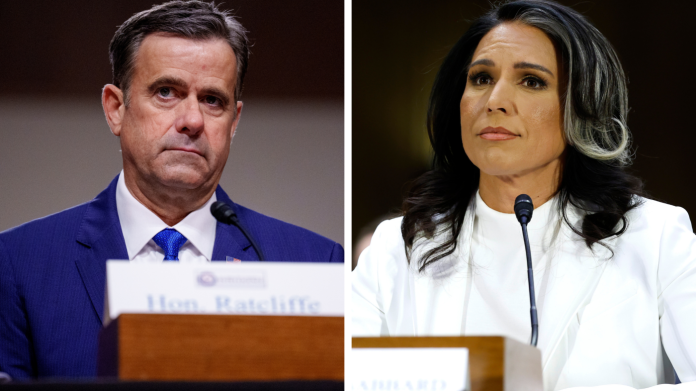
CIA Director John Ratcliffe and Director of National Intelligence Tulsi Gabbard are set to appear before hearings in the Senate on Tuesday and the House on Wednesday.

Andrew Harnik, Kevin Dietsc/Getty Images


hide caption

toggle caption

Andrew Harnik, Kevin Dietsc/Getty Images

As fallout from the Signal scandal continues, the leaders of several intelligence agencies — some of whom were part of the group chat that inadvertently shared war plans with a journalist — are set to testify before Congress this week.

The country’s top two intelligence officials, CIA Director John Ratcliffe and Director of National Intelligence Tulsi Gabbard, are among the five officials expected to appear as witnesses in a pair of hearings in the intelligence committees of the Senate on Tuesday and the House on Wednesday.

The others are FBI Director Kash Patel, Defense Intelligence Agency Director Jeffrey Kruse and Timothy Haugh, head of the National Security Agency and Central Security Service.

The previously scheduled hearings, to be livestreamed on YouTube, were planned to focus on the latest edition of an annual assessment of worldwide threats to U.S. national security, mainly from China, Russia and Iran. But they are also likely to address a security concern that originated closer to home.

The hearings begin just a day after Jeffrey Goldberg, the editor-in-chief of The Atlantic, revealed that a top Trump administration official had added him to a group chat — on the encrypted messaging app Signal — about the U.S.’ highly sensitive plans to bomb Houthi targets in Yemen earlier this month.

Gabbard and Ratcliffe were among the 18 individuals who participated in the text chain, a group that Goldberg said also included Vice President JD Vance, Defense Secretary Pete Hegseth and national security adviser Michael Waltz.

The National Security Council confirmed the authenticity of the message thread on Monday, saying it was “reviewing how an inadvertent number was added to the chain.” President Trump denied any knowledge of the incident when asked on Monday, and Hegseth told reporters that “nobody was texting war plans.”

Lawmakers on both sides of the aisle have criticized the security breach, with several Democrats calling for the participating officials to be investigated and disciplined. This week’s hearings give Congress a chance to press intelligence leaders directly.

Lawmakers are demanding accountability

The incident raises questions about the Trump administration’s handling of sensitive information.

Goldberg told NPR that he was not vetted before being added to the chat, where he was exposed to “operational military information” with details including targets, weapons and attack sequencing.

Such conversations are supposed to take place in what’s known as a Sensitive Compartmented Information Facility (SCIF), a secure room that top-ranking officials have in their offices and homes.

National security experts have voiced alarm that they instead used a publicly available messaging app. In fact, a 2023 Department of Defense memo specifically cited Signal as an example of an “unmanaged” messaging app that is not authorized to transmit non-public DOD information.

Democrats in Congress had roundly criticized many of Trump’s security and intelligence picks for their perceived lack of experience during the nomination process — and are now calling for further investigation.

House Minority Leader Hakeem Jeffries and Senate Minority Leader Chuck Schumer have publicly called for an investigation into what they respectively called “this unacceptable and irresponsible national security breach” and the “damage it created.”

“Everyone on the public WAR PLANS group text should immediately lose their security clearances and be fired,” tweeted California Rep. Eric Swalwell, a member of the House Homeland Security Committee. “Their idiocy just put a giant target on America. We are not safe.”

Sen. Roger Wicker, R-Miss., who chairs the Senate Armed Services Committee, told reporters, “We’re very concerned about it, and we’ll be looking into it on a bipartisan basis.”

While Republican lawmakers have largely downplayed the incident, several have been openly critical.

Rep. Don Bacon, R.-Neb., told CNN he thinks there should be accountability for what he called a “security violation.”

“Everyone should know better than putting top secret war plans on an unclassified phone,” he said.

Rep. Mike Lawler, R-N.Y., tweeted that classified information should “not be transmitted on unsecured channels — and certainly not to those without security clearances, including reporters.”

“Safeguards must be put in place to ensure this never happens again,” he added.

Japanese Court Disbands Unification Church in Wake of Abe Killing

0

A court in Tokyo on Tuesday ordered the Japanese branch of the Unification Church to disband, three years after it came under scrutiny following the assassination of the former prime minister, Shinzo Abe.

The shooting of Mr. Abe by a man with a grudge against the church led to revelations that the fringe religious group had pushed members into financial hardship to fund its donations to conservative politicians.

In a ruling that was widely expected but unusual in its severity, the court agreed to a government request to strip the church of its legal status to exist, saying that it had violated laws governing religious activities. The education ministry, which has oversight of religious groups, requested in October 2023 that the church be disbanded after determining that it forced members to make donations and buy religious goods.

The ministry collected the testimonies of some 1,550 former members who claimed to have suffered financial damages of 20.4 billion yen, or $140 million. The church, known for its mass weddings, was founded in South Korea by the Rev. Sun Myung Moon, who died in 2012. It has branches in scores of countries.

Attention has fallen on the church since the killing of Mr. Abe, who was gunned down on a street during a campaign speech. The suspect claimed that the church had bankrupted his family by forcing his mother, a member, to turn over her life savings.

Tetsuya Yamagami, who was arrested at the scene, has admitted to the July 2022 shooting, though he is still awaiting trial. After the assassination, it emerged that Mr. Yamagami blamed Mr. Abe, whom he perceived as supporting the church.

The revelation set off a scramble by conservative lawmakers seeking to distance themselves from the church, which has been a major political donor.

In an internal audit, the governing Liberal Democratic Party found that some 180 of its elected lawmakers, or almost half of its entire membership in Japan’s Parliament, either accepted donations or attended events held by the church and related organizations. However, the party’s leadership has maintained that it had no organizational ties to the religious group.

With Tuesday’s court decision, the government will now shift its efforts to “giving the maximum amount of support to the victims,” Yoshimasa Hayashi, the chief government spokesman, told reporters.

The church, which claimed some 600,000 members in Japan, is reported by local news media to have assets worth an estimated 110 billion yen. Some of that will likely be claimed by a court-appointed liquidator for use in compensating former members.

In a statement, the church, which changed its name in 2015 to the Family Federation for World Peace and Unification, said it planned to appeal the decision. Since the murder of Mr. Abe, it said members’ human rights have been violated and “inaccurate views of us have spread” in the media and on social media.

In recent history, Japan has disbanded two other religious groups. One of them was Aum Shinrikyo, the doomsday cult behind the deadly sarin gas attack on Tokyo subways in 1995. It was ordered to be broken up a year later.

The Unification Church has faced anger from former members in the past. In 2009, it agreed to improve its compliance with laws governing the conduct of religious groups. On Tuesday, the court cited the church’s failure to mend its ways as a reason for ordering its dissolution.

“It is difficult to expect improvements after the group failed to improve following the guidance on compliance, and a situation has been allowed to continue that cannot be overlooked,” the head judge, Kenya Suzuki, was quoted as saying by local media.

An expert on new religions said the full extent of the hardships and heartbreak caused by the church remains unknown. He said many former members cannot come forward for fear of retribution against themselves or their families.

“The testimonies collected by the education ministry are just the tip of the iceberg,” said Hotaka Tsukada, a professor at Bunkyo University who specializes in religion in society. “Many are still unable to speak out.”

Veterans will be hurt by Trump’s back-to-office order for VA therapists, sources say : Shots

0

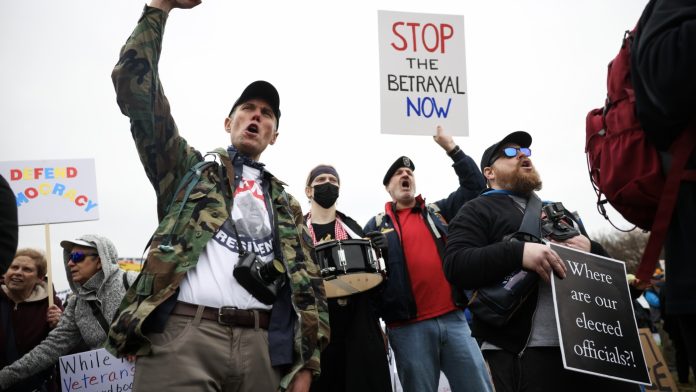
Veterans marched in on the National Mall in D.C. on March 14 to protest President Trump and Elon Musk’s plans to cut more than 70,000 workers from the Department of Veterans Affairs.

Kayla Bartkowski/Getty Images


hide caption

toggle caption

Kayla Bartkowski/Getty Images

As the Department of Veterans Affairs calls staff working in telehealth into offices across the country, a widespread concern about lack of space has emerged. The change will compromise medical ethics and patients’ privacy, clinicians and advocates at multiple VA locations told NPR.

Telehealth has become common in recent years among medical professionals — especially for mental health therapists — and the VA hired many clinicians on a remote basis. The practice allowed the VA to expand its reach of mental health services into rural areas.

Now, many say, leadership at the VA has described a working arrangement in which they will still be doing telehealth from open spaces in VA facilities. The VA leaders describe the proposed arrangement like a call center.

“What we’ve heard is that there’s not even enough room for each person to come in one day a week, let alone five,” says H, a mental health clinician who asked to be identified only by her initial, for fear of losing her job. “We’ve been told they’re cleaning out closets, they’re looking into purchasing headsets.”

Two younger men are shown. One is wearing a t-shirt with camouflage print; the other carries a small American flag.

Veterans’ marches to protest Trump’s policies took place in state capitols across the country on March 14. This one is in Indianapolis. (Photo by Jeremy Hogan/SOPA Images/LightRocket via Getty Images)

Jeremy Hogan/SOPA Images/LightRocket via Getty Images


hide caption

toggle caption

Jeremy Hogan/SOPA Images/LightRocket via Getty Images

H and other mental health providers interviewed for this story say they don’t see a way – even with the best headsets available – to provide patient privacy while practicing telehealth from an open space.

In an email response, VA spokesperson Peter Kasperowicz called privacy concerns “nonsensical.”

“VA is no longer a place where the status quo for employees is to simply phone it in from home,” Kasperowicz writes.

A federal law known as HIPAA, which stands for the Health Insurance Portability and Accountability Act, protects patient privacy, and clinicians say meeting it is the minimum they need to see from the VA. “People need to know that they have privacy and confidentiality, both from a HIPAA standpoint, but in order to do high quality psychotherapy work, both parties need to be fully concentrated and not worried about censoring themselves,” says H.

It is not only mental health clinicians who have concerns.

“There’s a lot of talk about sexual health,” says Paige, a physician at the VA, who asked to be identified by her middle name, for fear of being fired. Paige says there are many different kinds of clinicians throughout the department who regularly need to have delicate conversations with patients.

 ”Those are not things that any of us wanna talk about, with another person nearby,” she says.

Kayla Williams, a senior policy advisor for an organization called VoteVets, says this policy change is not in line with the historic ethos of the agency to take good care of veterans.

“Unfortunately, the emphasis in this current moment does not seem to be on providing that highest quality care, but figuring out ways to cut the size of the department,” Williams says.

The VA has cut hundreds of probationary positions – then reversed some decisions – while VA Secretary Doug Collins forecasted tens of thousands more additional jobs would be eliminated. Williams says that between the job cuts and the back-to-office order, VA workers are dispirited.

“I hear from someone almost every day who tells me that they and their colleagues are crying,” says Williams.

VA spokesperson Kasperowicz said in his email response that the organization would make space accommodations in order to ensure veterans’ access to care would remain uninterrupted and HIPAA compliant.

Veterans are disproportionately likely to die by suicide, compared to the rest of the population. The VA increased mental health staff by more than 50 percent in recent years, in response to the recognition of a growing need. But data show the estimated wait for a mental health care appointment can still be as long as 45 days.

A close up of the VA logo and the words "VA Medical Center" are shown on a white building.

VA Medical Centers and other health facilities exist across the country, and telehealth has expanded the VA’s reach even more. This is the Tibor Rubin Veteran Affairs Medical Center in Long Beach, California pictured in 2019.

Scott Varley/MediaNews Group/Torrance Daily Breeze via Getty Images


hide caption

toggle caption

Scott Varley/MediaNews Group/Torrance Daily Breeze via Getty Images

Clinicians say the VA’s reassurances are little comfort. Some worry they could lose their medical license for providing care in these conditions. They also wonder, if this boundary was crossed, what would be the next one.

H, the mental health professional, says she is concerned the change will lead to more loss of staff — and ultimately compromised care — for veterans. She says she is worried her colleagues will “simply will leave the VA,” she says, “because that’s not a workable solution.”

Have information you want to share about the ongoing changes across the federal government? Katia Riddle is available through encrypted communications on Signal at Katia.75

Russia and Ukraine Hold U.S.-Mediated Talks in Riyadh: What to Know

0

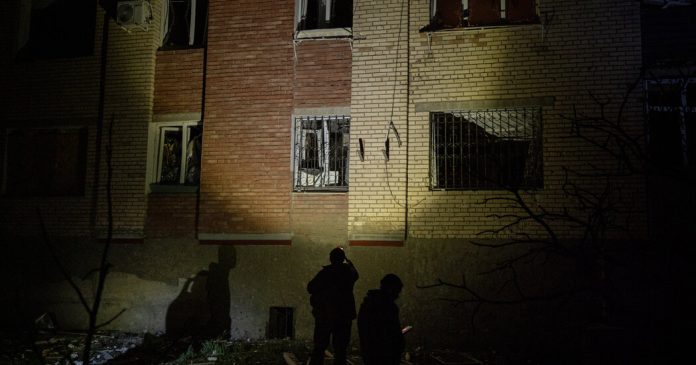
Ukrainian and U.S. officials on Tuesday held a second session of negotiations in Saudi Arabia to discuss a possible limited cease-fire, a day after Russian and American delegations held similar discussions that lasted more than 12 hours.

Kyiv and Moscow have been holding separate U.S.-mediated talks in Riyadh, the capital of Saudi Arabia, to discuss a temporary moratorium on strikes on energy sites, as well as a cease-fire in the Black Sea, a vital route for both nations to export commodities — in what could be a crucial step toward a full cessation of hostilities in Russia’s war with Ukraine.

Ukraine held its first session of talks on Sunday, followed by Russia on Monday. A Ukrainian official, speaking on the condition of anonymity to discuss the negotiations, said talks continued on Tuesday morning, and Ukrainian news media said they had ended after about one hour. The discussions have been aimed at finding common ground between Kyiv and Moscow, but both sides have cautioned against expecting an imminent deal.

The meetings in Riyadh were expected to focus on the details of a tentative agreement between Russia and Ukraine to temporarily halt strikes on energy infrastructure.

But Sergey Lavrov, the Russian foreign minister, said on Tuesday that the sides mostly discussed the safety of shipping in the Black Sea and the restoration of a grain deal agreed to in 2022 that allowed millions of tons of Ukrainian grain to be exported. Mr. Lavrov said that Russia was in favor of restoring the grain deal, but only if unspecified Russian demands were met.

Dmitri S. Peskov, the Kremlin’s spokesman, said on Tuesday that the Russian government was studying the results of the meeting between Russian and American delegations. He called the talks “technical” and said that the results would not be made public.

President Volodymyr Zelensky had said that Ukraine would prepare a list of infrastructure that could be included in the cease-fire agreement. He added that a third party would have to monitor the cease-fire and suggested that the United States could do so.

Steven Witkoff, whom President Trump has tapped to be his personal envoy to President Vladimir V. Putin of Russia, has said that the ultimate goal of the talks is a 30-day full cease-fire that would allow time for negotiations on a permanent truce.

But the path toward such a truce has been shaky. Moscow continues to insist on maximalist positions, including about asserting territorial control and ensuring Ukraine never joins NATO. The Ukrainian government has repeatedly said that it will not concede to the Kremlin’s demands and has accused Mr. Putin of stalling for time.

The Russian negotiators are led by Grigory B. Karasin, a senior Russian diplomat and lawmaker, and Sergey O. Beseda, an adviser to the head of the Federal Security Service, or F.S.B., the country’s domestic intelligence agency.

Mr. Karasin described the talks as “creative,” the Russian news agency Interfax reported.

While Mr. Karasin has been involved in sensitive foreign policy talks before, Mr. Beseda’s choice came as a surprise to some.

Mr. Beseda was head of the F.S.B. department responsible for international intelligence operations. He has been described by Russian news outlets as one of the main sources of intelligence that convinced Mr. Putin in 2022 that there was pro-Russian sentiment in Ukraine and that a brisk invasion could easily dismantle the government in Kyiv.

In 2023, Kyrylo Budanov, the head of Ukraine’s military intelligence, called Mr. Beseda a “very problematic person” for Ukraine who “has done a lot of evil.”

Mr. Umerov is leading the Ukrainian delegation in Riyadh, along with Pavlo Palisa, a top military adviser to Mr. Zelensky.

Both Mr. Umerov and Mr. Palisa are members of the Ukrainian delegation for peace talks that Mr. Zelensky appointed this month, a group led by his chief of staff, Andriy Yermak. Mr. Umerov was a key negotiator for Ukraine in peace talks with Russian diplomats in the early months of the war.

Ukrinform, the state news agency, said the Ukrainian team included deputy foreign and energy ministers, along with Mr. Zelensky’s top diplomatic adviser.

Last week, Mr. Putin told Mr. Trump in a telephone conversation that Russia would agree to a temporary truce only if Ukraine stopped mobilizing soldiers, training troops or importing weapons for the duration of any pause in fighting.

Mr. Putin also demanded the complete halt of foreign military aid and intelligence to Kyiv, calling it “the key condition for preventing an escalation of the conflict and making progress toward its resolution through political and diplomatic means,” according to the Kremlin’s readout of the call.

The White House said that military aid and intelligence sharing to Ukraine would continue despite the Kremlin’s demands. But the Trump administration has been less clear on Moscow’s calls for territorial concessions.

Mr. Witkoff echoed a Kremlin talking point on Sunday when he tried to legitimize the staged referendums that the Russian occupation forces held in parts of Ukraine to justify the annexation of those territories taken by military force. “There is a view within the country of Russia that these are Russian territories,” Mr. Witkoff told Fox News.

Fundamentally, Russia’s position regarding the conflict has remained the same. The Kremlin says it wants to “eliminate the root causes of the crisis” — essentially demanding that Ukraine capitulate.

Ukraine had previously agreed to an unconditional 30-day truce to cease all combat operations, at the urging of the Trump administration. But after Moscow said that it would support only a partial cease-fire on energy infrastructure, Mr. Zelensky spoke with Mr. Trump and agreed to the limited truce.

In recent days, Ukrainian officials have set out red lines going into negotiations: Kyiv will never accept Russian sovereignty over occupied Ukrainian territory; it will not agree to be blocked from joining NATO or to reduce the size of its army; and it must have security guarantees as part of any peace settlement.

Many Ukrainian officials and analysts have expressed doubt that even a limited cease-fire would hold for long, noting that previous truces between Moscow and Kyiv were routinely violated, with each side blaming the other.

“I do not believe in a cease-fire. We’ve been through this before,” Kostyantyn Yeliseyev, a veteran diplomat and former Ukrainian deputy foreign minister who took part in cease-fire negotiations in 2014 and 2015, said in an interview.

Mr. Witkoff said on Wednesday in an interview with Bloomberg News that Mr. Trump and Mr. Putin were “likely” to meet in Saudi Arabia within weeks. American officials will also probably continue talks with their Russian and Ukrainian counterparts in the Middle East to discuss details of a limited truce.

But the foundations of the diplomatic process have been wobbly, analysts said, with Moscow and Kyiv ready to continue fighting.

“Both sides still believe that they can continue the war regardless of the American position,” said Dmitry Kuznets, a military analyst with the Russian news outlet Meduza, which operates from Latvia after being outlawed by the Kremlin.

He added, “Moscow’s and Kyiv’s visions of what an agreement could look like are still infinitely far from each other.”

Maria Varenikova and Minho Kim contributed reporting.

What to know about Canada’s elections : NPR

0

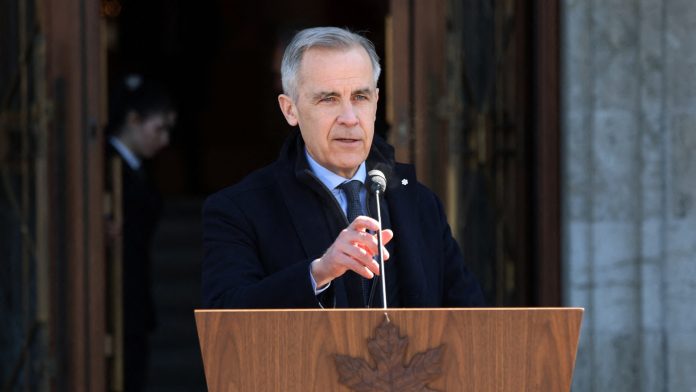
Canadian Prime Minister Mark Carney has set a snap election for April 28 — the first time he’ll run for an elected public office. He’s seen here at Rideau Hall in Ottawa on Sunday.

Dave Chan/AFP via Getty Images


hide caption

toggle caption

Dave Chan/AFP via Getty Images

Canadian Prime Minister Mark Carney and his Conservative challenger Pierre Poilievre have just under five weeks to make their case before the federal election, which comes in the midst of a trade war with the U.S. and threats to Canada’s sovereignty.

For Carney, the election will also be the first time his name is on a ballot for public office.

Canada’s top job is Carney’s first job in Parliament. He previously led central banks in Canada and England. Carney became prime minister earlier this month, after the Liberal Party chose him to succeed former Prime Minister Justin Trudeau when he resigned.

The federal election will be held on Monday, April 28; here’s a quick guide:

The snap election wasn’t a surprise

By convention, the leader of the party winning the most seats in Canada’s 343-seat House of Commons becomes prime minister.

The country had been set to hold its next general election on Oct. 20. But that plan was upended when Trudeau — facing weak support — announced on Jan. 6 that he would step down.

Trudeau also prorogued, or suspended, Parliament until March 24. Rival parties had said they would call for a no-confidence vote and force a new general election when members reconvened. But Governor-General Mary Simon agreed to Carney’s request to set a new election date in April, and Parliament is now dissolved.

Canada will hold the election as it comes under sustained economic and existential threat from its southern neighbor, with President Trump imposing tariffs and saying he wants to annex Canada as the 51st state.

Dramatic shifts have already taken place

Even before the campaign season was officially set, turbulence was roiling Canada’s politics. One week before Trudeau said he would resign, the populist Poilievre enjoyed a substantial 24-point lead in polls, reflecting Canadians’ frustrations with rising housing costs, inflation and a carbon tax.

But that was early January. The latest CBC poll tracker numbers show Carney, 60, now has a razor-thin edge over Poilievre, 45.

Jagmeet Singh, the leader of the New Democratic Party, is in a very distant third, according to the tracker.

“According to the most recent seat projections, the Liberals would probably have the upper hand if the elections were held today,” Daniel Béland, director of the McGill Institute for the Study of Canada, tells NPR’s Morning Edition.

Canadian Conservative Party leader Pierre Poilievre, dressed in a dark suit and tie, stands at a podium between two Canadian flags.

Canadian Conservative Party leader Pierre Poilievre has seen his large lead over the Liberals shrink in polls, after months in which President Trump has discussed taking over Canada and making it a state.

Dave Chan/AFP via Getty Images


hide caption

toggle caption

Dave Chan/AFP via Getty Images

The Trump factor affects both sides

Trump’s tariffs and rhetoric have transformed an election that might have been a referendum on regular voters’ economic well-being into a race focused on a trade war — and Canadian sovereignty.

“So far what President Trump has said and done regarding Canada has helped the Liberals,” Béland says.

When Trudeau was in office, his critics scored points by saying he didn’t have a plan to deal with Trump; now Poilievre — who in a December poll was seen as the best option for handling Trump — is accused of being too politically aligned with the U.S. president.

Recent remarks by a Poilievre ally, Alberta Premier Danielle Smith, stoked those concerns when she told the Brietbart outlet that she asked U.S. officials to “just put things on pause so we can get through an election.” She added that if Poilievre wins, he would be “very much in sync with … the new direction in America.”

“Pierre Poilievre will kneel down before Trump,” Carney said on Bluesky.

Poilievre’s Conservative Party has called Trump’s tariff threat “unjustified.” He also vowed in a CTV appearance, that “Canada will never be the 51st state of the U.S.”

Candidates face a compressed schedule

Official campaign periods in Canada’s federal elections “can last from 37 to 51 days,” according to Elections Canada.

This year’s five-week campaign will be on the short side of that norm, giving Carney and Poilievre, leaders of the two biggest parties, scant time to shore up support.

Poilievre is running for reelection to his riding, or district, of Carleton in rural Ottawa. Carney is running for a parliamentary seat for the first time, in the nearby Nepean riding. While most prime ministers have also held parliamentary seats, not all have.

The Liberals have been leading a minority government, meaning they did not have an outright majority of seats in Parliament and relied on other parties’ support.

In the recent Parliament, Liberals held 152 seats to the Conservatives’ 120 in the House of Commons.
Other parties that could influence the vote — and the makeup of the next government — include Singh’s New Democratic Party, which has been allied with the Liberals, and Bloc Québécois, led by Yves-François Blanchet. The NDP held 24 seats in the House of Commons, while Bloc Québécois held 33.

As Trump’s Policies Worry Scientists, France and Others Put Out a Welcome Mat

0

Just hours after opening its new program for American researchers called Safe Place For Science in reaction to Trump administration policies, Aix Marseille University received its first application.

Since then, the university in the south of France known for its science programs, has received about a dozen applications per day from what the school considers “scientific asylum” seekers.

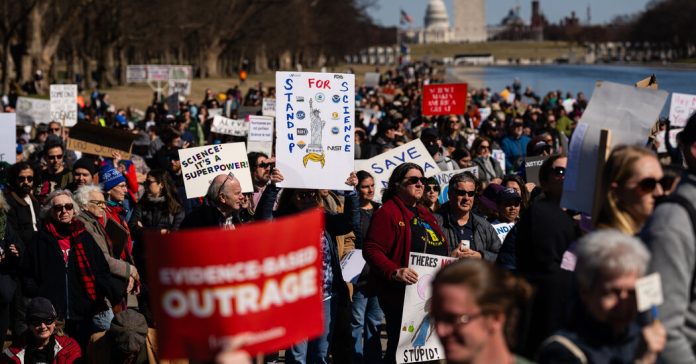
Other universities in France and elsewhere in Europe have also rushed to save American researchers fleeing drastic cuts to jobs and programs by the Trump administration, as well as perceived attacks on whole fields of research.

At stake are not just individual jobs, but the concept of free scientific inquiry, university presidents say. They are also rushing to fill huge holes in collective research caused by the cuts, particularly in areas targeted by the Trump administration, including studies of climate change, public health, environmental science, gender and diversity.

If the movement becomes a trend, it could mean the reversal of the long-term brain drain that has seen generations of scientists move to the United States. And while at least some Europeans have noted that the changes in the United States provide a unique opportunity to build stronger European research centers, most academics say that competition is not the short-term motivation.

“This program is ultimately linked to indignation, to declare what is happening in the United States is not normal,” said Éric Berton, president of Aix Marseille University, which has earmarked 15 million euros (nearly $16,300,000) for 15 three-year positions.

He said the number of openings “wasn’t much,” but the goal was to “give them a little hope.”

In France, Aix Marseille University is considered a leader in the push to bring in American researchers.

Since that program started, a cancer research foundation in Paris announced it was immediately putting up 3.5 million euros to welcome American cancer researchers. And last week, two universities in Paris announced they were offering positions to American scientists whose work has been curtailed or halted by the Trump administration.

“We are researchers. We want to continue to work at the highest level in these fields that are being attacked in the United States,” explained El Mouhoub Mouhoud, the president of Université Paris Sciences et Lettres.

The university plans to welcome 15 researchers who are already working on shared projects in targeted areas including climate science, health, humanities and gender studies, said Mr. Mouhoud. As a result, the projects would continue unfettered and the American researchers could enjoy “academic freedom to do their research,” he said.

“That’s good for everyone,” Mr. Mouhoud said.

The alarms at European scientific institutions began sounding as the Trump administration started slashing jobs and freezing science grants as part of its broad cost-cutting measures.

“We could lose a generation of science, a generation of scientists, something that we cannot recover from,” said Yasmine Belkaid, president of the Pasteur Institute in Paris.Credit…Mike Lawrence/Getty Images

Firings at U.S. centers deemed the pinnacle of science have been announced week after week including at the National Oceanic and Atmospheric Administration, the National Science Foundation, the U.S. Geological Survey and the Centers for Disease Control and Prevention.

The National Institutes of Health, the world’s largest funder of biomedical research, fired 1,200 employees and put grant reviews on hold, essentially turning off the tap of government funding for research projects in labs across the country.

The cuts come as some federal agencies have removed terms from websites and grant applications that are deemed unacceptable to the Trump administration, which is seeking to purge the federal government of “woke” initiatives. Among the terms considered taboo: “climate science,” “diversity,” and “gender.”

Taken together, the actions have sent a chill through academia and research institutes, with scientists worried not just for their jobs but the long-term viability of their research.

“What we see today is actually censorship, censorship of fundamental values ,” said Yasmine Belkaid, president of the Pasteur Institute in Paris, who moved to France last year after 30 years in the United States, where she had led the National Institutes of Health’s Center for Human Immunology.

“We could lose a generation of science, a generation of scientists, something that we cannot recover from,” she added. “It is our duty collectively to make sure that science on the whole is protected.”

Philippe Baptiste, the French minister of higher education and research, has been among the most outspoken and active European leaders on the issue. Mr. Baptiste, who led the French National Center of Space Studies before joining the government, described the Trump administration’s decisions as “collective madness” that required a swift and robust response from around the world.

“They are making decisions” he said, “that call into question whole swathes of research not just in the United States, but the world because there are a huge number of programs that we do jointly with the United States — on earth observation, on climate, on ecology, on the environment, on health data, on space exploration. It’s incalculable.”

Speaking of scientists with the National Oceanic and Atmospheric Administration with whom he worked closely in his past job, Mr. Baptiste said: “These people are of exceptional scientific quality, dealing with weather, climate and earth observation. And what’s the idea? To say that we can no longer work on these issues?”

Mr. Baptiste has been working with the presidents of French universities to come up with a government program. He has also pushed for a Europe-wide response, including drafting a letter, also signed by government ministers in 11 other European countries, which demands a coordinated effort and dedicated funding from the European Commission for startups, research and innovation.

More than 350 scientists signed a petition published this week in the French newspaper Le Monde, similarly calling on the European Commission to set up an emergency fund of 750 million euros to accommodate thousands of researchers working in the United States.

A European Commission spokesperson, Nika Blazevic, said a meeting was being planned to coordinate the most effective response to the Trump administration cuts to scientific research.

In Brussels, two sister universities — Vrije Universiteit Brussel and Université Libre de Bruxelles — said they planned to market to American students a program offering 36 postdoctoral positions open to international researchers from around the world.

The positions, largely funded by European Union money, will focus on research in climate, Artificial Intelligence, and other areas the schools view as socially important.

In the Netherlands, the minister of education, culture and science, Eppo Bruins, announced that he wanted to set up a fund “in the very short term” to attract leading scientists in a variety of fields. While he did not mention Mr. Trump directly, he hinted at it in a letter to the Dutch House of Representatives. “The geopolitical climate is changing, which is currently increasing the international mobility of scientists,” he wrote. “Several European countries are responding to this and are going to attract international scientific talent. I want the Netherlands to continue to be at the forefront.”

Ulrike Malmendier, a German economist who is member of Germany’s leading economic council, urged European governments to increase investment in science to attract out-of-work researchers from the United States. “The development in the U.S.A. is a huge opportunity for Germany and Europe,” Ms. Malmendier, who is a professor at the University of California, Berkeley, told Germany’s Funke media group. “I know that a lot of people are thinking about leaving,”

Reporting was contributed by Jeanna Smialek from Brussels, Claire Moses from London, and Christopher F. Schuetze and Melissa Eddy from Berlin.

Brain cancer that struck former Rep. Mia Love is very hard to treat, scientists say : Shots

0

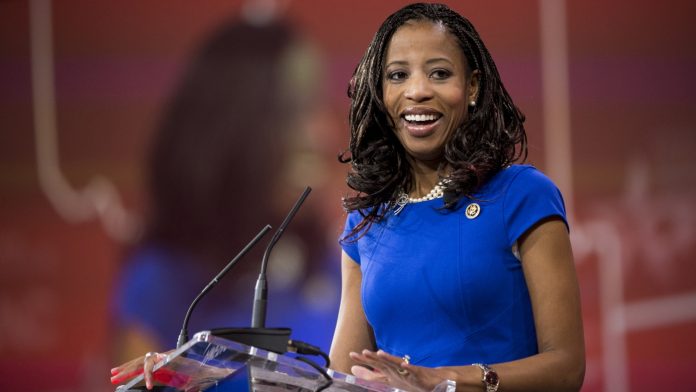
Rep. Mia Love, R-Utah, speaks at a conference in National Harbor, Md., on Feb. 26, 2015. Love died on March 23, 2025, from an aggressive type of brain cancer called glioblastoma.

Bill Clark/CQ-Roll Call, Inc./Getty Images


hide caption

toggle caption

Bill Clark/CQ-Roll Call, Inc./Getty Images

Mia Love, the first Black Republican woman elected to Congress, was diagnosed with glioblastoma in early 2022.

She died in Utah on Sunday at age 49, her family reported on the social media site X.

Love’s death offers a reminder that doctors have made little progress in treating this form of brain cancer, which is diagnosed in more than 12,000 people each year in the United States. Most die within two years.

“The last incremental step forward was a new chemo regimen in 2005,” says Dr. Michelle Monje, a professor of pediatric neuro-oncology at Stanford Medicine.

Progress has been slow because there are “more hurdles” when it comes to treating cancers that occur in the brain instead of the rest of the body, says Dr. Matthias Holdhoff, an associate professor of oncology at Johns Hopkins Medicine.

For example, he says, it’s hard to get cancer drugs into the brain, which is protected by a membrane called the blood-brain barrier. Also, treatments that use a patient’s own immune system to attack glioblastoma cells have been thwarted because this form of cancer creates what Holdhoff calls an “immune-suppressive environment” around tumor cells.

At the same time, though, there have been “enormous advances in understanding the disease,” Monje says, thanks largely to research funded by the National Institutes of Health and other federal agencies.

Both Holdhoff and Monje say what scientists are learning about glioblastoma is pointing to a range of promising new treatments.

A not-so-rare cancer

Glioblastoma starts in star-shaped cells called astrocytes, which are found in the brain and spinal cord. Astrocytes are glial cells, which protect and support neurons — the brain cells that allow thinking and movement.

Glioblastoma is the most common type of malignant brain tumor. It is also the cancer that caused the deaths of both Sen. John McCain in 2018 and Sen. Edward Kennedy in 2009.

Currently, surgery, chemotherapy, radiation therapy and immune therapy have limited effectiveness against this form of brain cancer.

But scientists say they now have a much better understanding of why glioblastoma is so deadly and how it might be slowed down or stopped.

Some advances in the field have come from Monje’s own lab, which discovered that mental activities like thinking caused glioblastomas to grow faster.

That’s because these cancer cells “become part of the nervous system,” Monje says.

As a result, the tumor cells can send signals to neurons that make them more active. And active neurons secrete a substance that acts like fuel to accelerate tumor growth.

Monje’s team showed that reducing levels of this substance halted tumor growth in mice. The team also demonstrated that reducing communication between neurons and cancer cells in mice made tumors grow more slowly.

“That’s very hopeful,” Monje says, adding that it may be possible to use existing brain drugs to accomplish this in people.

Another promising approach involves a relatively new type of immunotherapy that genetically modifies immune cells called CAR T cells. This “might lead to more effective ways to treat these cancers,” Holdhoff says.

Scientists are also finding better ways to get existing cancer drugs into the brain, Holdhoff says. These include the use of particles so tiny they can slip through the blood-brain barrier and technologies like ultrasound, which can temporarily disrupt the barrier.

“Right now we have a plethora of novel approaches and clinical trials,” Holdhoff says. “We are highly motivated.”

A Hostage Released From Gaza Campaigns for the Release of Others

0

More than 15 months have passed since Ilana Gritzewsky was released from Hamas captivity in Gaza. She still does not feel free. Her partner remains a hostage.

He was captured along with Ms. Gritzewsky from their home in an Israeli border village on Oct. 7, 2023, during the Hamas-led attack that ignited the war in Gaza and is among the hostages that Hamas continues to hold, more than 500 days later.

Traumatized from her own violent abduction, Ms. Gritzewsky, 31, has devoted herself to campaigning on behalf of the hostages still in the enclave, including her partner, Matan Zangauker, now 25, and two men she said she last saw in a Hamas tunnel while in captivity.

They were all kidnapped from the same Israeli kibbutz, Nir Oz, near the border with Gaza — among the roughly 250 hostages taken that day. Now, about 24 living hostages are still in Gaza, according to the Israeli government, along with the remains of at least 35 others who were taken on that October day.

Ms. Gritzewsky said that her captors beat her, then molested her, as they drove her to Gaza. Taken alone, she said she passed out along the way and awoke in the enclave surrounded by gunmen, half-naked, terrified and vulnerable.

The hostages’ fate has become ever more precarious, as Israel has returned to fighting in Gaza in a risky bid to pressure Hamas into releasing more captives, amid an impasse in cease-fire talks.

Trepidation over their fate has left Ms. Gritzewsky little time for self-healing.

“I’m not really available for my own rehabilitation, not for the body and not least for the soul,” she said.

“I live with the question of why me and not them. I have no answer,” she said, adding, “But if I am out, it’s a sign that God wanted me to raise my voice to help those who are alive gain their freedom and bring back the dead for a proper burial.”

Ms. Gritzewsky’s battle is at the heart of a fraught debate within Israeli society about the country’s priorities. She is backed by a broad section of society that wants to prioritize the hostages’ release at any cost, even if it means allowing Hamas to remain in power in Gaza for now. But others — including powerful ministers in the right-wing government — want to defeat Hamas, even if it delays or prevents a deal to free the remaining hostages.

Mr. Zangauker’s mother, Einav Zangauker, has emerged as a prominent voice in antigovernment protests staged by some of the families of hostages. They have been frustrated by what they view as the Israeli government’s foot-dragging over negotiating the captives’ freedom.

Some former hostages and the families of many current ones have instead pinned their hopes on the Trump administration. Several recently released hostages flew to the United States this month for meetings with President Trump and administration officials. They included Eli Sharabi, who came back emaciated on Feb. 8 to find his wife and two daughters had been killed in the October 2023, attack, and Keith Siegel, an American Israeli, who was accompanied by his wife, Aviva Siegel, who was kidnapped with him and freed in November 2023.

Ms. Gritzewsky recently returned from a month in the United States, where she met with Trump administration officials and Jewish communities, attended the Conservative Political Action Conference and addressed a rally for the hostages in Central Park.

Ms. Gritzewsky immigrated to Israel from Mexico in her teens. After starting a confectionary business, she went to work in a medical cannabis farm in Nir Oz, where she met Mr. Zangauker. They became a couple and moved in together. “We liked the quiet of the kibbutz, with our cup of coffee and cigarette,” she said. “We prefer anonymity.”

When gunmen overran Nir Oz early that October morning, they went from house to house until the assailants reached theirs, Ms. Gritzewsky said. The couple jumped out of the window of their safe room as assailants shot at the door. They ran in different directions and Ms. Gritzewsky lost sight of Mr. Zangauker. Then her nightmare continued. She was quickly captured, beaten and driven to Gaza.

She said she was trapped between two gunmen on a motorcycle, her head and face covered with a large piece of nylon or tarpaulin. A home security camera belonging to a Nir Oz resident, Eyal Barad, captured the moment, showing her with a white fabric wrapped around her head on the motorcycle with the gunmen. Ms. Gritzewsky said that the men pressed her leg onto the exhaust pipe, burning it, and that one of the kidnappers sitting behind her groped her, touching her breast under her shirt, and her legs. She passed out before they crossed the border.

When she came to, she said, she found herself on the floor in a dilapidated building, clearly in Gaza, her shirt up baring her breasts and pants pulled down, with seven gunmen standing over her. She does not know what exactly happened to her while she was passed out, but she said she gestured to them and told them in English that she had her period, believing that probably saved her from worse. “They hit me and lifted me up,” she said.

“I felt they were disappointed,” she said, adding, “I don’t think I have ever been so thankful for my period.”

Over more than 50 days she was moved from place to place, mostly aboveground, at first alone with her captors and then held with other hostages. Though she told her captors she suffered from a chronic digestive disease, she said she was not provided with any medication. She said she was held in private residences, in a hospital and, shortly before her release, in a tunnel.

Ms. Gritzewsky said she was interrogated about her army service. (She completed her military duty a decade ago.) One of her captors hugged her and told her, while pointing his pistol at her, that even if there was a deal, she would not be released because he wanted to marry her and have her children, she said. She said one told her he was a mathematics teacher, and another, a lawyer. She said they stole her earrings and a bracelet.

She understood that Mr. Zangauker had also been kidnapped to Gaza — when she described his long hair to one of her captors, the captor appeared to confirm that he was a hostage, referring to him as being from Ofakim, the Zangaukers’ hometown — but she never saw him in captivity.

Ms. Gritzewsky was released on Nov. 30, 2023, during a weeklong cease-fire when many of the other women and children were freed in exchange for Palestinian prisoners. On her return, she discovered she had a broken hip. Avigail Poleg-Dvir, Ms. Gritzewsky’s therapist since her release, said Ms. Gritzewsky had shared with her the main details of her abduction and captivity: the violence when she was taken, the motorcycle ride, the assault, waking up half-naked on the ground and the intimidation she faced in captivity. Ms. Gritzewsky said she also related the details to Israeli police investigators.

A United Nations report released last year found signs that participants in the Oct. 7 Hamas-led attack on Israel committed sexual violence in multiple locations and said that some hostages held in Gaza had been subjected to rape and sexual torture. A U.N. commission also accused Israel of sexual- and gender-based violence during its campaign in Gaza, including torture, abuse and sexual humiliation.

In December 2024, Hamas released a video of Mr. Zangauker in captivity, in which he begged Israel’s leaders to make a deal that would bring him and the other hostages home.

Rights groups and international law experts say that a hostage video is, by definition, made under duress, and that the statements in it are usually coerced. Israeli officials have called past Hamas videos a form of “psychological warfare,” and experts say their production can constitute a war crime.

But to Ms. Gritzewsky, the video provided proof that her partner was still alive.

“It wasn’t my Matan,” she said. “He was thin, with frightened eyes, screaming from within to be saved. It broke me, but it also gave me hope,” she said. “He survived.”

Could the U.S. and Russia benefit from a closer relationship? : NPR

0

President Trump is breaking with decades of U.S. policy toward Russia. NPR’s Michel Martin speaks with Elina Ribakova, senior fellow at the Peterson Institute for International Economics, about what both countries have to gain from a closer relationship.

In Germany’s New Parliament, Women Will Be a Rarer Sight

0

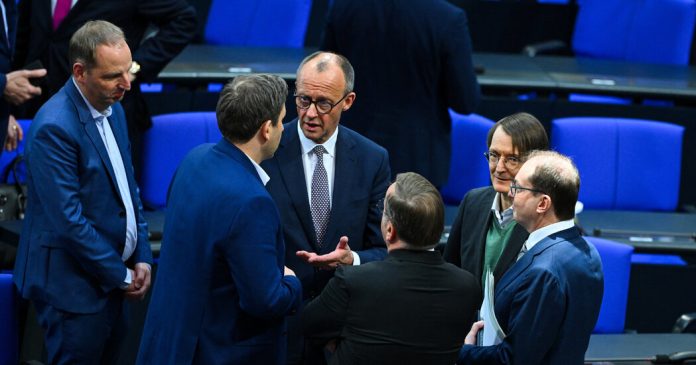
Two days after a coalition of conservatives won Germany’s federal election last month, the governor of Bavaria took to Instagram to say the party was “ready for political change” and posted a group picture of the likely future chancellor, Friedrich Merz, with five other leaders.

The photo seemed to suggest that a changed Germany will look remarkably like the country of old: It shows six white middle-aged white men sitting around a table of snacks. The only apparent concession to modern sensibilities was that half of them are not wearing neckties.

Three-and-a-half years after the only woman to serve as chancellor retired, German national politics seems to be backsliding when it comes to diversity and gender parity. While in the United States the new administration has been actively scuttling D.E.I. programs, in Germany the change appears to be less deliberate. But it is no less striking.

The German Parliament has always been more male and less diverse than the population it represents, and the new one that will be sworn in on Tuesday will be more male and — compared with the society as a whole — less diverse than the one before it. Only 32 percent of the 630 new lawmakers are women, a drop from 35 percent when the last Parliament was formed in 2021.

In a country where society has appeared at times reluctant to turn away from traditional gender roles, the number of women in the highest elected body has been stagnating since 2013, when it hit a high of 36 percent. The president of Germany, Frank-Walter Steinmeier, pointed to this at a recent Women’s Day celebration.

“When our democracy has a problem with women, then our country has a problem with democracy,” Mr. Steinmeier said. In a speech, he noted that even if every elected woman from all of the country’s parties voted together as a bloc, they would not reach the one-third minority needed to block changes to the Constitution.

One reason for the erosion of women’s presence in the halls of power is Germany’s political drift to the right, where parties tend to have fewer female lawmakers.

In the Parliament, the Bundestag, women make up only 12 percent of the hard-right Alternative for Germany (known as the AfD); 23 percent of Mr. Merz’s conservative Christian Democratic Union; 25 percent of its Bavarian-only sister party, the Christian Social Union; and 42 percent among center-left Social Democrats.

Only among the smallest parties in Parliament — the Greens and Die Linke, both on the left — are female parliamentarians in the majority.

When Olaf Scholz formed his cabinet in 2021, he vowed that he would name as many women to be ministers as men. That balance stayed in place until Christine Lambrecht, the defense minister, was forced to resign after several missteps, and was replaced by a man.

Mr. Merz has cited Ms. Lambrecht’s mistakes to explain why, when he names a new, conservative-led government, he will not be striving for parity.

“With it, we wouldn’t be doing women any favors either,” he said in a television interview late last year. The government is weeks away from being announced.

Mechthild Heil, who leads a group of women in Mr. Merz’s party, disagrees.

After taking note of the dearth of women’s voices in coalition talks, she went public with her concerns about the subordinate role women play in the party, writing a letter to Mr. Merz and demanding that women hold 50 percent of the leadership roles in Parliament.

“I can give you many examples of really competent women who are not being heard, who are not even sitting on the negotiating teams now,” Ms. Heil said. Without women present during negotiations, she said, important issues could be missed.

Ms. Heil later explained why she had decided to go public.

“We are always being told to stay quiet, that they’ll fix these issues — but we have heard these arguments for years and years and nothing changes,” she said.

Andrea Römmele, a political scientist at the Hertie School of Governance in Berlin and a keen watcher of German politics, says that one reason so few women are represented is that the pool of candidates is relatively small. Many women, she said, have to deal with dual pressures of work and raising a family.

“You can’t underestimate how work-intensive political work is,” she said.

Another problem, she says, is that many networks within political parties — especially when it comes to the Christian Democratic Union — formed years ago, when even fewer women were in position of power.

“It is striking when we now notice is how far behind we are all of a sudden,” she said.