Thursday, November 12, 2026
Home Blog Page 93

Israel’s Renewed Offensive in Gaza Displaces Palestinians Once Again

0

As the Israeli military has expanded its offensive in the Gaza Strip, taking control of more territory in parts of the south and north and issuing new evacuation orders, many people who had only recently returned to their homes have been forcibly displaced once again.

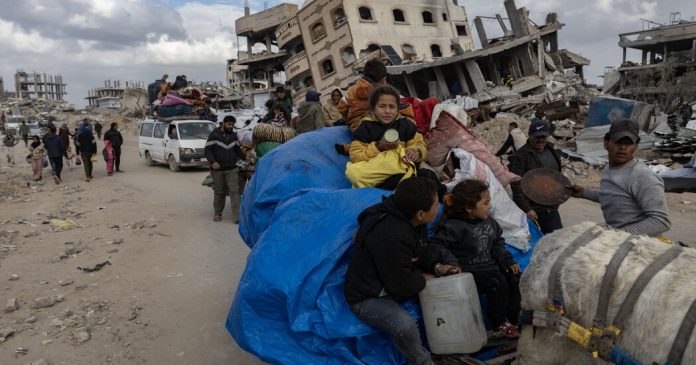
Israel’s drive into the southern city of Rafah pushed thousands of families from the Tal al-Sultan neighborhood, near the border with Egypt, to flee on foot on Sunday before Israeli troops completely encircled the area by the afternoon.

For many, the new round of mass displacement brought back painful memories of the earlier days of the war in Gaza. Residents of Tal al-Sultan and nearby areas said they had to walk on a specific route amid bombardment, carrying very few belongings, during the holy month of Ramadan, when Muslims fast during daytime.

Most of those who fled on Sunday walked several miles north to the city of Khan Younis, where they were left without shelter because of a severe shortage of basic necessities and tents, the Rafah local government, which includes Tal al-Sultan, said in a statement.

The Israeli military renewed its offensive in Gaza last week after an impasse in talks to extend a fragile, temporary cease-fire with Hamas that went into effect in mid-January. That truce was intended to be the first of three phases leading to the end of a war that began with the Hamas-led assault on Israel on Oct. 7, 2023, but the second phase has been delayed indefinitely.

Gaza’s health ministry said on Monday that 61 people were killed in Israeli bombardments over the past day, a day after it said the death toll in the enclave had surpassed 50,000 since the war began almost 18 months ago. The ministry’s figures do not distinguish between civilians and combatants.

The Israeli military said in a statement on Sunday that its troops had killed several fighters in Tal al-Sultan and raided a site it said was used as a Hamas command and control center. It did not provide evidence of its claims, which could not be independently verified.

On Monday, Al Jazeera reported that Hussam Shabat, a journalist who contributed to its coverage of the war, was killed in an Israeli airstrike on his car in northern Gaza. At least 208 journalists have been killed in Gaza since the start of the war, according to the Gaza government press office. The Israeli military said it was looking into the report.

Videos circulating online and verified by The New York Times show the apparently lifeless bodies of Mr. Shabat and two other men, as well as a donkey that had been pulling a cart, on a dusty road in Beit Lahia, in northern Gaza. Next to them is a car pocked with what appear to be bullet or shrapnel holes, with an Al Jazeera emblem and the letters “TV” on the windshield. A man shouts Mr. Shabat’s name and shakes his body, trying to get a response, while others carry away a person whose condition is unclear.

The Palestinian civil defense in Gaza said on Sunday that Israel’s siege of Tal al-Sultan had endangered the lives of nearly 50,000 people living there, with some either unable or unwilling to flee. Some residents, after months of repeated displacement, had only recently been able to return to their homes, or what was left of them, during the short-lived cease-fire.

“We left with the clothes on our backs under fire and bombardment,” said Mustafa Jabr, 36, after walking for nearly six hours along a sandy route with his family from their home in Tal al-Sultan on Sunday morning. “It was a very surprising and intense attack,” he said from a friend’s house in southern Khan Younis, where the family was now sheltering.

Mr. Jabr said that before encircling the neighborhood, Israeli vehicles had been regularly patrolling the area around the Philadelphi Corridor, a narrow strip of Gaza along the border with Egypt and one of the main sticking points in the cease-fire talks. But at dawn on Sunday, residents were jolted up by “sudden bombardment,” before fliers ordering people to evacuate along a specified route began raining down, he said.

“So we headed north under a hail of tank shelling and quadcopter fire that wounded dozens,” said Mr. Jabr. “Many old people were abandoned along the route because they were too weak to keep walking on the sand,” he said, adding, “The scenes I saw on the way were horrific, there were so many children and old people and disabled people.”

Mr. Jabr’s family was now among an increasing number of families in Gaza who were once again wondering when they would be able to return to their homes.

Ahmad and Faten al-Sayyed also fled on Sunday, walking with their four children to a relative’s tent in western Khan Younis. They had recently returned to their damaged home in Rafah after nine months of sheltering in a tent in Khan Younis, only to find themselves back in another tent less than a month later.

“I thought the second phase of negotiations would begin while we were back in our home in Rafah,” said Mr. al-Sayyed.

Although occasional gunfire was heard in Rafah in recent days, Mr. al-Sayyed said that he was shocked when Israeli troops advanced into the area. “We never imagined it would escalate into a full siege and military operation,” he said. “

As soon as the evacuation orders were issued, Mr. al-Sayyed told his children to pack two outfits each in their school bags.

Some on the route were carrying terrified, crying children, while others clutched whatever belongings they could. Most of the adults, observing Ramadan, neither ate nor drank anything along the way.

The elderly and ill, some in wheelchairs, struggled to keep up as drones “followed us, hovering above, moving right and left, watching every step,” said Mr. al-Sayyed.

The crowd found itself trapped for nearly an hour and a half after Israeli forces blocked the road, while people pleaded with the Red Cross to get them to safety.

“We could hear bulldozers and occasional gunfire,” Mr. al-Sayyed recalled. “Later, I saw how they had cleared paths for people to pass through, built mounds of sand around the area, set up fences and cameras, and positioned soldiers on top of those sand barriers,” he added, referring to Israeli troops.

They were then instructed to continue walking toward a United Nations warehouse, where an Israeli tank stopped them again and troops told everyone to sit on the ground.

“After nearly 20 minutes, the soldiers asked the women and children to sit on the right side of the street, while the men were ordered to sit on the left side,” said Mr. al-Sayyed. “People were terrified and their eyes were filled with fear,” he said, adding: “Mothers were crying for their grown sons, not wanting to be separated from them, fearing that they would be killed or arrested.”

Eventually, it was Mr. al-Sayyed’s turn to be searched by the soldiers. He said he was ordered to strip down and was made to remain seated, blindfolded, for more than an hour. He was then released and caught up with his wife and children.

“All I could hear was crying, and all I could see were scared faces,” said Ms. al-Sayyed.

“My son Mohammed was very terrified when he saw a dead boy,” she added. “He just collapsed onto the sand, screaming in a completely unhinged way, and all I could do was cry along with him.”

Iyad Abuheweila contributed reporting from Istanbul.
VA rescue effort saved 15,000 veterans’ homes. Some in Congress want to scrap it : NPR

0

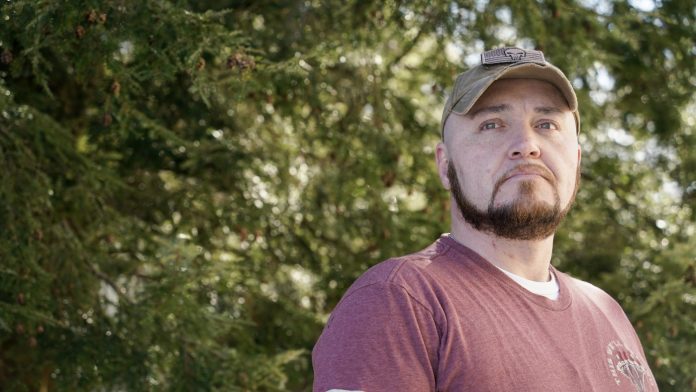
Iraq war veteran Kevin Conlon is among tens of thousands of veterans left facing foreclosure because of a debacle in the VA home loan program. 

Cindy Schultz for NPR


hide caption

toggle caption

Cindy Schultz for NPR

Kevin and Jenny Conlon live in upstate New York, not far from where he was stationed with the Army at Fort Drum. About 12 years ago, after Kevin’s two combat tours in Iraq, the couple had a young kid and were struggling to pay rent and save money. Getting a VA loan meant that they could buy a house with no down payment. And they’ve been there ever since.

“That’s the longest I’ve been in one place,” said Conlon. “Without the VA loan, there was no way that we could have afforded to buy a house,” his wife added.

The VA home loan has long been a bedrock benefit of the G.I. Bill, giving vets a leg up into the middle class.

But all that went awry for tens of thousands of vets like Conlon a few years ago, because of a blunder within the Department of Veterans’ Affairs.

The vets were left facing foreclosure after the VA scuttled a key part of a pandemic-era mortgage relief program. When NPR first uncovered the VA’s mistake, there were about 40,000 vets in danger of losing their homes. The VA responded by halting foreclosures for a full year while it rolled out a rescue plan.

NPR can now report that 15,000 veterans have so far been rescued by the VA’s new loan program. But at the same time, there are efforts in Congress to shut down the program, even though thousands of other vets, like Conlon, still need the help.

Kevin and Jenny Conlon look through Kevin’s scrapbook from his time in Iraq in their living room. Their white and gray cat Spaz and Beagle Paisely join them.

Kevin Conlon and his wife Jenny at their home in upstate New York. The couple have owned the house for 12 years and don’t know where they would go if they lose it. 

Cindy Schultz for NPR


hide caption

toggle caption

Cindy Schultz for NPR

Vets left stranded through no fault of their own

Kevin Conlon’s wounds from his time in Iraq aren’t visible, but they’ve taken years to heal. He served two combat tours, almost back to back. Roadside bombs hit his convoys repeatedly and left him with traumatic brain injuries. On the second tour his best friend died when he hugged a suicide bomber to the ground, giving his life to protect his friends. The trauma and survivors’ guilt wounded Conlon, he says, as bad as the blast injuries. He struggled with PTSD and thoughts of suicide for more than a decade before finally getting to a stable, healthy place.

“I am [OK] now,” Conlon said, “For a long time I was not.”

Jenny says the VA’s mortgage forbearance program, which allows homeowners who are struggling financially to stop paying their mortgage for a period of time, was a big contributor to his recovery. “That’s why we needed it, so he could go inpatient at a veterans program,” she said.

Kevin and Jenny Conlon hold hands as show their lock and key tattoos on the inside of their forearms. Kevin has the key and Jenny's lock is shaped like a heart.

Kevin and Jenny Conlon show their lock and key tattoos, as well as Kevin’s tribute to a fallen comrade.

Cindy Schultz for NPR


hide caption

toggle caption

Cindy Schultz for NPR

But October of 2022, the VA abruptly pulled the plug on a key part of its forbearance program that had allowed homeowners to bundle up their missed payments together and move them to the back of their loan’s term. That happened right as mortgage rates doubled to 7%, so basically refinancing wasn’t an option either. Thousands of vets suddenly had no affordable way to come out of forbearance and get current on their VA home loans.

As a result, the Conlons have been falling farther and farther behind, and they say their family has nowhere to go if they lose this house.

“ I joined right after September 11th.” said Conlon, who grew up in Queens, N.Y., and was in Manhattan the day of the attacks.

“I was willing to die for what I believed in. And for someone [to]… take away the home that my family lives in? Like we’ve paid enough, we’ve really paid enough,” he said.

Republican Rep. Derrick Van Orden of Wisconsin has a gray beard and is wearing a dark plaid blazer over a gray vest. He standing next to a marble statue on Capitol Hill.

Republican Rep. Derrick Van Orden of Wisconsin speaks to the media ahead in Washington, D.C., on Dec. 19, 2024.

Allison Robbert/AFP via Getty Images/AFP


hide caption

toggle caption

Allison Robbert/AFP via Getty Images/AFP

Some lawmakers want to scuttle VA’s new rescue program

At a recent House Veterans’ Affairs Subcommittee hearing, the head of the VA’s home loans program, John Bell, testified that 15,000 veterans have had their troubled mortgages rescued by the new VA Servicing Purchase program, or VASP.

That number was not greeted with applause by some Republicans on the committee.

Wisconsin Republican Derrick Van Orden sees the VASP program as a threat to the entire VA home loan program.

“I understand the whole developmental process of this, and it was moronic,” Van Orden said, “It gets rid of a bum loan, and it passes it off to the American taxpayers.”

Van Orden said he doesn’t like that VASP works by the VA buying a delinquent loan from the mortgage industry, then issuing a new low-interest rate loan to the vet homeowner. That new loan is then held on the VA’s books. He, and some other Republicans, say that’s too risky.

Van Orden has introduced two bills. One would allow vets who are behind on their mortgages to get current again through what’s called a “partial claim” program, basically restarting what the VA pulled the plug on a few years ago when it created the crisis in the first place. That’s a popular idea that unites both housing advocates, and the mortgage industry. l

Industry and housing groups issue dire warnings not to scrap VASP

Van Orden’s other bill would cap the VASP rescue program at just 250 loans per year, which critics say hobbles the program to the point of essentially killing it.

At the hearing, Elizabeth Balce with the Mortgage Bankers Association (MBA), a trade group that works to advance the interests of real estate lenders, said that would be a disaster.

 ”Without VASP, VA would have foreclosed on tens of thousands of borrowers,” she said. “MBA strongly opposes an arbitrary cap of 250 loans per fiscal year.”

Balce said with tens of thousands of vets still behind on their mortgages, strangling the VASP program, especially before VA stands up an alternative, would have one clear result.

“Foreclosure. Period,” she said, “That’s really where it’s gonna come to. The short answer is foreclosure.”

Nonprofit consumer protection groups also submitted a letter to the committee warning of unnecessary foreclosures if VASP is capped but also supporting a new partial claim program at VA.

The Conlon hug as they stand outside the front door of their home. Their door has a sign that says "Welcome to the Colon's" painted on a Puerto Rican flag. They also have a blue sign with a decorative C hanging on the brick next to the door.

The Conlons hope they can qualify for VASP and finally get current on their mortgage again before Congress does anything to shut down the program.

Cindy Schultz for NPR


hide caption

toggle caption

Cindy Schultz for NPR

Vets hoping for the best

Meanwhile, Kevin Conlon hopes Congress doesn’t scrap the VASP program before he and thousands of other vets can get current on their loans again.

“You’re talking about getting rid of something that would keep me and my family in a home that we love, that we need, and to do that to us is just – it’s intentionally cruel,” he said.

All this is happening while the Trump administration has fired thousands of VA employees and says it plans to lay off about 80,000 more, which could slow the program down.

At the hearing, the VA’s Bell claimed he didn’t know how many of those firings have already hit the home loan division. And the VA took no position on either of the bills to scrape and replace VASP.

Have information you want to share about ongoing changes across the federal government? NPR’s Chris Arnold can be reached at [email protected] or contacted through encrypted communications on Signal at ChrisArnold.07. Quil Lawrence is at [email protected] or QuilNPR.10

Trump Administration Cites Alien Enemies Act as It Plans New Extraditions

0

The Trump administration said on Monday that it planned to extradite a handful of Venezuelan men to Chile after declaring them subject to the Alien Enemies Act, a wartime law whose novel use is the subject of a pitched court battle.

In a statement, Justice Department officials said three men had been declared “alien enemies” and would be sent to Chile to face criminal charges there. The men are Venezuelan citizens, though one is also a citizen of Ecuador and another a citizen of Colombia.

Extradition is a long-established, frequently used process of sending accused criminals to face charges in another country. By citing the Alien Enemies Act, the Trump administration seems to be highlighting its aggressive posture on the contested legal issue without taking steps that might be deemed to violate a temporary restraining order issued by a federal judge.

Because the men are being extradited to face charges in a foreign country, their cases are different from the hurried deportations of more than 100 Venezuelans this month and will be the subject of a federal appeals court hearing Monday afternoon.

In the announcement on Monday, the administration again criticized the judge who issued that order, James E. Boasberg. “We would have already removed these violent gang members to Chile to face justice were it not for the nationwide injunction imposed by a single judge,” said Todd Blanche, the deputy attorney general. He added, “We hope common sense and justice will prevail.”

The extradition announcement comes as courts are wrestling with President Trump’s invocation of the law this month to send more than 100 Venezuelans to a giant prison complex in El Salvador. Civil rights groups have challenged the deportations, saying the men did not receive due process, and contest the accusation that they are members of the Venezuelan gang Tren de Aragua.

In invoking the 1798 law meant to expel invaders, the Trump administration has argued that the gang acts in coordination with Venezuela’s ruling party and is therefore subject to summary arrest and deportation. Civil rights groups have argued in court that the administration is misusing the law and violating immigrants’ rights.

The Justice Department said one of the men was currently in a Texas prison and wanted in Chile for extortion, kidnapping resulting in homicide and criminal association. The other two men, who are wanted on kidnapping charges, were in U.S. custody, officials said.

45 colleges are under investigation for ties to the Ph.D. Project : NPR

0

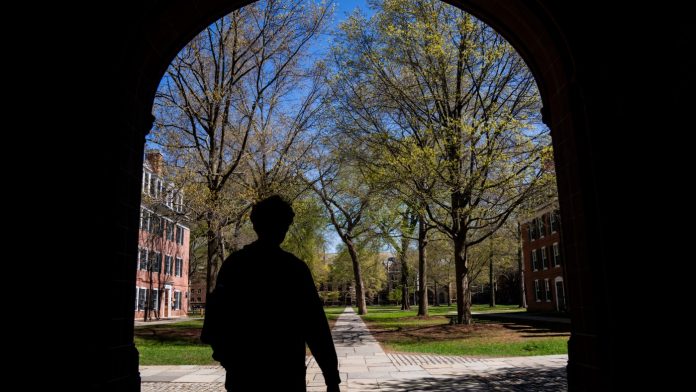
The campus of Yale University seen in New Haven, Conn. Yale is one of 45 colleges that are under investigation for allegedly engaging in “race-exclusionary practices.”

Joe Buglewicz/Bloomberg via Getty Images


hide caption

toggle caption

Joe Buglewicz/Bloomberg via Getty Images

When Leyland Lucas was a Ph.D. student at Rutgers University, there weren’t a lot of professors in the business department who looked like him. He’s Black and originally from Guyana, in South America.

He says a small nonprofit, called the Ph.D. Project, helped him successfully navigate and complete his Ph.D.

“I am incredibly grateful to the program, which was fulfilling a very critical role,” says Lucas, who is now a dean at the University of Guyana.

For about 30 years, the Ph.D. Project has provided support, mentorship and guidance to students from underrepresented groups who are earning doctoral degrees in business.

Before returning to Guyana, Lucas was a professor at Morgan State University in Baltimore, where he helped mentor other students through the Ph.D. Project.

“If you see people like you who understand some of the challenges you are facing, and you can see them and see how they have overcome those challenges, that serves as an incentive for you,” Lucas says.

But with its goal of diversifying academia, this small nonprofit has now drawn the attention of the Trump administration.

The U.S. Education Department announced it was investigating 45 universities with graduate schools that partner with the program, including the University of Kansas, the University of Utah and Ivy League schools like Cornell and Yale Universities. The department alleges these schools are violating the 1964 Civil Rights Act because the Ph.D. Project limits eligibility based on race, and therefore engages in “race-exclusionary practices.”

This comes as some universities have already begun to reexamine their DEI-related partnerships, scholarships and programs. Since taking office in January, President Trump has issued a number of executive orders banning DEI initiatives, and sent guidance to schools and colleges outlining how they must “cease using race preferences and stereotypes” in all aspects of campus life including admissions, hiring and activities. Some universities have shut down their diversity offices, discontinued the use of “diversity statements” in hiring or changed staff or department titles to eliminate DEI references.

The Ph.D. Project hasn’t escaped this purge. Just a few weeks ago the University of Iowa discontinued its partnership with the organization after the state’s Board of Regents voted to eliminate all programs with DEI functions. After the federal investigation announcement, the University of Kentucky also cut ties with the Ph.D. Project, even though it does not currently have any doctoral students actively engaged in the program.

In February the nonprofit issued a new mission statement removing the word diversity and adopting a broader approach.

“This year we opened up our application to anyone who is interested in helping to expand and broaden the pool of talent, both at the university level through faculty, as well as in corporate America,” says Alfonzo Alexander, the president and CEO of the Ph.D. Project.

“We’re really evolving so that we are able to do our work in today’s environment,” he explains. “And if that means that we can no longer specify certain requirements, then we just evolve in a way that we can still create opportunities.”

What the Ph.D. Project does

More than 1,500 Ph.D. students have participated in the Ph.D. Project over the last three decades. The organization holds annual conferences with sessions on how to write a dissertation, how to cope with the stress and challenges of a Ph.D. program and how to get work published in academic papers. Alums have gone on to become university provosts, deans of business schools, professors and business leaders.

“The PhD Project has changed my life because I was able to interact with individuals who looked like me and understood the journey that we were embarking on,” Adrian Mayse said in a statement posted to the organization’s website. Mayse got his Ph.D. at Jackson State University. He has worked as a professor at Howard University and Talladega College.

“They were an important transformation to my life,” explains Miles Davis, who first got involved with the Ph.D Project in 1995.

He had been working as a managing consultant when he decided to pursue a Ph.D. at George Washington University. He says the Ph.D. Project introduced him to the possibility of a career in higher education.

“I did not know one full-time Black faculty member. And so the idea of academia as a path was not even a consideration.” Davis has since worked as a professor, a dean and a university president.

Leyland Lucas and other alums of the program told NPR they didn’t get any special treatment or preferences based on their race. “We had to face the same guidelines as everyone else. And once we got into those Ph.D. programs, we had to perform and we have performed.”

He says, “I would really hate to see the Ph.D. Project somehow become misunderstood.”

Business school faculty are overwhelmingly white. Data from 2020 show less than 4% of faculty are Black, less than 3% are Hispanic, and just 0.3% are Native American or Alaska Native, according to the Association to Advance Collegiate Schools of Business, the country’s main business school accreditor. Those numbers don’t reflect the diversity of students enrolled in colleges, federal data show.

Lucas explains the main goal of the Ph.D. Project was to close those gaps, and he worries about what will happen when the work of “transforming the front of the classroom becomes misunderstood.”

How the Ph.D. Project got on the Trump administration’s radar 

In late February, the administration launched an online form, at enddei.ed.gov, where people could submit reports of discrimination in schools or colleges. The form says submissions will be used “to identify potential areas for investigation.”

“My assumption is that it came through the tip line,” says Wil Del Pilar, a leader at Ed Trust, a left-leaning organization that studies equity in education. He has a Ph.D. and says he had never heard of the Ph.D. Project before the department announced the investigations.

“We’ve effectively created a tool where people can tell on people and report anything that they believe to be discrimination or DEI. I expect we’re going to see more investigations based on this.”

It’s not uncommon for federal investigations to originate from online tips. Historically, many Education Department investigations have stemmed from complaints.

According to Inside Higher Ed, one complaint filed in 2018 flagged a number of programs aimed at creating more opportunities for women in STEM at the Rochester Institute of Technology. The complaints came from a professor emeritus in Michigan who self-identifies as a serial complainer, having filed hundreds of complaints to the Education Department about programs he believes discriminate based on sex or race. The federal government investigated, and ultimately RIT opened up the STEM programs to men.

Research has shown that, up until recently, many investigations have been closed without finding violations. If corrective action has been deemed necessary by the department, schools often choose to change or eliminate a program or policy, and in rare cases, face a fine.

And while the department has the authority to withhold federal funding, it has rarely happened.

But the climate surrounding recent investigations appears to have higher stakes than in years past. Trump has said colleges that don’t get in line with his administration’s priorities may also lose large amounts of federal money. It’s a threat he’s already delivering on, at Columbia University and the University of Pennsylvania.

That fear was palpable at the Ph.D. Project’s latest conference, held over the weekend in Chicago.

“It can be really scary for members of our organization to hear that their university may not continue partnering with us because of threats from the federal government of losing funding,” says Alexander.

But he says being all together and hearing how the organization has positively impacted its members helped remind him and others how important their work has been.

“These times have caused us, just like many other entities, to pivot and transition,” he says. “We may have to do it a little bit differently than what we’ve done in the past. But we will make sure that we continue on a path to where we’re impacting people in a positive way.”

He says he wakes up every day optimistic and recharged, and is convinced, “when we look back a year or two years from now, we’ll be better and stronger as an organization than we were before this current environment.”

Israel’s Internal Conflicts Return as Fighting in Gaza and Lebanon Continues

0

Eighteen months ago, in the aftermath of Hamas’s attack on Israel, Israelis suspended their internal conflicts to form a united military front against a shared external threat.

Now, that semblance of common cause has been cast aside. Beyond its borders, Israel has resumed fighting on four fronts — in Gaza, Lebanon, the occupied West Bank and Yemen. And internally, Israel’s citizens have returned to the bitter domestic feuds that once again, pose existential questions about their country’s future.

Prime Minister Benjamin Netanyahu’s ruling coalition has revived its contentious efforts, frozen after the attack in 2023, to expand its control over other branches of government. The moves have set off mass protests after the government tried to fire the head of Israel’s domestic intelligence service as well as the attorney general — two powerful gatekeepers who are overseeing investigations into both Mr. Netanyahu and his aides.

This week, Parliament will vote on the government’s plan to give itself greater control over the selection of justices on the Supreme Court, an institution that has long thwarted the ambitions of Mr. Netanyahu’s ultranationalist and religiously conservative allies.

“The foundations of the state are shaking,” Ehud Olmert, a former Israeli prime minister, said in an interview. “In Israel, Netanyahu is ready to sacrifice everything for his survival and we are closer to a civil war than people realize. In Gaza, we have returned to fighting — and for what? And overseas, I never remember such hatred, such opposition, to the state of Israel.”

To Mr. Netanyahu and his supporters, the moves are a legitimate effort to rein in unelected bureaucrats and judicial officials who have stymied the will of an elected government. “The leftist Deep State weaponizes the justice system to thwart the people’s will,” Mr. Netanyahu wrote on social media last week.

But to his critics, Mr. Netanyahu’s decisions constitute, at best, a huge conflict of interest for a prime minister currently standing trial for corruption. At worst, they are an attempted putsch against the judicial branches of government.

Mr. Netanyahu has further spurred domestic anger by breaking the cease-fire with Hamas in Gaza; the return to war endangers not only Palestinians but up to 60 Israeli hostages still held in the territory. In returning to war, Mr. Netanyahu has also drawn retaliation from Hamas’s allies in Lebanon and Yemen. And he has tested the patience and resolve of tens of thousands of exhausted military reservists who will be required to sustain what was already Israel’s longest war.

The public anger is exacerbated by the impression that Mr. Netanyahu has benefited politically from the return to war, which has helped shore up his fragile coalition government.

A far-right faction, Jewish Power, quit the government at the outset of a cease-fire in January, which raised the possibility that the war might end with Hamas still in charge of Gaza.

Hours after Israel restarted strikes on Gaza last Tuesday, killing hundreds of Palestinians, the party’s leader, Itamar Ben-Gvir, praised the move and returned his group to the government, bolstering Mr. Netanyahu’s majority in Parliament. That paves the way for the party to vote in favor of a new national budget whose passage by the end of the month is necessary to prevent the government’s collapse.

Mr. Ben-Gvir, who now oversees the police, is also one of the strongest supporters of the move to sack Ronen Bar, the head of the domestic intelligence service, and Gali Baharav-Miara, the attorney general. Both are considered to be significant checks on the far-right leader who was barred from serving in the Israeli military because of his extreme views and who has several convictions for incitement to racism and support for a terrorist group.

Analysts are divided about whether Mr. Netanyahu intends to continue endlessly with his various moves — both on the battlefield in Gaza and against his critics at home.

Some think he could soften some of his stances after the budget votes at the end of March, reducing his reliance on Mr. Ben-Gvir. A major litmus test is expected on April 8, when the Supreme Court is scheduled to rule on the legality of Mr. Bar’s firing. Mr. Netanyahu has hinted that he may ignore the ruling, and his response will indicate how far he is willing to defy the constitutional order.

“I don’t see him saying ‘no’ to the Supreme Court,” said Nadav Shtrauchler, a former adviser to Mr. Netanyahu, adding, “In the vast majority of cases, Netanyahu ends up being conservative.” But even if the Israeli leader steps back from the brink, his critics say that Mr. Netanyahu has already caused irreparable damage by breaking so many norms to reach this point.

Mr. Olmert, the former prime minister, was also investigated for corruption while in office, and was ultimately convicted and jailed. But he resigned his post before the case reached trial, and his government never tried to fire the attorney general who oversaw the investigation.

“What Netanyahu is doing would have been unthinkable,” Mr. Olmert said.

Myra Noveck contributed reporting.

US Exporters Vie to Shape Trump’s Reciprocal Tariffs Ahead of April 2

0

Ahead of President Trump’s next big trade move, his administration invited companies to weigh in on the economic barriers they faced abroad.

The list of complaints was both sprawling and specific. In hundreds of letters submitted to the administration in recent weeks, producers of uranium, shrimp, T-shirts and steel highlighted the unfair trade treatment they faced, in hopes of bending the president’s trade agenda in their favor. The complaints varied from Brazil’s high tariffs on ethanol and pet food, to India’s high levies on almonds and pecans, to Japan’s longstanding barriers to American potatoes.

Mr. Trump has promised to overhaul the global trading system on April 2, when he plans to impose what he is calling “reciprocal tariffs” that will match the levies and other policies that countries impose on American exports. The president has taken to calling this “liberation day,” arguing that it will end years of other countries “ripping us off.”

“It’s a liberation day for our country, because we’re going to be getting back a lot of the wealth that we so foolishly gave up to other countries,” Mr. Trump said last week.

The president had floated the idea of also announcing sector-specific tariffs on cars, pharmaceuticals and semiconductors that same day. On Monday, White House officials said that those additional tariffs had not yet been set for April 2 but that the situation remained very fluid.

One official said that separate tariffs on cars could still happen on April 2. Another official said that if tariffs on cars and other sectors did not happen on April 2, they could still be imposed at a later date.

Markets opened higher on Monday after Bloomberg and The Wall Street Journal reported that the White House was not likely to announce industry-specific tariffs on April 2.

Still, the price of imported cars, medicines and semiconductors will probably go up through Mr. Trump’s reciprocal tariff plan. Many details of that plan remain unclear, but administration officials have indicated that the reciprocal tariffs would add an additional fee on top of most or all products imported from specific countries.

It’s not clear how many countries will be hit, but Trump officials have mentioned the “dirty 15,” a reference to a group of countries that have tariffs on American products and run trade surpluses with the United States, presumably including most of America’s largest trading partners.

The reciprocal tariff plan has created a tricky calculus for many companies, which want to see trade barriers erased but fear ending up at the center of a trade war that could make them worse off. That is because Mr. Trump’s high-stakes approach could generate efforts by other countries to make deals with the United States and drop their own tariffs — or it could invite retaliation that ends up closing off foreign markets to American products.

Some American companies see an opportunity in Mr. Trump’s agenda. Many of the letters that companies submitted to the Office of the United States Trade Representative in recent weeks asked officials to fight for lower trade barriers on their behalf, highlighting the high levies, onerous inspections or other complications American exporters face in foreign markets.

But others appear hesitant to put themselves in the president’s cross hairs. Some industry representatives say privately that companies have been nervous that raising their hands for help could put them at the center of coming trade spats, disrupting the export markets they depend on and potentially making them a target for retaliation.

Publicly, many of America’s biggest exporters — like the trade groups that represent exporters of pork, soybeans and oil — tempered their filings with cautionary words about the harm that could come from disrupting export markets. Major business groups also continued to urge the administration to reduce trade barriers rather than raise them, and focus on striking new trade agreements that would open up foreign markets.

“The administration’s work on reciprocity should result in the removal, not the creation, of barriers to trade,” the Consumer Technology Association, which represents technology companies, said in its letter to trade representative. The group said it was “deeply concerned” that tariff threats against Europe would “increase global barriers to trade and dismantle the global trading system.”

Other groups seemed to be aware that the information they were handing the Trump administration could become ammunition in a trade war in which they could be casualties. The U.S. Chamber of Commerce said the information it was submitting on trade barriers was “not intended to justify the application of broad-based tariffs but should help U.S. negotiators to focus on specific issues of importance to American businesses of all sizes.”

It remains to be seen whether these submissions will have much influence over Mr. Trump, who has a history of basing trade policy on his impulses and intuition. But the quantity and variety of the responses highlight the enormous challenge for the Trump administration as it tries to figure out how to put its own imprint on the global trading system with just a few weeks of preparation. And it hints at the controversy that may be awaiting the administration once it finally reveals the details of a still-ill-defined trade policy.

Mr. Trump has suggested that his forthcoming tariffs could be sweeping and influential. But for now, even the basic question of whether the administration’s efforts will result in higher or lower barriers to trade remains unanswered.

The president has said his guiding principle is reciprocity. If other countries charge the United States high tariffs or install other economic barriers, the United States will mirror that treatment for their exports, he said. Mr. Trump has often mentioned India’s high tariffs on motorcycles, Europe’s tariffs on cars and its value-added tax, and Canada’s protections for its dairy market.

Treasury Secretary Scott Bessent said last week that the administration planned to come up with a tariff number for each country that it would impose on April 2. That number would represent the levies that foreign governments imposed on American products along with other barriers, like taxes.

Mr. Bessent said some countries might be able to pre-negotiate deals and not face additional tariffs. Officials in Britain, India, Mexico, the Europe Union and elsewhere have been angling for such an outcome, though some are also drawing up lists of retaliatory tariffs if Mr. Trump moves forward.

It also remains uncertain exactly what the president wants the reciprocal tariffs to accomplish. Mr. Trump’s administration has cited a litany of reasons for his tariffs, including making trade more fair for American exporters, eliminating trade deficits with other nations and generating more tariff revenue to finance his tax cuts.

With these goals still unclear, some companies are trying to shape the agenda. Many of the submissions to the trade representative pointed to China as a primary threat, with companies highlighting the risk that cheap Chinese imports pose to various U.S. industries.

Makers of American flags and Jacuzzis complained that competition from China was threatening to put them out of business. American Christmas tree growers argued that tariffs on artificial Christmas trees from China would help U.S. tree farms. The poultry industry criticized Chinese barriers to the sale of U.S. chicken parts, including chicken feet and wing tips.

But plenty of other countries were mentioned as well. Makers of catfish and prunes complained of Vietnam’s trade barriers. Corn growers cited Mexico’s recent ban on genetically modified corn. J.M. Smucker called out Europe’s tariffs on jam and jelly, while Chobani criticized Canada’s barriers to yogurt imports.

Nearly two dozen entries alone highlighted the dire situation of the American shrimp industry. The Louisiana Shrimp Association called for a quota or other limits on shrimp imports, saying foreign shrimp had depressed prices so much that shrimpers could not even afford to fire up their boats.

“The volume of cheap, possibly contaminated shrimp has put the domestic shrimp industry in a downward spiral,” George Barisich, a 69-year-old shrimper from Louisiana, wrote in a letter. “Last year, I received one-third of the price for shrimp that I got in the 1980s.”

Some called for the U.S. government to distinguish between different parts of the world. Medical manufacturers argued for protection from China but cautioned against hitting America’s closest allies, saying that could have unintended negative consequences.

The tool maker Stanley Black & Decker said that it had worked to trim its imports from China to around 15 percent in 2025 — from around 40 percent in 2018 — and that it should not be penalized for moving its supply chains to Mexico.

“Companies like ours that are doing the right thing and leaving China should be acknowledged,” the company said.

Many industry groups also sent letters arguing against tariffs on products that are not made in the United States, saying import taxes on spices, coffee and Christmas decorations would simply raise prices for American consumers.

America’s major export industries, such as corn, pork, oil and soybeans, highlighted some global barriers but also urged the Trump administration not to damage the export markets that their sales depend on.

Tyson Foods said negotiating new trade agreements was important to avoid falling behind other countries, while the National Milk Producers Federation said dairy exporters were operating at a disadvantage to foreign competitors because the United States had not kept up with the European Union and New Zealand in inking new trade deals.

The filings also contained a reminder that the legacy of trade wars can be long lasting. Some of the barriers that companies complained about — like China’s high tariff on cranberries or a European tariff on peanut butter — were the result of Mr. Trump’s first-term trade wars, in which countries retaliated against tariffs he had levied on them.

Even Tesla, whose chief executive, Elon Musk, is helping to drive much of the president’s strategy, warned of the negative effects that tariffs and retaliation could have on its business. The company noted that past U.S. trade actions had prompted increased levies on American electric vehicles.

“U.S. exporters are inherently exposed to disproportionate impacts when other countries respond to U.S. trade actions,” Tesla said.

Harley-Davidson, the motorcycle maker that Mr. Trump has frequently cited when talking about reciprocity, said it was now facing a 25 percent retaliatory tariff that Canada imposed this month in response to U.S. levies. It also warned about a 50 percent European tariff on motorcycles that had been suspended but could snap back into place.

“Harley-Davison has become a political target,” the company said. “This use of our brand in trade wars unrelated to our sector is unacceptable.”

Trump’s Moves on Greenland Appear to Be Backfiring

0

For more than 150 years, U.S. officials have repeatedly wanted, as President Trump puts it, to “get” Greenland.

The idea came up in the 1860s, then again before and after the world wars. In a way, the timing couldn’t be better than now, with Greenlanders re-examining their painful colonial history under Denmark and many people there itching to break off from Denmark, which still controls some of the island’s affairs.

But President Trump seems to have overplayed his cards — big time.

His decision, announced this weekend, to send a high-powered U.S. delegation to the island, apparently uninvited, is already backfiring. The administration tried to present it as a friendly trip, saying that Usha Vance, the wife of Vice President JD Vance, would attend a dogsled race this week with one of her sons and that Michael Waltz, the national security adviser, would tour an American military base.

But instead of winning the hearts and minds of Greenland’s 56,000 people, the move, coupled with Mr. Trump’s recent talk of how he will “get it, one way or the other,” is pushing Greenland further away.

Over the past 24 hours, the Greenlandic government has dropped its previous posture of being shy and vague in the face of Mr. Trump’s pushiness. Instead, it’s blasted him as “aggressive” and asked Europe for backup. And the planned visit may only strengthen the bonds between Greenland — an ice-covered land three times the size of Texas — and Denmark.

“This will clearly have the opposite effect of what the Americans want,” said Lars Trier Mogensen, a political analyst based in Copenhagen. “This offensive pushes Greenland further away from the U.S., even though a year ago, all parties in Greenland were looking forward to more business with the Americans.”

His prediction? Greenlanders, he said, will “seek safety in the status quo — in the Kingdom of Denmark and its alliances.”

Even the dogsled race has reacted coolly. The organizers of the race — the Avannaata Qimussersua, Greenland’s Super Bowl of dogsled races — said on Sunday of Ms. Vance and her son, “We did not invite them,” but added that the event was open to the public and “they may attend as spectators.”

The Greenland drama began during Mr. Trump’s first term. He floated the idea of buying the island from Denmark — with people in his camp pointing to its location and geopolitical importance — but the plan faded away. As out-of-the-blue as that might have seemed, Mr. Trump wasn’t the first American official to raise the idea.

In 1868, Secretary of State William Seward, fresh off the Alaska purchase, commissioned a study about acquiring Greenland. He was interested in Greenland’s coal, but the plan didn’t go anywhere. American officials resurrected the idea in 1910 and again in 1946, seeing Greenland as a strategically important chunk of territory, but each time Denmark didn’t want to part with it.

What has changed in recent years is Denmark’s grip. In 2009, Denmark granted Greenland self-rule, which means the island runs most of its affairs except defense, foreign policy and a few others. A movement for full independence has been gathering steam. This month, a closely watched parliamentary election on the island yielded an awkward and mixed result: The first-place party wants to pursue independence slowly while the second-place finisher wants it much faster and includes a prominent pro-Trump member who attended the president’s inauguration.

This raises another issue: the timing of the visit, while Greenland’s parties are still negotiating over who will form the island’s next administration.

“It’s bad timing. We don’t even have a new government yet. They should’ve waited,” said Jens Peter Lange, a dental technician in Ilulissat, a town in the Arctic Circle.

But he said, “Is it disrespectful? Not really. I’d rather say: they lack situational awareness.”

The visit has been in the works for weeks. Jørgen Boassen, a Greenlandic bricklayer and an outspoken supporter of Mr. Trump, said he and Tom Dans, an American businessman who advised Mr. Trump about Arctic affairs during his first term, helped organize it.

“Instead of just rejecting them, we should be cooperating with the Americans,” Mr. Boassen said in an interview. “We simply can’t avoid the U.S. as a partner, whether in trade or defense.”

“I think it’s absolutely great that they’re coming,” he added. “It’s a huge promotion for our Greenlandic sled dogs.”

Gérard Depardieu to Appear in Court Over Sexual Assault Allegations

0

The French actor Gérard Depardieu on Monday appeared before a Paris court where he faces two charges of sexually assaulting two women working on the set of a film in which he was starring.

The trial will be the first time Mr. Depardieu has been forced to answer in court to accusations of groping, sexual assault and harassment, and rape that have piled up against him for years, and which he has denied.

The charges in this trial came after two women on the set of “Les Volets Verts,” a movie by the French director Jean Becker that was released in 2022, filed police complaints that he had groped their genitals, buttocks and breasts. If found guilty, Mr. Depardieu faces up to five years in prison and a fine of 75,000 euros, or about $81,000.

Mr. Depardieu has denied all accusations in the case being brought to trial Monday. His lawyer, Jérémie Assous, called them “totally false and unrealistic.”

The trial was scheduled for last October, but was postponed after Mr. Depardieu did not appear for health reasons. Mr. Assous presented medical assessments that showed Mr. Depardieu suffered from long-term diabetes and heart problems after undergoing a quadruple bypass, and that anxiety from the trial had worsened his conditions.

For many, the case represents a breakthrough for the #MeToo movement in France, which was stalled for years, particularly in the film industry.

Considered the most famous and powerful actor France has produced in generations, Mr. Depardieu, now 76, has dominated the French screen for decades, appearing in more than 230 films, including “Cyrano de Bergerac” and “The Man in the Iron Mask.”

“He’s truly an artist, on a par with directors, given his aura,” said Geneviève Sellier, the author of “The Cult of the Auteur,” a book about sexual abuse in a segment of the movie industry. “So the fact that Depardieu was charged, and is going to trial, means that from now on the artist in France is no longer above the law.”

While the #MeToo movement toppled scores of powerful men in Hollywood almost immediately after it started in 2017, in France its advent was viewed suspiciously by some as a puritanical American import that was tainting an essential part of France’s intellectual and cultural identity.

The movement has brought some small structural changes to the cinema industry, including mandatory training for producers in preventing sexual violence on sets if movies are to receive important government subsidies. But it has otherwise faced strong resistance from a sector that is considered near sacred in France and run largely by men.

“Up until now, the French institutions of the cinema covered up all these excesses,” Ms. Sellier said. “All these institutions are run by men — who are immovable and who have turned a blind eye to these abuses for as long as possible.”

In recent months, however, a number of cases have gone to trial and resulted in convictions. Last fall, the film director and actor Nicolas Bedos was convicted of sexually assaulting two women in 2023 and sentenced to one year in prison, which was reduced to six months of house arrest with electronic surveillance.

Last month, a French court convicted the director Christophe Ruggia of sexually assaulting the actress Adèle Haenel when she was a minor, handing him a four-year sentence — two years under house arrest and the rest suspended. Mr. Ruggia has appealed the ruling.

It is too soon to determine if the rulings signal a shift for #MeToo in French cinema, said Marie Lemarchand, an actress who is a member of the Association of Actors and Actresses, which was formed in 2021 to lobby for changes in the industry.

“But symbolically, it’s very powerful, because these people who filed complaints were recognized as victims,” Ms. Lemarchand said.

The first allegations against Mr. Depardieu in the #MeToo era arose in 2018, when a young aspiring actress, Charlotte Arnould, told the police that the actor raped her twice when she was 22.

An investigation into those allegations was dropped, then later picked up again in 2020 and is continuing, according to the Paris prosecutor’s office.

After Ms. Arnould stepped forward publicly, others followed.

At least three investigations into allegations of sexual assault and rape against Mr. Depardieu, brought by French actresses and a Spanish journalist, were launched. Two were dropped because they were past the statute of limitations.

Mr. Depardieu has called all the accusations false and the media coverage a “lynching.” In 2023, he wrote in the conservative daily Le Figaro that he might be “provocative, overflowing, sometimes rude” but that he had “never, ever abused a woman.”

Many prominent people have rushed to Mr. Depardieu’s defense. Most notable among them is President Emmanuel Macron of France, who condemned what he called a “manhunt” against the actor, who he said “makes France proud.”

“There is always this protection of men’s honor,” said Ms. Lemarchand, noting that Mr. Depardieu had been nurtured by a system that at best ignored sexual abuse and violence and at worst promoted it.

But, there was a danger in singling out Mr. Depardieu as a “monster,” she said. “He can’t be separated from the rest of the profession, the environment in which we work,” she said, nor “from the rest of what our society values.”

The trial is scheduled to last two days but could be extended because the court’s medical expert has said that Mr. Depardieu’s health permitted him to attend for no more than six hours at a time, his lawyer said.

Ségolène Le Stradic contributed reporting from Paris

Lessons from a Lost-Pet Detective Named Kat

0

In 1996, Kat Albrecht was a police officer and bloodhound handler in Santa Cruz, Calif. Her dog, A.J., had been a part of many search and rescue efforts, sniffing out and locating lost people in the woods.

But when A.J. escaped Ms. Albrecht’s yard, there was no team of expert animal rescuers to turn to. So she sought help from a friend who had her own tracking dog, a golden retriever named Kea. “We knew that Kea understood, ‘Smell this pillowcase and follow the scent trail of this missing person,’” Ms. Albrecht recalled. “Would she understand, ‘Smell this stinky blanket and find my stinky bloodhound?’”

Within 20 minutes, Kea found A.J. lounging on a stranger’s porch. For Ms. Albrecht, it was a turning point. “We have all kinds of detection dogs: drug-detection, bomb-detection, termite-detection,” she said. “Why don’t we have cat-detection dogs? Why aren’t we training dogs to follow the scent trail of lost dogs?”

Ms. Albrecht decided to do just that, forging an unlikely career as a lost-pet detective. Along the way, she has worked with researchers to study the behavior of missing cats and founded the Missing Animal Response Network, which trains people to locate lost pets and assists panicked pet owners. She no longer searches for lost pets herself, but trains others to follow in her footsteps.

Ms. Albrecht spoke with The New York Times about her work. This conversation has been condensed and edited for clarity.

What strategies and techniques do you use to find missing pets?

One of the most fundamental things is the analysis of lost-pet behavior. Dogs and cats are like apples and oranges. They behave differently from each other when lost.

Cats will hide when they’re afraid, sick or injured. And it’s often within their territory — in your yard or one of your neighbor’s yards. It’s fine to post your missing cat on the internet, but you have to get permission from your neighbors to go into their yards to do a slow, methodical search. Because that is where studies have shown that cats are most likely to be. They’re close, but they’re silent and they’re hidden.

Other techniques and tactics would be the use of cat-detection dogs. We choose dogs that want to get the kitty but not “get” the kitty. I can share a story on one of those recoveries. The handler’s name was Karen, and her dog’s name was Halo. An indoor, skittish cat had escaped. Halo tracked from the escape point to a neighbor’s house and then alerted: There’s a cat under this deck.

When the owner crawled under the house, she couldn’t see the cat. But Karen was so confident in her dog. She said, “My dog is insisting there’s a cat under here.” So the owner crawled farther back, and she found Miso, the cat.

Isn’t there a risk that a skittish cat will be frightened by a dog and go deeper into hiding?

That’s exactly what Miso did. He moved farther back under the house. Once Karen knew that the cat was under that deck, she put Halo in the car. So, yeah, there’s a risk. But the ability of the dog to tell us there’s a cat under this house or in this wood pile is a very important clue.

Let me back up and say: A lot of people think that a search dog is the answer to finding their missing pet. It’s only one tool. We use cameras to monitor traps and feeding stations. We’ve also used amplified listening devices. It’s just being innovative in seeing what technologies are out there.

How does the behavior of missing dogs tend to differ from that of cats?

We have had cases where dogs have hidden, like when there’s fireworks going off. But in general, dogs run.

The interesting thing about dogs is, their recovery is more dependent upon the behavior of people. When people see this dog trotting down their sidewalk, are they thinking this is a lost dog?

A dog that is found in a rural area — people assume that it was dumped. They don’t realize that this dog may have escaped from its home or been involved in a rollover car accident. So even if it has an ID tag, they won’t call the number on there, because they’re thinking that if the owner cared about this dog, they wouldn’t have let it run loose.

What should people do if their dog goes missing?

You’ve got to get out there and broadcast it. So you’re doing things like posting on Facebook, making big, neon posters. We have what we call the five-plus-five-plus-55 rule: You want to use five words that people can read in five seconds if they’re traveling at 55 miles an hour. For example: “Lost black poodle, blue collar.” And you put these at major intersections.

You also need to do a physical search of your own property. Because we’ve just had so many cases where the owner thinks the dog is missing and the dog is right there.

Do you have any other advice for pet owners?

It’s a process to recover a missing dog or missing cat. Don’t give up too soon.

Lebanon, Ravaged by Israel-Hezbollah War, Needs Changes to Unlock Aid

0

On his first day in office, Lebanon’s new finance minister, Yassine Jaber, sat at his desk reading a color-coded report on the dire state of the ministry’s operations. Nearly everything was marked in alarming red.

The computers were decades old — some still ran on Windows 98. Like much of the government, the ministry relied on mountains of paper records, allowing dysfunction and corruption to fester.

“Things cannot continue as they are,” he sighed.

To fix how it’s run, Lebanon needs money. But to attract money, it needs to fix how it’s run: For years, it has failed to enact sweeping financial and governance overhauls required to unlock billions in international financial assistance that it has needed to address a debilitating economic crisis.

Now, that support is even more critical after the devastating 14-month war between Israel and Hezbollah, the Iran-backed militia that has long held political sway in this tiny Mediterranean country. A fragile truce is holding, but large parts of Lebanon are in ruins. Hezbollah has been left battered and cannot pay for reconstruction. Lebanon’s new government is able to afford “frankly none” of the bill, Mr. Jaber said.

Foreign donors hold the key to Lebanon’s recovery, but to meet their demands, the state must do what it has never done before: Undertake painful economic and structural changes, while confronting the thorny issue of Hezbollah’s arms.

“The foreign aid is not just charity,” said Paul Salem, the vice president for international engagement at the Middle East Institute in Washington. “They are not going to give billions and billions of dollars unless their position is respected.”

The total damage and economic loss from the war is estimated to be $14 billion, and Lebanon needs $11 billion to rebuild, the World Bank said this month, making the conflict the country’s most destructive since its long civil war ended in 1990.

“It’s very important to move fast on reconstruction; people are sleeping in tents. You have a whole part of Lebanon paralyzed,” said Mr. Jaber on that day in his office last month. “Everything today is a priority.”

The devastation has compounded the country’s economic woes, which began in 2019 when its financial system collapsed under the burden of state debt. That triggered a sovereign default and prompted banks to impose informal capital controls, leaving many Lebanese people with their life savings frozen.

Lebanon reached a draft funding deal with the International Monetary Fund in 2022 that was billed as a lifeline for the country, but it was conditioned on changes, including addressing the country’s weak governance and restructuring its financial sector. The government failed to deliver, hindered by deadlock and vested interests of the country’s political elite.

“Lebanon has to start by helping itself,” Mr. Jaber said. “How do you do that? By starting to show real action.”

Mr. Jaber spoke with The New York Times the day after Lebanon’s new government received a vote of confidence that has sidelined Hezbollah politically. Mr. Jaber, now one of the country’s most powerful figures, holds the reins to public spending and is responsible for reconstruction efforts and securing foreign aid.

Hezbollah’s patron, Iran, contributed heavily to reconstruction after their the group’s last major conflict with Israel in 2006, but is now largely unwilling because of its own crises, analysts said. The group has been further isolated by the collapse of another ally, the Assad regime in neighboring Syria.

As a result, Hezbollah — so powerful before the war that it was widely considered a state within a state — cannot finance reconstruction, Mr. Jaber said.

“It’s a different era,” he said.

Lebanon has so far secured a pledge of $250 million in reconstruction aid from the World Bank, said Mr. Jaber, an initial loan that is part of a broader $1 billion fund to be provided by donor countries, but amounting to only 2 percent of what the World Bank says the country needs.

Some experts question how quickly the government can make systemic changes. President Joseph Aoun has said that he hopes the foreign aid can come “step by step” as new policies are implemented.

Adding to the uncertainty, international assistance may depend on more than just a financial overhaul. Under the terms of the truce deal that ended the war in November, Hezbollah must also disarm — a task that could risk violence between Hezbollah’s largely Shiite supporters and domestic opponents. Experts said that the United States and Gulf Arab countries consider disarmament a prerequisite for large-scale assistance.

The Lebanese government has promised to bring all weapons under the state’s control, but it remains unclear how exactly it will achieve that, and if so, when. Mr. Jaber did not comment on disarming Hezbollah, but noted that the group was an established political party with popular support and that its political role was not a point of contention.

Hezbollah remains a potent military force, and some Lebanese officials have ruled out forcibly disarming it, hinting at a negotiated settlement. Earlier this month, the group’s leader, Naim Qassem, implicitly rejected the idea that the “resistance” would lay down its weapons.

The government is “being bombarded by both demands: painful economic and financial reforms, and strangling Hezbollah’s finances and presence,” said Mohanad Hage Ali, a senior fellow at the Carnegie Middle East Center in Beirut. But, without funding first, “you are pushing a government and a president, with no juice, to meet the most challenging goals.”

Hezbollah officials have insisted that reconstruction must not be linked to overhaul demands, fearing a loss of support if the rebuilding process is drawn out, experts said. Nearly 100,000 people are displaced in Lebanon, according to the United Nations, the vast majority of them from Hezbollah’s heartlands in the south.

“Reform will take a hell of a long time,” Mr. Hage Ali said.

Seeking to reassure Hezbollah’s supporters, Mr. Qassem, the group’s leader, has promised compensation for each affected household of between $12,000 and $14,000, intended to cover rent costs and replace furniture. But the process has been marred by delays.

With Hezbollah largely sidelined, a flurry of diplomatic efforts are underway to reassure foreign donors. Lebanese officials met this month with an I.M.F. delegation in Beirut, which Mr. Jaber said aimed to restart negotiations over the organization’s long-awaited rescue package. A top European Union official said last month that Brussels would monitor the talks to assess whether Europe could offer its own financial aid.

An immediate priority, Mr. Jaber said, is appointing a central bank governor who can set about reviving the country’s banking sector. Lebanon has failed to name a successor since Riad Salameh stepped down from the role in 2023, facing accusations that he ran the world’s largest Ponzi scheme for overseeing a strategy that required ever more borrowing to pay creditors.

Lebanon’s new leaders have also promised an external audit of all public institutions, part of a broader pledge to crack down on the corruption that has long plagued the country.

Mr. Jaber said he was hopeful but acknowledged the uncertainty ahead.

“Where there is a will, there is a way,” he said. The government faces a test “on the issue of their will.”

Dayana Iwaza contributed reporting.