Thursday, November 12, 2026
Home Blog Page 96

How Trump Insists on Thanks From Zelensky and Other Foreign Leaders

0

After President Trump spoke on the phone with President Volodymyr Zelensky of Ukraine last week, the White House wanted to make one thing clear: The Ukrainian leader was grateful to the American president. Very grateful.

The statement recounting the call mentioned four times that Mr. Zelensky had thanked the president for his efforts to negotiate terms of a ceasefire with Russia. It then went on to note that Mr. Zelensky was “grateful” for Mr. Trump’s leadership.

The description revealed a pattern in the Trump administration’s shaping of its foreign policy agenda: When it comes to diplomacy, Mr. Trump wants an implicit or explicit display of personal gratitude from American allies.

Michael Froman, the president of the Council on Foreign Relations, said that Mr. Trump’s transactional approach to diplomacy suggests that he sees aiding U.S. allies as a favor, rather than as a cornerstone of foreign policy that will pay dividends down the road.

“That does sort of signal a fundamentally different notion of order than we have had for the last 80 years, which is that while our allies need to step up and do more for their own defense, our support of their defense is also in our interest,” Mr. Froman said. “ I believe President Trump is questioning that.”

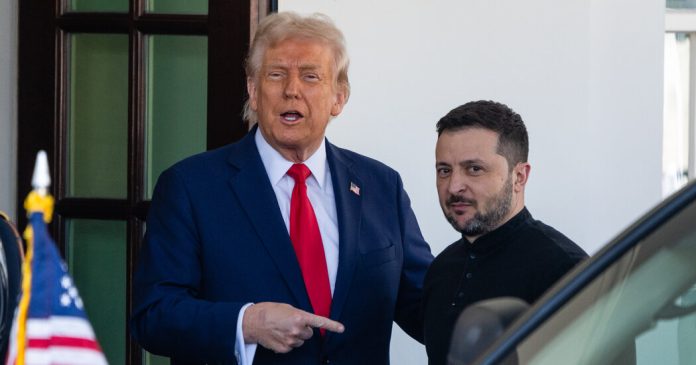
The starkest example of Trump’s insistence on a thank-you came during a meeting last month in the Oval Office that included Mr. Trump, Vice President JD Vance and Mr. Zelensky.

“You should be thanking the president for trying to bring an end to this conflict,” Mr. Vance scolded the Ukrainian leader. The last words Mr. Trump said to Mr. Zelensky as he brought the meeting to a close were: “You’re not acting at all thankful. And that’s not a nice thing.”

Last week’s phone call was the first time the two have spoken since then.

Mr. Trump appears to have taken a softer approach with Russia. In a description of a phone call between Mr. Trump and President Vladimir V. Putin last week, no expressions of gratitude were noted.

Mr. Trump’s desire for thanks is something of a shift in U.S. diplomatic relations. It is not unusual for presidents to want recognition for contributions to military and humanitarian support; President Joseph R. Biden Jr. had his own frustrations with Mr. Zelensky for relentlessly pushing for more.

But any friction between world leaders typically takes place behind closed doors, with a more restrained public description of a “full and frank discussion.”

White House officials defended Mr. Trump’s approach.

“It’s called respect,” said Harrison Fields, a White House spokesman.

“Every U.S. president should demand that from both allies and adversaries, especially when being asked to contribute billions of taxpayer dollars in their defense,” Mr. Fields said.

Kori Schake, the director of foreign and defense policy studies at the American Enterprise Institute who also served as a national security aide to President George W. Bush, said Mr. Trump treats “our allies like subjectsinstead of acting like peers.”

“What this signals is that in a strictly transactional global order, if you humble yourself in front of the American president, you can get what you want,” she added.

The parade of foreign visitors to the White House appears to have taken the hint.

NATO’s secretary general, Mark Rutte, top-billed his remarks with Mr. Trump earlier this month with “thank you so much.” He went on to credit Mr. Trump, who has long railed against the organization, for the alliance’s increased military spending and declined to defend Greenland, one of its members, from Mr. Trump’s threat of a hostile takeover.

During a visit to the White House the same week, Micheál Martin, the prime minister of Ireland, did not explicitly say the words “thank you.” Instead, he made a reference to Mr. Trump’s personal investment in the country rather than respond to the president’s complaint that Ireland was using a trade imbalance to take advantage of the United States.

“You have the distinction of being, I think, the only president that has physically invested in Ireland through Doonbeg,” Mr. Martin said of Mr. Trump, referring to one of his properties. “It’s just stunning,” he added.

Mr. Trump was smitten. “I love this guy,” he replied.

Even some of Mr. Trump’s cabinet members have started soliciting for thanks.

Secretary of State Marco Rubio jumped into an exchange on social media between Poland’s foreign minister, Radoslaw Sikorski, and Elon Musk about Starlink, the satellite internet service that Mr. Musk’s rocket company SpaceX has been providing to Ukraine.

When Mr. Sikorski asserted that the service was paid, in part, by the Polish Digitization Ministry and warned Mr. Musk against threatening to yank it, Mr. Rubio accused him of “just making things up.”

In a post on social media, Mr. Rubio said: “And say thank you because without Starlink Ukraine would have lost this war long ago and Russians would be on the border with Poland right now.”

Witold Zembaczynski, another Polish minister, wrote the words Mr. Rubio demanded, but in support of Mr. Sikorski.

“Thank you. It’s so simple #standwithukraine not with war criminalist #Putin.”

Matt Duss, the executive vice president at the Center for International Policy, said Mr. Trump has put on a “dominance display” throughout his career, both as a businessman and politician.

“He approaches foreign policy, the U.S.-led order, as a protection racket,” Mr. Duss said. “If you want protection, you have to show respect to the boss, and you’ve got to pay upstairs.”
A U.S. Investor Helped Build Russia’s Economy. He Was Jailed on Bogus Charges.

0

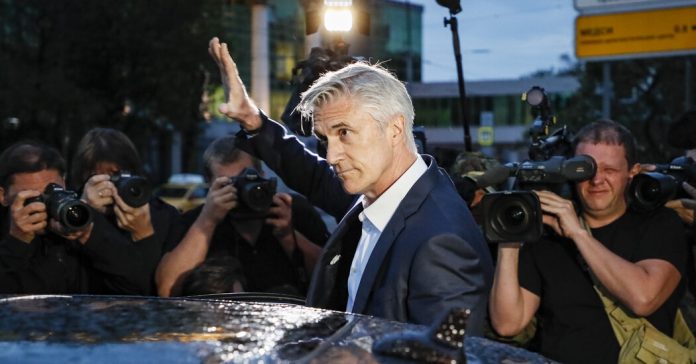
A foul cell in a Moscow detention center was about the last place an American businessman named Michael Calvey expected to find himself after spending 25 years building a flourishing venture capital firm in Russia that transformed some tech startups into global brands.

First, beefy agents from the F.S.B., the federal security service, ransacked his apartment before dawn. Hours later he was confined to a holding cell with two other inmates and a filthy hole in the floor for a toilet.

“The cell is stuffy and hot, an oppressive stench hanging in the air as if from accumulated decades of human sweat mixed with the indescribable horrors emanating from the toilet hole area,” Mr. Calvey wrote in a new book out this week called “Odyssey Moscow.” It details his extended ordeal through the Russian court system in a fabricated fraud case initiated in 2019: “In the course of a few surreal, terrifying hours I have morphed from one of the most successful Western businessmen in Russia into a prisoner of the state.”

With President Trump lauding the possibility of “major economic development transactions” between the United States and Russia as he seeks improved relations with Moscow, Mr. Calvey’s fate stands as a cautionary tale about the significant personal and professional risks involved in doing business in Russia, particularly given the arbitrary nature of its courts.

Perhaps no Western businessman promoted foreign investment in Russia more than Mr. Calvey, 57, who helped to forge internet titans from tech startups like Yandex — a version of Google, Amazon and Uber rolled into one — or Tinkoff Credit Systems, one of the world’s biggest digital banks. The firm he founded, Baring Vostok Capital Partners, earned colossal returns.

Then Baring Vostok got mired in a nasty commercial dispute with two dubious Russian partners who were stripping assets out of a bank in a troubled merger. Once, Mr. Calvey’s empty Moscow apartment mysteriously caught fire hours before a dinner involving tense negotiations.

After his firm filed a case with a London arbitration court, the partners convinced Department K of the F.S.B., responsible for internal financial crimes, that the American and several partners had perpetuated a massive fraud as part of a dastardly foreign plot to undermine Russia’s financial sector.

The agents pounced in February 2019, and although no evidence of wrongdoing ever emerged in court, Mr. Calvey and several partners spent years in jail or under house arrest.

“Once the F.S.B. gets involved in a case, they’re like a car with six gears going forward and none in reverse,” Mr. Calvey said in an interview in Switzerland, his home since finally being allowed to leave Russia in 2022. Lanky and trim, he retains a boyish air despite his gray hair. “They will never back up or lose face.”

His arrest stunned Western investors. “Everyone I knew was incredulous, angry and shocked,” said Bernie Sucher, an American banker with extended experience in Russia. “It was viewed as a direct assault on the very idea of long-term investment in the Russian economy.”

Unusually, dozens of influential Russians defended Mr. Calvey. They included Kirill Dmitriev, the head of Russia’s sovereign wealth fund and now a key negotiator for ending the Ukraine war; German Gref, the chief executive of Russia’s largest bank; and Alexei Kudrin, a previous finance minister. The U.S. Embassy in Moscow also objected strenuously to his arrest.

Mr. Calvey thought such interventions, combined with the blow to investor confidence, would get the case dropped. But nothing outweighed the F.S.B.

President Vladimir V. Putin did summon top Kremlin officials, ordering them to get the American businessman out of prison, but also to find something illegal that Mr. Calvey had done, he said he later learned. At a tense time in U.S.-Russia relations, the Kremlin could not admit to arresting a prominent American businessman on false pretenses, he said.

Released from prison after two months, Mr. Calvey was confined to his apartment with an electronic monitoring device strapped around his ankle for two years, and spent a third under court-ordered supervision with an 8 p.m. curfew. When he developed a cancerous tumor in one leg, the court refused to allow him to remove the device, so doctors operated without benefit of an M.R.I.

The Russian Foreign Ministry and the Russian Embassy in Washington did not respond to requests for comment about Mr. Calvey’s account. At the time of his conviction, Dmitry Peskov, the presidential spokesman, quoted Mr. Putin as saying that the government could not interfere in the courts.

When first arrested, Mr. Calvey was jailed in Matrosskaya Tishina prison, near downtown Moscow. It is sometimes called “Kremlin Central” because so many inmates face charges in high-profile corruption cases pushed by the Kremlin. There were no violent criminals, but nobody is ever acquitted, either, Mr. Calvey wrote.

His cellmates greeted him with a nonalcoholic toast: “Novoselye,” or welcome. One was a former deputy minister of culture. Another was an army general. A younger one was a computer hacker, and three were construction moguls. Trust nobody, one of them confided.

Their cell, 13 feet by 16 feet, was tidy and somewhat comfortable, with a television and a separate toilet. The men shared everything equally from cleaning chores to food supplies from outside. He dedicated his book to the men of Cell 604, and tears up when he talks about them. The book will be released Thursday in Britain and in early April in the United States.

Throughout his detention, Mr. Calvey endeavored to avoid his jailers seeing him disturbed. His reading list included Kafka as an apt reflection of his fate.

When one prosecutor summarized the case, for example, she admitted that not a single witness testified to a crime being committed, then added, “That just proves what a well-organized criminal group we are dealing with.” The entire courtroom laughed aloud, Mr. Calvey said.

The trial underscored F.S.B. control over the courts, with the closing statements repeating the opening accusations almost exactly, Mr. Calvey said. All the witness testimony might never have happened. “Russian people are of course the main victims of its courts,” he wrote.

In August 2021, Mr. Calvey was convicted of the misappropriation of funds and given a five-year suspended sentence. The conviction on false charges grated, he said, a stain on all his work for Russia.

His Russia saga started in 1991, when just two years out of the University of Oklahoma, Mr. Calvey went to work for his former Wall Street boss at the European Bank for Reconstruction and Development. It was established to help the former Soviet bloc transition to a market economy.

He worked on financing energy sector projects. Considered young for the magnitude of the deals, he tried to camouflage his age by adopting a serious demeanor at work, said Charlie Ryan, his first Moscow roommate.

“Life for an expat in 1990s Moscow was equal parts bizarre and marvelous,” Mr. Calvey wrote. Pizza Hut was considered a high-end restaurant to impress a date. Kilos of inexpensive caviar proved a substitute for breakfast cereal.

Mr. Calvey established Baring Vostok to build businesses catering to the new middle class. He married a Russian woman named Julia, with whom he had two sons and a daughter, now all young adults.

He existed within an elite business bubble, surrounded by people eager to integrate Russia into the global economy. At the time of his trial, Baring Vostok said that overall, it had invested more than $2.8 billion in 80 companies across the region, making it the biggest such Western player.

He learned Russian through countless hours he spent with young, ambitious entrepreneurs. “It was hard to spend time with them and not feel like Russia was a much, much better place than at the time of their grandparent’s generation,” he said.

When prominent businessmen got arrested, Mr. Calvey attributed it to their meddling in politics. He considered his Russian associates overly gloomy about the direction of their country.

He ignored repeated red flags that Mr. Putin, a former K.G.B. agent, had handed control over every major institution to the siloviki, a Russian term incorporating all security agencies. Not even the illegal annexation of Crimea in 2014 deterred Mr. Calvey.

“What I didn’t really appreciate, and only realized with my arrest, was the depth of the control and influence of the ruling caste of Russia, which is F.S.B. and the other siloviki,” he said.

Mr. Calvey’s businesses thrived even while he was imprisoned, and he pulled the plug only after Russia invaded Ukraine in 2022. The hasty disinvestment cost his company billions of dollars, he said.

He is done with Russia. Although under Russian law his conviction was nullified after his five-year probation period ended a year ago, last week a Moscow court changed the probationary sentence given to a French defendant in the case to a prison term in absentia.

Mr. Calvey expects some American businesses to return, although he considers Russia too risky for long-term investments. A peace deal might prompt him to invest in Ukraine, however. He is fostering internet startups elsewhere, employing young tech talent that fled Russia.

The simmering geopolitical differences between Moscow and Washington mean that any businessman can become a chessboard pawn, he said, adding: “You may hope that you’re not going to get stepped on the head, but ultimately it could happen at any time.”

Politics chat: Possible cuts to Social Security, DHS ends humanitarian parole

0

Congress returns from a break Monday and the week promises hearings on hot topics like air safety and Social Security.

Russia and Ukraine to Hold U.S.-Mediated Talks in Riyadh: What to Know

0

The United States will hold separate talks with Russia and Ukraine in Saudi Arabia to iron out details of a possible limited cease-fire in what could be a crucial step toward a full cessation of hostilities in the war.

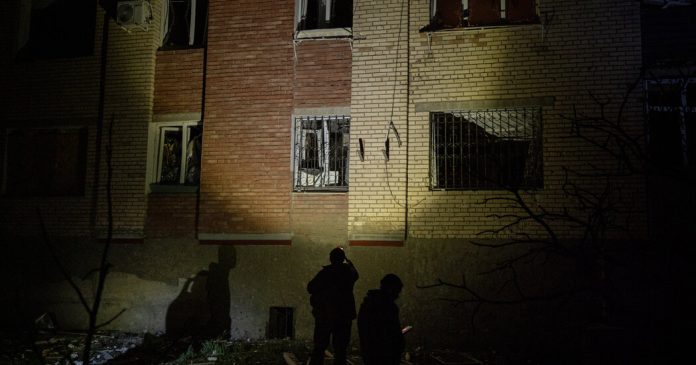
Russia and Ukraine both agreed this past week to temporarily halt strikes on energy infrastructure, but how and when to implement that partial truce are questions that have yet to be decided as attacks persist.

The talks — to be held in Riyadh, the Saudi capital, with American representatives mediating — are expected to focus on hammering out those details and on safety for shipping in the Black Sea. Kyiv’s delegation will first meet with U.S. mediators on Sunday, a Ukrainian official said, followed by Moscow-Washington talks on Monday.

The Ukrainian official, speaking on condition of anonymity to discuss a sensitive matter, said Sunday’s talks would begin in the evening, Kyiv time. He added that the Ukrainian delegation might hold additional discussions with U.S. officials on Monday, depending on progress.

Steve Witkoff, whom President Trump has tapped to be his personal envoy to President Vladimir V. Putin of Russia, has said that the ultimate goal of the talks is a 30-day full cease-fire that would allow time for negotiations on a permanent truce.

But the path toward such a truce has been shaky. Moscow continues to insist on maximalist positions, including about asserting territorial control and ensuring Ukraine never joins NATO. The Ukrainian government has repeatedly said that it will not concede to the Kremlin’s demands and accused President Vladimir V. Putin of Russia of stalling for time.

Unlike previous cease-fire discussions, which involved top government officials from all sides, this new round will focus on technical matters and will mostly involve diplomats and government advisers. Keith Kellogg, the U.S. special envoy to Ukraine, said that the American delegation would include some of his own staff, along with Michael Anton, policy planning director at the State Department; and aides to the national security adviser, Michael Waltz.

Dmitri S. Peskov, the Kremlin’s spokesman, said on Friday that Mr. Putin had personally selected negotiators for the talks. The Russian delegation will be led by Grigory B. Karasin, a senior Russian diplomat and lawmaker; and Sergey O. Beseda, an adviser to the head of the Federal Security Service, or F.S.B., the country’s domestic intelligence agency.

While Mr. Karasin has been involved in sensitive foreign policy talks before, Mr. Beseda’s choice came as a surprise to some.

An influential spymaster, Mr. Beseda was head of the F.S.B. department responsible for international intelligence operations. He has been described by Russian news outlets as one of the main sources of intelligence that convinced Mr. Putin in 2022 that there was pro-Russian sentiment in Ukraine and that a brisk invasion could easily dismantle the government in Kyiv.

In 2023, Kyrylo Budanov, the head of Ukraine’s military intelligence, called Mr. Beseda a “very problematic person” for Ukraine who “has done a lot of evil.”

President Volodymyr Zelensky of Ukraine said his defense minister, Rustem Umerov, would attend the negotiations in Riyadh. Mr. Umerov will be joined by Pavlo Palisa, a top military adviser to Mr. Zelensky, according to the Ukrainian official.

Both Mr. Umerov and Mr. Palisa are members of the Ukrainian delegation for peace talks that Mr. Zelensky appointed this month, a group led by his chief of staff, Andriy Yermak. Mr. Umerov was a key negotiator for Ukraine in peace talks with Russian diplomats in the early months of the war.

Given the technical nature of the talks on energy and shipping, Mr. Zelensky said that Ukraine would also send experts to Saudi Arabia. “There will be military, energy specialists, as well as people who are well versed in port and other civilian infrastructure,” he said on Wednesday.

Mr. Zelensky said Ukraine would prepare a list of infrastructure objects that could be included in the cease-fire agreement. He added that a third party would have to monitor the cease-fire, and suggested that the United States could do so.

While Russia and Ukraine may find common ground in talks about energy and shipping, both have laid out conditions for a complete cessation of hostilities that appear irreconcilable — a sign of the steep challenges ahead in any broader peace negotiations.

This past week, during a telephone conversation with President Trump, Mr. Putin said that Russia would agree to a temporary truce only if Ukraine stopped mobilizing soldiers, training troops or importing weapons for the duration of any pause in fighting.

Mr. Putin also demanded the complete halt of foreign military aid and intelligence to Kyiv, calling it “the key condition for preventing an escalation of the conflict and making progress toward its resolution through political and diplomatic means,” according to the Kremlin’s readout of the call.

The White House said that military aid and intelligence sharing to Ukraine would continue despite the Kremlin’s demands. But the Trump administration has been less clear on Moscow’s calls for territorial concessions and at times even appeared to align with the Kremlin’s stance.

Mr. Witkoff echoed a Kremlin talking point on Friday in saying that an “overwhelming majority” of Ukrainians living in four regions of the country that Russia has annexed had “indicated that they want to be under Russian rule” during referendums organized by Moscow. Those referendums were widely denounced as fraudulent and illegal by the international community.

Fundamentally, Russia’s position regarding the conflict has remained the same. The Kremlin says it wants to “eliminate the root causes of the crisis” — essentially demanding that Ukraine capitulate. That would mean Kyiv’s recognizing Russia’s territorial gains, declaring neutrality and agreeing to shrink its military, which would most likely leave Ukraine vulnerable to another invasion.

Ukraine had previously agreed to an unconditional 30-day truce to cease all combat operations, at the urging of the Trump administration. But after Moscow said that it would support only a partial cease-fire on energy infrastructure, Mr. Zelensky spoke with Mr. Trump and agreed to the limited truce.

In recent days, Ukrainian officials have set out red lines going into negotiations: Kyiv will never accept Russian sovereignty over occupied Ukrainian territory, it will not agree to be blocked from joining NATO or to reduce the size of its army, and it must have security guarantees as part of any peace settlement.

Many Ukrainian officials and analysts express doubt that even a limited cease-fire will hold for long, noting that previous truces between Moscow and Kyiv were routinely violated, with each side blaming the other.

“I do not believe in a cease-fire. We’ve been through this before,” Kostyantyn Yeliseev, a seasoned diplomat and former Ukrainian deputy foreign minister who took part in cease-fire negotiations in 2014 and 2015, said in an interview.

Mr. Witkoff said on Wednesday in an interview with Bloomberg News that Mr. Trump and Mr. Putin were “likely” to meet in Saudi Arabia within weeks. American officials will also probably continue meeting their Russian and Ukrainian counterparts in the Middle East to discuss details of a possible limited truce.

But the foundations of the diplomatic process have been wobbly, analysts said, with Moscow and Kyiv ready to continue fighting.

“Both sides still believe that they can continue the war regardless of the American position,” said Dmitry Kuznets, a military analyst with the Russian news outlet Meduza, which operates from Latvia after being outlawed by the Kremlin.

He added, “Moscow’s and Kyiv’s visions of what an agreement could look like are still infinitely far from each other.”

Maria Varenikova contributed reporting

Pope Francis Makes Public Appearance in Rome

0

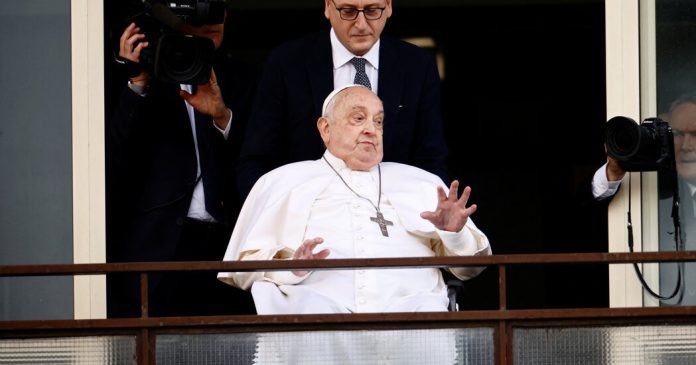
Looking frail, Pope Francis made his first, brief, appearance in more than six weeks on Sunday, appearing on the balcony of a Rome hospital to greet hundreds of people gathered in the square in front.

“I see a woman with yellow flowers,” said Francis, who was brought out on the second-floor balcony in a wheelchair. “E’ brava,” he said in appreciation of the woman. Then he sat and waved with both hands while people cheered and waved flags.

The pope’s voice was frail and raspy, which was to be expected for a patient who had suffered serious damage to his lungs and respiratory muscles, as his doctors explained at a news conference Saturday.

People began cheering and rhythmically clapping: “Francesco.”

“Long live the pope,” someone called to more cheers. After a few more moments, the pope was wheeled back into the hospital.

Only weeks ago, there was great concern within the church and beyond that Francis might not recover from a bout of pneumonia he had suffered in both lungs and other respiratory infections. His doctors, speaking at a news conference at the Policlinico A. Gemelli hospital on Saturday evening, said that the pope’s pneumonia had been so severe that it had twice put his life in critical danger.

But the pope received drug therapy treatment and oxygen that resulted in a “slow and progressive improvement,” allowing him to overcome the most critical episodes, Dr. Sergio Alfieri, the leader of the medical team taking care of the pope, said Saturday.

As in the past six weeks, Francis did not impart the traditional Sunday Angelus blessing that he normally gives from the Apostolic Palace overlooking St. Peter’s Square.

Later on Sunday, Francis was expected to return to the Casa Santa Marta, the guesthouse in the Vatican where he lives, to convalesce for another two months. The doctors said Saturday that Francis should avoid unnecessary exertions as well as meeting with large groups and people with small children, to minimize coming into contact with potential sources of infection.

Dr. Luigi Carbone, Francis’s Vatican-based doctor, said the pope’s residence was sufficiently equipped to deal with his medical needs and had emergency services available for him around the clock.

Francis entered the hospital on Feb. 18 with an acute respiratory insufficiency from viral and bacterial infections. The pope, his doctors said on Saturday, had never been intubated and remained alert and conscious throughout his hospitalization.

Francis remained in critical condition for several weeks as he experienced an asthmatic respiratory crisis; initial, mild kidney failure; and a bronchial spasm that caused him to inhale his vomit after a coughing fit. He used noninvasive mechanical ventilation during the night and high-flow oxygen therapy during the day.

Doctors insisted that Francis, who had kept up a grueling schedule before his illness, needed to take it easy for at least two months.

“Convalescence is by definition a phase of recovery so it is clear that in the period of convalescence, he will not be able to carry out his daily activity of meeting with people as he was used to,” at least in for time being, said Dr. Carbone.

Turkey Jails Istanbul Mayor Who Was Expected to Run for President

0

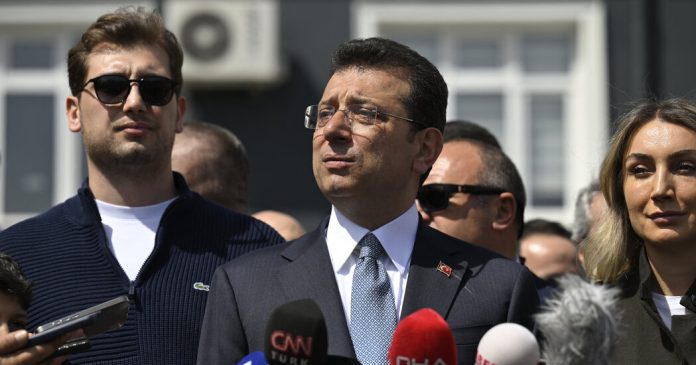
A Turkish court on Sunday jailed the mayor of Istanbul pending his trial on corruption charges, according to the state-run Anadolu news agency, hobbling a potential contender in Turkey’s next presidential election and the top rival of President Recep Tayyip Erdogan.

The mayor, Ekrem Imamoglu, was arrested at his home on Wednesday, four days before he was set to be named the presidential candidate of Turkey’s political opposition. He has denied the accusations against him, which Mr. Erdogan’s opponents have called a ploy to hinder a popular politician’s presidential bid.

The court ordered that Mr. Imamoglu be jailed on accusations of corruption pending a trial, the state-run news media said. State prosecutors have accused him of leading a criminal organization and overseeing bribery, bid rigging and other financial misdeeds at City Hall.

Prosecutors also accused him of supporting terrorism through his political coordination with a pro-Kurdish group during local elections last year. The court has not yet ruled on whether he will be jailed for those accusations as well.

The decision to jail Mr. Imamoglu, who has been elected mayor three times since 2019, raised the possibility that he would be removed from office.

That alone may not prevent him from running for president, but he faces other roadblocks. The day before his arrest, his alma mater, Istanbul University, voided his diploma, citing improper procedures in his transfer to the school in 1990. Turkey’s Constitution stipulates that the president must have completed higher education. The mayor said before he was detained that he would contest the ruling.

Mr. Imamoglu faces a slew of other court cases as well, including some that could temporarily bar him from politics.

In a post on X, the mayor called on Turks to stand together against “this black stain on our democracy,”

Of his detention, he said: “I stand tall. I will never bow.”

Critics of Mr. Erdogan, who has dominated Turkish politics for more than two decades, have long accused him of using state power to undermine his rivals. But, they say, arresting a presidential contender to eliminate him from the race before it begins represents a new level of authoritarianism.

Some European leaders have criticized the mayor’s arrest, which has prompted protests around Turkey, and they have called on the Turkish government to uphold the rule of law. Senior U.S. officials have said little.

Steve Witkoff, President Trump’s Middle East envoy, made no mention of the mayor’s detention in an interview with the former Fox News anchor Tucker Carlson that was posted on X on Saturday. But he said that Mr. Trump had recently spoken with Mr. Erdogan. The call was not made public by the White House at the time.

“There is just a lot of good, positive news coming out of Turkey right now as a result of that conversation,” Mr. Witkoff said, without providing further details.

Despite Mr. Imamoglu’s detention, Turkey’s main opposition party, the Republican People’s Party, or C.H.P., has gone ahead with a primary on Sunday to formally designate him its presidential candidate. Party members voted around the country, and the party called on nonparty members to turn out as well to cast symbolic ballots to support the jailed mayor.

Mr. Erdogan’s current presidential term, his second, expires in 2028. While the Constitution limits presidents to two full terms, he could legally run again if Parliament called for early elections, cutting short his second mandate.

Many people in Turkey expect that to happen. If it does, it is possible that Mr. Imamoglu, 54, could be barred from the race. Mr. Erdogan, 71, has not said whether he would run, but he has no clear successor and many people in Turkey expect him to seek another term.

The jailing of Mr. Imamoglu could disrupt the administration of Turkey’s largest city. The city government employs more than 100,000 people and oversees a number of companies that build housing, run public transportation and carry out infrastructure projects.

Large protests against Mr. Imamoglu’s detention have broken out nightly in cities across Turkey, despite the government’s efforts to stop them. Public demonstrations have been banned in the country’s three largest cities, social medial access has been restricted and major transit hubs have been closed to hamper the ability of protesters to gather in public squares.

On Saturday, the Interior Ministry said that 343 people had been arrested while protesting, and the office of Istanbul’s governor, who is appointed by Mr. Erdogan, said travelers “likely to participate in unlawful protests” would be prevented from entering the city.

Safak Timur and Gulsin Harman contributed reporting.

Taiwan President Takes Tougher Stance Toward China

0

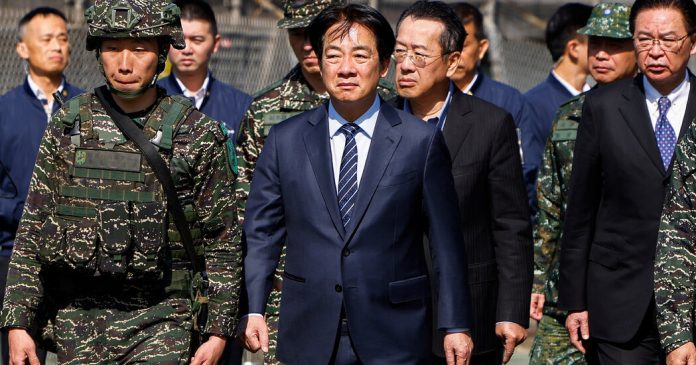
After Taiwan’s president, Lai Ching-te, launched a broad drive this month against what he warned was expanding Chinese subversion and spying, the backlash was swift.

Across the Taiwan Strait, Beijing hit back, sending a surge of military planes and ships near the island and warning that he was “playing with fire.” In Taiwan, Mr. Lai’s opponents accused him of dangerously goading China.

But Mr. Lai is wagering that he can — and, his supporters say, must — take a harder line against Chinese influence now, notwithstanding the threats from Beijing and the possibility that Taiwan’s opposition parties will dig in deeper against his agenda.

Mr. Lai appears to have concluded that China will limit its actions against Taiwan while Beijing focuses on trying to negotiate with President Trump over the escalating trade war, said David Sacks, a fellow at the Council on Foreign Relations who monitors Taiwanese affairs.

“The best guess is that he assessed that, if he was going to do this, he should do it at a time when China doesn’t want something to complicate its discussions with the United States,” Mr. Sacks, in an interview, said of Mr. Lai’s security steps.

Taiwan’s political parties have for decades argued over whether to try to work with or distance the island from neighboring China, which claims Taiwan as its territory, to be taken by force if Beijing leaders so decide. The contention has taken on a sharper edge since Mr. Lai declared on March 13 that China was a “foreign hostile force” exploiting Taiwan’s freedoms to “divide, destroy, and subvert us from within.”

He laid out 17 steps to fight back, including restoring military courts to try Taiwanese military personnel accused of espionage and other security crimes. He wants to more closely monitor Taiwanese people’s contacts with China to stop what he said was Beijing’s political exploitation of religious, educational and cultural exchanges. He demanded greater disclosure about Taiwanese politicians who visit China. Many such politicians belong to the opposition Nationalist Party.

“We have no choice but to take even more proactive measures,” Mr. Lai said.

Beijing despises Mr. Lai and his Democratic Progressive Party, accusing them of being separatists. Chinese officials quickly denounced Mr. Lai’s speech, especially his use of the term “foreign hostile force.” Taiwan’s opposition Nationalist Party, which favors ties and talks with China, accused Mr. Lai needlessly fanning tensions.

“Specifically singling out mainland China and the Chinese Communist Party is to some degree a provocation,” Hsu Chiao-hsin, a prominent Nationalist lawmaker, said in an interview. “This will trigger even more tensions across the strait.”

Nationalist politicians said they would resist at least some of Mr. Lai’s proposed steps. They argue that reinstating military courts, which were abolished in 2013 after protests over abuses of soldiers, is backsliding. “Many of these 17 steps restrict people’s civil rights,” Mrs. Hsu said.

Ko Chih-en, another Nationalist Party legislator, accused Mr. Lai of unfairly casting his domestic critics as “red” tools of Beijing. “Don’t make it like anyone with any connection to China is given a red hat so that everyone is in fear.”

The rising political acrimony could further complicate Mr. Lai’s plans, including perhaps most crucially a proposed increase in military spending meant to mollify Washington. President Trump and his team have said that Taiwan should sharply raise its defense budget, to as much as 10 percent of its economy, up from the current budgeted 2.45 percent.

Mr. Lai vowed last month to use an additional “special budget” later this year to push overall defense spending to more than 3 percent of the economy. But the increase must win approval from Taiwan’s legislature, where the Nationalists and a smaller party, the Taiwan People’s Party, hold a majority.

Mr. Lai may be thinking that despite their anger at him, Taiwan’s opposition parties will ultimately back the planned increase in military spending, Mr. Sacks said.

“I think that part of Lai’s calculus is also that if the opposition played games with his proposed defense spending increase, that would get Washington’s attention in a way they really don’t want,” Mr. Sacks said.

When Taiwan’s main annual budget passed this year, the opposition imposed cuts and conditions that Mr. Lai’s government said would hamper government operations. The opposition parties have said the cuts were aimed at wasteful spending, and Taiwan’s military preparedness would not be hurt by their measures.

“My sense is that President Lai will eventually be able to get a special budget passed by the legislature, but at some political costs,” said Russell Hsiao, the executive director of the Global Taiwan Institute in Washington. “The opposition parties will make him and the ruling party pay a political price, even though, eventually, they will go along with it — in part because they know that Washington is paying close attention.”

Negotiations over the special budget could be protracted and tense, even if both sides generally agree on more military spending, said Raymond Cheng-en Sung, the vice president of the Prospect Foundation, a government-funded institute in Taipei. “The limited window of opportunity that we have for getting this done could still vanish,” Mr. Sung said.

Several Nationalist lawmakers, including Richard Yeong-Kang Chen, a former admiral, said they broadly supported a rise in military spending. But the polarized atmosphere made legislative give-and-take harder, Mr. Chen said. Like most opposition politicians, he blamed Mr. Lai for the impasse. Mr. Lai’s side blames obstruction by the opposition parties.

“Putting it harshly, there’s virtually no communication now between the two parties,” Mr. Chen said of the Nationalists and Mr. Lai’s Democratic Progressive Party.

Mr. Lai won 40 percent of the vote in the presidential election last year, but his party lost its majority in the legislature, resulting in frequent standoffs over Mr. Lai’s initiatives. Brawls have broken out in Taiwan’s legislative chamber, and opponents of the Nationalist Party and Taiwan People’s Party staged protests outside the legislative building last year.

Hoping to weaken the opposition parties’ grip on the legislature, Mr. Lai’s Democratic Progressive Party has backed a recall campaign against opposition lawmakers, using a rule that members of the legislature can face fresh elections, outside of the usual cycle, if enough voters sign petitions. The The Nationalist Party has, in turn, backed recall petitions against D.P.P. lawmakers.

Mr. Lai’s recent speech on China appeared partly intended to sharpen the contrast with the opposition, said Ryan Hass, an expert on China and Taiwan at the Brookings Institution. “I think it was intended to reassert control of the narrative, to put people who are opposing his agenda on the back foot,” Mr. Hass said in an interview while visiting Taipei.

Still, he and many other experts say Taiwan does face growing efforts by China to illicitly influence public opinion on the island, erode confidence in its government and military forces, and to collect intelligence.

Mr. Lai said the growing threat from China was reflected in the data: 64 people faced charges of espionage in Taiwan in 2024, he said, three times the number charged with the offense in 2021.

Most of those accused of spying, Mr. Lai said, were former or current members of Taiwan’s armed forces.

Keir Starmer Talks Trump, Russia-Ukraine War and the Fragile Europe-US Alliance

0

With a staccato burst, a horn sounded in the control room of the H.M.S. Vanguard, sending the crew of the nuclear-armed Royal Navy submarine to battle stations. The voice of the commanding officer crackled over the intercom. “Set condition 1SQ,” he said, ordering its battery of ballistic missiles to be readied for launch.

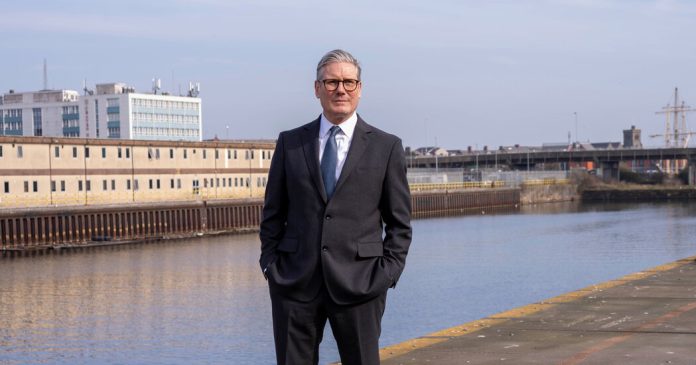
It was just a drill, conducted last Monday for a visiting V.I.P., Prime Minister Keir Starmer. But Mr. Starmer had reason to pay close attention when he was shown where the submarine’s launch key is stored: The prime minister is the only person in the United Kingdom authorized to order a nuclear strike.

“You’re looking for the ideal conditions?” Mr. Starmer asked softly, as the captain explained how the Vanguard must be maneuvered to the right depth to launch its Trident missiles. Mr. Starmer leaned forward in the captain’s chair, the blue glow from a bank of screens reflected in his eyeglasses.

Later, after he had climbed a 32-foot ladder to the submarine’s deck, Mr. Starmer reflected on its nearly seven-month-long mission. Prowling silently in the depths of the Atlantic Ocean, it is designed to deter a nuclear conflict with Russia (at least one of the four Vanguard-class submarines is always on patrol). At a time when Europe’s capacity to defend itself has come under criticism, not least from President Trump, Mr. Starmer said these mighty boats were an ironclad symbol of Britain’s commitment to NATO.

“Twenty-four hours, 365 days, year after year after year, for 55 years,” Mr. Starmer told me after we had cast off and the Vanguard steamed toward its home port in Scotland. “It has kept the peace for a very long time.”

Back on a tugboat, taking us to shore in the Firth of Clyde, Mr. Starmer sat alone, staring out a window at the gathering clouds. It has been a defining, if sobering, few weeks for the 62-year-old British leader: Swept into power eight months ago on a tide of discontent about the cost of living, he now finds himself fighting to avert a rupture of the post-World War II alliance between Europe and the United States.

“In our heart of hearts, we’ve known this moment was coming from just over three years ago, when Russian tanks rolled across the border” of Ukraine, Mr. Starmer said of Europe’s heightened vulnerability and the strains in the NATO alliance. “We have to treat this as a galvanizing moment and seize the initiative.”

The crisis has transformed Mr. Starmer, turning a methodical, unflashy human rights lawyer and Labour Party politician into something akin to a wartime leader. With debates over welfare reform and the economy largely eclipsed for now by fears about Britain’s national security, Mr. Starmer invoked Winston Churchill and, in a nod to his party, Clement Attlee, the first postwar Labour prime minister, as he described Britain’s singular role in a more fractured West.

“Many people are urging us to choose between the U.S. and Europe,” he said in one of three conversations last week. “Churchill didn’t do it. Attlee didn’t do it. It’d be a big mistake, in my view, to choose now.”

Pausing for a moment, Mr. Starmer added, “I do think that President Trump has a point when he says there needs to be a greater burden borne by European countries for the collective self-defense of Europe.”

The immediate question is whether Britain and Europe will play a meaningful role in Mr. Trump’s negotiations with President Vladimir V. Putin of Russia. To ensure that they do, Mr. Starmer is trying to assemble a multinational military force that he calls a coalition of the willing. The goal, he says, is keep Ukraine’s skies, ports and borders secure after any peace settlement.

“I don’t trust Putin,” Mr. Starmer said. “I’m sure Putin would try to insist that Ukraine should be defenseless after a deal because that gives him what he wants, which is the opportunity to go in again.”

Britain faces hurdles on every front: Russia has rejected the idea of a NATO peacekeeping force. Mr. Trump has yet to offer security guarantees, which Mr. Starmer says are crucial before countries will commit troops. Aside from Britain and France, no other European country has done so, even as Mr. Starmer led the first military planning meeting for the coalition on Thursday.

Senior British military and defense officials said they expected that ultimately, multiple countries would contribute planes, ships or troops to the effort. But regardless of the political and diplomatic uncertainties, Mr. Starmer said he felt he had little choice but to get ahead of the pack.

“If we only move at the pace of the most cautious,” he said, “then we’re going to move very slowly and we’re not going to be in the position we need to be in.”

Behind Mr. Starmer’s whirlwind of diplomacy is an even more elusive goal: persuading Mr. Trump of the value of NATO, the 75-year-old alliance the president disparages as a club of free riders, sheltering under an American security umbrella but failing to pay their fair share.

Unlike President Emmanuel Macron of France or Germany’s incoming chancellor, Friedrich Merz, Mr. Starmer has not called for Europe to chart an independent course from the United States on security. He insists that the “special relationship” is unshakable and that, in any case, British and American forces are deeply intertwined (the United States supplies the Trident missiles on British submarines).

Mr. Starmer has painstakingly cultivated Mr. Trump, phoning him every few days and turning up at the White House last month with a signed invitation from King Charles III for a state visit to Britain. The prime minister said Mr. Trump told him how much he treasured his meetings with Queen Elizabeth II.

The two men could hardly be less alike: Mr. Starmer, disciplined and reserved, with left-wing political roots; Mr. Trump, impulsive and expansive, with habits and instincts that shade into the regal. Yet they seem to have established a rapport. Mr. Trump occasionally calls him on his cellphone, one of Mr. Starmer’s aides said, to discuss favorite topics like his golf resorts in Scotland.

“On a person-to-person basis, I think we have a good relationship,” Mr. Starmer said of Mr. Trump, whom he first met over dinner in Trump Tower last fall. “I like and respect him. I understand what he’s trying to achieve.”

As for Mr. Trump’s actions — from imposing a 25 percent tariff on British steel to berating President Volodymyr Zelensky of Ukraine — Mr. Starmer said he recognized that the president had generated “quite a degree of disorientation.” The right response, he said, was not to get provoked by it.

“On the day in which the Oval Office meeting between President Trump and President Zelensky didn’t go particularly well, we were under pressure to come out very critically with, you know, flowery adjectives to describe how others felt,” Mr. Starmer recalled. “I took the view that it was better to pick up the phone and talk to both sides to try and get them back on the same page.”

Mr. Starmer dispatched his national security adviser, Jonathan Powell, to Kyiv, the Ukrainian capital, to coach Mr. Zelensky on how he could mend fences with Mr. Trump. In multiple sessions, two senior British officials said, they crafted language to mitigate Mr. Zelensky’s anxieties about a cease-fire in which the Russians would keep shooting.

Mr. Starmer then phoned Mr. Trump to relay the progress in Kyiv and lay the groundwork for a call between him and Mr. Zelensky. When the presidents spoke again, Mr. Zelensky threw his support behind Mr. Trump’s peacemaking effort.

In offering himself as a bridge, Mr. Starmer is trying to reclaim a role that Britain played for decades before it voted to leave the European Union in 2016. It showed, he said, that after a period in which Britain had been “disinterested” and “absent” from the world stage, “we’re back, if you like.”

But there are limits to Britain’s role in a post-Brexit world: The E.U. said it would exclude British weapons manufacturers from a defense fund worth 150 billion euros ($162 billion), unless Britain signs a security partnership agreement with Brussels. Britain, analysts say, will find it harder to act as a bridge if Mr. Trump spares it from more sweeping tariffs that he has vowed to impose on the European Union.

For now, Mr. Starmer’s statesmanship has buoyed his poll ratings and won him praise across the political spectrum. After a fitful start, in which he was dogged by a torpid economy, Mr. Starmer said the crisis “had injected an urgency” into his government.

How long that will last is anyone’s guess. Britain’s economy continues to sputter and Mr. Starmer has faced a backlash over decisions like cutting payments to help retirees with winter heating costs. The benefits of being a statesman, analysts say, can be evanescent if domestic woes keep piling up.

Even the fire at an electrical substation in London on Friday, which shut down Heathrow Airport and threw travel plans for tens of thousands into chaos, is a reminder of how events can temporarily swamp a government’s agenda.

Painful trade-offs loom, further down the road. Mr. Starmer has pledged to increase military spending to 2.5 percent of Britain’s gross domestic product by 2027, financed with a cut to overseas development aid. It is not clear how Britain will pay for a promised further increase to 3 percent of G.D.P. within a decade.

“We’ve all enjoyed the peace dividend,” Mr. Starmer said, noting that Europe is moving into a darker era. “I don’t want to veer into scaremongering,” he said, but added, “We need to think about defense and security in a more immediate way.”

Three days after the submarine visit, Mr. Starmer took part in a keel-laying ceremony for a new fleet of ballistic missile submarines, being built at a shipyard in Barrow-in-Furness, in northwest England. Four Dreadnought-class vessels, each almost the length of St. Paul’s Cathedral, are scheduled to go into service in the early 2030s, at an estimated cost of 41 billion pounds ($53 billion).

Standing in the cavernous factory, with the aft section of a submarine towering above him, Mr. Starmer expressed pride in this statement of British might. But it was also a reminder of the stretched state of its military.

The Vanguard-class submarines being replaced by the Dreadnoughts are nearly 30 years old — “pretty old kit,” in Mr. Starmer’s words — which necessitates prolonged maintenance periods. That has extended the patrols for the other vessels in the fleet and put acute pressure on their roughly 130-person crews.

The strain was on display during Mr. Starmer’s visit to the Vanguard, which set a Royal Navy record for longest patrol. Sailors said the food, excellent at first, deteriorated as the submarine’s provisions dwindled. Four were returning to spouses who’d had babies while they were away. Others lost family members, only learning the news from the captain on the eve of their return.

“It is with huge respect to the team,” that they survived seven months at sea, Mr. Starmer said after stepping gingerly off the submarine’s weathered deck. “But we shouldn’t be celebrating it.”

“This has doubled my resolve to ensure we go further and faster in our capabilities,” he said, “to make sure they are not put in that position again.”

At Least 4 Die After Nearly 30 Wildfires Erupt in South Korea

0

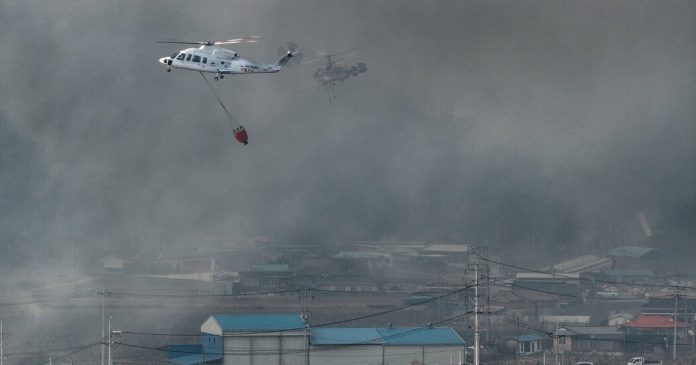
Nearly 30 wildfires broke out in southeastern South Korea over the weekend, killing four people and injuring six others, officials said on Sunday.

Thousands of firefighters and dozens of helicopters were sent out to fight 29 fires that burned through at least 4,700 acres and forced the evacuation of around 1,000 people, according to the Interior Ministry. The fires also disrupted train service and prompted the closing of some roads.

On Saturday evening, the government declared a state of disaster for part of the region. All but six of the 29 fires had been extinguished by Sunday morning, the Interior Ministry said.

All of the reported deaths and injuries were linked to a fire that started in Sancheong County, about 160 miles southeast of Seoul, the capital, on Friday afternoon, officials said.

Five of the six people hurt were seriously injured, according to the Central Disaster and Safety Countermeasures Headquarters. At least two of the dead were firefighters, officials said.

The Sancheong fire started when a farmer’s lawn mower caught fire, the authorities told the local news media.

A government report said a separate blaze began on Saturday morning in a cemetery in Euiseong County, about 110 miles southeast of Seoul. Another fire ignited from a garbage incinerator on Saturday afternoon in Gimhae, a city about 20 miles inland from Busan in the Korean Peninsula’s southeastern corner.

As of Sunday morning, the fire in Sancheong was about 30 percent contained, according to local officials. The fire in Euiseong was only about 3 percent contained, but fire officials said they expected to have it under control by the end of the day.

South Korean officials say that dry and windy conditions have allowed fires to spread easily. March, April and May are some of the nation’s driest months, according to the Korea Meteorological Administration.

How Scammers Launder Money and Get Away With It

0

Every few weeks, fireworks light up the night sky in Cambodia, set off by scammers to salute their biggest swindles.

By the time the shells pop and crackle, somebody’s life savings are probably gone. Maybe the victim fell for an online romance scam or bought into a fake cryptocurrency exchange. Whatever the scheme, the money has vanished, sucked into a complex money-laundering network that moves billions of dollars at a dizzying speed.

The F.B.I., China’s Ministry of Public Security, Interpol and others have tried to combat scammers, who ​often lurk on social media and dating apps, luring people into bogus financial schemes or other ruses. Telecom companies have blocked numbers. Banks have issued repeated warnings.

Yet the industry persists because its money-laundering operation is so efficient. Unsuspecting victims worldwide lose tens of billions of dollars each year, money that must be scrubbed of its criminal origins and deposited into the legitimate economy. The money-laundering system is so hydra-headed that when governments strike it in one place, it pops up in another.

This underworld peeks out in the Cambodian capital, Phnom Penh, home to a global clearinghouse for money launderers. It can be glimpsed, too, in the coastal city of Sihanoukville, a notorious refuge for fraudsters. Scammers ply their trade from call centers, operating in fortified compounds or on the upper floors of unfinished high-rises. Seaside restaurants are packed with money launderers and other criminals doing business over spicy Chinese food.

We obtained a cache of documents, a kind of money-laundering handbook, and spoke to nearly a half-dozen scammers and their launderers. The documents are not linked to any one scam or victim but reveal a method for moving illicit money that has proved all but impossible to stop.

The money launderers are as vital to criminals as getaway drivers are to bank robbers. Without them, there would be no loot.

Once scammers persuade strangers to part with their savings, they need to quickly move money from one account to another, and one country to another, before ​their targets discover the ruse and alert their banks​ or the police.

In the end, the money arrives “clean” — with virtually no trace to the original scam.

So how does it get done?

Following the trail led us, surprisingly, to an established financial conglomerate in Cambodia called Huione Group.

This is not a back-alley shop with a side hustle in cleaning dirty money. Huione is an established firm that does brisk and legitimate business in Southeast Asia and has satellite companies in other parts of the world. Its QR codes are everywhere in Cambodia — customers use them to pay their bills in hotels, restaurants and supermarkets. Huione ads are plastered along major highways. Its suite of financial services include banking and insurance.

But Huione (pronounced Hu-WAY-wahn) is a constellation of affiliates, and not all of them are legitimate. One arm offers bespoke money laundering services, according to the documents, which come from the company, and interviews with two people who are directly familiar with the operation. They spoke on the condition of anonymity out of fear for their safety. The company did not respond to requests for comment.

Another affiliate openly runs an online bazaar for criminals to find money launderers. The precise size of this marketplace is practically impossible to measure, but the analytics firm Elliptic has linked it to $26.8 billion in cryptocurrency transactions since 2021. The industry is so opaque that it is difficult to separate legitimate transactions from illegal ones, but Elliptic says the bazaar is the world’s largest illicit internet market.

Hun To, a cousin of Cambodia’s prime minister, is a director of one Huione company.

Huione’s clients include large criminal enterprises, such as a group in Myanmar that exploits human trafficking victims, according to a scammer, a money launderer and examinations of their cryptocurrency trade by the analytics firms Elliptic and Chainalysis.

And yet, this money-laundering network operates with impunity. The group has never been targeted for sanctions by any government. The cryptocurrency company Tether has frozen some of the group’s accounts, at the behest of unspecified law enforcement officials, and the messaging app Telegram has shut down some of its channels. But neither measure made a lasting effect.

Huione makes money at every step of the process.

First, one affiliate, which until recently was called Huione Guarantee, hosts the marketplace where scammers can find matchmakers. The matchmakers are essential to the system and their work is so repetitive that the Chinese name for it is “moving bricks,” according to Yanyu Chen, an anthropologist who studies money-laundering schemes in Cambodia.

The online bazaar is made up of thousands of chat groups on Telegram.

On these Telegram channels, anonymous users advertise money laundering services with the wink and nod of barely disguised language. The posts are public; anyone with the Telegram app can see them. Some merchants also sell stolen personal data, applications for impersonating others and other essential services to scammers.

One channel, called “Demand and Supply,” had more than 400,000 users with hundreds of daily messages, including advertisements for money-laundering services. After we sent questions to Huione Group and others in late February, Telegram said it had removed the channel. But another quickly sprung up, with some 250,000 members joining within a week.

Huione Guarantee did not respond to repeated requests for comment but has denied its relationship with Huione Group, the financial conglomerate. It even changed its name in October, shedding the Huione name. But it told customers on Telegram that Huione Group remained one of its “strategic partners and shareholders.”

Second, the bazaar guarantees the laundering transactions. Why? Because there is little honor among thieves, and scammers get scammed, too. To prove their credibility, matchmakers and money mules pay a deposit to Huione Guarantee, which holds it in escrow. This assures scammers that nobody will abscond with their money (or if someone does, that person will lose some of their own money).

The price to launder money is determined by the crime committed to get it. Scams like impersonating government officials incur a higher cost because the victims are more likely to call the police or alert their banks.

Location affects the price, too. Launderers charge up to 60 percent to clean money in China. That is because the country has tightened controls since 2020, arresting thousands of people and freezing large sums of money in a nationwide crackdown.

China and Cambodia have agreed to collaborate on law enforcement operations, leading to multiple arrests of mostly lower-level criminals. This has not made a dent on the scamming and money-laundering industries.

While the matchmaker deals are worked out privately, one-on-one, the bazaar makes money, too. It sells ads on public groups, charges maintenance fees for private groups and takes small cuts from deals. Most of the transactions are denominated in the cryptocurrency Tether, but some are conducted in cash, gold and through bank transfers. (The bazaar even issued its own cryptocurrency last year.)

The bazaar denies any criminal association in disclaimers posted on its website and on Telegram channels. “All business in the public groups is provided by third-party merchants, which has nothing to do with Huione Guarantee,” one post says.

Third, another Huione affiliate, Huione International Pay, is more directly involved in laundering money. It is a matchmaker itself, according to internal company documents and two people familiar with its operations.

The documents and insiders indicate that Huione International Pay operates with the efficiency of a legitimate, professional bank. It is based inside the conglomerate’s headquarters in Phnom Penh, a glass and concrete building with two panda statues standing guard by the entrance.

One company department handles customer relations for scammers and other illicit actors. Another monitors Telegram channels. A third department tracks money mule accounts in at least a dozen countries, according to internal documents we reviewed.

Huione’s companies operate with a veneer of legitimacy in a country with “very limited regulatory enforcement, if any at all,” said John Wojcik, a threat analyst with the United Nations Office on Drugs and Crime. The conglomerate’s obscure ownership structure creates challenges for targeted law enforcement, he said.

But even if Huione were shut down, other operators would quickly replace it, according to Mr. Wojcik.

“We can already see competitors now positioning themselves,” he said.

The National Bank of Cambodia, which regulates financial institutions, said the government was committed to ensuring that “financial transactions are safe and transparent.” It said the government was working to comply with international anti-money-laundering recommendations.

The national bank said that it had not renewed a license for Huione’s payment service (the one with the QR codes) to operate in Cambodia because it “did not meet the renewal requirements.” Huione quickly announced plans to register its business in Japan and Canada.

Money mules are the people who run the bank accounts and wallets.

Some mules open these bank accounts using fake identities, which artificial intelligence has made easier to create, according to Elad Fouks, who monitors fraud for Chainalysis.

Mules spread out the deposits and withdrawals to make them less noticeable to banks. Transactions below $10,000, for example, are less likely to draw attention. Most accounts and virtual wallets that are used for money laundering are active only for a few weeks or months.

Still, the mules — and not matchmakers or scammers — run the highest risk of getting caught.

In one U.S. court case that outlines the mechanics of such operations, the lead defendant, Daren Li, ran a money mule syndicate that registered 74 U.S. shell companies to launder nearly $80 million. The companies set up accounts at Bank of America and elsewhere.

When victims sent money to the accounts, the funds quickly moved to a bank in the Bahamas. From there, the money was used to purchase Tether cryptocurrency held on the exchange Binance.

Within days, the money moved to another virtual wallet.

Mr. Li worked with Huione International Pay to launder money, according to records we reviewed. But both the F.B.I. and the Secret Service declined to confirm the link. Mr. Li pleaded guilty in November to conspiracy to commit money laundering.

Imagine, once again, that you are a scam boss. Something has gone wrong: Your mule has been arrested; the bank froze his account; or maybe he ran off with your money.

In these cases, your matchmaker arbitrates disputes.

If the mule is at fault, the matchmaker will help retrieve the deposit from escrow and get it to you. If nobody is to blame, the losses are chalked up to the cost of doing business.

But, if all goes well, you will have your payday, usually in Tether, which you can convert to U.S. dollars at a casino or using Huione’s payment company.

You can use that money to pay your employees.

These days, scamming operations mimic professional institutions, employing thousands of people in marketing, sales and human resources departments. Often, many employees are victims of human trafficking who are coerced into scamming faraway targets. Some scammers even model their organizations on 19th century company towns, paying wages only after employees complete a season of work. Until then, workers receive company credit.

The wages enrich the restaurants, casinos and brothels that make a killing from captive employees who are often confined to fortified compounds.

Also on the scammer payroll are attractive models who are paid to join video calls and persuade victims to part with their cash. Some of them swap their faces using artificial intelligence.

Scammers, like everyone else, have to pay their landlords — for housing and, in their case, for protection.

And then there are the behind-the-scenes services, many of which can be bought through Huione’s bazaar. Scammers pay software developers to build websites that imitate investment platforms. They need internet and computer infrastructure. And they pay thieves to steal personal data on potential victims: national identification numbers, credit card information, location data and even details about previous hotel stays.

Some of the money will go to dealerships that sell luxury cars. Some is used to buy property in places like London and Dubai.

And of course, some of it will go to fireworks.

Henry Huang and Tat Oudom contributed reporting. Audio produced by Parin Behrooz.